
Life, 1925-06-04 · page 11 of 44
Life — June 4, 1925 — page 11: what you’re looking at
What you’re looking at
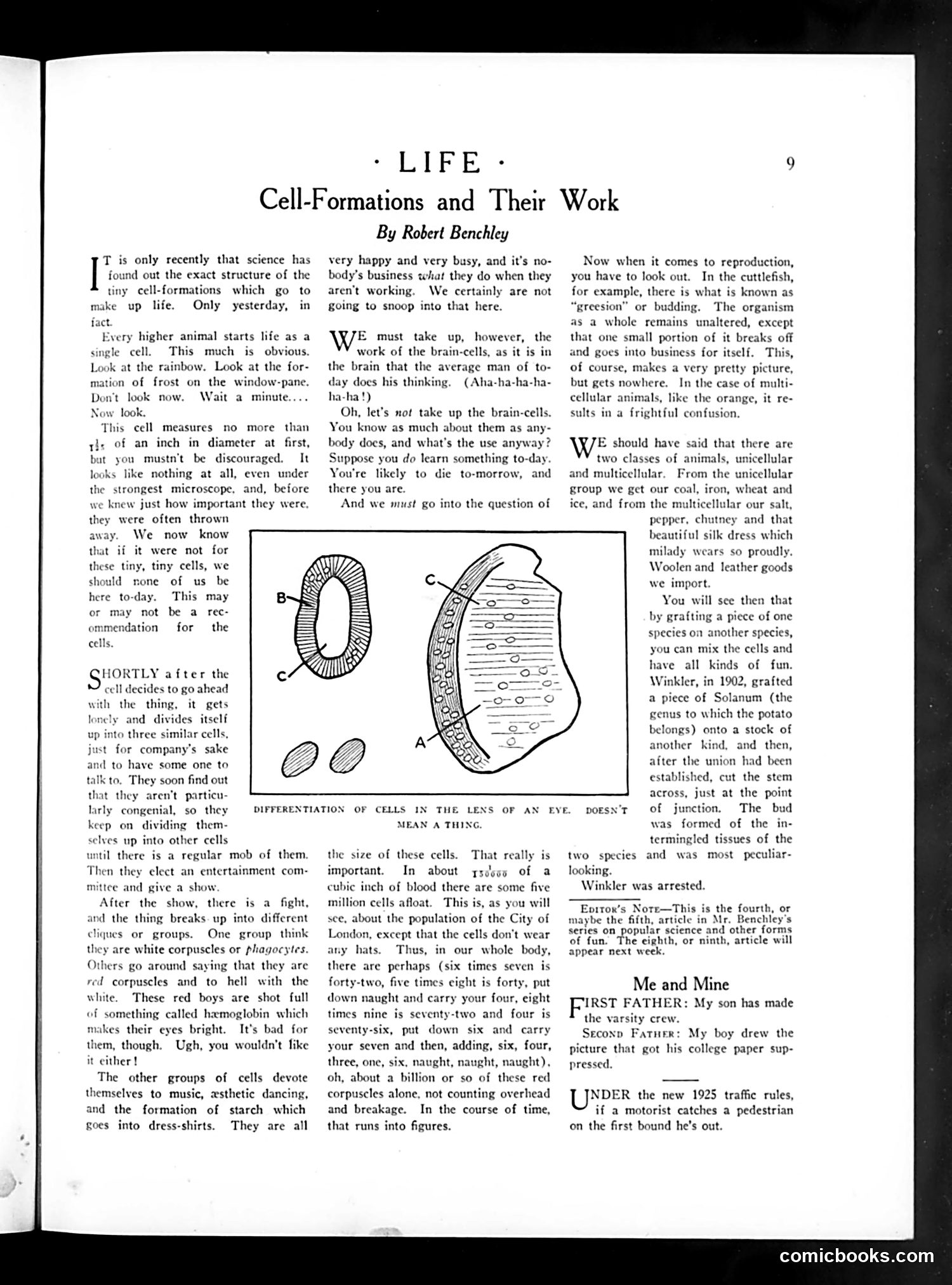
This page is primarily educational rather than satirical. It's an article titled "Cell-Formations and Their Work" by Robert Benchley explaining basic cell biology to a general audience. The only illustration shows a microscopic diagram of cells differentiating in an eye lens, with labeled parts (A, B, C) and smaller individual cells below. The image demonstrates how cells specialize and change form. The article uses accessible, humorous language typical of Benchley's style—comparing the number of blood cells to London's population, for instance—to make science engaging for lay readers. The brief sidebar items "Me and Mine" appear to be unrelated humor pieces. This represents Life magazine's educational mission alongside satire, making complex scientific concepts entertaining for 1920s readers.
📄 Transcribed text from this page (OCR, searchable)
Machine-transcribed from the original scan — historical spelling and the odd misread are preserved.
* LIFE * Cell-Formations and Their Work found out the exact structure of the tiny cell-formations which go to make up life. Only yesterday, in fact. Every higher animal starts life as a single cell. This much is obvious. Look at the rainbow. Look at the for- mn of frost on the window-pane. t look now. Wait a minute Now look. This cell measures no more qi of an inch in diameter at first, but you mustn’t be discouraged. It looks like nothing at all, even under the strongest microscope, and, before we knew just how important they were, they were often thrown We now know that if it were not for these tiny, tiny cells, we should none of us be here to-day. This may or may not be a rec- ommendation for the cells. [' is only recently that science has than HORTLY after the cell decides to go ahead the thing, it gets and divides itself up into three similar cells, just for company’s sake and to have some one to talk to. They soon find out that they aren't particu- larly congeni: so they keep on dividing them- selves up into other cells until there is a regular mob of them. Then they elect an entertainment com- mittee and give a show. After the show, there is a fight, and the thing breaks. up into different cliques or groups. One group think they are white corpuscles or phagocytes. Others go around saying that the red corpuscles and to hell with the These red boys are shot full of something called haemoglobin which makes their eyes bright. It's bad for them, though. Ugh, you wouldn't fike it either! The other groups of cells devote themselves to music, xsthetic dancing, and the formation of starch which goes into dress-shirts. They are all lonely DIFFERENTIATION By Robert Benchley very happy and very busy, and it’s no- body’s business what they do when they aren't working. We certainly are not going to snoop into that here. E must take up, however, the work of the brain-cells, as it is in the brain that the average man of to- day does his thinking. (Aha-ha-ha-ha- ha-ha!) Oh, let’s not take up the brain-cells. You know as much about them as any body does, and what's the use anyway? Suppose you do learn something to-day You're likely to die to-morrow, and there you are. And we must go into the question of OF CELLS IN THE MEAN A THING. the size of these cells. That really is important. In about ysossy of a cubic inch of blood there are some five million cells afloat. This is, as you will sce, about the population of the City of London, except that the cells don't wear any hats. Thus, in our whole body, there are perhaps (six times seven is forty-two, five times eight is forty, put down naught and carry your four, eight times nine is seventy-two and four is seventy-six, put down six and carry your seven and then, adding, six, four, three, one, naught, naught, naught), oh, about a billion or so of these red corpuscles alone, not counting overhead and breakage. In the course of time, that runs into figures. LENS OF AN EYE. Now when it comes to reproduction, you have to look out. In the cuttlefish, for example, there is what is known as “greesion” or budding. The organism as a whole remains unaltered, except that one small portion of it breaks off and goes into business for itself. This, of course, makes a very pretty picture, but gets nowhere. In the case of multi- cellular animals, like the orange, it re- sults in a frightful confusion, W should have said that there are two classes of animals, unicellular and multicellular. From the unicellular group we get our coal, iron, wheat and ice, and from the multicellular our salt, pepper, chutney and that ful silk dress which milady wears so proudly, Woolen and leather goods we import. You will see then that by grafting a piece of one species on another species, you can mix the cells and have all kinds of fun. Winkler, in 1902, grafted a piece of Solanum (the genus to which the potato belongs) onto a stock of another kind, and then, after the union had been established, cut the stem across, just at the point poesn’t of junction. The bud was formed of the in- termingled tissues of the two species and was most peculiar- looking. Winkler was arrested. bea’ Epitox’s Nore—This is the fourth, or maybe the fifth, article in Mr. Benchley’s series on popular science and other forms of fun. The eighth, or ninth, article will appear next week. Me and Mine IRST FATHER: My son has made the varsity crew. Seconp Fatner: My boy drew the picture that got his college paper sup- pressed, NDER the new 1925 traffic rules, if a motorist catches a pedestrian on the first bound he's out. comicbooks.com