
Life, 1925-06-04 · page 20 of 44
Life — June 4, 1925 — page 20: what you’re looking at
What you’re looking at
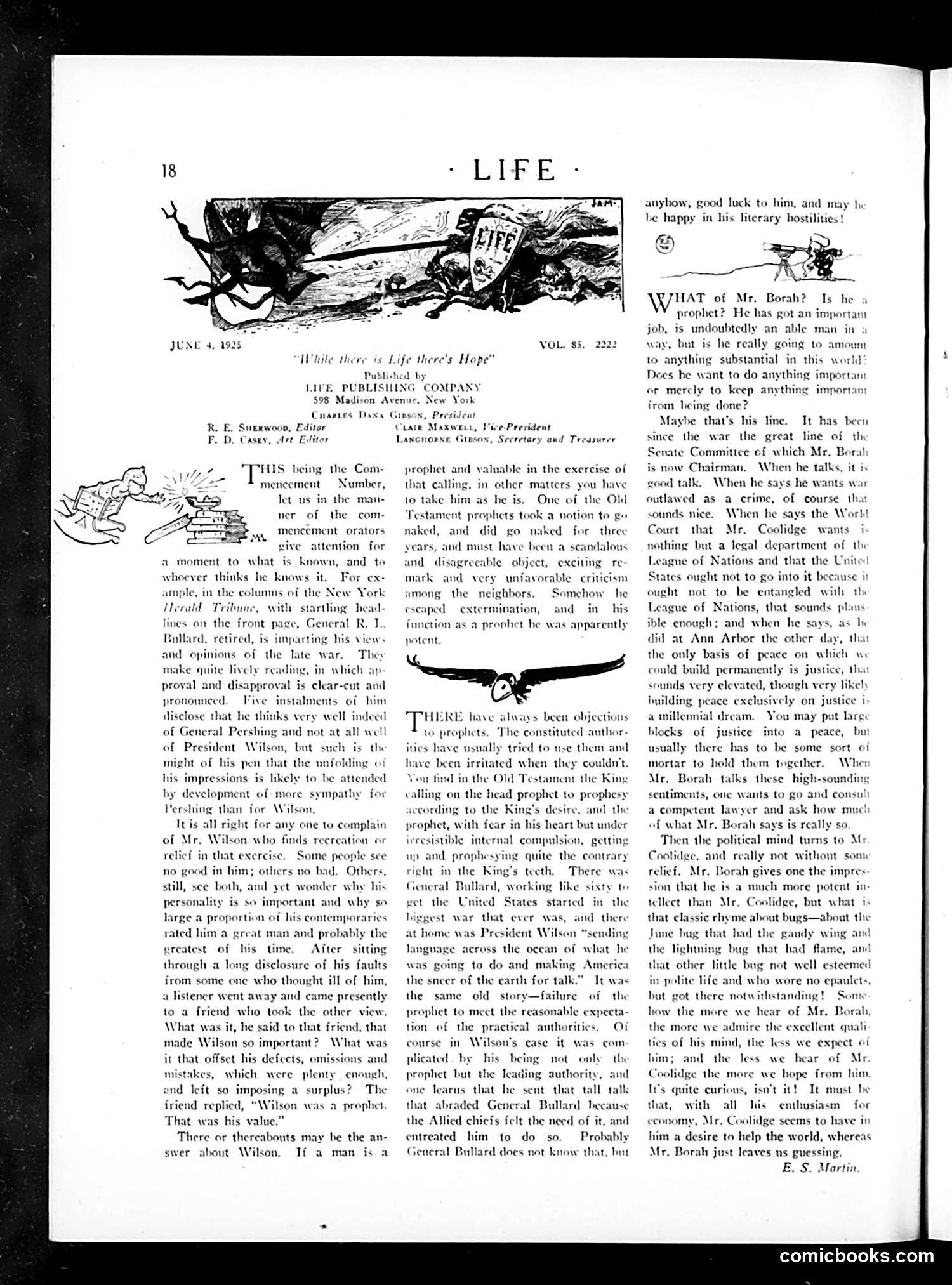
This commencement issue contains editorial commentary comparing political figures to biblical prophets. The main text discusses President **Woodrow Wilson**, analyzing why contemporaries considered him "a prophet" despite his many flaws and unpopular decisions. The author argues that Wilson, like Old Testament prophets, spoke uncomfortable truths to power—particularly regarding World War I and the League of Nations—even when authorities and the public disagreed. General **R.L. Bullard** (a retired military figure) had recently published critical retrospectives on Wilson's war leadership in the *Herald Tribune*. The piece then pivots to **Senator William Borah**, posing whether he too functions as a "prophet"—likely referencing his isolationist stance and challenges to prevailing foreign policy. The satire lies in the *prophet* framework: these political figures claim moral authority while being dismissed or contradicted by establishment powers, mirroring biblical prophets' perpetual conflicts with kings.
📄 Transcribed text from this page (OCR, searchable)
Machine-transcribed from the original scan — historical spelling and the odd misread are preserved.
JUNE 4, 1925 While there is Life there's Hope" LIFE ed by PUBLISHING COMPANY $98 Madison Avenue, New k Cuartes Dasa Ginsox, President R. E. Snexwooo, Editor F. D. Casey, Art Edito HIS being the Com- mencement Number, let us in the man- ner of the com- mencement orators sive attention for a moment to what is known, and to whoever thinks he knows it. For ex- ample, in the columns of the New York Herald Tribune, with lines on the front page startling head General R. 1 Bullard, retired, is imparting his views and opinions of the late war. They make quite lively reading, in which ap proval and disapproval is clear-cut and pronounced. Five instalments of him disclose that he thinks very well indeed of General Pershing and not at all well of President Wilson, but might of his pen that the unfolding of such is th his impressions is likely to be attended by development of more sympathy for Pershing than for Wilson. It is all right for any one to complain of Mr, Wilson who finds recreation or relief in that exercise. Some people see no good in him; others no bad. Others, still, see both, an personality is so important and why so yet wonder why his large a proportion of his contemporaries rated him a great man and probably the greatest of his time, After sitting through a long disclosure of his faults from some one who thought ill of him, a listener went away and came presently to a friend who took the other view. What was it, he said to that friend, that made Wilson so important? What was it that offset his defects, omissions and mistakes, which were plenty enough, and left so imposing a surplus? The friend replied, “Wilson was a prophet That was his value.” There or thereabouts m: swer about Wilson, Ti a he the an- man is a Ciatr Maxweit, Vice-President Laxe rorxe Gipsosx, Secretary and Treasurer prophet and valuable in the exercise of that calling, in other matters you have One of the Old Testament prophets took a notion to go naked, and to take him as he i did go naked for threc years, and must have been a scandalous and mark disagreeable object, exciting re- and very unfavorable criticism neighbors. Somehow he ped extermination, and in his function as a prophet he was apparently potent, among the HER prophets. The constituted author- have always been objection ities have usually tried to use them and have been irritated when they couldn't va find in the Old Testament the Kin calling on the head prophet to prophesy to the King’s desire, and the prophet, with fear in his heart but under irresistible internal compul: ion, getting up and prophesying quite the contrary right in the King’s teeth, There was General Bullard, working like sixty to get the United States started in the dd there sending higgest war that ever was, a at home was President Wil langua was going to do and making America the sneer of the earth for talk.” It was the same old story—failure of | the prophet to mect the reasonable expecta- tion ¢ across the ocean of what he f the practical authorities, O7 course in Wilson's case it was com plicated. by his being not only the prophet but the leading authority, and one learns that he sent that tall talk that abraded General Bullard hecause the Allied chiefs felt the need of entreated him to do so. Probably General Bullard does not know that, but anyhow, good luck to him, and may Ik le happy in his literary hostilities! V HAT of Mr. Borah? Is he prophet? He has got an important is undoubtedly an able man in a ay, but is he really to anything substanti Does he want to do anything important er merely to keep anythin from heing done? Maybe that’s his line. It has been since the war the great line of th. Senate Committce of which Mr. Boral is now Chairman. When he talks, it is good talk. When he says he wants war outlawed as a crime, of course that sounds nice. When he says the Worki Court that Mr. Coolidge wants i nothing but a legal department of the ‘ations and that the United is world import League of States ought not to go into it because ir ought not to be entangled with th: League of Nations, that sounds plaus ible enough; and when he says, as le did at Ann Arbor the other day, that the only basis of peace on which could build permanently is justice, that sounds very elevated, though very likel building peace exclusively on justice is a millennial dream. You may put large blocks of justice into a peace, bu usually there has to be some sort of mortar to hold them together. Wher Mr. Borah talks these high-soundin: sentiments, one wants to go and consult a competent lawyer and ask how mucli of what Mr. Borah says is really so. Then the political mind turns to Mr Coolidge, and really not without som« relief. Mr. Borah gives one the impres sion that he is a much more potent tellect than Mr. Coolidge, but what is that classic rhyme about bugs—about the June bug that had the gaudy wing and the lightning bug that had flame, and that other little bug not well esteemed in polite life and who wore no epaulets, but got there notwithstanding! Some how the more we hear of Mr. Borah, the more we admire the excellent quali ties of his mind, the less we expect oi him; and the of Mr. Coolidge the 1 we hope from him It's quite curic isn't it! It must be that, with all his enthusiasm for cconomy, Mr, Coolidge seems to have in him a desire to help the world, wher Mr. Borah just leaves us guessing. E. S. Martin less we he; comicbooks.com