A complete issue · 36 pages · 1925
Life — May 28, 1925
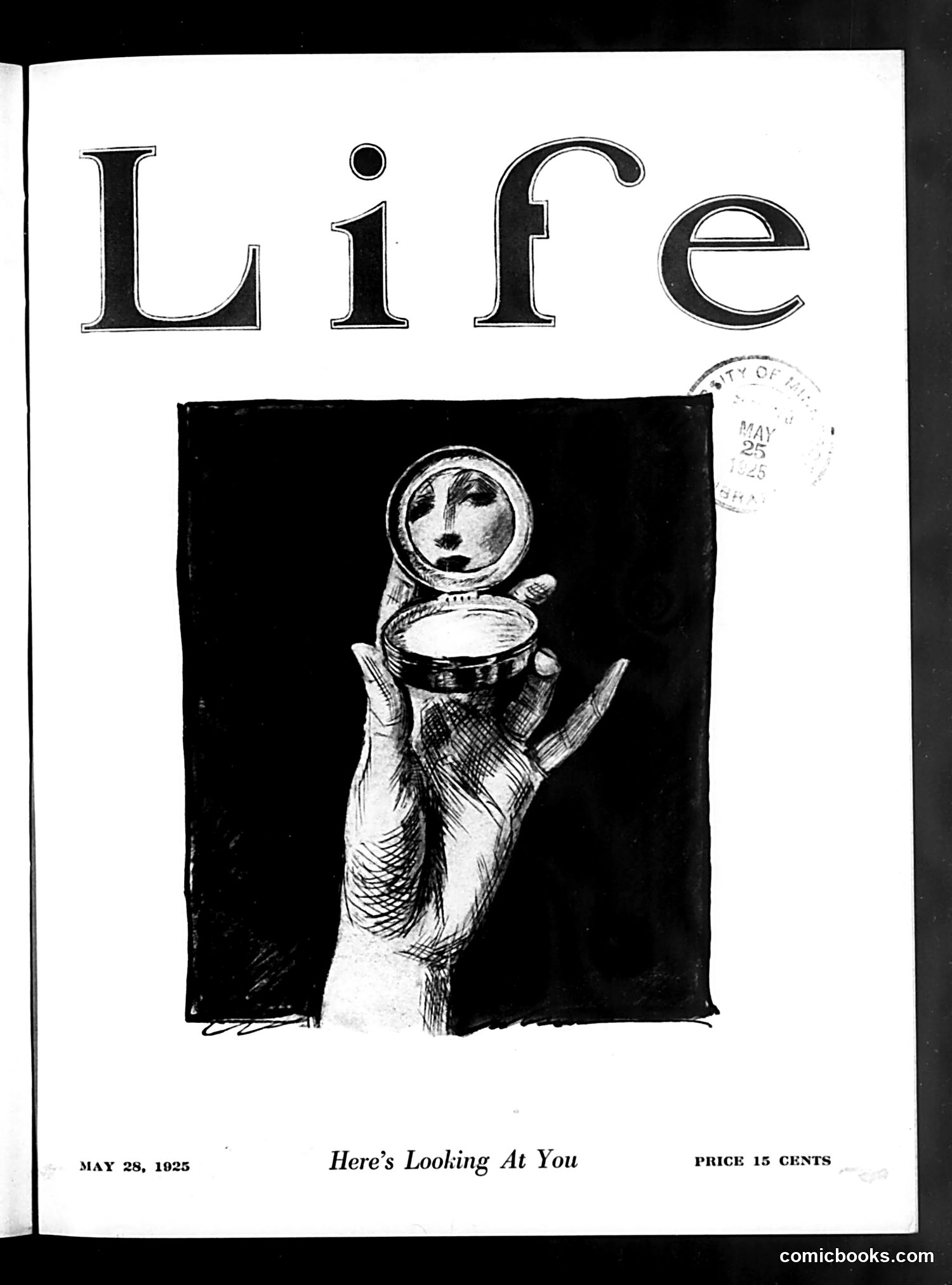
This is a Life magazine cover titled "Here's Looking At You," featuring a stark illustration of a hand holding a cocktail glass with a face reflected in it. The image uses visual metaphor to comment on drinking culture during Prohibition (1920-1933). The face gazing back from the glass likely represents the drinker confronting themselves—a commentary on alcohol consumption and self-reflection. The dramatic, somewhat unsettling style suggests social concern about drinking habits. During Prohibition, despite federal ban on alcohol sales, speakeasies and private drinking remained widespread, making this a timely satirical subject. The 15-cent price reflects 1925 economics. The image critiques drinking culture through clever visual symbolism rather than explicit political commentary.
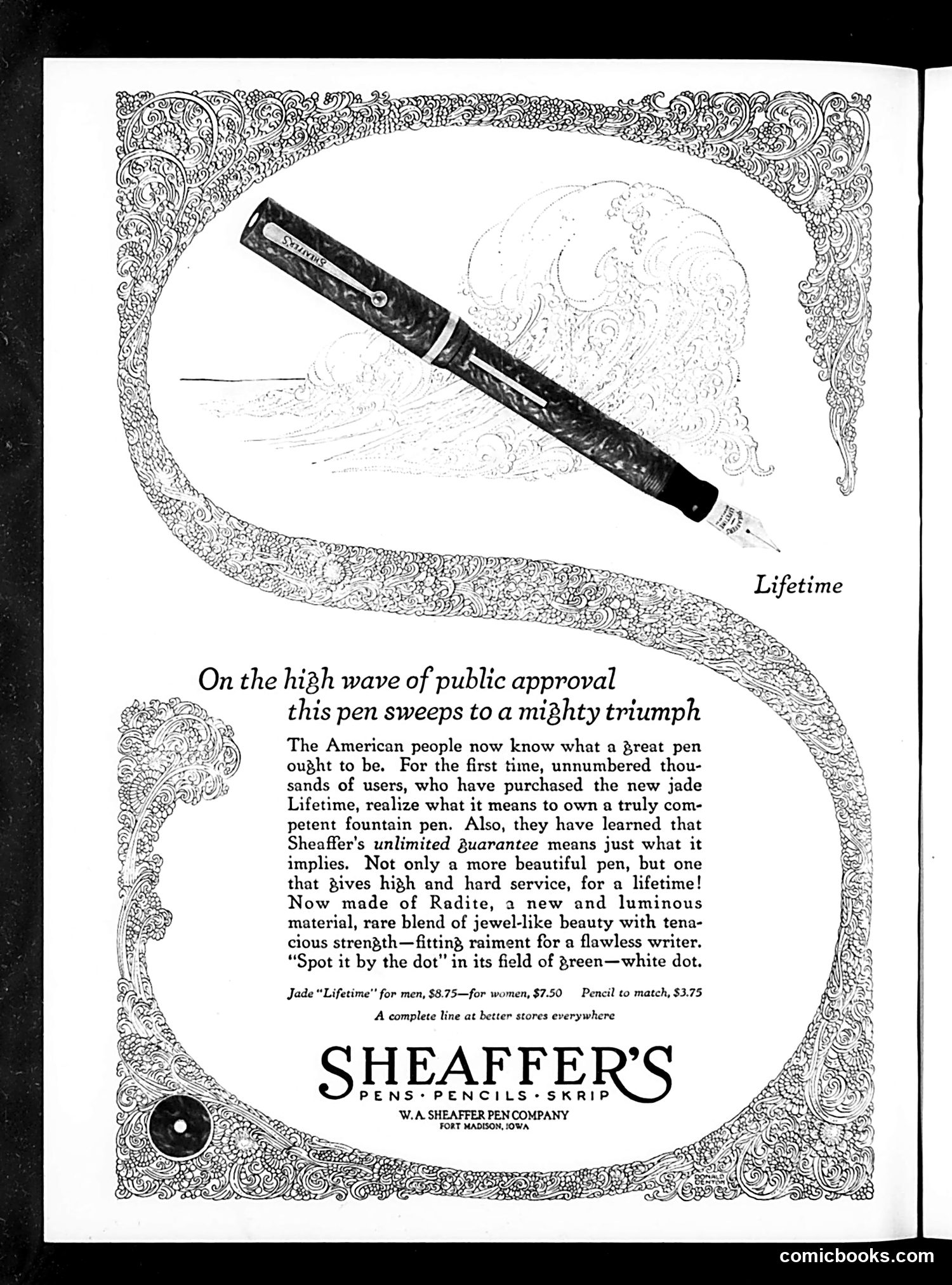
This page is **primarily an advertisement**, not political satire. It's a Sheaffer pen ad from the magazine *Life*. The image shows the Jade "Lifetime" fountain pen positioned dramatically across an illustrated profile of a human head. The ornate decorative border frames the composition. The ad's text emphasizes the pen's superiority: it's made of "Radite" (a proprietary material), offers "unlimited guarantee," and promises durability for "a lifetime." Pricing is listed ($8.75 for men's models, $7.50 for women's). The headline claims the pen enjoys "public approval" and "sweeps to a mighty triumph," using promotional hyperbole typical of 1920s-30s advertising. There is **no political cartoon or satire here**—this is straightforward commercial advertising for writing instruments, leveraging aspirational messaging about quality and permanence.
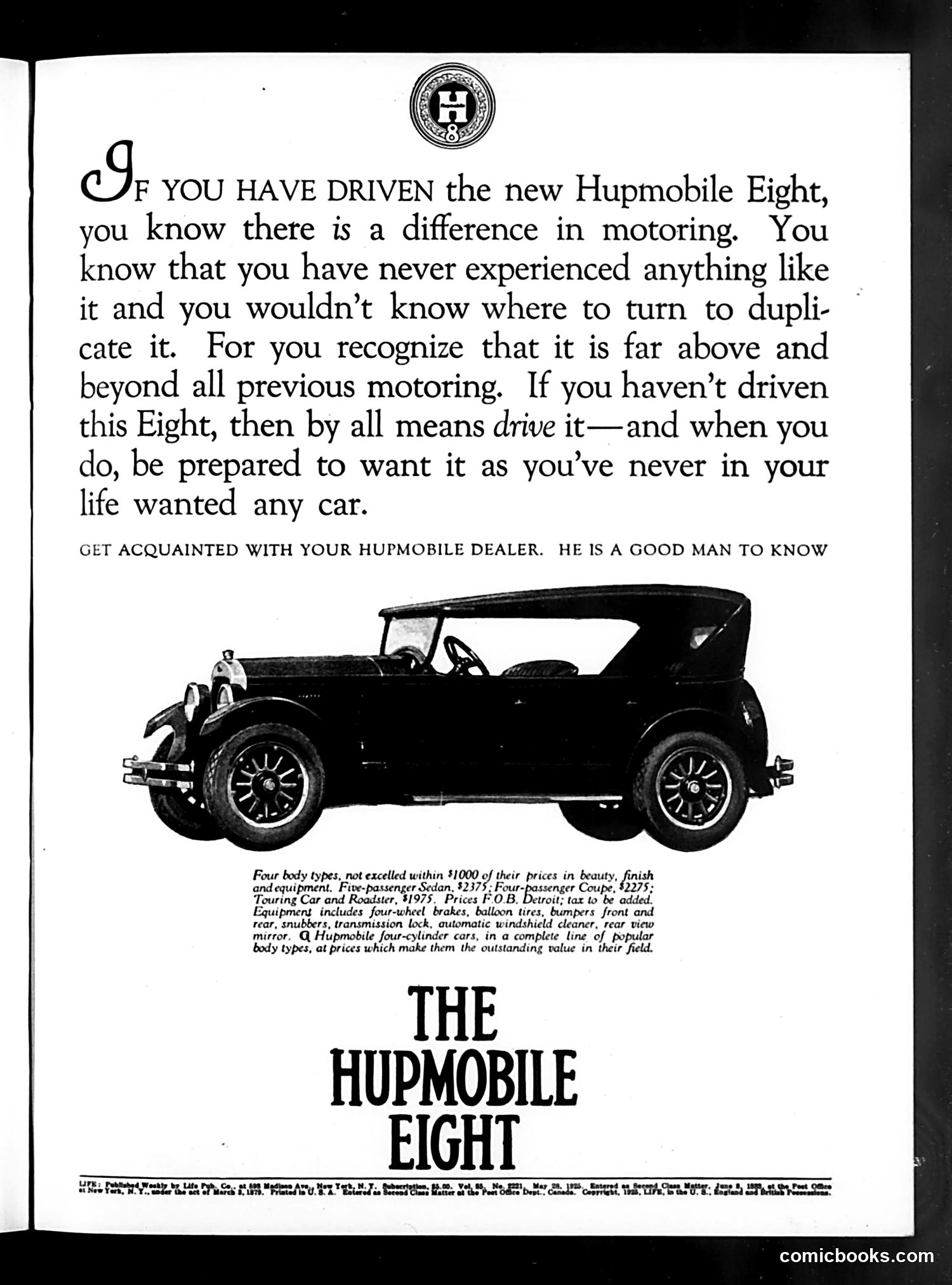
This is **not a satirical cartoon page, but rather an automobile advertisement** from Life magazine's advertising section. The page promotes the Hupmobile Eight, a luxury car model. The ad uses persuasive rhetoric rather than satire, claiming the Hupmobile Eight offers a driving experience superior to all competitors. It encourages both experienced drivers and those unfamiliar with the model to test-drive it, asserting they'll want to purchase it afterward. The accompanying illustration shows a side-view technical drawing of the automobile. Small print details four body types and pricing ($1,100-$1,975 range), mentioning features like four-wheel brakes and balloon tires—notable technological advances of that era. This represents straightforward commercial advertising, not editorial content or political commentary.
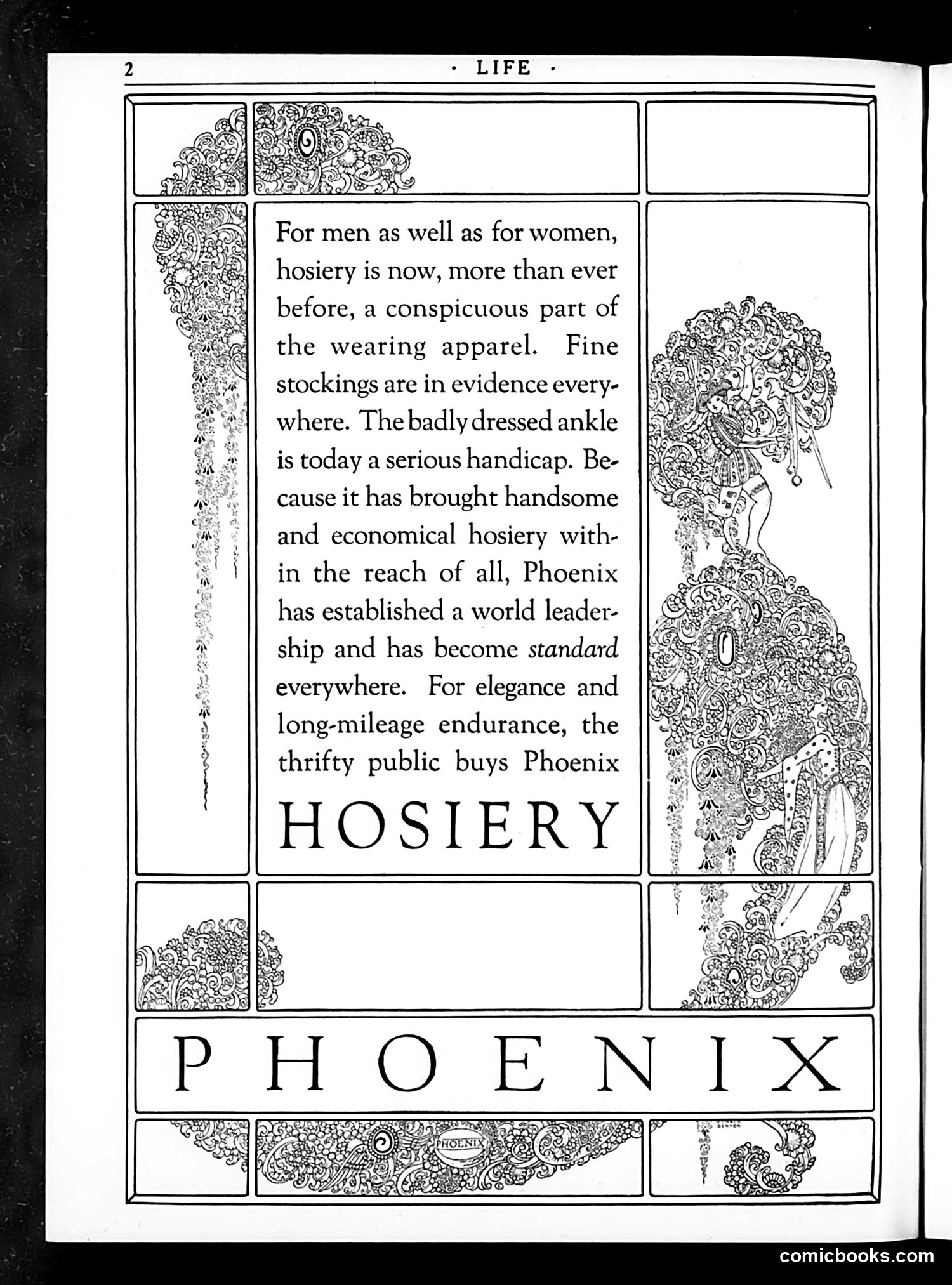
This page is **primarily advertising**, not political satire. It's a Phoenix brand hosiery advertisement from Life magazine. The text promotes Phoenix stockings to both men and women, emphasizing that well-made hosiery is now a visible fashion element. The ad claims Phoenix has achieved "world leadership" in providing affordable, elegant stockings that are durable ("long-mileage endurance"). The decorative Art Nouveau-style illustrations showing legs in stockings are typical early 20th-century advertising imagery designed to be elegant and persuasive. The "badly dressed ankle" reference suggests social anxiety about appearance—a common advertising strategy then, as now—making the case that quality hosiery is essential to respectability. This represents mainstream commercial messaging rather than editorial commentary or satire.
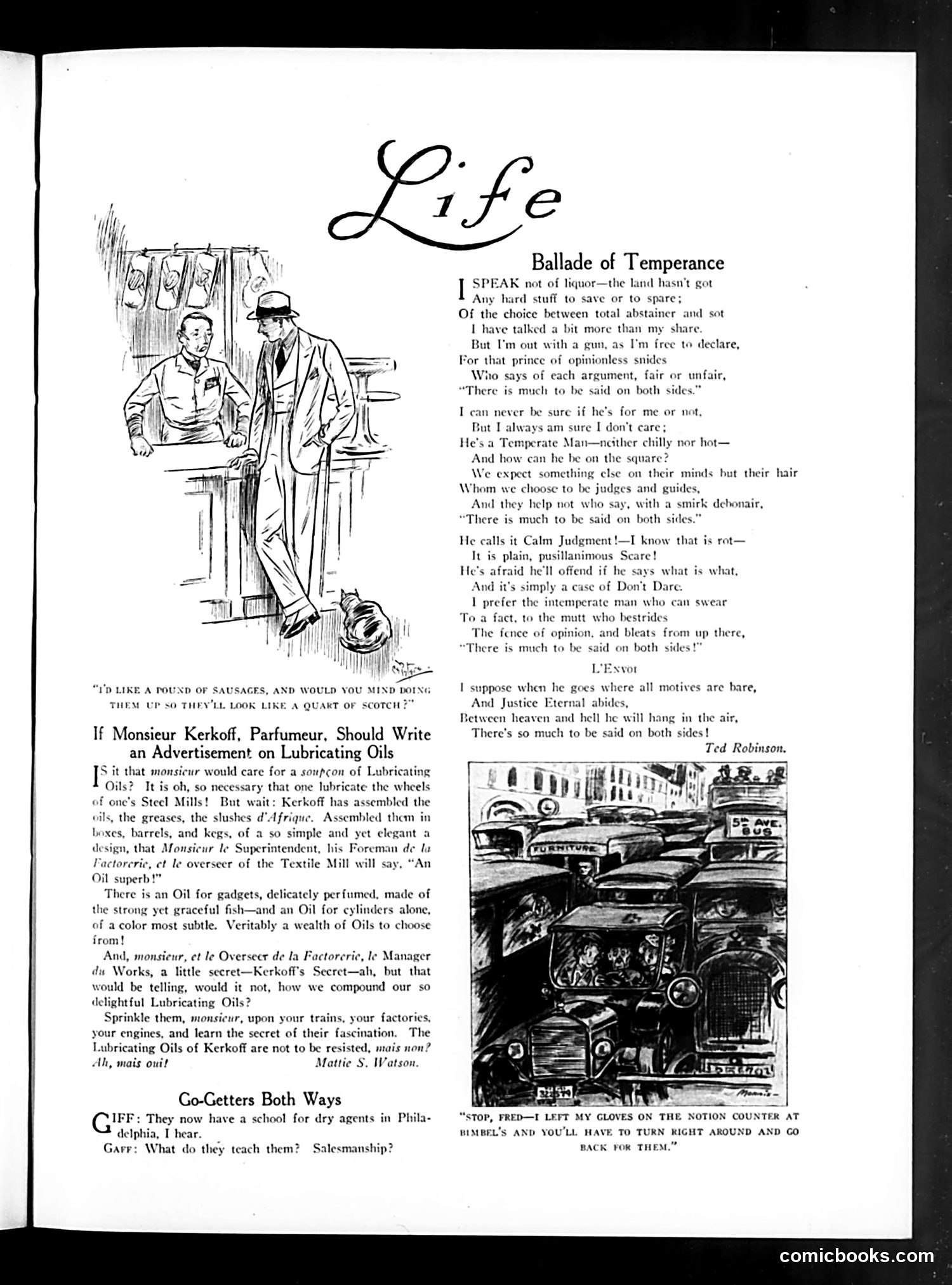
This page contains three distinct pieces: 1. **"Ballade of Temperance"** (poem by Ted Robinson): A satirical poem mocking temperance advocates who claim "there is much to be said on both sides" of the prohibition debate. The poem ridicules their supposed neutrality as cowardly fence-sitting. 2. **"If Monsieur Kerkoff...Should Write an Advertisement"** (by Mattie S. Watson): Humorous mock-advertisement imagining how a French perfume manufacturer might absurdly market lubricating oils using flowery French language and pretension—satirizing both French affectation and over-elaborate advertising copy. 3. **"Co-Getters Both Ways"**: A brief joke about a Philadelphia dry-agent training school, apparently playing on salesmanship terminology. The page satirizes temperance hypocrisy, pretentious advertising, and contemporary American anxieties around prohibition-era enforcement.
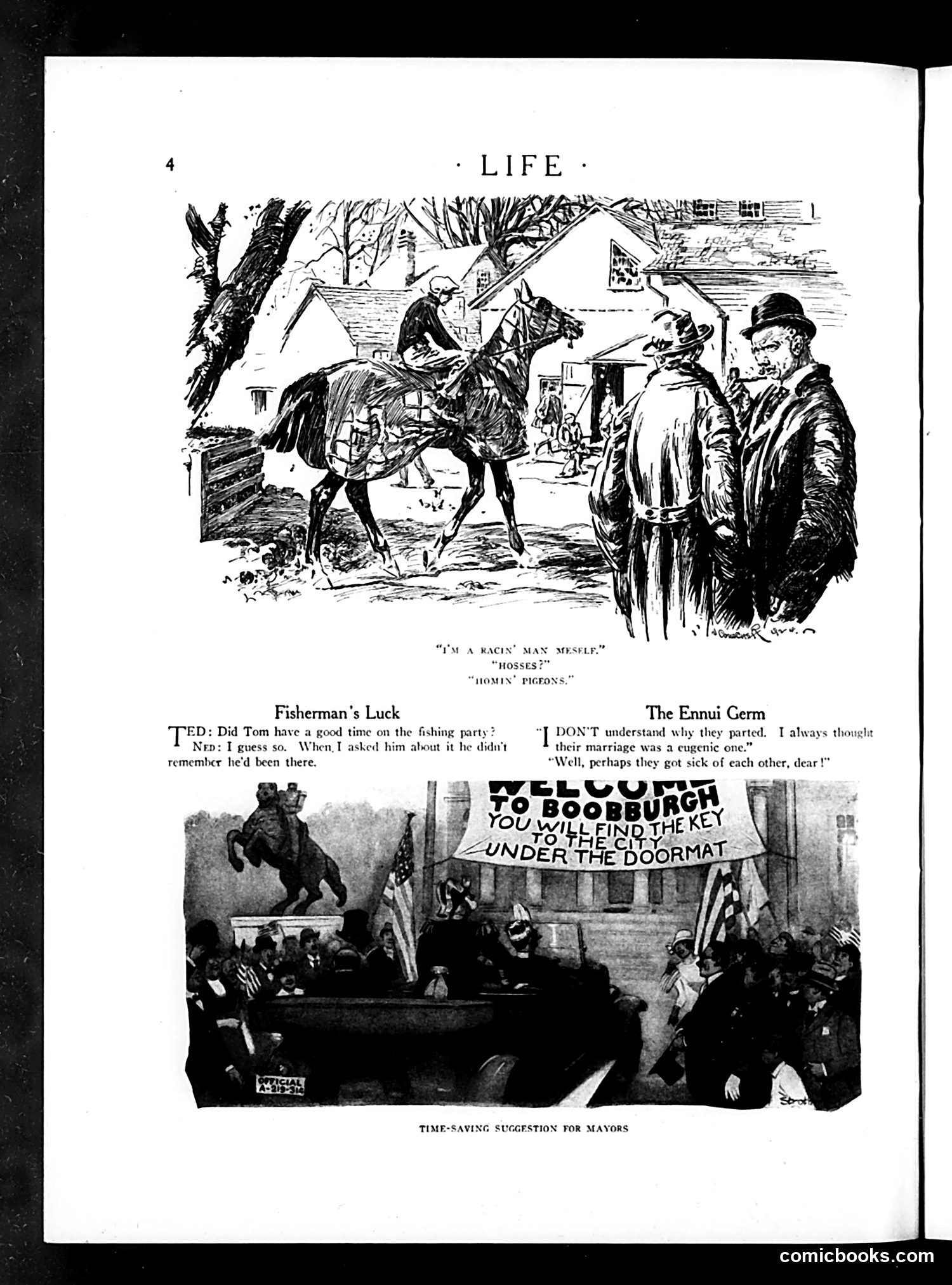
This page contains three distinct pieces of humor: **Top cartoon**: A rural scene with a horseman and three men in coats and hats. The caption quotes refer to being a "racing man myself," "horses," and "hominy pigeons" — appearing to mock rural dialect or class differences through dialogue. **"Fisherman's Luck"**: A brief joke where Tom supposedly had a good fishing trip, but when asked about it, claimed he didn't remember being there — implying he was drunk or the story is fabricated. **"The Ennui Germ"**: A couple's marriage dissolved because they were "sick of each other," sarcastically suggesting boredom as a contagion. **Bottom photo**: A political rally with a banner reading "WELCOME TO BOOBUSVILLE — YOU WILL FIND THE KEY UNDER THE CITY DOORMAT," captioned "TIME-SAVING SUGGESTION FOR MAYORS." This satirizes gullible urban voters or perhaps critiques municipal corruption through the idea of leaving keys unguarded.
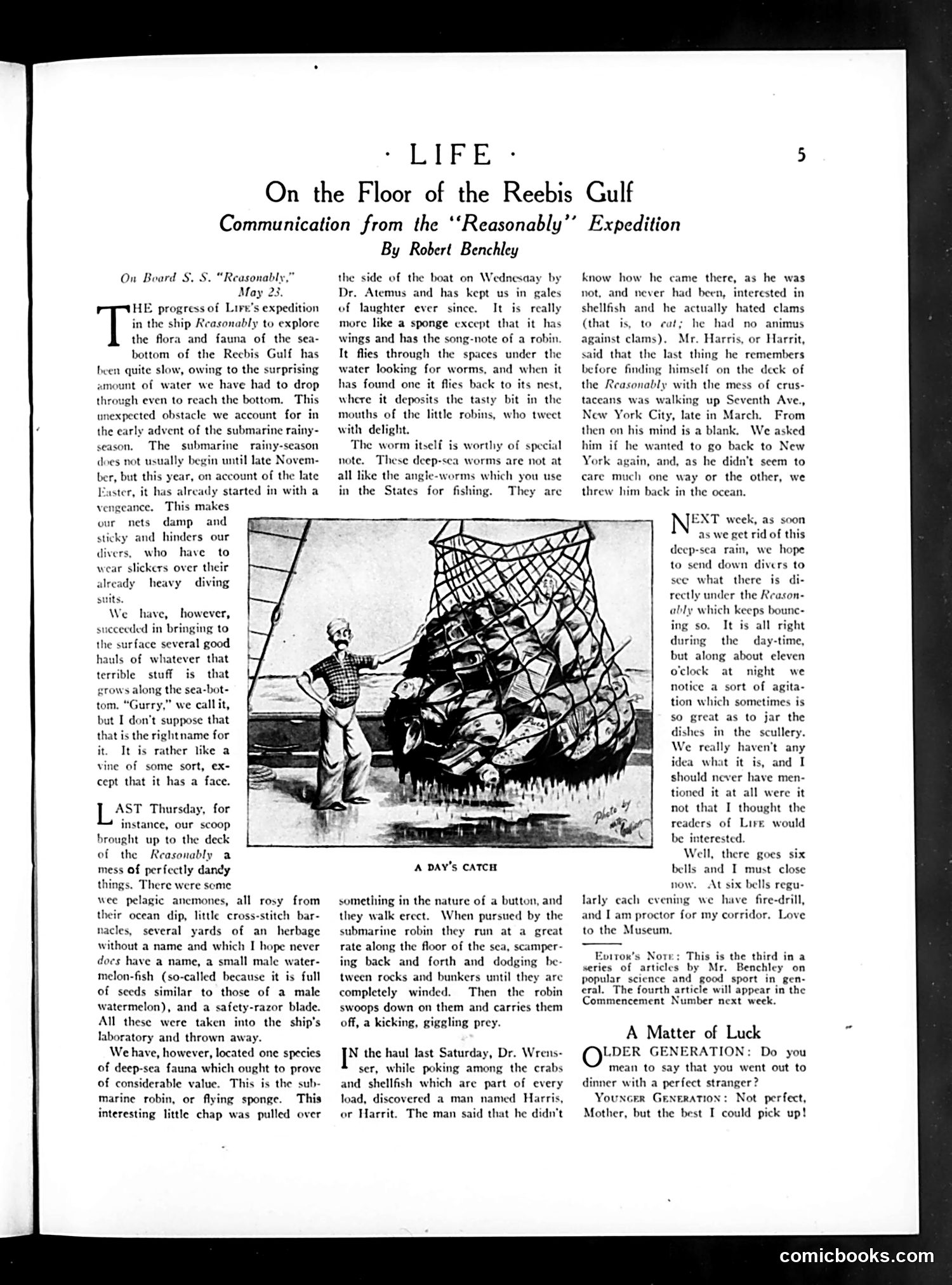
This page contains a non-satirical article titled "On the Floor of the Reebis Gulf," documenting a deep-sea expedition aboard the S.S. "Reasonably." The article by Robert Benckley describes marine life discoveries, including unusual sea creatures and worms found on the ocean floor. The central illustration, captioned "A DAY'S CATCH," shows a sailor examining a large fishing net filled with various sea creatures and specimens. This appears to be a straightforward, humorous nature-expedition account rather than political satire. The content focuses on the scientific oddities and practical challenges of deep-sea exploration, with Benckley's characteristic wit applied to marine biology rather than social commentary. The "Reasonably" expedition name itself may be a gentle joke about scientific modesty.
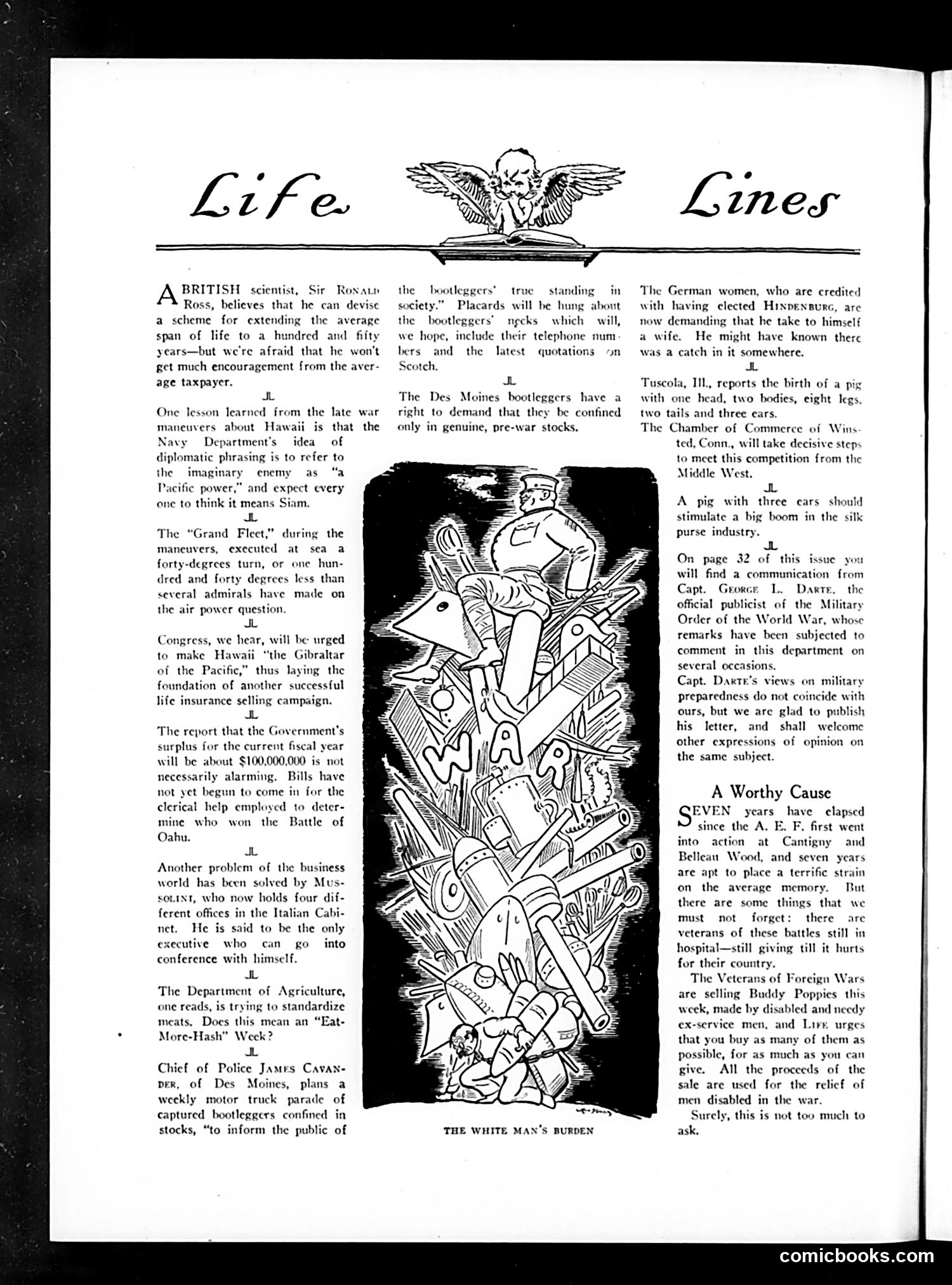
This page from *Life* magazine features a satirical cartoon titled "The White Man's Burden," depicting a heavily laden figure struggling under an enormous pile of responsibilities and burdens. The image appears to reference Rudyard Kipling's famous 1899 poem justifying Western imperialism. The cartoon critiques the various obligations Americans assumed—diplomatic, military, and economic—particularly regarding Pacific expansion and interventions. The accompanying text discusses Hawaii's strategic importance, bootleggers, military preparedness, and war veterans. The satire suggests that American imperial ambitions and global responsibilities have become an excessive, crushing burden rather than a noble endeavor. It challenges the romanticized notion of Western leadership promoted in Kipling's poem.
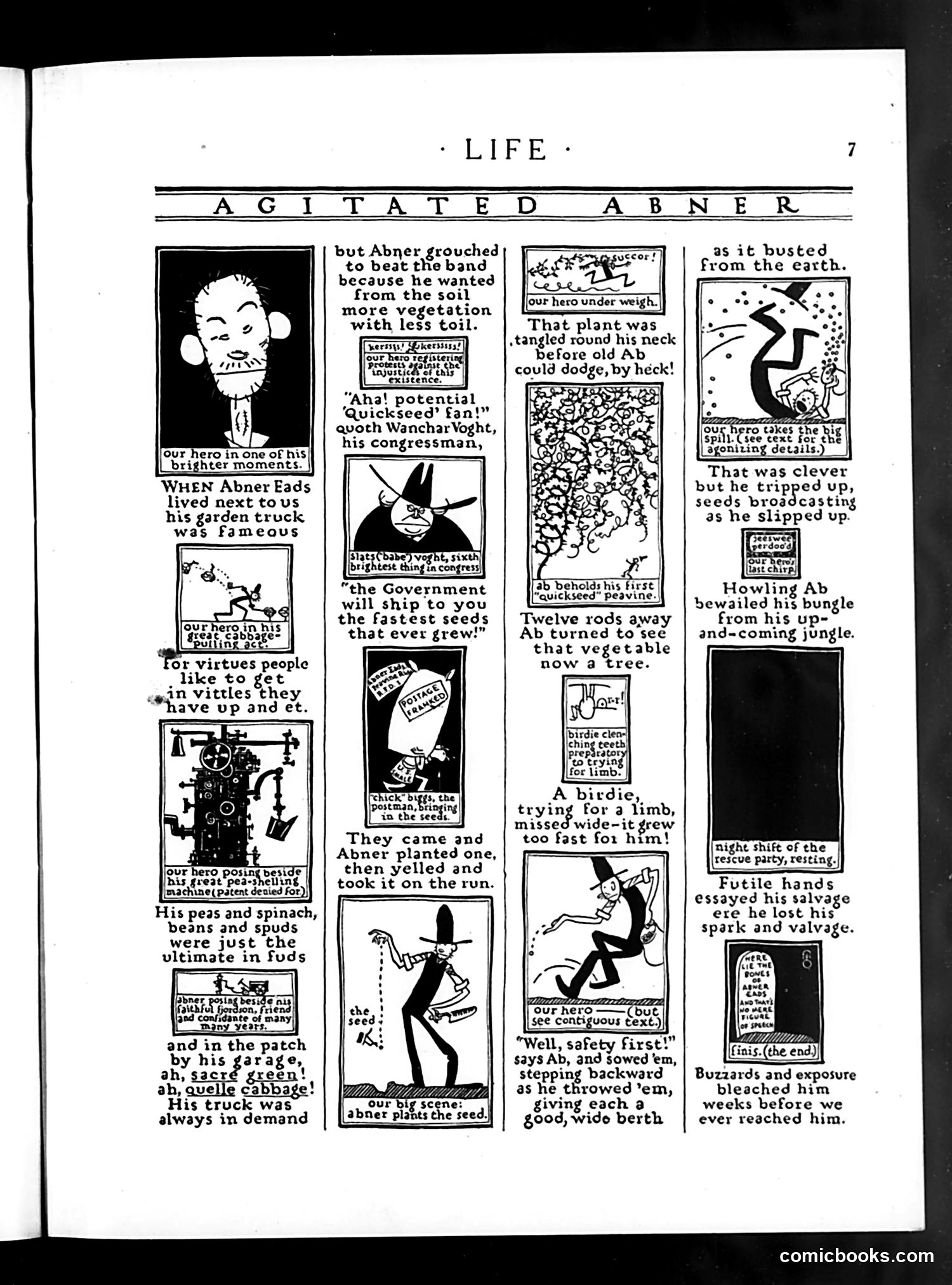
This is a comic strip narrative about a character named Abner Eads, a farmer whose garden truck business becomes entangled with government seed distribution. The satire centers on government inefficiency: Abner plants seeds the government promised would grow faster, but they grow *too* fast and wildly, creating chaos—tangled plants, rapid overgrowth, and agricultural disaster. The joke satirizes federal agricultural programs, likely referencing early-20th-century government crop initiatives. "Wancharvoght" (a congressman) and references to "the Government will ship to you the fastest seeds that ever grew" mock bureaucratic overconfidence in technological solutions. The strip's humor comes from the gap between government promises and disastrous real-world results for ordinary farmers like Abner.
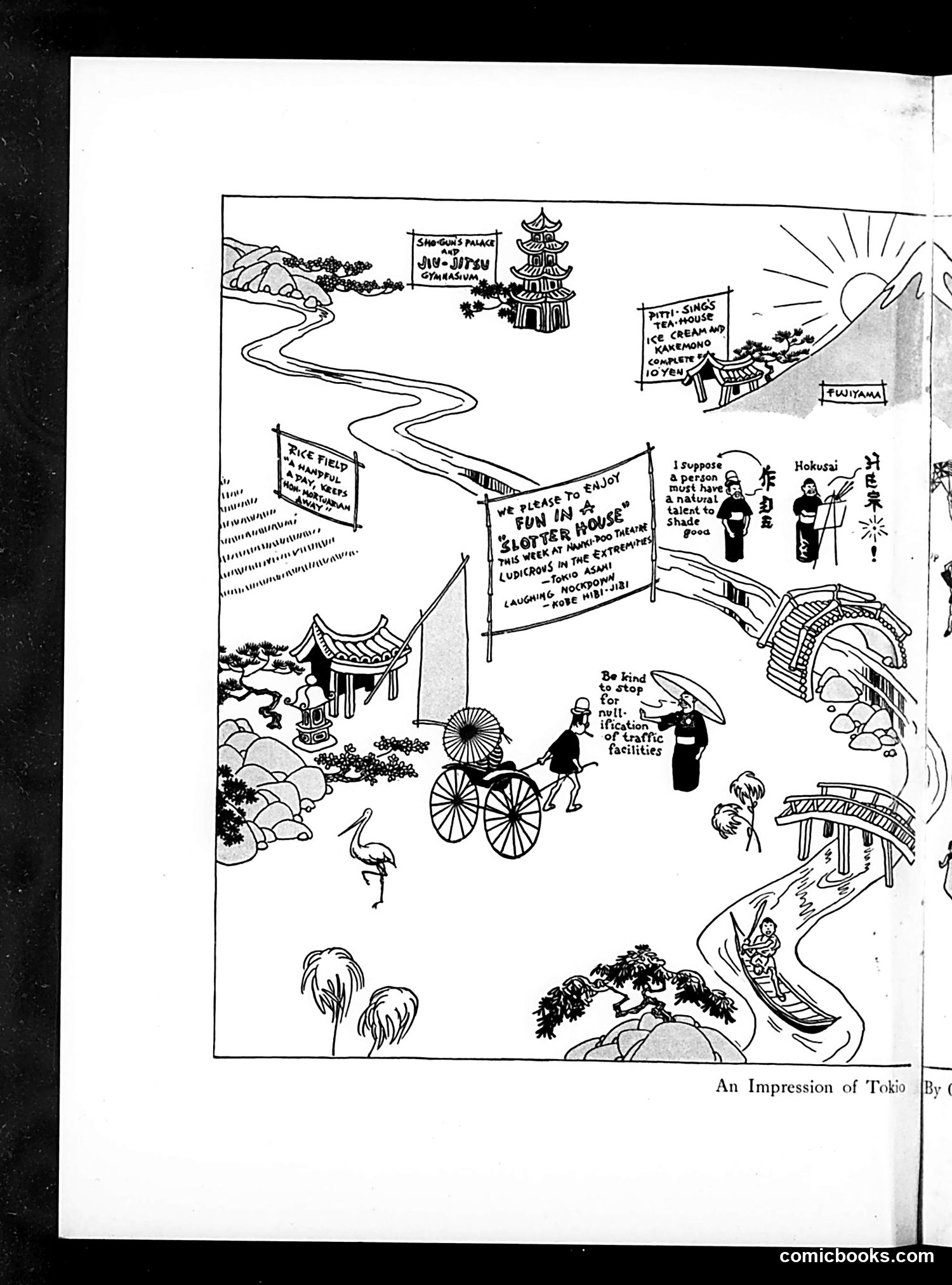
This illustration titled "An Impression of Tokio" depicts a satirical map of Tokyo, likely from the early 20th century when Japan was opening to Western tourism and influence. The cartoon humorously labels various attractions and cultural sites: Shogun's Palace with a pagoda, a "Lottery in a Tea House" venue, rice fields, and a Fujiyama mountain view. Text boxes contain playful commentary about Japanese customs and tourist experiences, including references to "Hokusai" (the famous artist) and advice about enjoying local attractions. The drawing mixes traditional Japanese architectural elements—pagodas, bridges, temples—with Western figures (people in Western dress) to emphasize the collision of cultures. The overall tone appears lighthearted rather than mean-spirited, presenting Tokyo as an exotic, somewhat bewildering destination for American readers unfamiliar with Japanese culture and modern Japan's rapid Westernization.
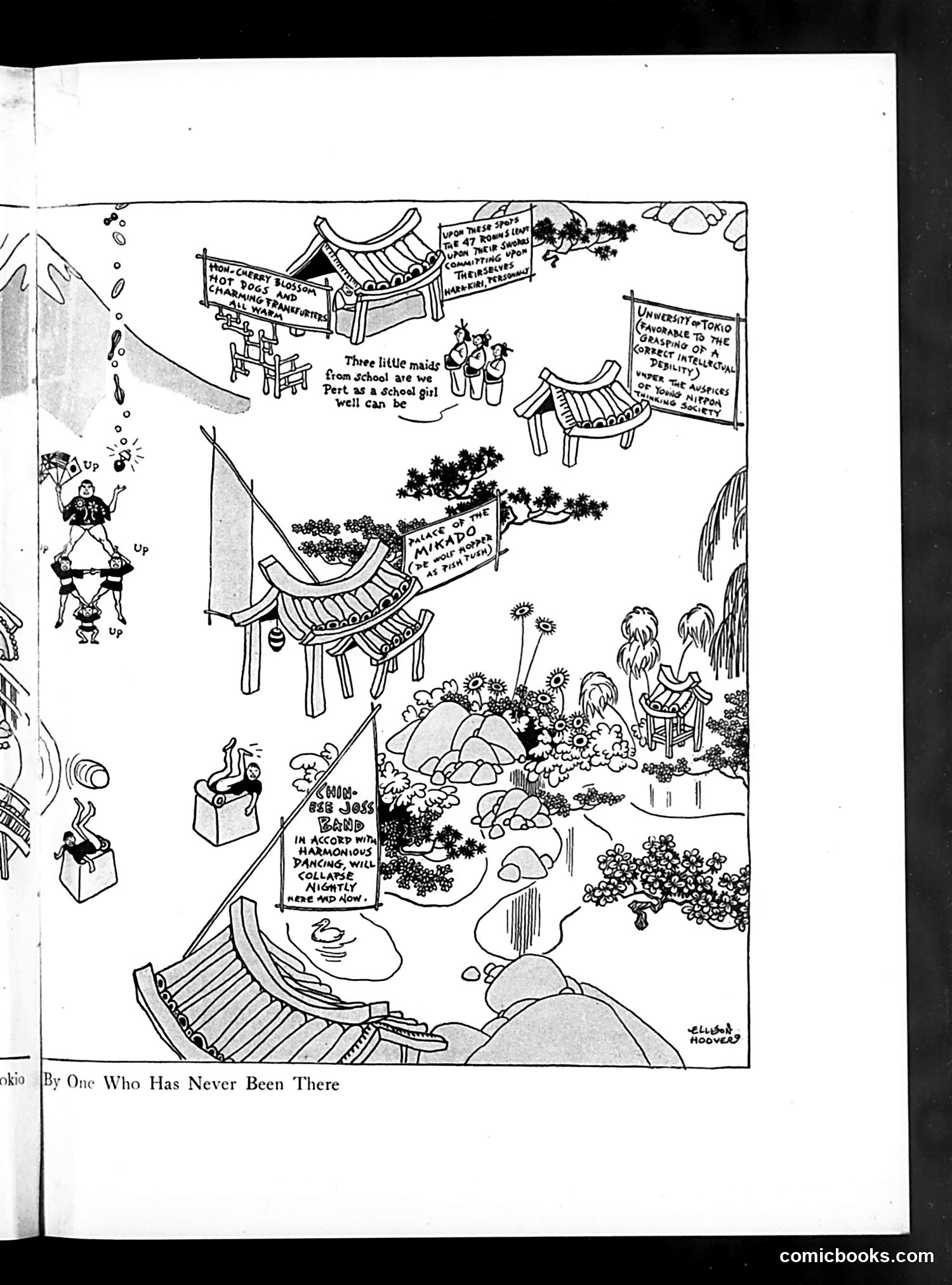
This is a whimsical illustrated commentary on Japan, drawn by someone admittedly without firsthand knowledge. The cartoon depicts an imaginary Japanese landscape populated with stereotypical elements: pagodas, traditional architecture, exotic vegetation, and figures in period dress. The text boxes reference specific locations and cultural observations—mentioning Tokyo University, a "Mikado" reference, and various Japanese customs. On the left, a small figure labeled "Up" appears multiple times, possibly representing a Westerner's perspective or naive elevation. The overall satire seems to critique Americans' fantasies about Japan based on imagination rather than actual experience—a commentary on Orientalism and how Western audiences consumed exoticized versions of Asian cultures without genuine understanding.
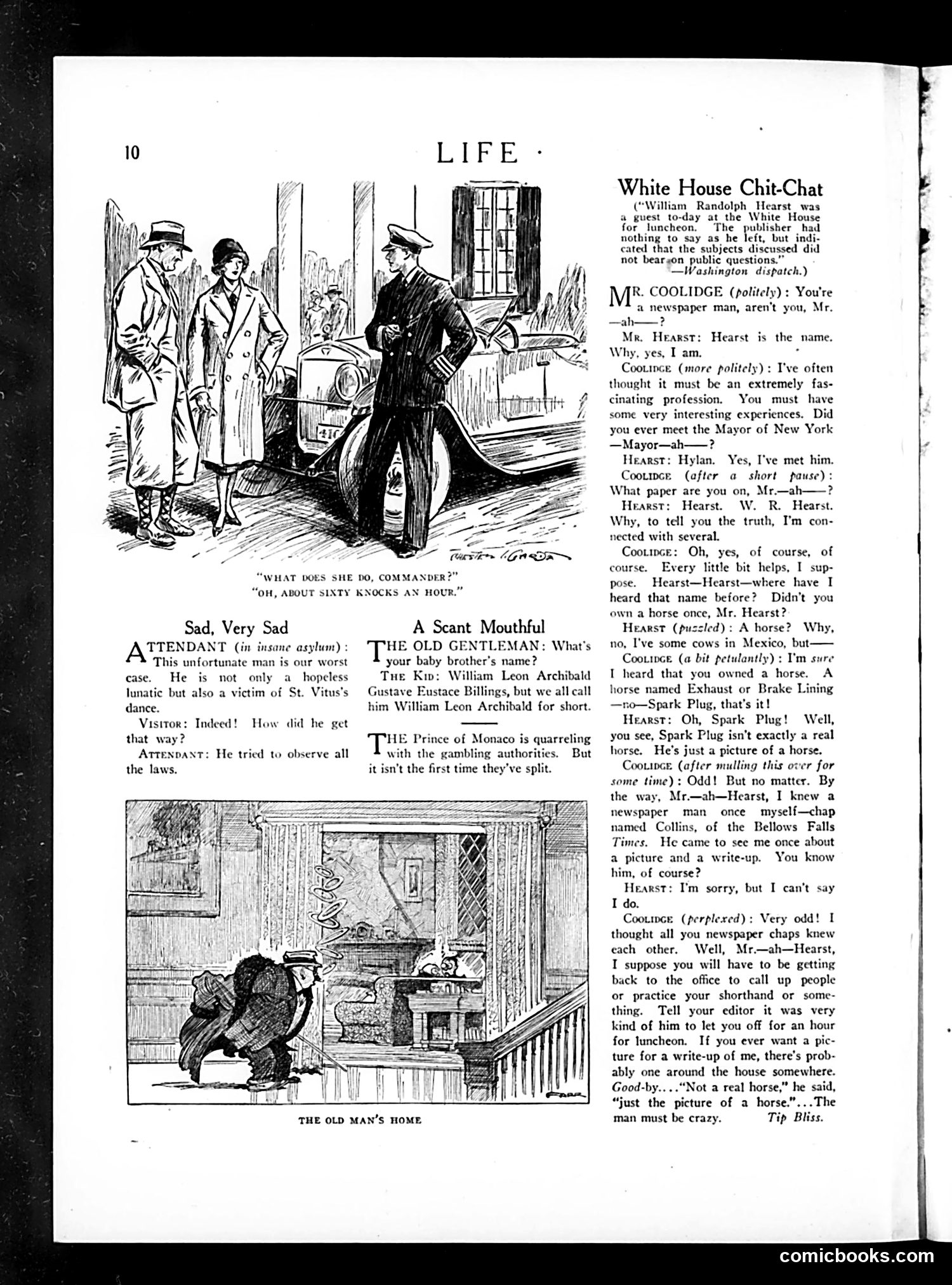
This page contains three satirical pieces about newspapers and public figures circa the early 1900s. The top cartoon "What Does She Do, Commander?" depicts someone with a very fast-moving bicycle or vehicle, satirizing excessive speed. "Sad, Very Sad" mocks an asylum attendant's failed observation skills regarding a patient's brother. "A Scant Mouthful" references William Randolph Hearst and the Prince of Monaco's gambling dispute. The "White House Chit-Chat" dialogue features Hearst discussing his horse "Spark Plug" with Mr. Coolidge, appearing to satirize Hearst's wealth and eccentricity. "The Old Man's Home" illustration shows an elderly man in domestic circumstances. The overall theme ridicules newspaper culture, wealthy publishers like Hearst, and public figures' peculiar habits—typical satire for Life's era of muckraking journalism.
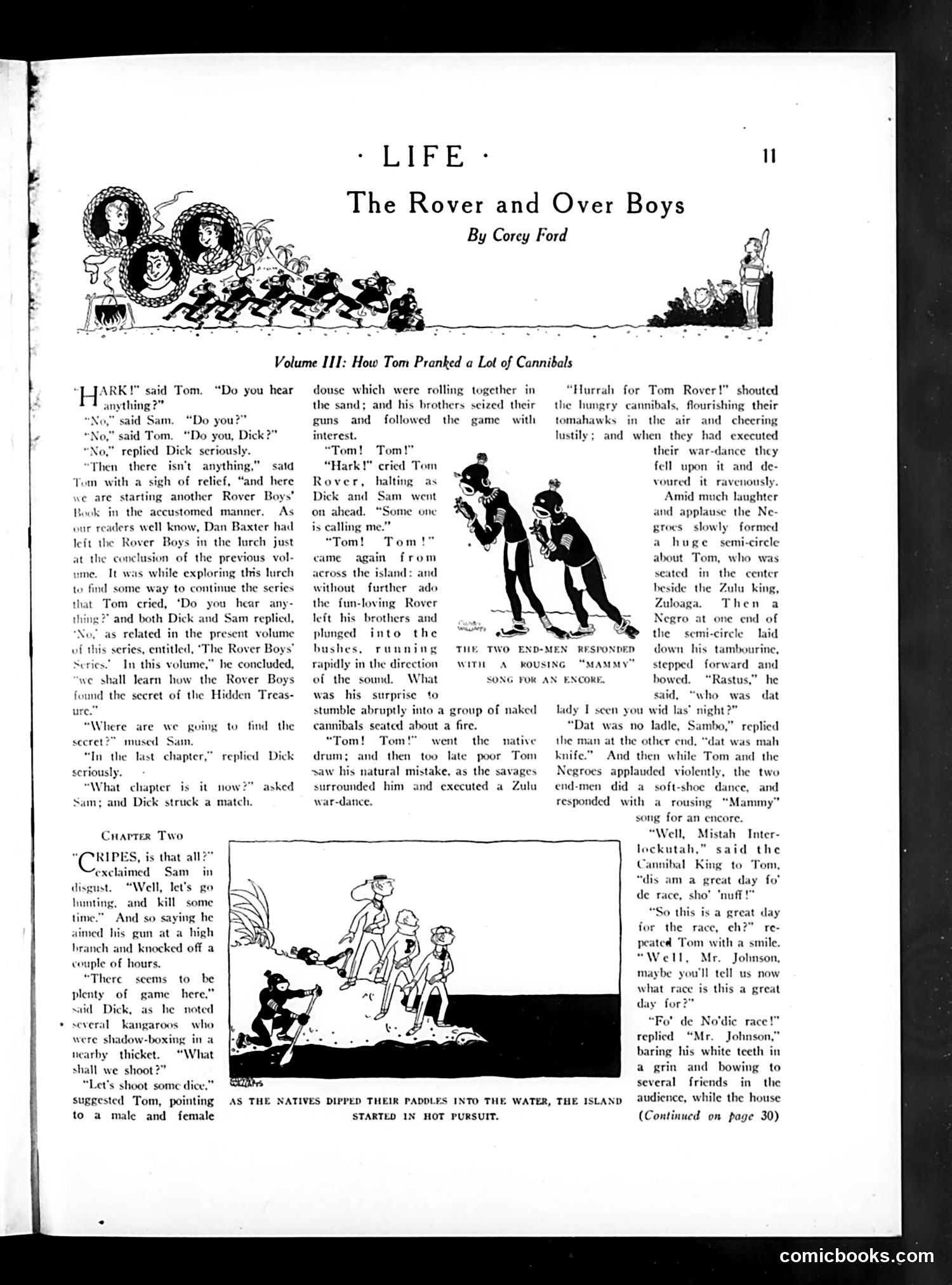
This is a serialized adventure story illustrated with comic strips, not political satire. The narrative follows Tom Rover and his brothers as they pursue criminals across an island. The illustrations depict Tom and companions encountering cannibals and native peoples, whom they chase after discovering their location. The content reflects early-20th-century adventure fiction conventions: European/American protagonists pursuing "exotic" antagonists in colonial settings, with indigenous peoples depicted as threats to be overcome. The story's tone treats these encounters as exciting sport ("game here") rather than examining the colonial power dynamics at work. The page continues a serial narrative, indicating this was episodic entertainment for Life's readers rather than standalone political commentary.
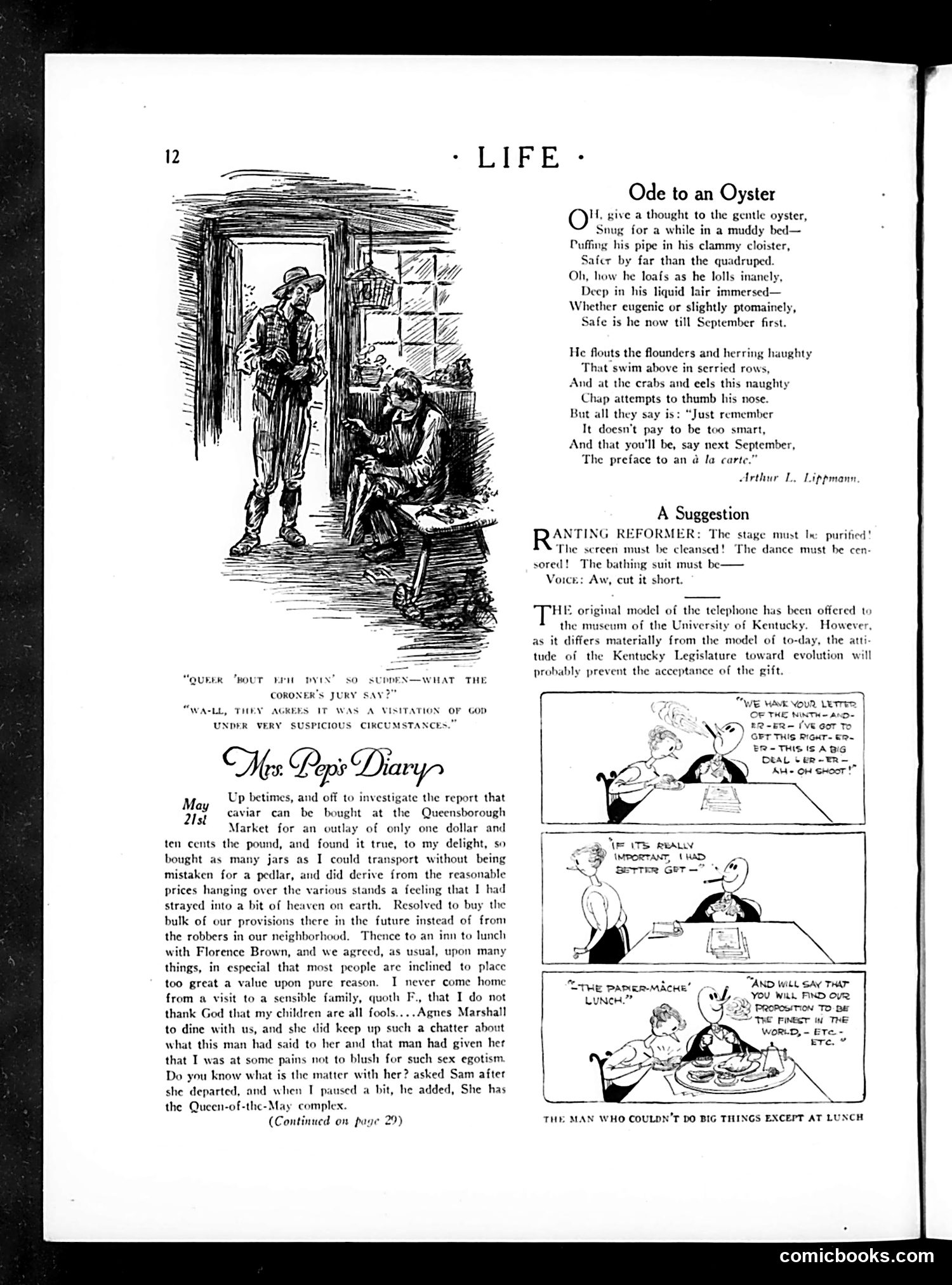
This page contains three distinct pieces: 1. **"Ode to an Oyster"** by Arthur L. Lippmann—a humorous poem celebrating an oyster's safe, sedentary existence in its shell, contrasting it with the dangers faced by other sea creatures. 2. **"A Suggestion"** - A brief satirical exchange where a "Ranting Reformer" demands moral purification of entertainment (stage, screen, dance, bathing suits), and another voice dismissively responds "cut it short." 3. **"Mrs. Peps Diary"** - A personal essay dated May 21st describing the author's discovery of inexpensive caviar at market and subsequent lunch plans with Florence Brown, ending with commentary on a woman's "Queen-of-the-May complex." 4. **A three-panel comic** titled "The Man Who Couldn't Do Big Things Except at Lunch" depicting someone unable to accomplish tasks except during meals.
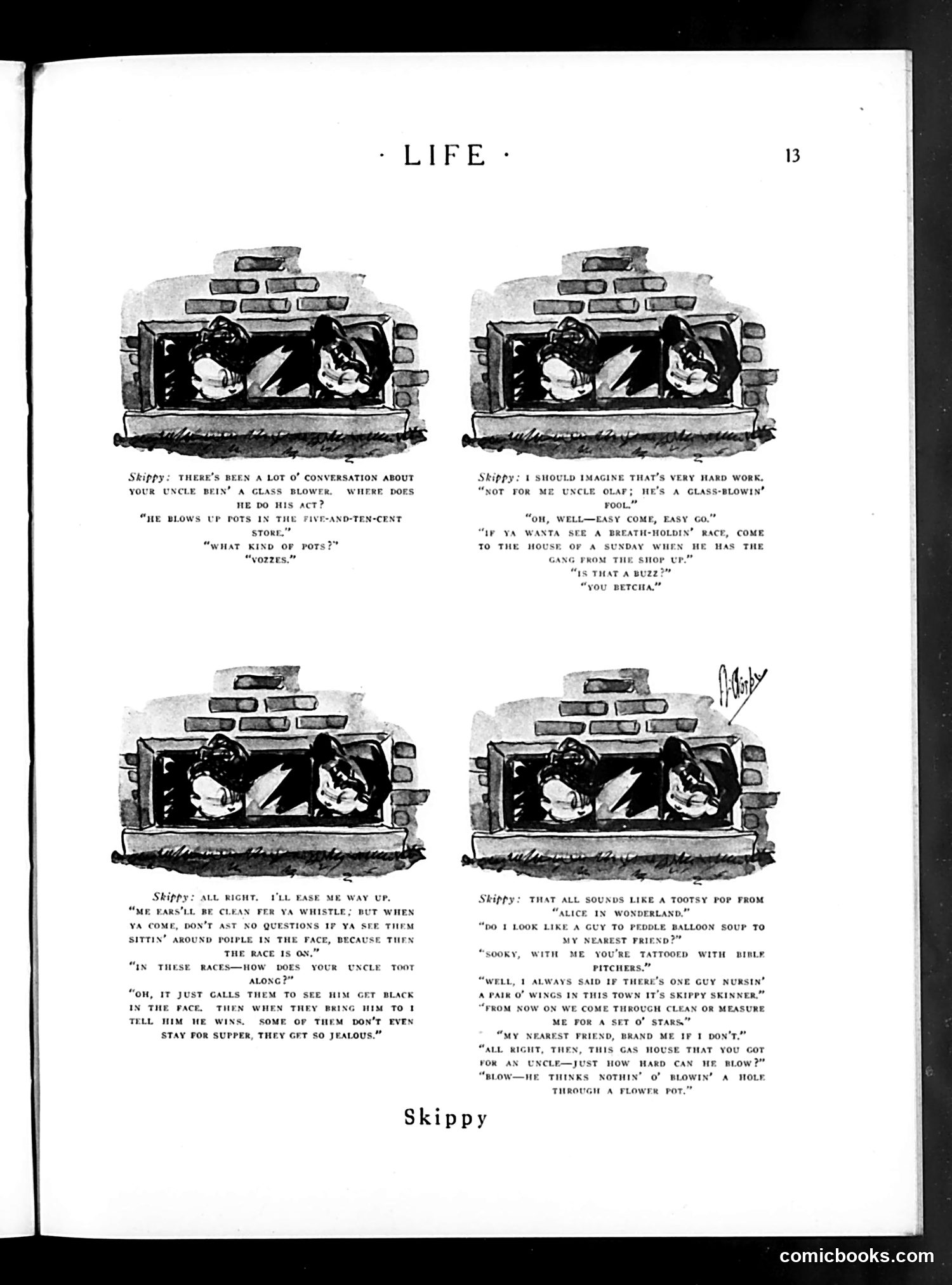
This is a comic strip featuring two young boys in what appears to be a delivery vehicle or cart. The dialogue reveals working-class urban humor typical of early 20th-century Life magazine satire. The joke centers on one boy ("Skippy") explaining to his companion about his Uncle Olt, who works blowing glass—likely making decorative items or glassware. The humor derives from a misunderstanding: when asked what his uncle does, the boy describes glass-blowing in crude street dialect, leading to absurdist riffs on the phrase ("glass house," "breath-holder race," "peddle balloon soup"). The strip satirizes children's misinterpretations of adult work and working-class speech patterns—common humor subjects in early Life magazine. The casual, colloquial language captures period urban youth culture.
This page contains editorial commentary responding to Dean Inge's controversial remarks about Jews. The text criticizes Inge for making inflammatory statements while fundraising, noting the hypocrisy of "jolting the Jews while Dr. Manning passes the hat" for fifteen million dollars. The small cartoon visible appears to feature caricatured figures, though details are unclear in this reproduction. The article discusses Jewish success in New York business and finance, touching on antisemitic tropes about Jewish wealth and influence in commerce, banking, and trade. The writer attempts a measured defense—acknowledging Jewish prosperity while downplaying it as unremarkable compared to other successful immigrant groups. This reflects 1920s American antisemitism, even in ostensibly sophisticated publications like Life.
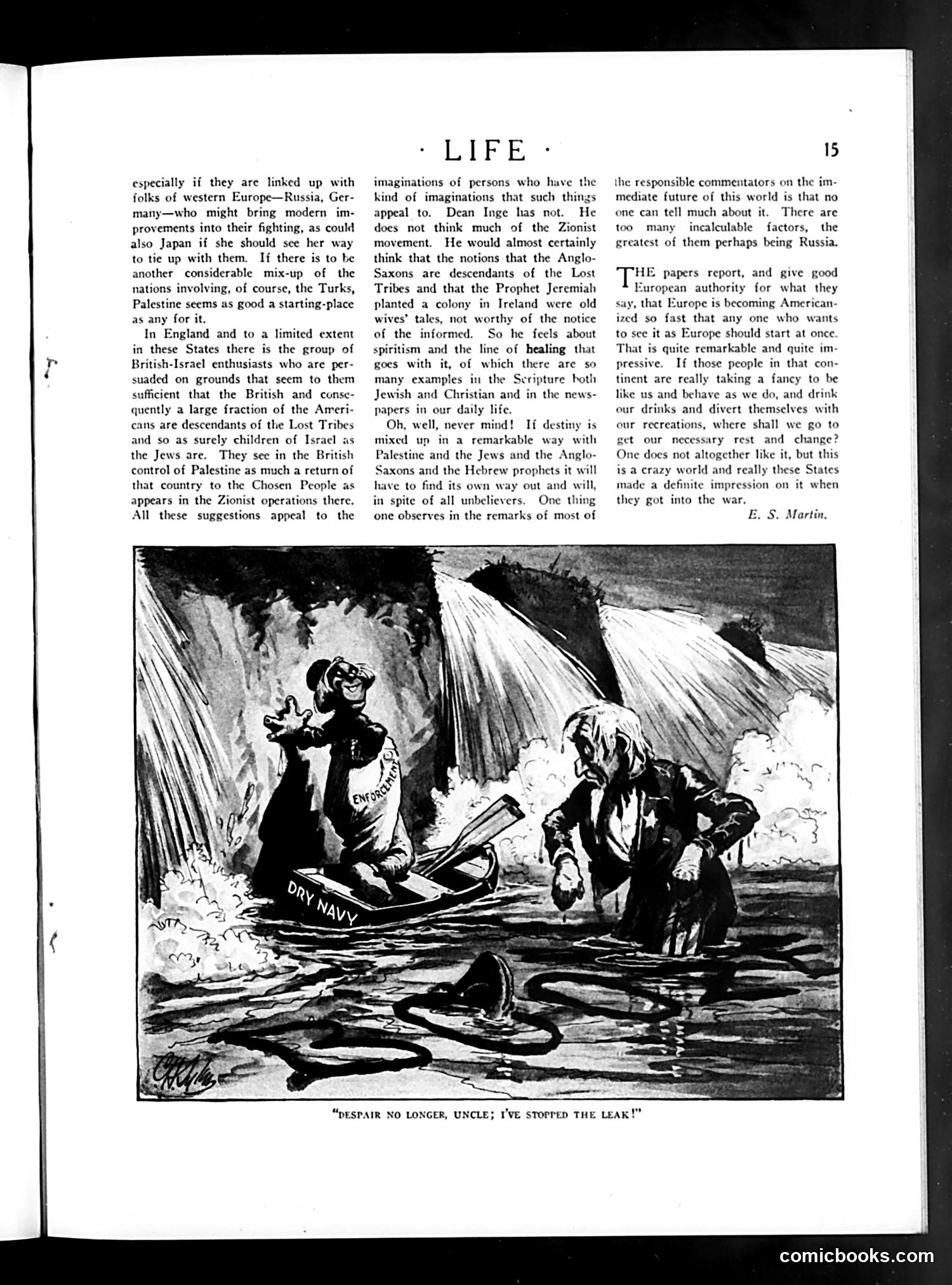
This political cartoon depicts Uncle Sam (labeled "DRY NAVY") attempting to patch a sinking vessel amid rough seas. A figure labeled "EXPRESSIONISM" works frantically beside him to stop leaks in the boat. The satire criticizes the U.S. Navy's readiness during what appears to be a pre-WWI or WWI period. The "leak" represents naval vulnerabilities or military unpreparedness. The "expressionism" figure—likely referencing German artistic modernism or broader German influence—ironically claims to have solved structural problems, suggesting skepticism about foreign solutions to American military deficiencies. The surrounding text discusses British-American relations, Zionism, and European politics, contextualizing broader anxieties about international entanglements and national security.
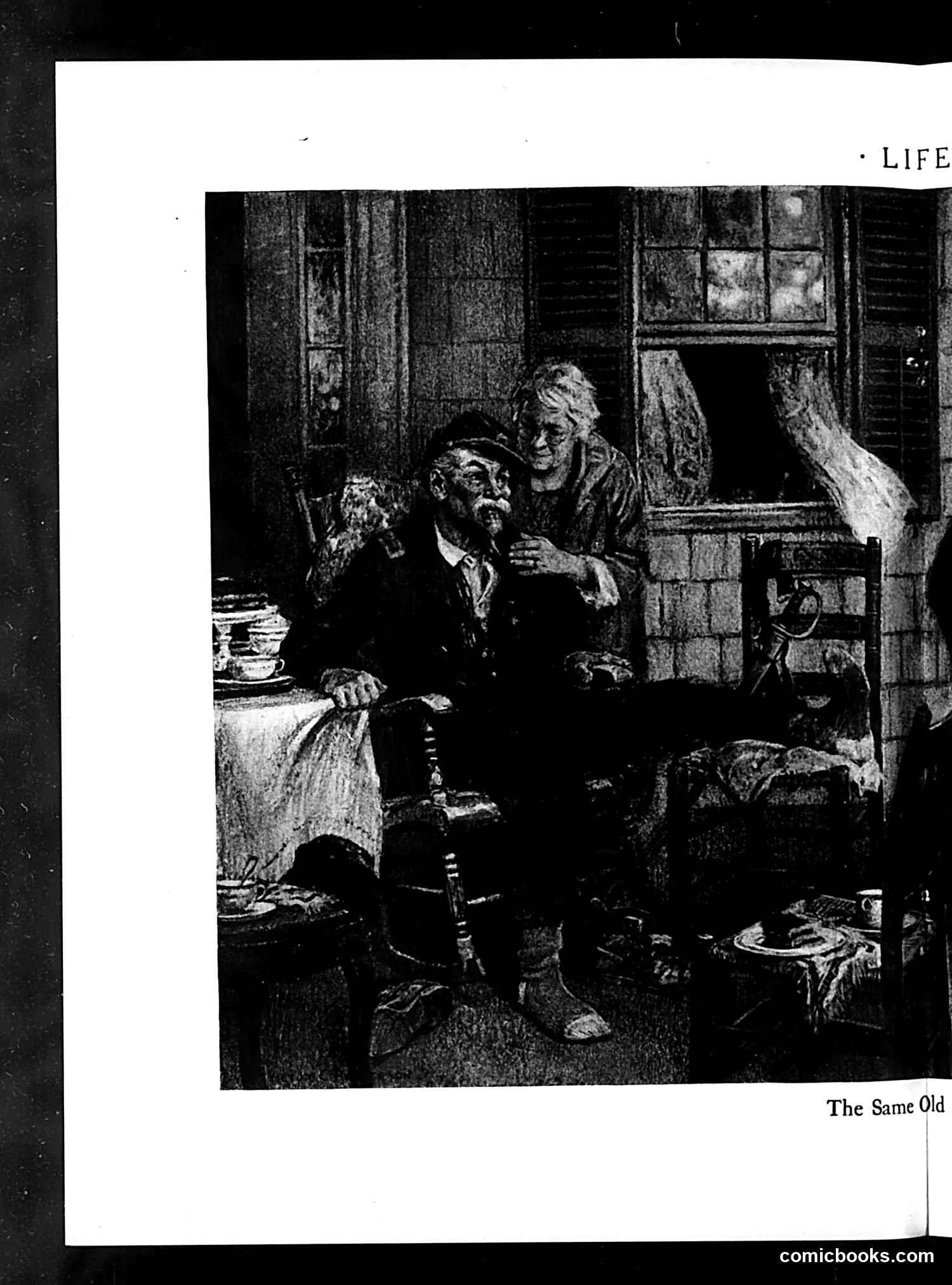
This appears to be a satirical illustration from *Life* magazine depicting a domestic scene in a modest, cluttered room. Three figures—two men and a woman—are shown in what looks like shabby living quarters with a window, simple furniture, and scattered belongings. The caption "The Same Old" suggests commentary on unchanging poverty or social conditions. The figures' worn clothing and the sparse, disorderly interior suggest economic hardship. The satire likely critiques either the persistence of lower-class living conditions despite promises of improvement, or perhaps the cyclical nature of social problems. Without additional context or visible publication date, the specific political target remains unclear, though the image reflects *Life*'s typical social commentary on American class disparities.
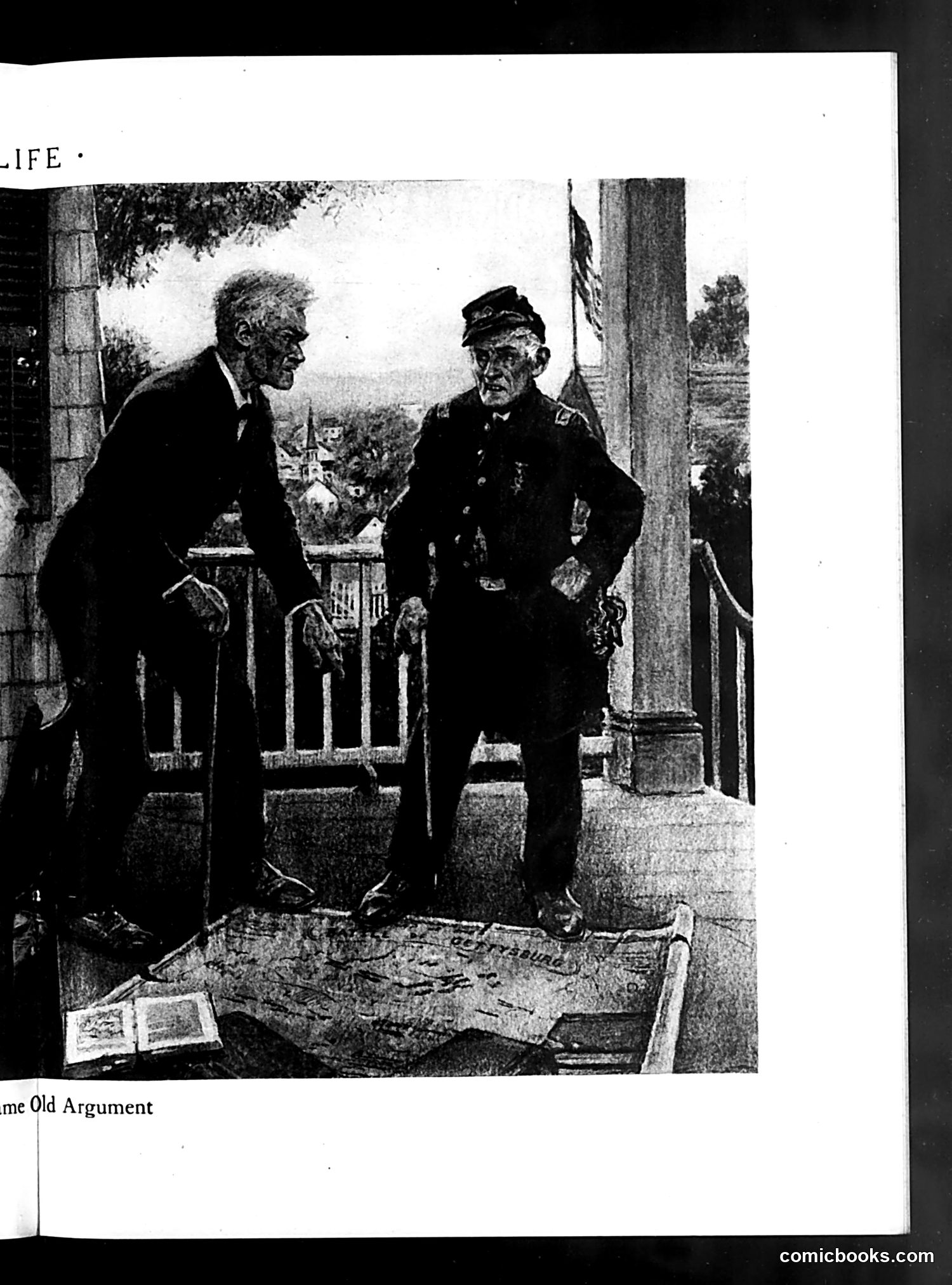
This page from *Life* magazine shows two men examining what appears to be a military map or document on a table, with a balcony and landscape visible behind them. The caption reads "Some Old Argument." The figure on the left wears civilian dress (appears elderly), while the figure on the right wears a military uniform with visible insignia and a peaked cap. The "old argument" likely refers to a recurring diplomatic or military dispute between civilian and military leadership—a common satirical theme in American publications during periods of international tension or war. Without clearer dating or identifying information, the specific historical context remains unclear, though the imagery suggests this commentary on civilian-military relations was timely when published.
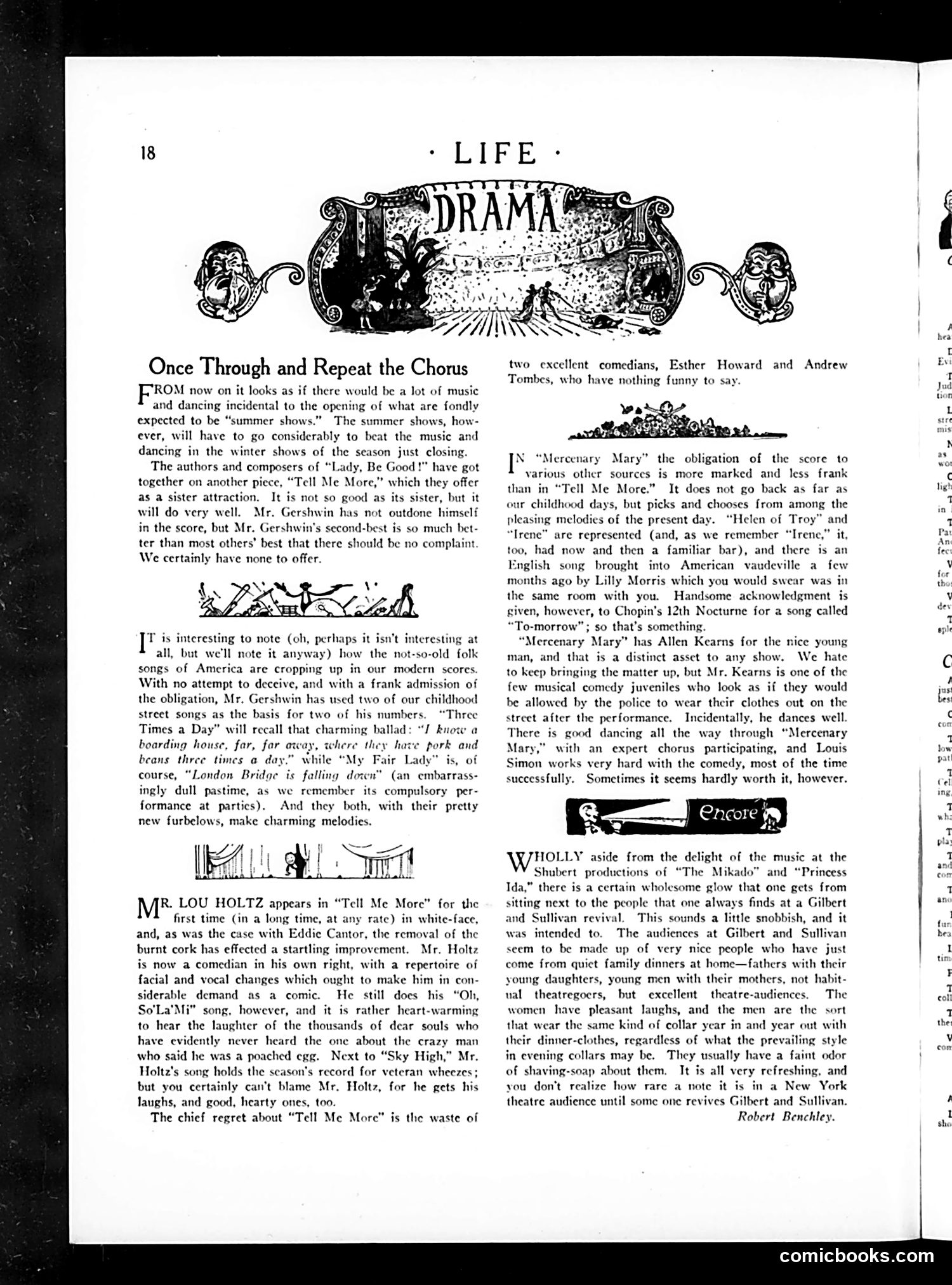
This page reviews two Broadway musicals: "Tell Me More" and "Mercenary Mary." The critic praises composer George Gershwin for cleverly incorporating American folk songs—particularly children's street rhymes like "London Bridge"—into modern theatrical scores, acknowledging the source rather than disguising the borrowing. The review notes comedian Lou Holtz's improvement after abandoning blackface makeup ("burnt cork"), comparing his transformation favorably to Eddie Cantor's similar decision. However, the critic laments the wasted comic talents of Esther Howard and Andrew Tombes in "Tell Me More," who are given poor material. Allen Kearns receives praise as the juvenile lead in "Mercenary Mary," specifically for his youthful, respectable appearance—a humorous jab at other performers whose disheveled stage appearances wouldn't survive police scrutiny off-stage. The small decorative illustrations scattered throughout are typical Life magazine ornaments, not specific political cartoons.
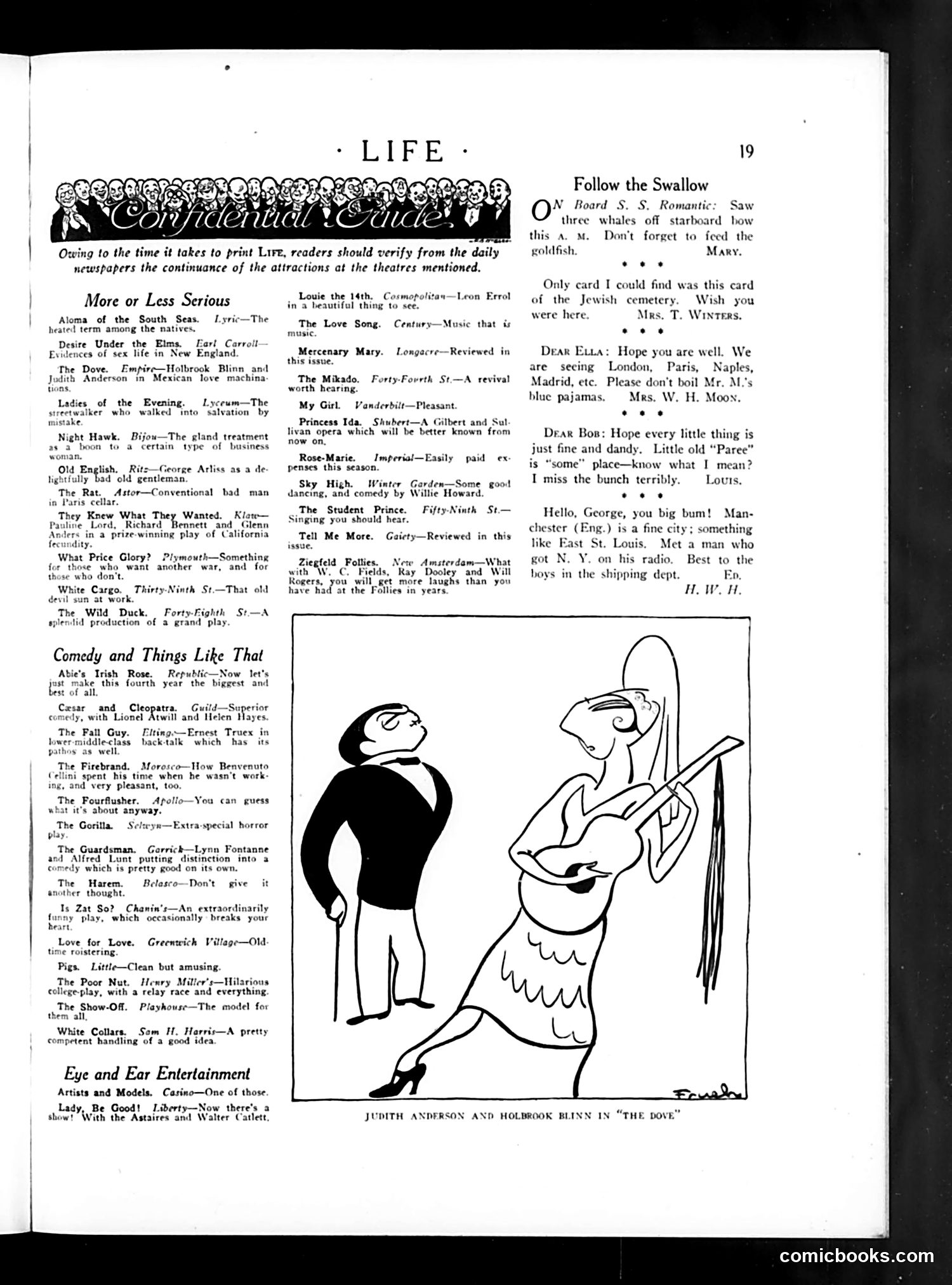
This page features theater reviews and a cartoon illustrating the "Follow the Swallow" column—postcards from travelers. **The Cartoon:** The illustration by Spandel shows two figures: a man in formal dress on the left and a woman in casual travel clothes on the right, holding what appears to be a parasol or umbrella. The woman appears to be a caricatured "modern woman" traveler—independent, casual, and abroad. The cartoon likely mocks the contemporary trend of young women traveling unaccompanied, a relatively new social phenomenon in the 1920s that scandalized more conservative society. **The "Follow the Swallow" Column:** This appears to be a humorous column collecting brief, lighthearted postcards from travelers. The cards show typical tourist activities (seeing whales, visiting cemeteries, boiling laundry) and casual correspondence—reflecting the era's travel culture and the informal leisure activities of the middle class. **Overall Context:** The page captures 1920s entertainment, modern travel, and changing social attitudes toward women's independence and leisure.
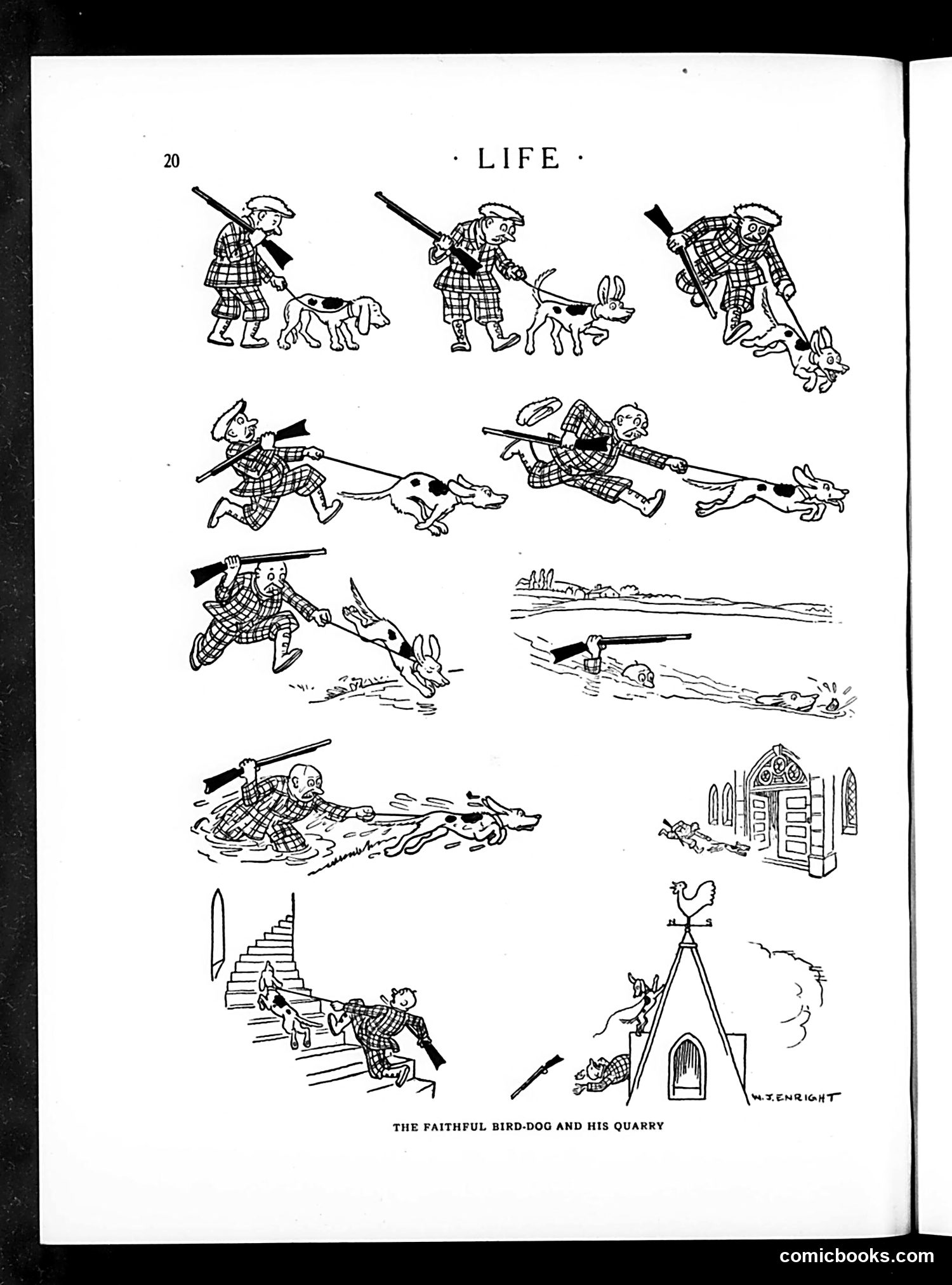
This is a humorous illustrated sequence depicting hunting scenes with a Scottish-dressed hunter and his dog pursuing rabbits. The page shows a narrative progression: the hunter and dog stalking prey, chasing rabbits through various landscapes (water, fields, terrain), and ending at what appears to be a church or dwelling. The final panel shows the dog at the church entrance while the hunter appears exhausted or defeated. The satire likely plays on the concept of "quarry" — suggesting the hunter's pursuit extends beyond game animals to something else (possibly suggested by the church setting). The "faithful bird-dog" reference is ironic given the rabbits shown. The cartoonist's signature is "W. Tenright." Without additional context, the specific social or political target remains unclear, though it appears to mock either hunting mishaps or obsessive pursuit.
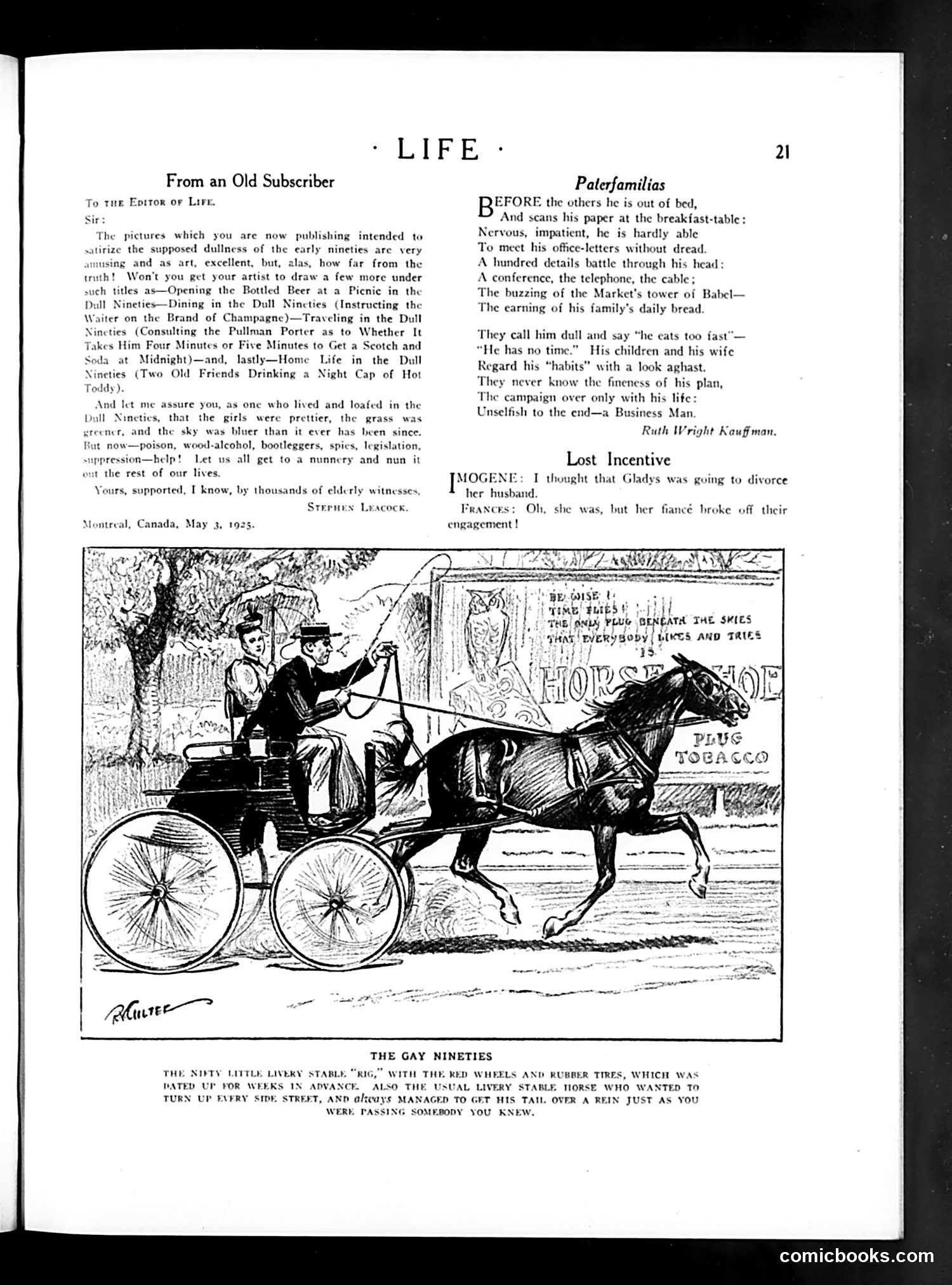
This page contains nostalgia and social commentary about 1890s American life. A reader's letter praises Life's satirical drawings of the "Dull Nineties," arguing the era was actually pleasant—prettier girls, bluer skies—unlike the current 1920s with its "poison, wood-alcohol, bootleggers" and Prohibition-era problems. The poem "Paterfamilias" portrays a businessman as noble and self-sacrificing, working ceaselessly for his family despite being called dull and eating too fast. The cartoon "The Gay Nineties" depicts a livery-stable horse and carriage from that era, humorously noting the horse's habit of awkwardly positioning its tail over the reins whenever passing acquaintances. The brief joke "Lost Incentive" quips that a woman lost her divorce incentive when her fiancé ended their engagement—suggesting marital dissatisfaction was common enough to contemplate divorce. Overall, the page mixes genuine nostalgia for pre-Prohibition America with gentle mockery of both past and present social conventions.
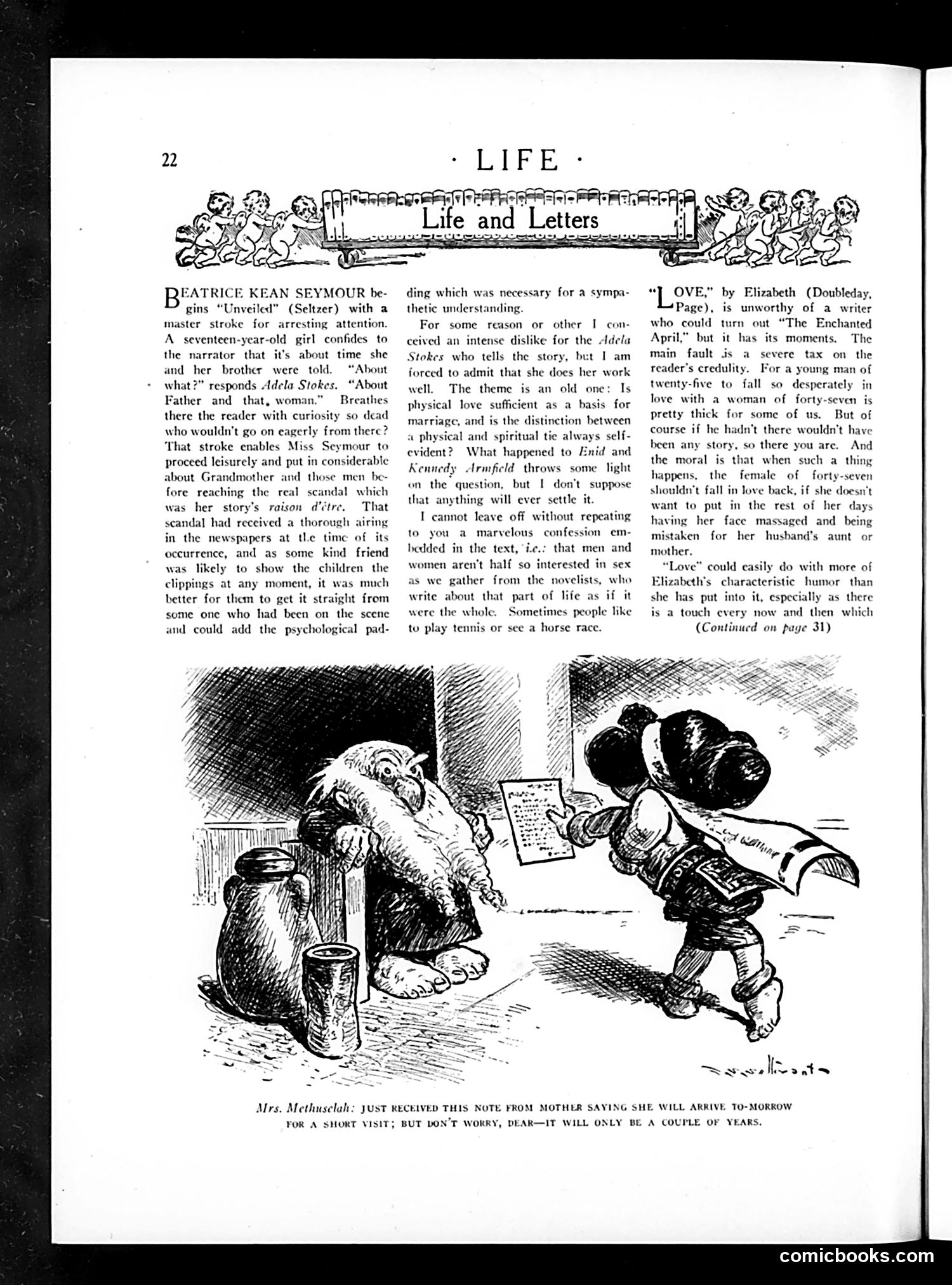
This is a book review section from *Life* magazine. The main article reviews "Unveiled" by Beatrice Kean Seymour, a novel about a scandal involving an affair. The reviewer critiques the book's central premise: whether physical love alone can sustain marriage. He notes the story addresses an age-gap romance between a 25-year-old man and a 47-year-old woman, calling this "pretty thick" (implausible) but acknowledging it was necessary for the plot. The cartoon below satirizes this same theme. "Mrs. Methuselah" receives a note from her elderly mother announcing a visit, with the joke being her deadpan response: "it will only be a couple of years"—implying her mother is so ancient that even a "short visit" will consume years. The satire mocks extreme old age and the generational gap, reinforcing the review's skepticism about age disparities in romance.
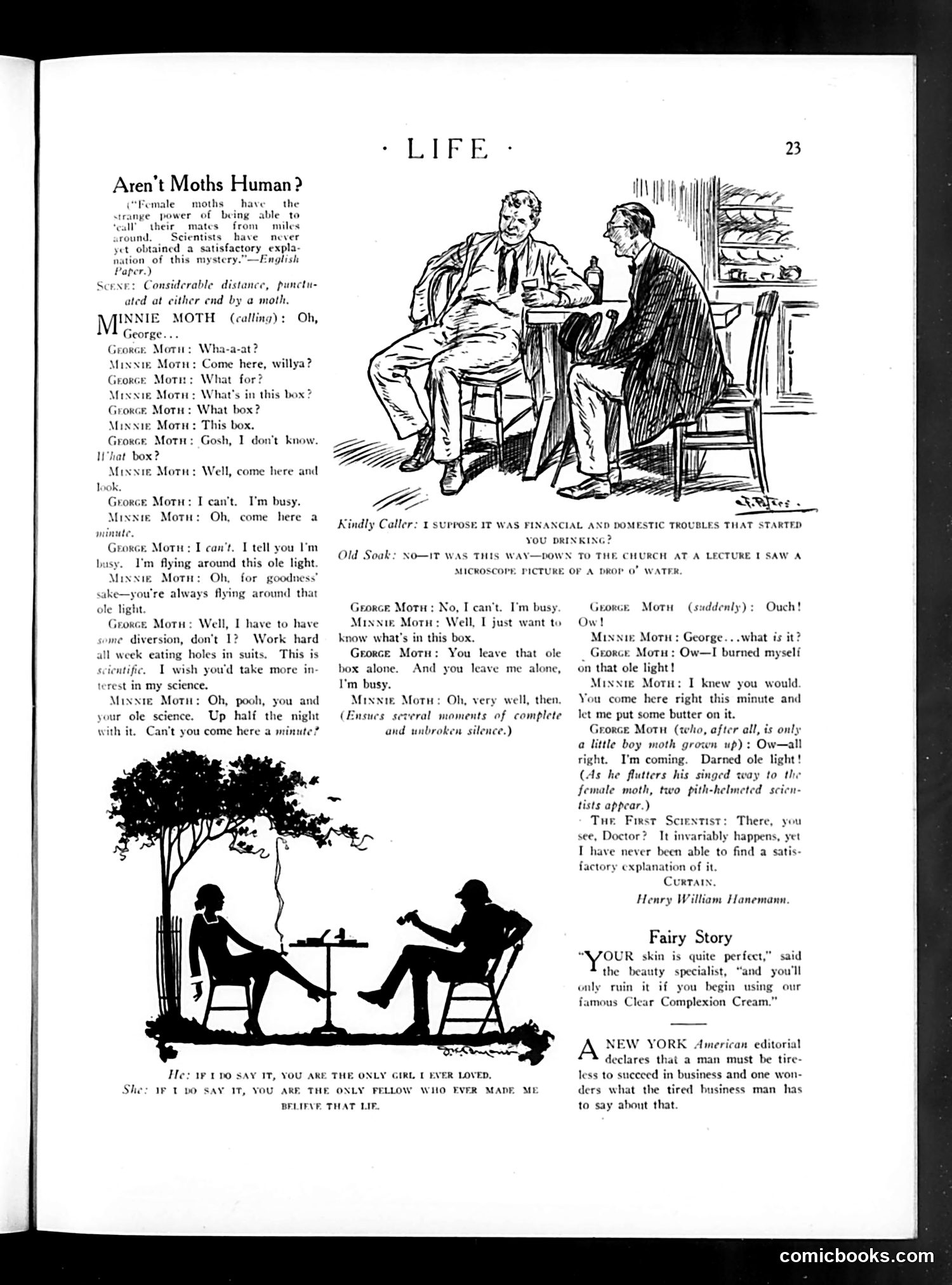
This page contains a humorous one-act play satirizing scientific observation. Two moths, George and Minnie, exhibit distinctly human domestic conflict: George obsessively circles a light bulb (claiming it's "scientific"), while Minnie tries to distract him with questions about a mysterious box. When George burns himself, Minnie fusses over him maternally—demonstrating exactly the mysterious attraction between moths that scientists cannot explain. Two bewildered researchers witness this, still baffled. The satire mocks both domestic squabbling and scientific pretension: George's "work" is merely compulsive behavior he rationalizes as science, while the scientists' inability to explain moth behavior reflects real gaps in early 20th-century entomology. The joke is that human behavior—nagging spouses, obsessive hobbies, nurturing instincts—mirrors animal behavior, suggesting we're not as elevated as we believe.
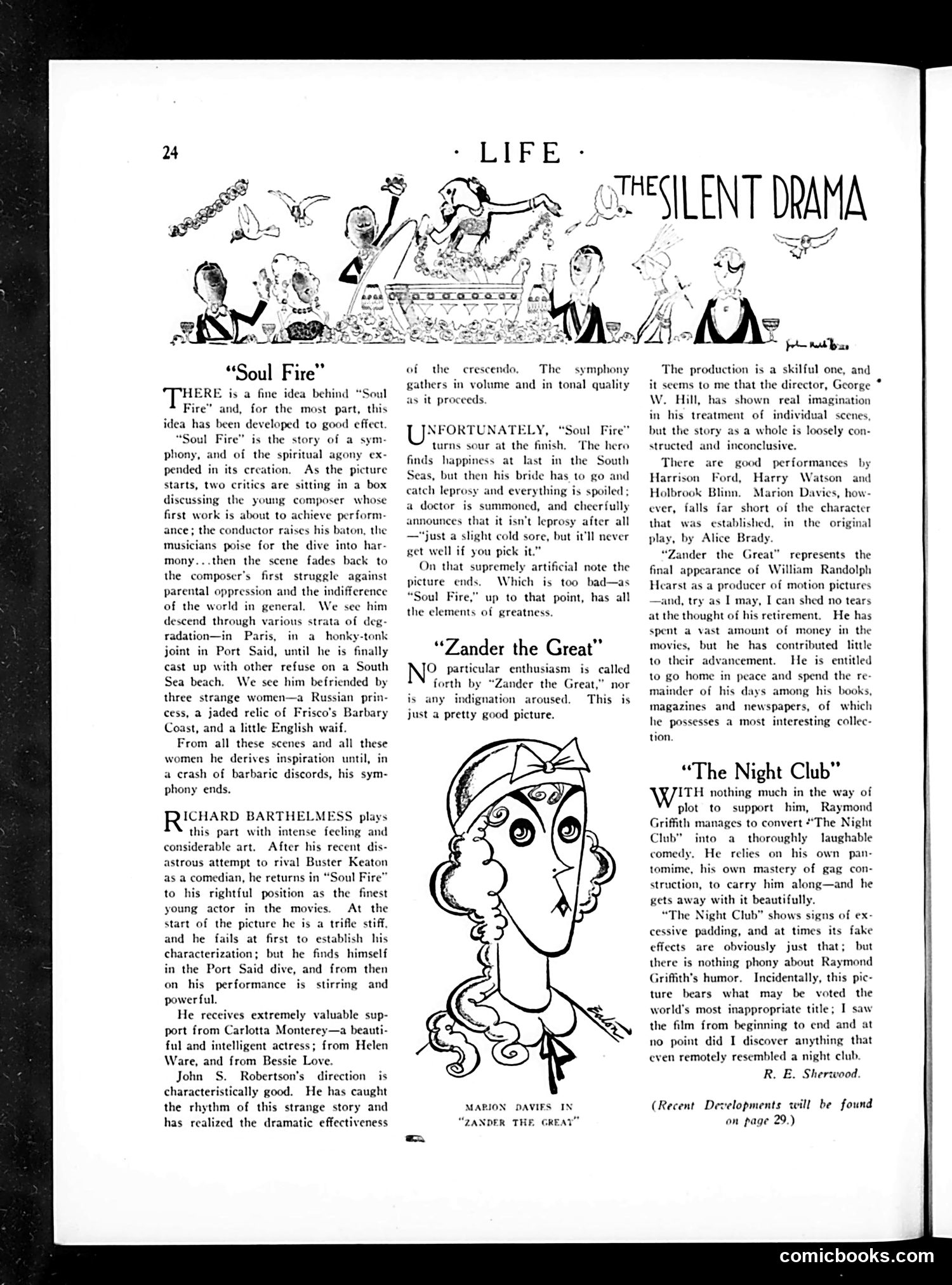
This page reviews three silent films. The top illustration depicts "The Silent Drama" genre generally—showing a theatrical scene with performers and audience. **"Soul Fire"** stars Richard Barthelmess as a struggling young composer. The reviewer praises his performance and the film's artistic ambition (depicting a symphony's creation through flashbacks to the composer's hardships in Paris and Port Said). However, the ending is criticized as artificially sentimental: the hero finds happiness in the South Seas, but his bride contracts leprosy—then it's revealed to be merely a cold sore. This absurd tonal shift undermines the film's earlier greatness. **"Zander the Great"** features Marion Davies (William Randolph Hearst's protégée). The reviewer calls it competently made but loosely constructed. Notably, the reviewer uses this review to deliver a pointed jab at Hearst himself, sarcastically congratulating his "retirement" from film production, suggesting he contributed "little to their advancement" despite spending vast sums. **"The Night Club"** with Raymond Griffith relies on visual comedy and gag construction rather than plot.
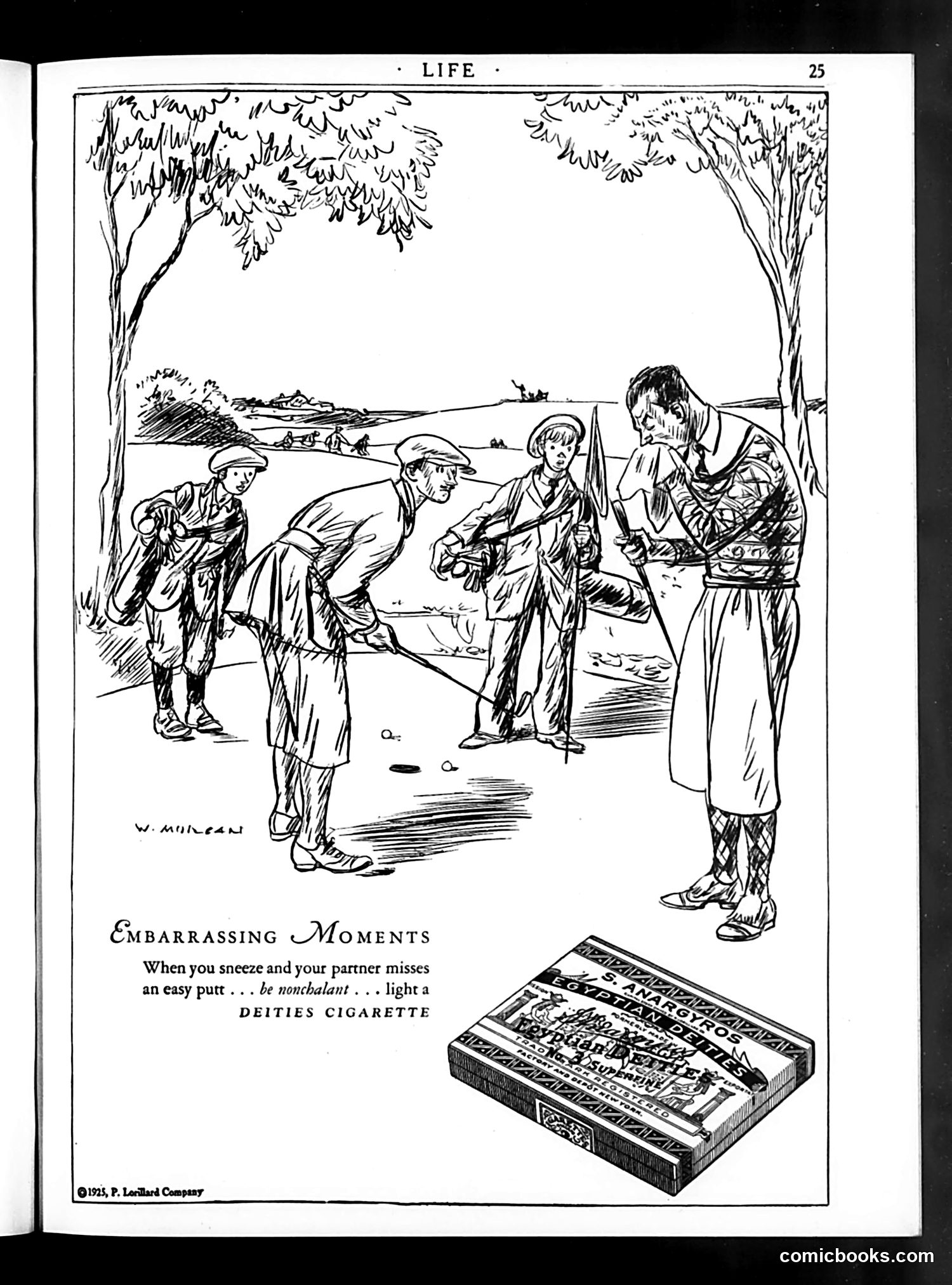
This is a cigarette advertisement disguised as humor. The cartoon depicts a golf scene where one player has sneezed while his partner was attempting an easy putt, causing the partner to miss. The "embarrassing moment" is the social awkwardness that results. The ad's solution is absurdly cynical: smoke a Deities cigarette to appear casually indifferent about ruining your partner's game. The humor lies in this implicit endorsement of nonchalance as a social smokescreen—literally and figuratively, since lighting a cigarette provides both distraction and literal smoke. This reflects 1920s advertising culture, when cigarette companies brazenly marketed to any demographic and occasion, and when smoking was positioned as a sophisticated response to social discomfort. Modern readers would recognize this as simultaneously promoting both cigarettes and emotional avoidance as solutions to interpersonal tension.
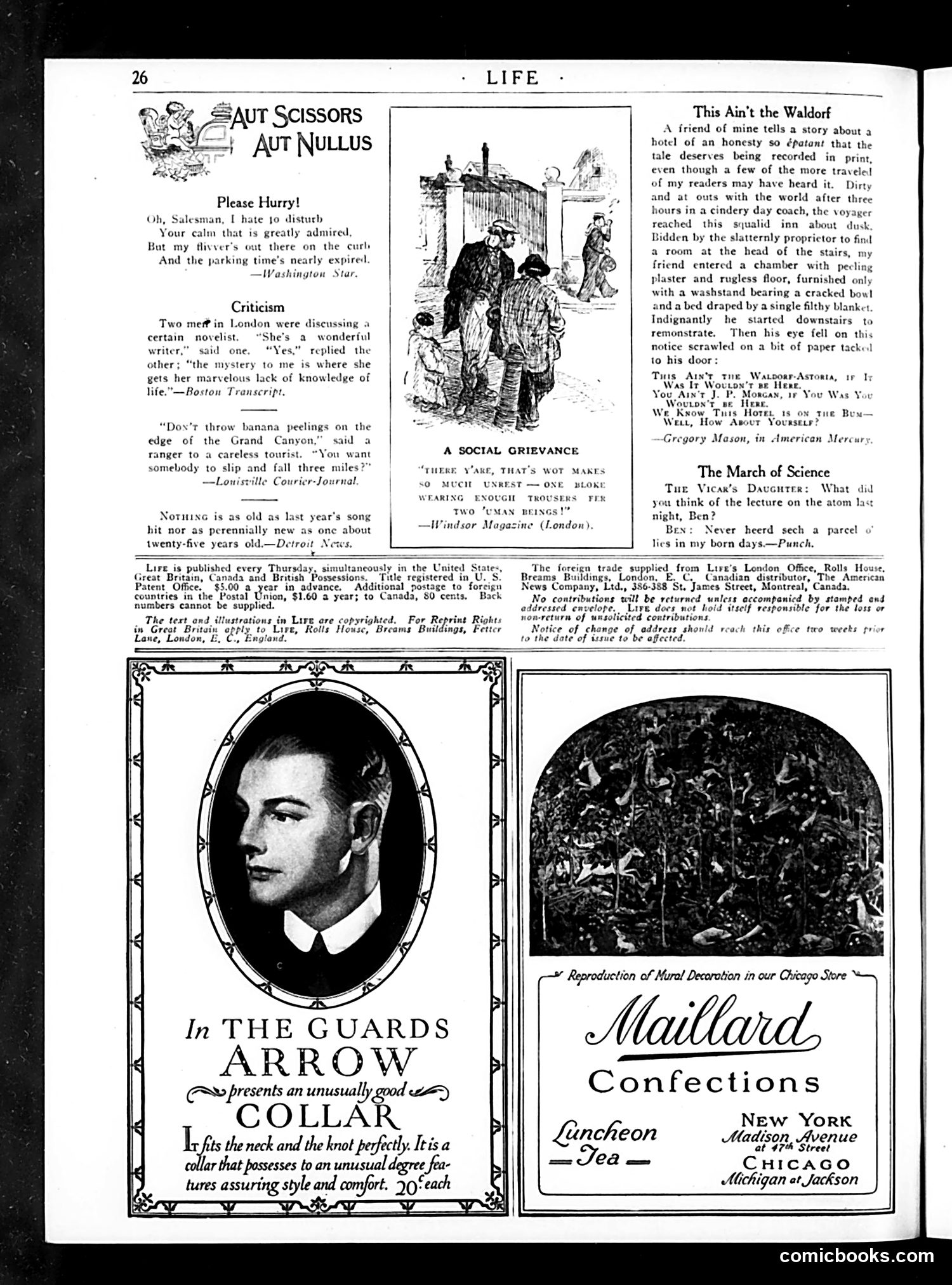
This page from *Life* magazine (a satirical publication, not the later photo magazine) contains several elements: **Main Content:** Short humor pieces and satirical observations typical of the era—quips about novelists, tourists, and social complaints. "A Social Grievance" jokes about class tension ("one block wearing enough trousers for two human beings"). "This Ain't the Waldorf" is a longer humorous anecdote about a shabby hotel that ironically posts a sign comparing itself to the famous Waldorf-Astoria, deflating pretension through contrast. "The March of Science" mocks scientific progress, with a character dismissing atomic theory as lies. **Advertisements:** The page includes two ads—one for Arrow collars (marketed as stylish and comfortable) and Maillard Confections (candy and tea shops in New York and Chicago). **Overall:** This is primarily a humor/satire and advertising page typical of early 20th-century American magazines, mixing social commentary with commercial notices.
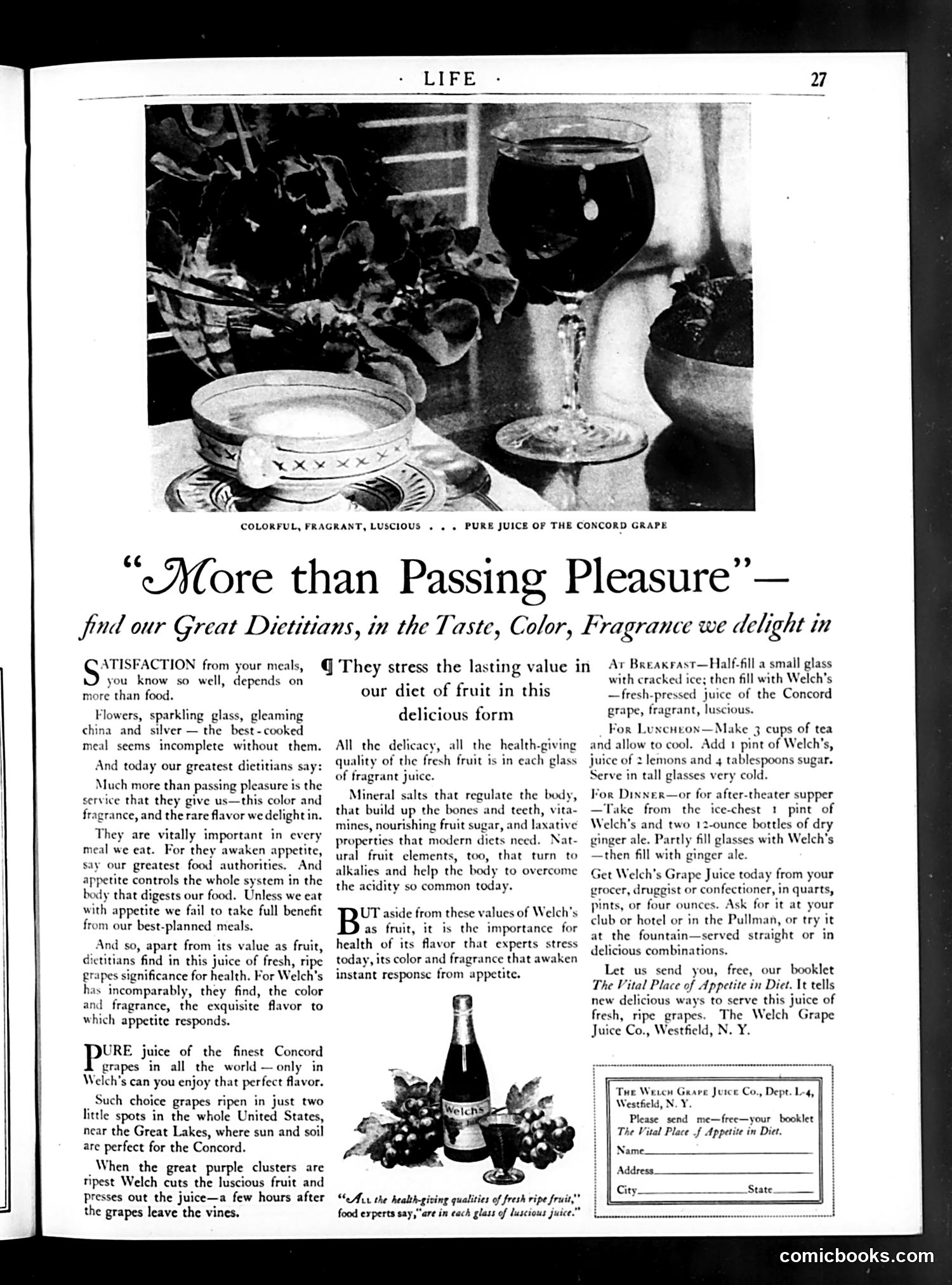
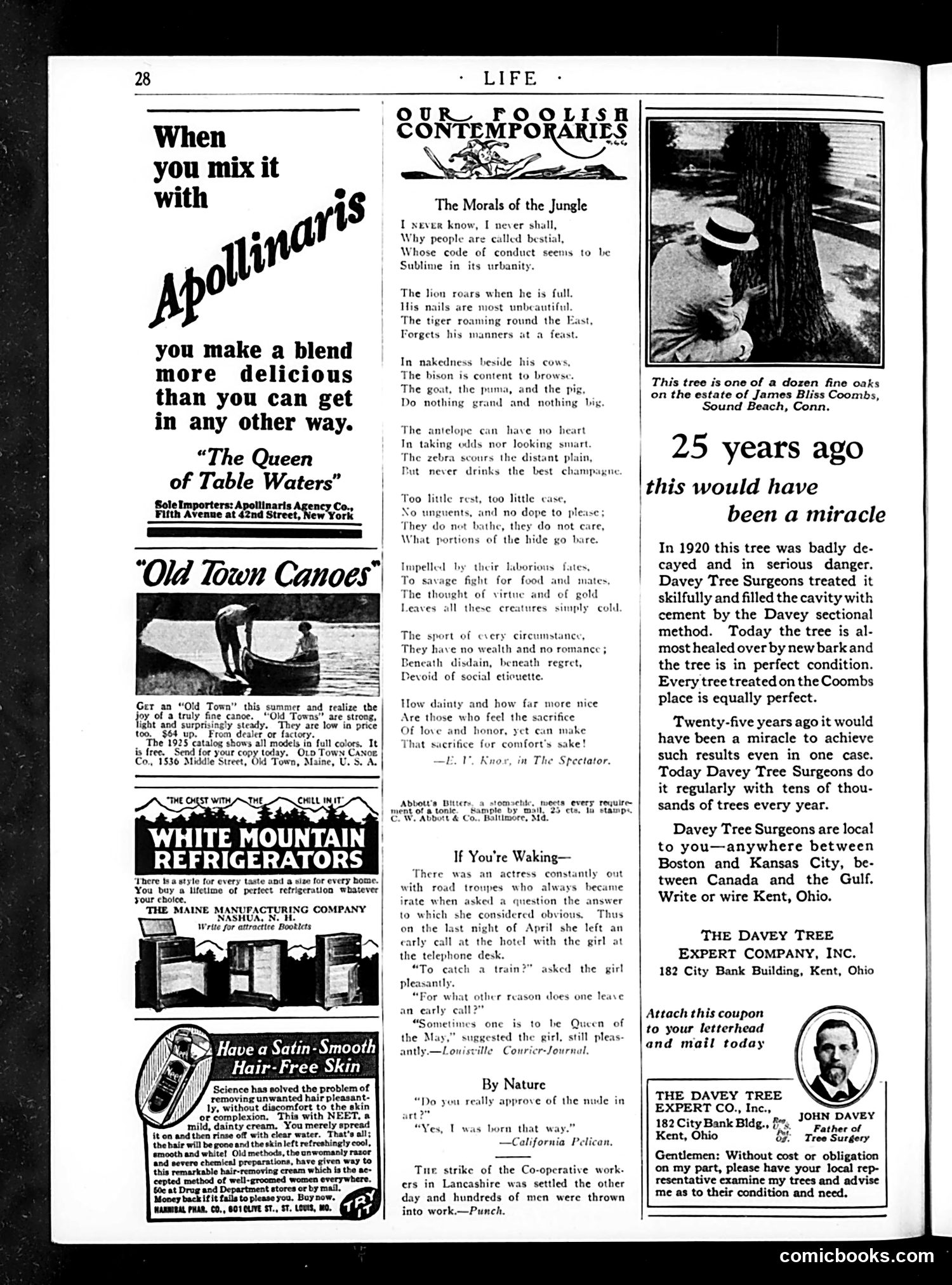
This page is primarily **advertising and light humor**, not political satire. The main content includes: **"The Morals of the Jungle"** — A humorous poem contrasting animals' "uncivilized" behavior with humans' pretentious etiquette. The satirical point: humans pride themselves on social refinement (champagne, bathing, "honor"), yet wild animals simply follow natural instinct. It's social satire mocking human pretension, not animal commentary. **"If You're Waking"** — Brief comedic anecdotes (a theater actress's irritability; cooperative workers returning to jobs). These are gentle joke-column filler typical of 1920s magazines. **The bulk of the page features product advertisements** for Apollinaris water, Old Town Canoes, White Mountain refrigerators, hair-removal cream (Neet), and a **Davey Tree Surgeons testimonial** with a before/after tree photo. No political figures or serious commentary appear here. This reflects *Life* magazine's mid-1920s character as a humor and lifestyle publication, blending lightweight satire with commercial advertising.
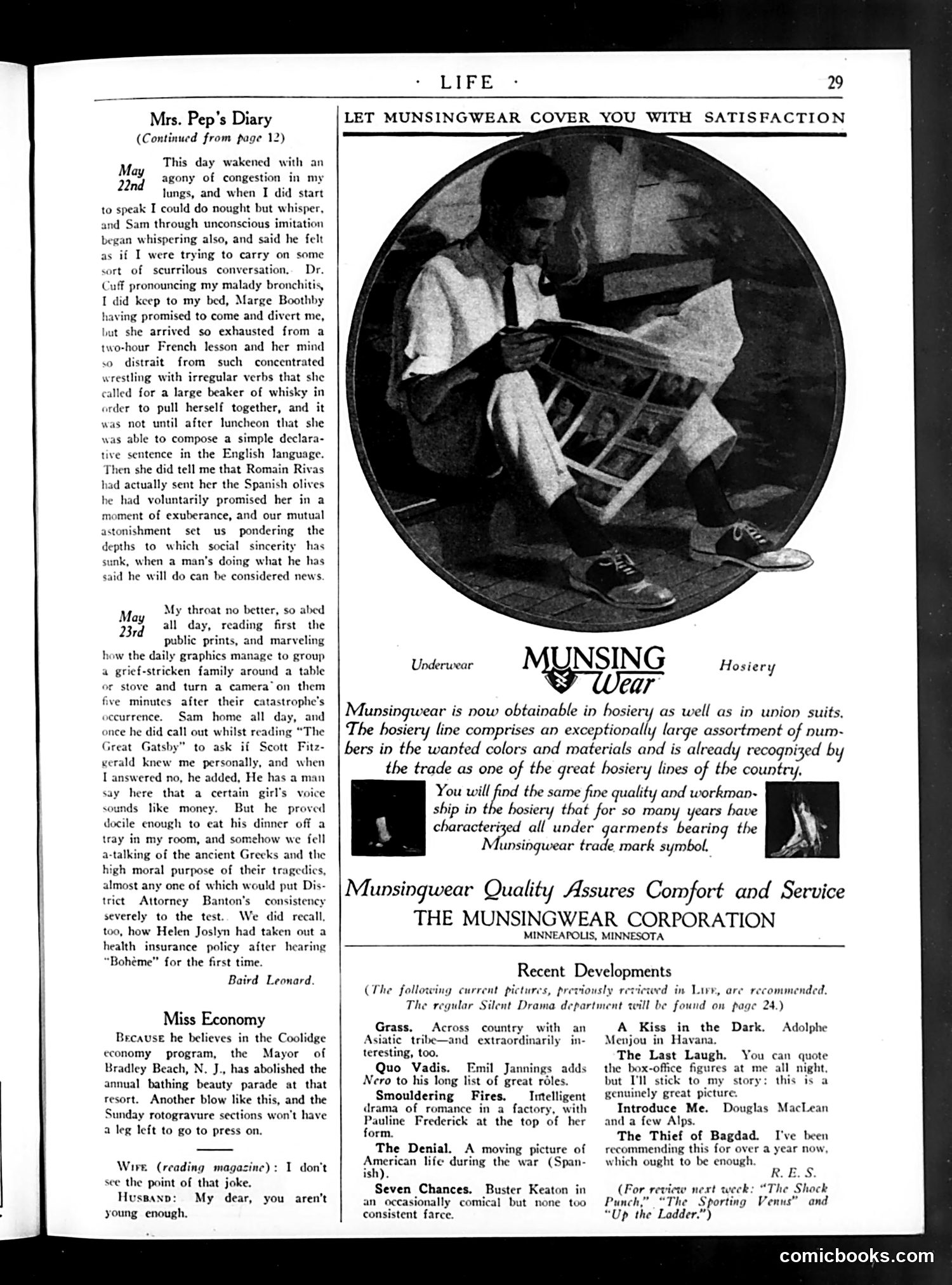
This page combines **Mrs. Pep's Diary** (a humor column depicting upper-middle-class domestic life) with a **Munsingwear hosiery advertisement** and film reviews. The diary satirizes social pretension and the gap between stated intentions and actions. The entry mocks a woman named Marge Boothby, exhausted from French lessons, needing whisky to compose simple English sentences—lampooning both educational affectation and women's intellectual struggles. A key joke: characters are astonished that Romain Rivas *actually followed through* on a promise of Spanish olives, treating basic honesty as remarkable social news. The brief joke at bottom mocks Coolidge-era budget cuts: the Mayor of Bradley Beach eliminated the annual bathing beauty parade for economy, leaving rotogravure sections (photographic newspaper sections) without content. The Munsingwear ad emphasizes quality hosiery now available alongside their traditional underwear line.
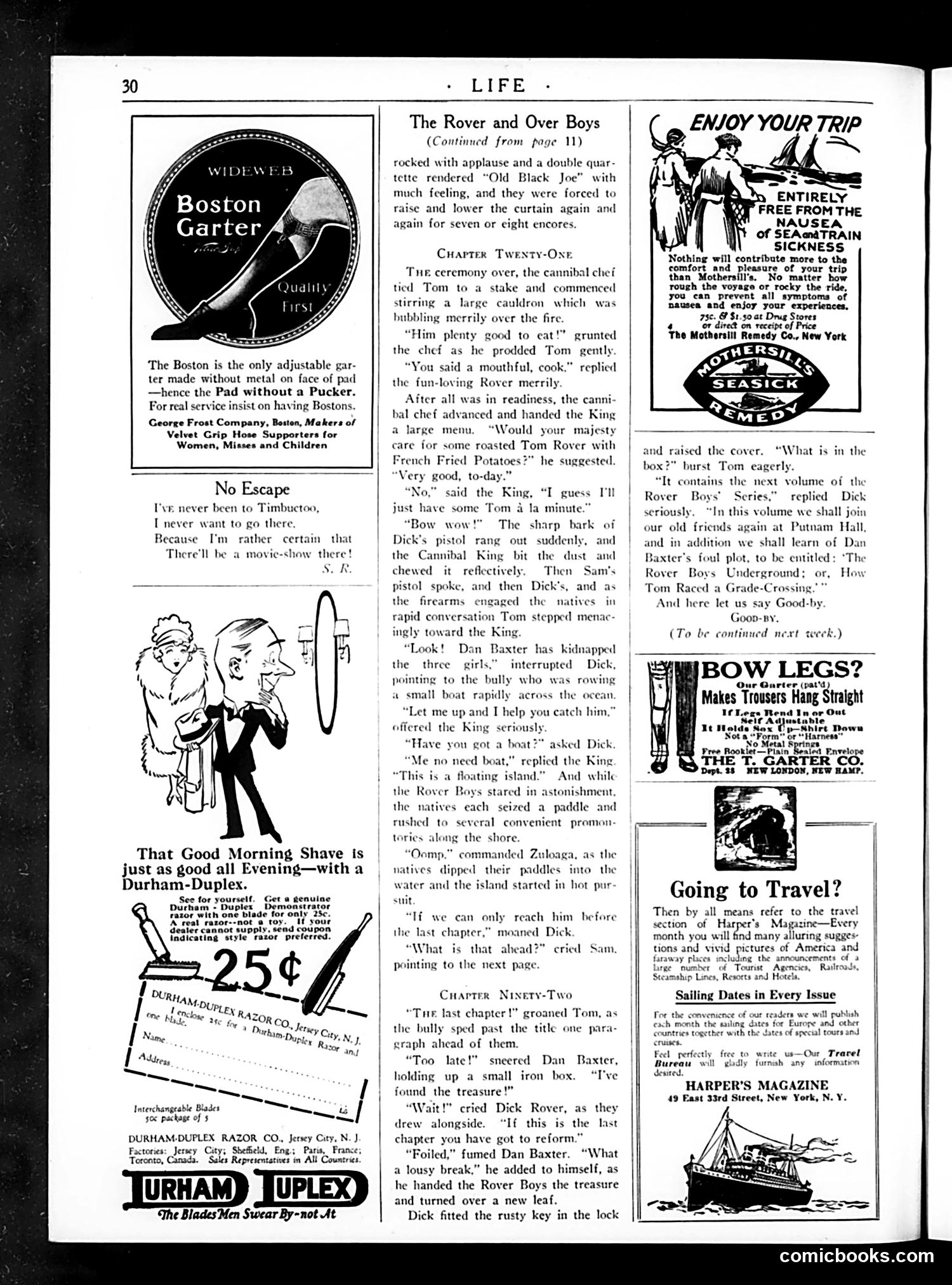
This page contains serialized fiction ("The Rover and Over Boys," a parody of the popular Rover Boys adventure series) mixed with period advertisements. The main satire targets **contemporary serial adventure fiction**—the Rover Boys stories were wildly popular youth literature. The fictional chapter mocks melodramatic conventions: cannibal chiefs, kidnappings, convenient islands, and the predictable "last chapter" where villains must reform. The joke about Dan Baxter reforming because "it's the last chapter" satirizes how such serials followed rigid formulas. The advertisements reflect early-1900s concerns: Boston Garters (adjustable hosiery), Durham-Duplex razors, and notably **Mothersill's Remedy** for seasickness—reflecting when ocean travel was common and uncomfortable. The cartoon "No Escape" jokes that movies are inescapable—even in remote Timbuctoo—mocking cinema's rapid proliferation as an inescapable cultural force. Overall, this is light satirical commentary on both mass-market fiction formulas and advertising-driven consumer culture.
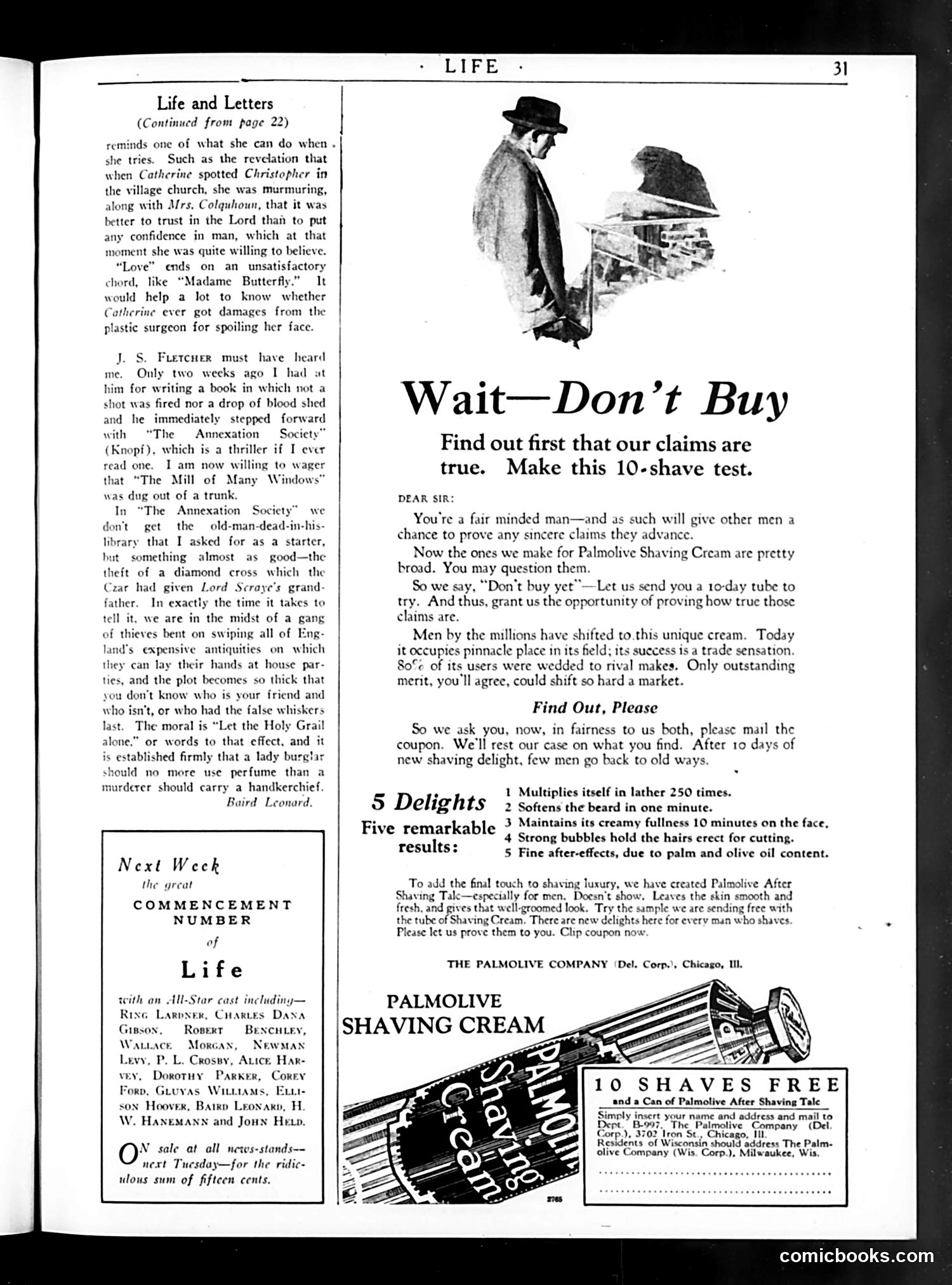
This page is primarily **advertising for Palmolive Shaving Cream**, not political satire. The "Wait—Don't Buy" advertisement uses a persuasion technique common to early 20th-century marketing: challenging readers to test the product's claims themselves before purchasing. The top section contains book reviews by "Baird Leonard," discussing novels like "Love," "The Annexation Society," and "The Mill of Many Windows"—literary criticism rather than political commentary. The advertisement's humor derives from its confident tone and numbered "5 Delights" claims (lather multiplication, beard softening, etc.). The offer of "10 shaves free" was a genuine sales tactic of the era. The page's illustrations show men in period dress, likely meant to appeal to masculine grooming interests. The only recognizable reference is the upcoming Life magazine "Commencement Number" announcement at bottom left, featuring celebrities like Ring Lardner and Charles Dana Gibson. This is essentially a **content and advertising hybrid page**, not a political cartoon requiring historical context beyond understanding early 1900s consumer marketing strategies.
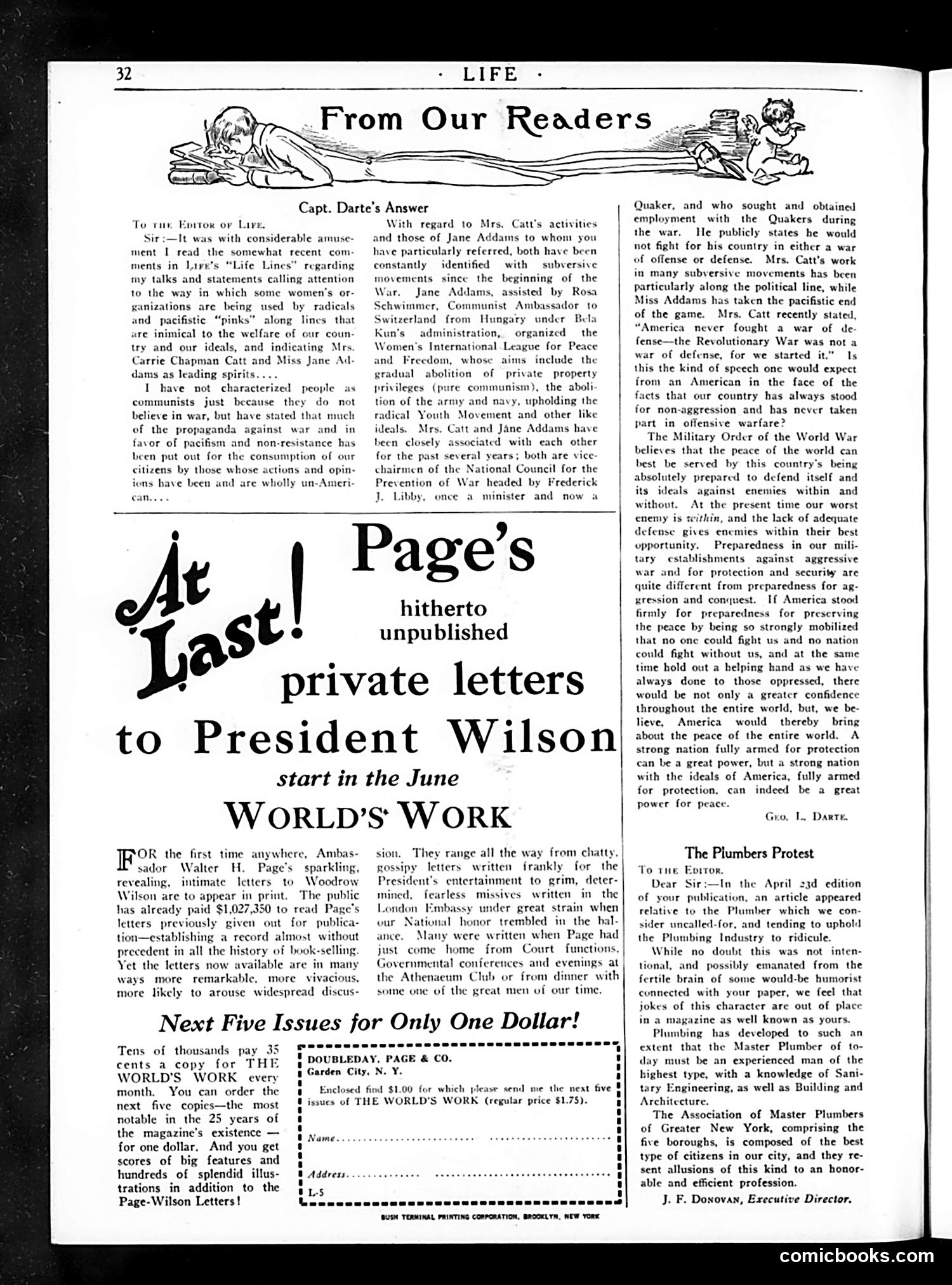
This page contains two distinct elements: a readers' letter section and advertising. **The Letters Section ("From Our Readers"):** Captain Dante responds to criticism of his earlier statements attacking women's organizations. He defends characterizing figures like **Jane Addams** and **Carrie Chapman Catt** as associated with subversive, communist-influenced movements. Dante specifically identifies **Rosa Schwimmer** (whom he incorrectly labels "Communist Ambassador from Hungary under Béla Kun") as connected to Addams' Women's International League for Peace and Freedom, claiming it promotes abolishing private property and the military—equating pacifism with communism. **The Advertisement:** Life promotes previously unpublished letters from Ambassador **Walter H. Page** to President **Woodrow Wilson**, emphasizing their historical significance and mass appeal. **Historical Context:** This reflects post-WWI American anxieties conflating pacifism, women's activism, and communism as threats. The red-scare atmosphere made peace advocates targets for accusations of radicalism.
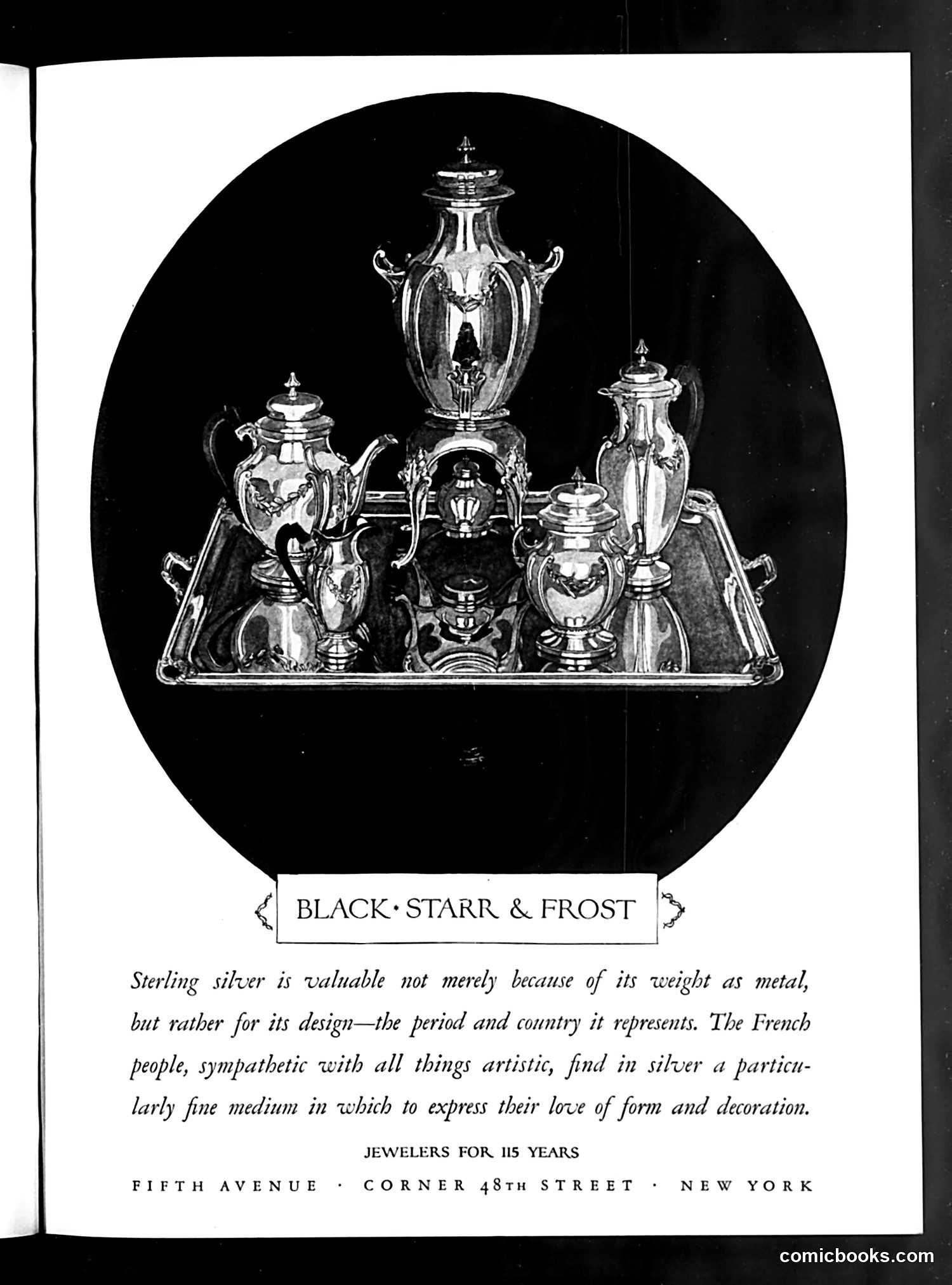
This is a **full-page advertisement**, not a political cartoon. It promotes Black, Starr & Frost, a New York jewelry firm claiming 115 years in business. The ad displays an elegant arrangement of sterling silver serving pieces and decorative vessels arranged on a tray against a dark background. The text appeals to aspirational consumers by linking silver ownership to refined taste and French artistic sensibility. It argues that sterling silver's value derives from its aesthetic design and cultural prestige rather than mere material weight—a marketing strategy positioning the product as a symbol of sophistication and good taste for affluent American consumers. There is no satire or political commentary present; this is straightforward luxury goods advertising from the early twentieth century.