
Life, 1925-05-28 · page 24 of 36
Life — May 28, 1925 — page 24: what you’re looking at
What you’re looking at
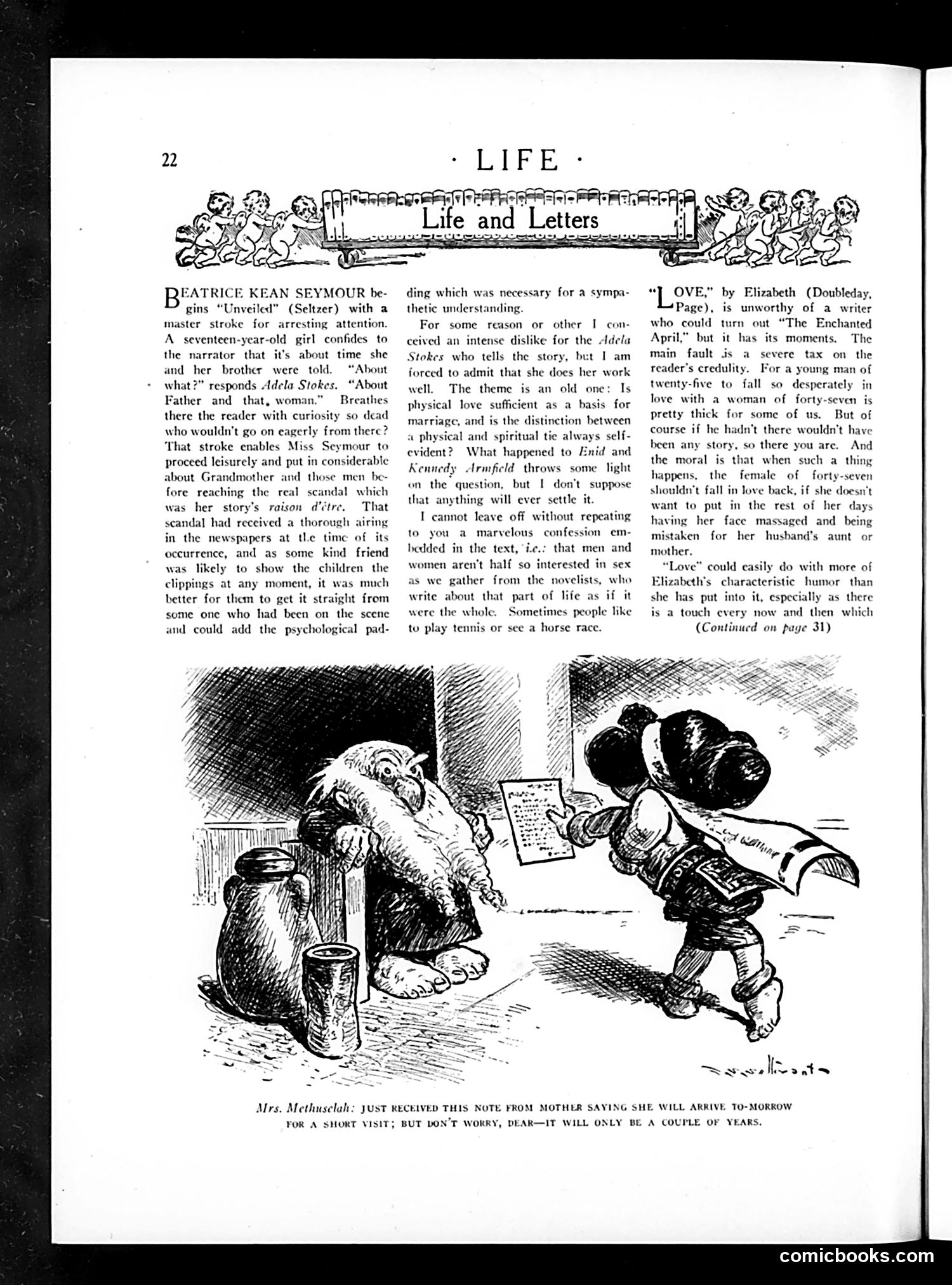
This is a book review section from *Life* magazine. The main article reviews "Unveiled" by Beatrice Kean Seymour, a novel about a scandal involving an affair. The reviewer critiques the book's central premise: whether physical love alone can sustain marriage. He notes the story addresses an age-gap romance between a 25-year-old man and a 47-year-old woman, calling this "pretty thick" (implausible) but acknowledging it was necessary for the plot. The cartoon below satirizes this same theme. "Mrs. Methuselah" receives a note from her elderly mother announcing a visit, with the joke being her deadpan response: "it will only be a couple of years"—implying her mother is so ancient that even a "short visit" will consume years. The satire mocks extreme old age and the generational gap, reinforcing the review's skepticism about age disparities in romance.
📄 Transcribed text from this page (OCR, searchable)
Machine-transcribed from the original scan — historical spelling and the odd misread are preserved.
EATRICE KEAN SEYMOUR be- gins “Unveiled” (Seltzer) with a master stroke for arresting attention. A seventeen-year-old girl confides to the narrator that it's about time she and her brother were told. “About what?" responds Adela Stokes. “About Father and that, woman.” — Breathes there the reader with curiosity so dead who wouldn't go on eagerly from there? That stroke enables Miss Seymour to proceed leisurely and put in considerable about Grandmother and those men be- fore reaching the real scandal which was her story's raison d’étre, That scandal had received a thorough airing in the newspapers at the time of its occurrence, and as some kind friend was likely to show the children the clippings at any moment, it was much better for them to get it straight from some one who had been on the scene and could add the psychological pad- - LIFE * ding which was necessary for a sympa- thetic understanding. For some reason or other I ceived an intense dislike for the Stokes who tells the story, but I am forced to admit that she does her work well. The theme is an old one: Is physical love sufficient as a basis for marriage, and is the distinction between x physical and spiritual tie always self- evident? What happened to Enid and Kennedy Armfield throws some light on the question, but I don't suppose that anything will ever settle it. I cannot leave off without repeating to you a marvelous confession em- Iedded in the text, ie.: that men and women aren't half so interested in sex as we gather from the novelists, who write about that part of life as if it were the whole. Sometimes people like to play tennis or see a horse race. by Elizabeth (Doubleday, is unworthy of a writer who could turn out “The Enchanted April,” but it has its moments. The main fault is a Page), severe tax on the reader's credulity. For a young man of twenty-five to fall so desperately in love with a woman of forty-seven is pretty thick for some of us. But of course if he hadn't there wouldn't C been any story, so there you are. And the moral is that when such a thing happens, the female of forty-seven shouldn't fall in love back, if she doesn’t want to put in the rest of her days having her face massaged and being mistaken for her husband's mother, “Love” could easily do with more of Elizabeth's characteristic humor than she has put into it, especially as there is a touch every now and then which (Continued on paye 31) aunt or Mrs. Methuselah: JUST RECEIVED THIS NOTE FROM MOTHER SAYING SHE WILL ARRIVE TO-MORROW FOR A SHORT VISIT; BUT DON’T WORRY, DEAR—IT WILL ONLY BE A COUPLE OF YEARS. comicbooks.com