
Life, 1925-05-28 · page 7 of 36
Life — May 28, 1925 — page 7: what you’re looking at
What you’re looking at
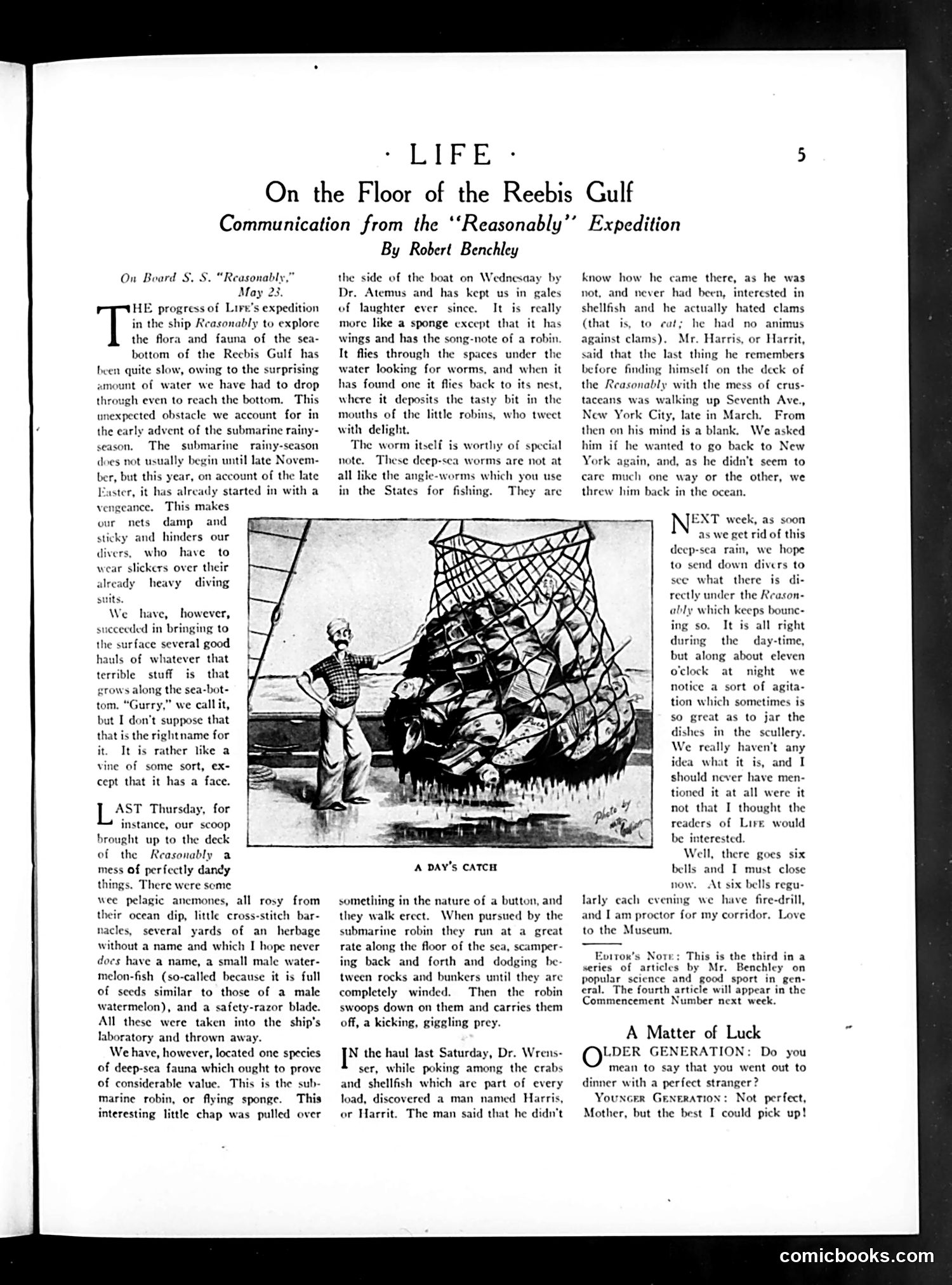
This page contains a non-satirical article titled "On the Floor of the Reebis Gulf," documenting a deep-sea expedition aboard the S.S. "Reasonably." The article by Robert Benckley describes marine life discoveries, including unusual sea creatures and worms found on the ocean floor. The central illustration, captioned "A DAY'S CATCH," shows a sailor examining a large fishing net filled with various sea creatures and specimens. This appears to be a straightforward, humorous nature-expedition account rather than political satire. The content focuses on the scientific oddities and practical challenges of deep-sea exploration, with Benckley's characteristic wit applied to marine biology rather than social commentary. The "Reasonably" expedition name itself may be a gentle joke about scientific modesty.
📄 Transcribed text from this page (OCR, searchable)
Machine-transcribed from the original scan — historical spelling and the odd misread are preserved.
‘ LIFE > On the Floor of the Reebis Gulf Communication from the ‘‘Reasonably’’ Expedition On Board “Reasonably,” May 23. HE progress of Lire’s expedition in the ship Reasonably to explore the flora and fauna of the sea- bottom of the Reebis Gulf has been quite slow, owing to the surprising amount of water we have had to drop through even to reach the bottom. This. unexpected obstacle we account for in the early advent of the submarine rainy- season, The submarine rainy-season does not usually begin until late Novem- ber, but this year, on account of the late Easter, it has already started in with a vengeance. This makes our nets damp and sticky and hinders our divers, have to wear slickers over their already heavy diving We have, however, succeeded in bringing to the surface several good hauls of whatever that terrible stuff is that grows along the sea-bot- tom. “Gurry,” we callit, but I don’t suppose that that is the rightname for it. It is rather like a vine of some sort, ex- cept that it has a face. LAST Thursday, for instance, our scoop brought up to the deck of the Re mess of perfe things. There were some wee pelagic anemones, all rosy from their ocean dip, little cross-stitch bar- nacles, several yards of an herbage without a name and which I hope never does have a name, a small male water- melon-fish (so-called because it is full of seeds similar to those of a male watermelon), and a safety-razor blade. All these were taken into the ship's laboratory and thrown away. We have, however, located one species of deep-sea fauna which ought to prove of considerable value. This is the sub- marine robin, or flying sponge. This interesting little chap was pulled over who By Robert Benchley the side of the boat on Wednesaay by Dr. Atemus and has kept us in gales of laughter ever since. It is really more like a sponge except that it has wings and has the song-note of a robin. It flies through the spaces under the water looking for worms, and when it has found one it flies back to its nest, where it deposits the tasty bit in the mouths of the little robins, who tweet with delight. The worm itself is worthy of special note. These deep-sea worms are not at all like the angie-worms which you use in the States for fishing. They are A DAY'S CATCH something in the nature of a button, and they walk erect. When pursued by the submarine robin they run at a great rate along the floor of the sea, scamper- ing back and forth and dodging be tween rocks and bunkers until they are completely winded. Then the robin swoops down on them and carries them off, a kicking, giggling prey. N the haul last Saturday, Dr. Wrens- ser, while poking among the crabs and shellfish which are part of every load, discovered a man named Harris, or Harrit. The man said that he didn’t know how he came there, as he was not, and never had been, interested in shellfish and he actually hated clams (that is, to eat; he had no animus against clams). Mr. Harris, or Harrit, id that the last thing he remembers before finding himself on the deck of the Reasonably with the mess of crus- taceans was walking up Seventh Ave., New York City, late in March. From then on his mind is a blank. We asked him if he wanted to go back to New York again, and, as he didn't seem to care much one way or the other, we threw him back in the ocean. EXT week, as soon as we get rid of this deep-sea rain, we hope to send down divers to see what there is di- rectly under the Reason- ably which keeps boune- ing so. It is all right during the day-time, but along about eleven o'clock at night we notice a sort of agita- tion which sometimes is so gr as to jar the dishes in the scullery. We really haven't any idea what it is, and I should never have men- tioned it at all were it not that I thought the readers of Lire would be interested. Well, there goes six bells and I must close At six bells regu- larly cach evening we have fire-drill, and I am proctor for my corridor, Love to the Museum. now. Evitor’s Nore: This is the third in a series of articles by Mr. Benchley on popular science and good sport in. gen- eral. The fourth article will appear in the Commencement Number next week. A Matter of Luck LDER GENERATION: Do you mean to say that you went out to dinner with a perfect stranger? Youncer Generation: Not perfect, Mother, but the best I could pick up! comicbooks.com