
Life, 1925-05-28 · page 26 of 36
Life — May 28, 1925 — page 26: what you’re looking at
What you’re looking at
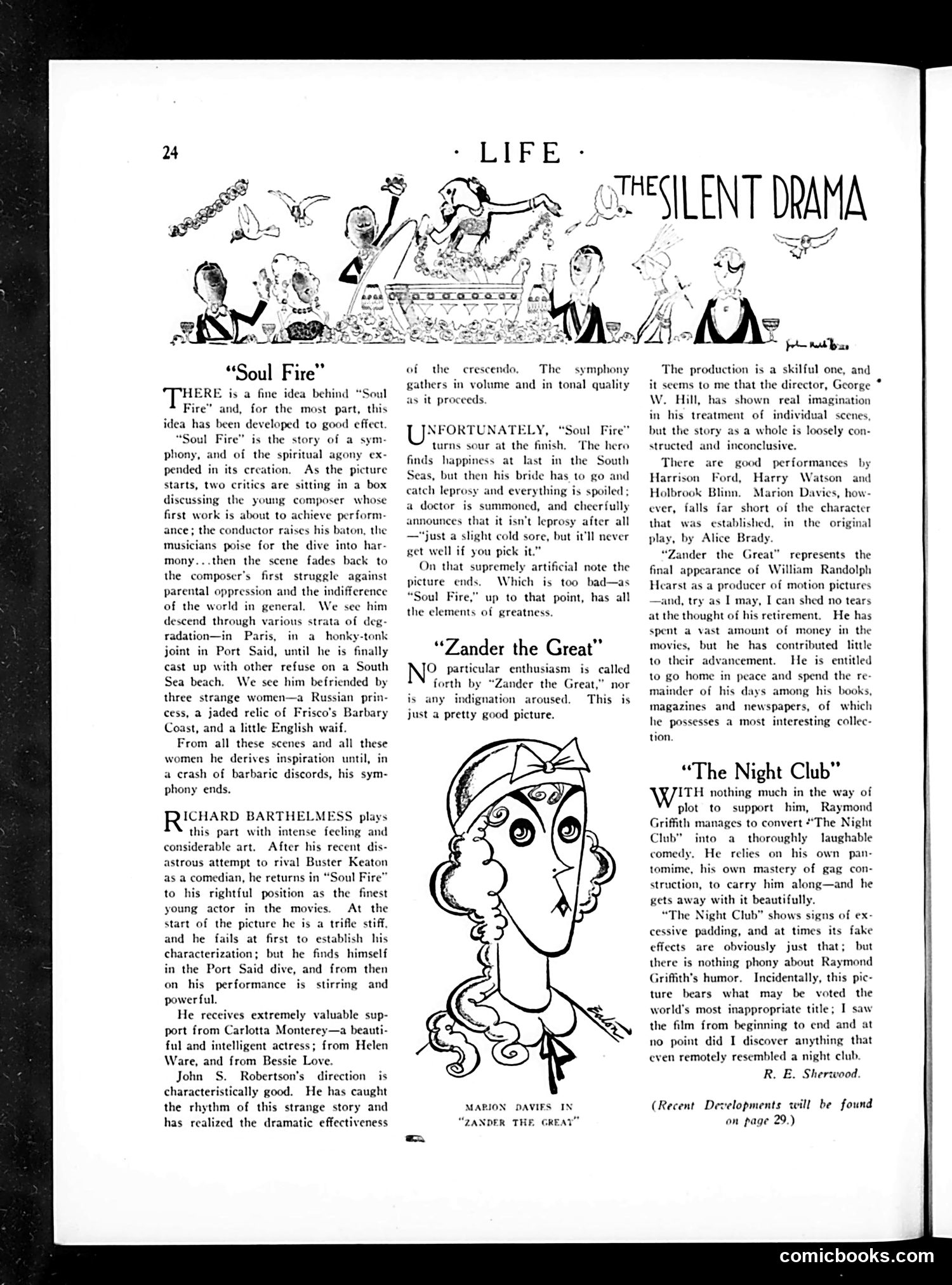
This page reviews three silent films. The top illustration depicts "The Silent Drama" genre generally—showing a theatrical scene with performers and audience. **"Soul Fire"** stars Richard Barthelmess as a struggling young composer. The reviewer praises his performance and the film's artistic ambition (depicting a symphony's creation through flashbacks to the composer's hardships in Paris and Port Said). However, the ending is criticized as artificially sentimental: the hero finds happiness in the South Seas, but his bride contracts leprosy—then it's revealed to be merely a cold sore. This absurd tonal shift undermines the film's earlier greatness. **"Zander the Great"** features Marion Davies (William Randolph Hearst's protégée). The reviewer calls it competently made but loosely constructed. Notably, the reviewer uses this review to deliver a pointed jab at Hearst himself, sarcastically congratulating his "retirement" from film production, suggesting he contributed "little to their advancement" despite spending vast sums. **"The Night Club"** with Raymond Griffith relies on visual comedy and gag construction rather than plot.
📄 Transcribed text from this page (OCR, searchable)
Machine-transcribed from the original scan — historical spelling and the odd misread are preserved.
= is a fine idea behind “Soul "and, for the most part, this idea has been developed to good effect. “Soul Fire” is the story of a sym- phony, and of the spiritual agony ex- pended in its creation. As the picture starts, two critics are sitting in a box discussing the young composer whose first work is about to achieve perform- ance; the conductor raises his baton, the musicians poise for the dive into har- mony...then the scene fades back to the composer's first struggle against parental oppression and the indifference of the world in general, We see him descend through various strata of deg- radation—in Paris, in a honky-tonk joint in Port Said, until he is finally cast up with other refuse on a South Sea beach, We see him befriended by three strange women—a Russian prin- cess, a jaded relic of Frisco’s Barbary Coast, and a little English waif. From all these scenes and all these women he derives inspiration until, in a crash of barbaric discords, his sym- phony ends. ICHARD BARTHEL S plays this part with intense feeling and considerable art. After his recent dis- astrous attempt to rival Buster Keaton as a comedian, he returns in “Soul Fire” to his rightful position as the finest young actor in the movies. At the start of the picture he is a trifle stiff. and he fails at first to establish his characterization; but he finds himself in the Port Said dive, and from then on his performance is stirring and powerful. He receives extremely valuable sup- port from Carlotta Monterey—a beauti- ful and intelligent actress; from Helen Ware, and from Bessie Love. John S. Robertson's direction is characteristically good. He has caught the rhythm of this strange story and has realized the dramatic effectiveness of the crescendo. The symphony gathers in volume and in tonal quality as it proceeds. [JSFORTUN ATELY, “Soul Fire” turns sour at the finish, The hero finds happiness at last in the South Seas, but then his bride has to go and catch leprosy and everything is spoiled ; a doctor is summoned, and cheerfully announces that it isn't leprosy after all “just a slight cold sore, but it'll never get well if you pick it.” On that supremely artificial note the picture ends. Which is too bad—as “Soul up to that point, has all the elements of greatness. “Zander the Great” O particular enthusiasm is called forth by “Zander the Great,” nor is any indignation aroused. This is just a pretty good picture. MARION DAVIES “ZANDER THE GRE fia bus The production is a skilful one, and it seems to me that the director, George * W. Hill, has shown real imagination in his treatment of individual scenes, but the story as a whole is loosely con- structed and inconclusive. There are good performances by Harrison Ford, Harry Watson and Holbrook Blinn. Marion Davies, how- ever, falls far short of the character that established, in’ the original play, by Alice Brady. “Zander the Great” represents the final appearance of William Randolph Hearst as a producer of motion pictures —and, try as I may, I can shed no tears at the thought of his retirement. He has spent a vast amount of money in the movies, but he has contributed little to their advancement. He is entitled to go home in peace and spend the re- mainder of his days among his books, magazines and newspapers, of which he possesses a most interesting collec- tion. was “The Night Club” ITH nothing much in the way of plot to support him, Raymond Griffith manages to convert “The Night Club” into a thoroughly laughable comedy, He his own pan- tomime, his own mastery of gag con- struction, to carry him along—and he gets away with it beautifully. “The Night Club” shows signs of ex- cessive padding, and at times its fake effects are obviously just that; but there is nothing phony about Raymond Griffith's humor. Incidentally, this pic- ture bears what may be voted the world’s most inappropriate title; I saw the film from beginning to end and at no point did I discover anything that even remotely resembled a night club. R. E. Sherwood. relies on (Recent Developments will be found on page 29.) comicbooks.com