
Life, 1925-05-28 · page 20 of 36
Life — May 28, 1925 — page 20: what you’re looking at
What you’re looking at
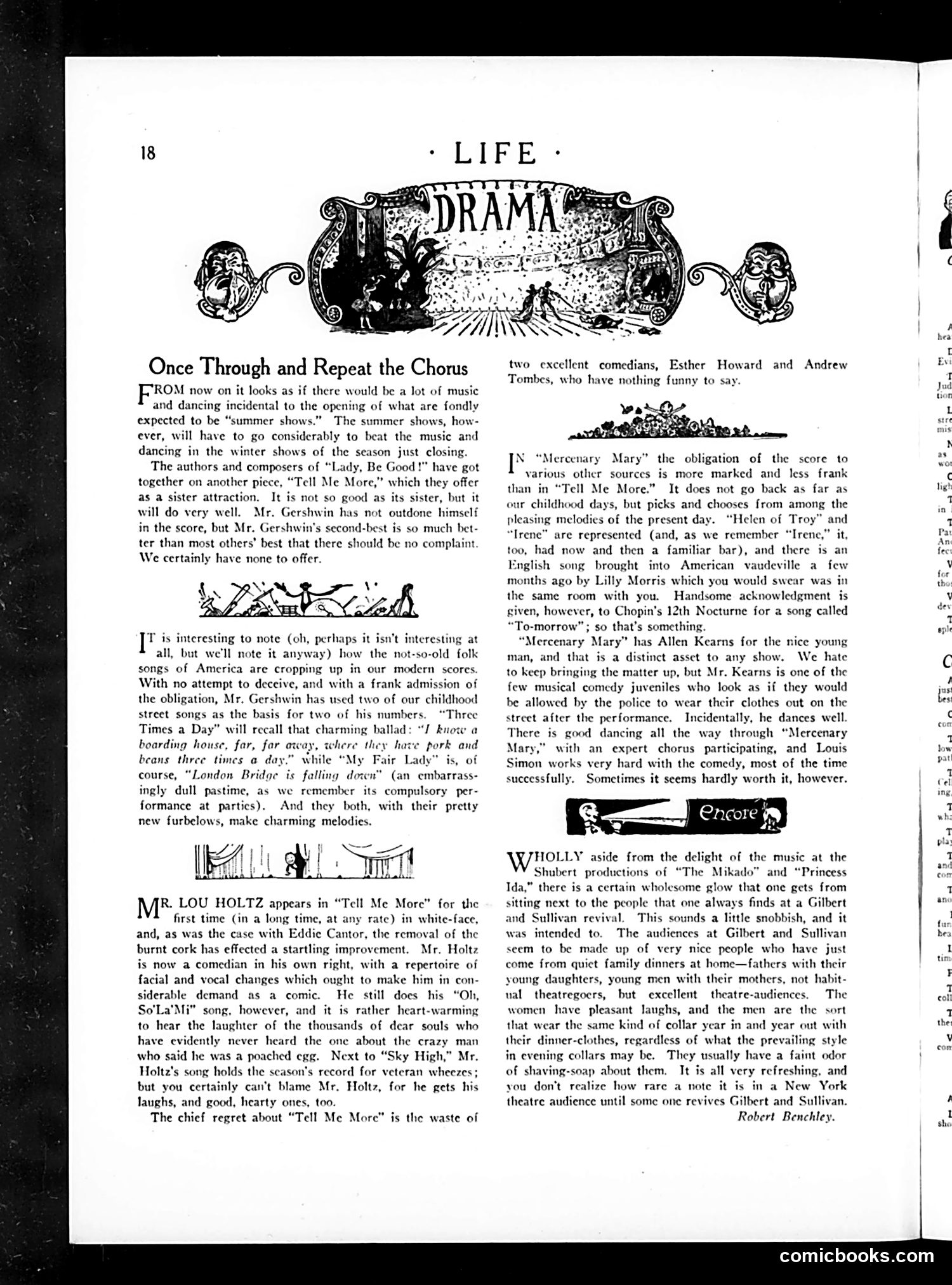
This page reviews two Broadway musicals: "Tell Me More" and "Mercenary Mary." The critic praises composer George Gershwin for cleverly incorporating American folk songs—particularly children's street rhymes like "London Bridge"—into modern theatrical scores, acknowledging the source rather than disguising the borrowing. The review notes comedian Lou Holtz's improvement after abandoning blackface makeup ("burnt cork"), comparing his transformation favorably to Eddie Cantor's similar decision. However, the critic laments the wasted comic talents of Esther Howard and Andrew Tombes in "Tell Me More," who are given poor material. Allen Kearns receives praise as the juvenile lead in "Mercenary Mary," specifically for his youthful, respectable appearance—a humorous jab at other performers whose disheveled stage appearances wouldn't survive police scrutiny off-stage. The small decorative illustrations scattered throughout are typical Life magazine ornaments, not specific political cartoons.
📄 Transcribed text from this page (OCR, searchable)
Machine-transcribed from the original scan — historical spelling and the odd misread are preserved.
Once Through and Repeat the Chorus ROM now on it looks as if there would be a lot of music and dancing incidental to the opening of what are fondly expected to be “summer shows.” The summer shows, how- ever, will have to go considerably to beat the music and dancing in the winter shows of the season just closing. The authors and composers of “Lady, Be Good!” have got together on another piece, “Tell Me More,” which they offer as a sister attraction. It is not so good as its sister, but it will do very well. Mr. Gershwin has not outdone himself in the score, but Mr. Gershwin’s second-best is so much bet- ter than most others’ best that there should be no complaint We certainly have none to offer. I" is interesting to note (oh, perhaps it isn’t interesting at all, but we'll note it anyway) how the not-so-old folk songs of America are cropping up in our modern scores. With no attempt to deceive, and with a frank admission of the obligation, Mr. Gershwin has used two of our childhood street songs as the basis for two of his numbers. “Three Times a Day” will recall that charming ballad: “J kuow @ boarding house, far, far az there they have pork and beans three times a day,” while “My F; is, of course, “London Bridge is falling dow (an embarrass- ingly dull pastime, as we remember its compulsory per- formance at partics). And they both, with their pretty new furbelows, make charming melodies. lk ME LOU HOLTZ appears in “Tell Me More” for the first time (in a long time, at any rate) in white-face, and, as was the case with Eddie Cantor, the removal of the burnt cork has effected a startling improvement. Mr. Holtz is now a comedian in his own right, with a repertoire of facial and vocal changes which ought to make him in con- siderable demand as a comic. He still does his “Oh, So'La’Mi” song, however, and it is rather heart-warming to hear the laughter of the thousands of dear souls who have evidently never heard the one about the crazy man who said he was a poached egg. Next to “Sky High,” Mr. Holtz's song holds the season's record for veteran wheeze but you certainly can't blame Mr. Holtz, for he gets his laughs, and good, hearty ones, too. The chief regret about “Tell Me More” is the waste of two excellent comedians, Esther Howard and Andrew Tombes, who have nothing funny to say. | “Mercenary Mary” the obligation of the score to various other sources is more marked and less frank than in “Tell Me More.” It does not go back as far as our childhood days, but picks and chooses from among the pleasing melodies of the present day. “Helen of Troy” and “Irene” are represented (and, as we remember “Irene,” it, too, had now and then a familiar bar), and there is an English song brought into American vaudeville a few months ago by Lilly Morris which you would swear was in the same room with you. Handsome acknowledgment is given, however, to Chopin's 12th Nocturne for a song called ‘o-morrow”; so that’s something. “Mercenary Mary” has Allen Kearns for the nice young man, and that is a distinct asset to any show. We hate to keep bringing the matter up, but Mr. Kearns is one of the few musical comedy juveniles who look as if they would be allowed by the police to wear their clothes out on the street after the performance. Incidentally, he dances well. There is good dancing all the way through “Mercenary Mary,” with an expert chorus participating, and Louis Simon works very hard with the comedy, most of the time successfully. Sometimes it seems hardly worth it, however. HOLLY aside from the delight of the music at the hubert productions of “The Mikado” and “Princess Ida,” there is a certain wholesome glow that one gets from sitting next to the people that one always finds at a Gilbert and Sullivan revival, This sounds a little snobbish, and it was intended to. The audiences at Gilbert and Sullivan seem to be made up of very nice people who have just come from quict family dinners at home—fathers with their young daughters, young men with their mothers, not habit- ual theatregoers, but excellent theatre-audiences. The women have pleasant Iaughs, and the men are the sort that wear the same kind of collar year in and year out with their dinner-clothes, regardless of what the prevailing style in evening collars may be. They usually have a faint odor of shaving-soap about them. It is all very refreshing, and you don’t realize how rare a note it is in a New York theatre audience until some one revives Gilbert and Sullivan. Robert Benchley. sho comicbooks.com