
A complete issue · 40 pages · 1925
Life — May 14, 1925
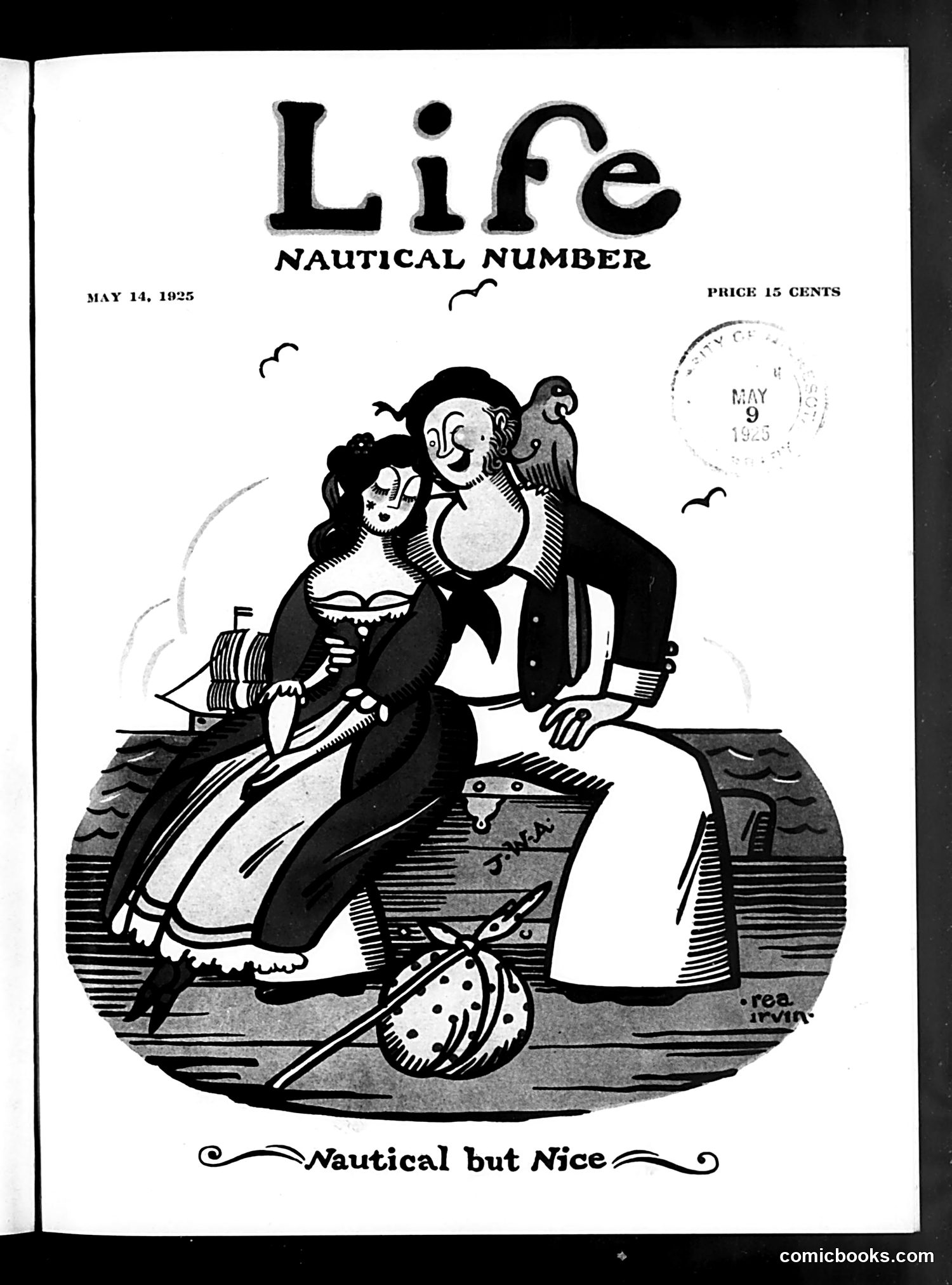
This is the cover of Life's "Nautical Number" featuring a humorous illustration titled "Nautical but Nice." The cartoon depicts a well-dressed couple in a rowboat. The man wears formal attire (tuxedo and top hat) while the woman wears an elegant dress—incongruous formal wear for rowing. The exaggerated caricature style, with the man's prominent nose and the woman's fashionable appearance, suggests satire about upper-class pretension. The joke appears to target wealthy people attempting to appear refined or fashionable while engaging in casual activities. The phrase "Nautical but Nice" plays on the tension between nautical/informal contexts and maintaining formal social appearances. This reflects 1920s humor about class performativity and the leisure activities of affluent Americans during the prosperous Jazz Age.
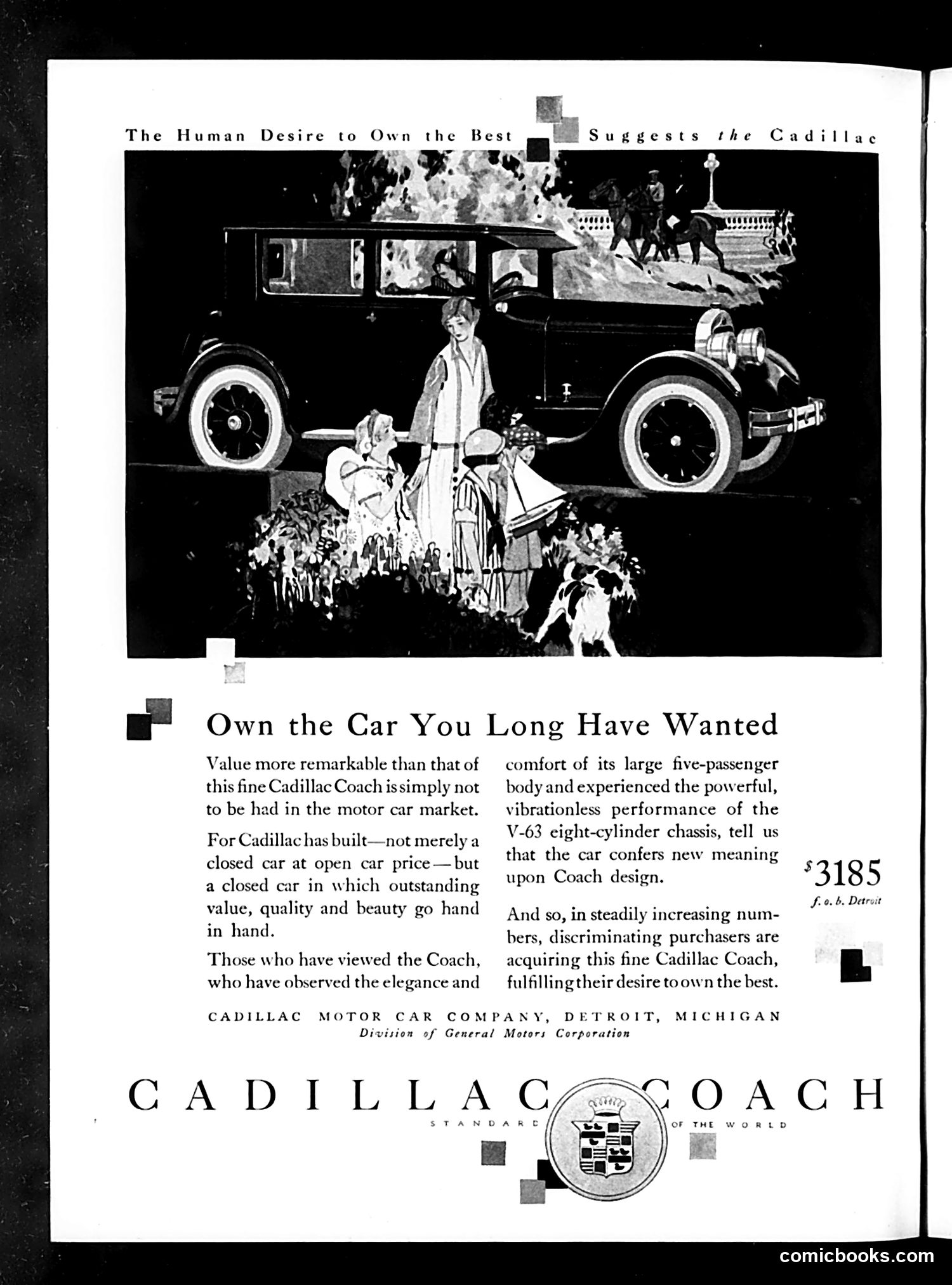
This is primarily a **Cadillac automobile advertisement**, not satire or political commentary. The headline "The Human Desire to Own the Best Suggests the Cadillac" frames car ownership as reflecting personal aspiration and status. The illustration shows an idealized 1920s family scene with a Cadillac Coach, emphasizing luxury and leisure. The composition—with well-dressed figures, flowering gardens, and an estate setting—appeals to middle-to-upper-class aspirations during the prosperous 1920s. The text emphasizes the car's engineering ("V-63 eight-cylinder chassis"), quality craftsmanship, and exclusivity, positioning it as a marker of refined taste and financial success. At $3185, it was a significant luxury purchase, making ownership itself a status symbol—which the advertisement explicitly acknowledges and celebrates.
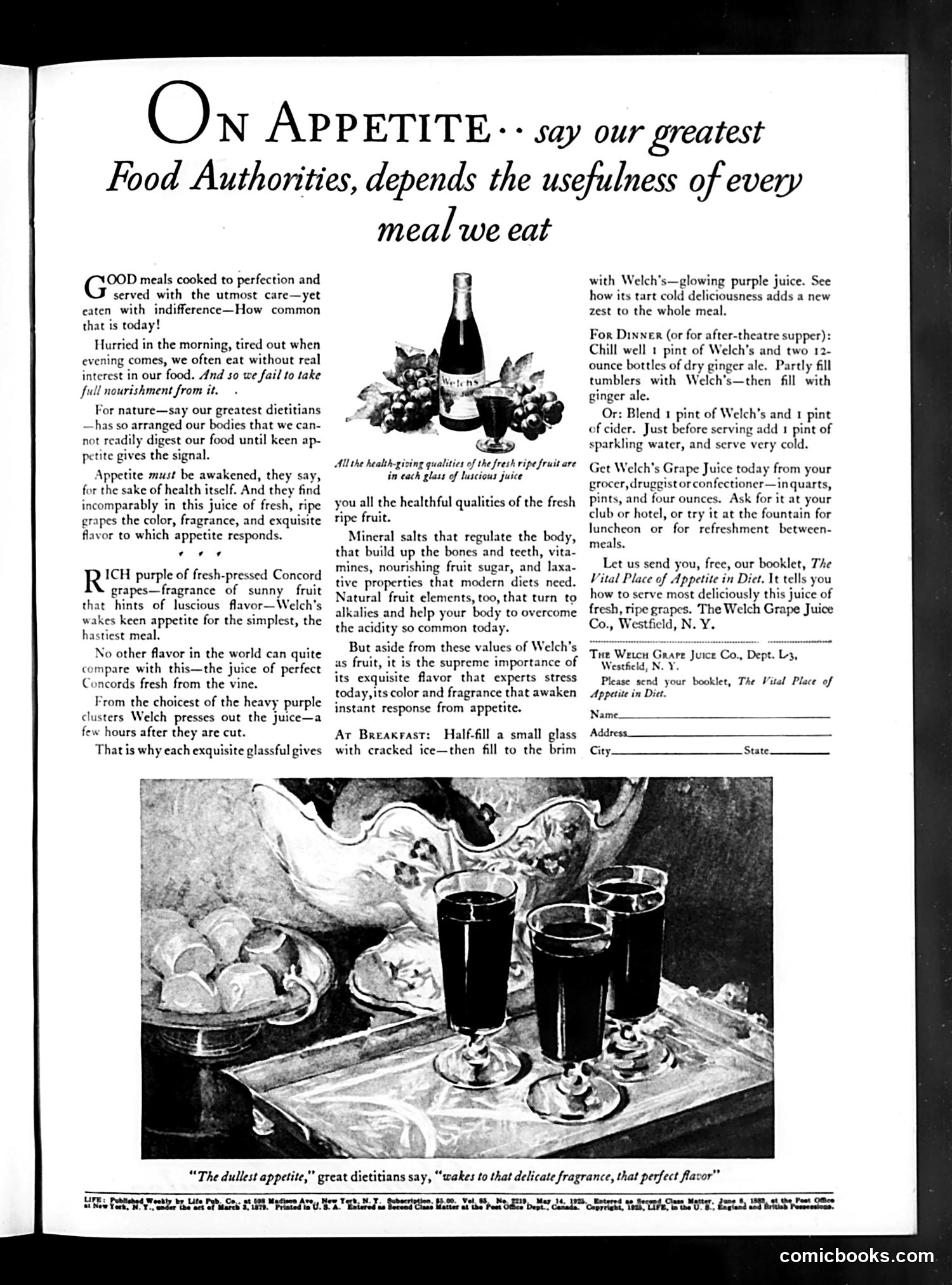
This is **not a political cartoon or satire**, but rather a **vintage advertisement** for Welch's Grape Juice, circa early 20th century. The page promotes Welch's as a health product that stimulates appetite and aids digestion. It emphasizes the juice's "healthizing qualities" and natural fruit elements, offering specific serving suggestions for breakfast, dinner, and between-meal refreshment. The photograph shows glasses of dark grape juice alongside food items, illustrating the product's role in meals. This reflects the era's marketing approach: positioning commercial beverages as scientifically beneficial health tonics rather than mere refreshments. The rhetoric about "food authorities" and "dietitians" represents typical early-1900s advertising strategy leveraging pseudoscientific health claims to boost sales.
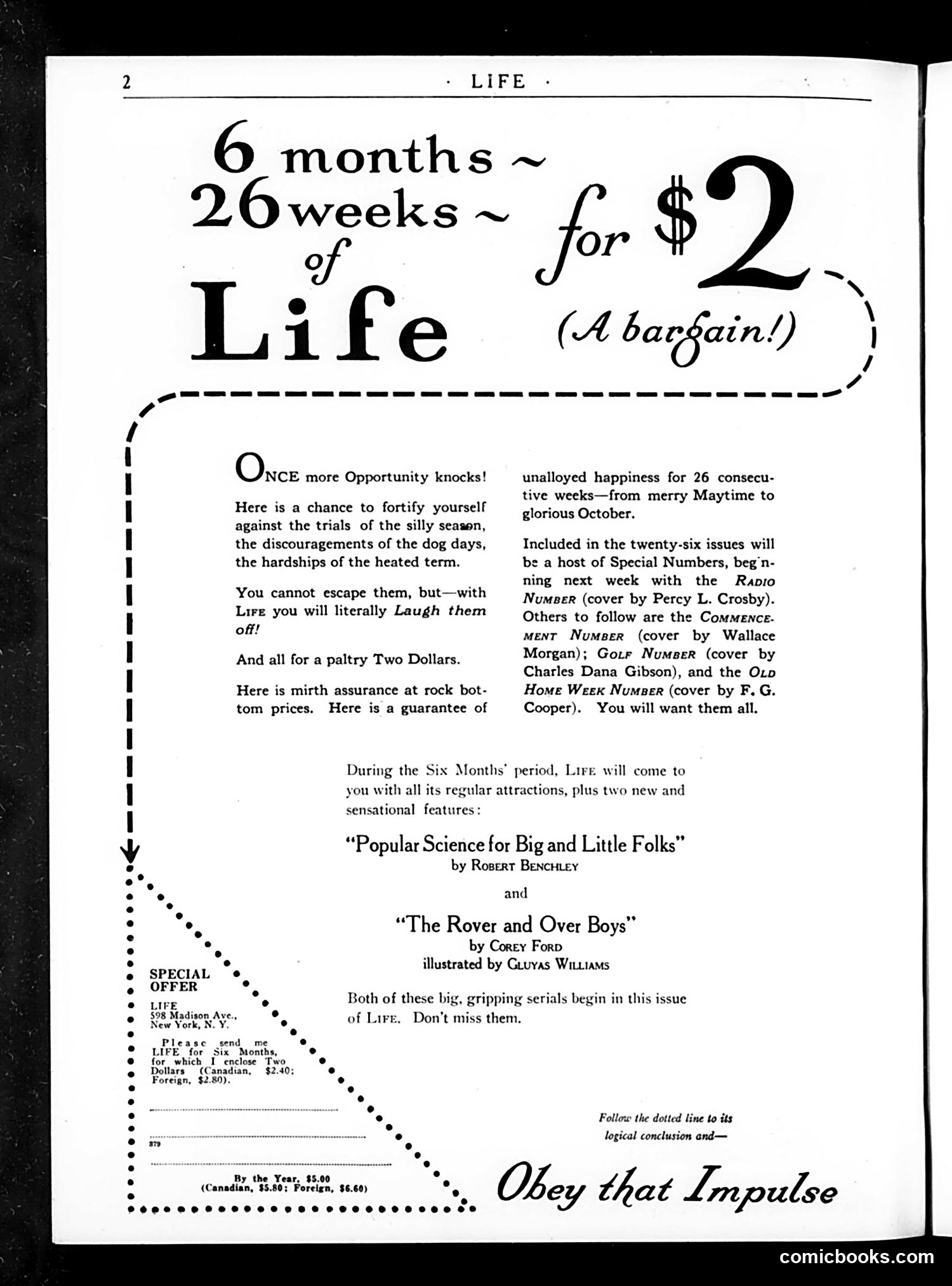
This page is primarily a **subscription advertisement** for *Life* magazine, not political satire or editorial content. The ad promotes a six-month subscription (26 weeks) for $2, marketed as "a bargain." It promises regular content plus special numbered issues featuring covers by notable illustrators (Percy L. Crosby, Wallace Morgan, Charles Dana Gibson, F.C. Cooper). Two new serial features are highlighted: "Popular Science for Big and Little Folks" by Robert Benchley and "The Rover and Over Boys" by Corey Ford (illustrated by Cluyas Williams). The phrase "Obey that Impulse" at bottom is a call-to-action catchphrase typical of period advertising. **This is commercial content, not satire.** The humor, if any, lies in the playful tone promoting subscription value rather than political commentary.
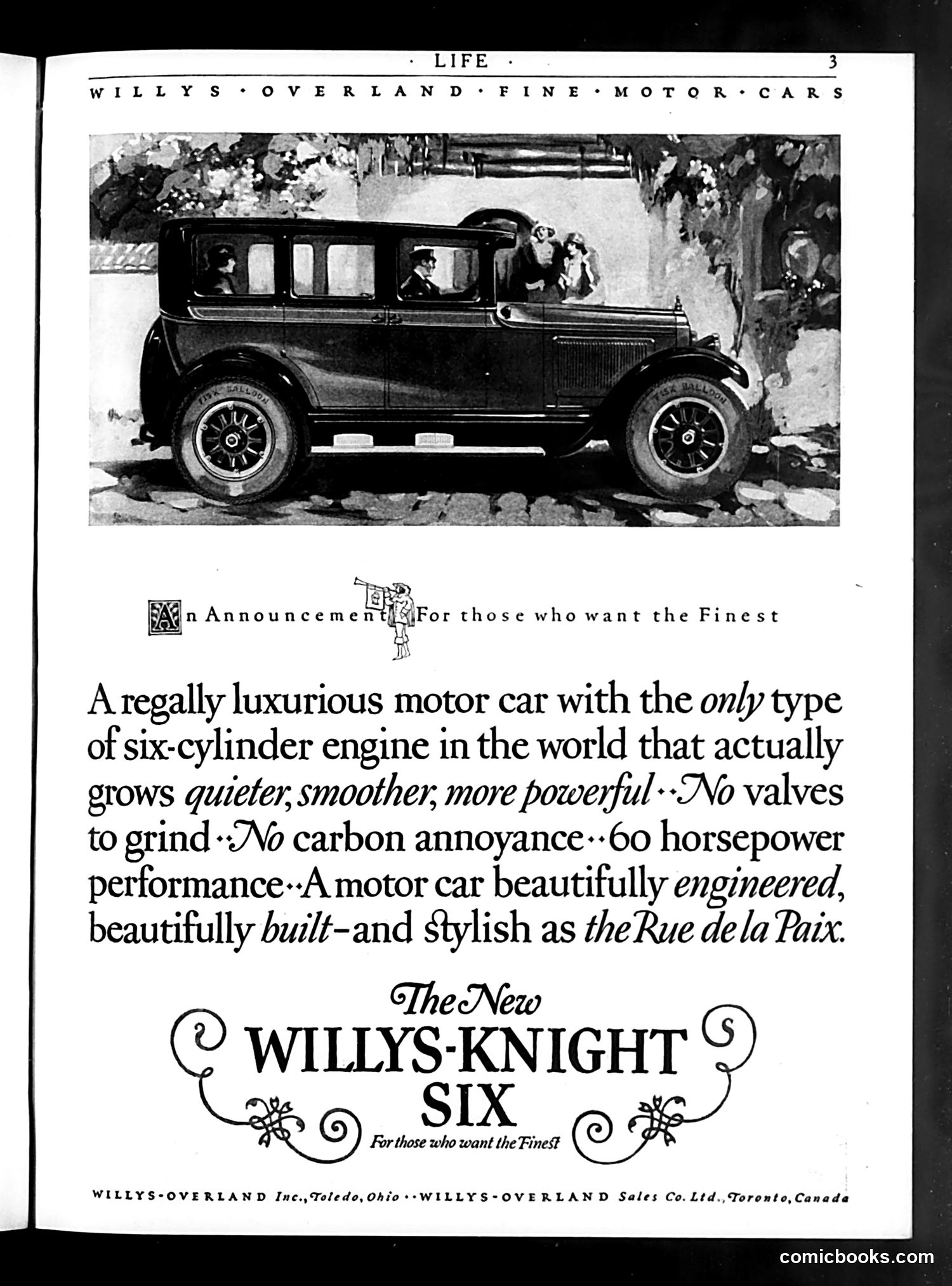
This page is primarily **advertising**, not satire or political content. It features a full-page advertisement for the Willys-Knight Six automobile, published in *Life* magazine. The ad promotes the car's technical features: a six-cylinder engine that allegedly grows "quieter, smoother, more powerful" with use, has no valve grinding, produces no carbon buildup, and delivers 60 horsepower. The photograph shows the vehicle in profile with passengers visible through its windows. The copy emphasizes luxury positioning ("For those who want the Finest") and compares the car's styling to the prestigious French automobile "Rue de la Paix." The ornamental typography and flourishes reflect early 1920s advertising design. This is a straightforward commercial advertisement with no satirical intent or political commentary.
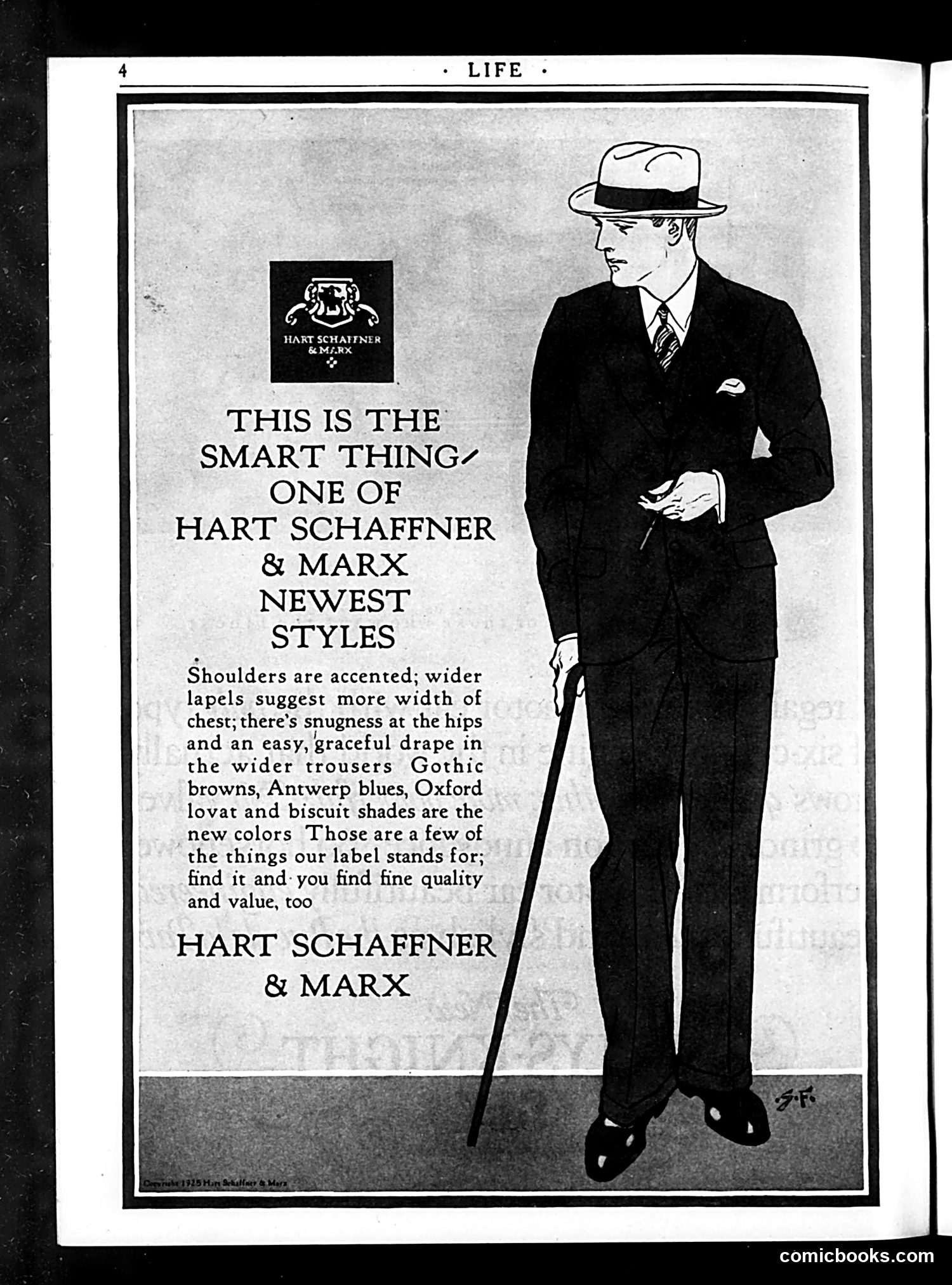
This page is primarily **advertising, not satire or political commentary**. It features a full-page advertisement for Hart Schaffner & Marx menswear, showcasing their newest suit styles. The illustration depicts a well-dressed man in a dark suit, fedora, and holding a cane—representing the "smart" gentleman consumer. The ad highlights design features: accented shoulders, wider lapels for chest width, snug hips, and graceful draping in wider trousers. The copy emphasizes the brand's reputation for "fine quality and value," listing fashionable fabric colors of the era: Gothic browns, Antwerp blues, Oxford lovat, and biscuit shades. This is typical 1920s-era men's fashion advertising, with no political or satirical content—just commercial promotion of contemporary style standards.
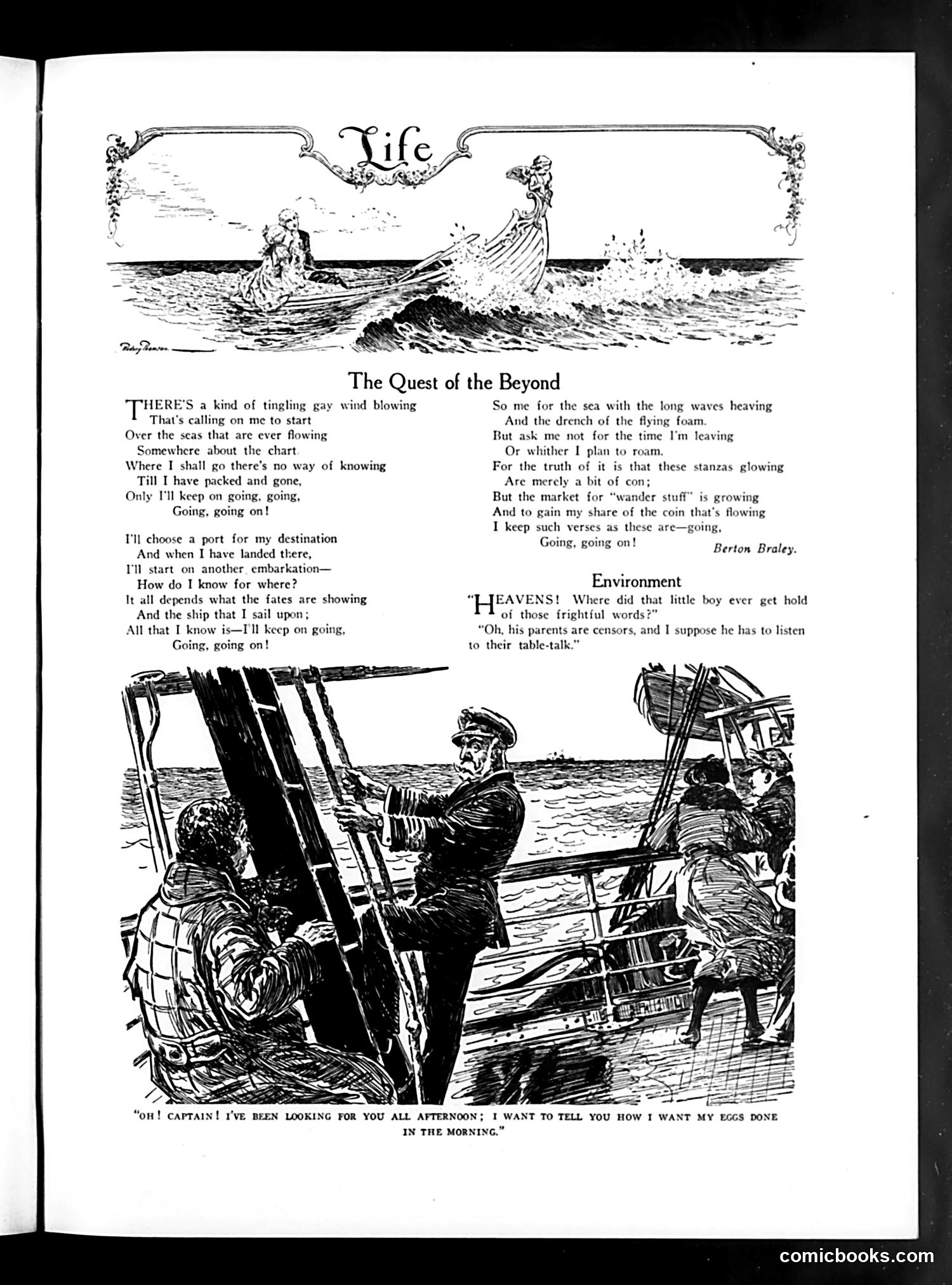
This page contains two distinct pieces: **"The Quest of the Beyond"** (top): A poem by Berton Braley celebrating wanderlust and maritime adventure. It romanticizes restless travel and exploration, with repeated refrains of "Going, going on!" This reflects early 20th-century cultural enthusiasm for travel and escape. **"Environment"** (bottom): A satirical cartoon and dialogue about parental censorship. An adult expresses shock that a boy has encountered "frightful words," attributing it to censors and table-talk. The accompanying illustration shows sailors on a ship, with one saying he's been "looking for" the captain "all afternoon" to discuss egg preparation. This appears to satirize how adults euphemistically sanitize language around children while ironically using coarse speech themselves.
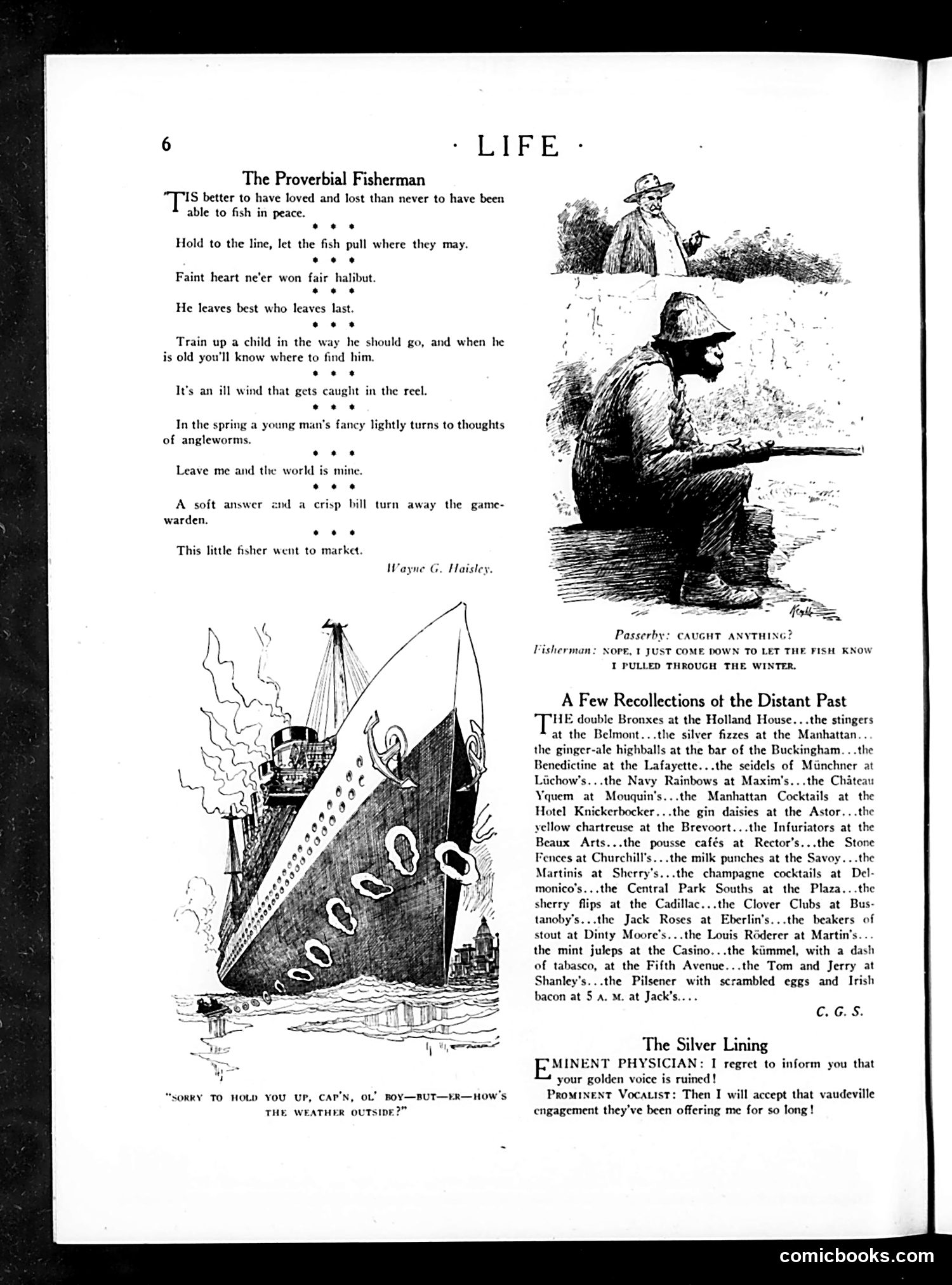
This page combines fishing-themed humor with nostalgic social commentary. "The Proverbial Fisherman" by Wayne G. Haisley presents fishing aphorisms ("It's better to have loved and lost than never to have been able to fish in peace"). The main cartoon shows two fishermen: a passerby asks "Caught anything?" and the fisherman replies he's just come down to "let the fish know I pulled through the winter"—a Depression-era joke about survival and modest expectations. The lower section, "A Few Recollections of the Distant Past," nostalgically catalogs now-closed New York establishments (hotels, restaurants, bars like the Waldorf, Lafayette, Delmonico's). This reflects early-20th-century urban sophistication lost to economic decline or Prohibition. The ship cartoon with "HOLD YOU UP" references weather delays—common maritime humor.
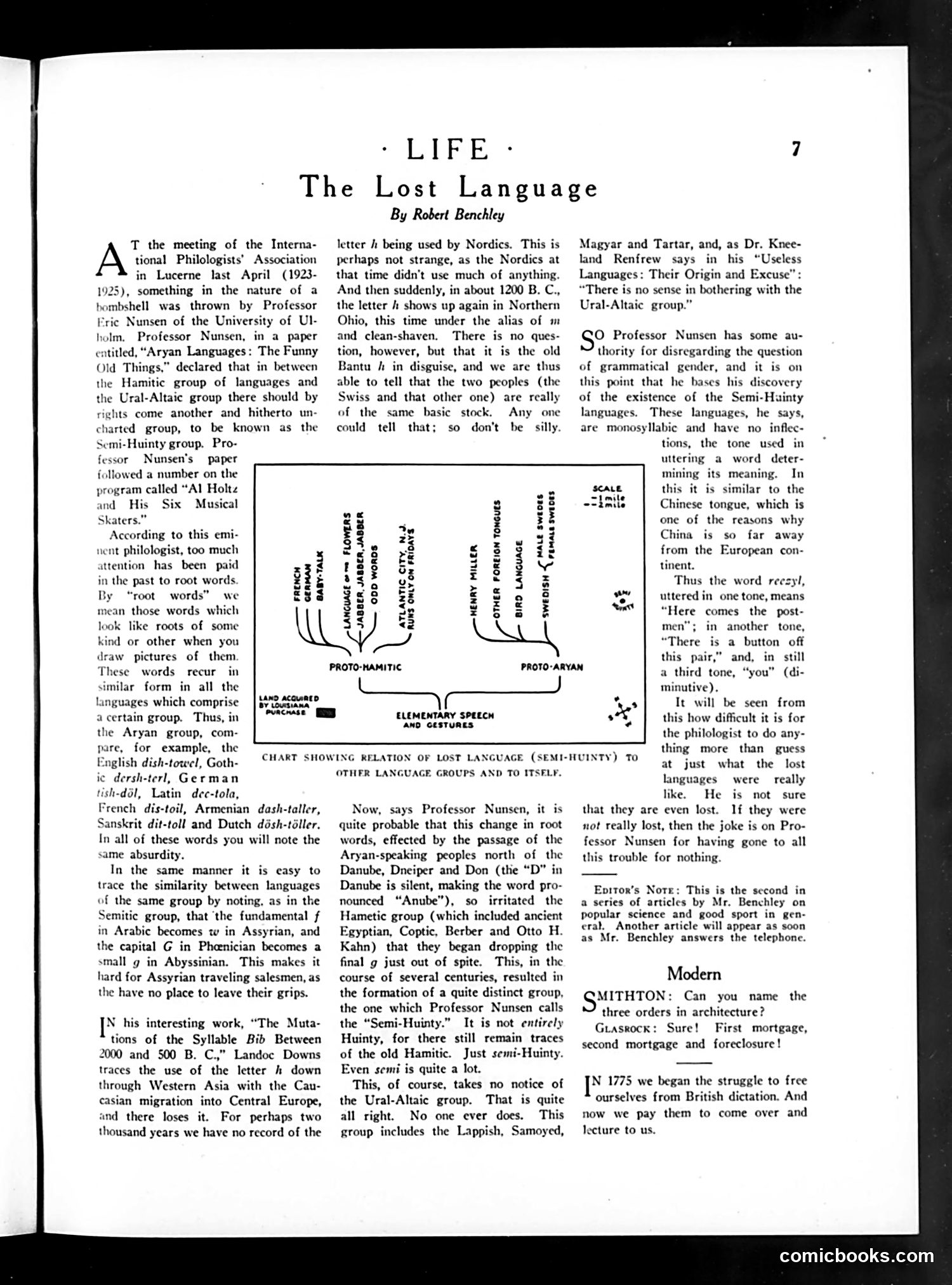
This is primarily a linguistic article, not a political cartoon. The page discusses Professor Nunsen's theory about the "Semi-Huinty" language group—a hypothetical connection between ancient Hamitic languages and Northern European languages. The central diagram shows linguistic relationships between "Proto-Hamitic" and "Proto-Aryan" language families, tracing how root words (like "dish-towel" in English) appear across different language groups. Benchley's satire is gentle: he pokes fun at philologists' difficulty in proving whether truly "lost" languages ever existed, and how obscure linguistic theories can become. The humor lies in the scholarly pedantry required to make such connections plausible, rather than any specific political reference.
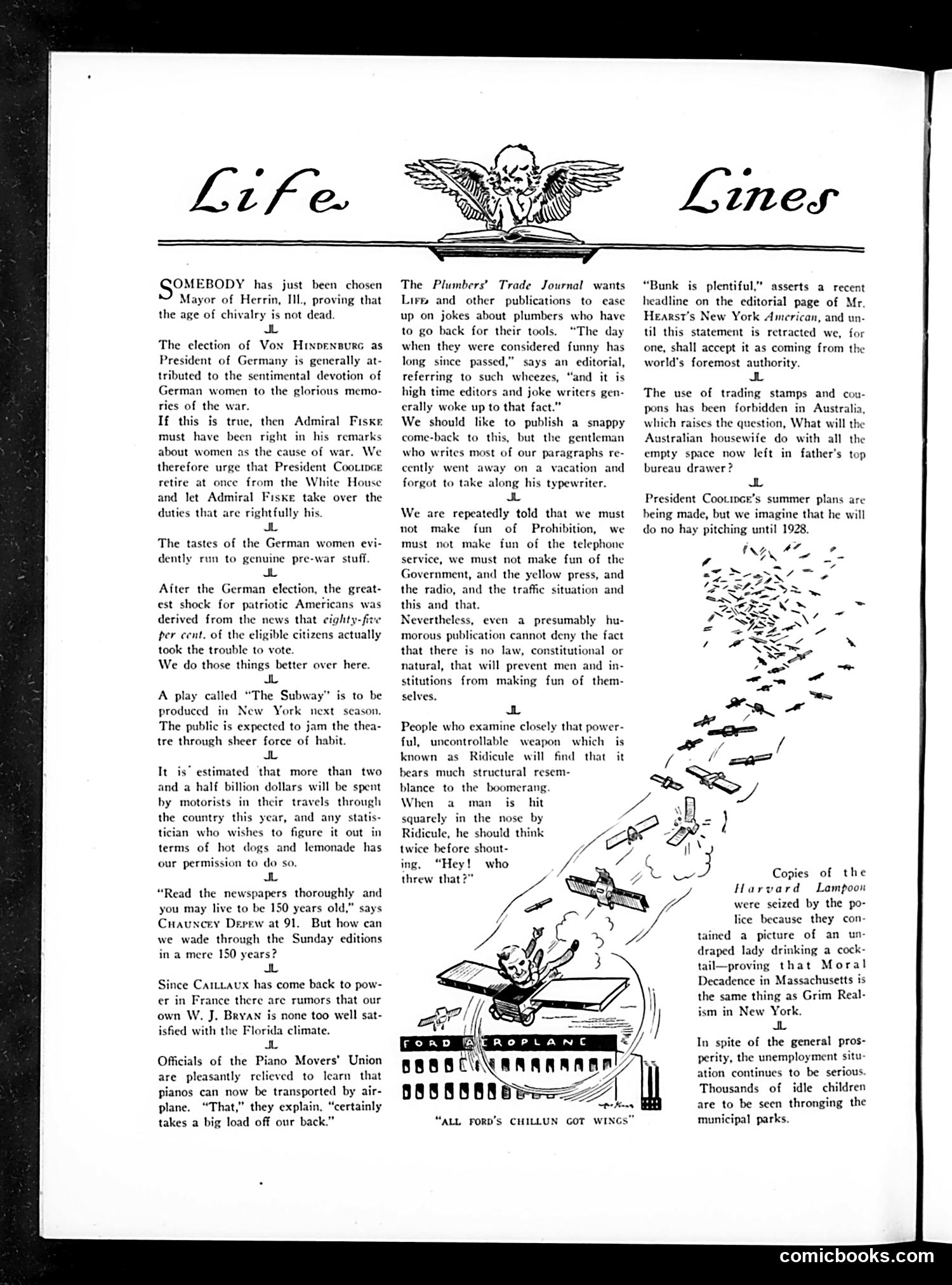
The main cartoon depicts a Ford Trimotor airplane ("All Ford's Chillun Got Wings") dropping what appear to be children or small figures onto a cityscape below. This satirizes Henry Ford's famous statement that "Any customer can have a car painted any color that he wants so long as it is black," here extended absurdly to aircraft production. The surrounding text discusses various contemporary issues: German politics and women's suffrage, Prohibition enforcement, theater productions, and unemployment among children. The cartoon's dark humor suggests anxiety about industrialization and mass production's societal impacts during the late 1920s economic boom. Ford's mass manufacturing success is mocked as indiscriminate and potentially chaotic.
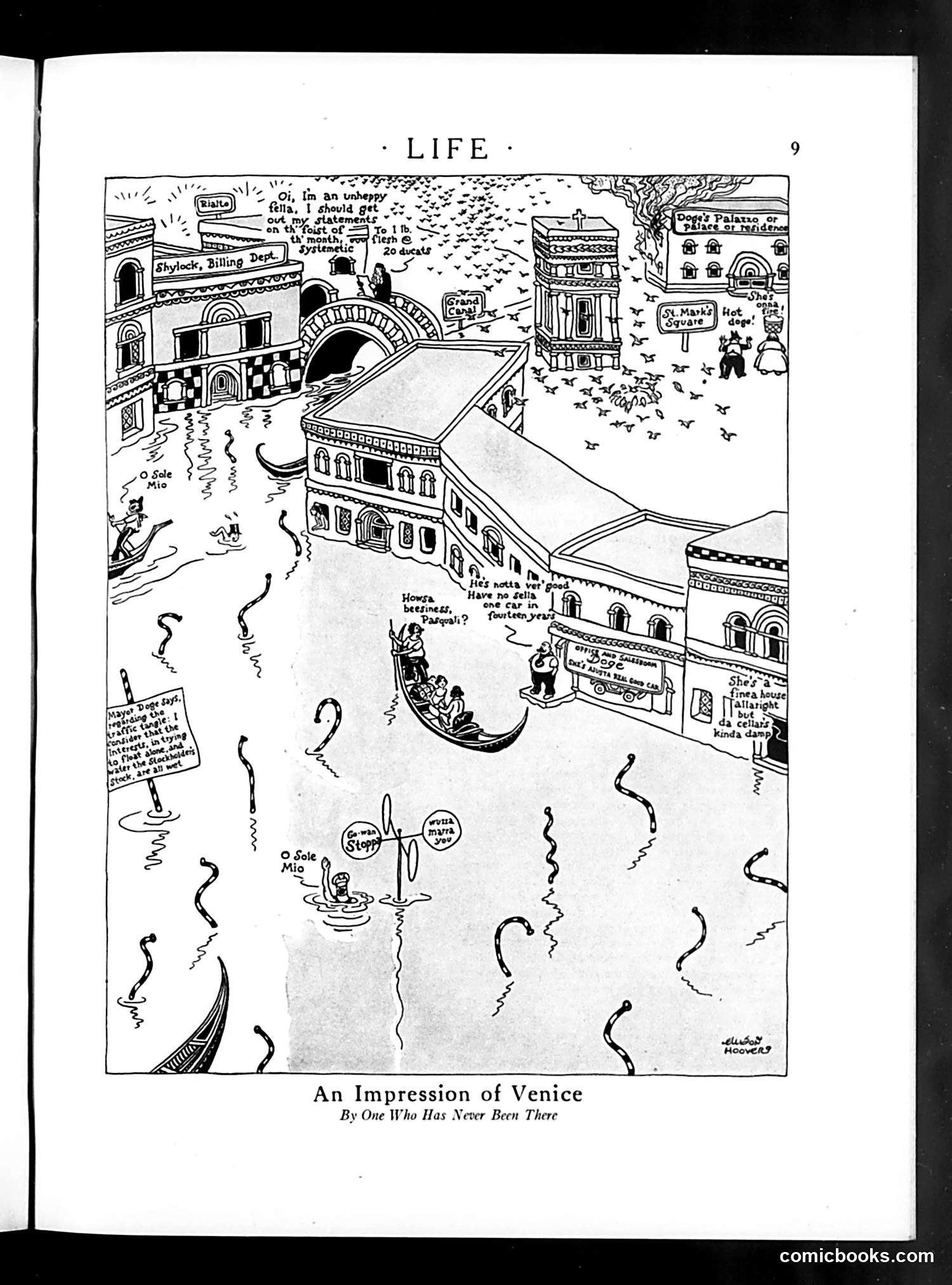
This satirical cartoon depicts Venice through the eyes of someone who has never visited, creating absurdist humor through exaggeration. The drawing shows iconic Venetian architecture (palaces, churches, St. Mark's Square) rendered in an impossible, surreal landscape flooded with water. The joke centers on common misconceptions and stereotypes about Venice: the artist has literalized the city's famous canals by filling the entire scene with water and serpentine creatures. Speech bubbles contain Italian phrases and tourist observations ("Have no dells and car in fourthyears?"), suggesting confused cultural references and garbled understanding. The humor mocks both tourist ignorance about foreign places and the gap between imagination and reality—how preconceived notions can produce wildly inaccurate impressions.
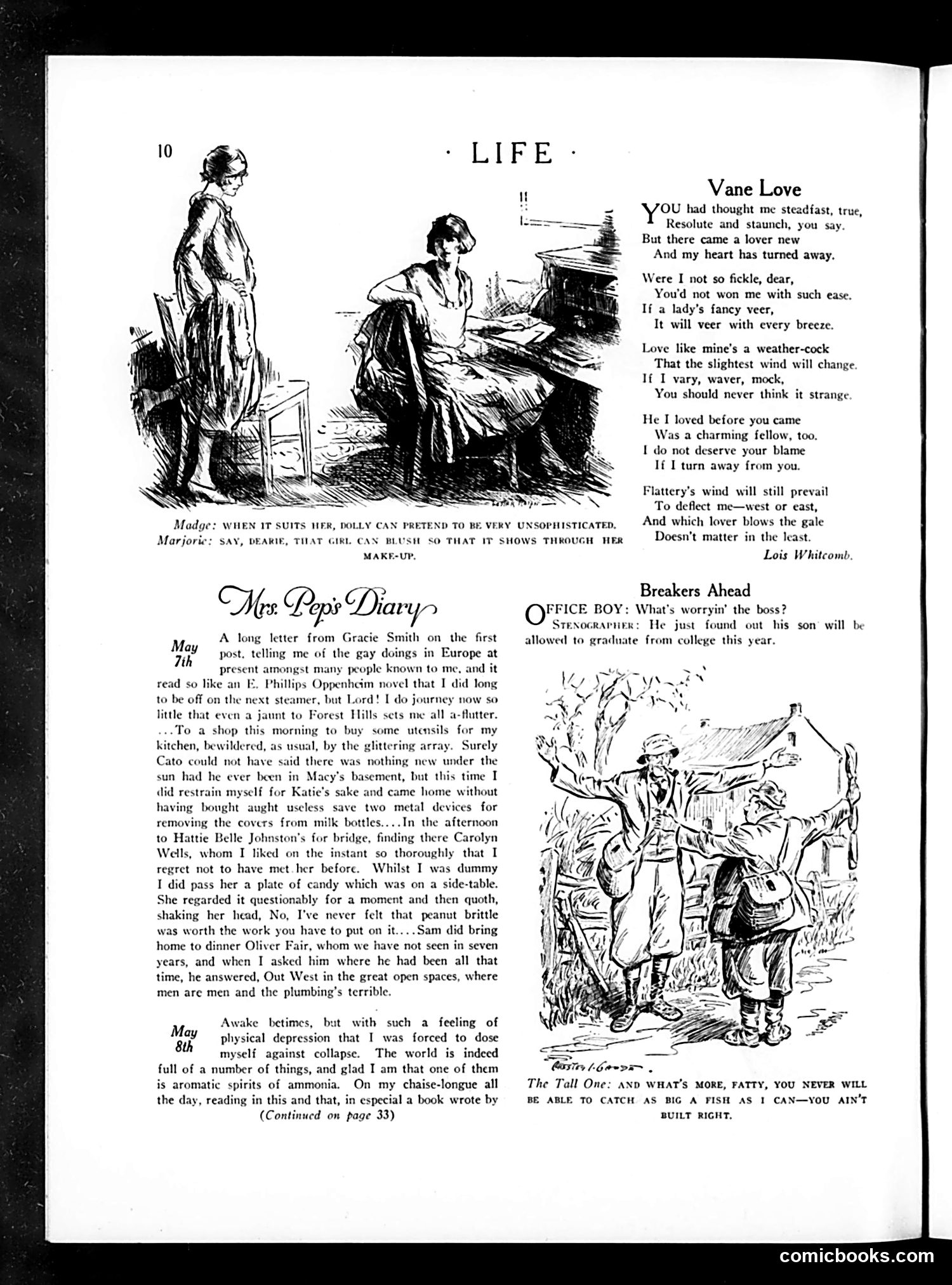
This page from *Life* magazine contains three distinct pieces: 1. **Top illustration**: A sketch showing two women in what appears to be a domestic scene, with captions suggesting commentary on female appearance and social performance ("when it suits her, Dolly can pretend to be very unsophisticated"). 2. **"Vane Love" poem** by Lois Whitcomb: A romantic verse about romantic inconstancy—a lover who has strayed. The satirical tone mocks the predictability of such emotional situations. 3. **"Mrs. Pop's Diary"**: A humorous diary entry dated May 7th-8th, detailing mundane domestic activities (shopping, visiting friends, household management). The satire targets the triviality of upper-class women's daily concerns and their preoccupation with social calls and domestic minutiae. 4. **"Breakers Ahead" cartoon**: A brief comic about an office boy informing a stenographer that his boss's son will graduate college, with a rural illustration below. The overall theme mocks domestic life, romance, and social pretension.
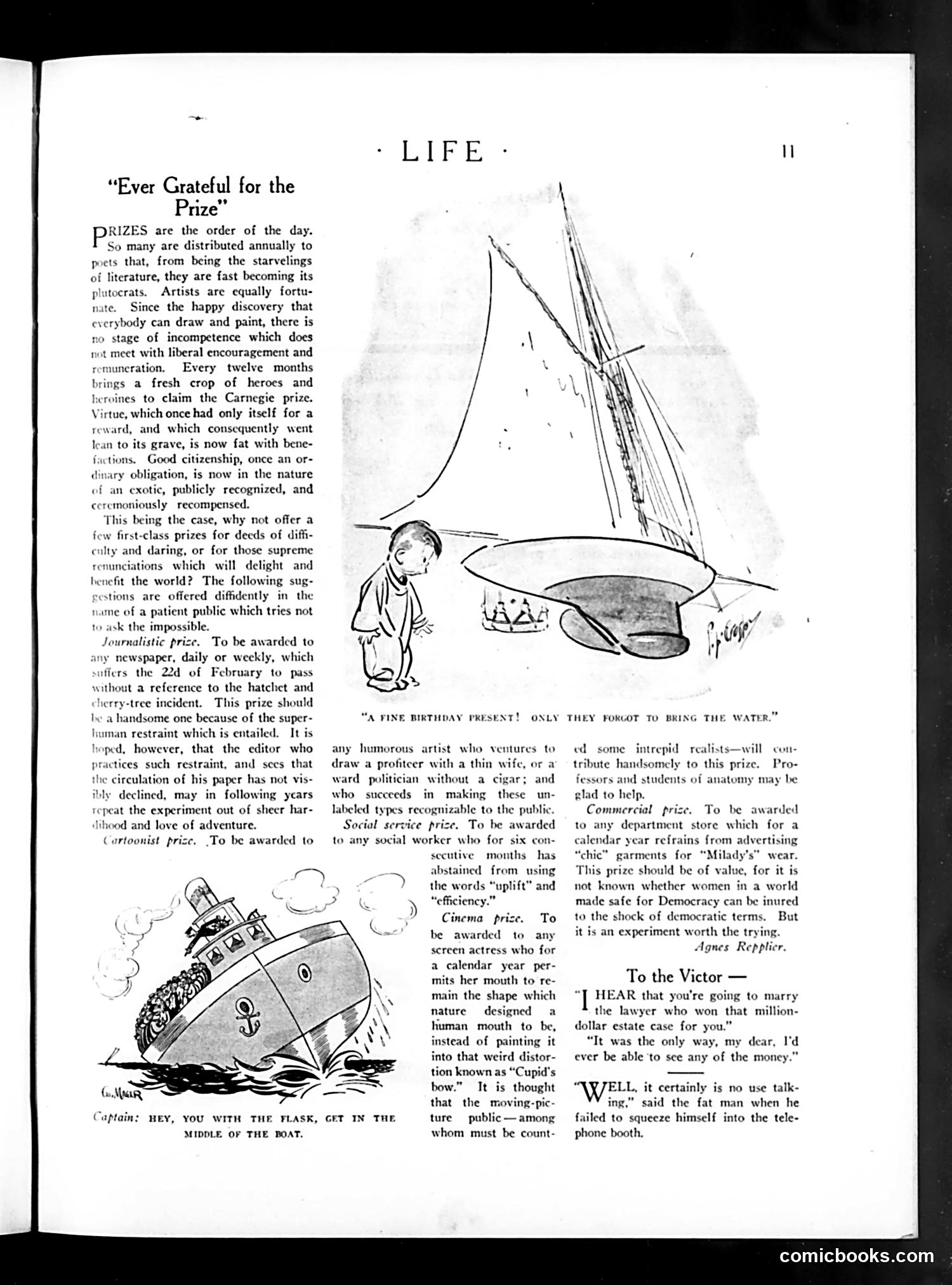
This page satirizes various proposed prizes for public service and artistic achievement. The main text describes a "Journalistic Prize" requiring newspapers to avoid referencing "the hatchet and cherry-tree incident"—a reference to the apocryphal George Washington anecdote. The satirist mocks this impossible restraint on editors. Two cartoons accompany the text: the upper shows a small figure beside a large sailing vessel with a crown, captioned "A FINE BIRTHDAY PRESENT! ONLY THEY FORGOT TO BRING THE WATER." The lower depicts a sinking ship full of passengers, captioned "CAPTAIN: HEY, YOU WITH THE FLASK, GET IN THE MIDDLE OF THE BOAT." Both use maritime disasters as visual metaphors for social absurdities, employing dark humor typical of early 20th-century satirical magazines.
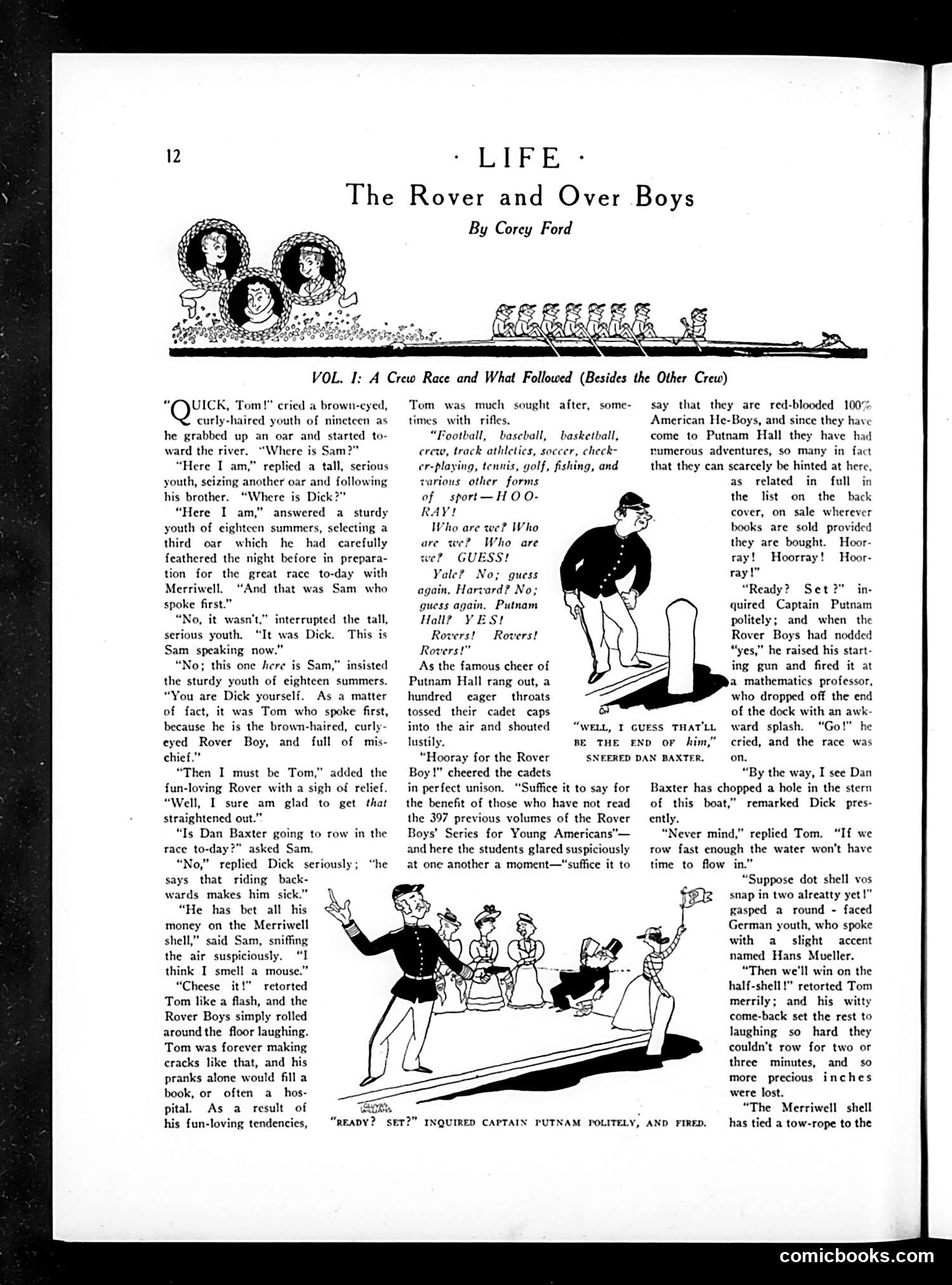
This is a humorous fiction piece about competitive rowing at what appears to be a prestigious American school or college. The narrative focuses on the rivalry between two crews preparing for a race, featuring characters like Tom, Sam, and Captain Putnam. The illustrations show young men in athletic gear preparing boats and competing. The satire gently mocks the intense competitiveness and dramatic behavior of student athletes—their superstitions, boasting, and pranks. One caption shows Captain Putnam firing a starting gun while a student named Dan Baxter anxiously watches. The piece plays on the era's romanticization of collegiate sports and the sometimes absurd seriousness with which young athletes approached their competitions. It's lighthearted mockery of athletic culture rather than political satire.
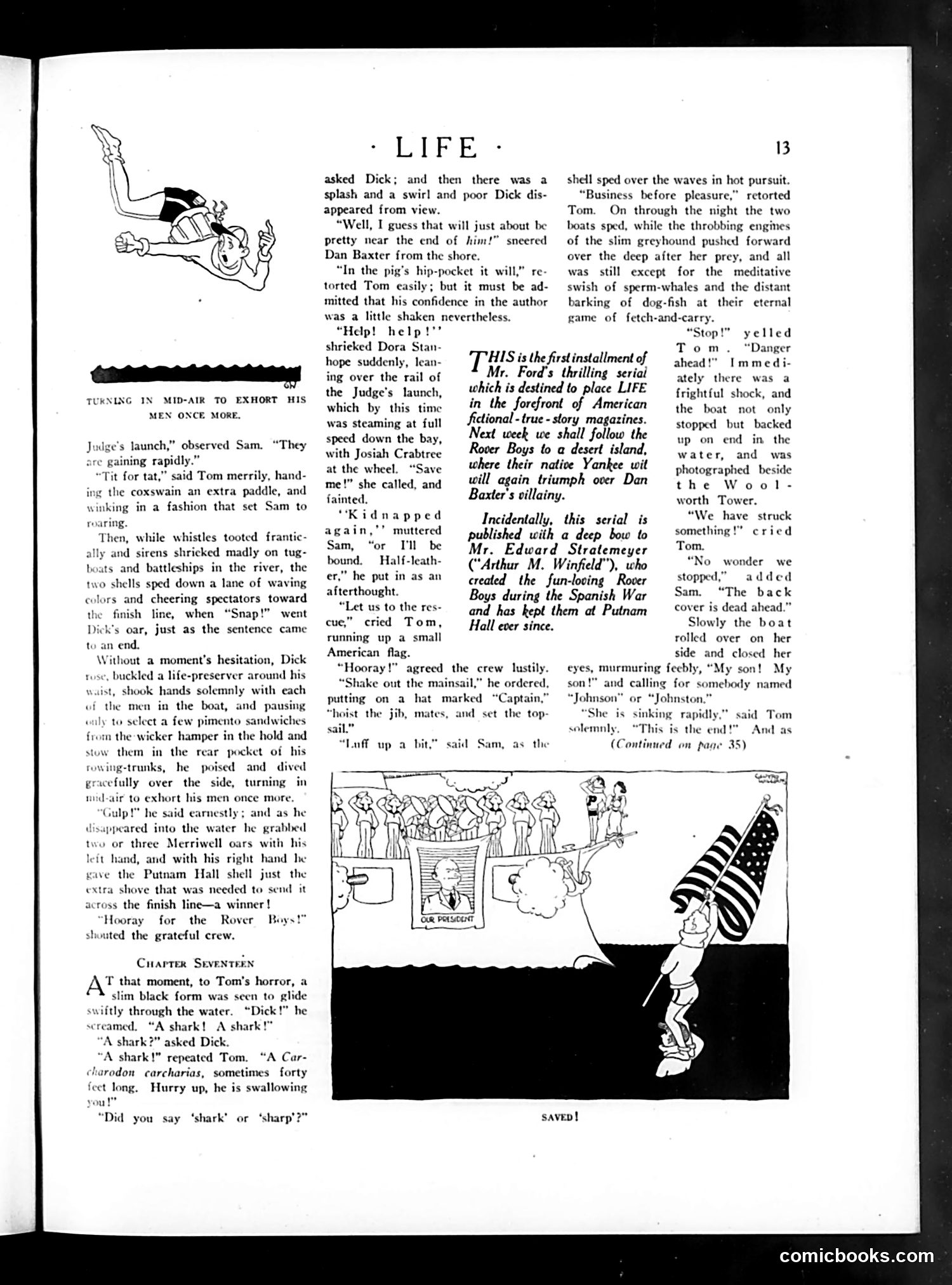
This page presents the first installment of a serialized adventure story titled "Life" (page 13). The narrative follows characters named Dick, Tom, Sam, and Dan Baxter in a maritime adventure involving a shark attack and rescue at sea. The illustrated cartoon at bottom shows a figure being rescued from water while holding an American flag, labeled "SAVED!" This appears to be the climactic moment of the story excerpt. The text box explicitly states this is Mr. Ford's "thrilling serial" and credits Arthur M. Winsfield for creating the "fun-loving Rover Boys" during the Spanish War, noting their popularity at Putnam Hall. The content represents early 20th-century adventure fiction for general audiences, emphasizing patriotic themes (the flag) and action-adventure narratives typical of the era's popular serialized stories in American magazines.
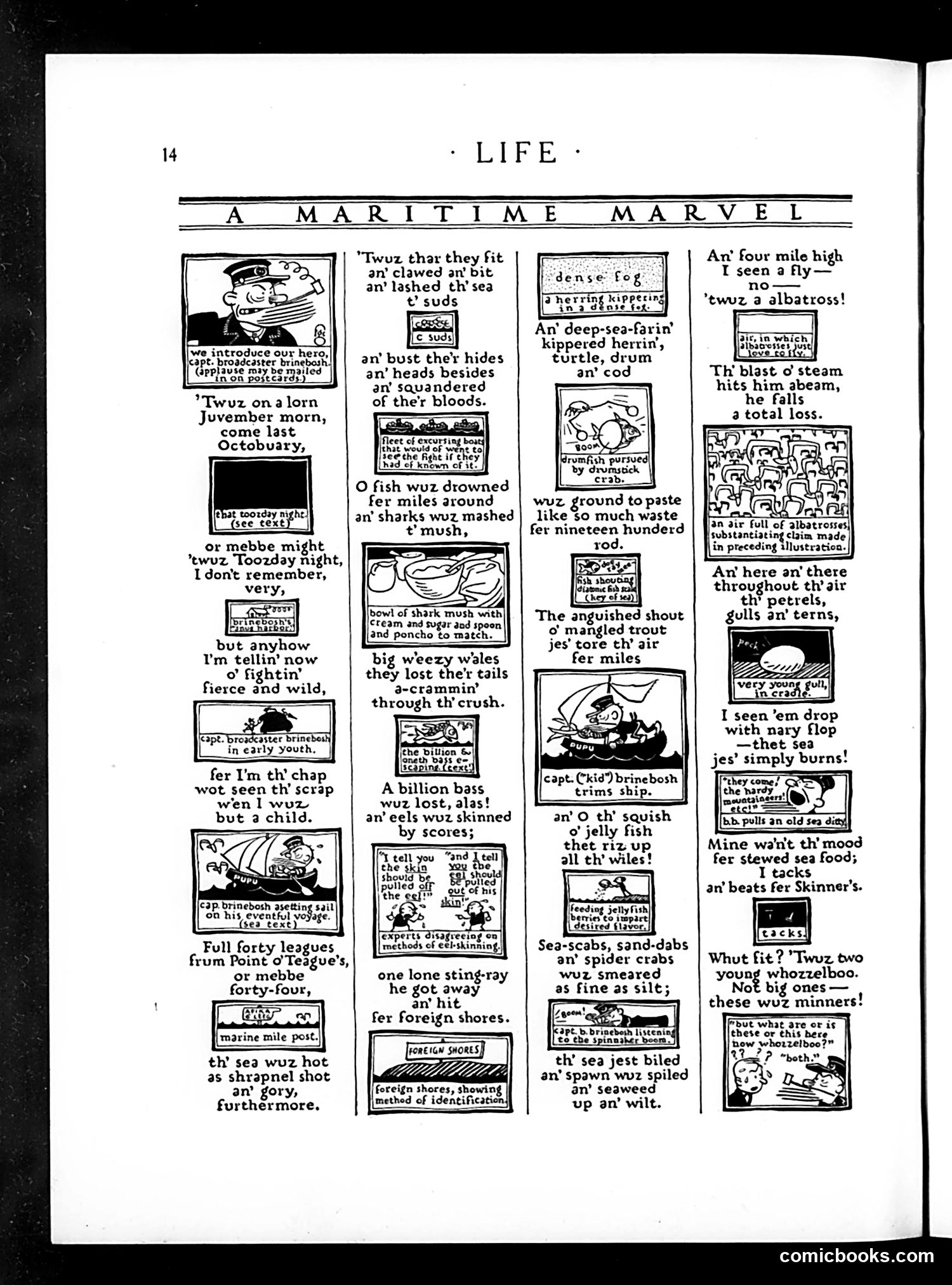
This page is a humorous comic narrative about a fishing voyage, told in dialect verse with accompanying illustrations. The story follows sailors from what appears to be a commercial fishing expedition, describing their catches and maritime adventures in exaggerated, colloquial language ("'Twuz," "an'," "fer"). The comic celebrates naval/fishing culture through tall tales about enormous sea creatures (whales, bass, eels, squids), implausibly large catches, and dramatic maritime incidents. References to specific locations like "Point Teague's" and "foreign shores" suggest an actual expedition, though the increasingly fantastical claims indicate this is satirical. The overall joke mocks sailors' legendary storytelling tradition—the tendency to embellish fishing tales with increasingly absurd details. The pairing of crude dialect with detailed illustrations emphasizes the working-class nautical humor that Life magazine's audience would have found entertaining.
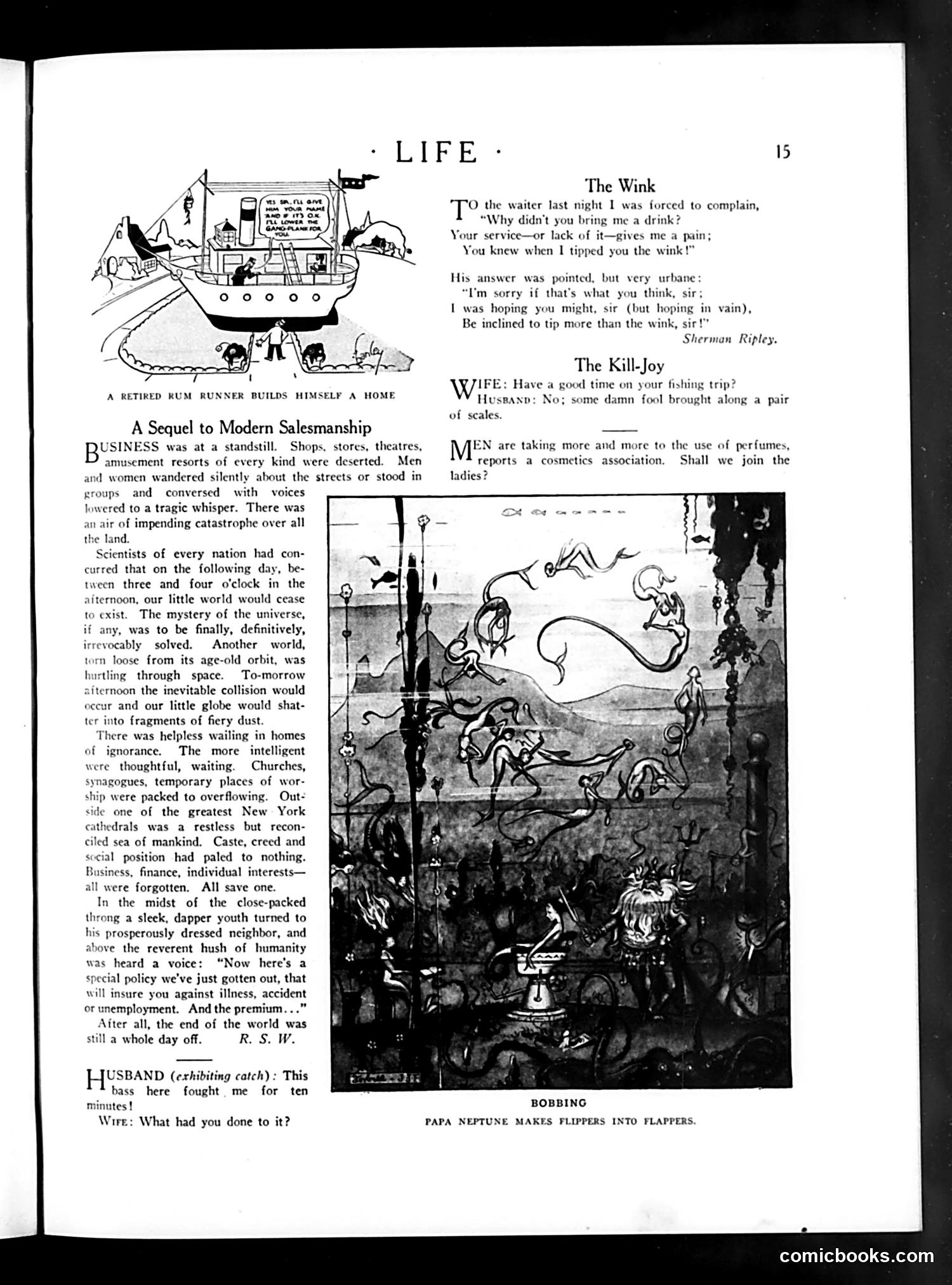
This page contains several humor pieces rather than political cartoons. The top illustration shows "A Retired Rum Runner Builds Himself a Home"—a reference to Prohibition-era bootleggers repurposing their smuggling vessels into residences, satirizing how criminals adapted after losing their illegal trade. The main cartoon titled "Bobbing" depicts "Papa Neptune Makes Flippers Into Flappers," showing the Roman god of the sea transforming fish flippers into human legs. This likely mocks the 1920s "flapper" trend—young women adopting short skirts, bobbed hair, and modern behavior—by presenting the fashion as an absurd transformation, as if women were becoming something unnatural or foreign. The smaller text pieces are joke exchanges between couples on mundane domestic topics.
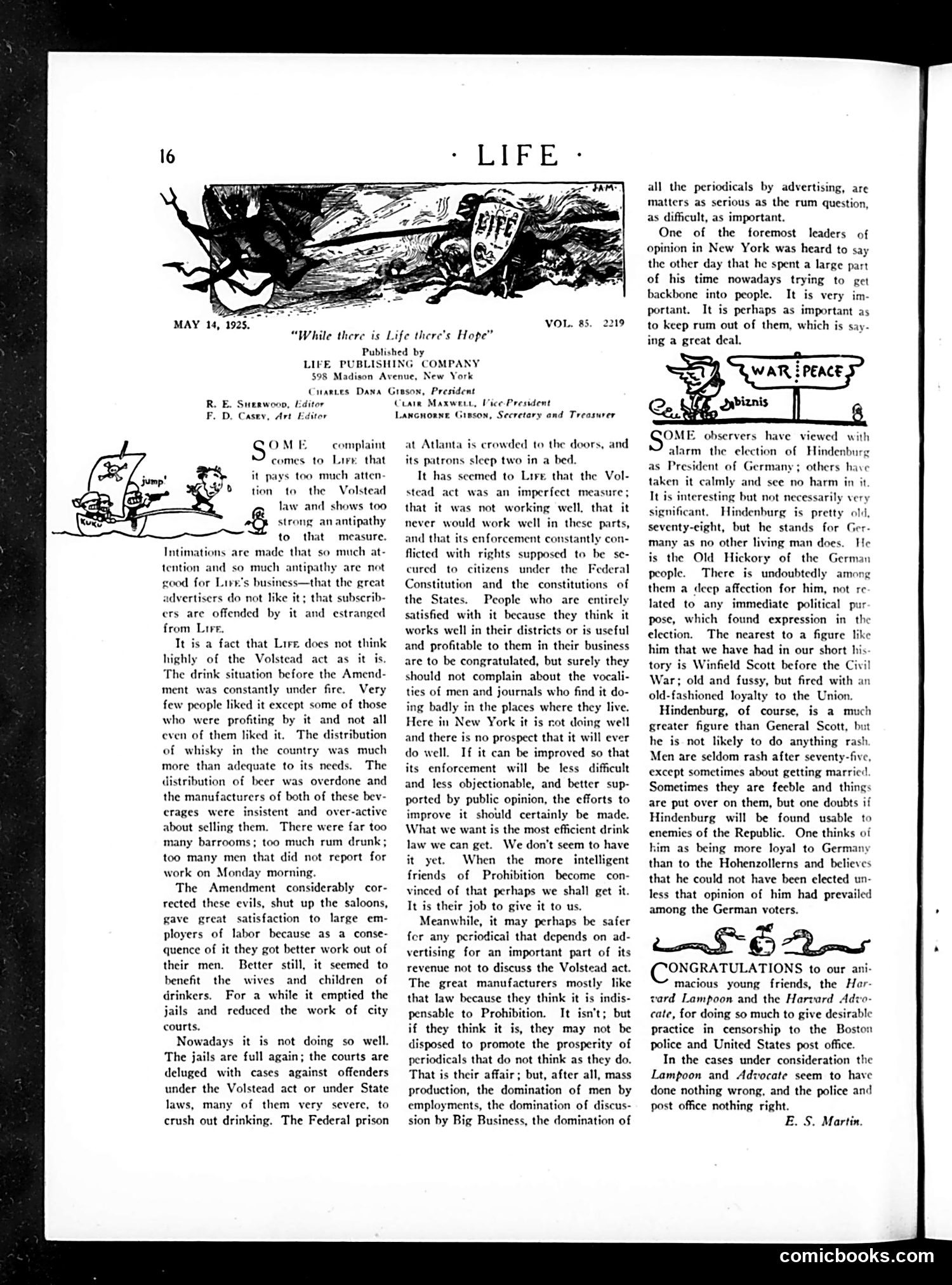
This page contains *Life* magazine's editorial defense of its critical coverage of Prohibition—the constitutional ban on alcohol (1920-1933) enacted via the Volstead Act. **The Issue:** Life's publishers received complaints that the magazine's anti-Prohibition stance offended advertisers and subscribers, potentially hurting business. **Life's Argument:** The editorial acknowledges this pressure but defends its position. It notes that while Prohibition initially improved public welfare (fewer drunks, better worker productivity, emptied jails), it has since "not doing so well"—jails are full again, federal prisons overcrowded, enforcement conflicts with constitutional rights. **The Satire:** Life ironically suggests that periodicals dependent on advertising might wisely *avoid* criticizing Prohibition, since large manufacturers support the law. This highlights the tension between editorial independence and commercial pressure—suggesting that Big Business dominance threatens open discussion. **Historical Context:** This reflects the "Roaring Twenties" conflict between Prohibition's idealistic supporters and practical critics who saw widespread bootlegging and corruption.
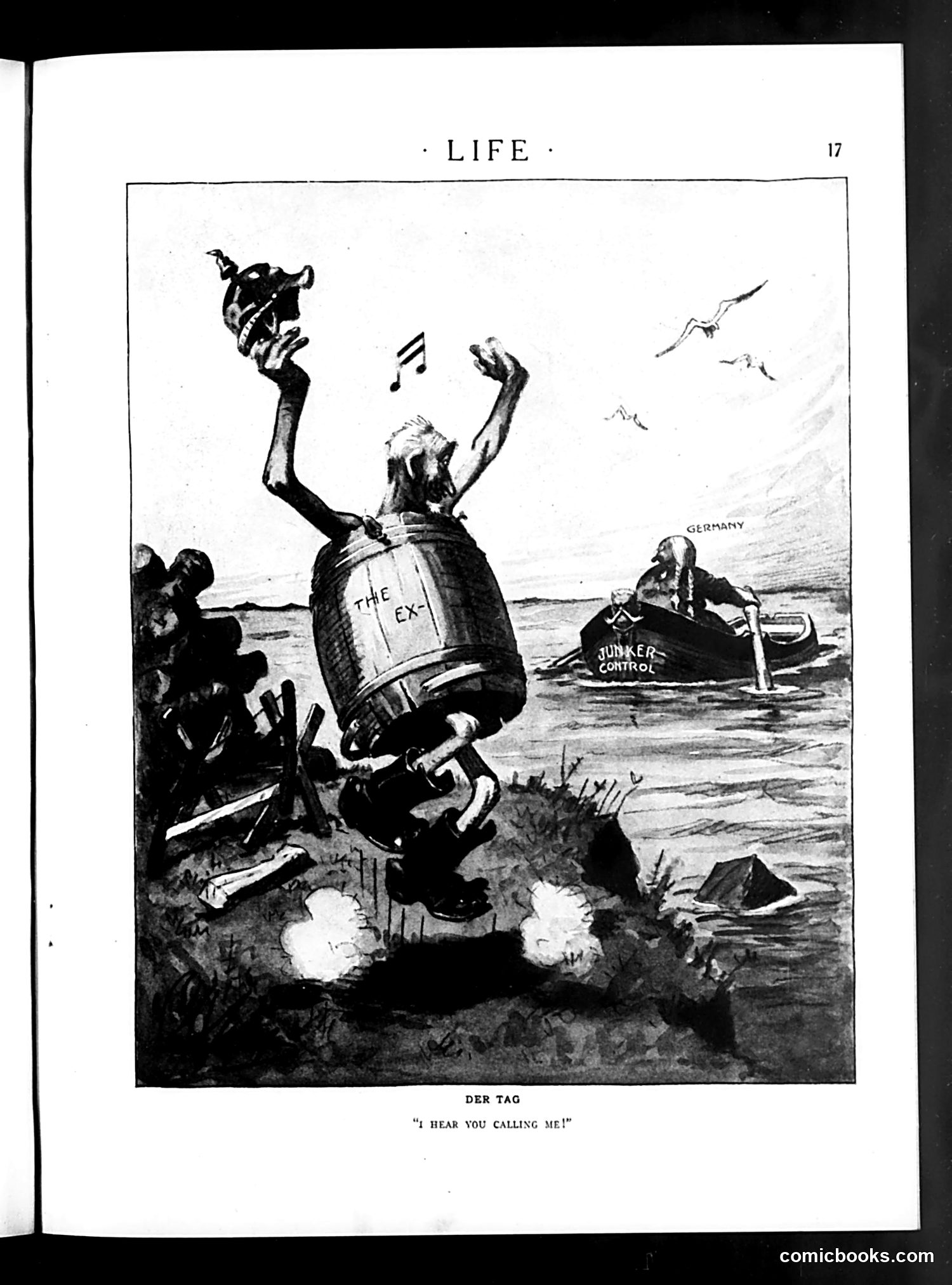
This WWI-era satirical cartoon titled "Der Tag" (German for "The Day") depicts Germany as a military figure emerging from water, celebrating with raised arms and musical notes. The figure wears a military helmet labeled "THE EX" and holds what appears to be a grenade or bomb. In the background, a vessel labeled "BUNKER CONTROL" sits in the water near "GERMANY." The cartoon mocks Germany's military ambitions and confidence, likely referencing German naval or submarine warfare strategies (bunker control suggests U-boat operations). The caption "I hear you calling me!" suggests Germany responding to some perceived call to action. This appears to be American anti-German propaganda, satirizing German military aggression during the First World War. The tone is mocking and dismissive of German military posturing.
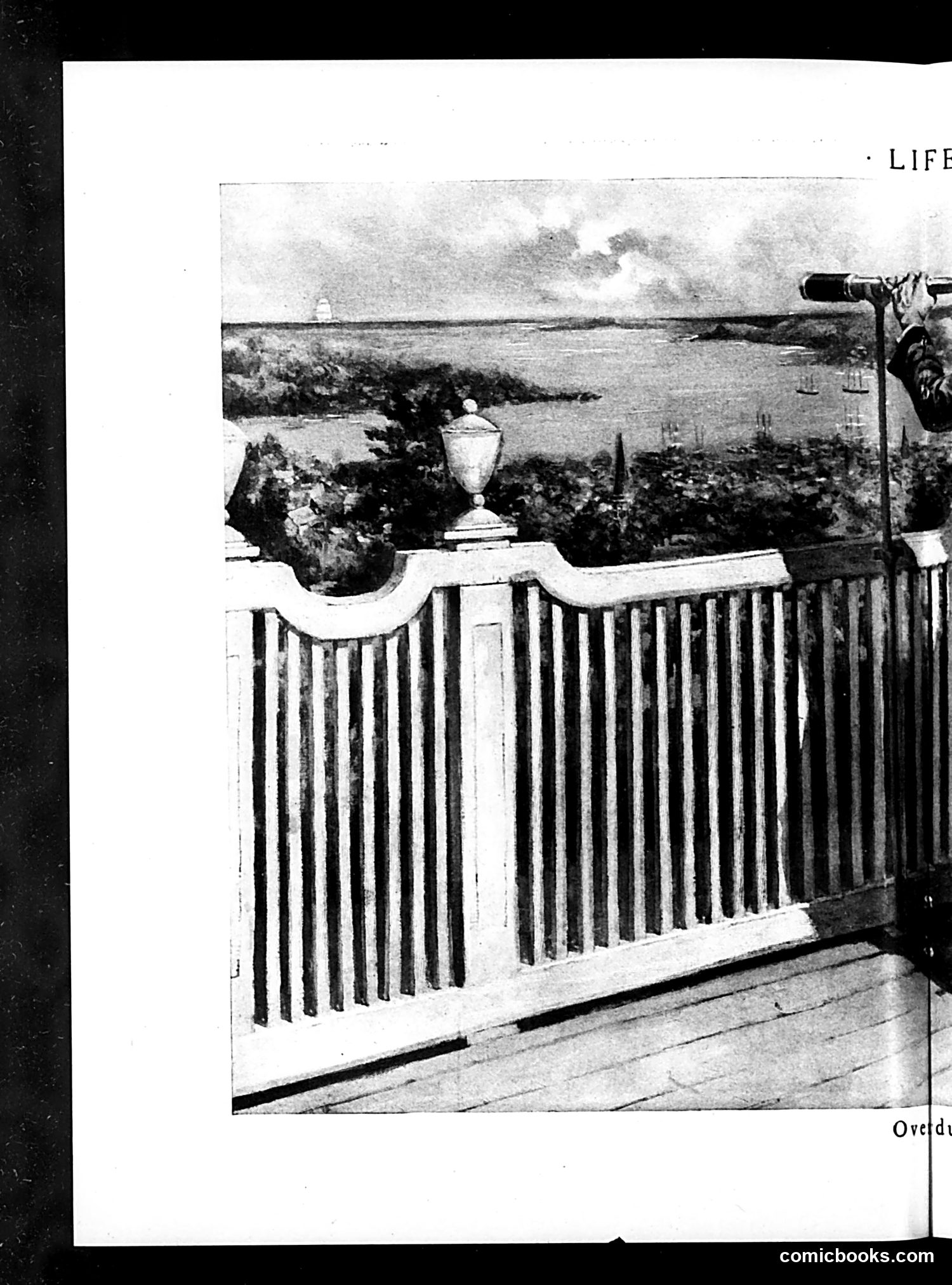
This appears to be a page from *Life* magazine featuring a scenic photograph rather than a political cartoon. The image shows an elegant balcony or terrace with white railings and decorative urn, overlooking a coastal or waterside landscape with vegetation and distant sailboats. A telescope or viewing instrument is visible on the right side. The page lacks substantial OCR text beyond the masthead and watermark, making it difficult to determine the specific satirical intent or context. Without accompanying caption text or article content, I cannot identify what social or political commentary this image was intended to convey to contemporary readers. The photograph appears primarily documentary or illustrative rather than explicitly satirical.
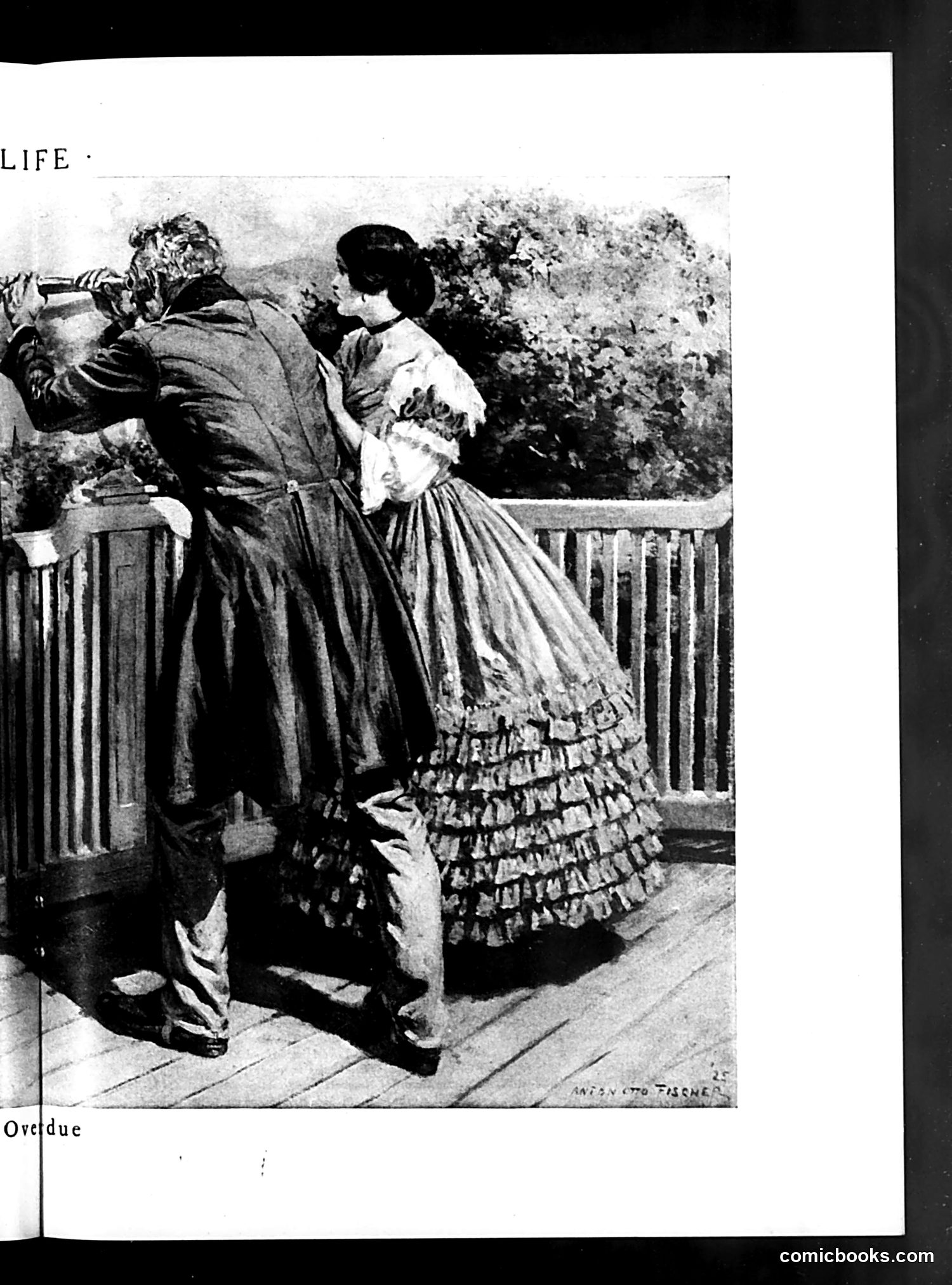
This appears to be a satirical illustration from *Life* magazine showing a romantic scene on a terrace or balcony overlooking landscaped grounds. A man in dark formal attire holds up a telescope or spyglass while a woman in an elaborate ruffled dress stands beside him, gazing outward. The joke likely satirizes courtship rituals or romantic pretense—the man uses the telescope ostensibly to show the woman a distant view, but the setup suggests the real "sight" is the woman herself or their intimate proximity. The exaggerated formality of their dress and the theatrical composition parody Victorian-era romantic conventions and the elaborate social performances expected of courting couples. Without clearer text or artist attribution visible, the specific political or social target remains unclear.
This is a satirical review of a vanity publication—a book called "Plays Produced Under the Stage Direction of David Belasco"—authored anonymously but clearly by the famous theatrical producer David Belasco himself. Life's critic Robert Benchley mocks the book's pretentious packaging and overwrought self-aggrandizement. The publication includes 47 pages listing Belasco's plays alongside literary giants (Shakespeare, Goldsmith, Sheridan), epigraphs from Goethe, and crayon sketches. Benchley notes the contradiction between Belasco's earlier "juvenile productions" (which at least admitted humor) and his later works, which he presents without irony as masterpieces. The satire's core: a powerful theater director publishing an elaborate press release disguised as a book to justify his historical importance. Benchley suggests readers should simply revive the plays themselves to judge their actual merit—the ultimate dismissal of Belasco's self-mythologizing.
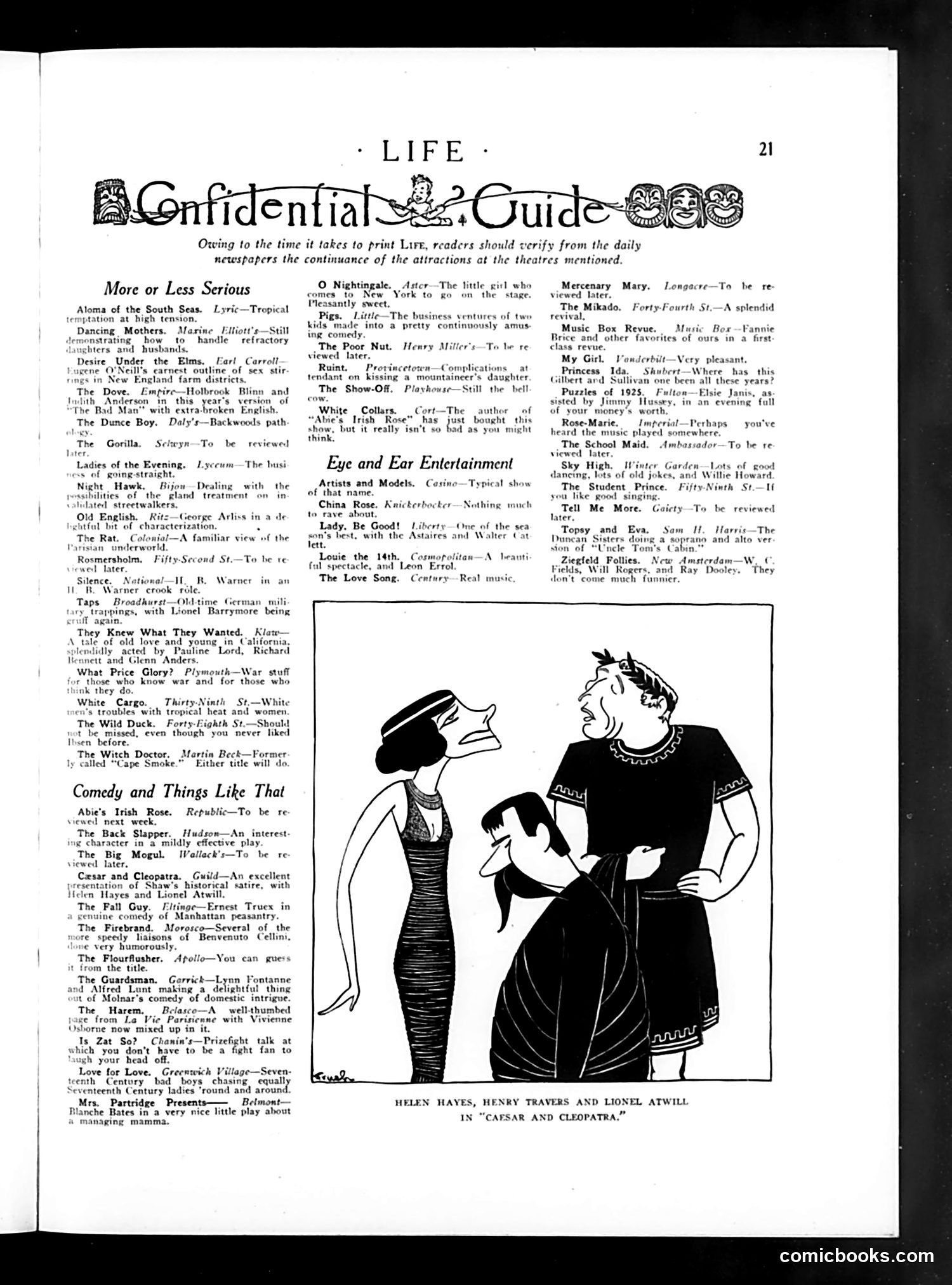
This page is primarily a **theater listing and review guide** for Broadway shows, typical of Life magazine's entertainment coverage in the 1920s. The text contains brief, witty descriptions of current theatrical productions—both serious dramas and comedies. The **illustration** shows three figures from the play "Caesar and Cleopatra" (credited as featuring Helen Hayes, Henry Travers, and Lionel Atwill). It's a simple theatrical sketch depicting actors in costume, likely meant to promote this Shaw production. The "satire" here is subtle—the descriptions mock theatrical conventions with tongue-in-cheek humor. For example, "Dancing Mothers" is described as teaching how to handle "refractory daughters and husbands," while "White Cargo" concerns "white men's troubles with tropical heat and women." This reflects Life's role as a **cultural arbiter** offering sophisticated commentary on New York's theater scene for educated, urban readers interested in the latest entertainment.
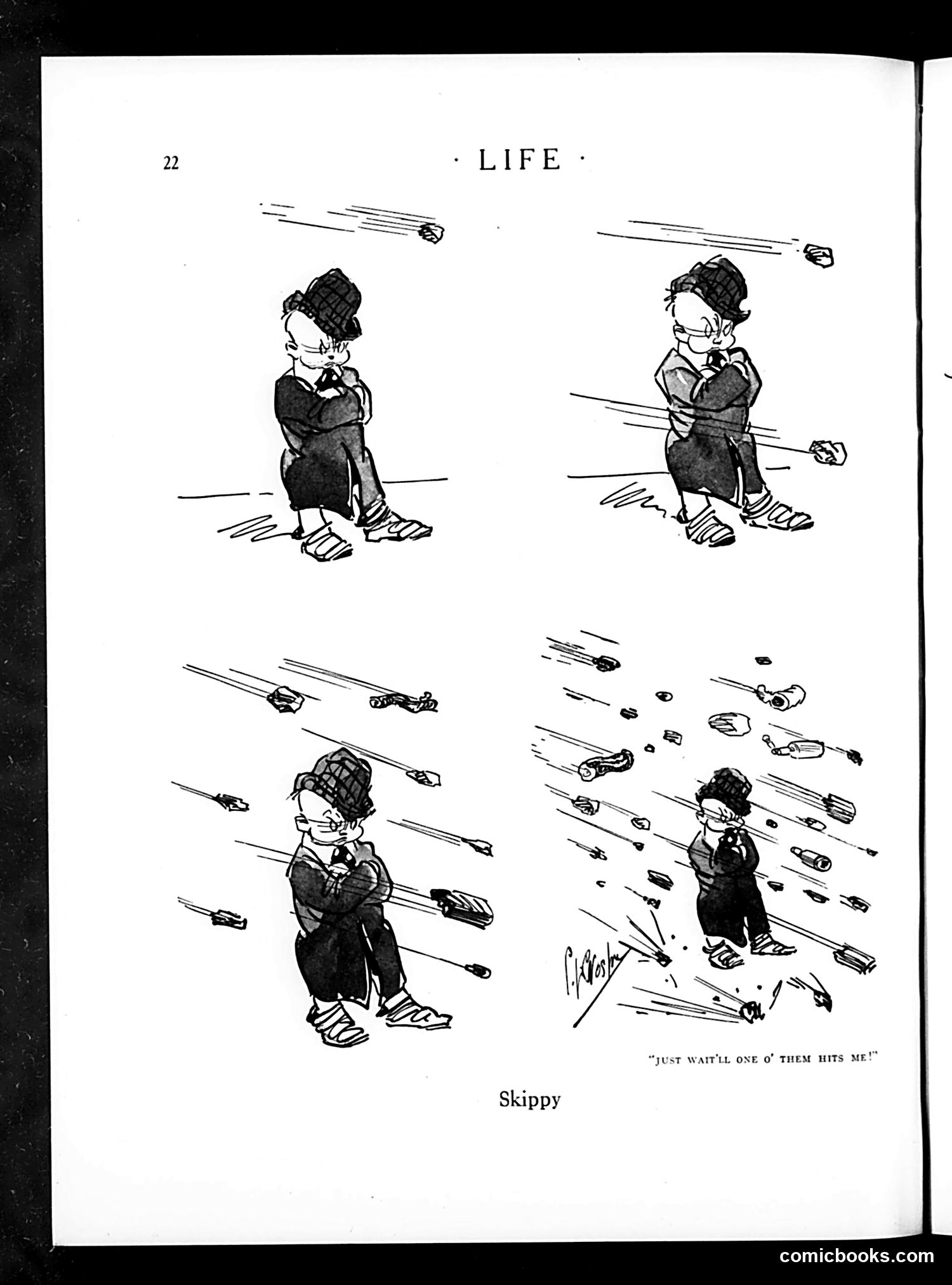
This is a humorous comic strip titled "Skippy" showing a small boy in various stages of dodging flying objects—likely stones or projectiles. The sequence progresses from the boy standing confidently in the first panels to increasingly chaotic scenes where he's surrounded by incoming missiles. The caption—"JUST WAIT'LL ONE O' THEM HITS ME!"—expresses mock bravado. The joke is the ironic contrast between his confident threat and the visual reality: he's already being pelted from all directions, yet he's threatening what will happen when he *actually* gets hit. This appears to be gentle slapstick humor typical of early-to-mid 20th century children's comics, using exaggeration and visual comedy rather than political satire.
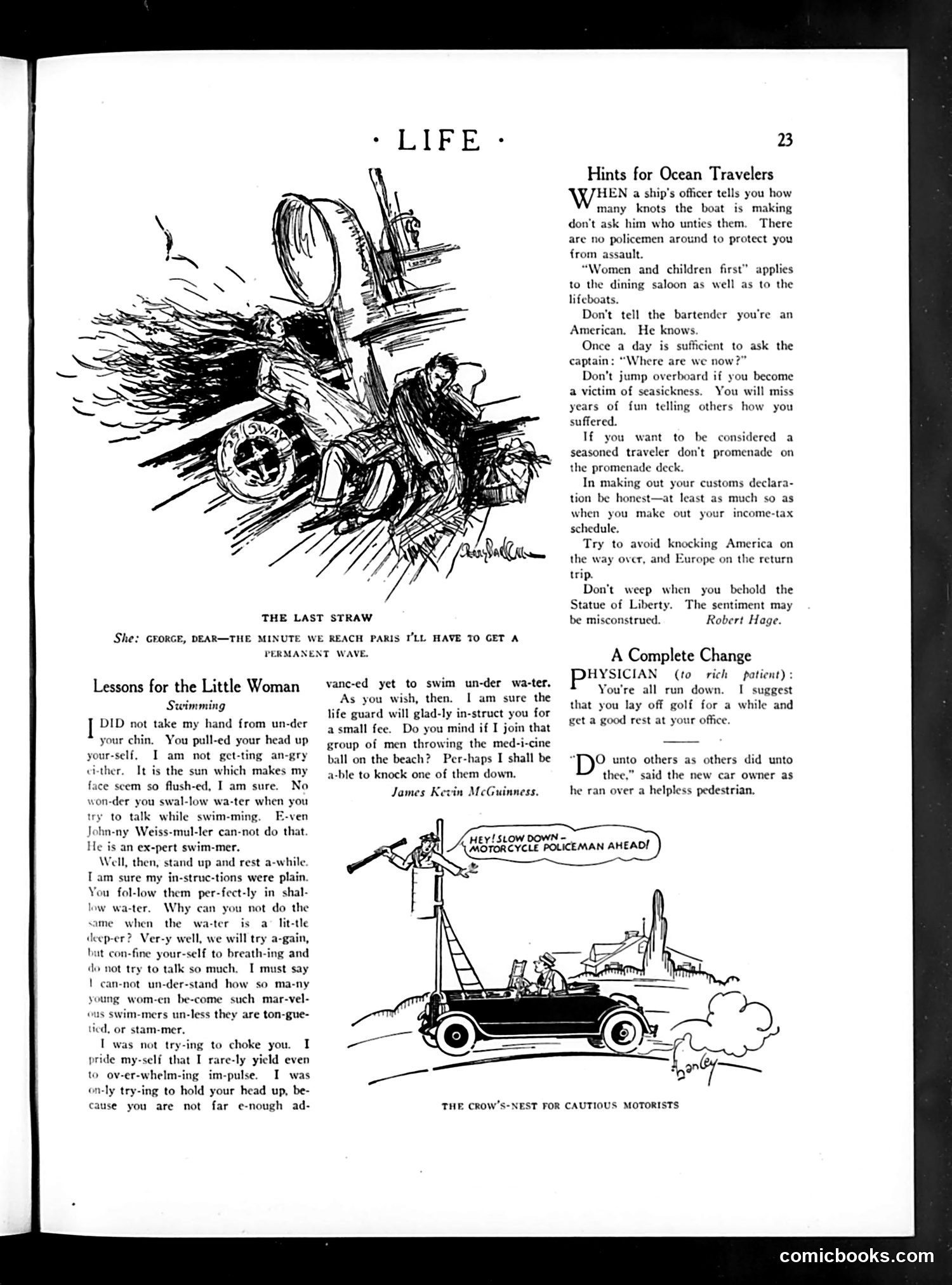
This page contains three separate satirical pieces mocking social conventions of the era: **"The Last Straw"**: A wife complains to her husband George that upon reaching Paris, she must get a permanent wave—suggesting women's endless vanity and impractical priorities even during travel. **"Lessons for the Little Woman"**: A swimming instructor's condescending instructions to a female student, portrayed through broken syllables to mock her assumed incompetence. The humor derives from his transparent irritation (flushed face, offering to leave) while denying it, and the absurdity of her asking questions while swimming. **"A Complete Change"**: A doctor tells a wealthy patient to rest at the office instead of golfing—inverting the typical prescription. The second joke mocks the "golden rule," showing a new car owner hitting a pedestrian while claiming he's following biblical ethics. **"The Crow's Nest"**: A motorist with a motorcycle policeman atop his car—satirizing reckless drivers and safety concerns. The page reflects 1920s attitudes toward gender roles, class, and emerging automobile culture.
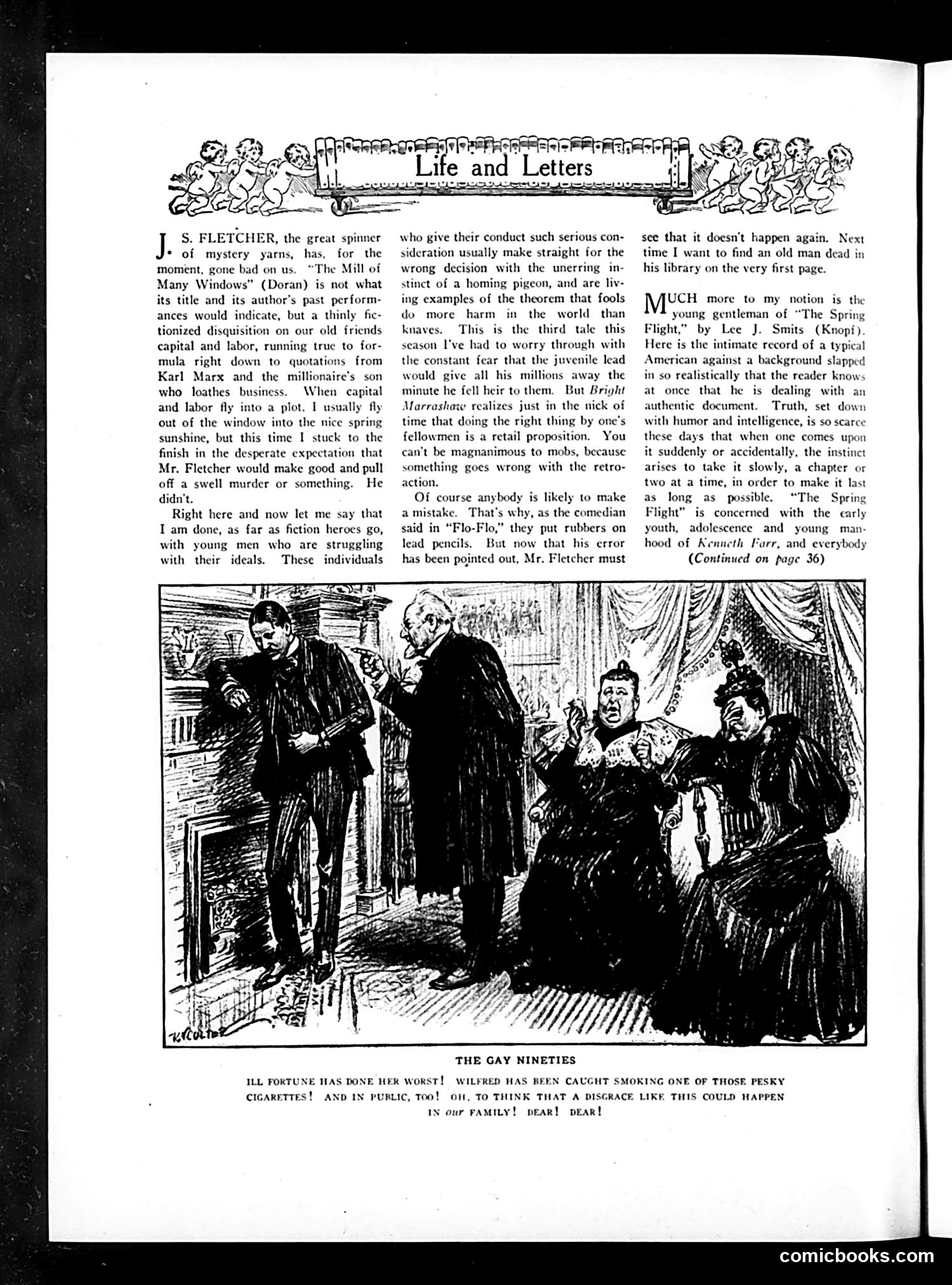
This page contains a literary review column alongside a period cartoon titled "The Gay Nineties." **The Reviews:** Critic J.S. Fletcher dismisses novelist S. Fletcher's *The Mill* for recycling tired socialist themes (capital vs. labor, millionaire sons rejecting business). Fletcher expresses frustration with "young men struggling with their ideals" as protagonists—they predictably make wrong choices. He praises *The Spring Flight* by Lee J. Smits instead, appreciating its authentic, realistic portrayal of youth without heavy-handed ideology. **The Cartoon:** "The Gay Nineties" satirizes Victorian-era social anxieties. A scandal unfolds: young Wilfred has been caught smoking cigarettes in public—a shocking transgression for the period. The shocked family members express horror that "a disgrace like this" could happen to their respectable household. The joke mocks the exaggerated propriety and pearl-clutching morality of the 1890s, where minor vices sparked genuine social shame. The cartoon's humor relies on period attitudes toward tobacco and public decorum that seem quaint to modern readers.
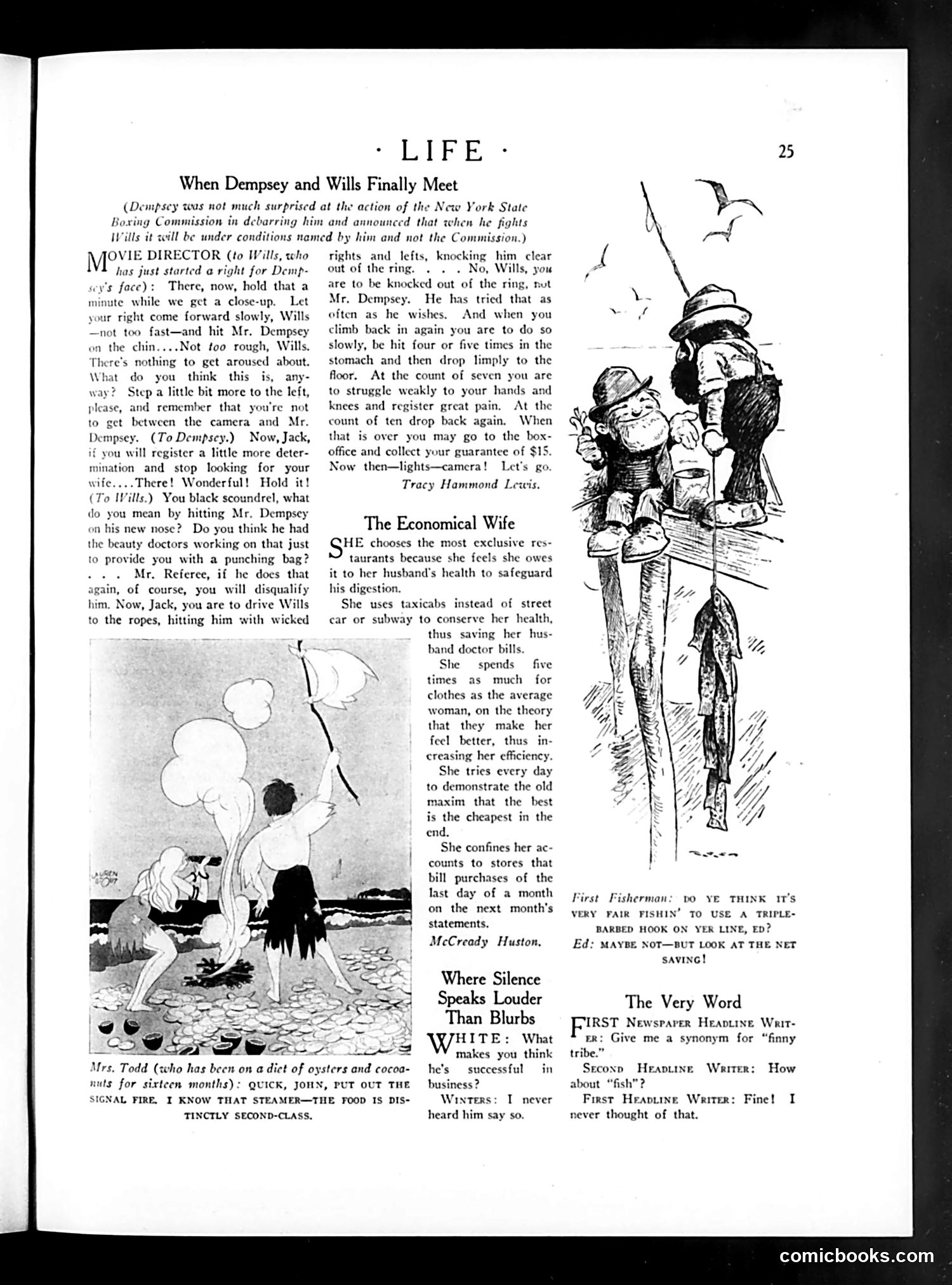
This 1920s *Life* magazine page satirizes the Dempsey-Wills boxing match controversy. The main cartoon mocks a movie director choreographing the fight like a staged film production, with explicit instructions on how Wills (a Black boxer) must lose to champion Jack Dempsey. The satire targets race bias in boxing: Wills is ordered to take predetermined punishment while Dempsey controls the outcome. The director's casual racism ("You black scoundrel") underscores how the sport was rigged against Black competitors. The other cartoons are unrelated humor pieces about economical wives and newspaper writing. The historical context: Dempsey vs. Wills was a contentious 1920s fight delayed by racist objections to interracial boxing. This *Life* piece exposes how the boxing establishment manipulated matches to protect white champions.
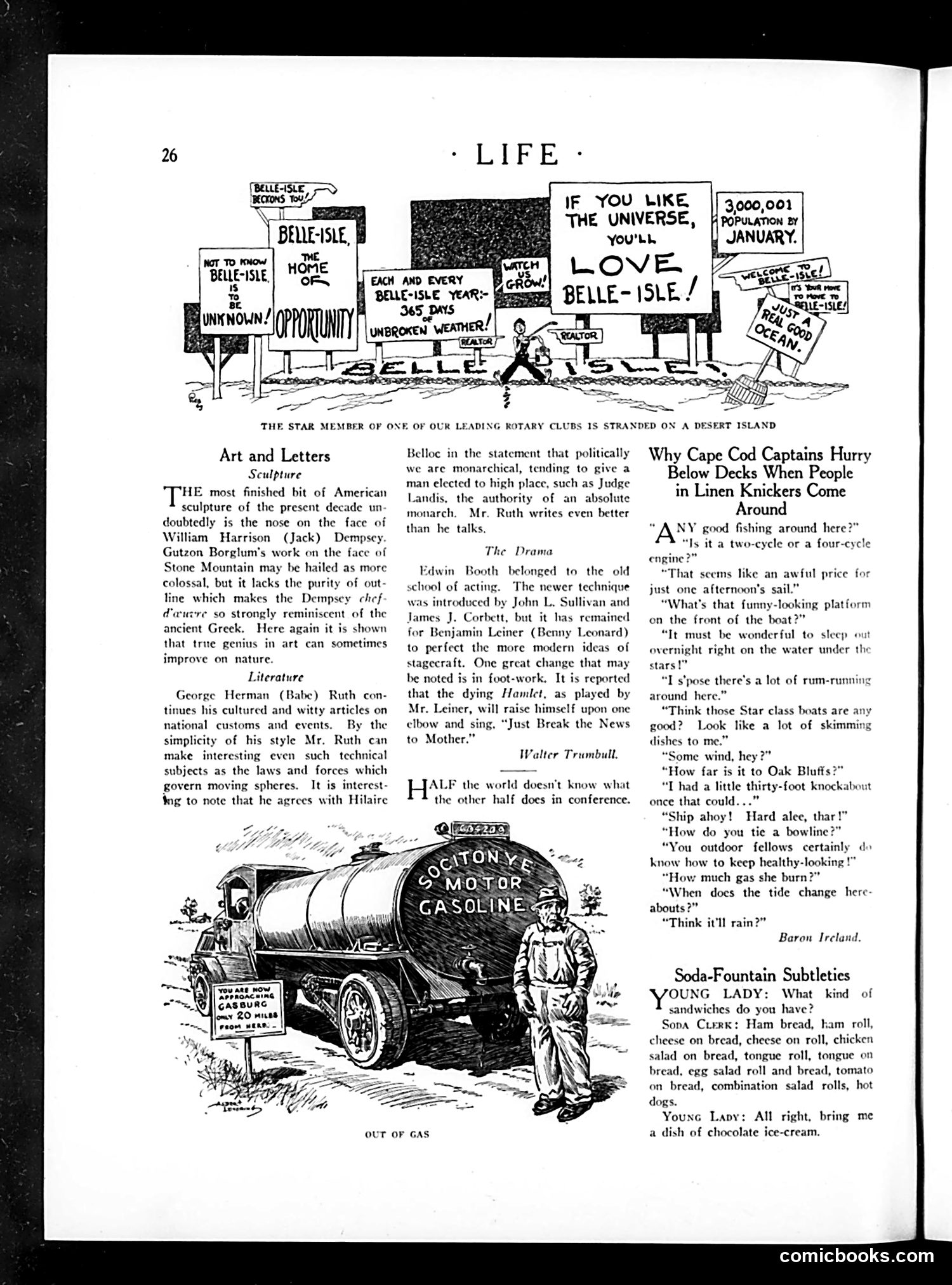
**Top Cartoon**: This satirizes a Rotary Club member stranded on a desert island who has erected promotional billboards for "Belle-Isle," treating even isolation as a marketing opportunity. The joke mocks American business culture's obsession with advertising and salesmanship—even a castaway cannot escape the impulse to promote and sell. **"Art and Letters" Section**: Humorous mock-serious commentary that playfully elevates contemporary celebrities as cultural arbiters. Jack Dempsey (boxer) is praised for his nose as "sculpture"; Babe Ruth is credited with writing intelligent social commentary; boxer-turned-actor Benny Leonard is hailed for modernizing Hamlet's stagecraft. The satire mocks both celebrity worship and the tendency to grant undue intellectual authority to famous athletes. **"Out of Gas" Cartoon**: Depicts a gasoline truck stranded with empty tanks—a straightforward visual joke about ironic predicament. **"Cape Cod Captains" Section**: Satirizes wealthy tourists ("linen knickers") who annoy experienced sailors with ignorant questions about boats, fishing, and maritime practices, forcing captains to hide below deck to avoid them. **"Soda-Fountain Subtleties"**: Mocks overly elaborate menu descriptions where simple items are elaborately named, contrasting with a customer's straightforward request.
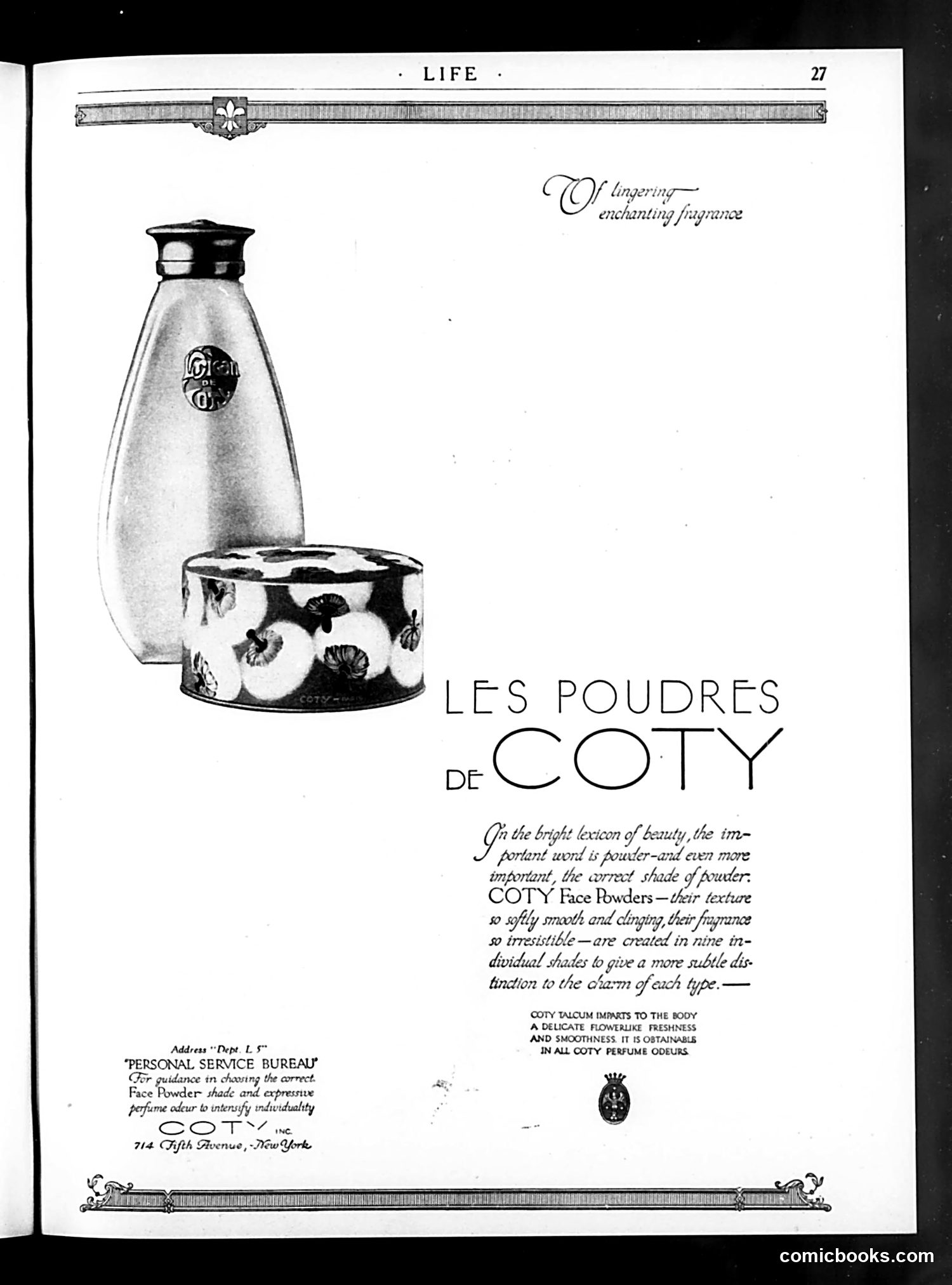
This is a **cosmetics advertisement**, not a political cartoon. It promotes Coty face powders and talcum products—luxury beauty items marketed to women. The ad emphasizes that powder selection is crucial to beauty, and Coty offers nine individual shades to suit different skin tones and complexion types. The elegant bottle and decorative powder container shown are the actual products. The "Personal Service Bureau" references Coty's customer service at their Fifth Avenue location in New York, offering guidance on shade selection—positioning powder choice as a personalized, sophisticated decision requiring expert consultation. This reflects early 20th-century beauty marketing: cosmetics were becoming mainstream and respectable for middle/upper-class women, with manufacturers positioning themselves as authorities on "correct" beauty standards and individual distinction through product choice.
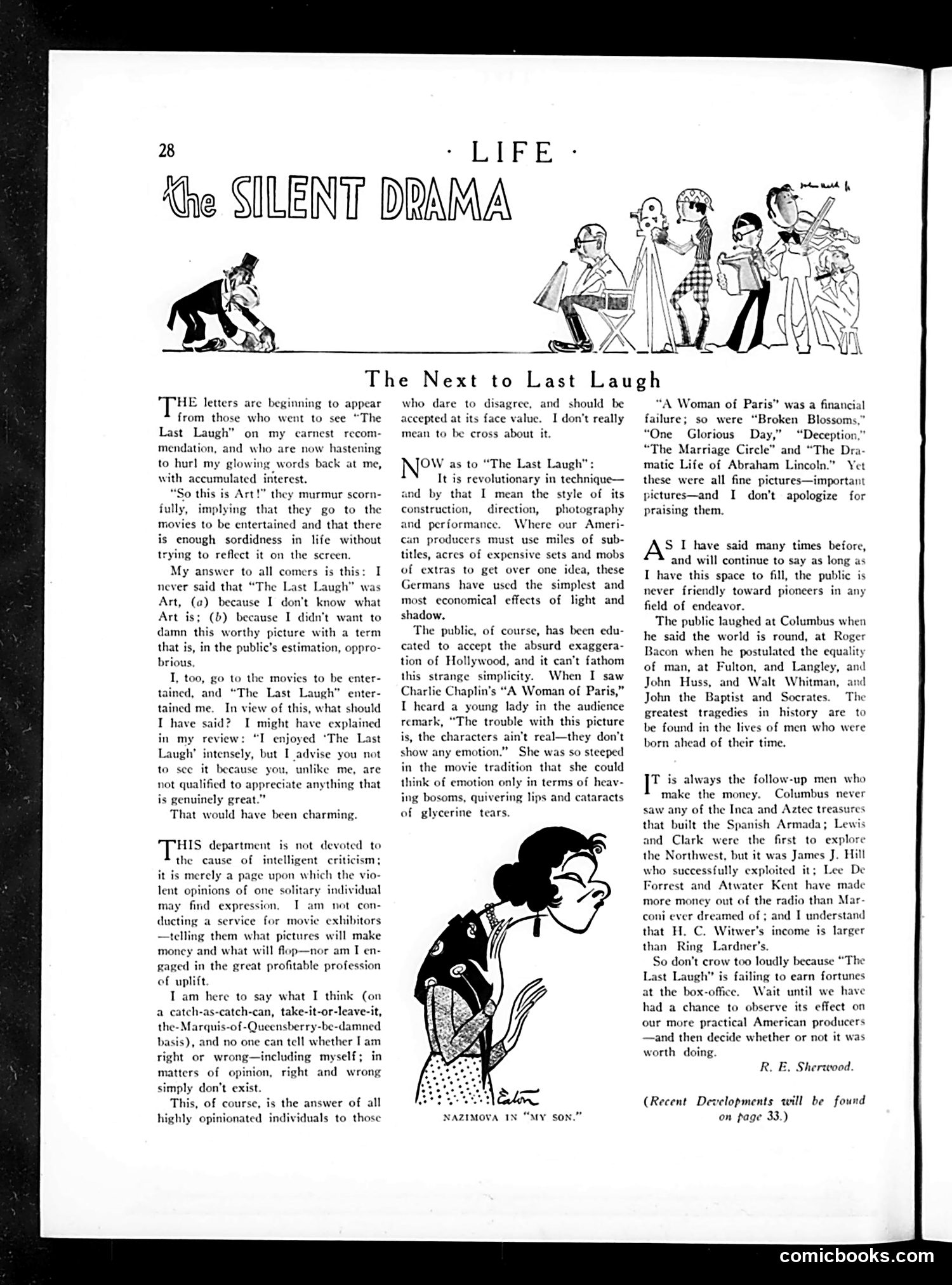
This article defends the German film "The Last Laugh" against critical letters from readers. The author (R.E. Sherwood) argues the film is artistically revolutionary in its *technique*—using minimal sets, titles, and extras compared to Hollywood's excessive style—relying instead on sophisticated cinematography and direction. The satirical point: audiences educated by exaggerated Hollywood melodrama (heaving bosoms, glycerine tears) cannot appreciate subtle, realistic emotion. The cartoon shows a woman (likely Alla Nazimova from "My Son") expressing this shallow reaction. Sherwood defends other "important" financial failures like Chaplin's "A Woman of Paris," arguing pioneers are never popular—citing historical examples (Columbus, Bacon, Whitman). The real money goes to followers, not innovators. The article mocks both mass audiences' limited taste and society's failure to support artistic pioneers.
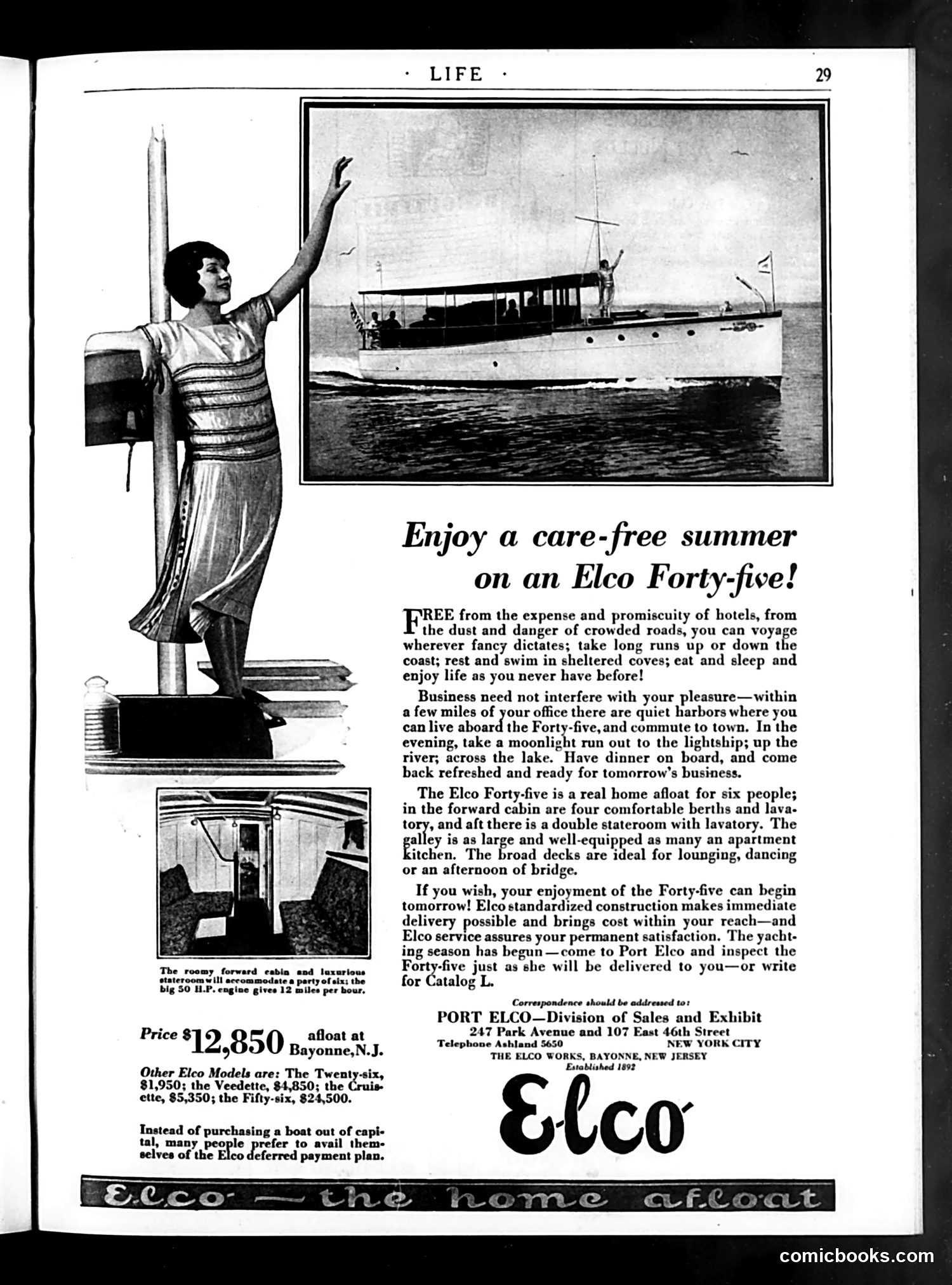
This page is primarily a **product advertisement**, not satire or political commentary. It promotes the Elco Forty-five, a luxury motorboat priced at $12,850 (substantial money in the 1920s). The left image shows a classical female figure (likely representing leisure or freedom) with arm raised triumphantly near a mailbox—symbolizing escape from urban life and business obligations. The adjacent boat photograph displays the actual product. The ad's pitch targets affluent professionals: you can live aboard near your office, commute to work, then enjoy evening cruises and dinners on the boat. This appeals to wealthy businessmen seeking respite from city constraints while maintaining professional responsibilities. The classical statue is purely decorative, evoking aspirational leisure rather than satirizing anything. The overall message is straightforward marketing: the Elco Forty-five promises freedom, comfort, and prestige for the wealthy.
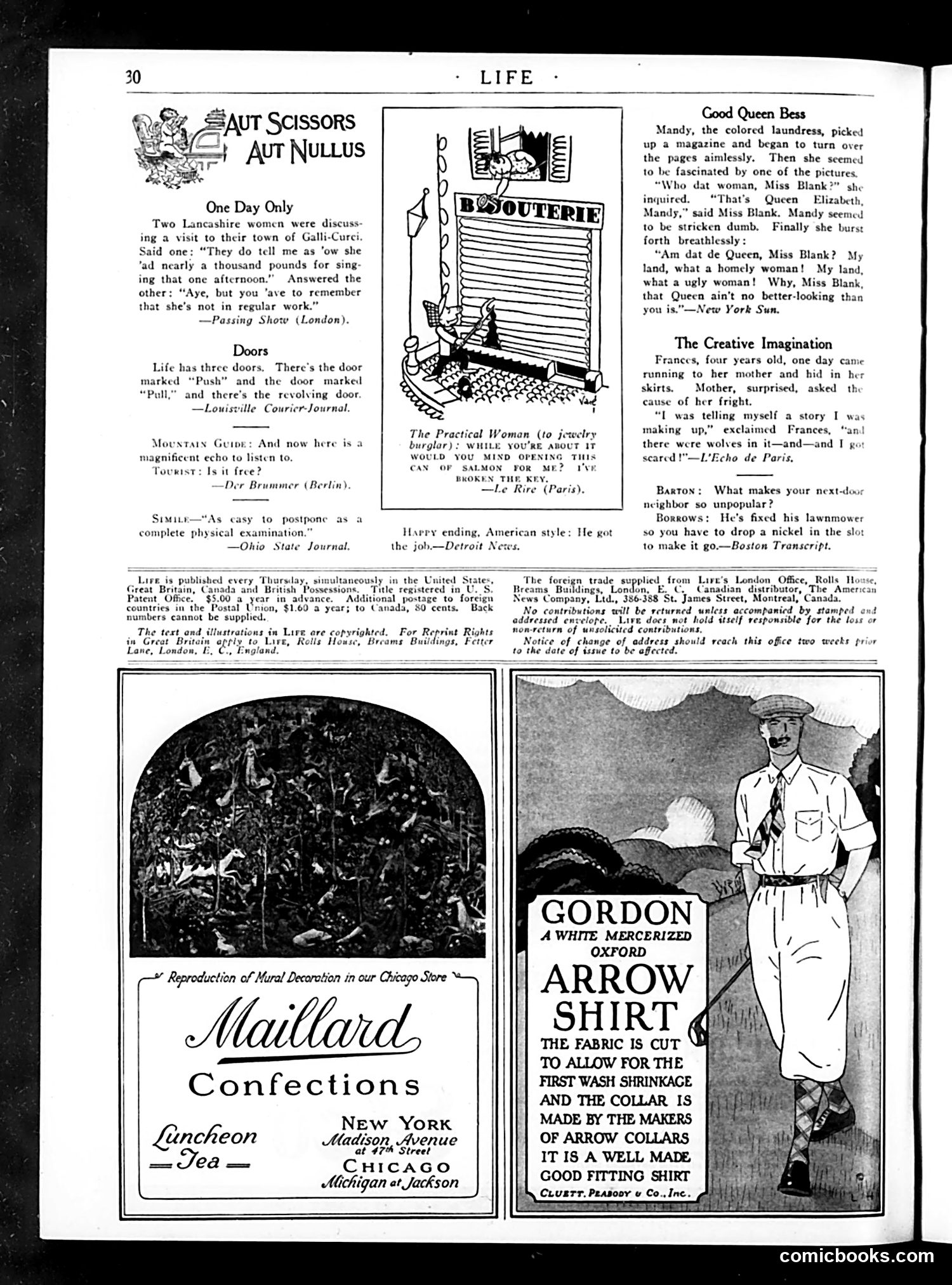
This page from *Life* magazine contains short humorous anecdotes and advertisements rather than political cartoons. The jokes mock working-class speech patterns and social assumptions. "One Day Only" features Lancashire dialect humor about opera singer Amelita Galli-Curci's high fees—the joke being that a woman earning substantial money for one performance is considered unusual because she isn't in "regular work." "Good Queen Bess" relies on racist caricature, presenting a Black laundress's reaction to Queen Elizabeth I with exaggerated dialect, making her unflattering comparison the punchline. "The Creative Imagination" humorously depicts a child frightened by her own invented scary story. Other brief jokes concern doors, echoes, and borrowing lawnmowers—mild observational humor typical of the era. The advertisements feature *Maillard* confections and *Arrow* shirts, emphasizing quality and proper fit. The page reflects early 20th-century American magazine humor standards, including now-offensive racial stereotypes presented as entertainment.
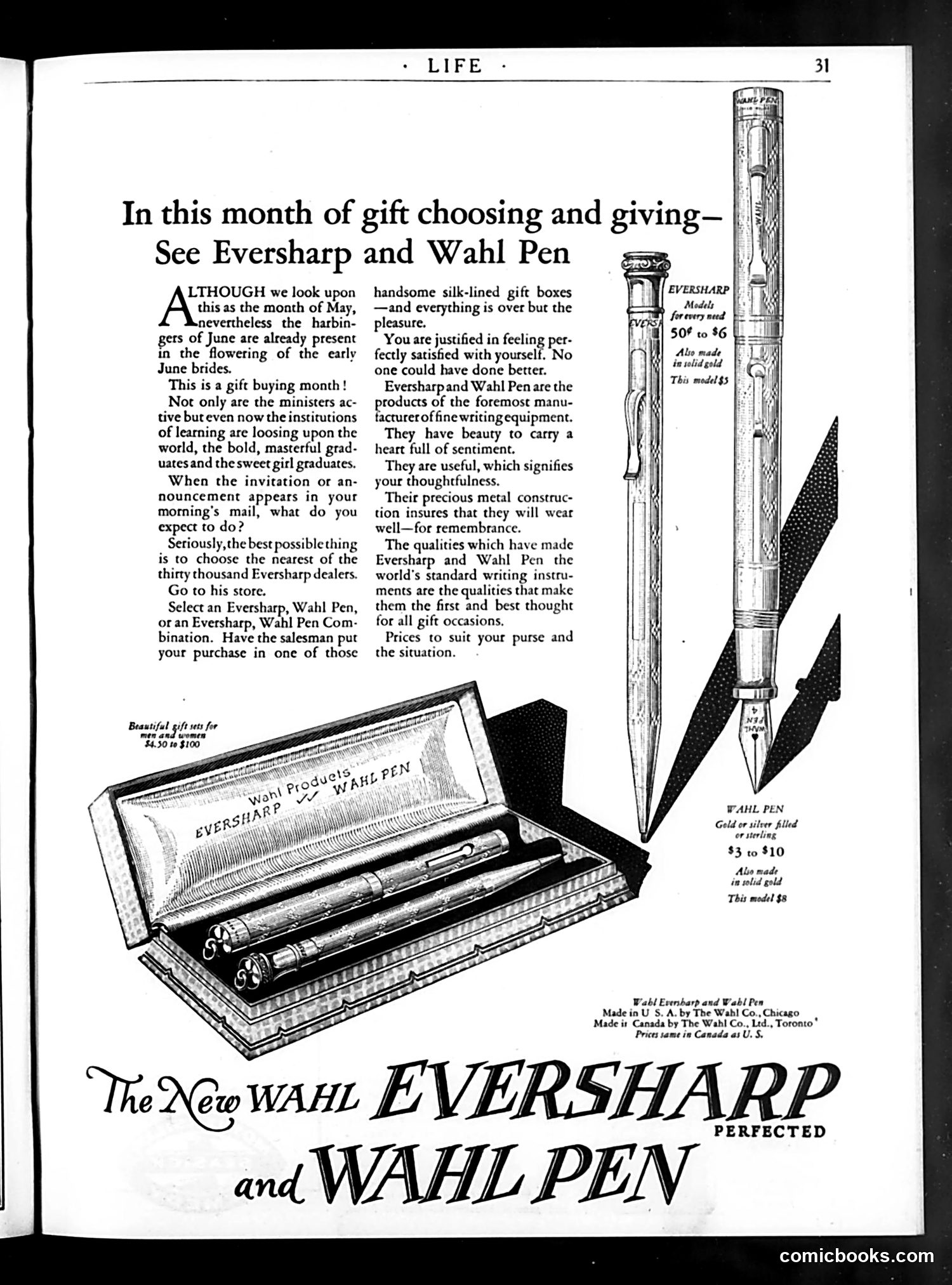
This is a **full-page advertisement**, not editorial content or satire. It promotes Eversharp fountain pens and Wahl pens as graduation and wedding gifts for June. The ad uses the seasonal context of early June—graduation season and wedding announcements—to market writing instruments as thoughtful gifts. It appeals to gift-givers by arguing these pens are "the first and best thought for all gift occasions" because they combine beauty, usefulness, and durability ("precious metal construction" ensuring longevity). The pricing ($3-$100) suggests options across income levels. The ad emphasizes the pens' quality as products of "the foremost manufacturer of fine writing equipment," positioning them as prestigious gifts that signal the giver's thoughtfulness. There is **no cartoon or satire** on this page—it's straightforward commercial persuasion targeting middle-class consumers during gift-giving season.
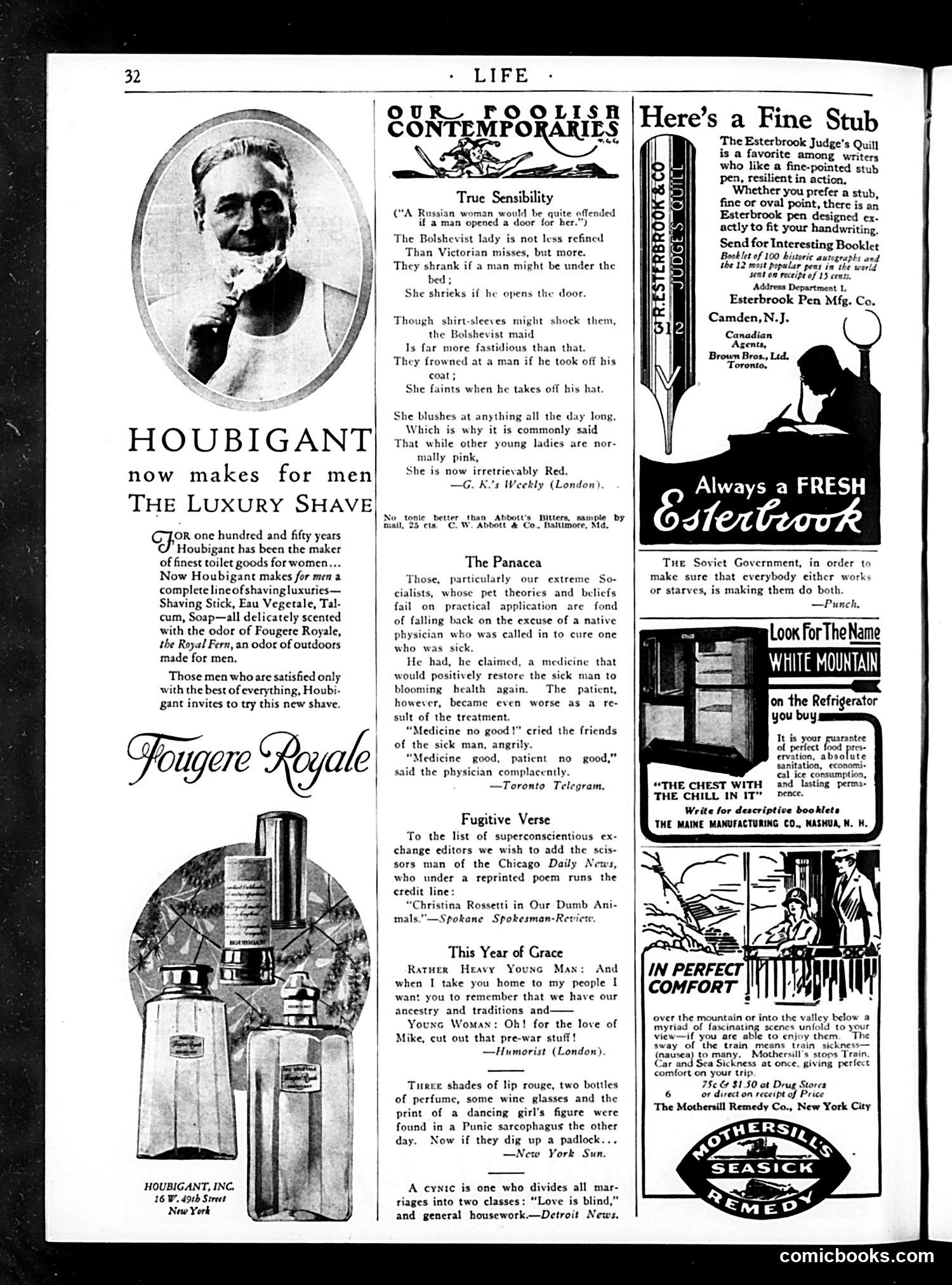
This is primarily an **advertising page** with several satirical poems interspersed. The main content includes: **"True Sensibility"** — A satirical poem contrasting Victorian and Bolshevik women. It mocks Soviet ideology by suggesting that while Bolshevists claimed to reject bourgeois propriety, they're actually *more* prudish than Victorian ladies—fainting at men removing hats, blushing constantly. The punchline notes they're "irretrievably Red" (both embarrassed and communist). **"The Panacea"** — A jab at Socialists whose theories fail in practice, comparing them to a useless physician who blames the patient rather than his medicine. **Other brief satirical items** mock post-war social changes (young women rejecting "pre-war" courtship traditions) and Soviet forced labor policies. The page reflects 1920s American anxiety about Bolshevism and social upheaval, using humor to ridicule both communist ideology and modernizing social norms. The advertisements (Houbigant shaving products, Esterbrook pens, White Mountain refrigerators) anchor it as genuine magazine content from this period.
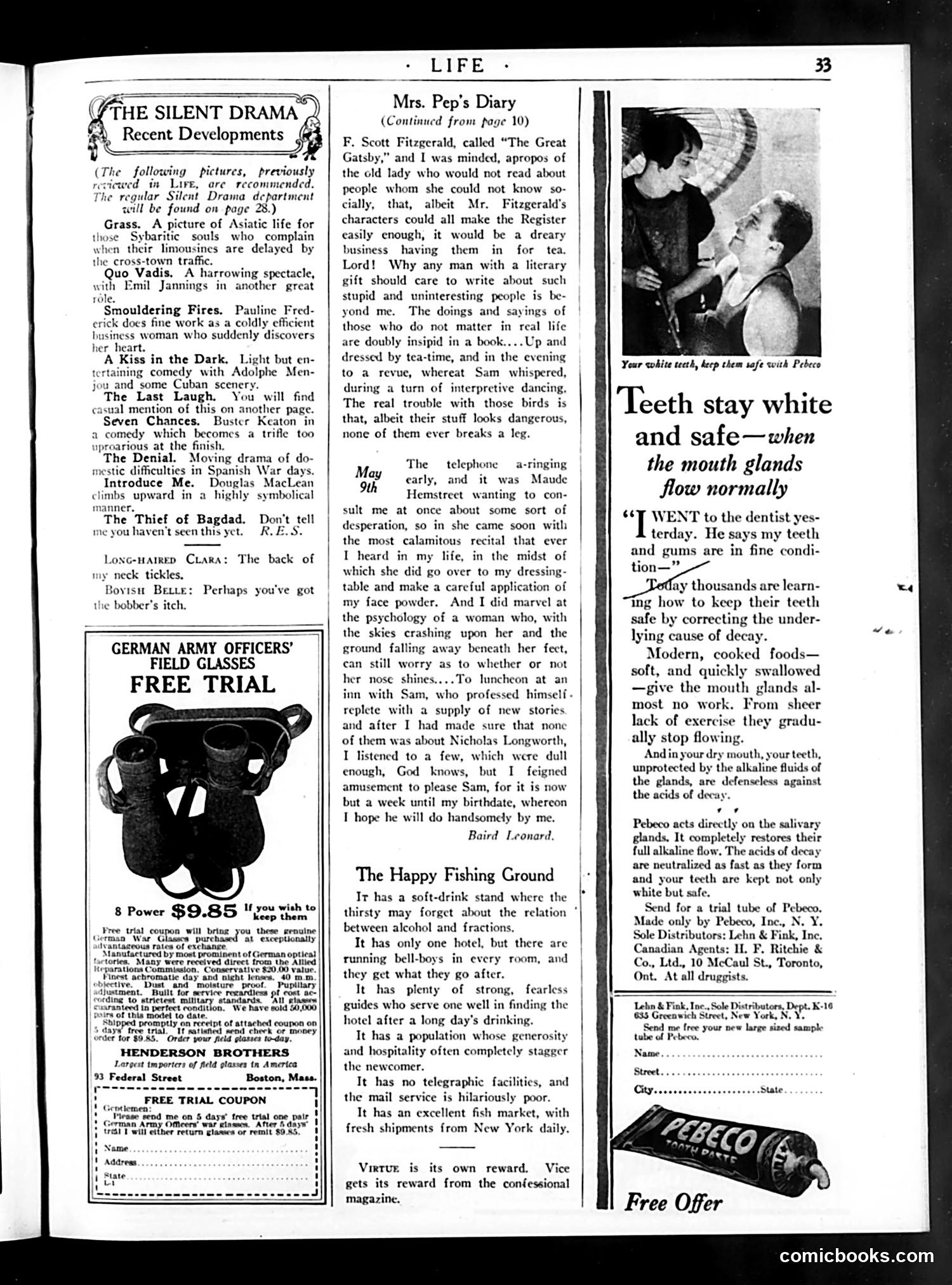
This page is primarily **advertising and diary content**, not political satire. The main items are: **"Mrs. Pep's Diary"**: A gossipy society column mocking literary pretension. The diarist dismisses F. Scott Fitzgerald's *The Great Gatsby*, complaining that writing about "people whom she could not know socially" is tedious—even if they could technically "make the Register" (social register). The satire targets upper-class snobbery: the narrator finds interpretive dancers and dramatic monologues ridiculous, yet obsesses over a friend's nose powder during a crisis. It's gentle mockery of shallow socialites who value appearance over substance. **German Army Officers' Field Glasses advertisement**: Likely exploiting post-WWI sentiment by selling surplus German military equipment as bargains. The reference to "Allied Reparations Commission" suggests these are war spoils being liquidated cheaply. The page reflects 1920s preoccupations: Jazz Age social climbing, literary culture debates, and the commercialization of wartime leftovers.
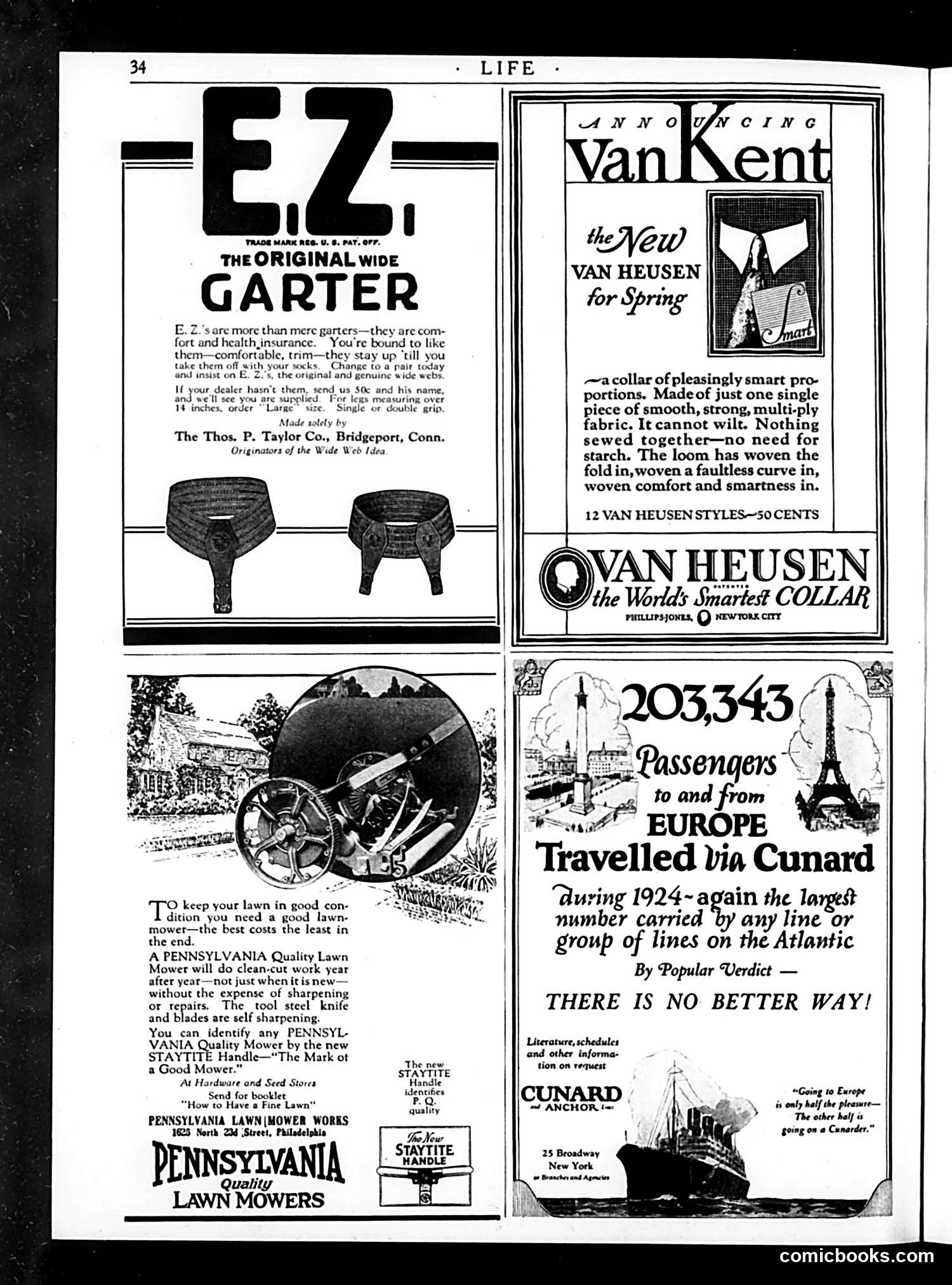
This is primarily an **advertising page**, not satirical content. It contains four distinct product advertisements from circa 1924: 1. **E.Z. Garters** — elastic leg garters marketed as comfortable and durable ("stay up 'till you take them off") 2. **Van Heusen Collars** — dress shirt collars advertised as wrinkle-resistant, made from single-piece fabric requiring no starch 3. **Pennsylvania Lawn Mowers** — featuring "Staytite" handles, marketed as self-sharpening and low-maintenance 4. **Cunard Shipping Line** — promoting transatlantic passenger service to Europe, boasting they carried over 203,000 passengers in 1924, "the largest number carried by any line" The page reflects 1920s consumer culture: practical men's clothing, lawn care equipment, and luxury travel. No political satire is present—these are straightforward commercial advertisements typical of *Life* magazine's revenue model during this era.
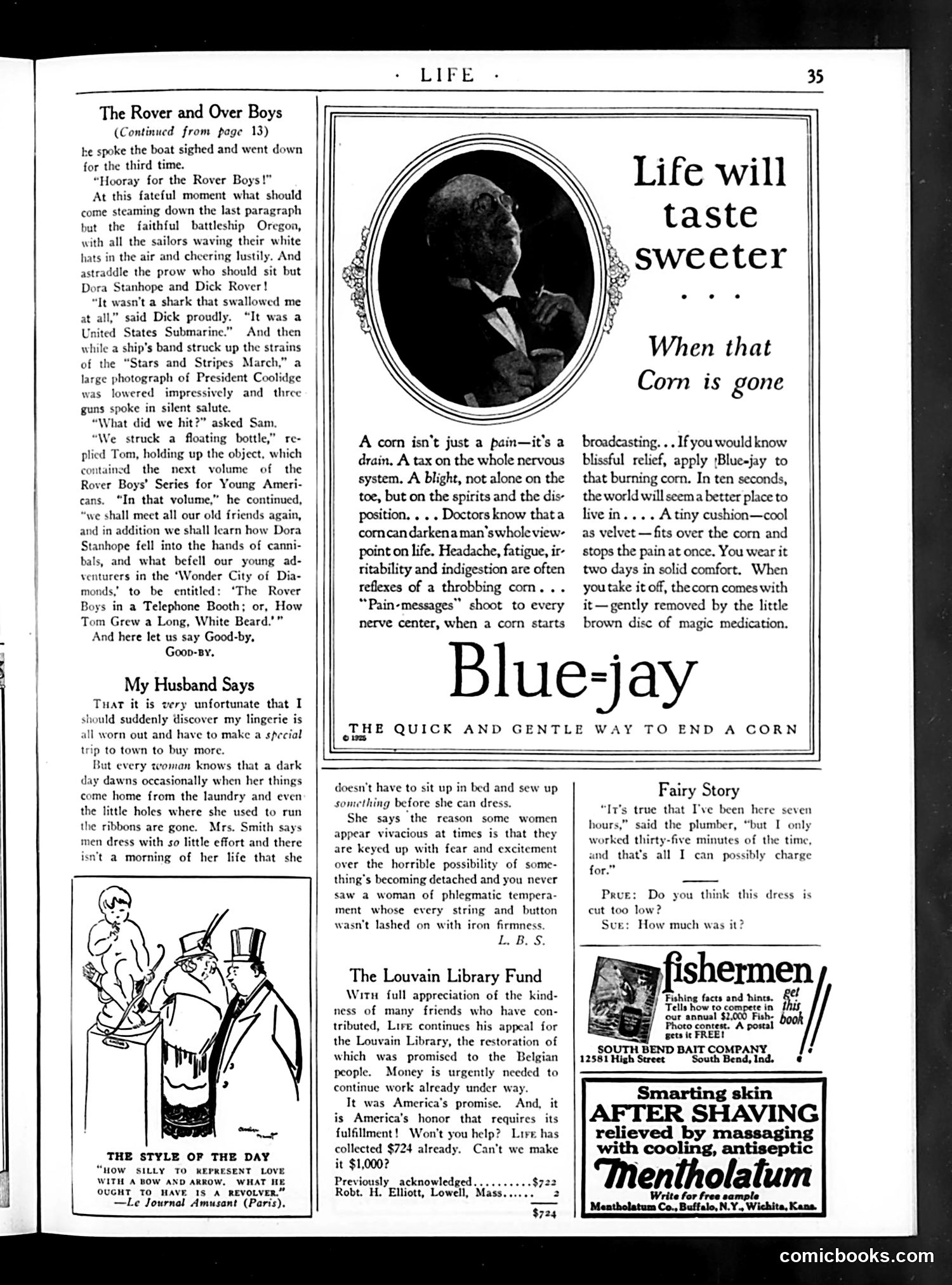
This page contains satirical commentary mixed with period advertisements (circa 1920s). **The Rover Boys parody** (top left) mocks the popular children's adventure series by absurdly escalating its melodrama—a shark, a submarine, President Coolidge's photograph lowered ceremonially, and a ship's band playing "Stars and Stripes March." The joke targets both the series' predictable heroics and Americans' patriotic excess of the era. **"My Husband Says"** is a domestic humor column poking fun at women's lingerie maintenance and the performative effort required to appear "vivacious"—satirizing gender expectations that women must maintain perfect appearance despite men's effortless dressing. **The Paris quote** at bottom left offers French commentary on representing love, sarcastically suggesting a revolver instead of Cupid's arrow—likely social commentary on American violence or courtship customs. The page is otherwise dominated by **advertisements** (Blue-jay corn remedy, fishermen's bait, Mentholatum aftershave) typical of the era's commercial magazine content.
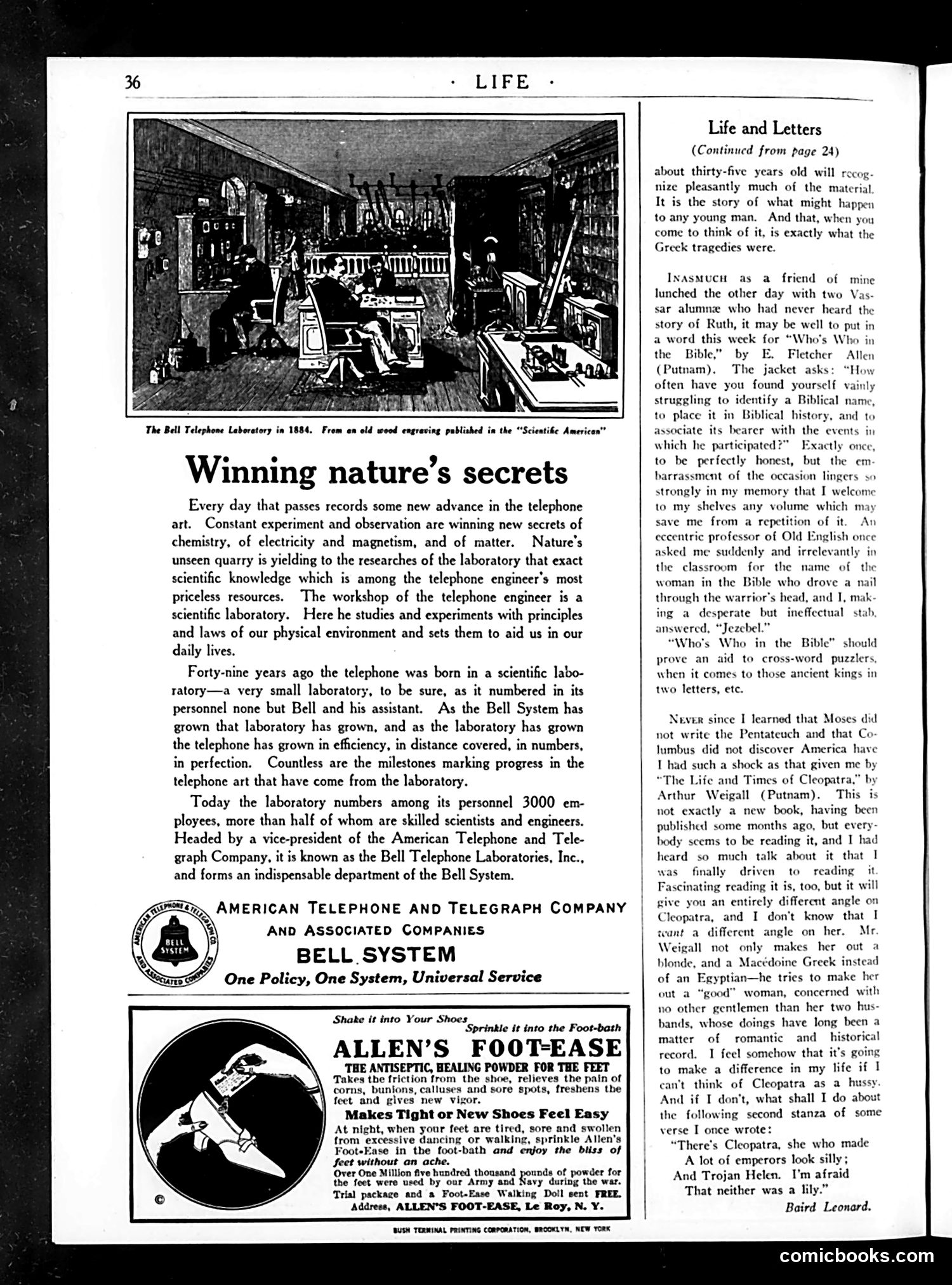
This page is primarily **corporate advertising disguised as editorial content**. The main article, "Winning nature's secrets," celebrates Bell Telephone Laboratories' growth from Alexander Graham Bell's modest two-person operation to a 3,000-person research institution. The piece frames telephone development as scientific progress benefiting society—a common early-20th-century corporate propaganda technique. The accompanying wood engraving shows the 1884 Bell lab, lending historical authority to the narrative. Below is an unrelated advertisement for **Allen's Foot-Ease powder**, a product marketed for foot comfort and pain relief. It notably claims military endorsement, referencing WWI usage by Army and Navy—a common advertising tactic to build consumer trust through patriotic association. The page's juxtaposition reveals how Life magazine blended editorial promotion with advertising, making corporate messaging appear journalistic while monetizing the space.
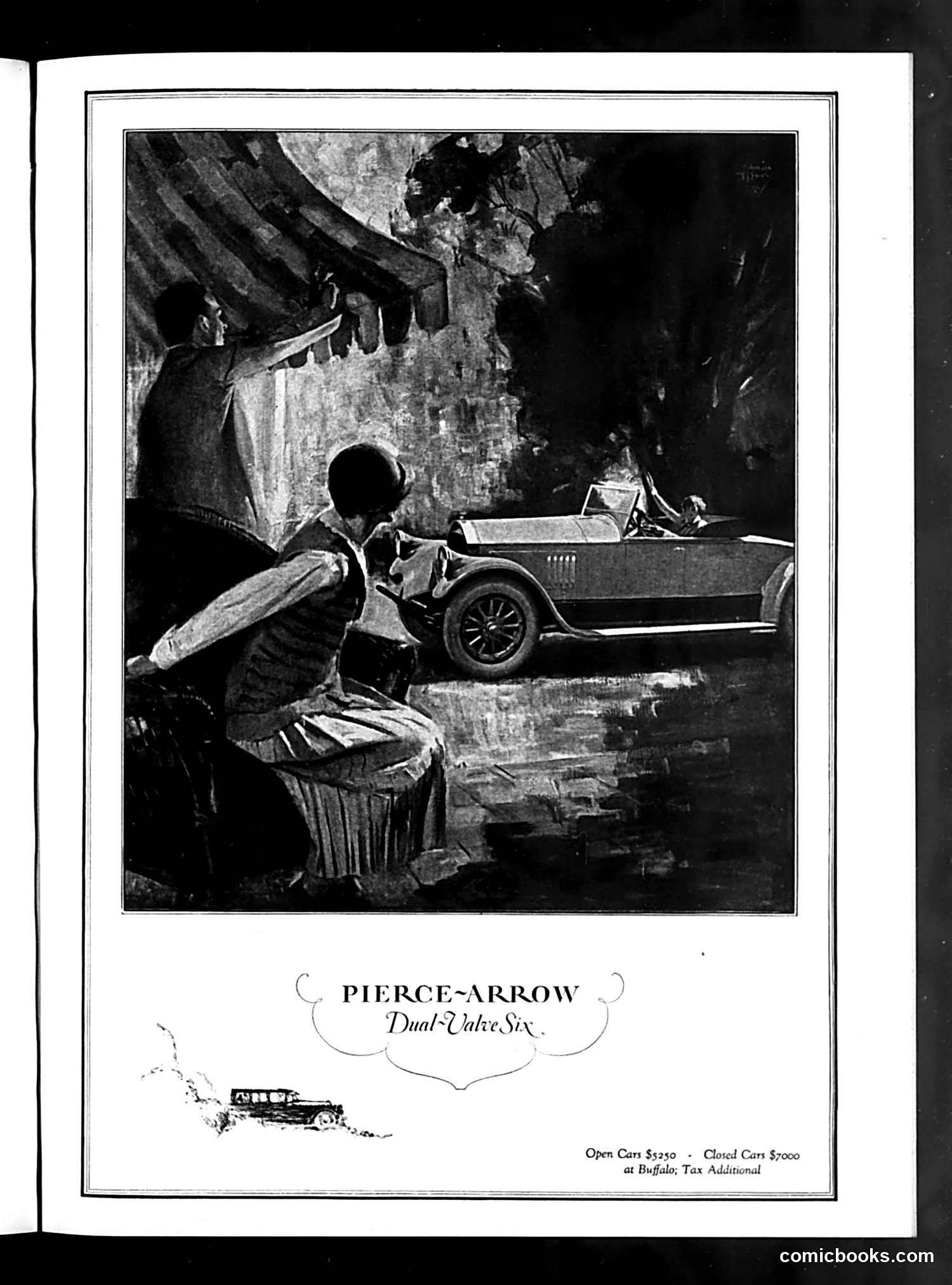
This is a **automobile advertisement**, not political satire. It promotes the Pierce-Arrow "Dual Valve Six" luxury car, manufactured in Buffalo, New York. The image depicts a dramatic nighttime scene: a well-dressed couple in an open-air Pierce-Arrow automobile on what appears to be a city street or alley, with architectural elements suggesting an urban setting. The woman holds a large feathered fan or plume. The advertisement emphasizes luxury and romance—typical marketing for high-end vehicles of this era. Pricing is listed at $5,250 for open cars and $7,000 for closed models (substantial sums in the early 1920s). The theatrical staging and dramatic lighting suggest aspirational lifestyle messaging common to period automobile advertising, rather than commentary or satire.
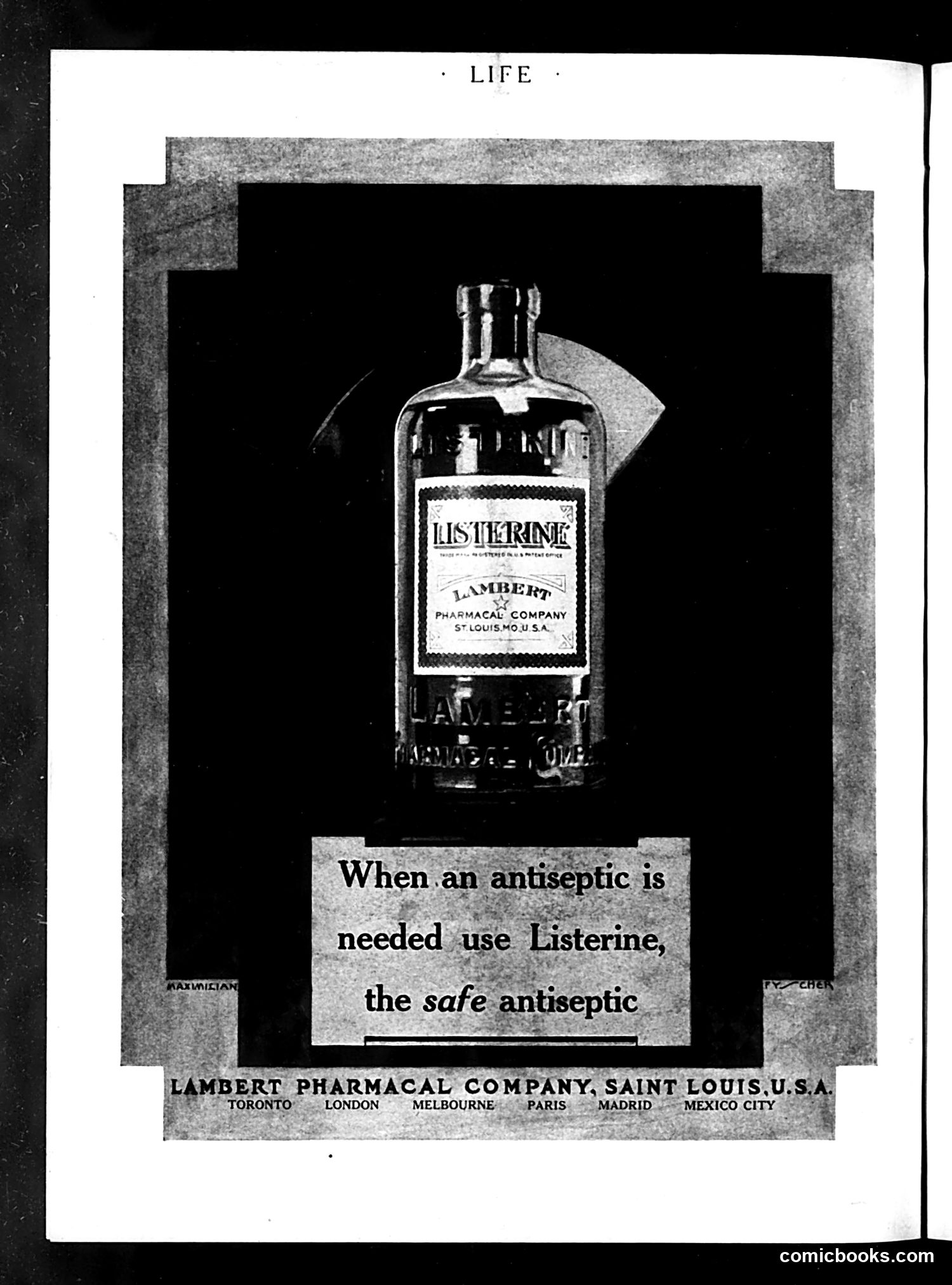
This is a full-page advertisement rather than a cartoon. It promotes Listerine antiseptic mouthwash, manufactured by Lambert Pharmacal Company of Saint Louis. The ad features a large bottle of Listerine against a dark background with the headline "When an antiseptic is needed use Listerine, the *safe* antiseptic." The emphasis on "safe" likely reflects early 20th-century concerns about patent medicines and unregulated products. At this time, many commercial remedies made dubious health claims. By marketing Listerine as the "safe" option, Lambert positioned their product as trustworthy and reliable compared to competing, potentially harmful alternatives. The ad lists international distribution points, suggesting Listerine's global reach and legitimacy.