
Life, 1925-05-14 · page 18 of 40
Life — May 14, 1925 — page 18: what you’re looking at
What you’re looking at
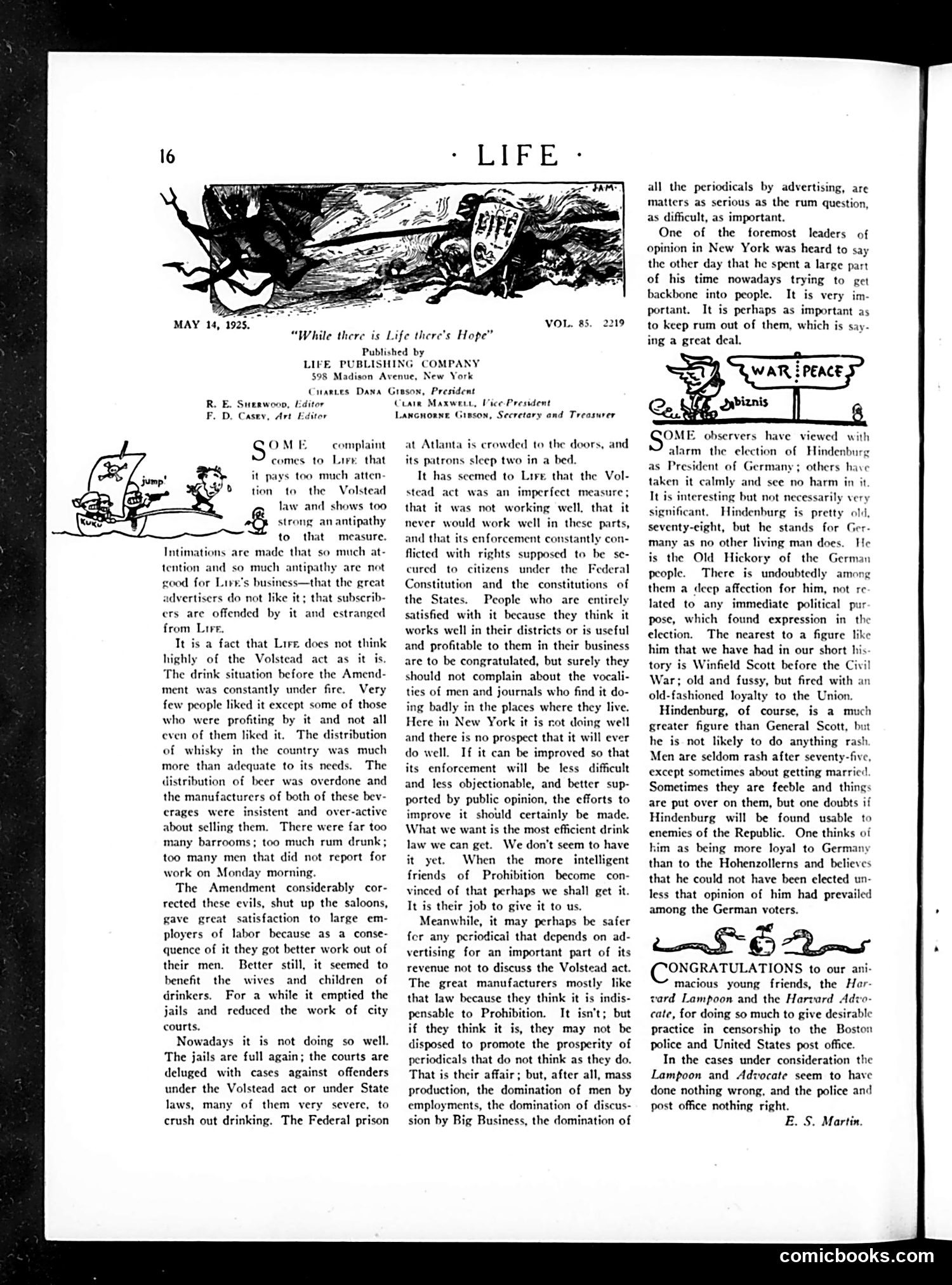
This page contains *Life* magazine's editorial defense of its critical coverage of Prohibition—the constitutional ban on alcohol (1920-1933) enacted via the Volstead Act. **The Issue:** Life's publishers received complaints that the magazine's anti-Prohibition stance offended advertisers and subscribers, potentially hurting business. **Life's Argument:** The editorial acknowledges this pressure but defends its position. It notes that while Prohibition initially improved public welfare (fewer drunks, better worker productivity, emptied jails), it has since "not doing so well"—jails are full again, federal prisons overcrowded, enforcement conflicts with constitutional rights. **The Satire:** Life ironically suggests that periodicals dependent on advertising might wisely *avoid* criticizing Prohibition, since large manufacturers support the law. This highlights the tension between editorial independence and commercial pressure—suggesting that Big Business dominance threatens open discussion. **Historical Context:** This reflects the "Roaring Twenties" conflict between Prohibition's idealistic supporters and practical critics who saw widespread bootlegging and corruption.
📄 Transcribed text from this page (OCR, searchable)
Machine-transcribed from the original scan — historical spelling and the odd misread are preserved.
MAY 14, 1925, | “While there is Life there's Hope” Published by LIFE PUBLISHING COMPANY $98 Madison Avenue, New York Cuarces Dana Grasonx, President R. E. Siterwooo, Editor F. D. Casey, Art Editor OME complaint comes to Lire that it pays too much atten- tion to the Volstead law and shows too & strong an antipathy to that measure. Intimations are made that so much at- tention and so much antipathy are not good for Lirr’s business—that the great advertisers do not like it; that subserib- ers are offended by it and estranged from Lire. Tt is a fact that Lire does not think highly of the Volstead act as it is. The drink situation before the Amend- ment was constantly under fire. Very few people liked it except some of those who were profiting by it and not all even of them liked it. The distribution of whisky in the country was much more than adequate to its needs. The distribution of beer was overdone and the manufacturers of both of these bev- crages were insistent and over-active about selling them. There were far too many barrooms; too much rum drunk; too many men that did not report for work on Monday morning. The Amendment considerably cor- rected these evils, shut up the saloons, gave great satisfaction to large em- ployers of labor because as a conse- quence of it they got better work out of their men. Better still, it seemed to benefit the wives and children of drinkers. For a while it emptied the jails and reduced the work of city courts, Nowadays it is not doing so well. The jails are full again; the courts are deluged with cases against offenders under the Volstead act or under State laws, many of them very severe, to crush out drinking. The Federal prison Corre Maxwent, Vice President Lancnorne Gisson, Secretary and Treasurer at Atlanta is crowded to the doors, and its patrons sleep two in a bed. It has scemed to Lire that the Vol- stead act was an imperfect measure; that it was not working well, that it never would work well in these parts, and that its enforcement constantly con- flicted with rights supposed to be se- cured to citizens under the Federal Constitution and the constitutions of the States. People who are entirely satisfied with it because they think it works well in their districts or is useful and profitable to them in their business are to be congratulated, but surely they should not complain about the vocali- ties of men and journals who find it do- ing badly in the places where they live. Here in New York it is rot doing well and there is no prospect that it will ever do well. If it can be improved so that its enforcement will be less difficult and less objectionable, and better sup- ported by public opinion, the efforts to improve it should certainly be made. What we want is the most efficient drink law we can get. We don’t seem to have it yet. When the more intelligent friends of Prohibition become con- vinced of that perhaps we shall get it. It is their job to give it to us. Meanwhile, it may perhaps be safer fer any periodical that depends on ad- vertising for an important part of its revenue not to discuss the Volstead act. The great manufacturers mostly like that law because they think it is indis- pensable to Prohibition. It isn't; but if they think it is, they may not be disposed to promote the prosperity of periodicals that do not think as they do. That is their affair; but, after all, mass production, the domination of men by employments, the domination of discus- sion by Big Business, the domination of all the periodicals by advertising, are matters as serious as the rum question, as difficult, as important. One of the foremost leaders of opinion in New York was heard to say the other day that he spent a large part of his time nowadays trying to get backbone into people. It is very im- portant. It is perhaps as important as to keep rum out of them, which is say- ing a great deal. 2 observers have viewed with alarm the election of Hindenburg as President of Germany; others have taken it calmly and see no harm in it It is interesting but not n sarily very significant. Hindenburg is pretty old, seventy-eight, but he stands for Ger- many as no other living man does. He is the Old Hickory of the German people. There is undoubtedly among them a deep affection for him, not re lated to any immediate political pur » which found expression in the election. The nearest to a figure like him that we have had in our short his tory is Winfield Scott before the Civil War; old and fussy, but fired with an old-fashioned loyalty to the Union. Hindenburg, of course, is a muct greater figure than General Scott, but he is not likely to do anything rash Men are seldom rash after seventy-five, except sometimes about getting married Sometimes they are feeble and things are put over on them, but one doubts if Hindenburg will be found usable to enemies of the Republic. One thinks of kim as being more loyal to Germany than to the Hohenzollerns and believes that he could not have been elected un- less that opinion of him had prevailed among the German voters. Cn E53 Views ONGRATULATIONS to our ani- macious young friends, the Har vard Lampoon and the Harvard Advo- cate, for doing so much to give desirable practice in censorship to the Boston police and United States post office. In the cases under consideration the Lampoon and Advocate seem to have done nothing wrong, and the police and post office nothing right. E. S. Martin. comicbooks.com