
Life, 1925-05-14 · page 30 of 40
Life — May 14, 1925 — page 30: what you’re looking at
What you’re looking at
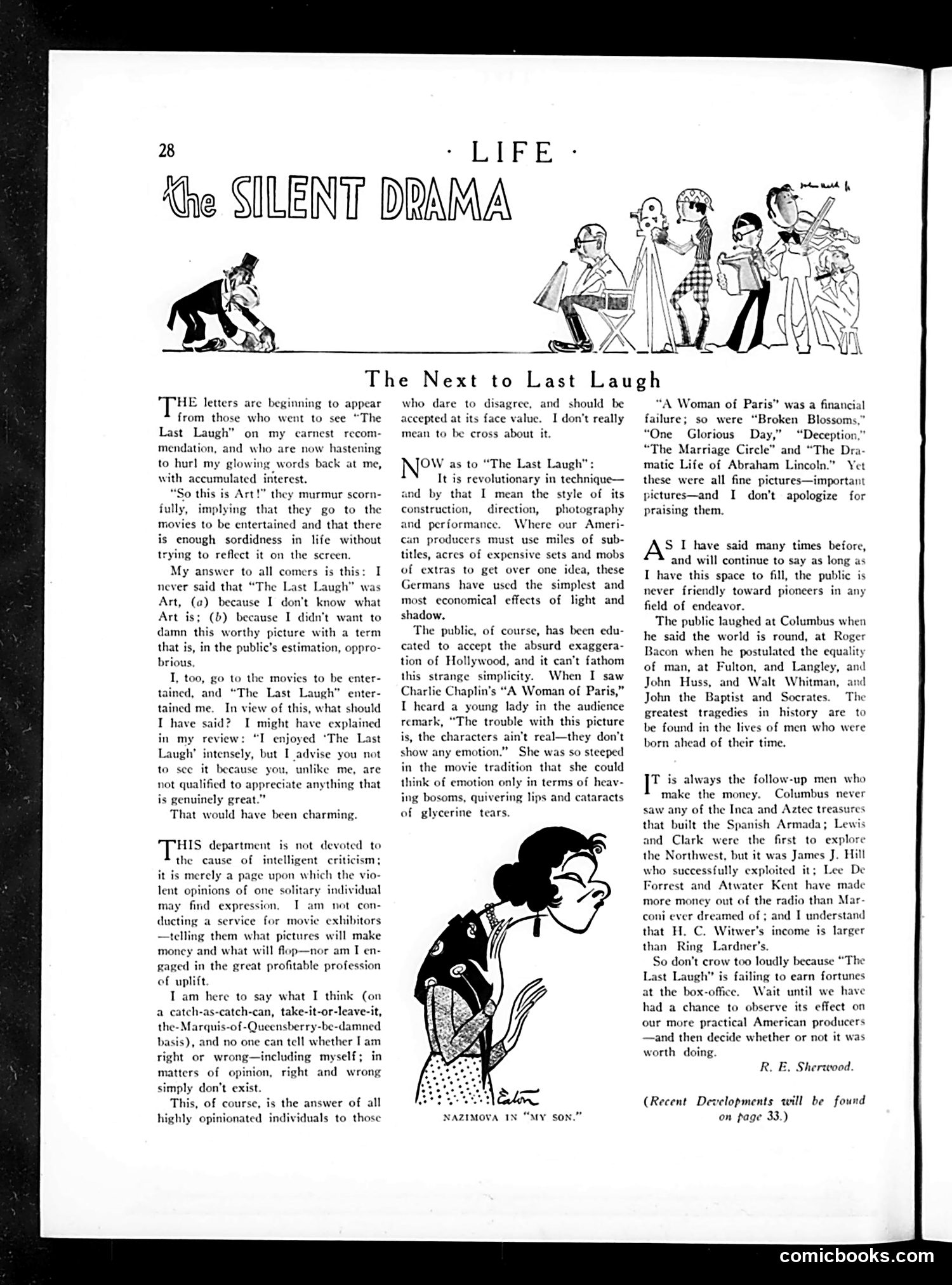
This article defends the German film "The Last Laugh" against critical letters from readers. The author (R.E. Sherwood) argues the film is artistically revolutionary in its *technique*—using minimal sets, titles, and extras compared to Hollywood's excessive style—relying instead on sophisticated cinematography and direction. The satirical point: audiences educated by exaggerated Hollywood melodrama (heaving bosoms, glycerine tears) cannot appreciate subtle, realistic emotion. The cartoon shows a woman (likely Alla Nazimova from "My Son") expressing this shallow reaction. Sherwood defends other "important" financial failures like Chaplin's "A Woman of Paris," arguing pioneers are never popular—citing historical examples (Columbus, Bacon, Whitman). The real money goes to followers, not innovators. The article mocks both mass audiences' limited taste and society's failure to support artistic pioneers.
📄 Transcribed text from this page (OCR, searchable)
Machine-transcribed from the original scan — historical spelling and the odd misread are preserved.
the ' LIE « NI DRAMA The Next to Last Laugh HE letters are beginning to appear from those who went to see “The Last Laugh” on my carnest recom- mendation, and who are now hastening to hurl my glowing words back at me, with accumulated interest. “So this is Art!” they murmur scorn- , implying that they go to the movies to be entertained and that there is enough sordidness in life without trying to reflect it on the screen. My answer to all comers is this: I never said that “The t Laugh’ Art, (a) because I don't know what Art is; (b) because I didn’t want to damn this worthy picture with a term that is, in the public’s estimation, oppro- brious, was I, too, go to the movies to be enter- tained, and “The Last Laugh” enter- tained me, In view of this, what should I have said? I might have explained "I enjoyed ‘The Last Laugh’ intensely, but I advise you not to see it because you, unlike me, are not qualified to appreciate anything that is genuinely great That would have been charming. in my review HIS department is not devoted to the cause of intelligent criticism it is merely a page upon which the vio- lent opinions of one solitary individual may find expression, Tam not con- ducting a service for movie exhibitors —telling them what pictures will make moncy and w will flop—nor am I en- ged in the great profitable profession uplift. I am here to say what I think (on a catch-as-catch-can, take-it-or-leave-it, the- Marquis-of-Queensberry-be-damned basis), and no one can tell whether Tam right or wrong—including myself; in matters of opinion, right and wrong simply don’t exist. This, of course, is the answer of all highly opinionated individuals to those who dare to disagree, and should be accepted at its face value. I don’t really mean to be cross about it. OW as to “The Last Laugh": It is revolutionary in technique— and by that I mean the style of its construction, direction, photography and performance. Where our Ameri- can producers must use miles of sub- titles, acres of expensive sets and mobs of extras to get over one idea, these Germans have used the simplest and most economical effects of light and shadow. The public, of course, has been edu- cated to accept the absurd exaggera- tion of Hollywood, and it can’t fathom this strange simplicit When I saw Charlie Chaplin's “A Woman of Paris,” I heard a young lady in the audience remark, “The trouble with this picture is, the characters ain't real—they don't show any emotion.” She was so steeped in the movie tradition that she could think of emotion only in terms of heav- ing bosoms, quivering lips and cataracts of glycerine tears. NAZIMOVA IN “MY SON.” “A Woman of Paris” was a financial failure; so were “Broken Blossom “One Glorious Day,” “Deceptior “The Marriage Circle” and “The Dra- matic Life of Abraham Lincoln.” Yet these were all fine pictures—important pictures—and I don’t apologize for praising them. AS I have said many times before, and will continue to say as long as I have this space to fill, the public is never friendly toward pioneers in any field of endeavor. The public laughed at Columbus when he said the world is round, at Roger Bacon when he postulated the equality of man, at Fulton, and Langley, and John Huss, and Walt Whitman, d John the Baptist and Socrates. The greatest tragedies in history are to be found in the lives of men who were born ahead of their time. T is the follow-up men who make the money. Columbus never saw any of the Inca and Aztec treasures that built the Spanish Armada; Lewis and Clark were the first to exple the Northwest, but it was James J. Hill who successfully exploited it; Lee De Forrest and Atwater Kent have made more money out of the radio than Mar- coni ever dreamed of ; and I understand that H. C. Witwer's income is larger than Ring Lardner’s. So don't crow too loudly because “The Last Laugh” is failing to earn fortunes at the box-office. Wait until we have had a chance to observe its effect on our more practical American producers —and then decide whether or not it was worth doing. R. E, Sherwood. (Recent Developments will be found on page 33.) comicbooks.com