
Life, 1925-05-14 · page 22 of 40
Life — May 14, 1925 — page 22: what you’re looking at
What you’re looking at
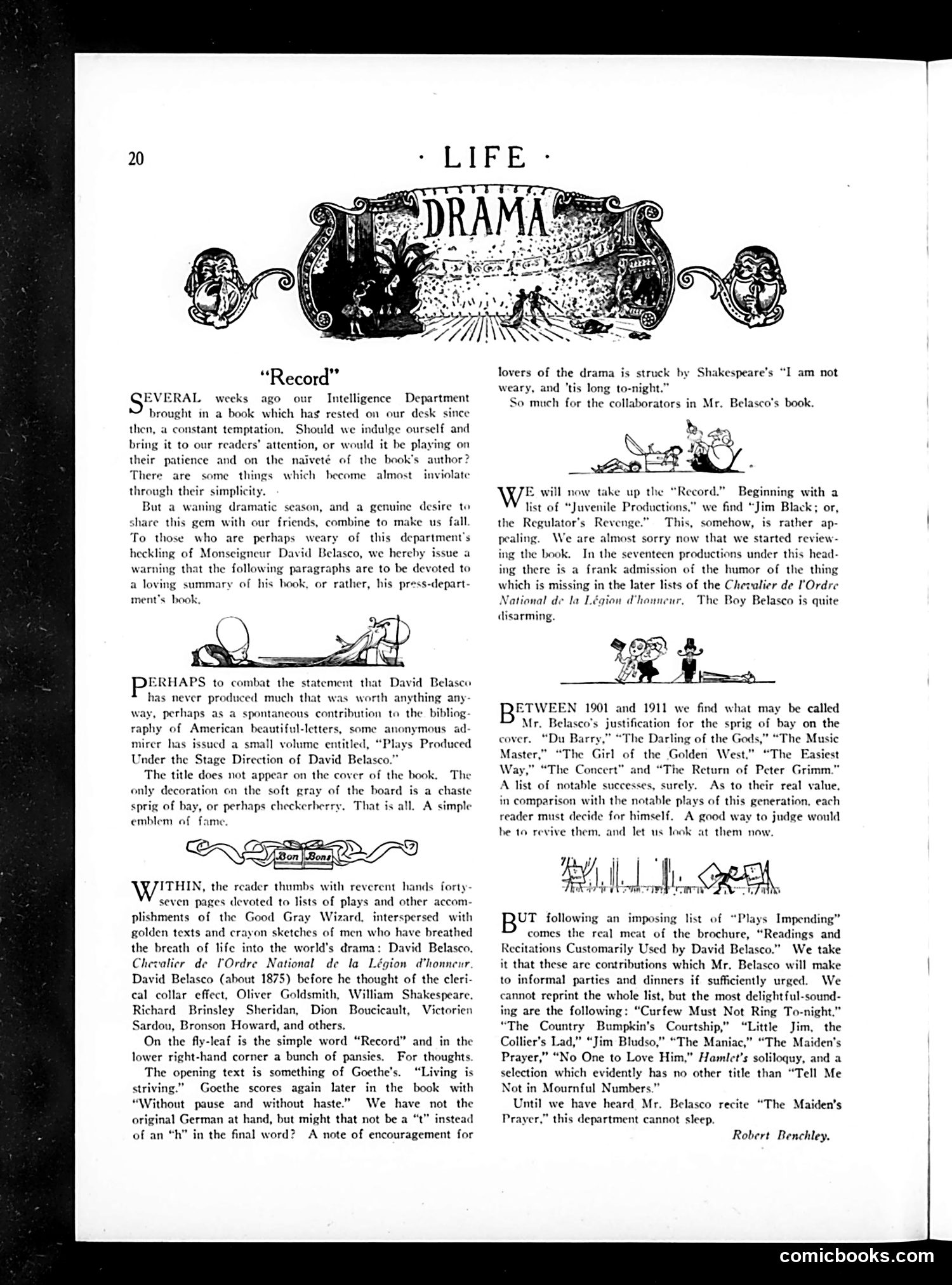
This is a satirical review of a vanity publication—a book called "Plays Produced Under the Stage Direction of David Belasco"—authored anonymously but clearly by the famous theatrical producer David Belasco himself. Life's critic Robert Benchley mocks the book's pretentious packaging and overwrought self-aggrandizement. The publication includes 47 pages listing Belasco's plays alongside literary giants (Shakespeare, Goldsmith, Sheridan), epigraphs from Goethe, and crayon sketches. Benchley notes the contradiction between Belasco's earlier "juvenile productions" (which at least admitted humor) and his later works, which he presents without irony as masterpieces. The satire's core: a powerful theater director publishing an elaborate press release disguised as a book to justify his historical importance. Benchley suggests readers should simply revive the plays themselves to judge their actual merit—the ultimate dismissal of Belasco's self-mythologizing.
📄 Transcribed text from this page (OCR, searchable)
Machine-transcribed from the original scan — historical spelling and the odd misread are preserved.
“Record” VERAL weeks ago our Intelligence Department brought in a book which hag rested on our desk since then, a constant temptation, Should we indulge ourself and bring it to our readers’ attention, or would it be playing on their patience and on the naiveté of the book's author? There are some things which become almost through their simplicity. But a waning dramatic season, and a genuine desire to share this gem with our friends, combine to make us fall To those who are perhaps weary of this department's heckling of Monseigneur David Belasco, we hereby issue a warning that the following paragraphs are to be devoted to a loving summary of his hook, or rather, his press-depart- ment's book, inviolate ERHAPS to combat the statement that David Belasco has never produced much that was worth anything any- » perhaps as a spontaneous contribution to the bibliog- raphy of American beautiful-letters, some anonymous ad mirer has issued a small volume entitled, “Plays Produced Under the Stage Direction of David Belasco.” The title does not appear on the cover of the book. The only decoration on the soft gray of the board is a chaste sprig of bay, or perhaps checkerherry. That is all. A simple emblem of fame. C)\VE Gon end DFAT ITHIN, the reader thumbs with reverent hands forty- seven pages devoted to lists of plays and other accom- plishments of the Good Gray Wizard, interspersed with golden texts and crayon sketches of men who have breathed the breath of life into the world's drama: David Belasco, Chevalier de Ordre National de la Légion d'honneur David Belasco (about 1875) before he thought of the cleri- cal collar effect, Oliver Goldsmith, William Shakespeare, Richard Brinsley Sheridan, Dion Boucicault, Victorien Sardou, Bronson Howard, and others. On the fly-leaf is the simple word “Record” and in the lower right-hand corner a bunch of pansies. For thoughts. The opening text is something of Goethe's. “Living is striving.” Goethe scores again later in the book with “Without pause and without haste.” We have not the original German at hand, but might that not be a “t” instead of an “h” in the final word? A note of encouragement for lovers of the drama is struck by Shakespeare’s “I am not weary, and ‘tis long to-night.” So much for the collaborators in Mr. Belasco’s book. E will now take up the “Record.” Beginning with a list of “Juvenile Productions,” we find “Jim Black; or, the Regulator’s Revenge.” This, somehow, is rather ap- pealing. We are almost sorry now that we started review- ing the book. In the seventeen productions under this head- ing the a frank admission of the humor of the thing which is missing in the later lists of the Chevalier de l'Ordre National de la Légion d'honneur, The Boy Belasco is quite disarming. ETWEEN 1901 and 1911 we find what may be called Mr. Belasco’s justification for the sprig of bay on the cover. “Du Barry,” “The Darling of the Gods,” “The Music Master,” “The Girl of the Golden West.” “The Easiest Way,” “The Concert” and “The Return of Peter Grimm.” A list of notable successes, surely. As to their real value, in comparison with the notable plays of this generation, each reader must decide for himself. A good way to judge would he to revive them, and let us look at them now, BUT fottowing an imposing list of “Plays Impending” comes the real meat of the brochure, “Readings and Recitations Customarily Used by David Belasco.” We take it that these are contributions which Mr. Belasco will make to informal parties and dinners if sufficiently urged. We cannot reprint the whole list, but the most delightful-sound- ing are the following: “Curfew Must Not Ring To-night.” “The Country Bumpkin's Courtship,” “Little Jim, the Collier's Lad,” “Jim Bludso,” “The Maniac,” “The Maiden's Prayer,” “No One to Love Him,” Hamlet’s soliloquy, and a selection which evidently has no other title than “Tell Me Not in Mournful Numbers.” Until we have heard Mr. Belasco recite “The Maiden’s Prayer,” this department cannot sleep. Robert Renchley. comicbooks.com