
Life, 1925-05-14 · page 9 of 40
Life — May 14, 1925 — page 9: what you’re looking at
What you’re looking at
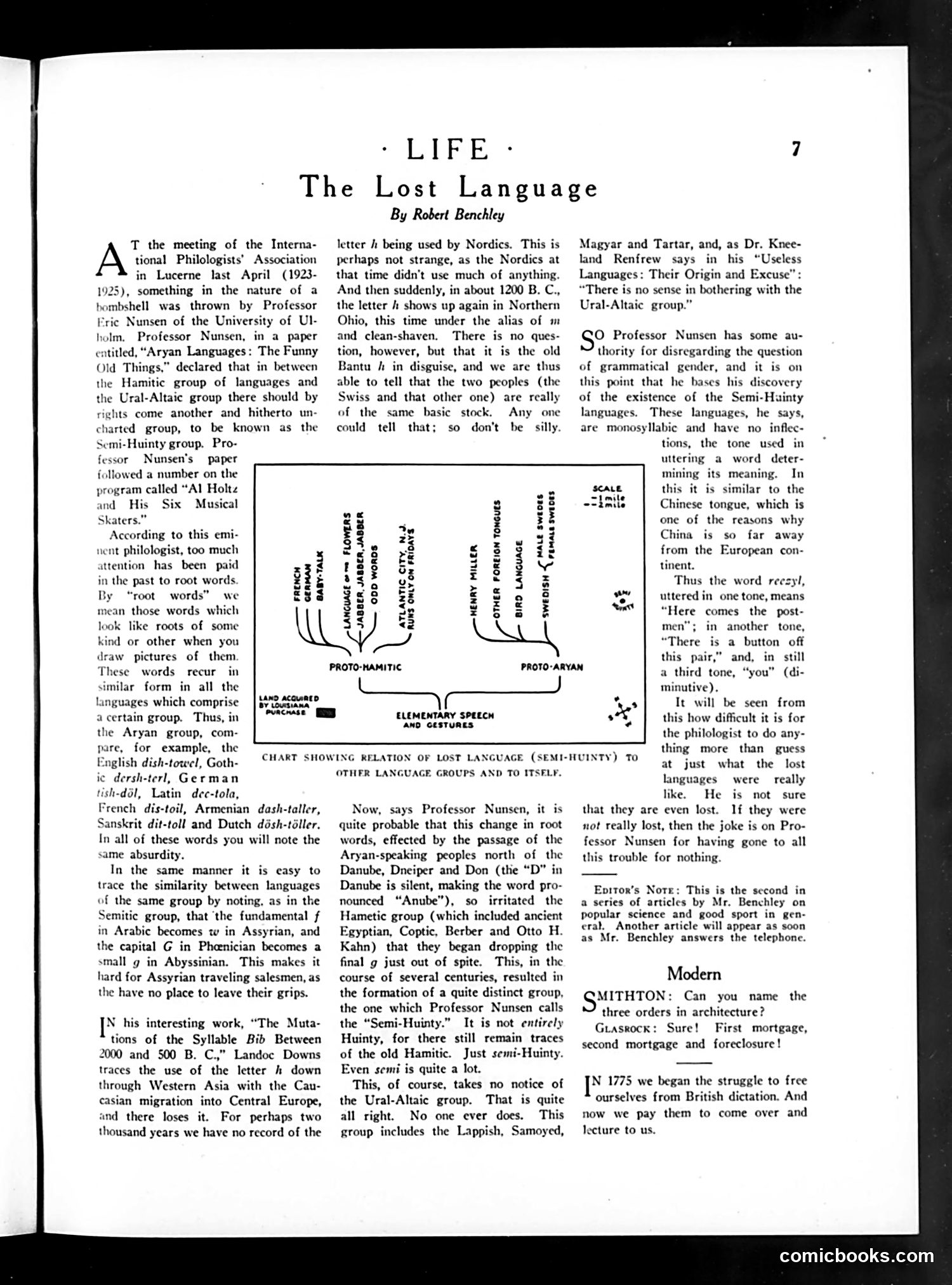
This is primarily a linguistic article, not a political cartoon. The page discusses Professor Nunsen's theory about the "Semi-Huinty" language group—a hypothetical connection between ancient Hamitic languages and Northern European languages. The central diagram shows linguistic relationships between "Proto-Hamitic" and "Proto-Aryan" language families, tracing how root words (like "dish-towel" in English) appear across different language groups. Benchley's satire is gentle: he pokes fun at philologists' difficulty in proving whether truly "lost" languages ever existed, and how obscure linguistic theories can become. The humor lies in the scholarly pedantry required to make such connections plausible, rather than any specific political reference.
📄 Transcribed text from this page (OCR, searchable)
Machine-transcribed from the original scan — historical spelling and the odd misread are preserved.
- LIFE : The Lost Language T the meeting of the Interna- A tional Philologists’ Association in Lucerne last April (1923- 1923), something in the nature of a bombshell was thrown by Professor Eric Nunsen of the University of Ul- holm. Professor Nunsen, in a paper entitled, “Aryan Languages: The Funny Old Things,” declared that in between the Hamitic group of languages and the Ural-Altaic group there should by rights come another and hitherto un- charted group, to be known as the Semi-Huinty group. Pro- fessor Nunsen’s paper followed a number on the program called “Al Holtz and His Six Musical Skaters.” According to this emi- nent philologist, too much attention has been paid in the past to root words. By “root words” we mean those words which look like roots of some kind or other when you draw pictures of them. These words recur in similar form in all the languages which comprise acertain group. Thus, in the Aryan group, com- pare, for example, the English dish-towel, Goth- ic dersh-terl, German tish-d6l, Latin dec-tola, French dis-toil, Armenian dash-taller, Sanskrit dit-toll and Dutch désh-téller. In all of these words you will note the same absurdity. In the same manner it is easy to trace the similarity between languages of the same group by noting, as in the Semitic group, that ‘the fundamental f in Arabic becomes w in Assyrian, and the capital G in Phenician becomes a small g in Abyssinian. This makes it hard for Assyrian traveling salesmen, as the have no place to leave their grips. |X his interesting work, “The Muta- tions of the Syllable Bib Between 2000 and 500 B. C.,” Landoc Downs traces the use of the letter h down through Western Asia with the Cau- casian migration into Central Europe, and there loses it. For perhaps two thousand years we have no record of the By Robert Benchley letter 4 being used by Nordics. This is perhaps not strange, as the Nordics at that time didn’t use much of anything. And then suddenly, in about 1200 B. C., the letter 4 shows up again in Northern Ohio, this time under the alias of m and clean-shaven. There is no ques- tion, however, but that it is the old Bantu h in disguise, and we are thus able to tell that the two peoples (the Swiss and that other one) are really of the same basic stock. Any one could tell that; so don’t be silly. JABBER DD worps MALE sweoes, PEmace SwHOES, GUAGE © == FLOWERS. JABBER, JABBER, te RUNS ONLY OW FRIDAYS: MENRY MILLER OTHER FOREIGN TONGUES BIRD LANGUAGE sweoisn <, f ATLANTIC CITY, N.J. PROTO-MAMITIC ELEMENTARY SPEECH AND GESTURES CHART SHOWING RELATION OF LOST LANGUAGE (SE OTHER LANGUAGE GROUPS AND TO ITSELF. Now, says Professor Nunsen, it is quite probable that this change in root words, effected by the passage of the Aryan-speaking peoples north of the Danube, Dneiper and Don (the “D” in Danube is silent, making the word pro- nounced “Anube”), so irritated the Hametic group (which included ancient Egyptian, Coptic, Berber and Otto H. Kahn) that they began dropping the final g just out of spite. This, in the course of several centuries, resulted in the formation of a quite distinct group, the one which Professor Nunsen calls the “Semi-Huinty.” It is not entirely Huinty, for there still remain traces of the old Hamitic. Just semi-Huinty. Even semi is quite a lot. This, of course, takes no notice of the Ural-Altaic group. That is quite all right. No one ever does. This group includes the Lappish, Samoyed, PROTO-ARYAN Magyar and Tartar, and, as Dr. Knee- land Renfrew says in his “Useless Languages: Their Origin and Excuse”: “There is no sense in bothering with the Ural-Altaic group.” O Professor Nunsen has some au- thority for disregarding the question of grammatical gender, and it is on this point that he bases his discovery of the existence of the Semi-Huinty languages. These languages, he says, are monosyllabic and have no infle s, the tone used in gf a word deter- mining its meaning. In this it is similar to the Chinese tongue, which is one of the reasons why China far away from the European con- tinent. Thus the word reezyl, uttered in. one tone, means “Here comes the post- men"; in another tone, “There a button off this pair,” and, in. still a third tone, “you” (di- minutive), It will be seen from this how difficult it is for the philologist to do any- thing more than guess at just what the lost languages were really like. He is not sure that they are even lost. 1f they were not really lost, then the joke is on Pro- fessor Nunsen for having gone to all this trouble for nothing. SCALE = Tmite orimile is so HUINTY) To Epttor’s Note: This is the second in a series of articles by Mr. Benchley on popular science and good sport in gen- erat. Another article will appear as soon as Mr. Benchley answers the telephone. Modern MITHTON: Can you name three orders in architecture? Grasrock: Sure! First mortgage, second mortgage and foreclosure! the N 1775 we began the struggle to free ourselves from British dictation. And now we pay them to come over and lecture to us. comicbooks.com