
A complete issue · 36 pages · 1925
Life — February 12, 1925
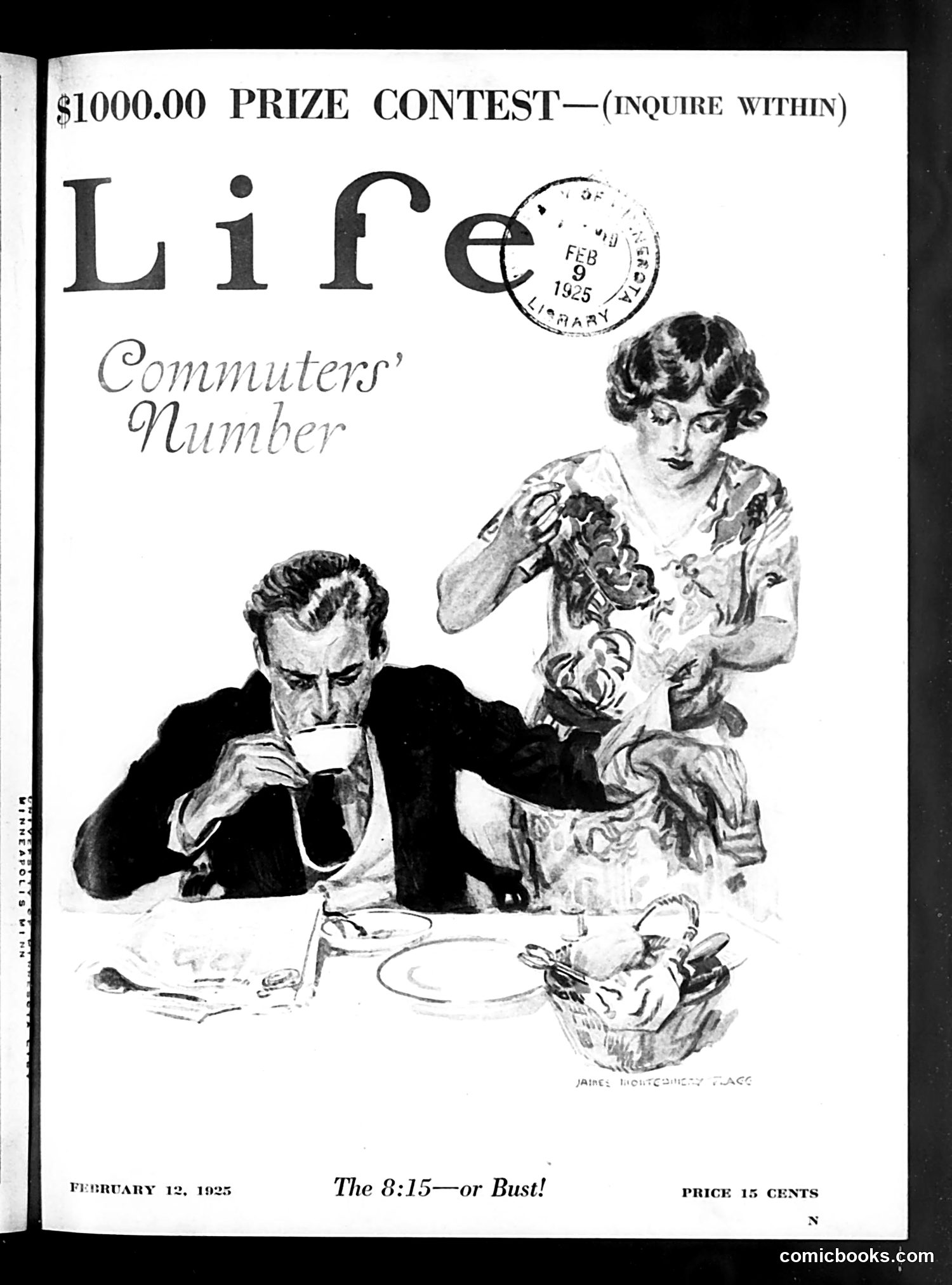
This is a **Life magazine cover** advertising a "$1000.00 Prize Contest" for the "Commuters' Number" issue. The illustration depicts a domestic scene with satirical intent: a man in formal attire is drinking coffee at breakfast while a woman (presumably his wife) stands behind him, appearing to adjust his clothing or collar. The caption "The 8:15—or Bust!" references the pressure commuters face to catch their morning train. The satire likely mocks the rushed morning routine of suburban commuters and the domestic dynamics surrounding their departure—suggesting wives managing their husbands' punctuality and appearance before work. The contest element invited readers to submit entries related to commuter life themes. The image exemplifies 1920s satirical humor about modern domesticity and work culture.
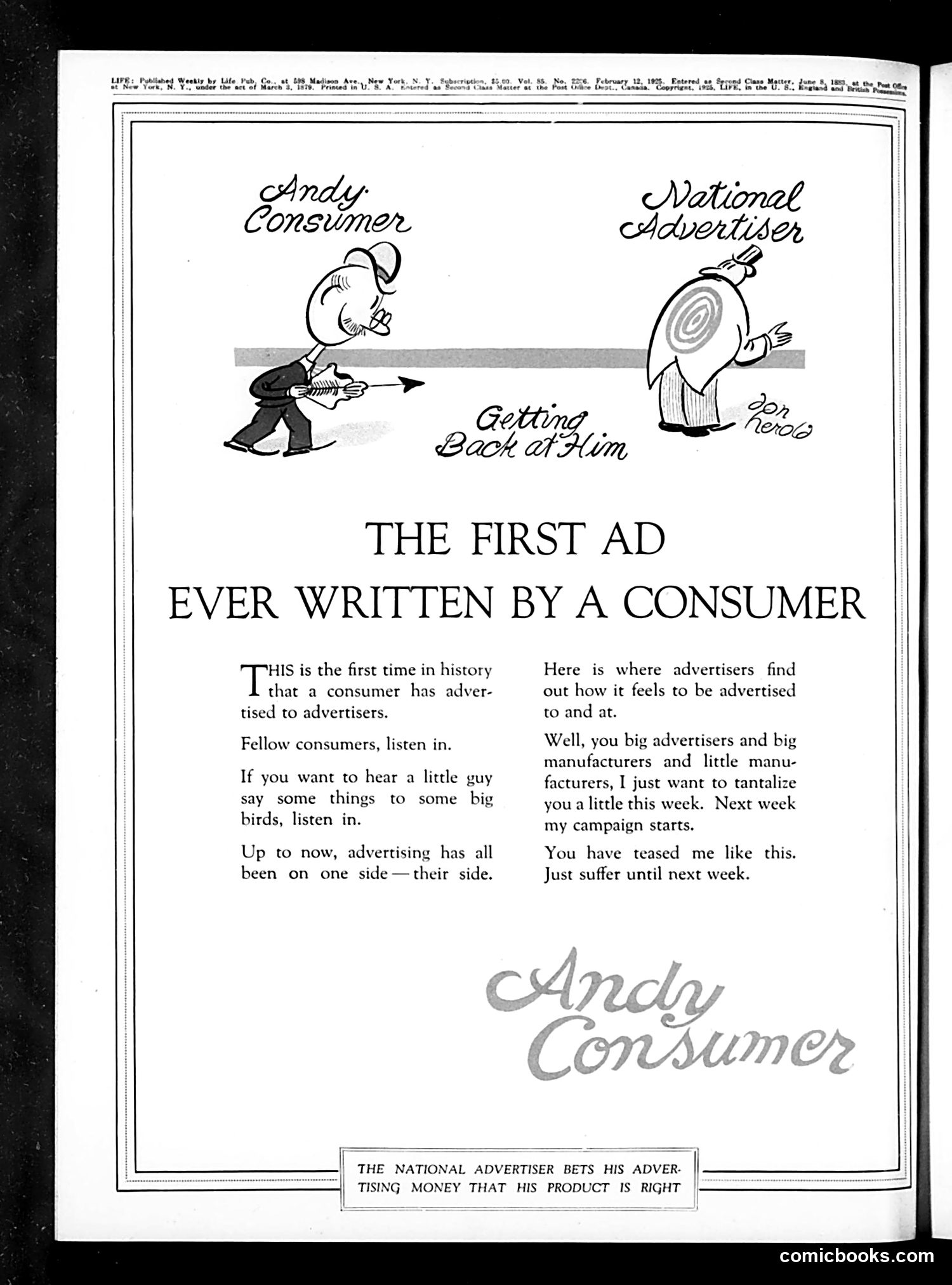
This satirical piece imagines a consumer (labeled "Andy Consumer") firing back at national advertisers with his own advertisement. The cartoon shows Andy shooting an arrow at a target-wearing figure labeled "National Advertiser," captioned "Getting Back at Him." The satire critiques the one-sided nature of advertising: historically, only corporations could advertise to consumers. Andy's fictional "first consumer ad" reverses this power dynamic—he threatens to launch a retaliatory advertising campaign next week to "tantalize" the big companies as they've teased him. The joke reflects early-20th-century frustration with aggressive marketing tactics. By imagining consumer-created counter-advertising, the piece humorously protests the asymmetrical relationship between corporations and the public they target.
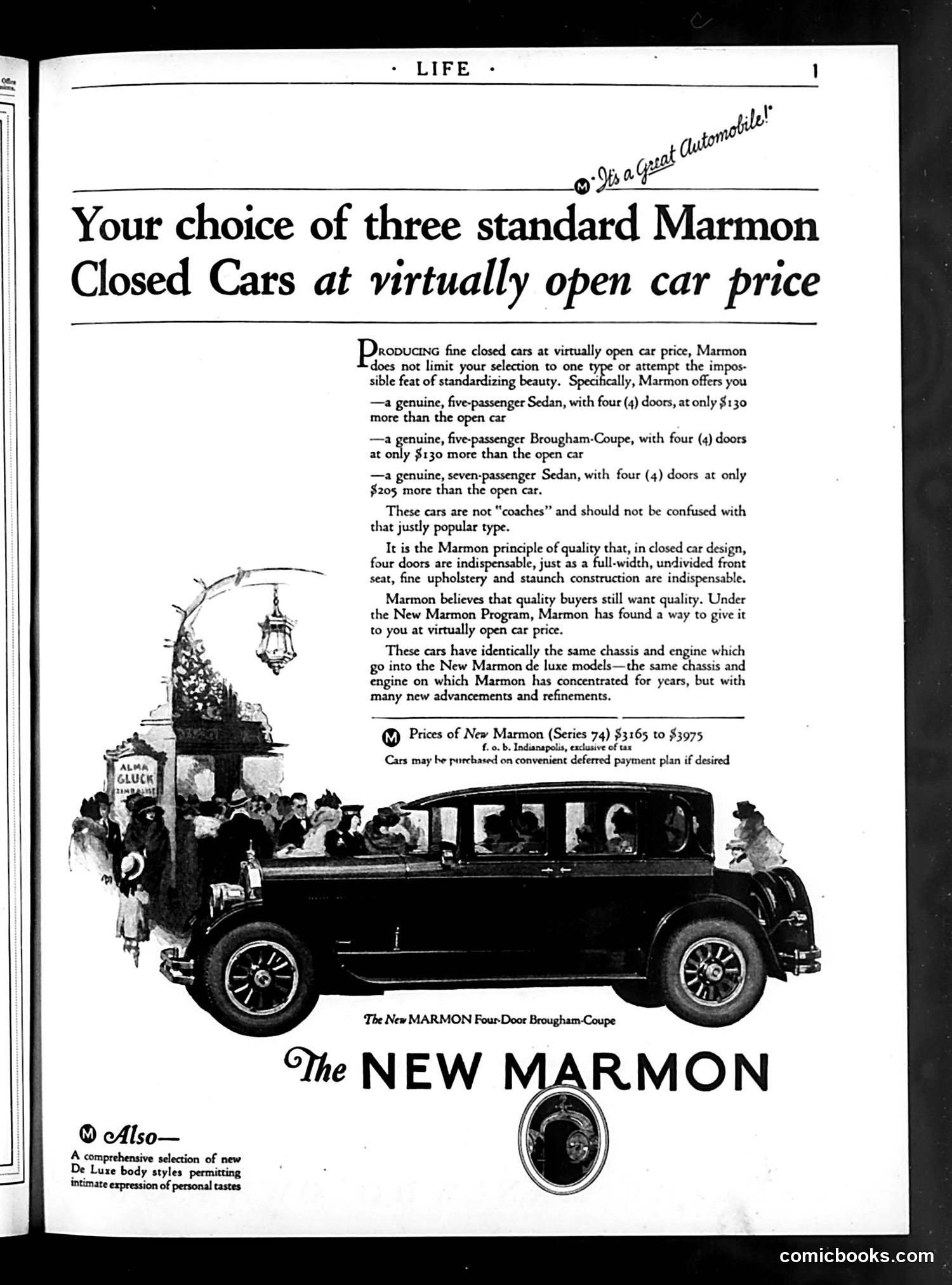
This page is **primarily an advertisement**, not satire or political commentary. It promotes the new Marmon automobile (Series 74), offering three closed-car models at prices competitive with open cars—$130-$205 above open-car cost. The left illustration depicts a street scene with people gathered around an "Alma Gluck" sign (likely referencing the famous opera singer), suggesting the car's appeal to sophisticated, cultured audiences. The main image shows the "Four-Door Brougham-Coupe" with well-dressed passengers, emphasizing luxury and respectability. The ad's pitch centers on **quality and practicality**: four doors and full-width front seats make closed cars desirable, not merely "coaches" for the wealthy. This represents early automotive marketing positioning closed cars as practical upgrades rather than luxury goods, appealing to middle-class buyers.
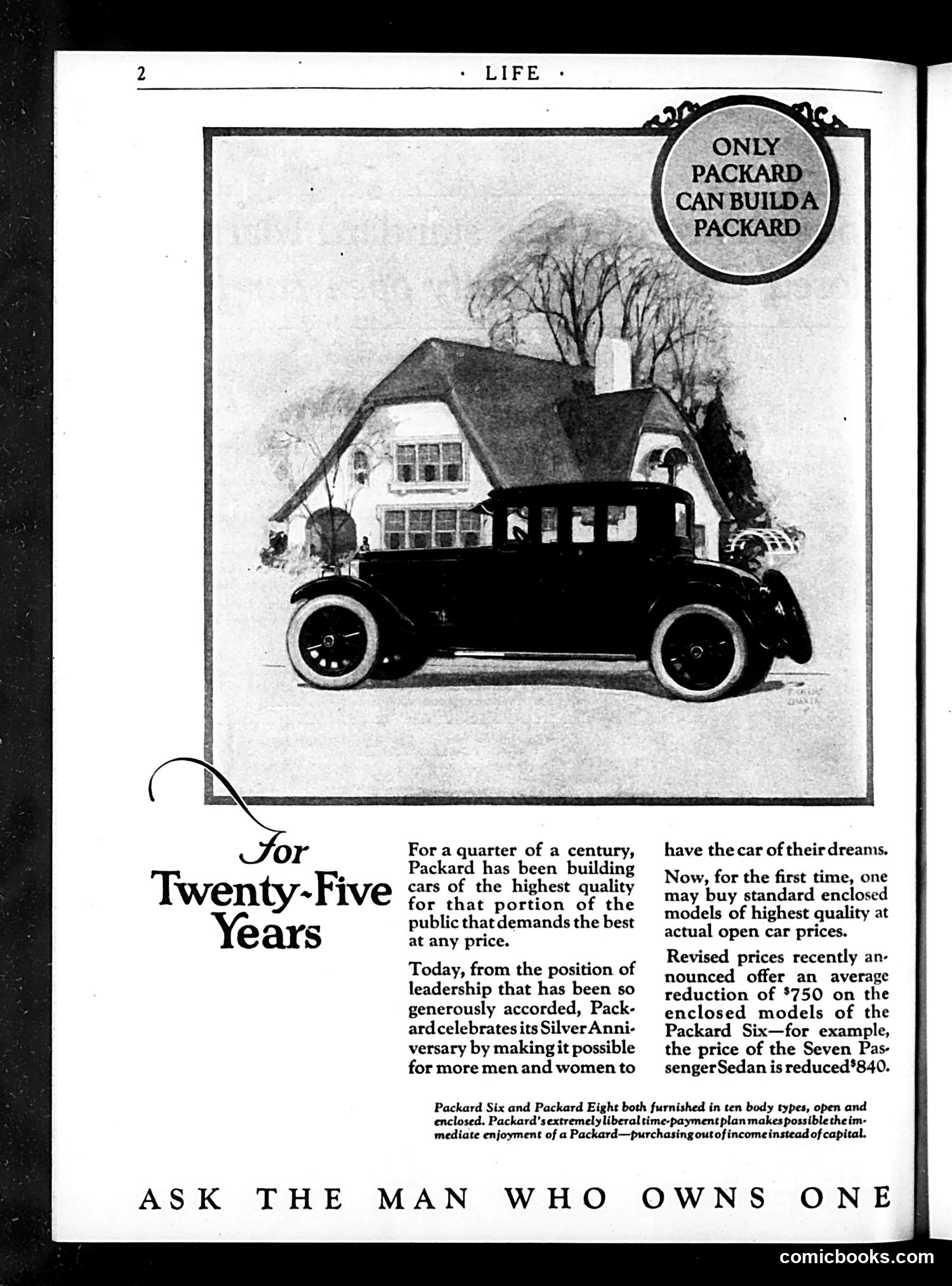
This is primarily a **Packard automobile advertisement**, not political satire. The page celebrates Packard's "Silver Anniversary"—twenty-five years in business. The visual joke is straightforward: a luxury car is superimposed in front of an elegant suburban home, suggesting that owning a Packard represents achieving the American dream of prosperity and refined living. The tagline "Only Packard can build a Packard" asserts brand superiority through exclusivity. The advertisement emphasizes that Packard recently reduced prices on enclosed models (like the Seven-Passenger Sedan, now $840), making luxury more accessible while maintaining quality—a significant selling point during what appears to be economically challenging times. The final line, "Ask the man who owns one," was apparently Packard's actual advertising slogan, appealing to satisfied customers as testimonials.
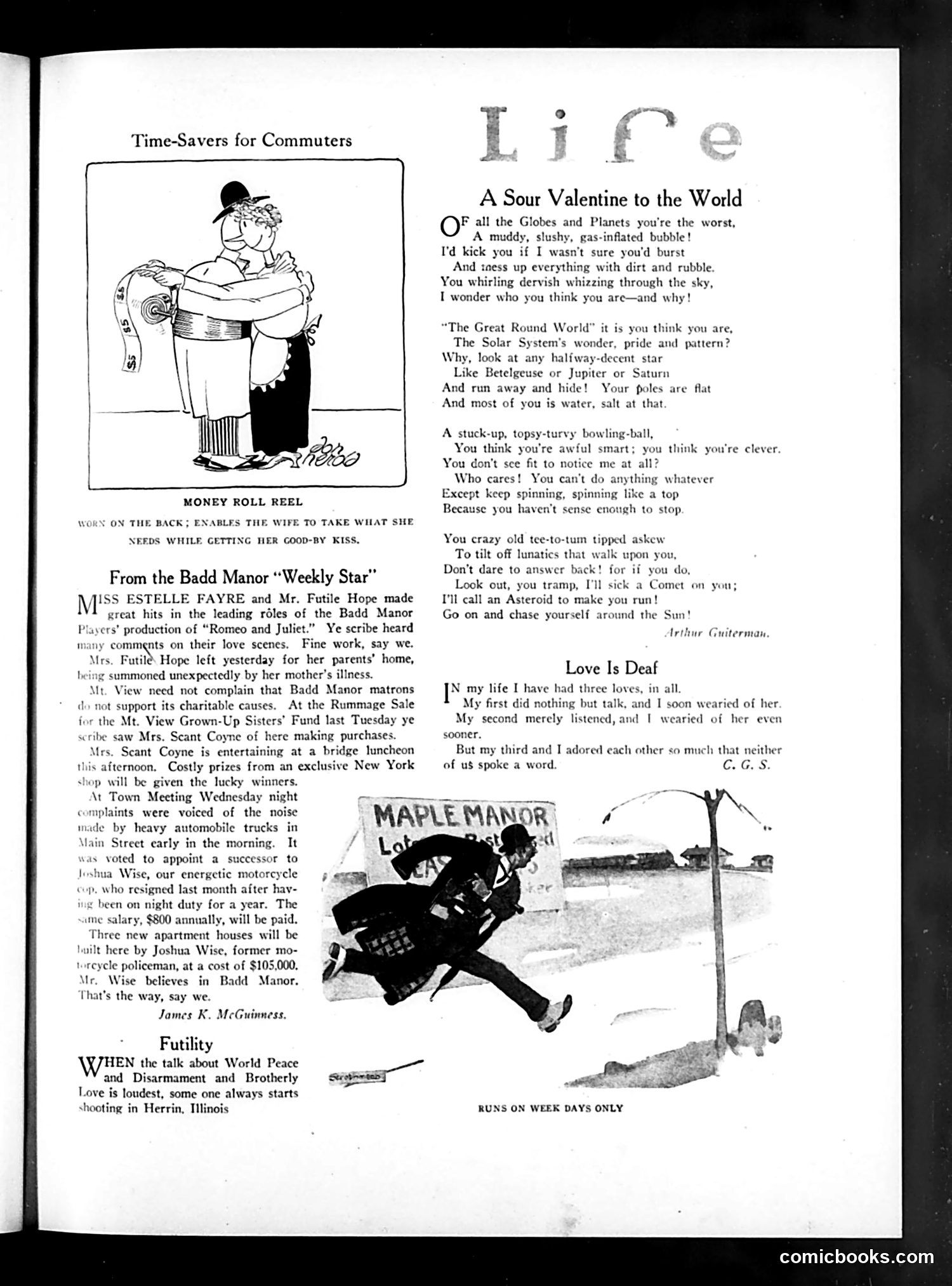
**"Time-Savers for Commuters" Cartoon:** The cartoon shows a man being handed a money roll by a woman, captioned "WORN ON THE BACK; IT'S EASIER FOR THE WIFE TO TAKE WHAT SHE NEEDS WHILE GETTING HER GOOD-BY KISS." This is marital satire: the joke mocks husbands' powerlessness in household finances, suggesting wives control spending so thoroughly they can pilfer money during farewell kisses. It's commentary on wives' financial authority within marriage—presented as humorous emasculation. **Page Content:** The page contains literary works ("A Sour Valentine to the World," "Love Is Deaf"), theatrical reviews of Badd Manor productions, and a photograph of someone on what appears to be amusement park equipment at Maple Manor. The overall tone is light satirical entertainment typical of Life magazine's era.
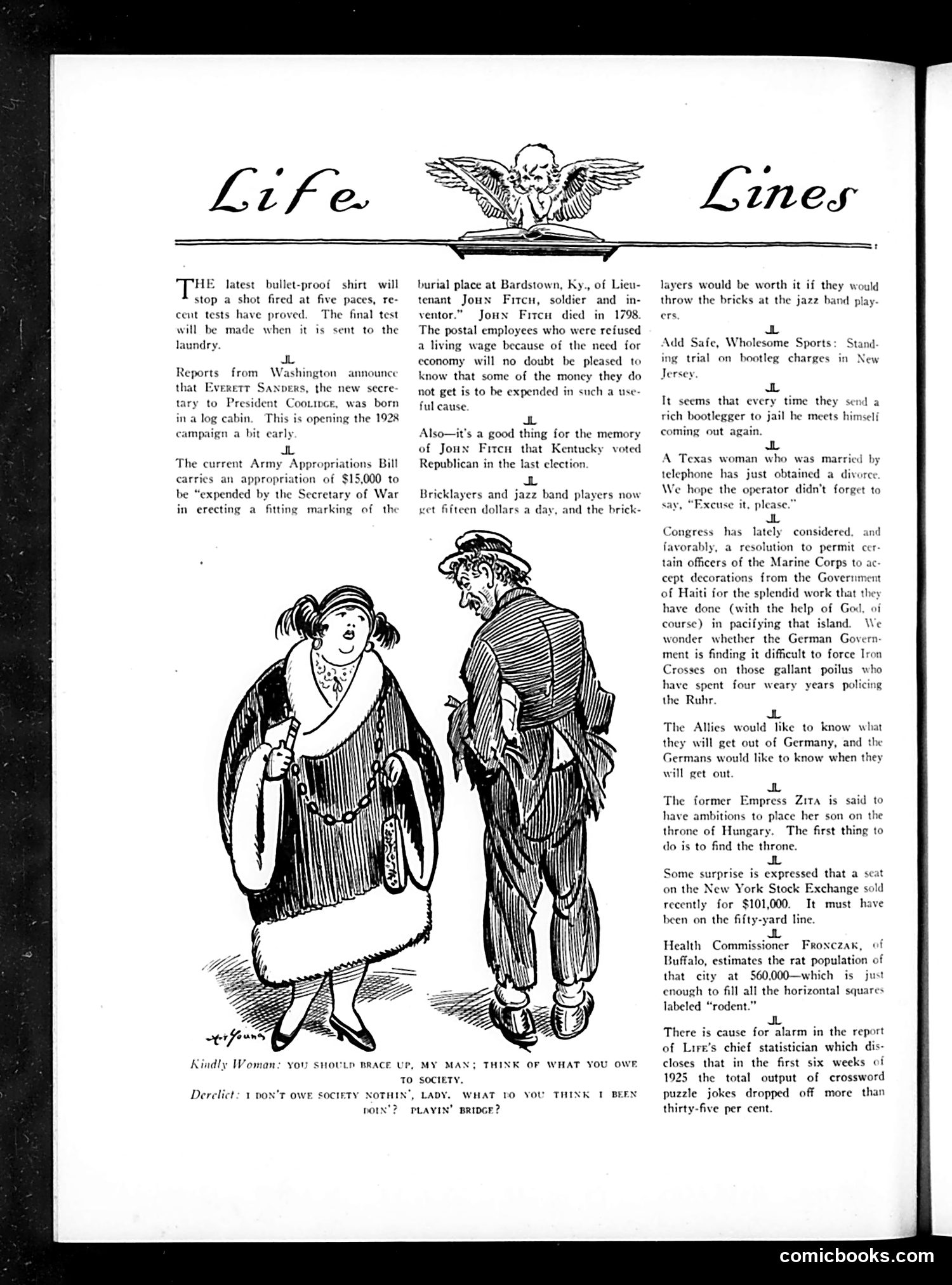
The cartoon depicts a social critique through a conversation between a working-class man and a fashionably-dressed woman. The caption reveals the joke: she demands he "brace up" and think of his debt to society, while he retorts that he owes society nothing—asking what she thinks he's been doing by "playin' bridge?" This satirizes class hypocrisy and gender dynamics of the 1920s: the wealthy woman lectures about civic duty while engaging in leisure activities (bridge), while the working man resents being shamed about financial obligations. The surrounding "Life Lines" column contains brief topical commentary on politics, military affairs, and social absurdities of 1928, typical of the magazine's satirical format.
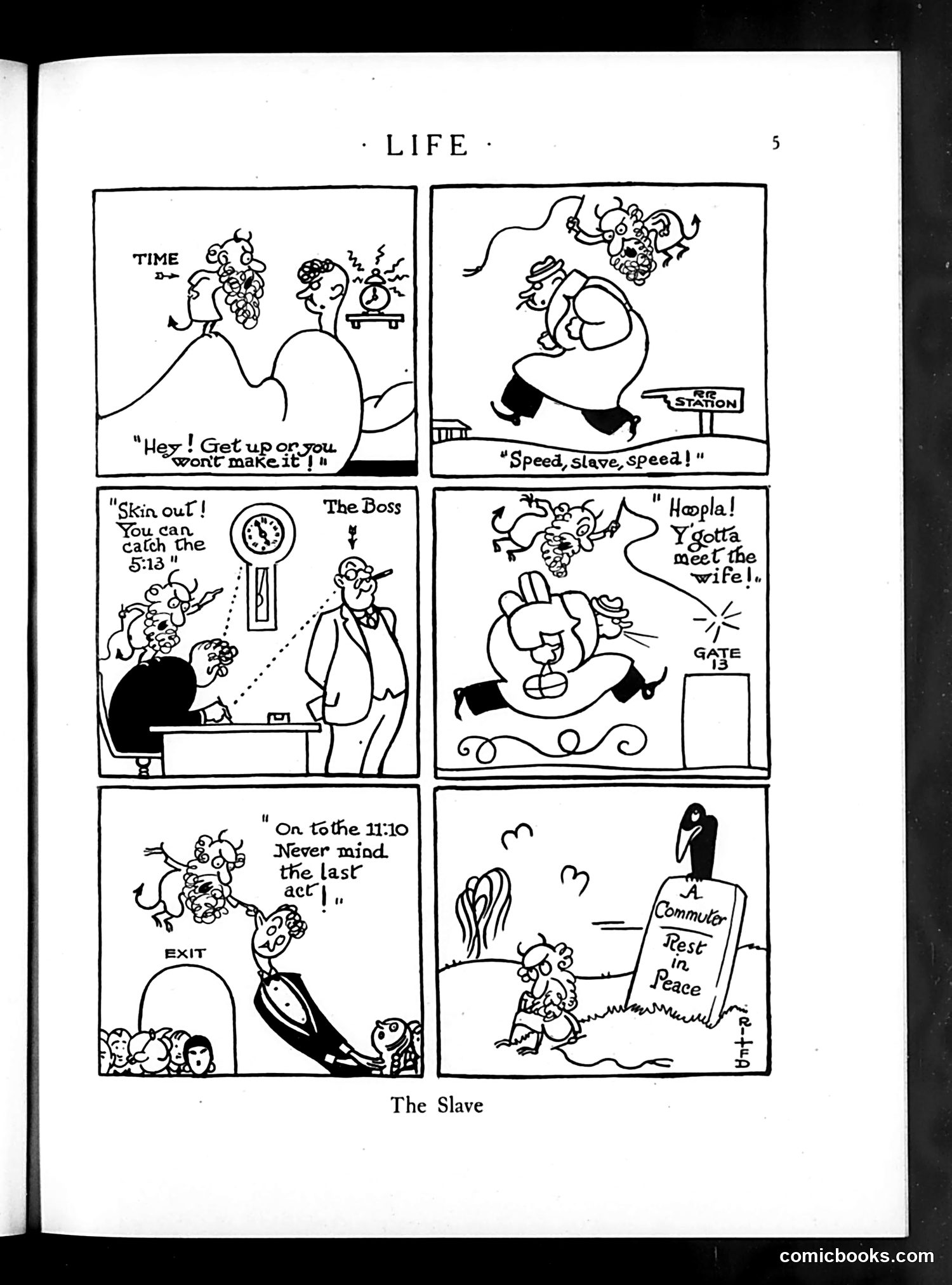
This six-panel comic satirizes the daily grind of working-class commuters, titled "The Slave." The narrative follows a harried man through his morning routine: his wife urges him to wake up ("Hey! Get up or you won't make it!"), he's told to rush to the station, barely escapes catching the time, faces his boss's demands at the office, rushes to meet his wife at a gate, catches a train to an 11:10 departure, and finally ends at a gravestone reading "Commute Rest in Peace." The satire depicts the relentless cycle of commuting and work as a kind of slow death—a mechanical, dehumanizing routine that consumes the worker's entire life. The comic critiques the monotony and exhaustion of urban wage labor and the commuter lifestyle.
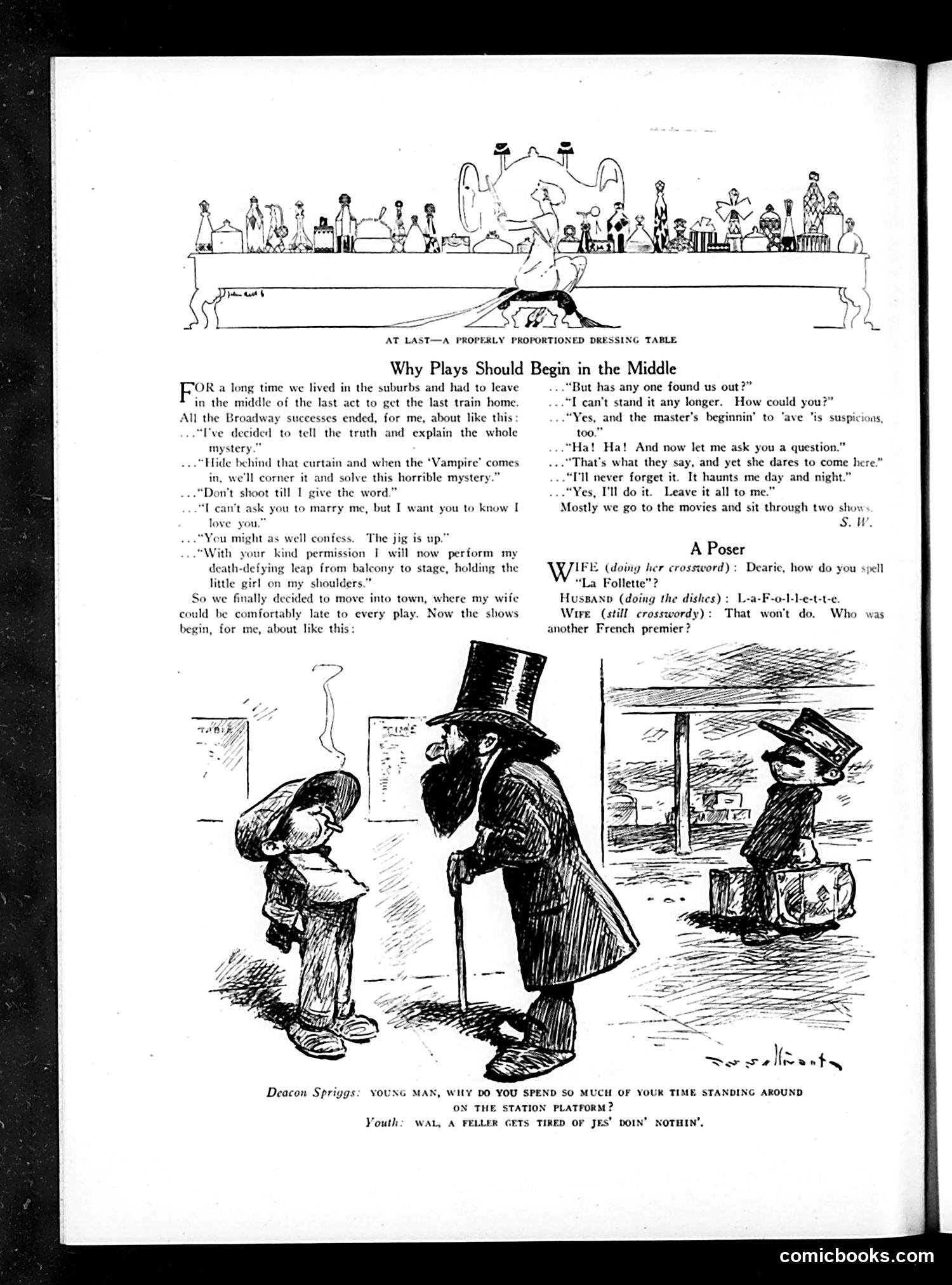
This page contains two satirical pieces about theater and urban life. **"Why Plays Should Begin in the Middle"** mocks Broadway theater conventions. The author complains that plays end too late, forcing audiences to catch late trains home from the suburbs. His solution: move to the city so his wife can attend shows comfortably—revealing the absurdity of prioritizing theater schedules over practical life decisions. **"A Poser"** is a brief domestic joke where a wife and husband disagree on spelling "La Follette" (likely referring to Robert La Follette, a prominent Progressive politician). The humor lies in their marital bickering over a crossword puzzle. **"Deacon Springs"** cartoon depicts a city gentleman confronting a rural youth loitering at a train station, exemplifying class and cultural tensions between urban and rural America during this era.
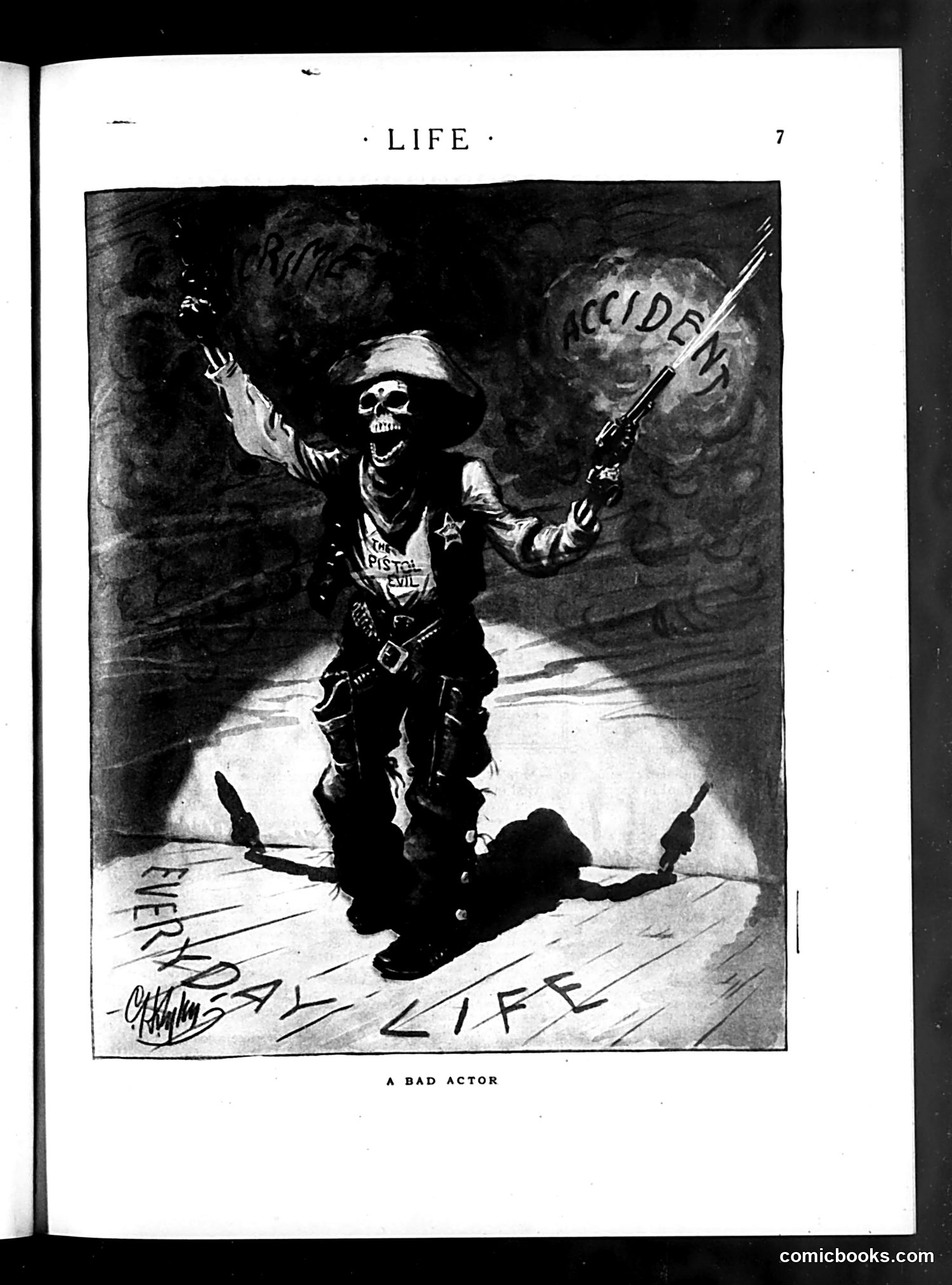
This political cartoon depicts a skeletal figure dressed as Death or the Grim Reaper, wearing military attire with a "Pistol" label visible on the chest. The skeleton holds weapons labeled "Accident" and "Murder," while standing on a wooden floor marked with words including "Life" and what appears to be "Mercy." The satire criticizes someone—likely a political or military figure of the era—as incompetent ("a bad actor") at managing or controlling violence and death. The skeleton's theatrical pose mocks the subject's dramatic but ineffectual performance. The labels on weapons suggest criticism of how lethal force is being portrayed or justified, possibly commenting on war rhetoric, judicial executions, or reckless leadership that causes preventable deaths through negligence or malice.
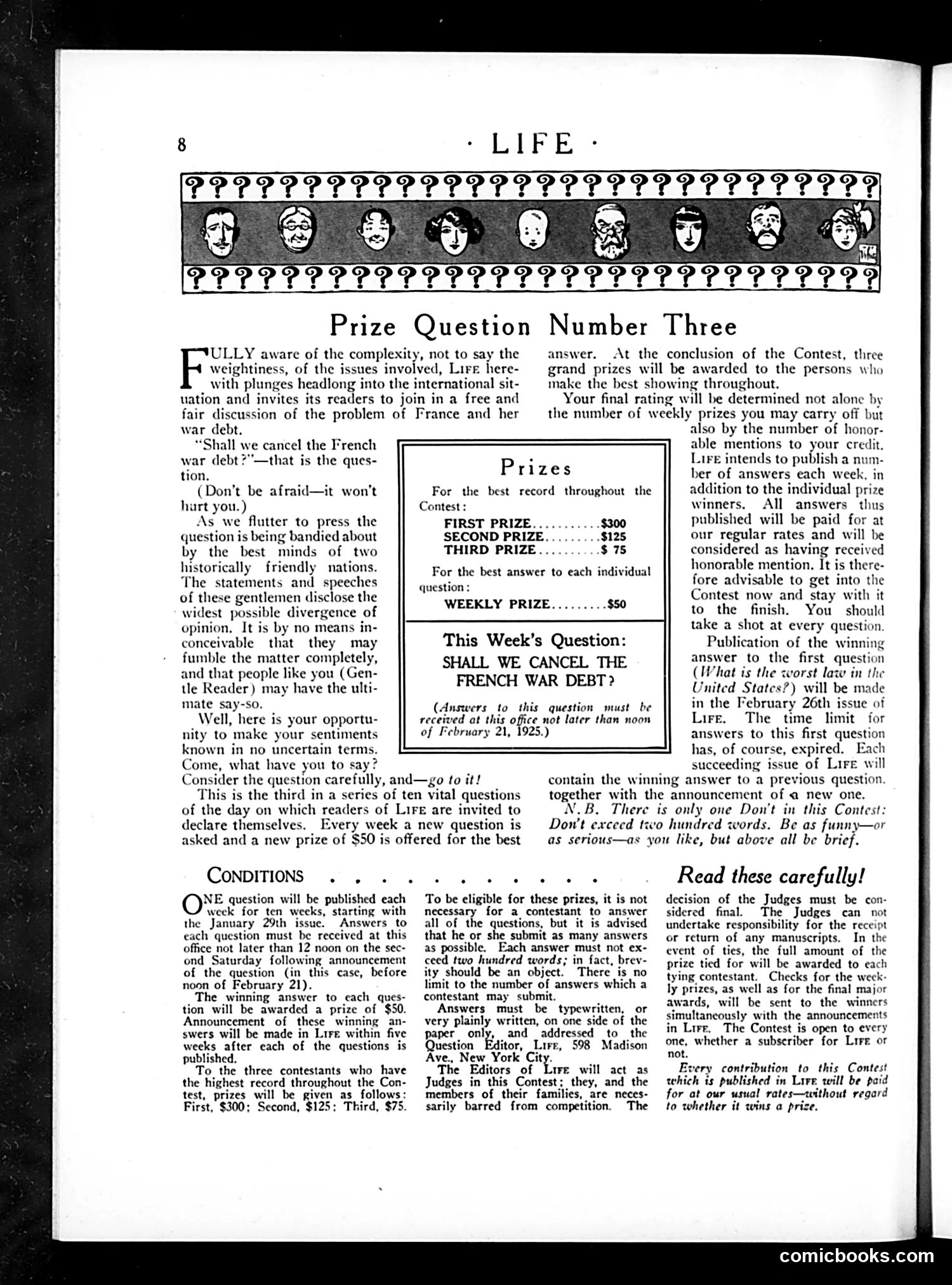
This page announces "Prize Question Number Three" for Life magazine's contest series. The content is primarily editorial and instructional rather than satirical. The page invites readers to answer a political question: "SHALL WE CANCEL THE FRENCH WAR DEBT?" This references post-World War I tensions over European war debts to the United States. The text notes this question involves "historically friendly nations" with "the widest possible divergence of opinion," indicating genuine political debate of the era. The decorative header shows nine illustrated faces with question marks, likely representing different viewpoints on controversial issues. Winners receive prizes ($300 first place, $125 second, $75 third), with answers due by February 21, 1925. The page exemplifies how Life engaged readers in contemporary political discussions through interactive contests, reflecting 1920s debates about American foreign policy and war reparations.
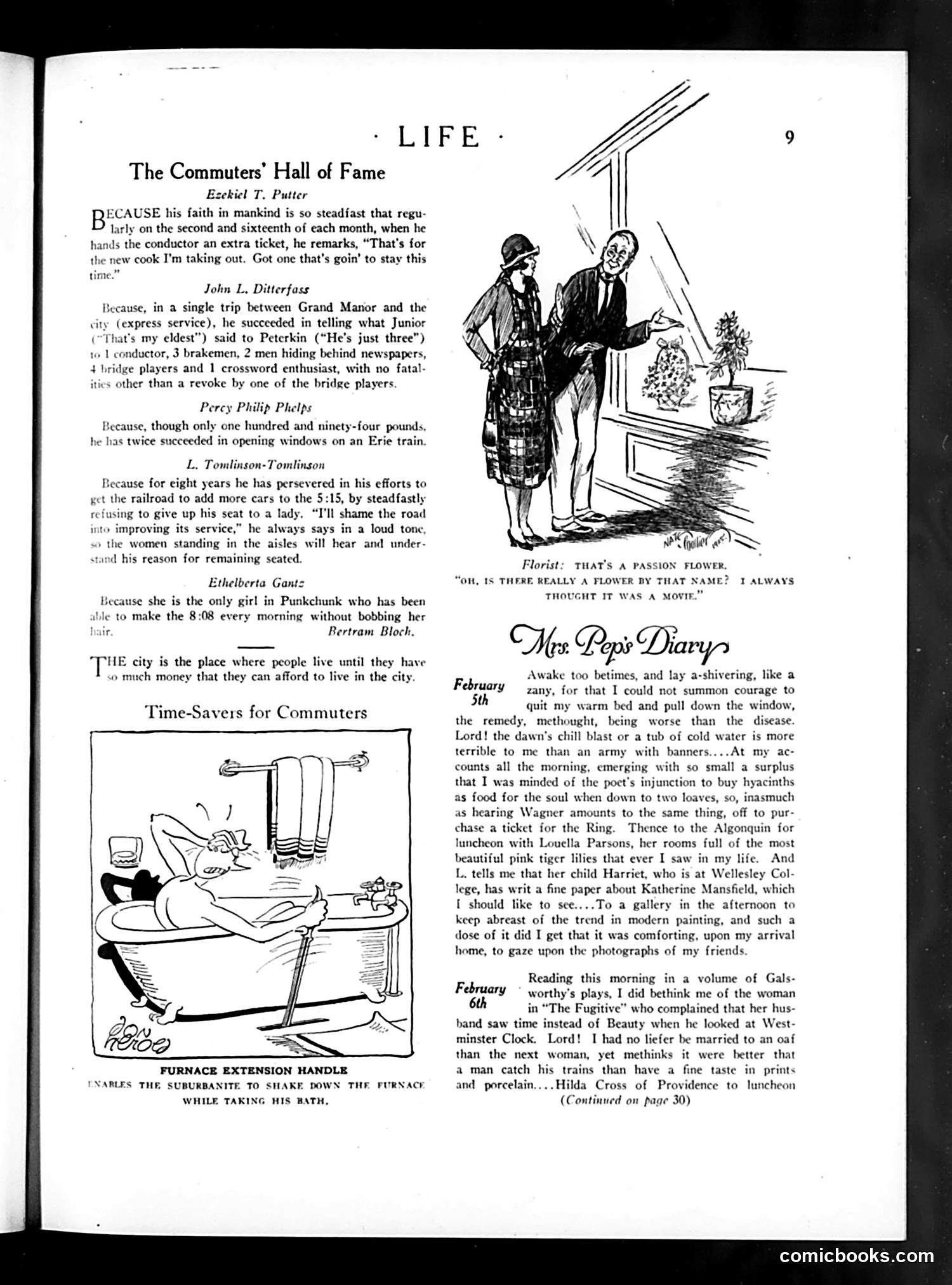
This page contains humorous vignettes about commuters. The main cartoon depicts a florist and customer, with dialogue about a flower's name—a light domestic joke about botanical terminology. The "Time-Savers for Commuters" cartoon shows a man attempting to bathe while commuting, illustrating the absurd lengths daily travelers go to save time. The caption suggests using "a furnace extension handle" to manage one's bath while commuting—obviously satirical exaggeration of the harried commuter's lifestyle. "The Commuters' Hall of Fame" lists brief tributes to various transit regulars (a conductor, train passenger, railroad advocate, etc.), celebrating ordinary people's dedication to commuting routines. The satire gently mocks both the absurdity of commuting dependency and these individuals' stoic persistence with it. The page reflects 1920s American urban culture and the emerging commuter lifestyle.
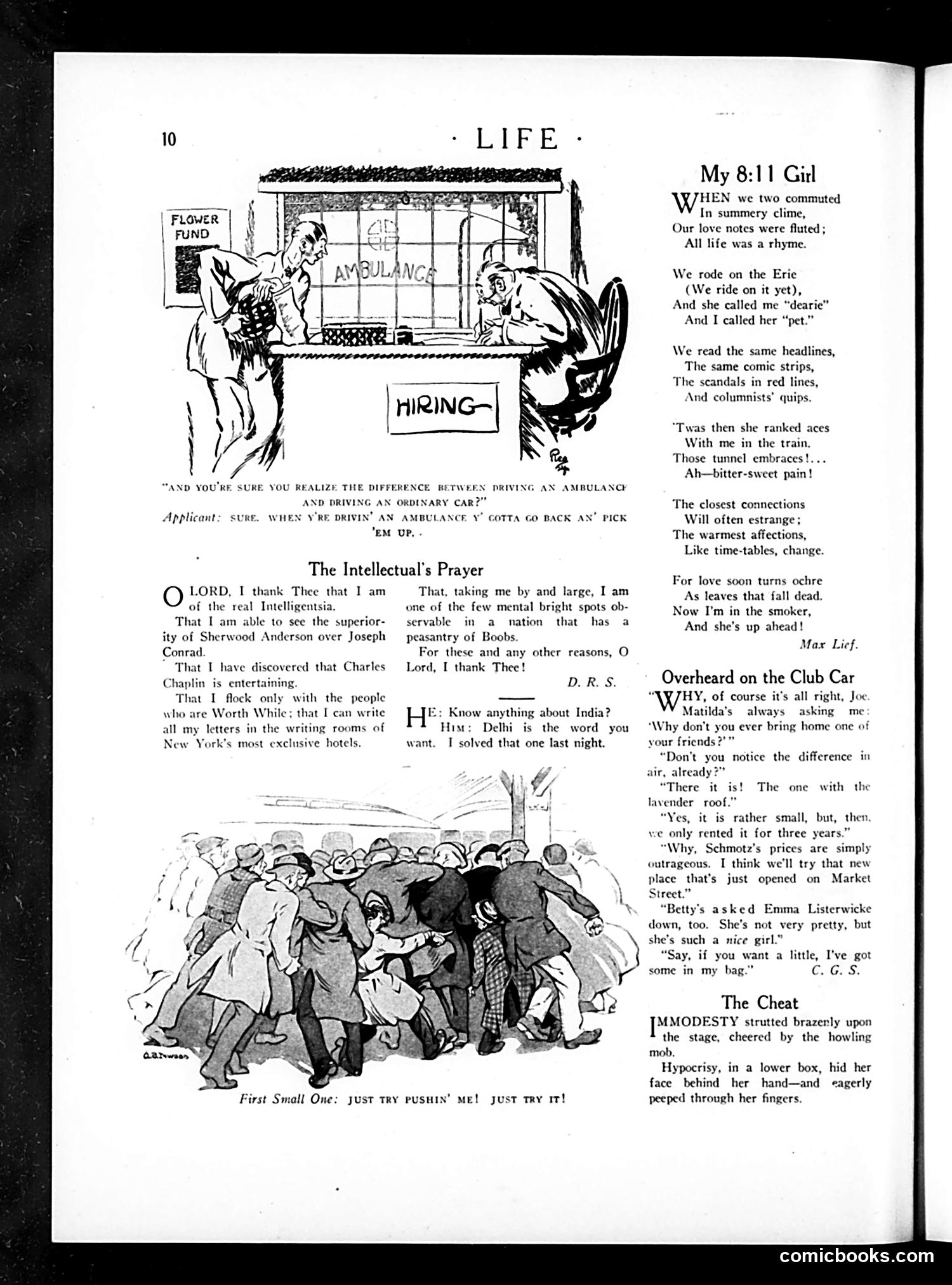
The top cartoon satirizes ambulance driving during wartime. The caption contrasts driving an ambulance versus "an ordinary car," suggesting ambulance drivers received special status or privileges—likely a reference to WWI, when ambulance service was considered prestigious work. The humor mocks someone boasting about this distinction. Below, "The Intellectual's Prayer" is a poem by D.R.S. mocking pretentious intellectuals who name-drop (Sherwood Anderson, Joseph Conrad, Charles Chaplin) and claim exclusive social circles while bragging about writing in "New York's most exclusive hotels." The large cartoon at bottom depicts a crowded mob, captioned "First Small One: JUST TRY PUSHIN' ME! JUST TRY IT!"—likely satirizing aggressive crowd behavior or street confrontations of the era.
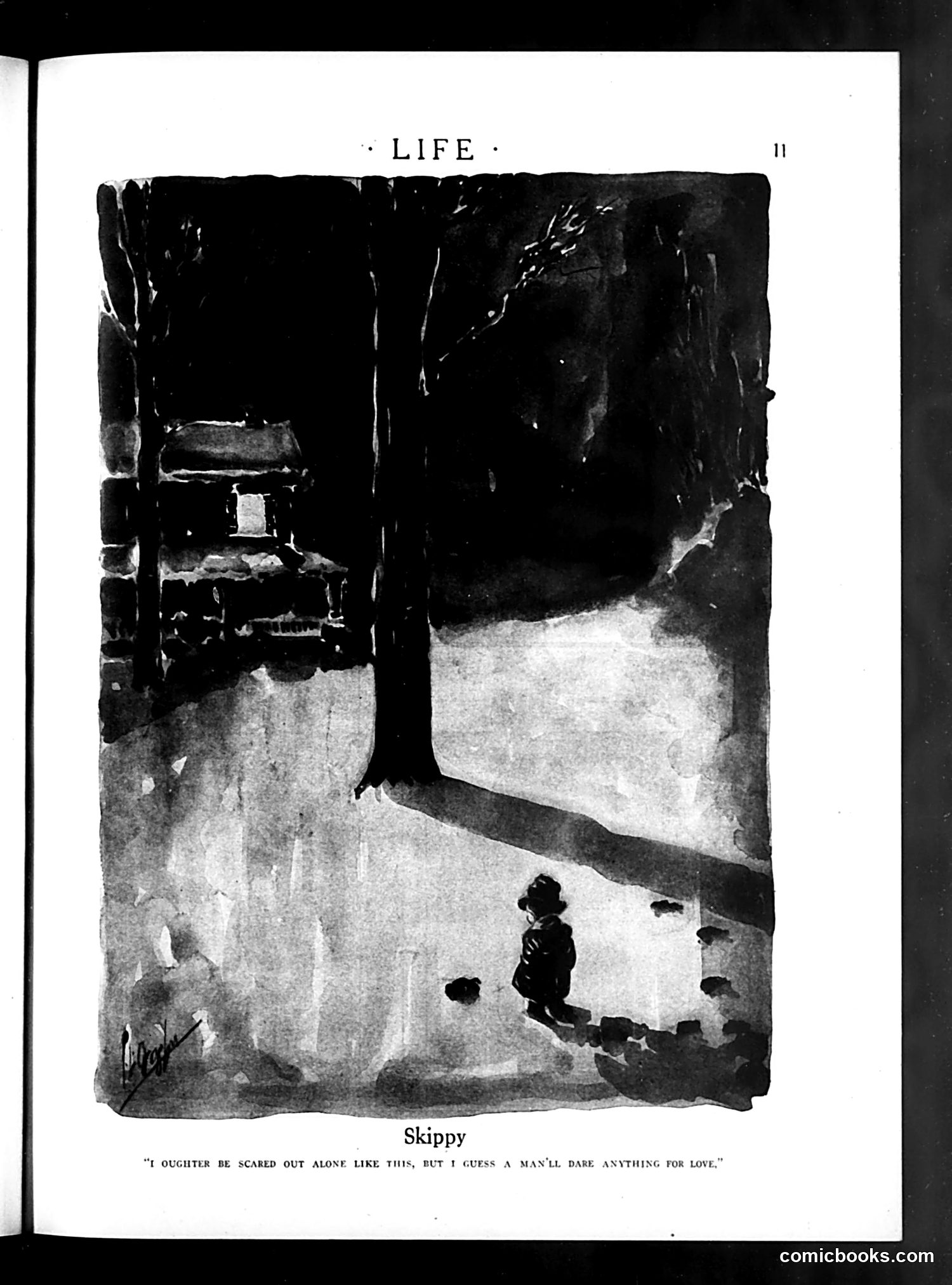
This is a cartoon titled "Skippy" by the artist (signature visible), featuring a solitary child sitting in what appears to be a snowy outdoor setting, possibly a park or wooded area at night. A bare tree dominates the composition, and there's a structure visible in the background. The caption reads: "I OUGHTA BE SCARED OUT ALONE LIKE THIS, BUT I GUESS A MAN'LL DARE ANYTHING FOR LOVE." The humor derives from the incongruity between the child character's small size and his adult reasoning about romantic courage. The joke plays on a child's misunderstanding of adult motivations—he's willing to overcome fear of being alone at night, attributing this bravery to romantic love rather than childish reasons like adventure or exploring.
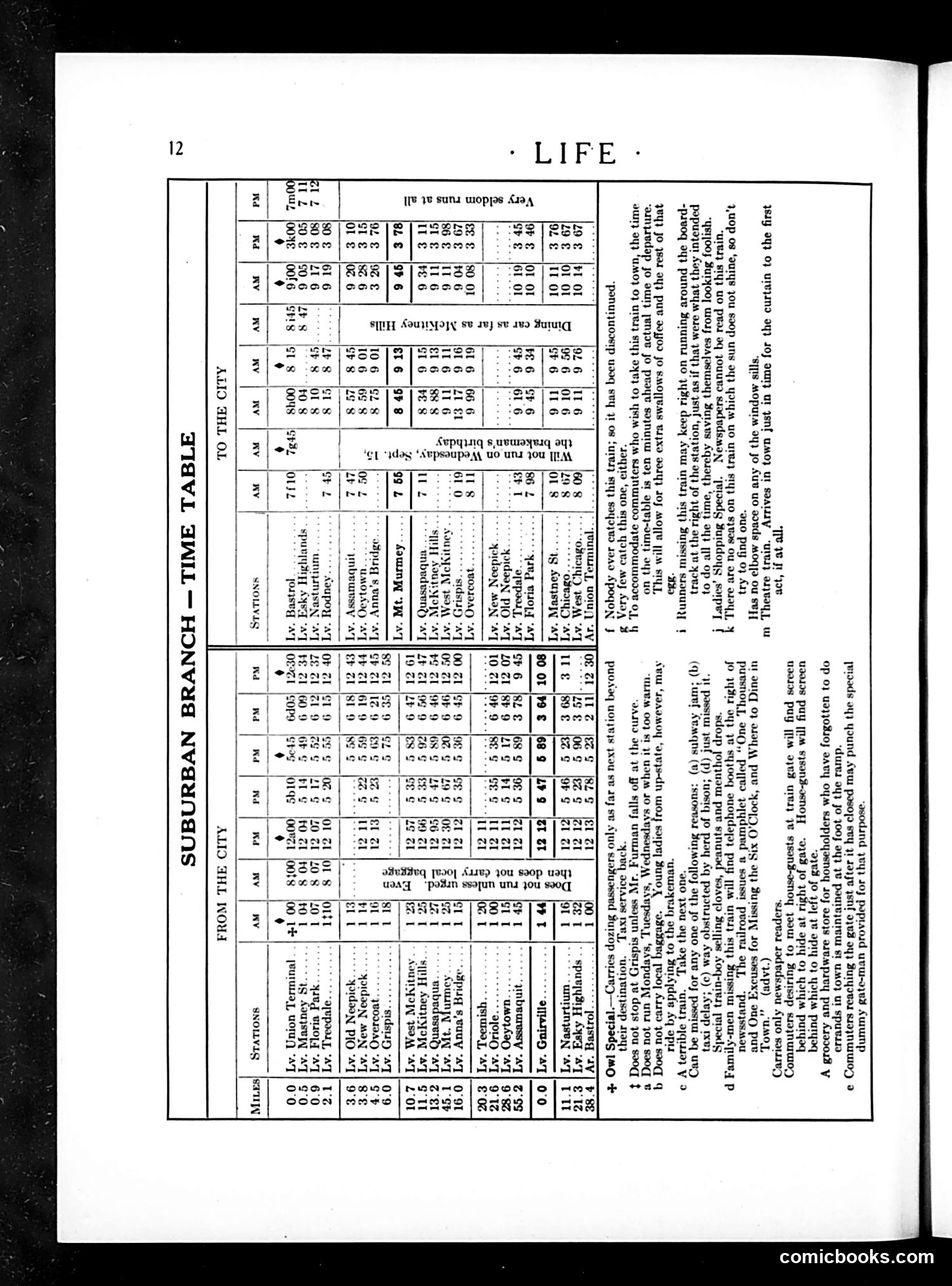
This page is primarily a **Suburban Branch—Time Table** listing train schedules "From the City" to various destinations, with multiple columns of departure and arrival times organized by station stops. The page contains minimal cartoon or satirical content—it is functionally a transportation timetable, likely from an early 20th-century issue of *Life* magazine. The text appears to be practical scheduling information rather than political or social satire. Without clear visual cartoons or caricatures visible in the image quality provided, I cannot identify specific figures or satirical commentary. This appears to be a standard reference page inserted into the magazine rather than editorial or humorous content requiring historical context to decode.
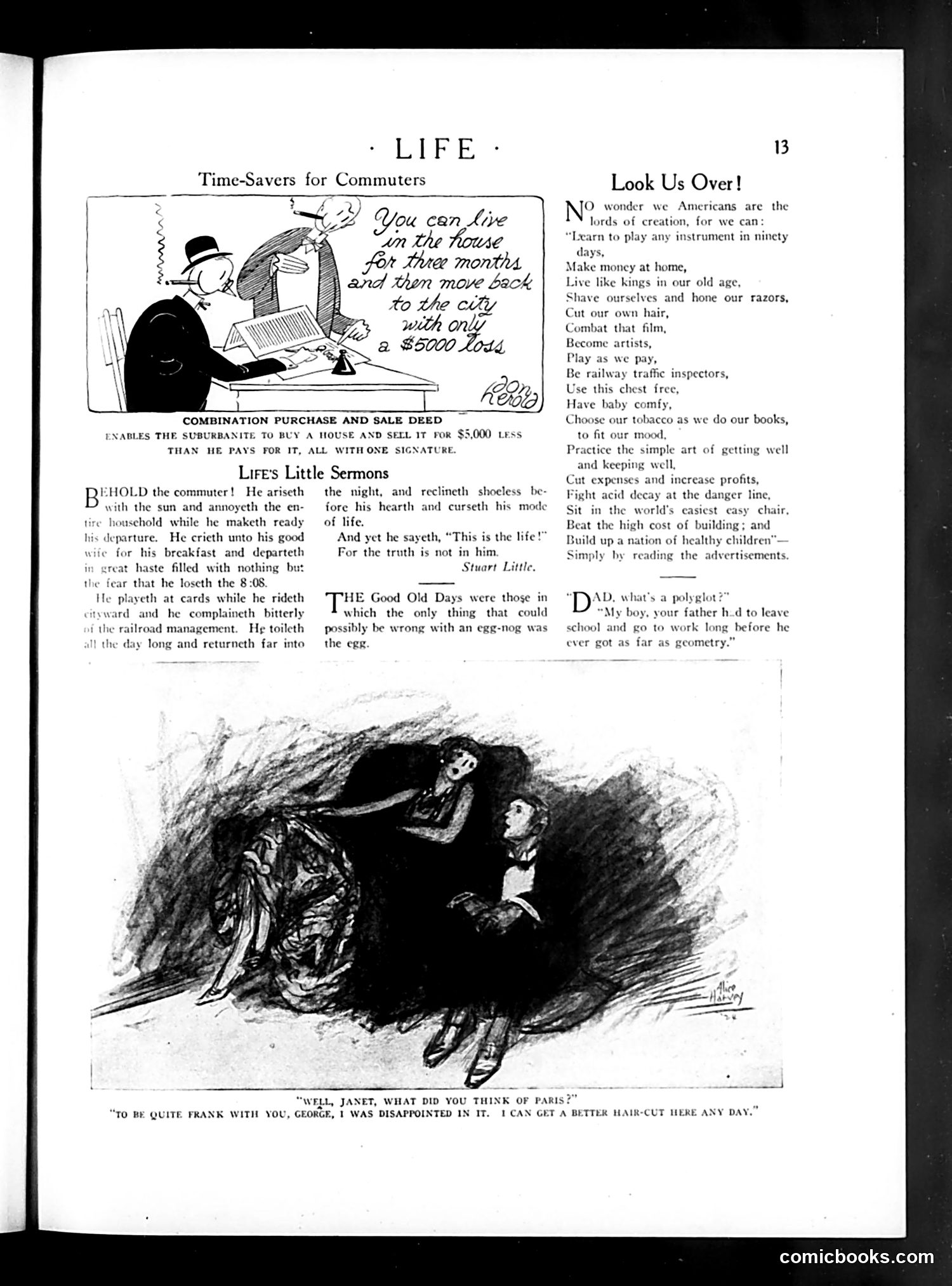
**Top Cartoon ("Time-Savers for Commuters"):** A man at a desk considers a scheme to buy a house for three months, then sell it at a $5,000 loss as a tax write-off. This satirizes wealthy commuters exploiting real estate transactions for financial advantage—a commentary on early 20th-century tax loopholes. **"Look Us Over!" Essay:** Lists humorous American self-sufficiency pursuits (making money at home, cutting hair, becoming artists) as alternatives to traditional employment. This likely mocks post-WWI economic anxiety and "get rich quick" schemes. **Bottom Cartoon:** A woman complains to her husband George about a disappointing Paris trip, sarcastically noting she could get a better haircut locally. This jokes about tourism and marital expectations regarding expensive travel.
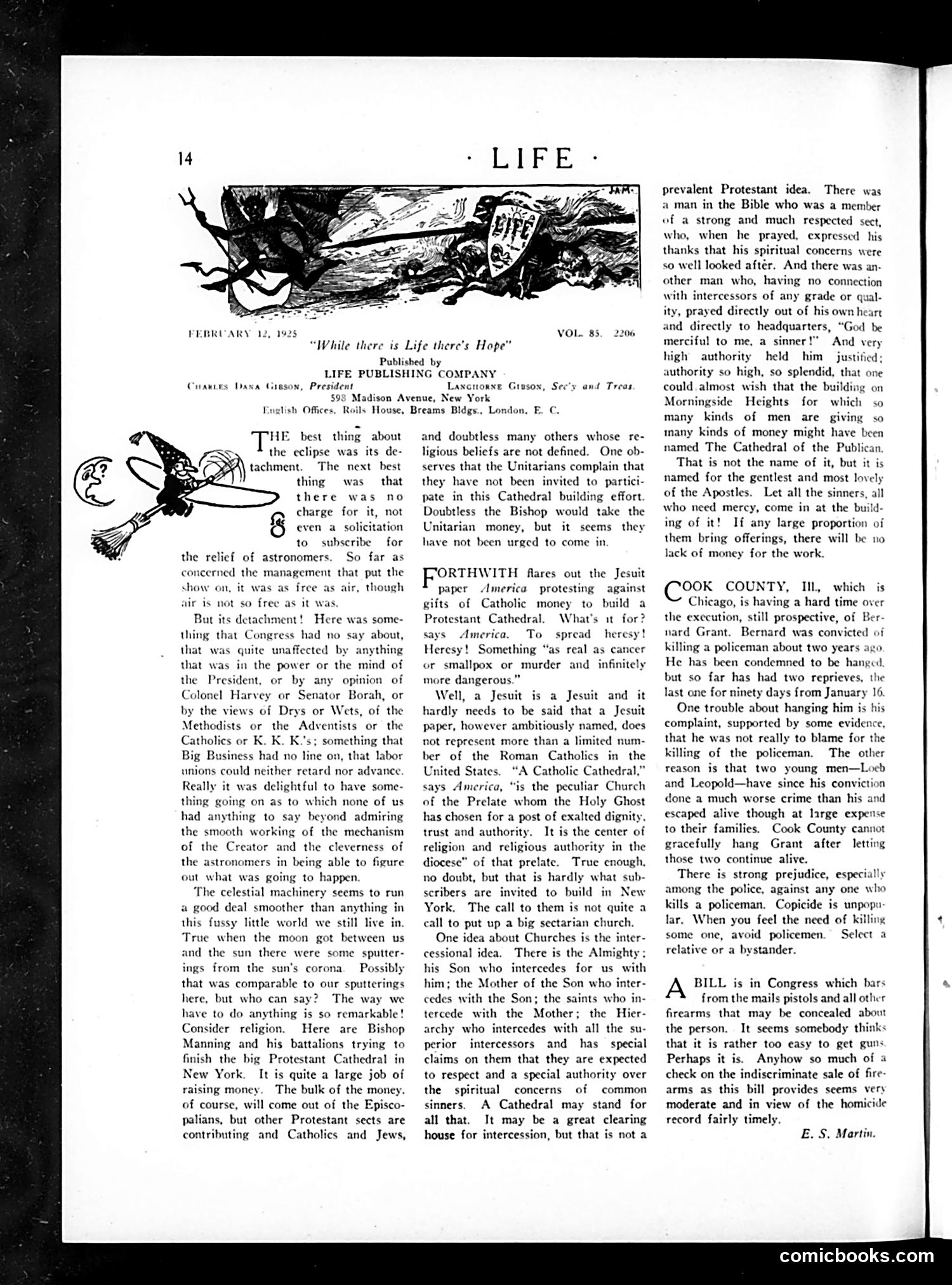
The main cartoon shows a figure labeled with a crescent moon and star, appearing to represent Islam or an Islamic entity, positioned above what looks like an eclipse or celestial body. The accompanying editorial discusses religious controversies of the era. The text references debates over building a "Protestant Cathedral" in New York, discussing tensions between Protestant, Catholic, and Jewish fundraising efforts. It also mentions controversy surrounding a Jesuit publication (*America*) protesting against gifts to a Catholic cathedral, and discusses a Congressional bill regulating firearms concealment. The cartoon's specific satirical point about the eclipse and the Islamic figure is unclear from the image alone, but it appears connected to broader 1920s religious and sectarian tensions in American public life.
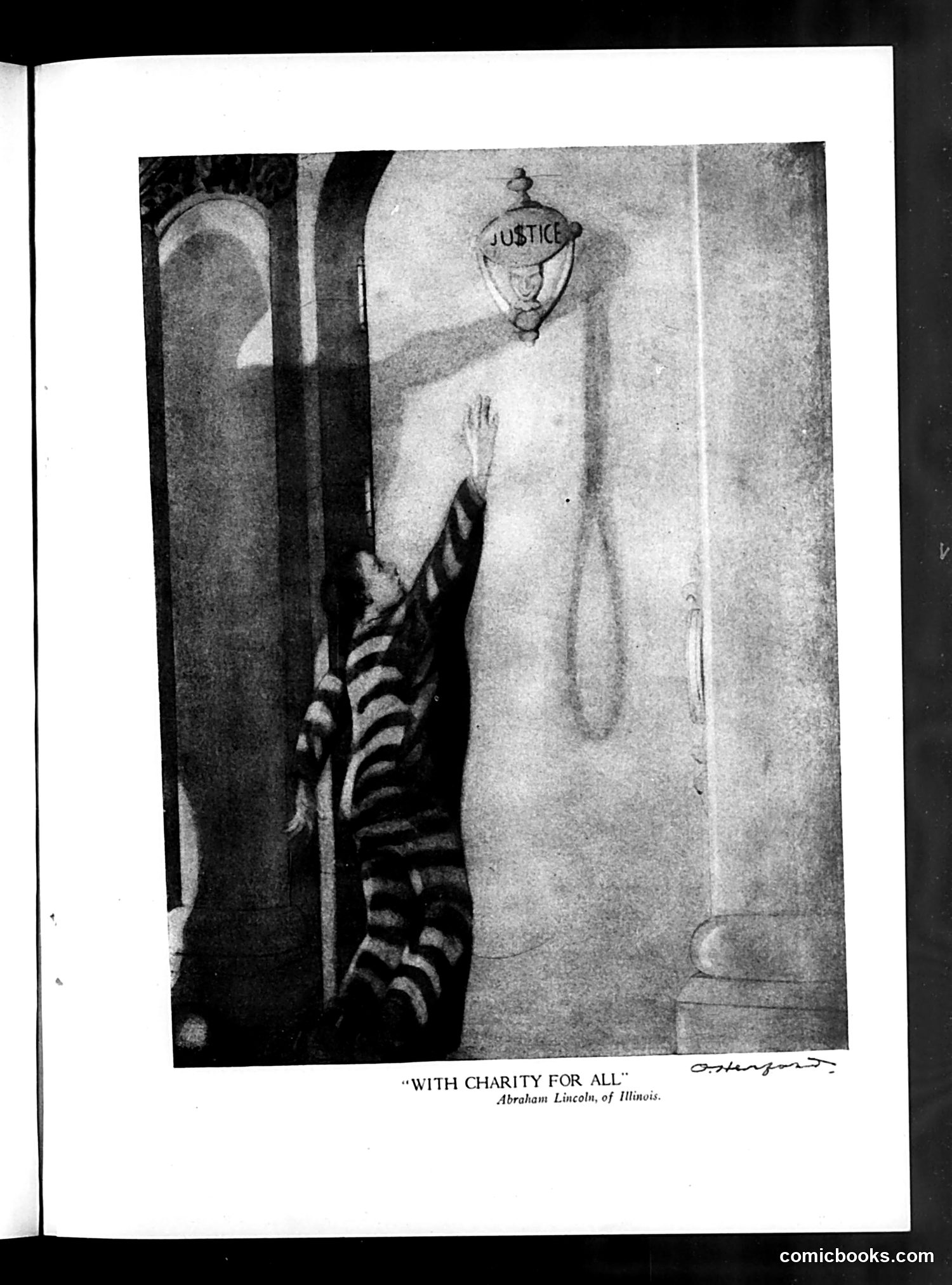
This is a political cartoon titled **"With Charity for All"** attributed to Abraham Lincoln, of Illinois. The image shows a figure in striped prison clothing reaching toward a wall where a lamp labeled "JUSTICE" hangs above. The prisoner's hand is raised as if pleading or grasping toward the symbol of justice. The cartoon appears to critique the gap between American ideals of justice and their actual application—likely referencing Lincoln's famous phrase about charity toward all. The imprisoned figure, rendered in shadow and darker tones, contrasts sharply with the illuminated "JUSTICE" symbol, suggesting that justice remains visibly present yet unreachable for the incarcerated or marginalized. The satire points to the failure to extend equal justice to all people despite the nation's stated principles.
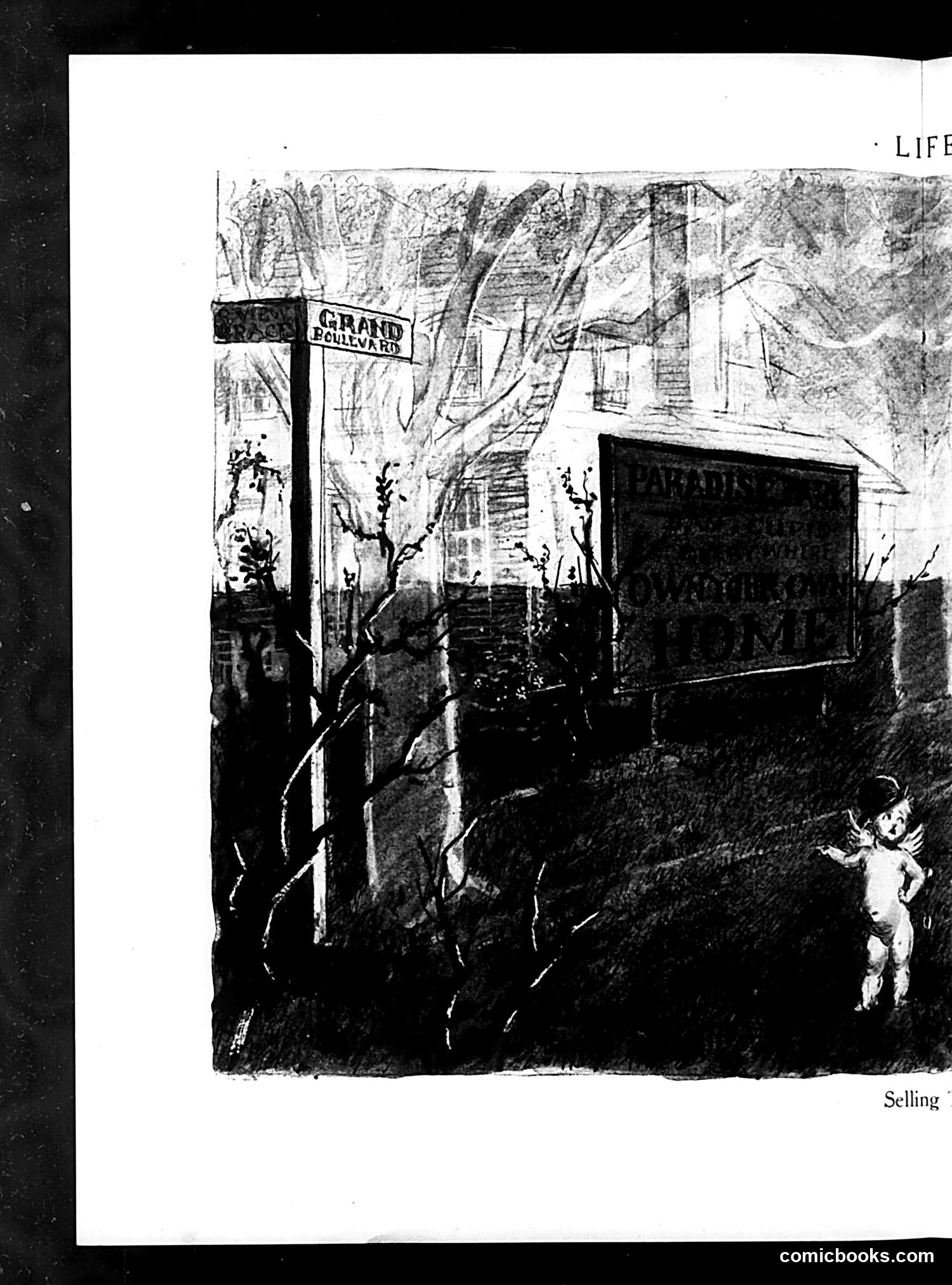
This appears to be a cartoon titled "Selling" from Life magazine, depicting a street scene on "Grand Boulevard." The illustration shows a cherub or cupid figure (right foreground) in what appears to be an urban alley or street corner lined with bare trees and buildings. There's a sign visible reading "Grand Boulevard" and what looks like a storefront or window display marked "Paradina" on the right side. The cartoon likely satirizes urban commercialism or street vending, though the specific political or social commentary is unclear from the image alone. The cherub figure—traditionally associated with innocence or romantic ideals—placed in this gritty urban commercial setting suggests ironic contrast between innocent imagery and hardscrabble street-level commerce. Without additional context about the publication date or surrounding articles, the precise satirical target remains uncertain.
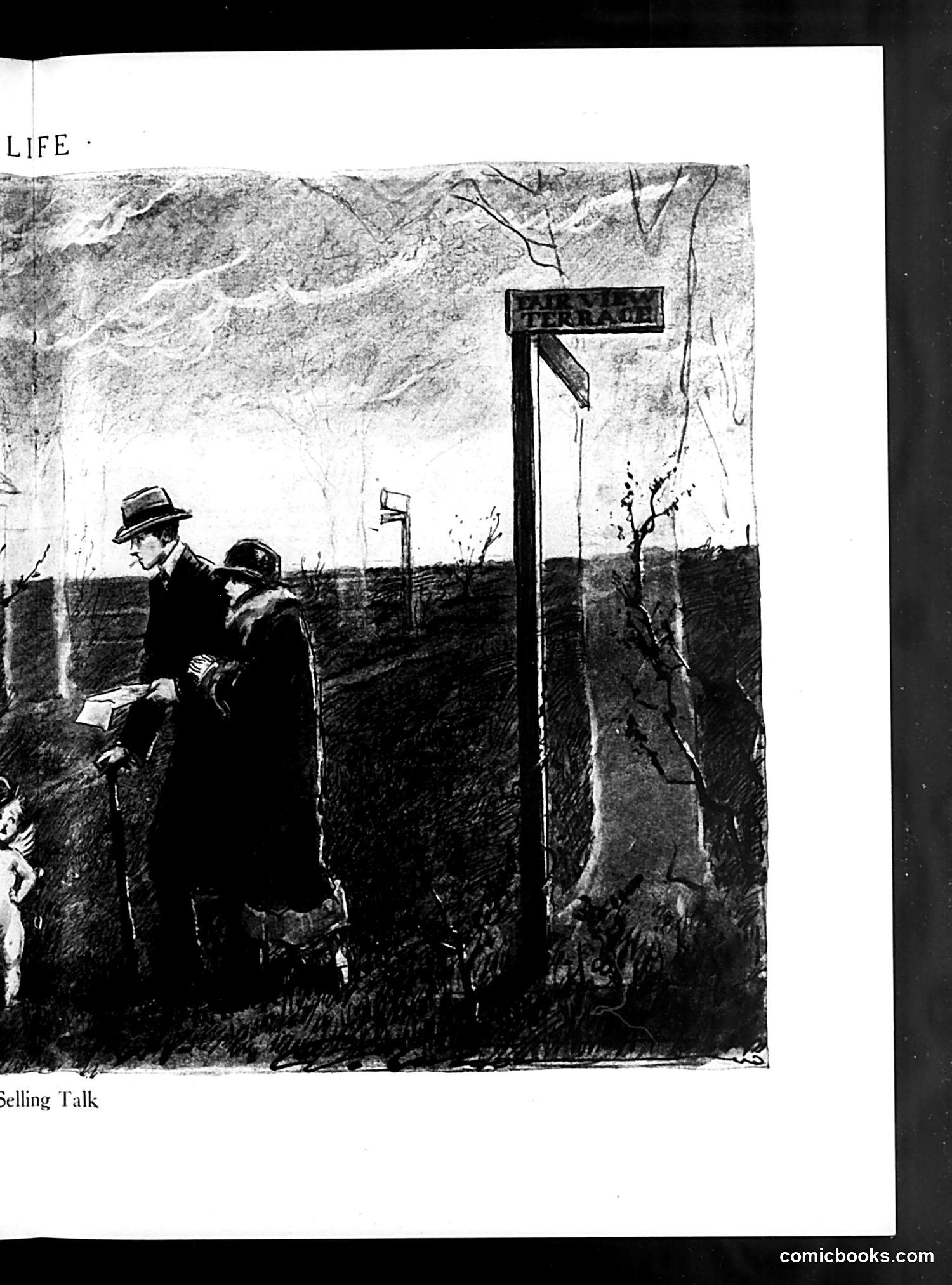
This appears to be a satirical cartoon from *Life* magazine showing two well-dressed men in suits and hats standing near a street sign reading "TERRACED" in what looks like a rural or undeveloped area. One man holds papers, suggesting he's a salesman or real estate agent "pitching" the property to a potential buyer. The joke likely critiques deceptive real estate sales practices—presenting bare, undeveloped land with grandiose terminology ("terraced") to make it sound more valuable or developed than it actually is. The barren landscape with scraggly plants and the formal business attire of the salesmen contrast sharply, emphasizing the gap between sales rhetoric and reality. This mocks the era's aggressive land speculation and misleading marketing tactics.
This page reviews three theatrical productions. The critic discusses "Isabel," a smart comedy at the Empire Theater featuring Leslie Howard and Margaret Lawrence, whose dialogue and cast elevate what is admittedly a "slight" play. The reviewer praises the supporting performances, particularly Edna May Oliver's comedic talent. The page also covers J.M. Barrie's one-act play "Shall We Join the Ladies?"—described as an unfinished mystery that the critic suspects Barrie wrote as deliberate burlesque rather than serious drama, joking that Barrie can claim he was "spoofing" if criticized. Finally, the critic reviews "The Piker," a crook play where a minor thief accidentally steals a large sum, then attempts a dramatic confession to gain notoriety as a "Master Bandit." The reviewer credits Leon Gordon's original concept but faults the execution for monotonous pacing that undermines the story's tragic potential. The reference to "Bernie Kaplan" failing at an "impressive exit" (like Cyrano) suggests the protagonist's attempted drama falls flat.
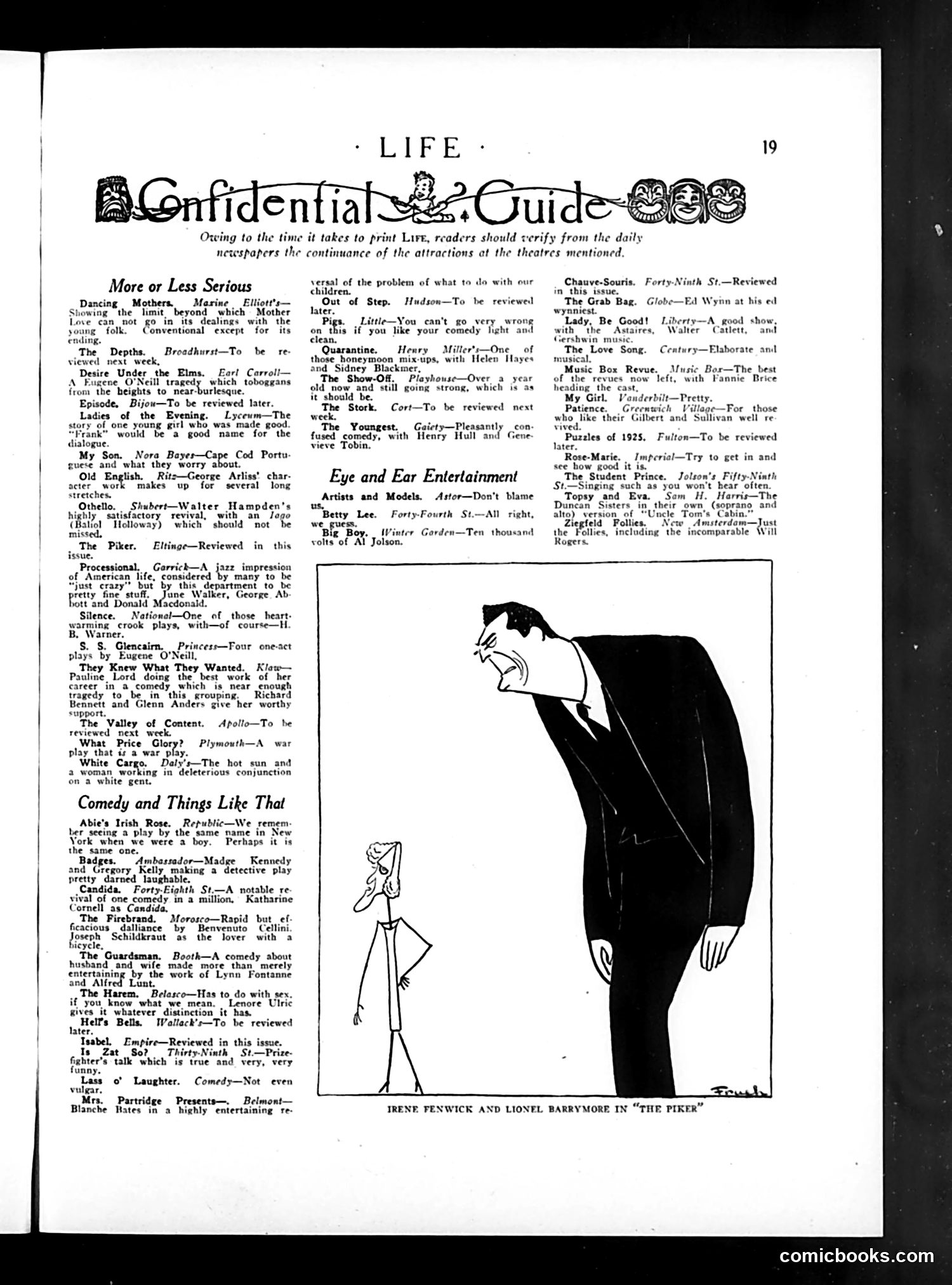
This page is a theater review guide from Life magazine covering Broadway and New York performances. The illustrated cartoon at bottom shows two figures from "The Piker"—Irene Fenwick and Lionel Barrymore—in an exaggerated dramatic pose typical of 1920s stage comedy. The reviews themselves are satirical capsule critiques of current plays. Life's critics use caustic wit: praising Eugene O'Neill's "Processional" as "pretty fine stuff" while dismissing "The Depths" as degenerating into "near-burlesque," and noting that "Ladies of the Evening" has dialogue so bad "Frank" would be an appropriate title. The humor targets both theatrical pretension and contemporary social anxieties—references to "Desire Under the Elms," sex-themed plays, and morality tales about young women suggest Life was commenting on Jazz Age concerns about changing social mores. The tone throughout is that of cosmopolitan New York critics mocking both earnest theater and audience tastes.
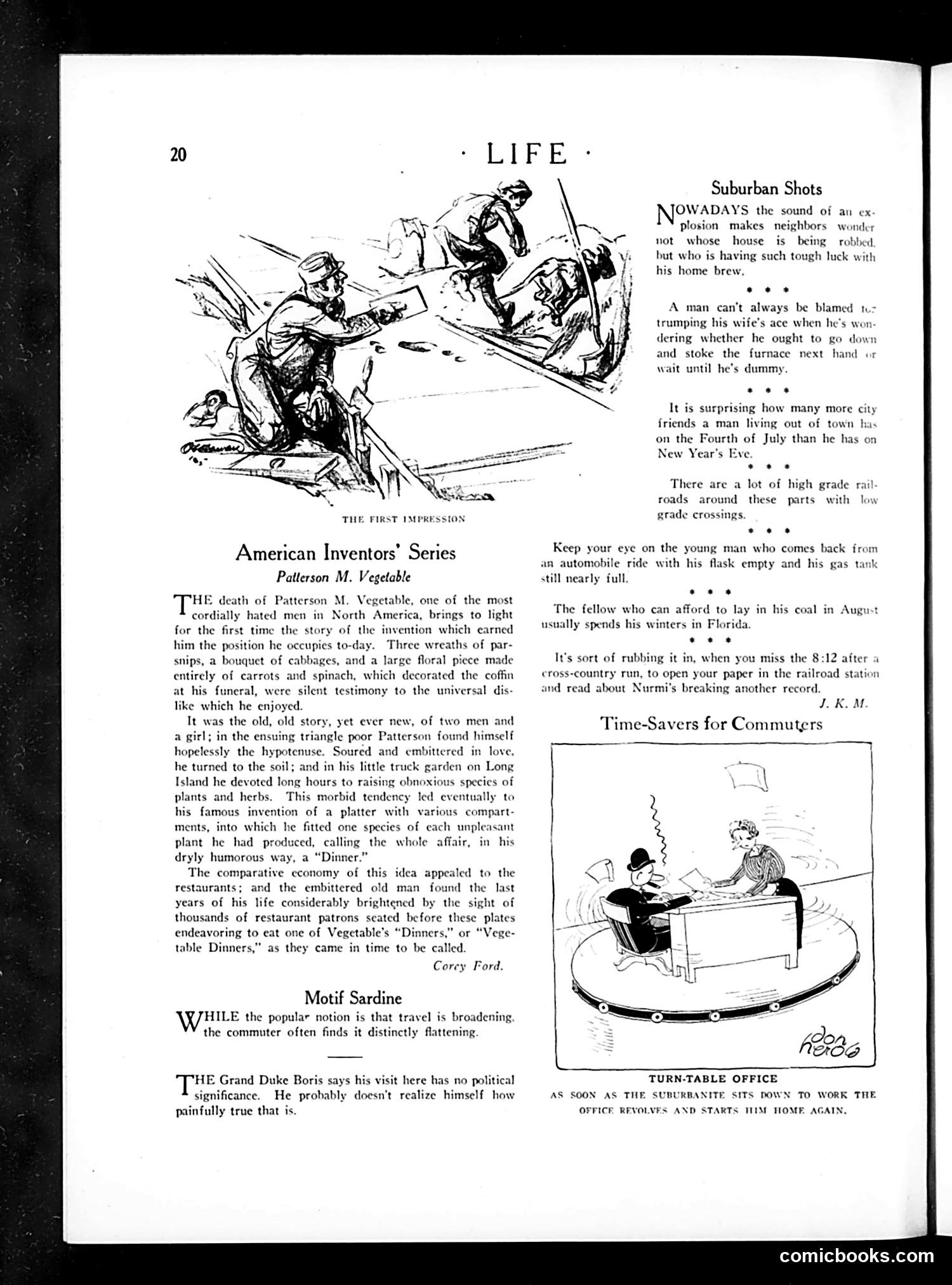
This page contains three distinct pieces of humor satirizing early 20th-century American life: **"Patterson M. Vegetable"** (top): A mock biographical article about an inventor of compartmentalized dinner plates containing various unpleasant vegetables. The satire targets both the inventor (portrayed as bitter and unlikable) and restaurant culture's acceptance of unpalatable food. The elaborate funeral wreaths made of vegetables underscore the dark comedy. **"Suburban Shots"** (right column): Brief, quip-style observations mocking suburban and commuter life, including references to Prohibition-era "home brew" explosions, marital tensions during furnace-tending season, and the gap between Fourth of July socializing and New Year's isolation. These capture 1920s anxieties about suburban monotony and domestic responsibilities. **"Time-Savers for Commuters"** (bottom): A cartoon showing a revolving office desk that spins a commuter immediately back home—satirizing the commuter's desire to escape work and the monotony of suburban commuting. The overall theme mocks the emerging suburban lifestyle and its discontents.
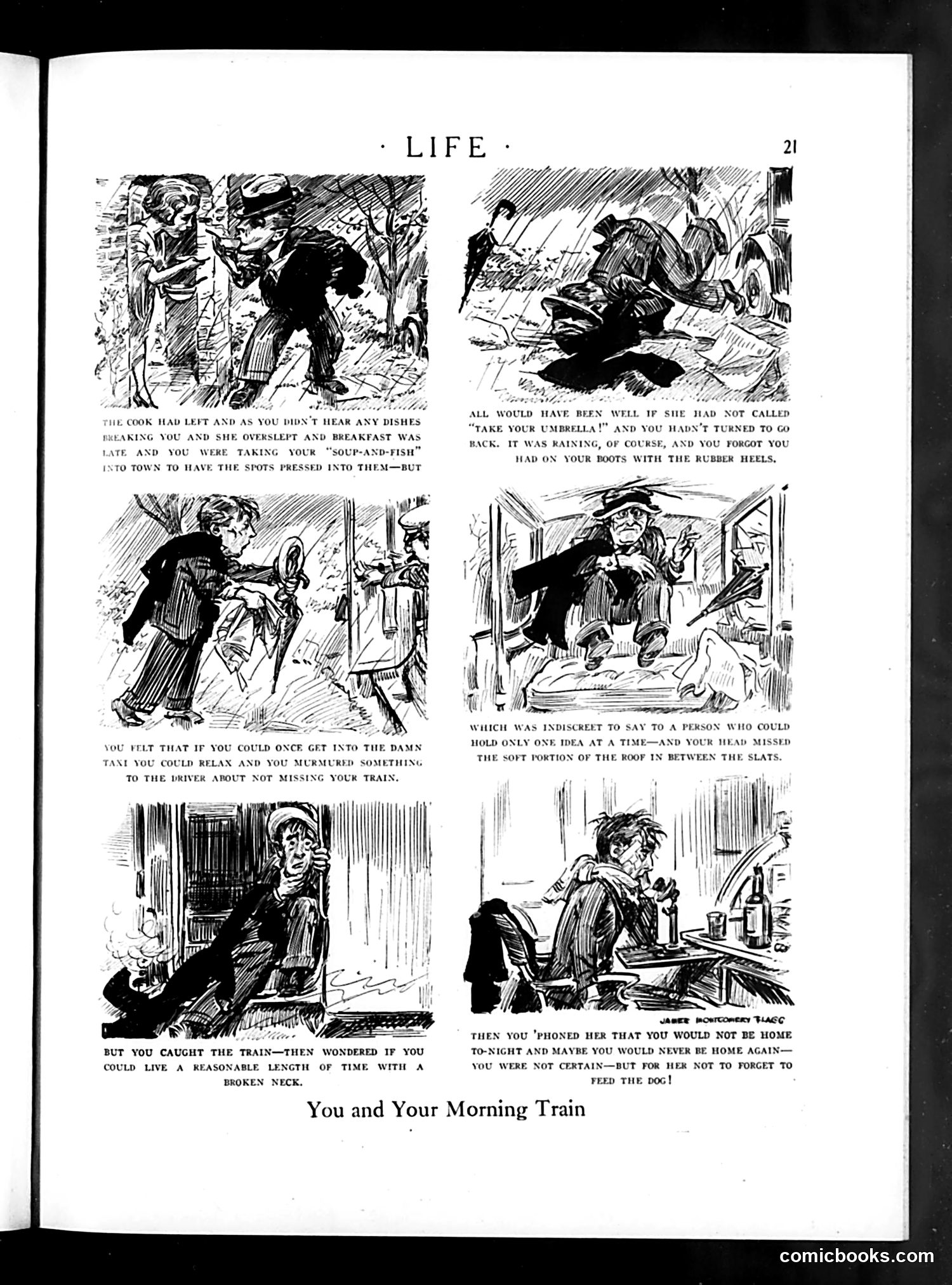
This is a humorous comic strip depicting the chaos of a commuter's rushed morning routine. The narrative follows an unnamed man dealing with domestic mishaps: an oversleeping cook, forgotten laundry (formal "soup-and-fish" dinner clothes needing pressing), a rainy departure, and near-injury when he bumps his head on the roof getting into a taxi. The satire targets the absurdity of modern urban commuting life—the anxiety of potentially missing trains, physical indignities, and petty domestic crises that pile up. The final panel's punchline is characteristically bittersweet: while contemplating whether he could survive a broken neck, his main concern is ensuring his wife remembers to feed the dog—a jab at domestic priorities and the mundane details that paradoxically matter most. The comic reflects early-20th-century Life magazine's satirical focus on everyday middle-class anxieties and the modern commuter experience.
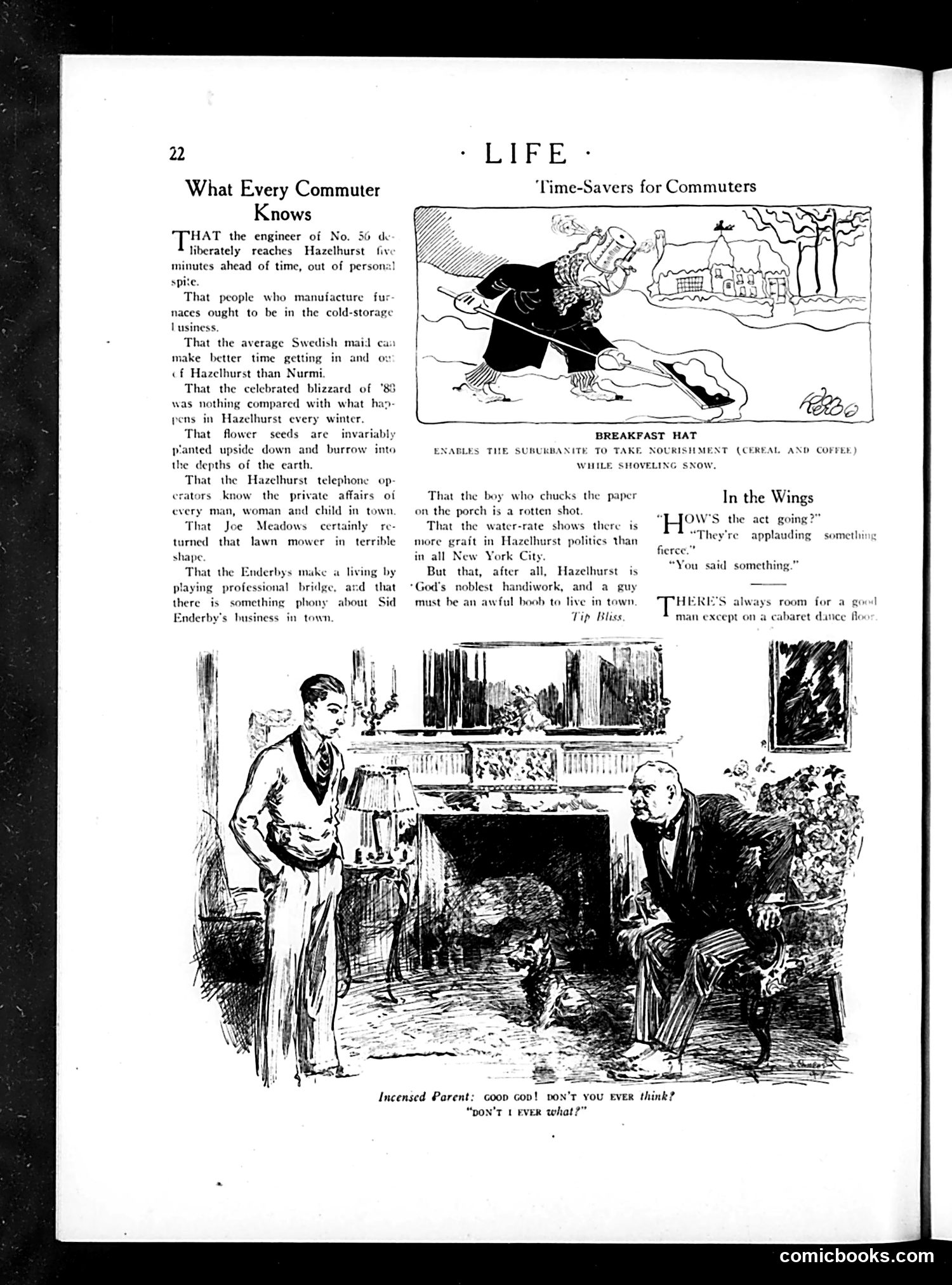
This 1920s *Life* magazine page offers satirical observations about suburban commuting life in "Hazelhurst," likely a fictional stand-in for an actual New York commuter town. The top cartoon depicts a man shoveling snow while eating breakfast—the "Breakfast Hat" caption jokes that suburbanites need to multitask even during meals due to harsh winters. The left column humorously catalogs things every commuter "knows": trains deliberately run late out of spite, brutal winters exceed historical blizzards, telephone operators gossip about everyone, and local politics are as corrupt as New York City's. The bottom illustration shows an "Incensed Parent" confronting what appears to be a young man, with the parent exasperated: "Don't you ever think?" This critiques youth's apparent lack of foresight or responsibility. The "In the Wings" section contains brief theatrical backstage banter, unrelated to the commuter theme. Overall, the page mocks both suburban life's frustrations and the character flaws it supposedly breeds.
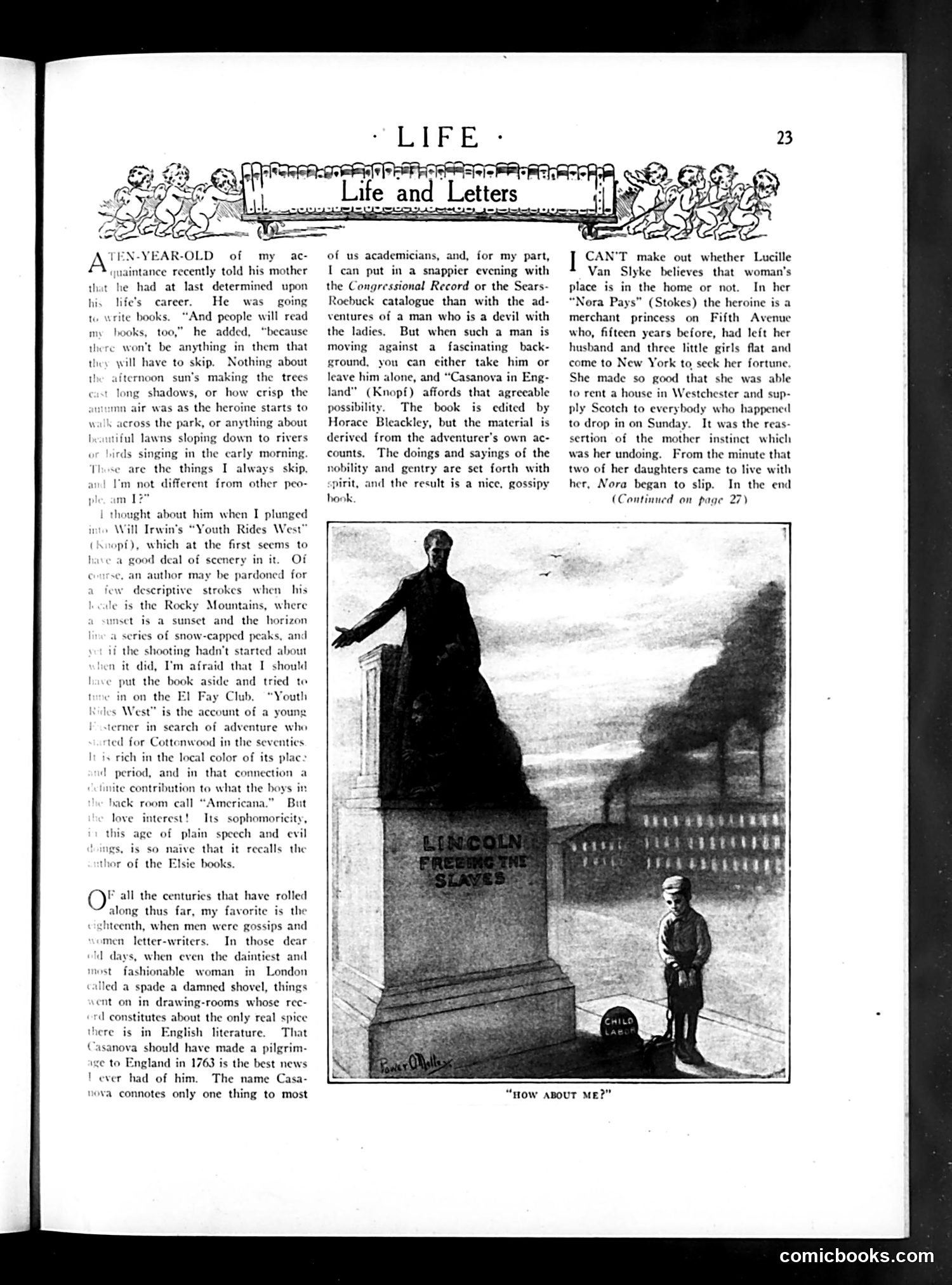
This page contains a literary column reviewing recent books. The main illustration, captioned "How About Me?", depicts a statue of Lincoln with a small child looking up at it—a commentary on American historical memory and perspective. The text discusses several books: Will Irwin's "Youth Rides West" (criticized for excessive descriptive scenery about Rocky Mountains), "Casanova in England" edited by Horace Bleackley (praised for 18th-century gossip and letter-writing), and Lucille Van Slyke's "Nora Pays" about a successful businesswoman who abandons her family for fortune. The overarching theme critiques overly ornate literary descriptions and sentimentality. The author mocks readers who skip flowery passages about nature and praises the 18th century's direct, gossip-filled writing style. The Lincoln cartoon likely suggests that even monumental historical figures seem small from a child's perspective—a visual metaphor for how literature's grand descriptions may miss what actually matters to readers.
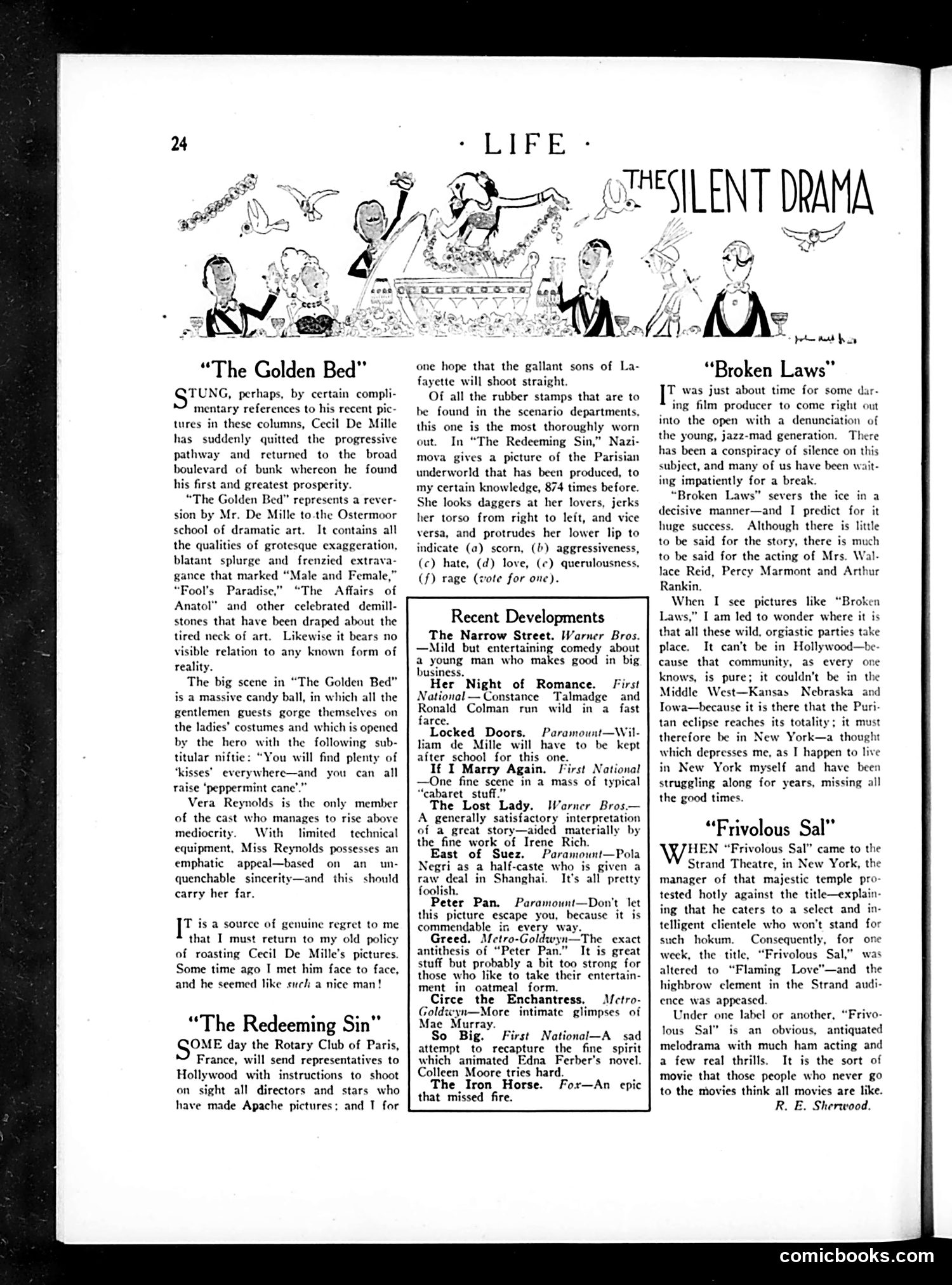
This page reviews recent silent films with sharp satire. The main cartoon shows exaggerated theatrical figures celebrating "The Silent Drama"—mocking Hollywood's grandiosity. The critic savagely attacks director **Cecil B. DeMille**, accusing him of abandoning artistic integrity to return to sensationalist spectacle. "The Golden Bed" is ridiculed for grotesque exaggeration and lack of realism, particularly its famous "massive candy ball" scene. The reviewer expresses betrayal, having recently praised DeMille. Similar contempt targets **Nazimova's "The Redeeming Sin,"** dismissed as a tired Apache underworld cliché repeated 874 times before, where the actress merely "protrudes her lower lip" to convey various emotions. The brief capsule reviews below mock formulaic Hollywood—praising **Constance Talmadge** and **Irene Rich** while skewering mediocre productions. The overall tone reflects 1920s highbrow disdain for commercial filmmaking's sensationalism versus artistic merit.
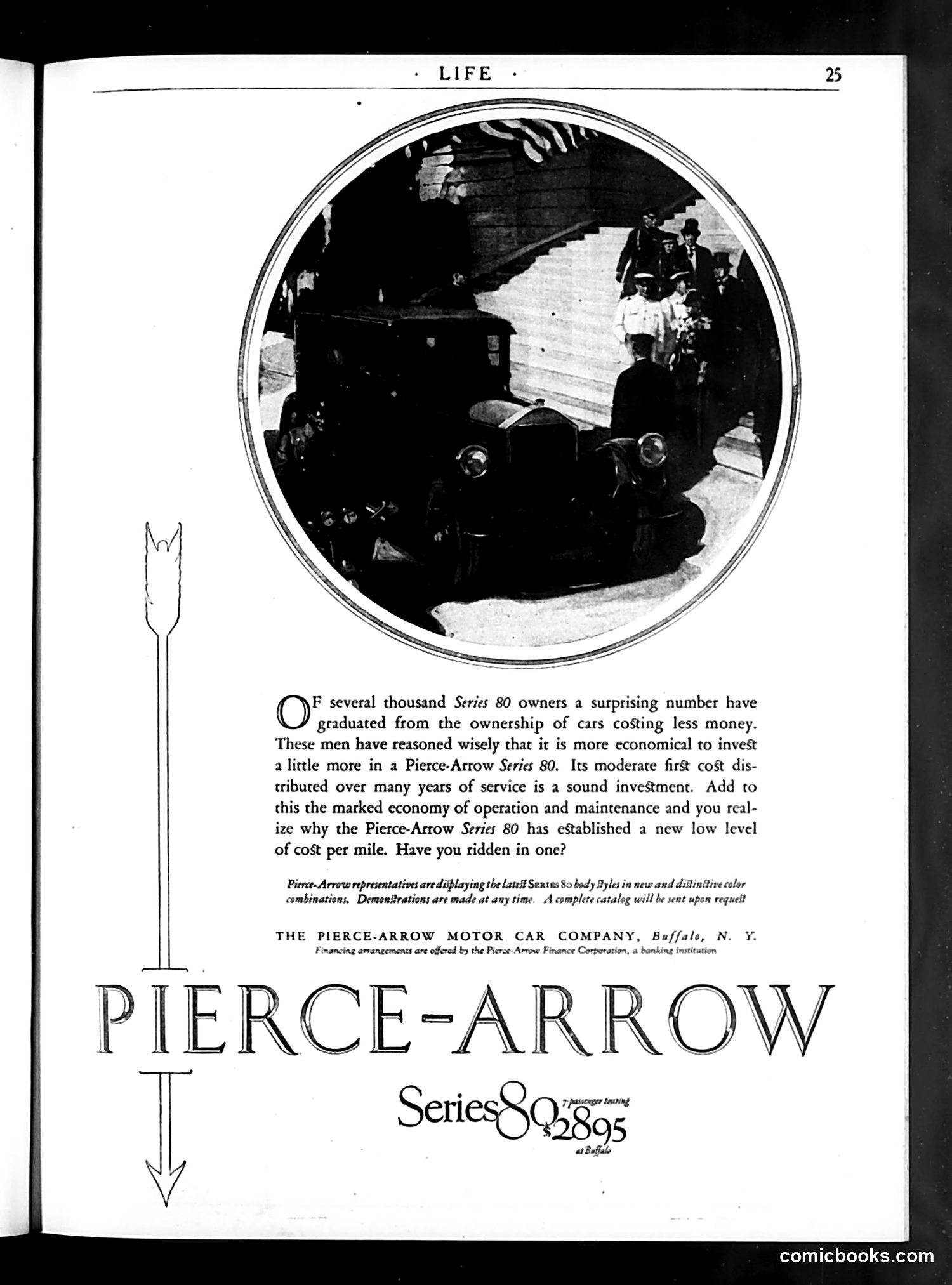
This is not a political cartoon but a **full-page automobile advertisement** from *Life* magazine. The circular photograph shows a Pierce-Arrow Series 80 automobile parked outside what appears to be an elegant building, with well-dressed passengers visible. The advertisement's message targets affluent buyers by arguing that the Pierce-Arrow Series 80, though moderately priced at $2,895, represents sound long-term investment. It appeals to logic: owners of cheaper cars have "reasoned wisely" that spending more upfront saves money over years of ownership through lower maintenance and operational costs. The tone is aspirational marketing dressed as practical economics—suggesting that purchasing this luxury car demonstrates intelligence and financial prudence rather than extravagance. The ad emphasizes availability of financing and invites test drives, standard advertising tactics of the period.
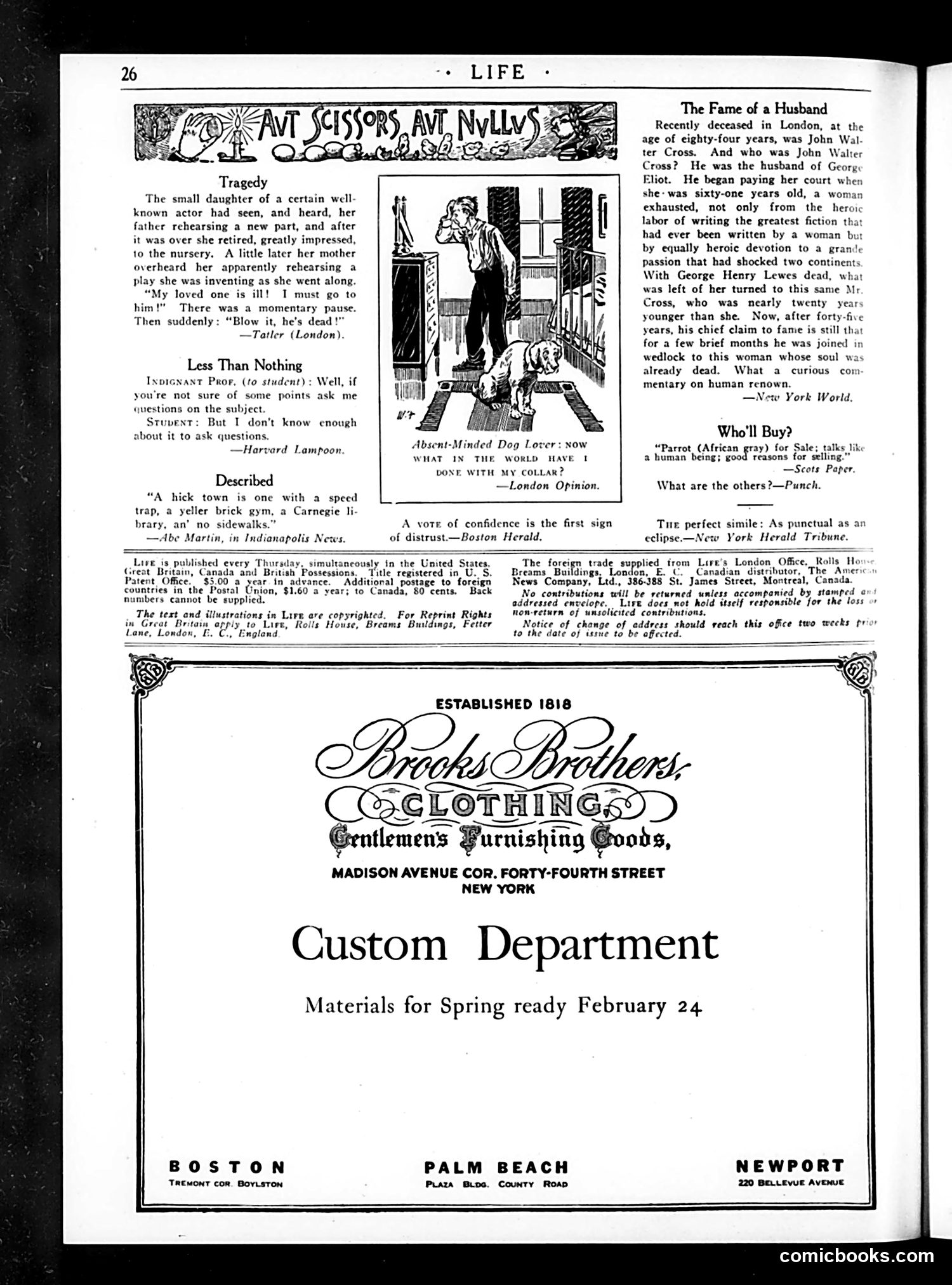
This page from *Life* magazine contains several short humorous anecdotes rather than political cartoons. The content includes: **"Tragedy"** — A joke about a young child mimicking her actor father's dramatic rehearsal, ending with her improvised line "Blow it, he's dead!" — satirizing overwrought theatrical performance. **"Less Than Nothing"** — Harvard Lampoon humor about a student so unprepared he lacks even basic knowledge to formulate questions. **"Described"** — Abe Martin's definition of a "hick town" as a small place with stereotypical features: speed traps, loud brick buildings, and a Carnegie library. **"Absent-Minded Dog Lover"** — A visual cartoon showing a man unable to locate his collar, humorously suggesting the dog has taken it. The page also includes editorial commentary mocking the posthumous fame of John Walter Cross, whose sole claim to recognition was being George Eliot's brief husband—satirizing how women writers' legacies can be overshadowed by their marital connections. The bottom half is advertising for Brooks Brothers clothing.
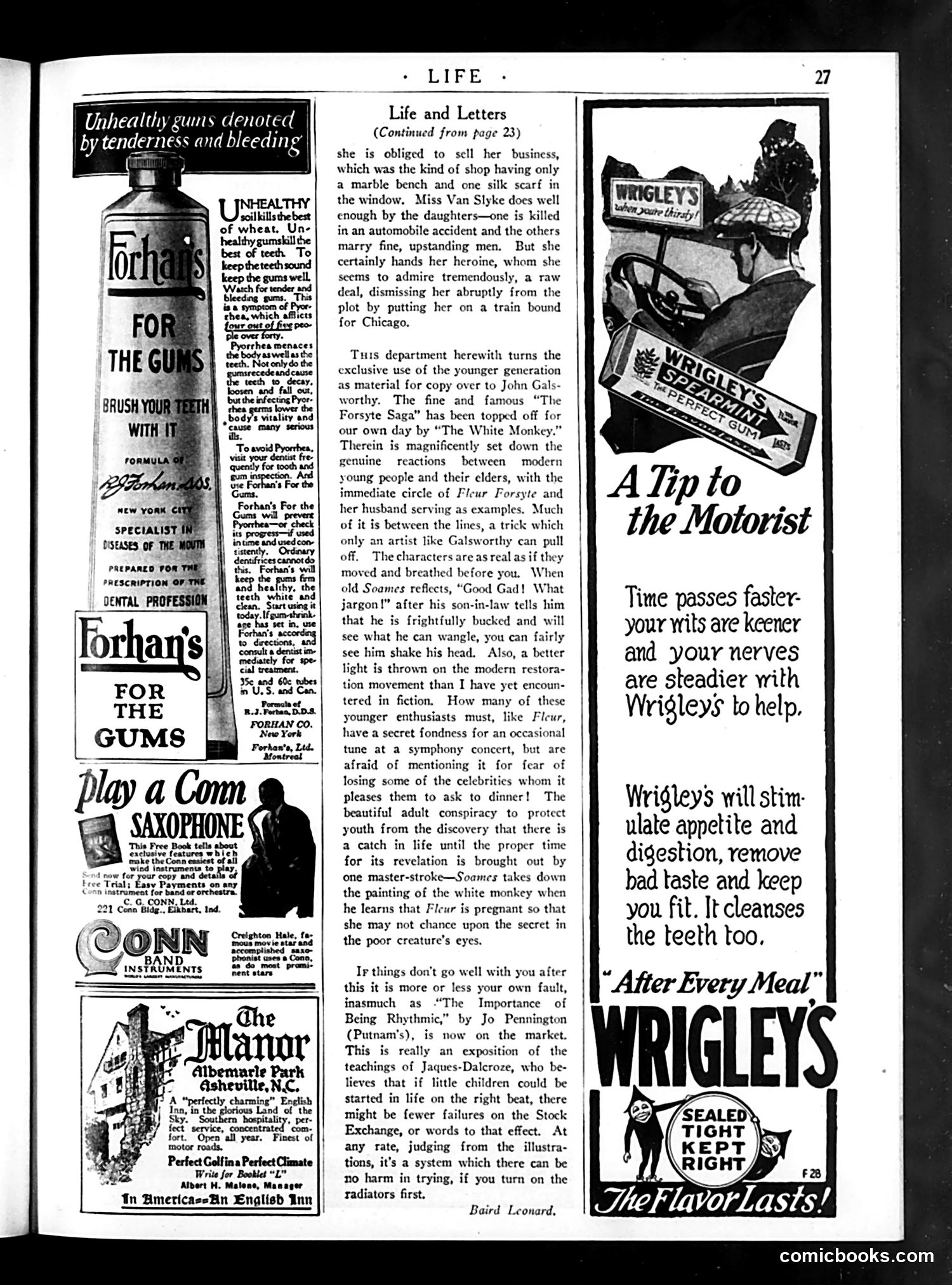
This is primarily a **book review column** ("Life and Letters") discussing contemporary 1920s literature, alongside period advertisements—not political satire. The review discusses novels including John Galsworthy's "The White Monkey" (part of his *Forsyte Saga*), praising its realistic portrayal of generational conflict between modern young people and their elders. The critic admires Galsworthy's subtle characterization and his depiction of the restoration movement. The advertisements are typical of the era: Forhan's toothpaste (warning of pyorrhea/gum disease), Wrigley's chewing gum (claiming digestive and dental benefits), a saxophone instruction book, Conn band instruments, and resort/hotel promotions. **No cartoons or political satire appear on this page.** It represents Life magazine's typical mix of literary commentary and commercial advertising from the 1920s.
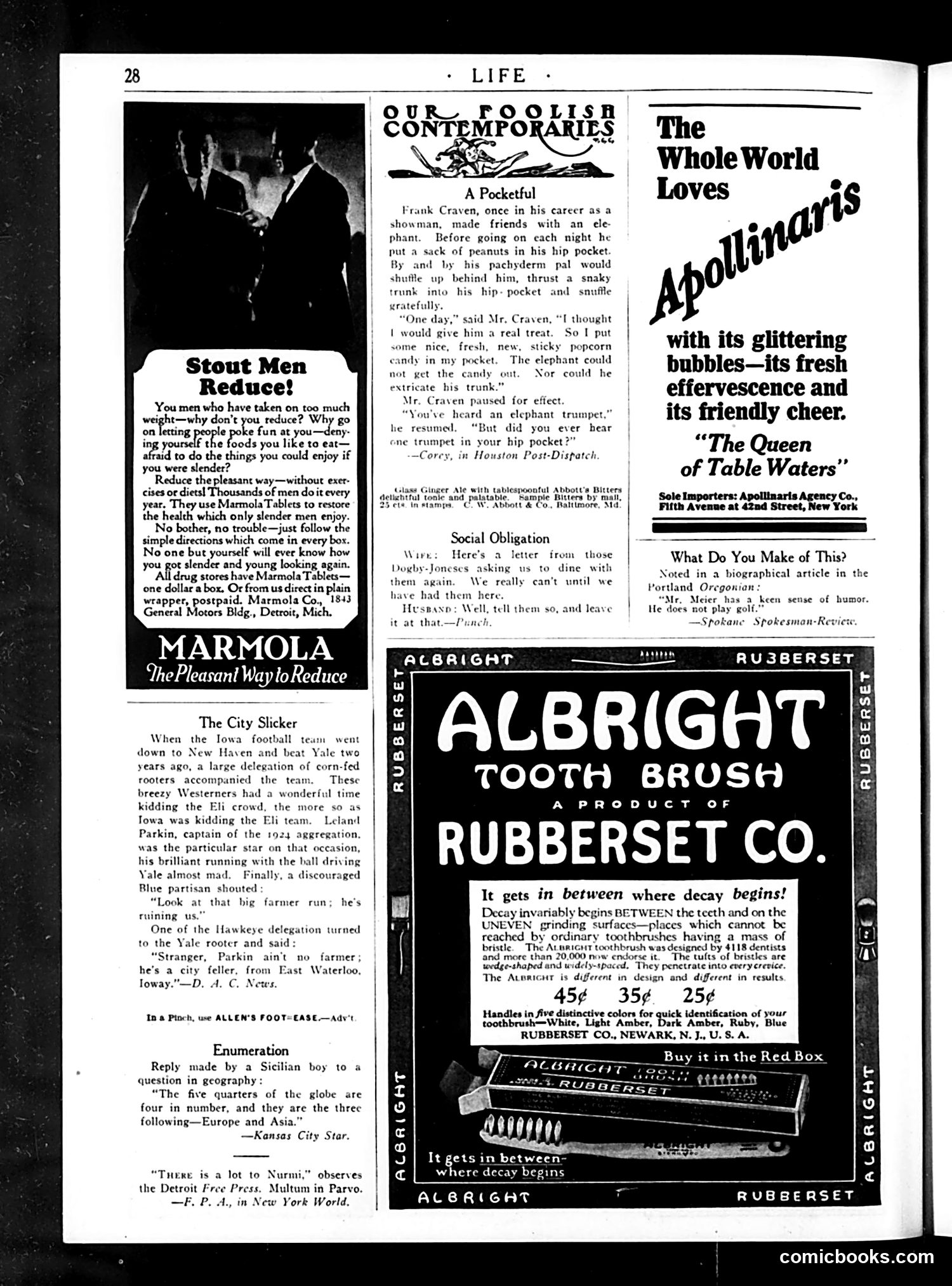
This page contains **humorous anecdotes and advertisements** rather than political cartoons. **Notable content:** - **"A Pocketful"**: A showman's story about befriending an elephant by offering peanuts—until he tries sticky popcorn, trapping the elephant's trunk. It's a simple joke about unintended consequences. - **"The City Slicker"**: Iowa football fans from rural areas tease Yale supporters, then are themselves surprised to learn their team captain isn't actually a farmer but "from East Waterloo, Iowa"—a reversal-joke playing on stereotypes about Midwesterners. - **Advertisements**: The page is dominated by ads for Marmola (weight-loss tablets), Apollinaris water, and Rubberset toothbrushes—typical 1920s products with period marketing language. The short humor pieces use gentle irony and wordplay typical of *Life* magazine's satirical style, but target everyday social situations rather than political figures.
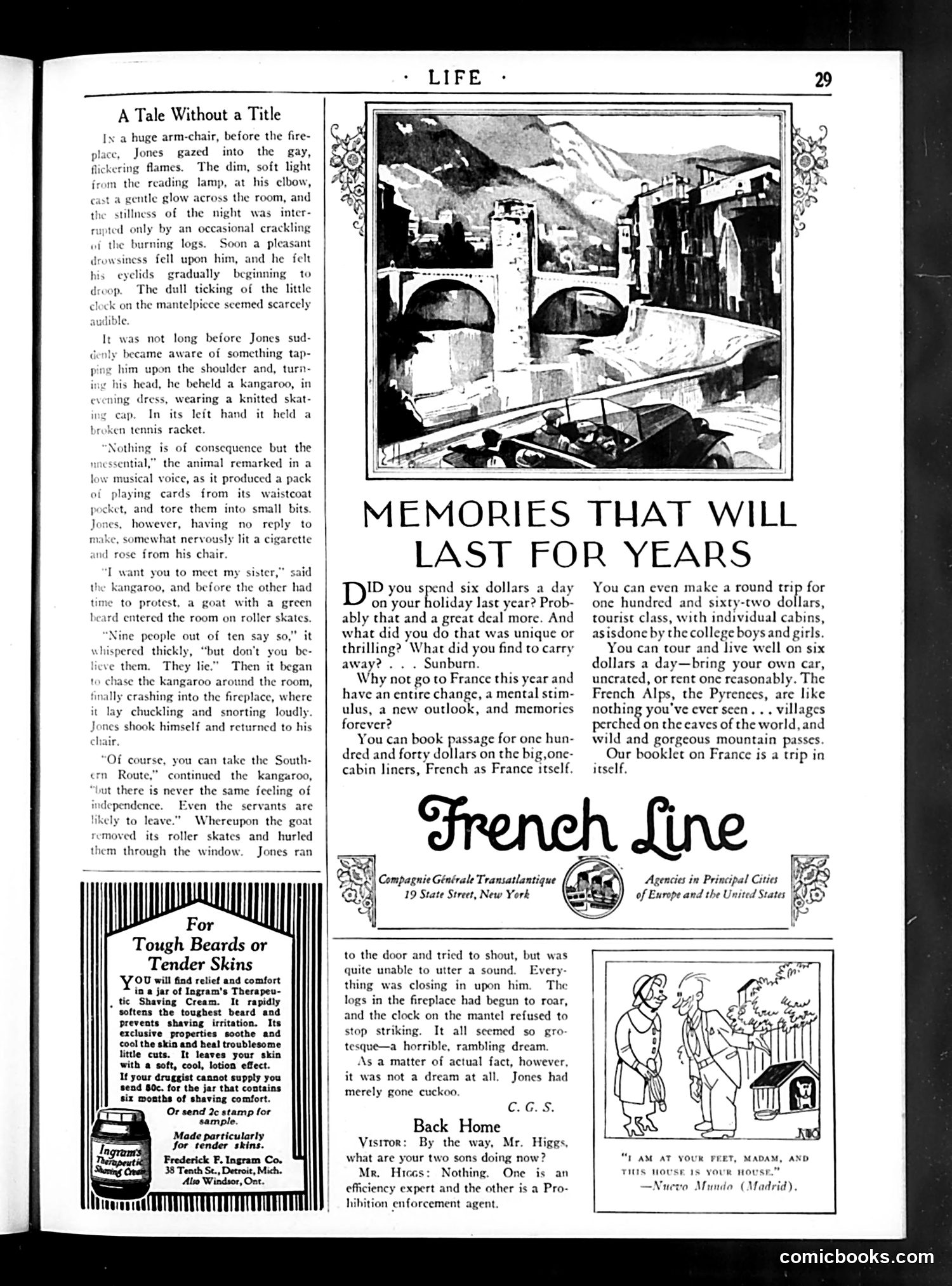
This page contains a absurdist short story titled "A Tale Without a Title" featuring a man named Jones who falls asleep by his fireplace and dreams of surreal encounters with anthropomorphic animals—a kangaroo in evening wear and a goat on roller skates—who speak in non-sequiturs and behave chaotically. The satire targets the vagueness and pretension of modernist literature popular in the 1920s. The story deliberately avoids logical narrative or meaningful point, with characters making cryptic statements like "Nothing is of consequence but the nonessential." This parodies the experimental, deliberately obscure literary style that had become fashionable among avant-garde writers. The dream-like breakdown at the end—reality dissolving into chaos—further mocks modernist writers' fascination with psychological fragmentation and surrealism as artistic techniques. The page also contains period advertisements (shaving cream, French ocean liners) typical of Life magazine's advertising mix.
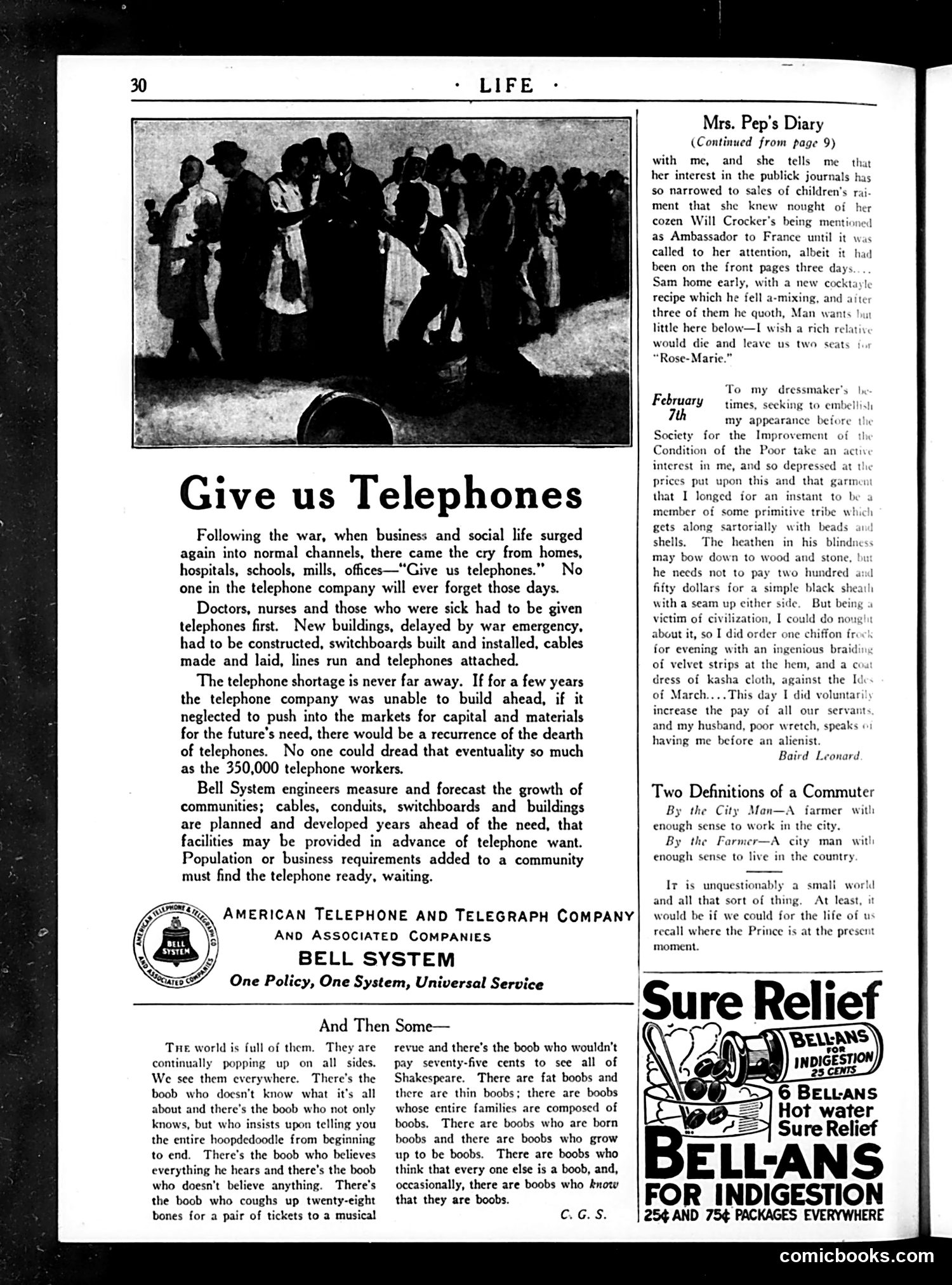
This page contains primarily **advertising and satirical commentary**, not political cartoons. The main image shows a crowd—likely representing post-WWI Americans demanding telephone service—accompanying a Bell System advertisement. The ad argues that telephone infrastructure requires years of advance planning to meet growing demand, positioning the company as forward-thinking and essential. The satirical section "And Then Some" by C.G.S. is a humorous essay cataloging different types of "boobs" (foolish people)—those who know nothing, those who won't stop talking, those who believe everything or nothing, theater-goers, etc. It's gentle social satire about human folly and pretension. "Mrs. Pep's Diary" is a gossip column about wealthy socialites' mundane concerns: fashion prices, servants' wages, and awareness of current events. The humor lies in their superficiality and disconnect from broader world issues. The **Bellans indigestion advertisement** at bottom is unrelated product marketing.
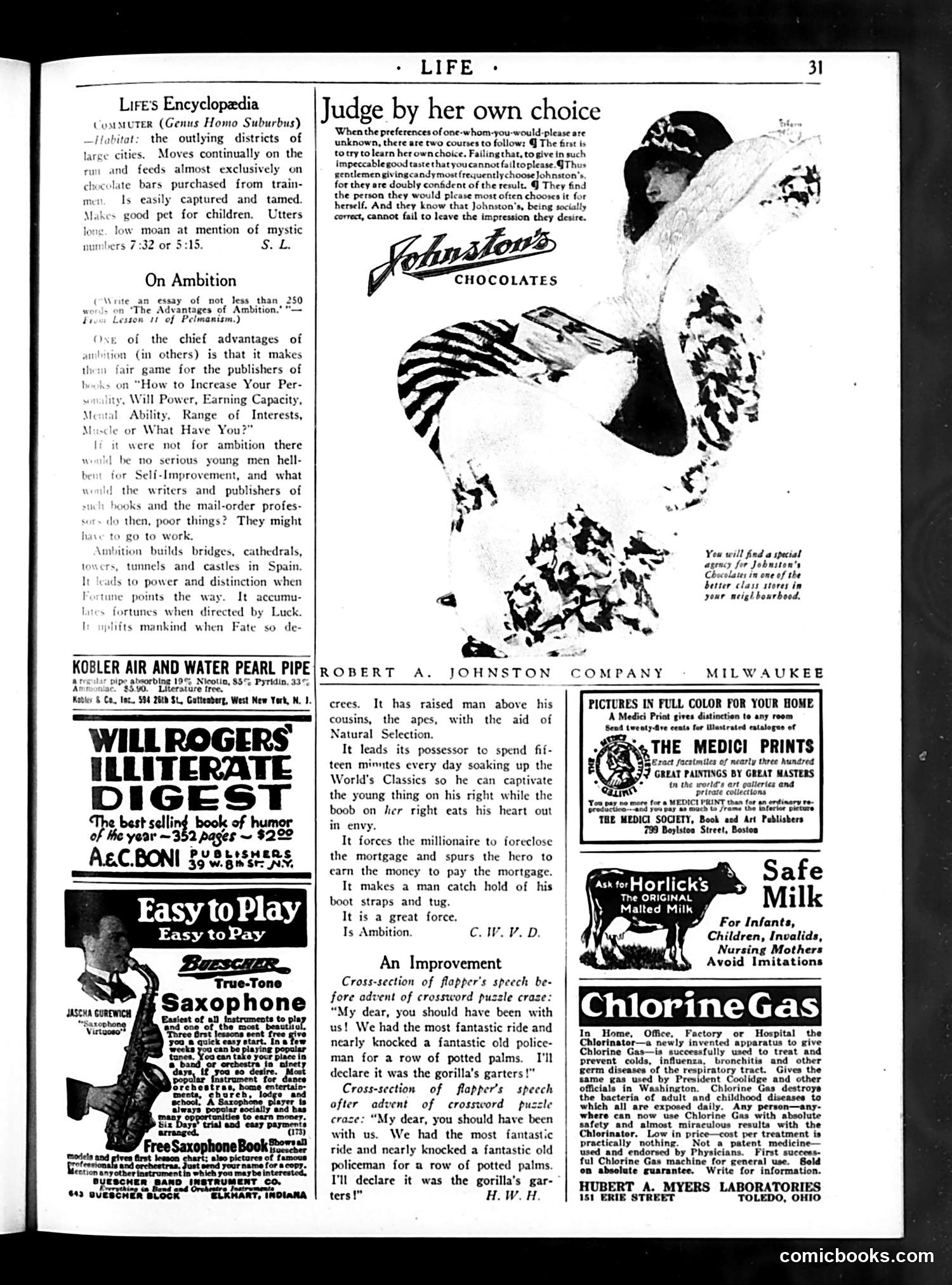
This page from **Life magazine** (a satirical publication, likely 1920s based on references to "flappers" and crossword puzzles) contains mostly **advertisements and short humor pieces** rather than political cartoons. The main content includes: **"Judge by Her Own Choice"** — A Johnston's Chocolates ad playing on courtship anxieties: if you don't know a woman's taste, give her the "safe" choice of Johnston's chocolates, which are "socially correct." **"On Ambition"** — An essay satirizing self-help publishing, mocking the industry's exploitation of ambitious young men seeking self-improvement books. **"An Improvement"** — A brief joke about how the crossword puzzle craze has made flapper speech repetitive and less colorful. Before crosswords, they spoke colorfully; after, they speak identically. The **advertisements** (Will Rogers' "Illiterate Digest," Horlick's Malted Milk, Chlorine Gas disinfectant) are period products marketed with period-appropriate appeals. No significant political satire or caricature is visible. This is primarily a humor and advertising page.
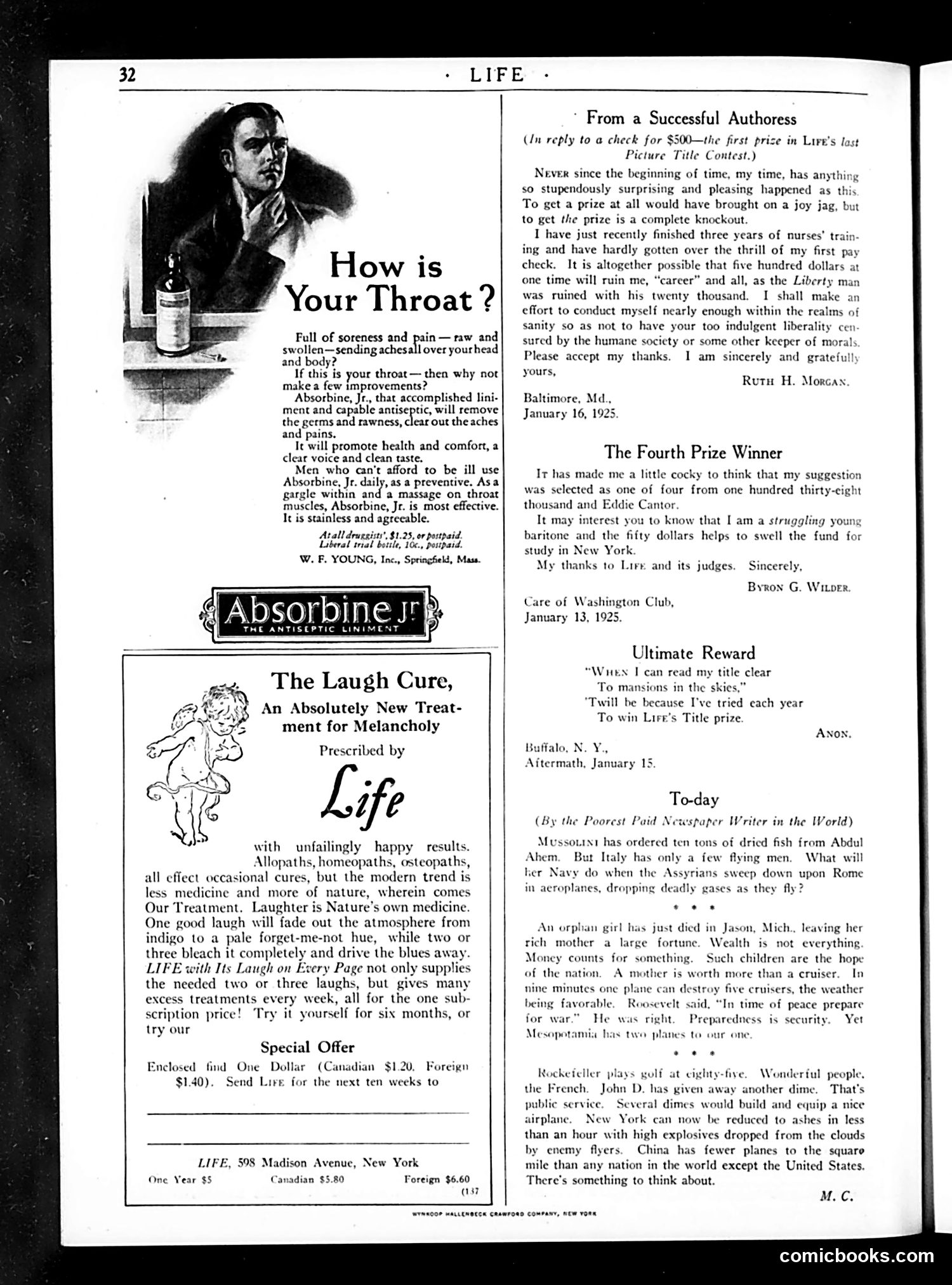
This page mixes advertisements with reader submissions to Life's picture-title contest. The **Absorbine Jr. ad** uses a sore-throat appeal to sell liniment—standard medical advertising of the era, when such products made broad health claims. "**The Laugh Cure**" is Life's self-promotional advertisement, joking that laughter (provided by their magazine) cures melancholy better than medicine. This reflects 1920s optimism about humor's therapeutic value. The right column prints **winning contest entries**—readers submitted captions for a Life photo and won cash prizes. Ruth H. Morgan won $500 (substantial money then); Byron Wilder won $50. Their grateful letters show how valuable such prizes were to working people. The final section, "**To-day**," appears to be satirical news commentary on current events (Mussolini, Italy, orphans), though the text is fragmentary. The page overall reflects Life's dual identity: a humor magazine that also published serious content and reader participation contests.
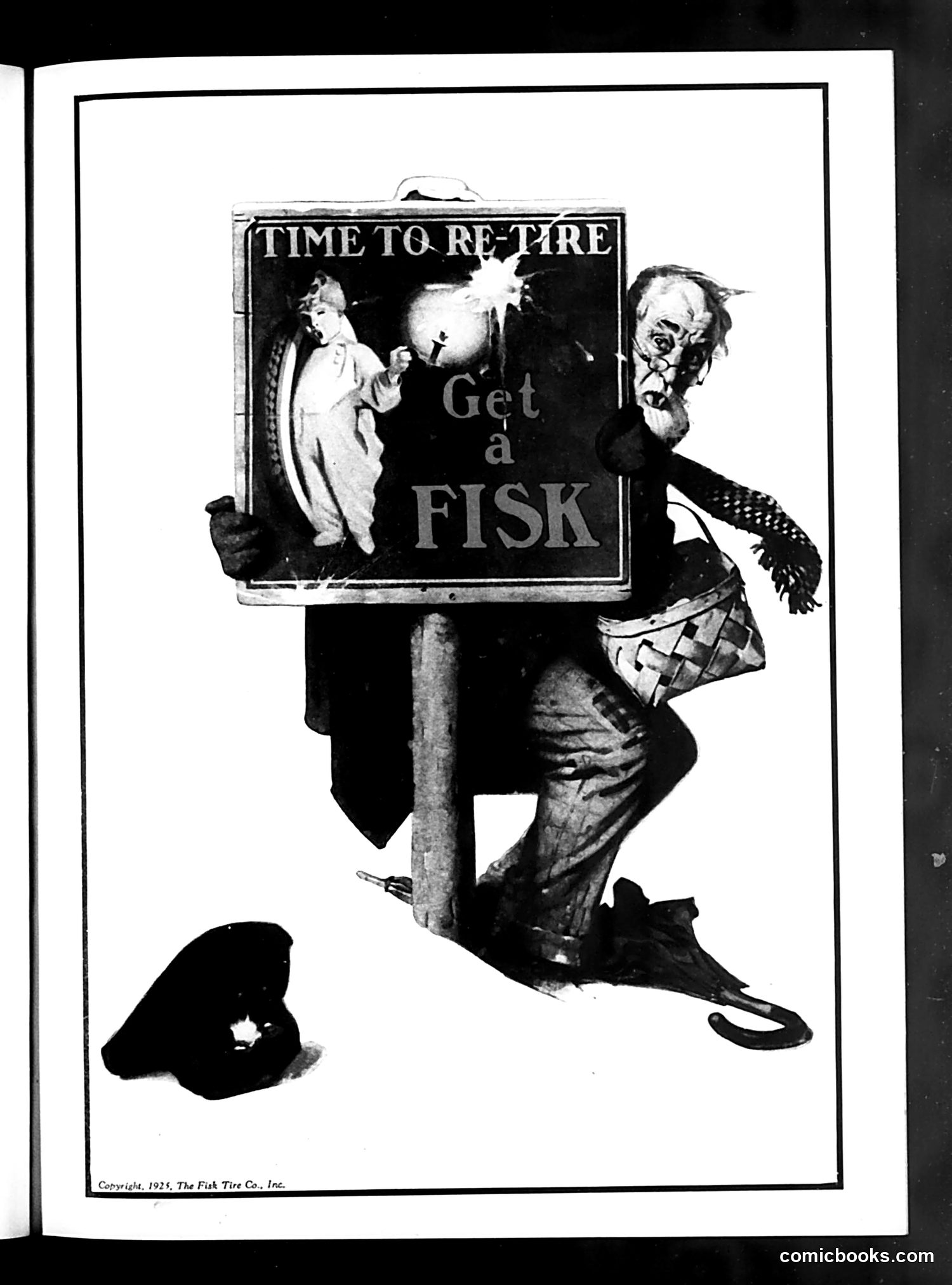
This is a **1925 Fisk Tire Company advertisement**, not a political cartoon. The image shows a caricatured old man (appearing tired and worn) holding a sign reading "TIME TO RE-TIRE / Get a FISK." The satire is commercial, not political: it's a visual pun playing on the double meaning of "retire." The exhausted figure represents an old, worn-out tire (or vehicle owner) who needs replacement. The dropped hat at his feet emphasizes his decrepit state. This was Fisk's famous advertising campaign from the early 20th century, known for using the "Time to Retire" slogan with exaggerated character illustrations to suggest that old tires—like tired old people—should be replaced with Fisk products.
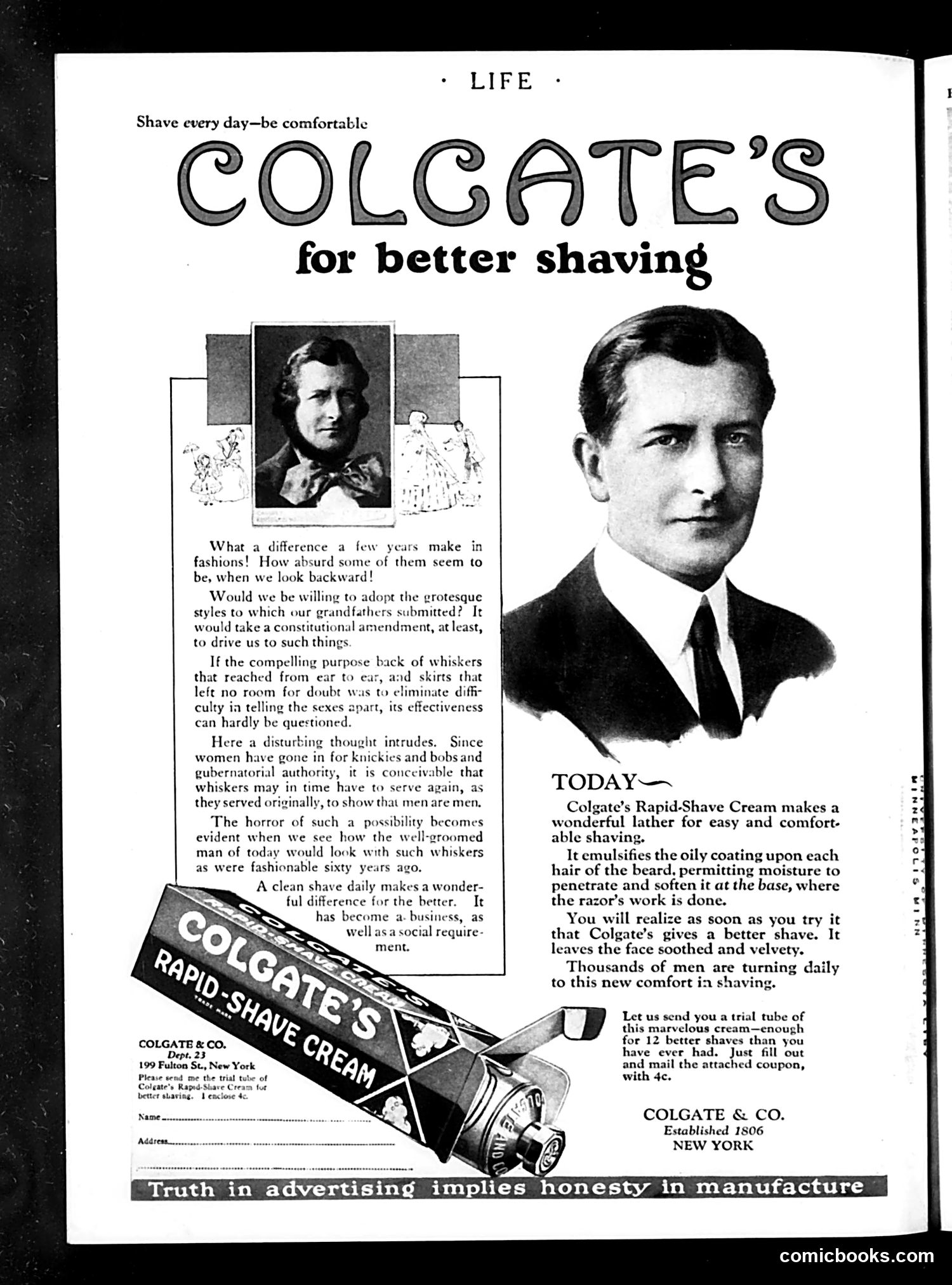
This is primarily a **shaving cream advertisement**, not political satire, though it uses social commentary as a hook. The ad's humor pivots on **gender anxiety** about changing social roles. It opens by mocking outdated 19th-century fashions (full beards, restrictive skirts), then pivots darkly: since women now wear "knickies and bobs" (bobbed hair, knickers) and pursue "gubernatorial authority" (political power), men may eventually need to grow beards again to visibly distinguish themselves as male. The "disturbing thought" is that modern masculinity requires constant maintenance—daily shaving—to assert male identity in an era when women are encroaching on traditionally male domains. The well-groomed man becomes a social and business requirement, not just appearance. **The satire targets**: 1920s anxieties about feminism and women's expanding rights, framed through the lens of masculine grooming. The ad exploits these fears to sell Colgate's Rapid-Shave Cream as essential to maintaining clear gender boundaries.