
Life, 1925-02-12 · page 26 of 36
Life — February 12, 1925 — page 26: what you’re looking at
What you’re looking at
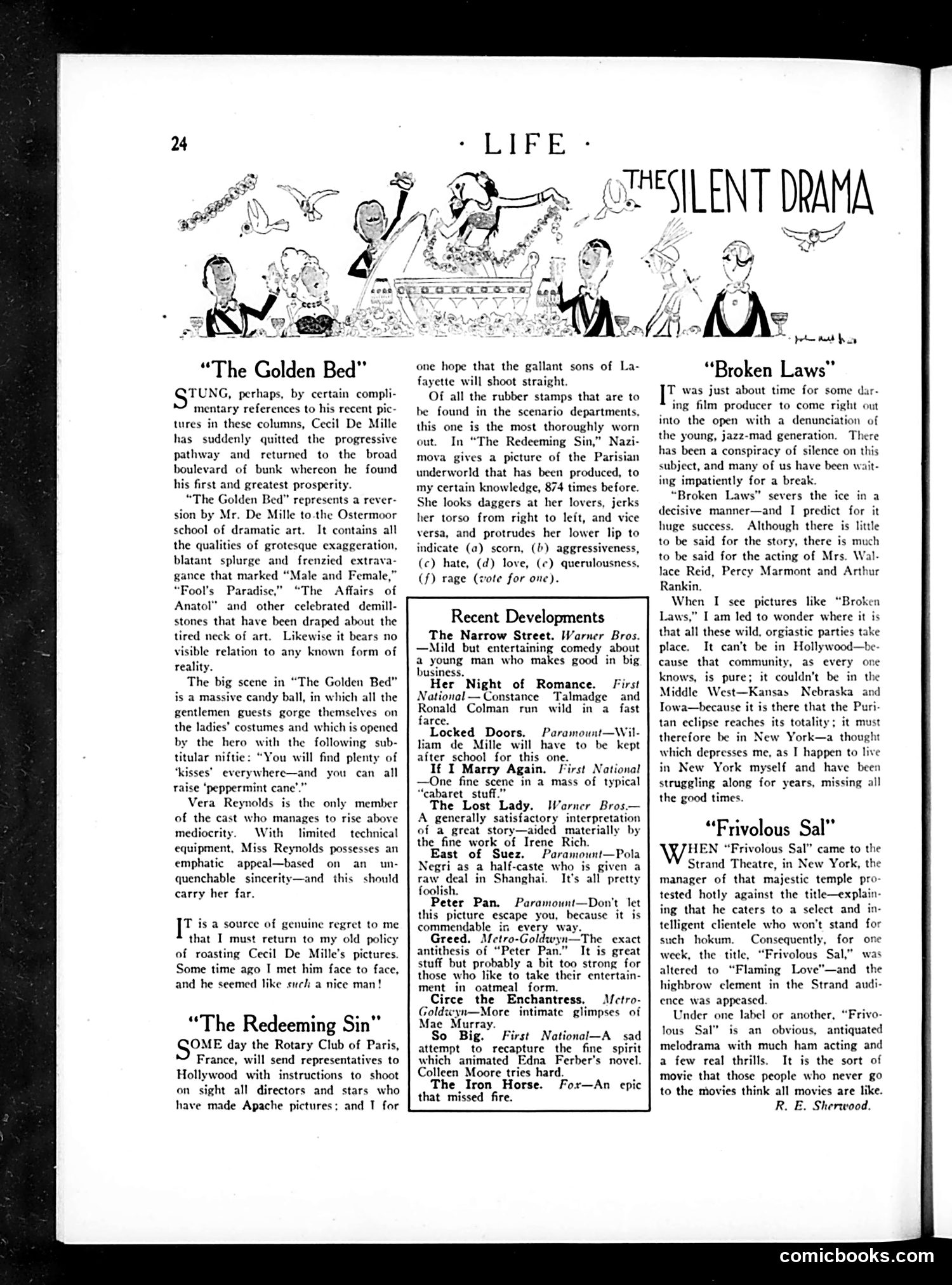
This page reviews recent silent films with sharp satire. The main cartoon shows exaggerated theatrical figures celebrating "The Silent Drama"—mocking Hollywood's grandiosity. The critic savagely attacks director **Cecil B. DeMille**, accusing him of abandoning artistic integrity to return to sensationalist spectacle. "The Golden Bed" is ridiculed for grotesque exaggeration and lack of realism, particularly its famous "massive candy ball" scene. The reviewer expresses betrayal, having recently praised DeMille. Similar contempt targets **Nazimova's "The Redeeming Sin,"** dismissed as a tired Apache underworld cliché repeated 874 times before, where the actress merely "protrudes her lower lip" to convey various emotions. The brief capsule reviews below mock formulaic Hollywood—praising **Constance Talmadge** and **Irene Rich** while skewering mediocre productions. The overall tone reflects 1920s highbrow disdain for commercial filmmaking's sensationalism versus artistic merit.
📄 Transcribed text from this page (OCR, searchable)
Machine-transcribed from the original scan — historical spelling and the odd misread are preserved.
“The Golden Bed” TUNG, perhaps, by certain compli- mentary references to his recent pic- tures in these columns, Cecil De Mille has suddenly quitted the progressive pathway and returned to the broad boulevard of bunk whereon he found his first and greatest prosperity. “The Golden Bed” represents a rever- sion by Mr. De Mille to.the Ostermoor school of dramatic art. It contains all the qualities of grotesque exaggeration, blatant splurge and frenzied extrava- gance that marked “Male and Female,” “Fool's Paradise,” “The Affairs of Anatol” and other celebrated demill- stones that have been draped about the tired neck of art. Likewise it bears no visible relation to any known form of reality. The big scene in “The Golden Bed” is a massive candy ball, in which all the gentlemen guests gorge themselves on the ladies’ costumes and which is opened by the hero with the following sub- titular niftie: “You will find plenty of ‘kisses’ everywhere—and you can all raise ‘peppermint cane’.”” Vera Reynolds is the only member of the cast who manages to rise above mediocrity. With limited _ technical equipment, Miss Reynolds possesses an emphatic appeal—based on an un- quenchable sincerity—and this should carry her far. T is a source of genuine regret to me that I must return to my old policy of roasting Cecil De Mille’s pictures. Some time ago I met him face to face, and he seemed like such a nice man! “The Redeeming Sin” SOME day the Rotary Club of Paris, France, will send representatives to Hollywood with instructions to shoot on sight all directors and stars who have made Apache pictures; and T for one hope that the gallant sons of La- fayette will shoot straight. Of all the rubber stamps that are to be found in the scenario departments, this one is the most thoroughly worn out. In “The Redeeming Sin,” Nazi- mova gives a picture of the Parisian underworld that has been produced, to my certain knowledge, 874 times before. She looks daggers at her lovers, jerks her torso from right to leit, and vice versa, and protrudes her lower lip to indicate (a) scorn, (b) aggressiveness, (c) hate, (d) love, (¢) querulousness, (f) rage (vote for one). Recent Developments The Narrow Street. Warner Bros. —Mild but entertaining comedy about a young man who makes good in big business, Her Night of Romance. First National — Constance Talmadge and Ronald Colman run wild in a fast farce. Locked Doors, Paramount—Wil- liam de Mille will have to be kept after school for this one. I Marry Again. First National —One fine scene in a mass of typical “cabaret_ stuff.” The Lost Lady. Warner Bros.— A generally satisfactory interpretation of a great story—aided materially by the fine work of Irene Rich. East of Suez. Paramount—Pola Negri as a half-caste who is given a raw deal in Shanghai. It's all pretty foolish. Peter Pan. Paramount—Don't let this picture escape you, because it is commendable in every way. Greed. Metro-Goldwyn—The exact antithesis of “Peter Pan.” It is great stuff but probably a bit too strong for those who like to take their entertain- ment in oatmeal form. Circe the Enchantress. Metro- Goldwyn—More intimate glimpses of Mae Murray. So Big. First National—A sad attempt to recapture the fine spirit which animated Edna Ferber’s novel. Colleen Moore tries hard. The Iron Horse. Fox—An epic that missed fire. SILENT DRAMA b Se = Ee, ped oe “Broken Laws” T was just about time for some dar- ing film producer to come right out into the open with a denunciation of the young, jazz-mad generation. There has been a conspiracy of silence on this subject, and many of us have been wait- ing impatiently for a break. “Broken Laws” severs the ice in a decisive manner—and I predict for it huge success. Although there is little to be said for the story, there is much to be said for the acting of Mrs. Wal- lace Reid, Percy Marmont and Arthur Rankin, When I see pictures like “Broken Laws,” I am led to wonder where it is that all these wild, orgiastic parties take place. It can't be in Hollywood—| cause that community, as every knows, is pure; it couldn't be in th Middle West—Kansas Nebraska Iowa—because it is there that the Puri- tan eclipse reaches its totality; it must therefore be in New York—a thought which depresses me, as I happen to live in New York myself and have been struggling along for years, missing all the good times. “Frivolous Sal” HEN “Frivolous Sal” came to the Strand Theatre, in New York, the manager of that majestic temple pro tested hotly against the titl—explain- ing that he caters to a select and in- telligent clientele who won't stand for such hokum. Consequently, for one week, the title, “Frivolous Sal,” was altered to “Flaming Love"—and the highbrow clement in the Strand audi- ence was appeased. Under one label or another, “Frivo- lous Sal” is an obvious, antiquated melodrama with much ham acting and a few real thrills. It is the sort of movie that those people who never go to the movies think all movies are like. R. E. Sherwood. comicbooks.com