
Life, 1925-02-12 · page 20 of 36
Life — February 12, 1925 — page 20: what you’re looking at
What you’re looking at
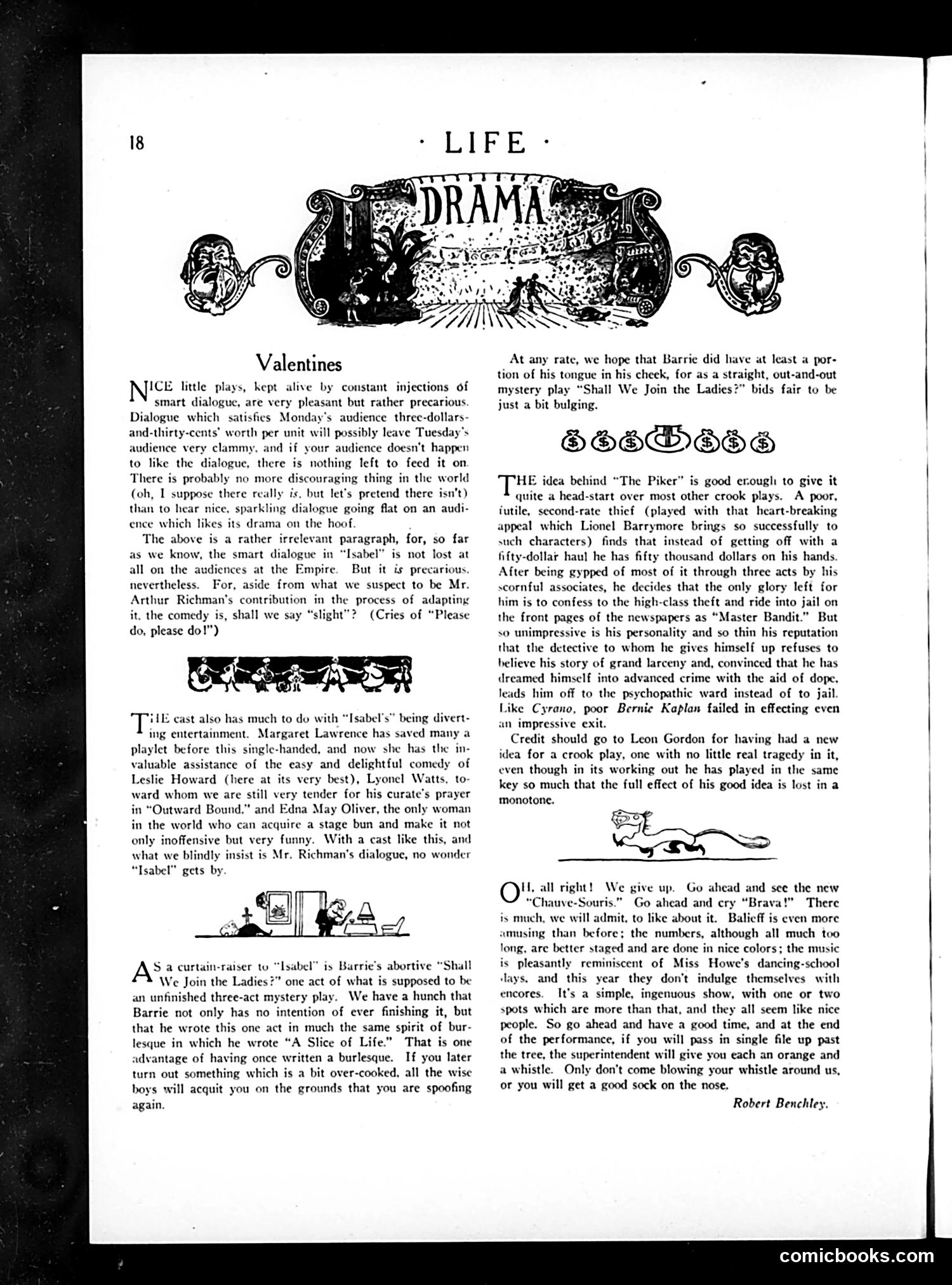
This page reviews three theatrical productions. The critic discusses "Isabel," a smart comedy at the Empire Theater featuring Leslie Howard and Margaret Lawrence, whose dialogue and cast elevate what is admittedly a "slight" play. The reviewer praises the supporting performances, particularly Edna May Oliver's comedic talent. The page also covers J.M. Barrie's one-act play "Shall We Join the Ladies?"—described as an unfinished mystery that the critic suspects Barrie wrote as deliberate burlesque rather than serious drama, joking that Barrie can claim he was "spoofing" if criticized. Finally, the critic reviews "The Piker," a crook play where a minor thief accidentally steals a large sum, then attempts a dramatic confession to gain notoriety as a "Master Bandit." The reviewer credits Leon Gordon's original concept but faults the execution for monotonous pacing that undermines the story's tragic potential. The reference to "Bernie Kaplan" failing at an "impressive exit" (like Cyrano) suggests the protagonist's attempted drama falls flat.
📄 Transcribed text from this page (OCR, searchable)
Machine-transcribed from the original scan — historical spelling and the odd misread are preserved.
Valentines little plays, kept alive by constant injections of mart dialogue, are very pleasant but rather precarious. Dialogue which satisfies Monday's audience three-dollars- and-thirty-cents’ worth per unit will possibly leave Tuesday's audience very clammy, and if your audience doesn’t happen to like the dialogue, there is nothing left to feed it on There is probably no more discouraging thing in the world (oh, I suppose there really is, but let's pretend there isn’t) than to hear nice, sparkling dialogue going flat on an audi- ence which likes its drama on the hoof, The above is a rather irrelevant paragraph, for, so far as we know, the smart dialogue in “Isabel” is not lost at all on the audiences at the Empire. But it is precarious, nevertheless. For, aside from what we suspect to be Mr. Arthur Richman’s contribution in the process of adapting it. the comedy is, shall we say “slight”? (Cries of “Please do, please do!”) Tie cast also has much to do with “Isabel's” being divert- ing entertainment. Margaret Lawrence has saved many a playlet before this single-handed, and now she has the in- valuable assistance of the easy and delightful comedy of Leslie Howard (here at its very best), Lyonel Watts, to- ward whom we are still very tender for his curate’s prayer in “Outward Bound.” and Edna May Oliver, the only woman in the world who can acquire a stage bun and make it not only inoffensive but very funny. With a cast like this, and what we blindly insist is Mr. Richman’s dialogue, no wonder “Isabel” gets by. S a curtain-raiser tu “Isabel” is Barrie's abortive “Shall We Join the Ladies?” one act of what is supposed to be an unfinished three-act mystery play. We have a hunch that Barrie not only has no intention of ever finishing it, but that he wrote this one act in much the same spirit of bur- lesque in which he wrote “A Slice of Life.” That is one advantage of having once written a burlesque. If you later turn out something which is a bit over-cooked, all the wise boys will acquit you on the grounds that you are spoofing again. At any rate, we hope that Barrie did have at least a por- tion of his tongue in his cheek, for as a straight, out-and-out mystery play “Shall We Join the Ladies?” bids fair to be just a bit bulging. EEN] ENOTES HE idea behind “The Piker” is good crough to give it quite a head-start over most other crook plays. A poor, iutile, second-rate thief (played with that heart-breaking appeal which Lionel Barrymore brings so successfully to such characters) finds that instead of getting off with a fifty-dollar haul he has fifty thousand dollars on his hands. After being gypped of most of it through three acts by his scornful associates, he decides that the only glory left for him is to confess to the high-class theft and ride into jail on the front pages of the newspapers as “Master Bandit.” But so unimpressive is his personality and so thin his reputation that the detective to whom he gives himself up refuses to believe his story of grand larceny and, convinced that he has dreamed himself into advanced crime with the aid of dope, leads him off to the psychopathic ward instead of to jail Like Cyrano, poor Bernie Kaplan failed in effecting even an impressive exit. Credit should go to Leon Gordon for having had a new idea for a crook play, one with no little real tragedy in it, even though in its working out he has played in the same key so much that the full effect of his good idea is lost in a monotone. Oo"! all right!) We give up. Go ahead and sce the new hauve-Souris.” Go ahead and cry “Brava!” There is much, we will admit, to like about it. Balieff is even more amusing than before; the numbers, although all much too long, are better staged and are done in nice colors; the music is pleasantly reminiscent of Miss Howe's dancing-school slays, and this year they don't indulge themselves with encores. It's a simple, ingenuous show, with one or two spots which are more than that, and they all seem like nice people. So go ahead and have a good time, and at the end of the performance, if you will pass in single file up past the tree, the superintendent will give you each an orange and a whistle. Only don’t come blowing your whistle around us, or you will get a good sock on the nose. Robert Benchley. comicbooks.com