
Life, 1925-02-12 · page 21 of 36
Life — February 12, 1925 — page 21: what you’re looking at
What you’re looking at
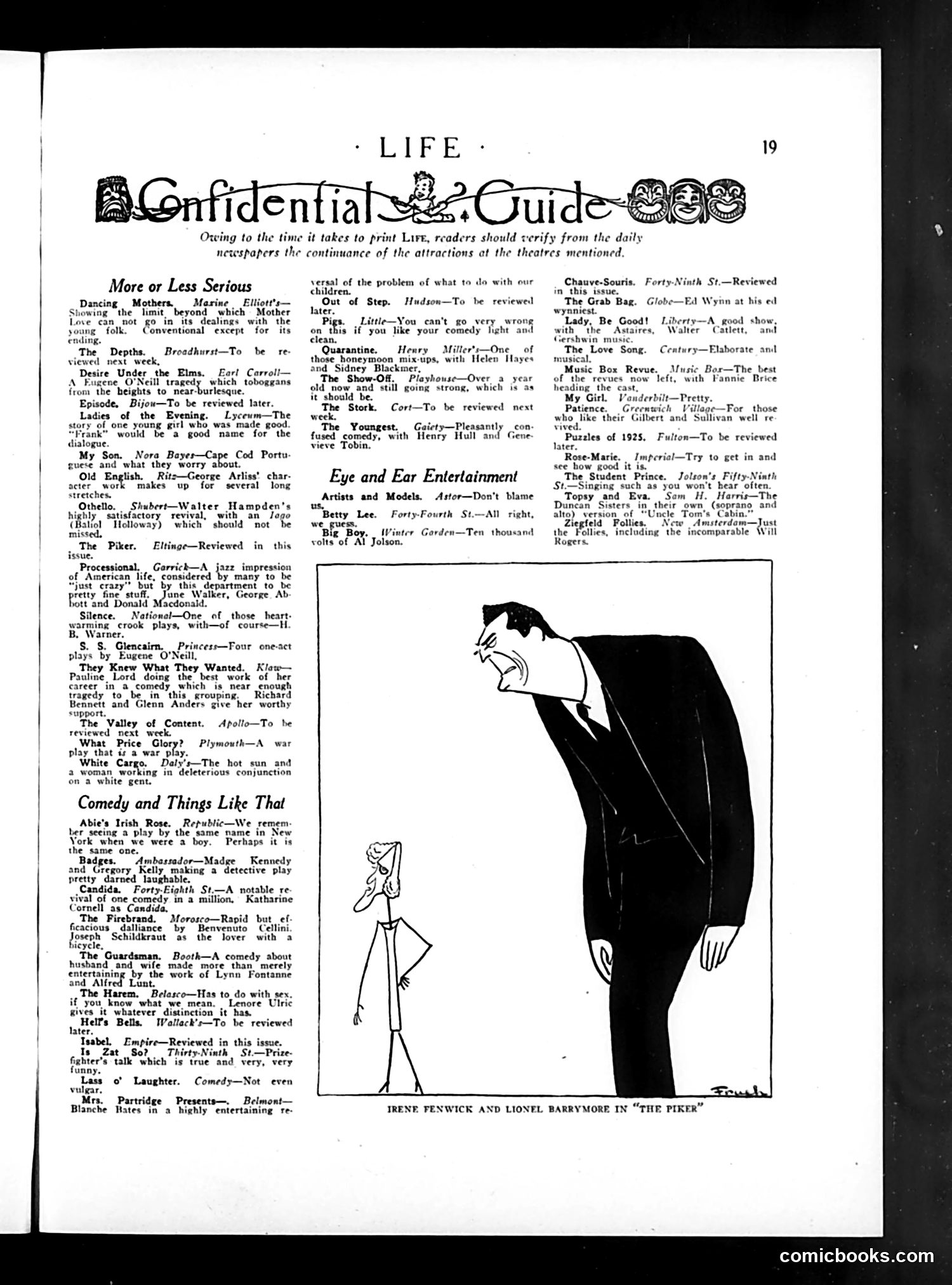
This page is a theater review guide from Life magazine covering Broadway and New York performances. The illustrated cartoon at bottom shows two figures from "The Piker"—Irene Fenwick and Lionel Barrymore—in an exaggerated dramatic pose typical of 1920s stage comedy. The reviews themselves are satirical capsule critiques of current plays. Life's critics use caustic wit: praising Eugene O'Neill's "Processional" as "pretty fine stuff" while dismissing "The Depths" as degenerating into "near-burlesque," and noting that "Ladies of the Evening" has dialogue so bad "Frank" would be an appropriate title. The humor targets both theatrical pretension and contemporary social anxieties—references to "Desire Under the Elms," sex-themed plays, and morality tales about young women suggest Life was commenting on Jazz Age concerns about changing social mores. The tone throughout is that of cosmopolitan New York critics mocking both earnest theater and audience tastes.
📄 Transcribed text from this page (OCR, searchable)
Machine-transcribed from the original scan — historical spelling and the odd misread are preserved.
19 Owing to the time it takes to print Lire, readers should verify from the daily newspapers the continuance of the attractions at the theatres mentioned. More or Less Serious Dancing Mothers. Marine Elliott’s— howing the limit, beyond which Mother can not go in its dealings with the ng folk, Conventional except for its The Depths. viewed next week, Desire Under the Elms. Ear! Carrol!— A Eugene O'Neill tragedy which toboggans from the heights to_near-burlesque. Episode, Bijow—To be reviewed later. Ladies of the Evening. Lycewm—The story of one young girl who was made g “Frank” woukl be a good name for the dialogue. My Son. Nora Baxer—Cape Cod Portu- guese and what they worry about. Broadhurst—To be re- Old English. Ritz—George Arliss’ char- acter work makes up for several long stretches. Othello. Shubert—Walter Hampden’s highly satisfactory re with an Jogo (Baliol Holloway) which’ should not be miss The Piker. Eltinge—Reviewed in this issue. Processional. Garrich—A_ jazz impression of American life, considered by many to be “just crazy” but by this department to be retty fine stuff, lune Walker, George Ab- pott and Donald Macdonald. Silence. National—One of those heart: warming crook plays, with—of course—H B. Warner. S. S$. Glencaim. Princess—Four one-act plays by Eugene O'Neill, They Knew What They Wanted. Klow— Pauline, Lord doing the best work of her career in a comedy which is near enough tragedy to be in this grouping, Richard Bennett and Glenn Anders give her worthy support. The Valley of Content. reviewed next week What Price Glory? play that is a war play. ite Cargo, Daly’s—The hot sun and 2 woman working in deleterious conjunction on a white gent. Comedy and Things Like That Abie's Irish Rose. Republic—We remem: ber seeing a play by the same name in New York when we were a boy. Perhaps it is the same one. Badges. © Ambassador—Madge Kennedy and Gregory ‘Kelly making a detective play pretty darned laughable. Candida. Forty-Eighth St.—A notable re vival of one comedy in a million, Katharine Cornell as Candida, The Firebrand. Morosco—Rapid but ef. ficacious dalliance by Benvenuto Cellini Joseph Schildkraut as the lover with a bicycle, The Guardsman. Booth—A comedy about husband and wife made more than merely entertaining by the work of Lynn Fontanne and Alfred. Lunt. |, The Harem. Belasco—Has to do with sex. if you know what we mean. Lenore Ulric gives it whatever distinction it has. Bells, Wollack's—To be reviewed Apollo—To he Plymouth—A_ war Isabel, Empire—Reviewed in this issue. Is Zat So? Thirty-Ninth St.—Prize- fighter’s talk which is true and very, very funny. Lass ot Laughter. Comedy—Not even vulgar. Mrs. Partridge Presents—. Belmont— Blanche Hates in a highly entertaining re- versal of the problem of what to do with our children. Out of Step. Hudson—To be reviewed later. Pigs Little“You can't go very wrong on this if you like your comedy light and clean, Henry Miller*s—One of ps, with Helen Hayes Quarantine. those honeymoon mi and Sidney Blackmer, The Show-Of. Playhouse—Over a year old now and still going strong, which is as it should be. The Stork. Cort—To be reviewed next week. The Youngest. Gaicty—Pleasantly con- fused comedy, with Henry Hull and Gene. vieve Tobin, Eye and Ear Entertainment Artists and Models. Astor—Don't blame 1S Betty Lee. AN right, we guess. . Big Boy, {Vinter Gorden—Ten thousand volts of Al Jolson. Forty-) Chauve-Souris. inth St.—Reviewed in this issue. The Grab Bag. Globe—Eal Wyin at his ed wynniest. Lady, Be Good! with the | Astaires, The Love Song. musical. Music Box Revue. 1 of the revues now left, heading the cast, My Girl. Vonderbilt—Pretty. Patience, wich Vill who like their Gilbert a vived Puzzles of 1925, ater. Rose-Marie. Impcrial—Try to get in and see how good it i The Student Prince. Jolson’s Fift t.—Singing such as you won't bear often. Sem H. Harris—The their own, (soprano and Liberty—A_ good show, Walter Catlett, and Century—Elaborate anid Bor—The best th Fannie Brice —For those an well re Fulton—To be reviewed Topsy and Eva Duncan. Sisters alto) version of “Uncle Tom's Cab Ziegfeld Follies, New | Amsterde the Follies, including the incomparable Will Rogers. IRENE, FENWICK AND LIONEL BARRYMORE IN “THE PIKER” comicbooks.com