
Life, 1925-02-12 · page 25 of 36
Life — February 12, 1925 — page 25: what you’re looking at
What you’re looking at
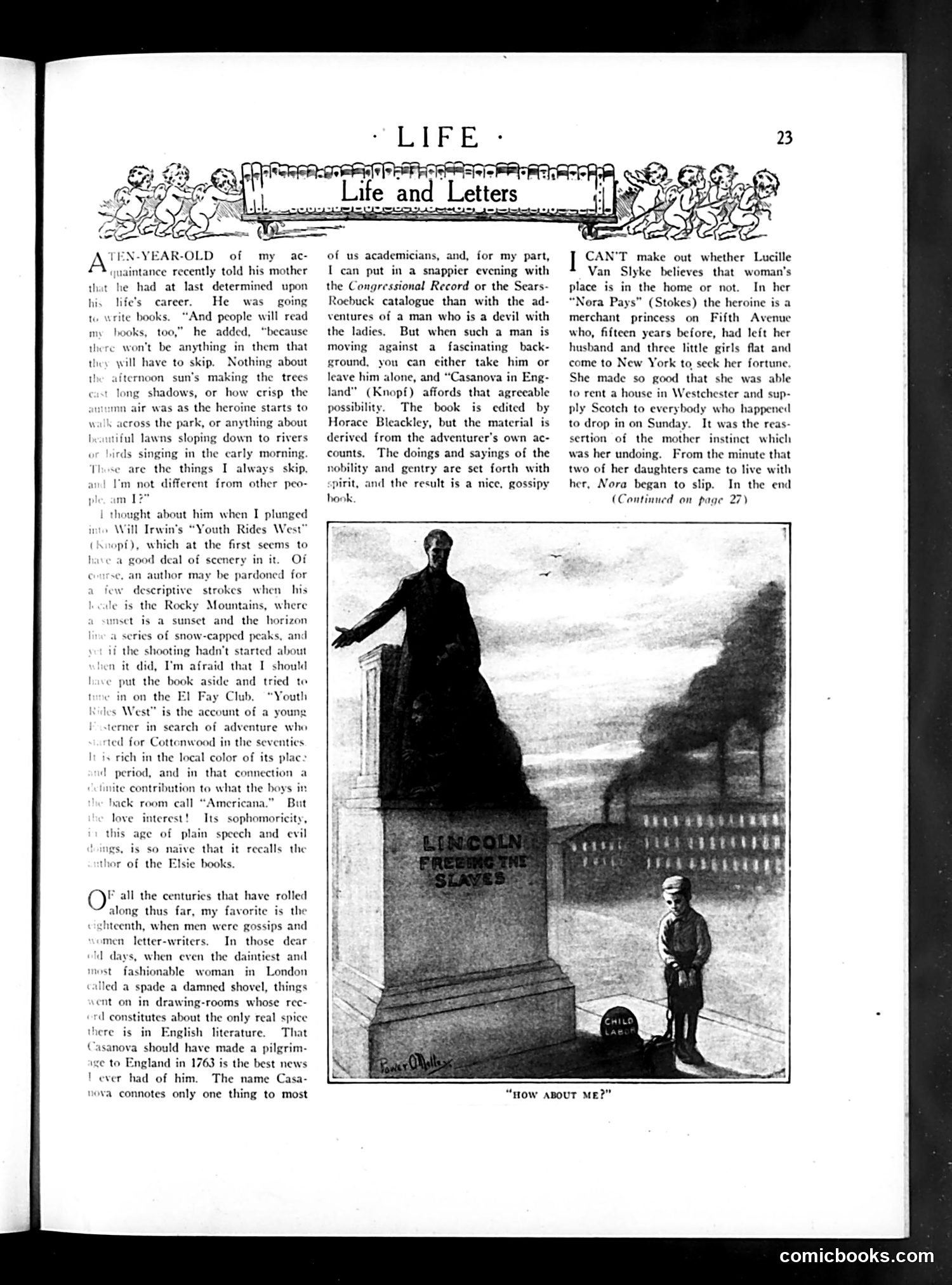
This page contains a literary column reviewing recent books. The main illustration, captioned "How About Me?", depicts a statue of Lincoln with a small child looking up at it—a commentary on American historical memory and perspective. The text discusses several books: Will Irwin's "Youth Rides West" (criticized for excessive descriptive scenery about Rocky Mountains), "Casanova in England" edited by Horace Bleackley (praised for 18th-century gossip and letter-writing), and Lucille Van Slyke's "Nora Pays" about a successful businesswoman who abandons her family for fortune. The overarching theme critiques overly ornate literary descriptions and sentimentality. The author mocks readers who skip flowery passages about nature and praises the 18th century's direct, gossip-filled writing style. The Lincoln cartoon likely suggests that even monumental historical figures seem small from a child's perspective—a visual metaphor for how literature's grand descriptions may miss what actually matters to readers.
📄 Transcribed text from this page (OCR, searchable)
Machine-transcribed from the original scan — historical spelling and the odd misread are preserved.
TEN-YEAR-OLD of my ac- uaintance recently told his mother e had at last determined upon career. He going nd people will read my books, too,” he added, “because there won't be anything in them that they will have to skip. Nothing about the afternoon sun’s making the trees cast long shadows, or how crisp the mn air was as the heroine starts to . across the park, or anything about tiful lawns sloping down to rivers rds singing in the carly morning. se are the things I always. skip, I'm not different from other peo- his life's was te e-books. m thought about him when I plunged » Will Irwin's “Youth Rides West” pi), which at the first seems to a good deal of scenery in it. Of se, an author may be pardoned for strokes when his ile is the Rocky Mountains, where sunset and the horizon jew descriptive unset is a series of snow-capped peaks, and if the shooting hadn't started about n it did, I'm afraid that I should © put the book aside and tried to « in on the El Fay Club. s West” is the account of a y terner in search of adventure wi ted for Cottonwood in the seventies s rich in the local color of its plac: period, and in that connection a ite contribution to what the boys in ack room call “Americana.” But love interest! Its sophomoricity, this age of plain speech and evil rs, is so naive that it recalls the thor of the 1 Isie books. O all the centuries that have rolled along thus far, my favorite is the ghtcenth, when men were gossips and letter-writers. In those dear id days, when even the daintiest and most fashionable woman in London called a spade a damned shovel, things ent on in drawing-rooms whose rec- d constitutes about the only real spice there is in glish literature. That Casanova should have made a pilgrim- ise to England in 1763 is the best news ever had of him. The name Casa- vova connotes only one thing to most men 1 of us academicians, and, for my part, I can put in a snappier evening with the Congressional Record or the Sears- Roebuck catalogue than with the ad- ventures of a man who is a devil with the ladies. But when such a man is moving against a fascinating back- ground, you can cither take him or leave him alone, and “Casanova in Eng- land” (Knopf) affords that agreeable possibility. The book is edited by Horace Bleackley, but the material is derived from the adventurer’s own ac- counts, The doings and sayings of the nobility and gentry are set forth with pirit, and the result is a nice, gossipy hook CAN'T make out whether Lucille Van Slyke believes that woman's place is in the home or not. In her “Nora Pays” (Stokes) the heroine is a merchant princess on Fifth Avenue who, fifteen years before, had left her husband and three little girls flat and come to New York to, seck her fortune. She made so good that she was able to rent a house in Westchester and sup- ply Scotch to everybody who happened to drop in on Sunday. It was the reas- sertion of the mother instinct which was her undoing. From the minute that two of her daughters came to live with her, Nora began to slip. In the end (Continued on page 27) eee oe eee So VidL UEREOU EER “HOW ABOUT ME?” comicbooks.com