
A complete issue · 37 pages · 1925
Life — January 29, 1925
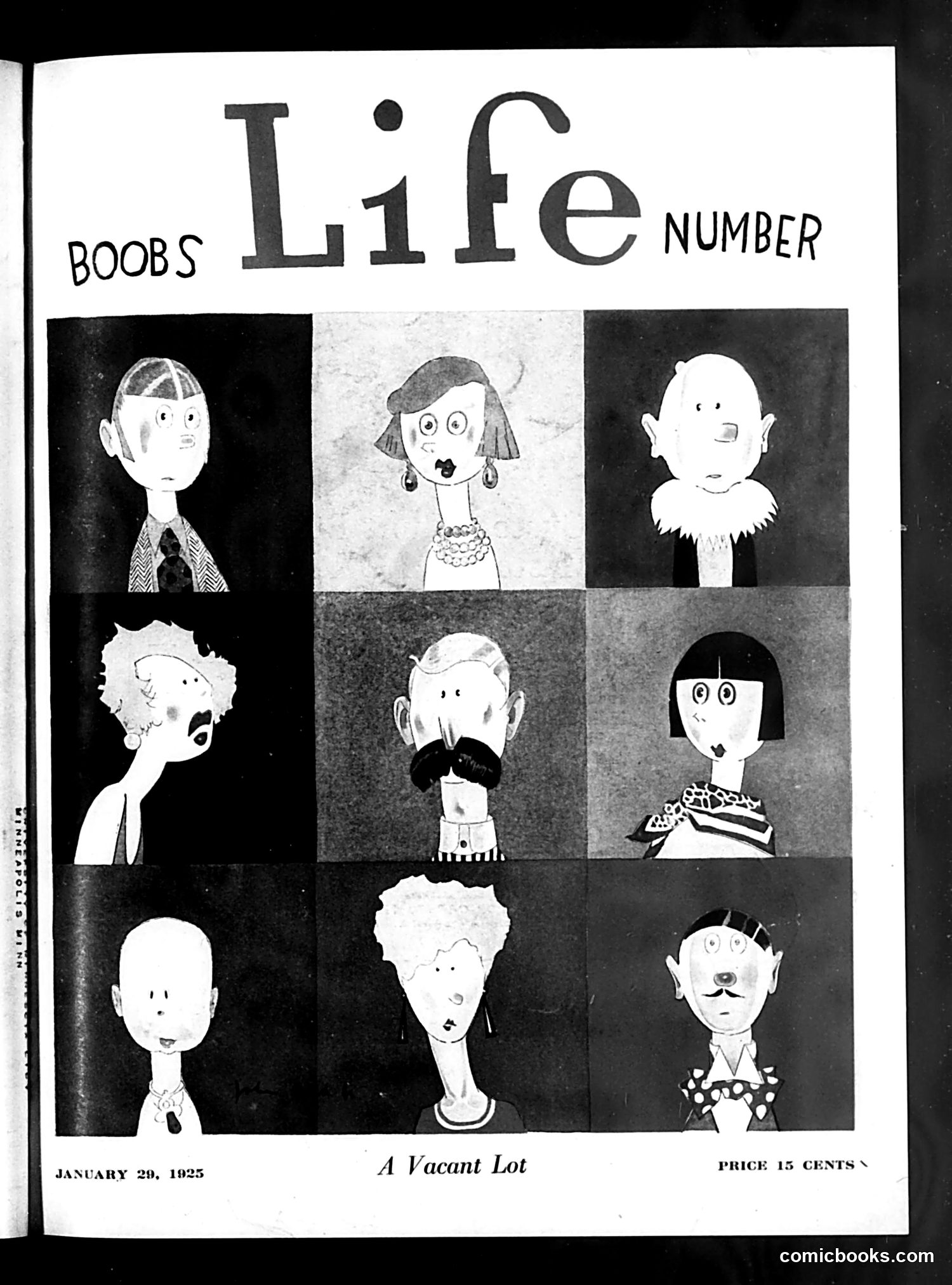
This January 29, 1925 *Life* magazine page presents a grid of nine exaggerated facial caricatures titled "A Vacant Lot." The satirical premise appears to mock various types of people by depicting them as intellectually empty ("vacant"). The drawings employ period caricature techniques—exaggerated features, distinctive hairstyles, and clothing details—to suggest different social types or professions. Without additional context identifying specific individuals, the exact targets remain unclear. However, the humor relied on 1920s readers recognizing whether these represented politicians, celebrities, social stereotypes, or public figures of the era. The "boobs" reference in the header suggests mockery of foolish or stupid people, a common *Life* magazine approach to social satire during this period.
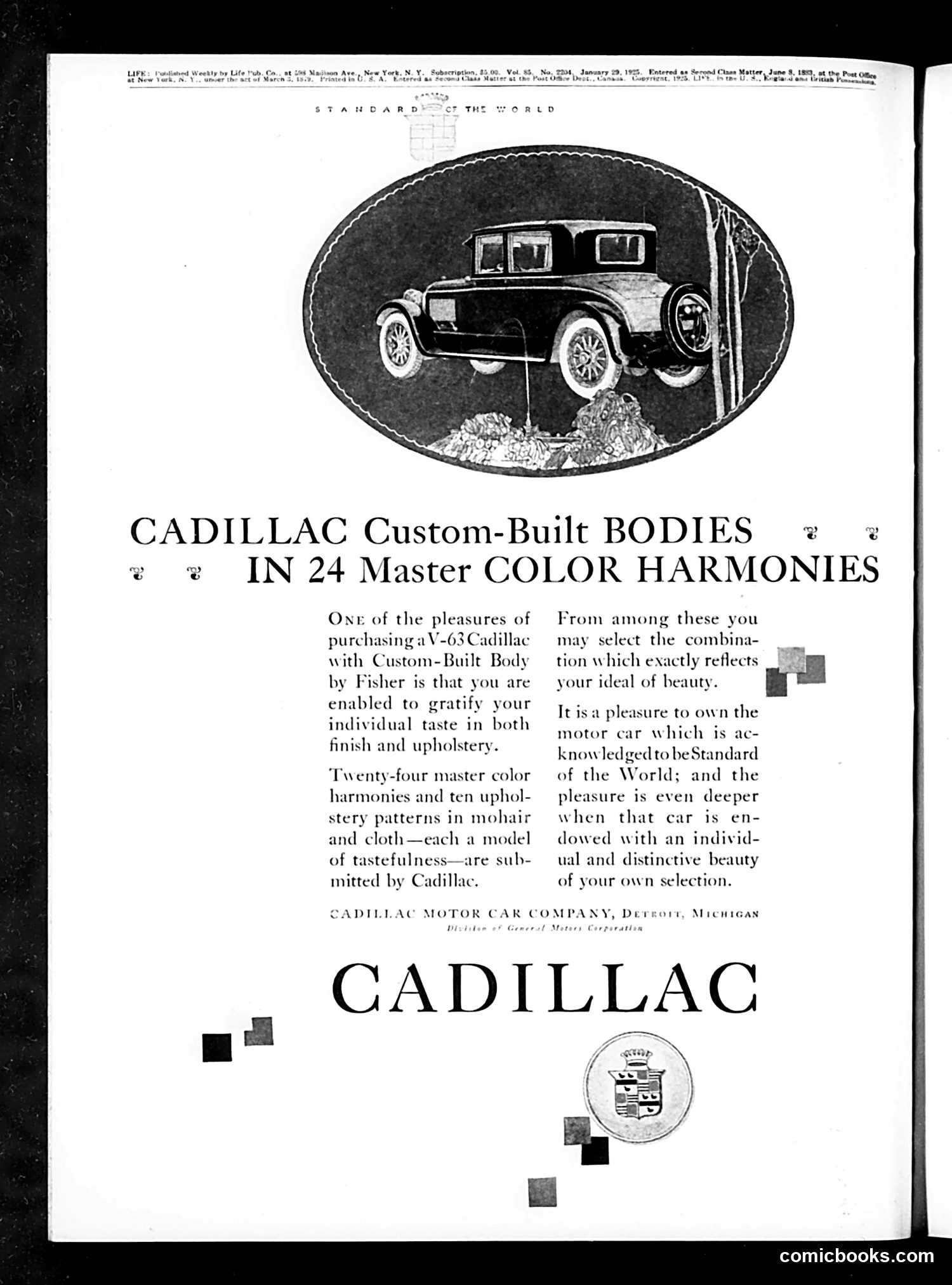
This is primarily a **Cadillac automobile advertisement**, not political satire or comics content. The ad promotes the V-63 Cadillac with "Custom-Built Bodies" available in "24 Master Color Harmonies." The oval illustration shows a luxury car of 1920s vintage parked elegantly beside what appears to be a classical column or building element. The marketing pitch emphasizes **personalization and status**: buyers can choose from numerous color and upholstery combinations to express individual taste. The text stresses that owning a Cadillac—acknowledged as "Standard of the World"—becomes even more prestigious when customized to reflect the owner's aesthetic preferences. This reflects the era's emphasis on consumer choice and luxury goods as markers of personal identity and social standing. The page contains no political commentary or satirical cartoons.
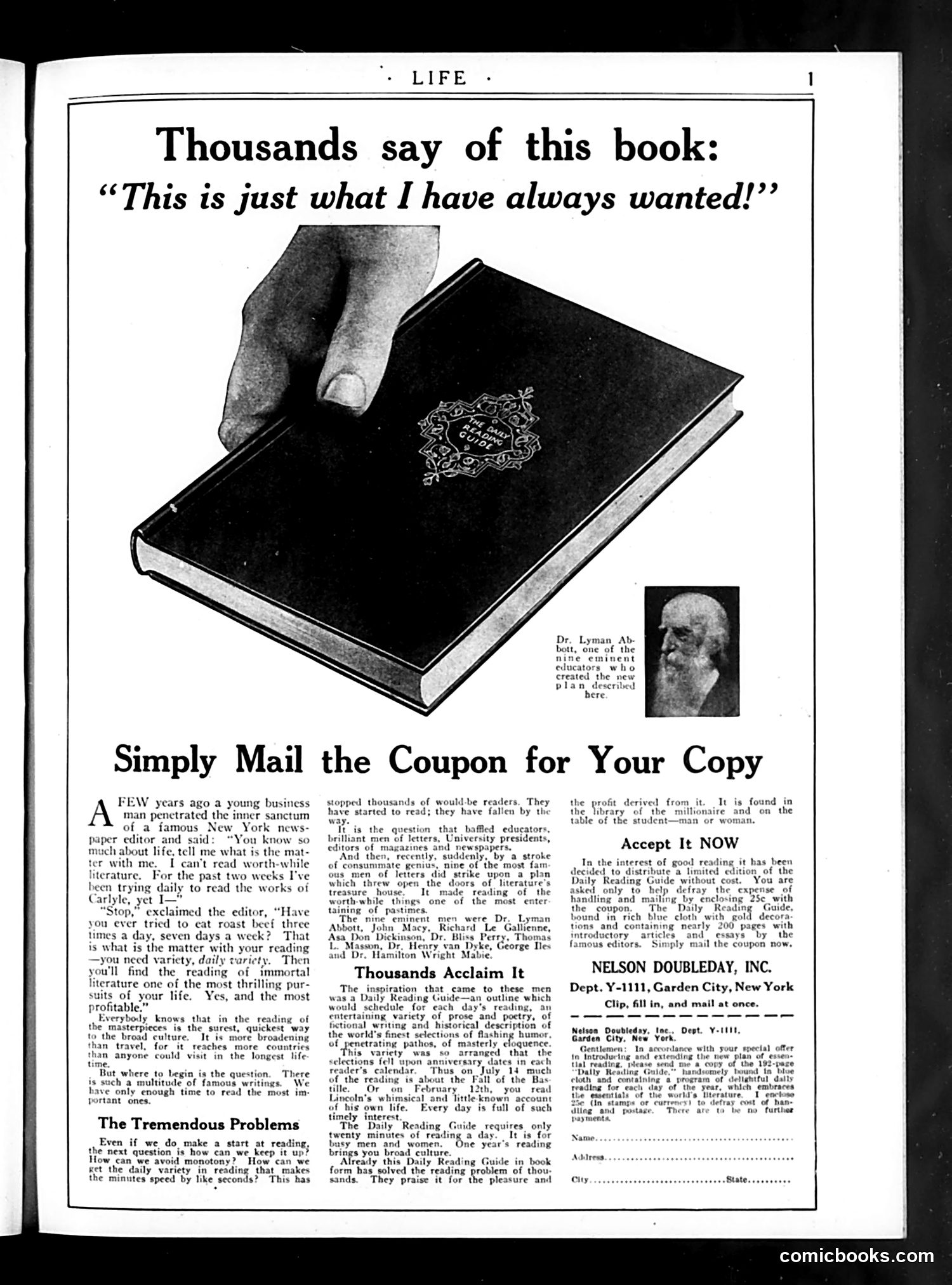
This is primarily an **advertisement for the "Daily Reading Guide,"** a book curated by Dr. Lyman Abbott and eight other prominent editors/writers. It appears in Life magazine, which was indeed satirical, but this particular page functions as a commercial promotion rather than satire. The ad claims the guide offers daily literary selections—prose, poetry, historical writing—designed to educate readers in "twenty minutes of reading a day." The marketing appeals to busy Americans seeking self-improvement without time commitment. The photograph shows Dr. Lyman Abbott (identified in caption), apparently a respected figure whose endorsement lends credibility. The coupon-based mail-order format was standard for early 20th-century magazine advertising. There is **no visible political satire or cartoon** on this page—it's straightforward product promotion targeting educated, aspiring readers.
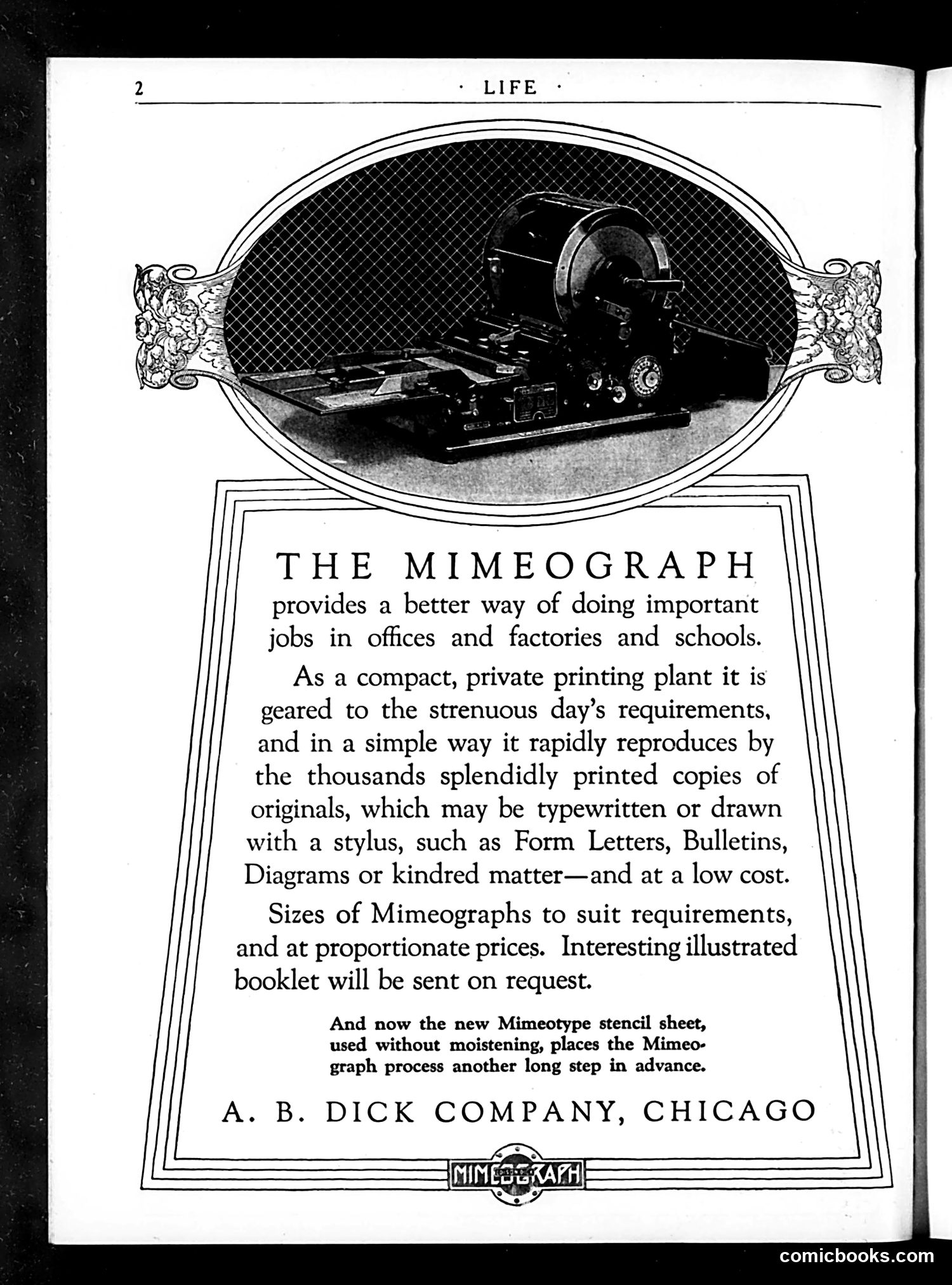
This page is primarily **advertising, not satire or editorial content**. It's a full-page advertisement for the Mimeograph machine, manufactured by A.B. Dick Company of Chicago. The ad promotes the mimeograph as a practical office technology for "offices and factories and schools," emphasizing its ability to produce "splendidly printed copies" of documents "at a low cost." It highlights a new innovation: the "Mimeotype stencil sheet, used without moistening." The circular photograph at top shows the mimeograph machine itself—a mechanical device typical of early 20th-century office equipment. There is no political cartoon or satire here; this is straightforward product marketing aimed at institutional buyers seeking cost-effective document reproduction technology.
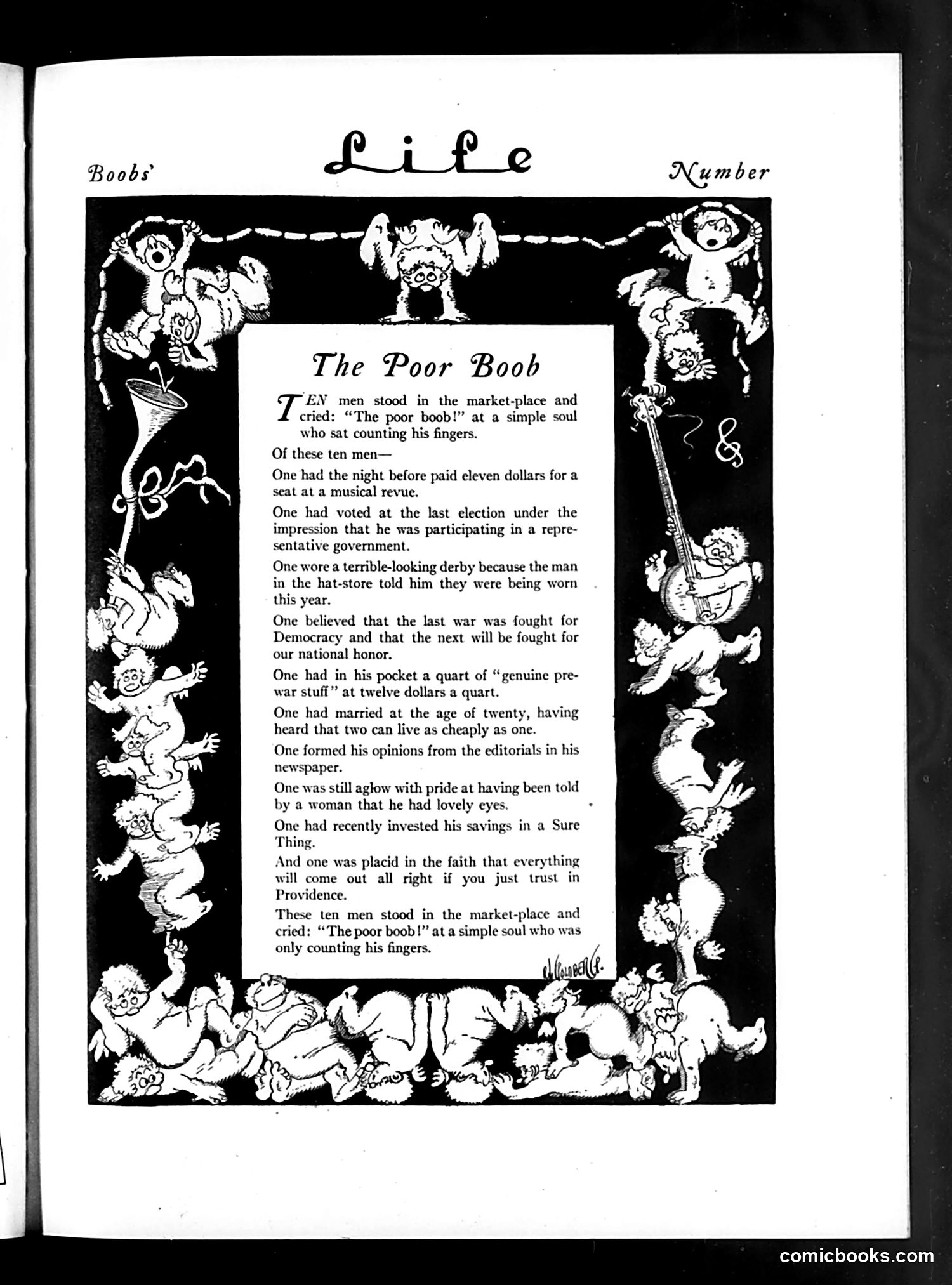
This satirical piece mocks ordinary men for their gullibility and poor judgment. The text lists ten types of foolish behavior: wasting money on entertainment, voting naively, following fashion trends uncritically, holding idealistic beliefs about war, purchasing dubious products, marrying for wrong reasons, forming opinions from newspapers rather than thinking independently, taking compliments too seriously, making poor investments ("Sure Thing"), and relying on blind faith instead of reason. The central irony: these ten men ridicule "the poor boob" counting on his fingers—yet each exemplifies some form of stupidity themselves. The satirical message criticizes mass gullibility across social classes, suggesting Americans routinely make foolish decisions while judging others. The whimsical border decorations emphasize the piece's satirical, sardonic tone toward common human folly.
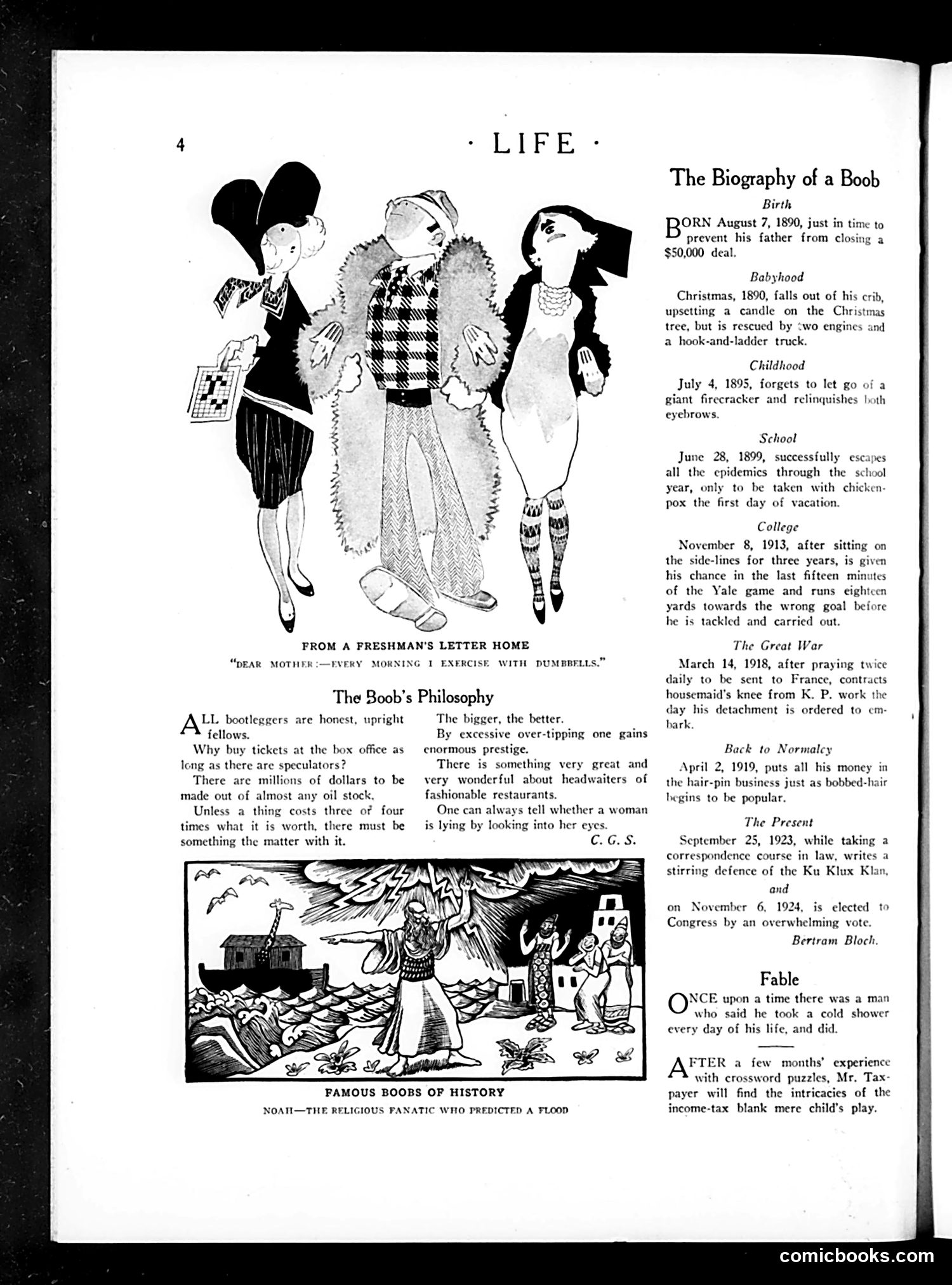
This satirical biography mocks a stereotypical fool through major life events. The figure is born in 1890, survives childhood mishaps (firecracker accident), barely graduates school, fails spectacularly at college football (1913 Yale game), and serves incompetently in WWI. The accompanying philosophy section ridicules "bootleggers" (Prohibition-era illegal alcohol dealers) and their pretensions. The famous boobs cartoon depicts Noah, a biblical reference mocking religious fanatics who allegedly predicted a flood. The satire targets American male foolishness, social climbers, and gullibility. References to the KKK (1924 election mention) and income-tax confusion suggest contemporary 1920s anxieties. The overall tone is cynical about American society's "boobs"—gullible, incompetent citizens.
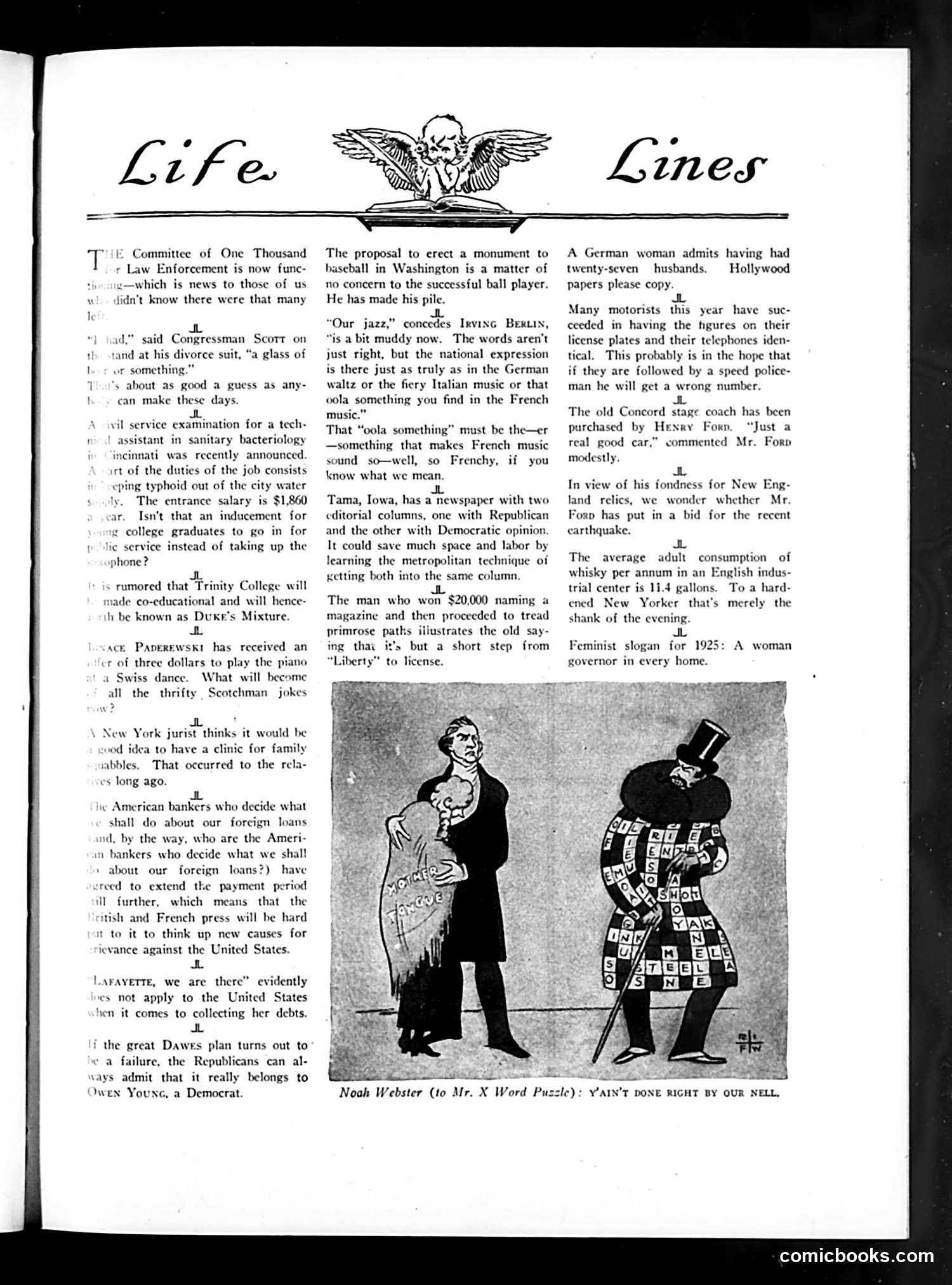
This cartoon satirizes the treatment of the English language in modern word puzzles. The figure on the left (identified as Noah Webster, the legendary American lexicographer) confronts a woman representing a word puzzle creator. Webster appears distressed, gesturing toward the woman whose dress is covered entirely in scrambled letters and word-puzzle squares. The caption's pun—"Nell" (likely referring to Noah Webster's legacy or the English language itself, personified as female)—suggests that word puzzles are mangling, disrespecting, or "not doing right by" proper English and its authoritative standards. The satire targets the popularization of word puzzles as frivolous entertainment that corrupts linguistic integrity.
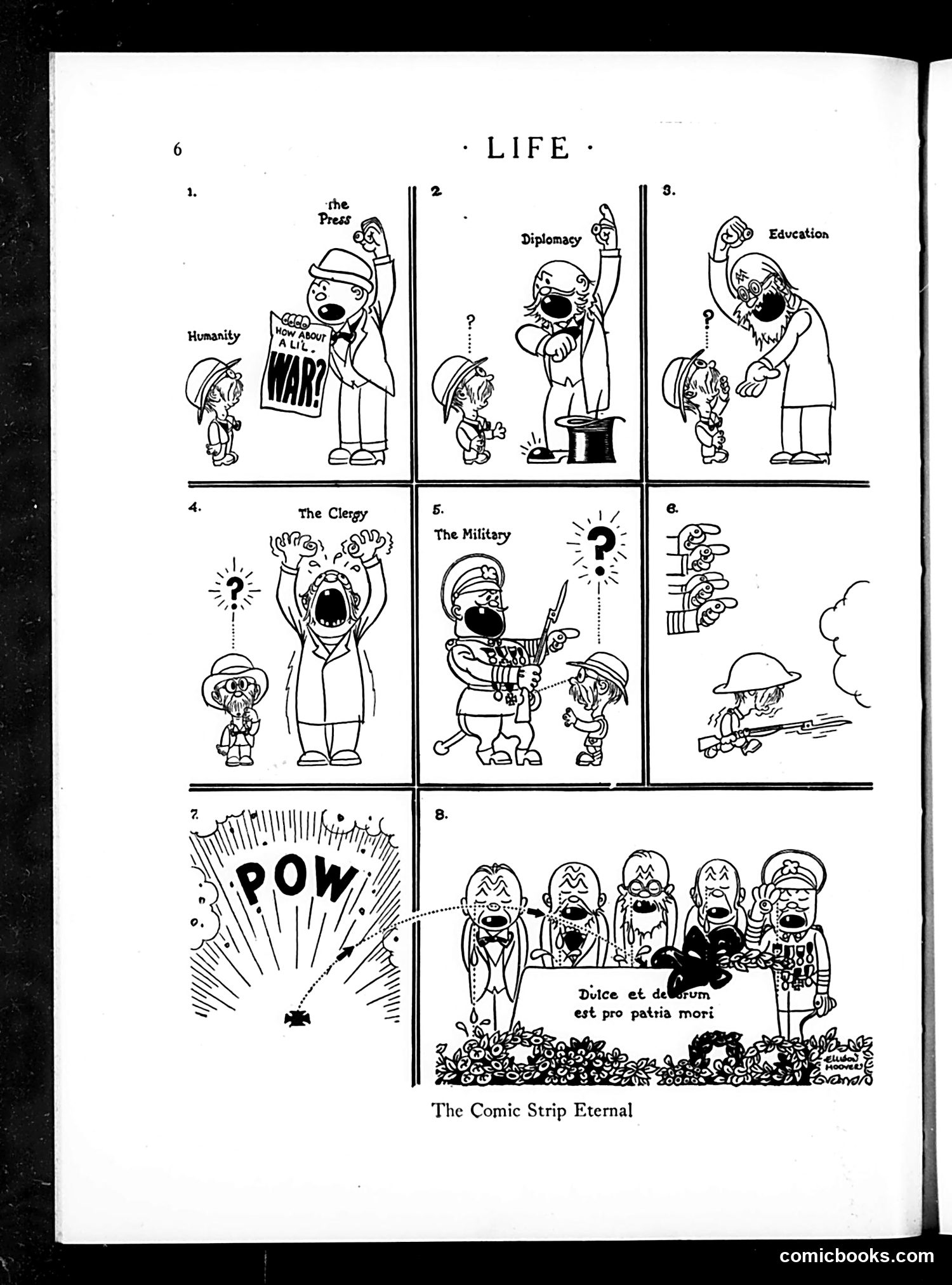
This satirical comic critiques how major institutions shape humanity through their propaganda or influence: 1. **The Press** (with "WAR!" headline) exploits humanity for sensationalism 2. **Diplomacy** manipulates with unclear promises (the "?" indicates deception) 3. **Education** indoctrinates rather than enlightens 4. **The Clergy** confuses with religious mysticism 5. **The Military** deploys violence and weaponry 6. Panel 6 shows warfare's destructive result 7. Panel 7 depicts the explosive consequences 8. The final panel shows five authority figures standing over corpses with the Latin phrase "Dulce et decorum est pro patria mori" (It is sweet and fitting to die for one's country)—a bitter indictment of how these institutions collectively sacrifice ordinary people while claiming noble purpose. The cartoon argues these five pillars of society perpetuate cycles of violence and death.
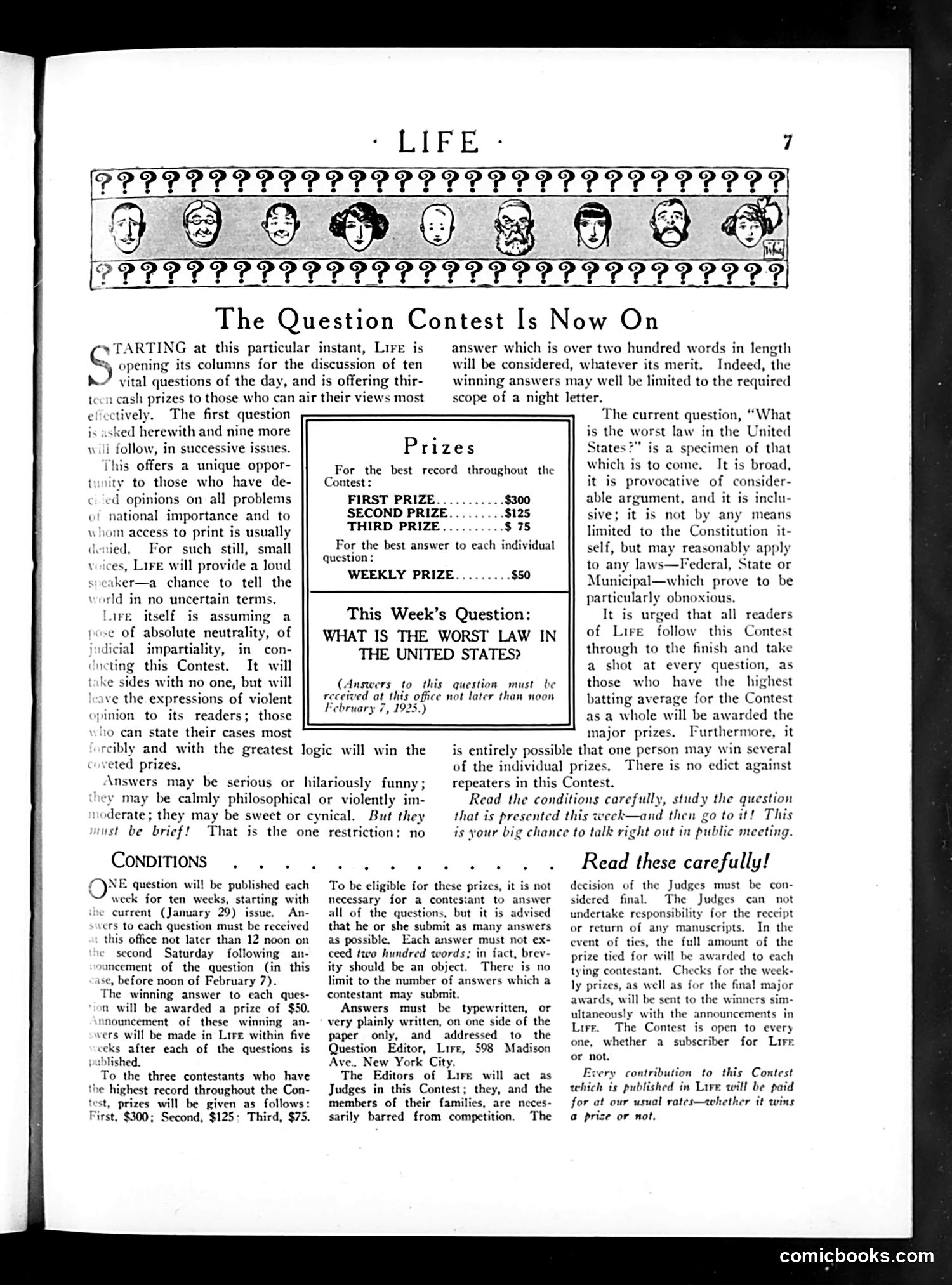
This page announces **Life's new Question Contest**, a reader participation feature offering cash prizes ($300 first prize). The decorative header shows **nine caricatured faces** with question marks, likely representing different character types or public figures of the era—a visual reference to the contest's appeal to diverse readers. **This week's question**: "What is the worst law in the United States?" The text frames this as serious intellectual engagement, noting the question is "broad," "provocative," and invites substantial argument about constitutional and legal matters. Life positions itself as offering readers "a loud speaker—a chance to tell the world" their views. The page emphasizes contest rules: answers under 200 words, typewritten submissions, and that judges' decisions are final. This appears to be a genuine reader-engagement feature rather than satire.
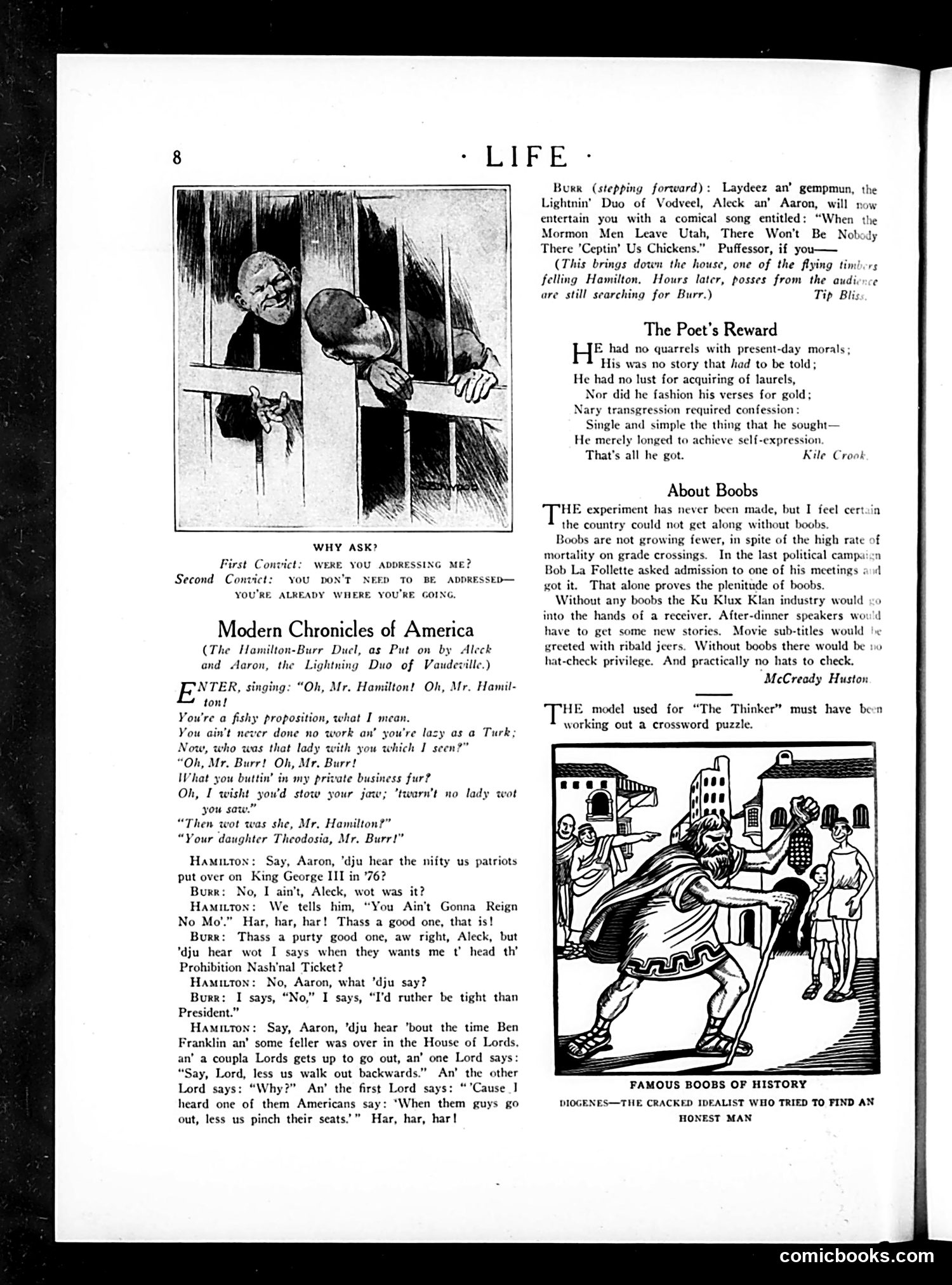
This page contains satirical commentary on American politics and social customs circa the 1920s-1930s. **"Modern Chronicles of America"** presents a comedic dialogue between Hamilton and Burr—historical figures famous for their 1804 duel. The sketch mocks contemporary political arguments about prohibition, patriotism, and propriety, with references to King George III and Benjamin Franklin. The humor targets pompous political rhetoric and changing American values. **"About Boobs"** by McCready Huston satirizes the prevalence of foolish behavior in American society, suggesting boobs (fools) are essential to the country's functioning—a cynical commentary on mass culture. **"Famous Boobs of History"** illustrates Diogenes, the Greek philosopher known for seeking an honest man. The caption sarcastically notes he was a "cracked idealist"—suggesting honest people are impossible to find. The page's overall theme: American society runs on foolishness and dishonesty.
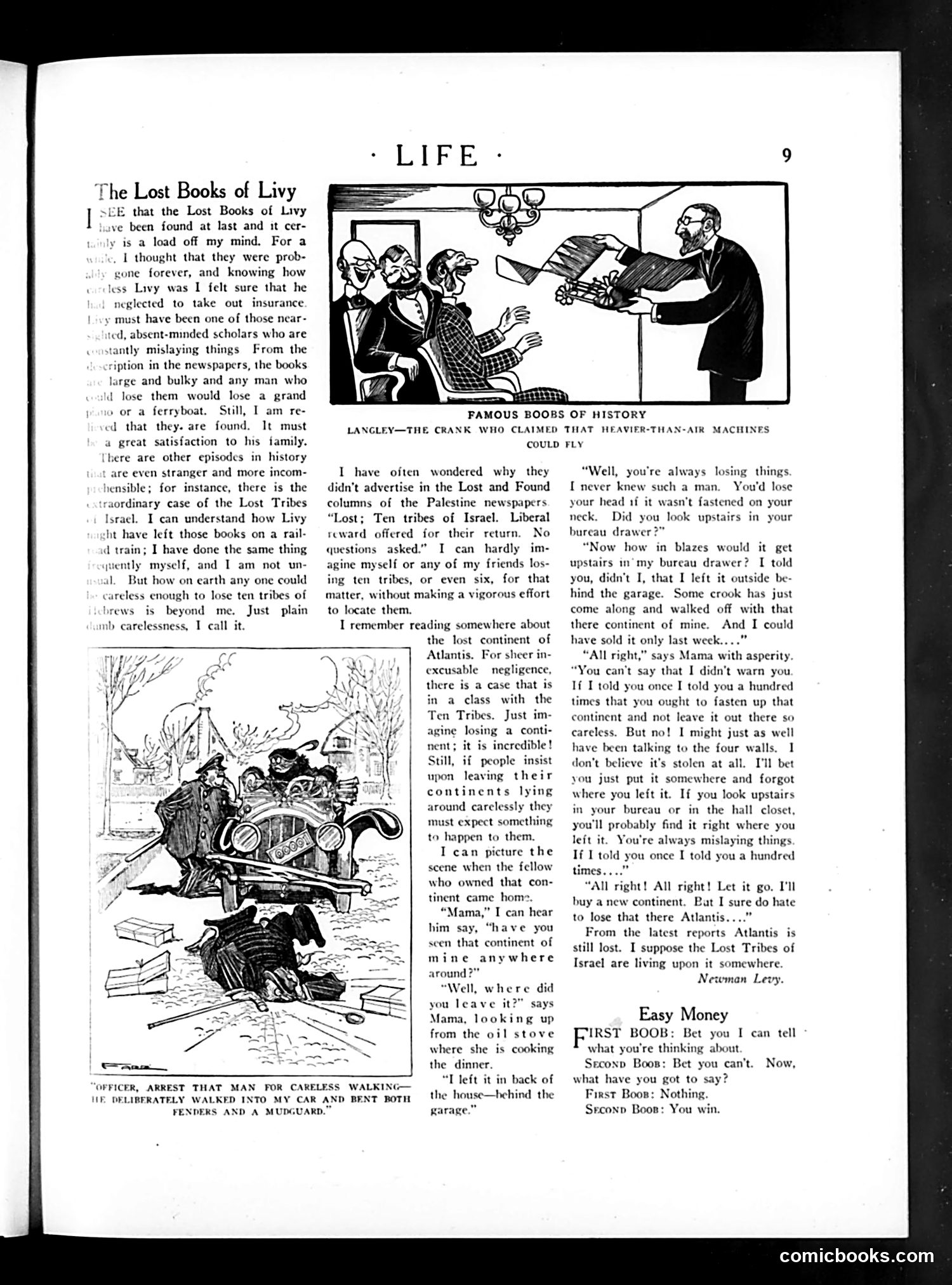
This page contains two distinct pieces of satire: **"The Lost Books of Livy"** is an essay by Newman Levy about missing historical texts. The accompanying cartoon shows a man presenting a book to three people, illustrating how careless people lose important items. The essay humorously suggests the "Lost Tribes of Israel" might be living somewhere undiscovered, attributing such negligence to absent-minded scholars. **"Easy Money"** is a brief comedic dialogue between two bookies making bets, with the punchline relying on wordplay—one claims he can predict thoughts, setting up the other's witty response. The lower illustration depicts someone who "deliberately walked into my car and bent both fenders and a mudguard"—depicting insurance fraud or accident scams of the era through visual comedy.
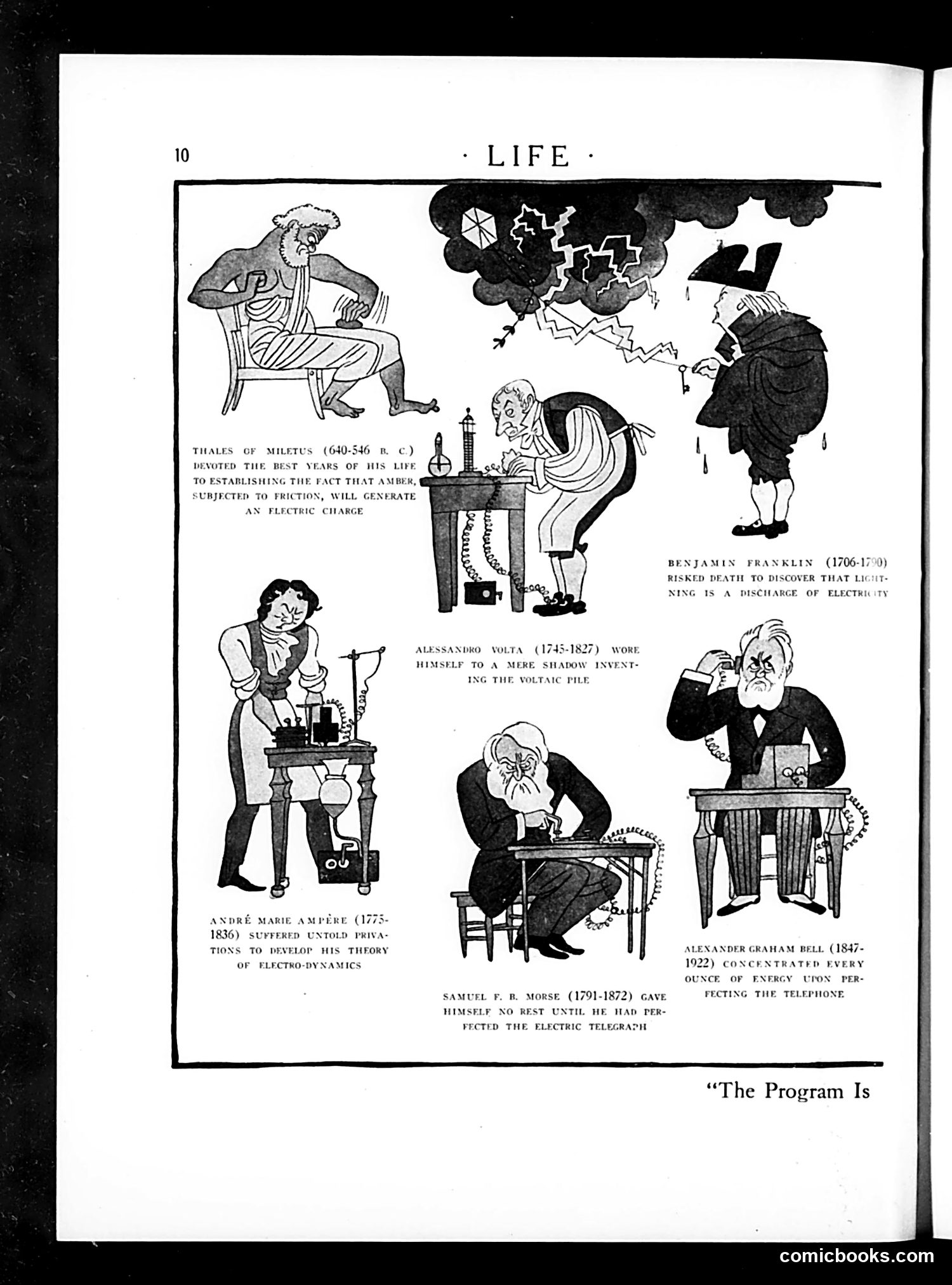
This page from *Life* magazine illustrates the history of electricity discoveries through six scientist caricatures: **Thales of Miletus** (640-546 BC) discovered amber generates electric charge through friction. **Alessandro Volta** (1745-1827) invented the voltaic pile (early battery). **Benjamin Franklin** (1706-1790) demonstrated lightning is electricity. **André-Marie Ampère** (1775-1836) developed electromagnetic theory. **Samuel F.B. Morse** (1791-1872) perfected the electric telegraph. **Alexander Graham Bell** (1847-1922) invented the telephone. The cartoon humorously depicts each scientist suffering or struggling with their respective discoveries—shock, exhaustion, or obsessive focus—suggesting the personal toll of scientific breakthroughs. This satirizes how inventors often sacrifice comfort and safety pursuing knowledge.
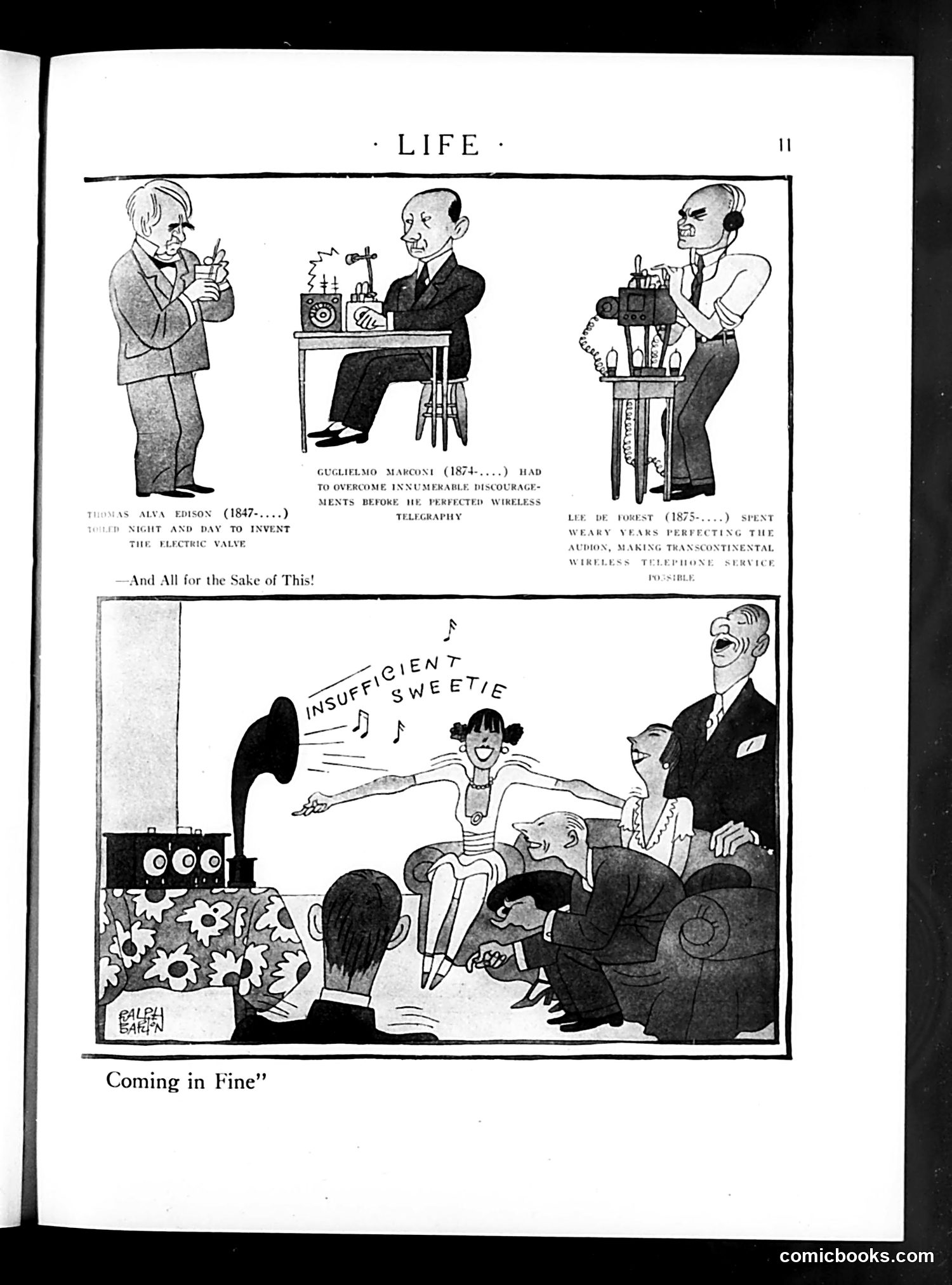
**Top Panel:** Three inventors are depicted with their innovations. Thomas Alva Edison (1847-) invented the electric valve; Guglielmo Marconi (1874-) overcame discouragement perfecting wireless telegraphy; Lee de Forest (1875-) spent years perfecting the audion for wireless telephone service. The caption "And All for the Sake of This!" suggests these serious technological achievements led to a frivolous outcome. **Bottom Panel ("Coming in Fine"):** A woman performs an "insufficient sweetie" song on what appears to be a wireless radio broadcast, while a man and audience members listen. The satire mocks how groundbreaking wireless technology—developed through decades of serious scientific work—is being used primarily for entertainment and popular music rather than serious purposes. It's a commentary on technology's commercialization and trivialization.
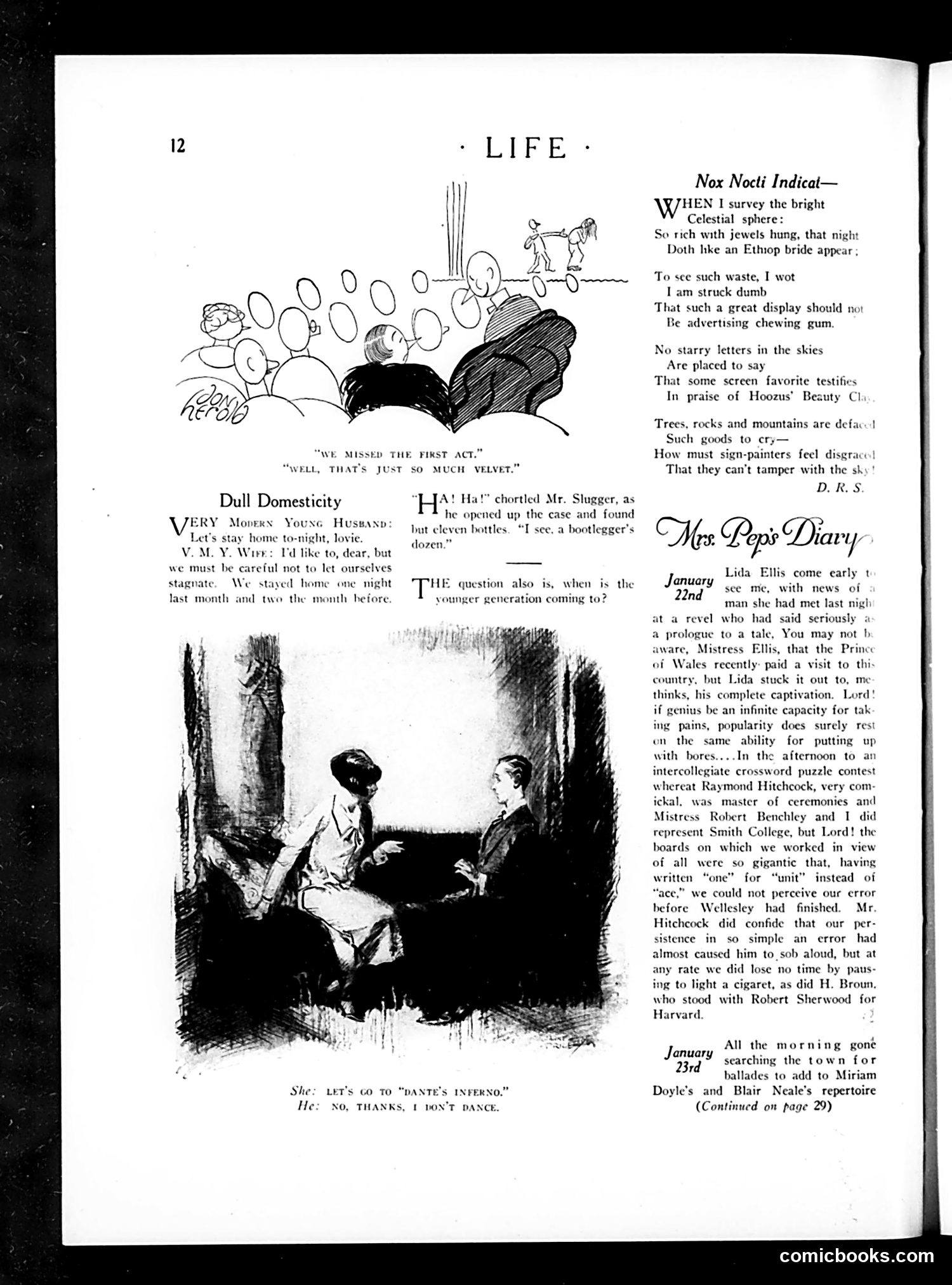
This page contains three distinct pieces: 1. **"We Missed the First Act"** - A cartoon showing an audience in a theater looking confused, with the caption joking that they've arrived late but at least got "much velvet" (suggesting an expensive/fancy venue). The satire mocks people attending shows without watching the full performance. 2. **"Dull Domesticity"** - A sketch of a married couple in conversation about staying home, with the husband reluctant. It's a domestic comedy about marital routine. 3. **"Mrs. Pops' Diary"** - A diary entry dated January 22nd describing social activities, including visits from acquaintances and mentions of various people (Raymond Hitchcock, Robert Benchley, etc.). This appears to be celebrity gossip/society commentary presented as a fictional diary. The page satirizes upper-class social life, theater culture, and domestic relationships typical of 1920s Life magazine humor.
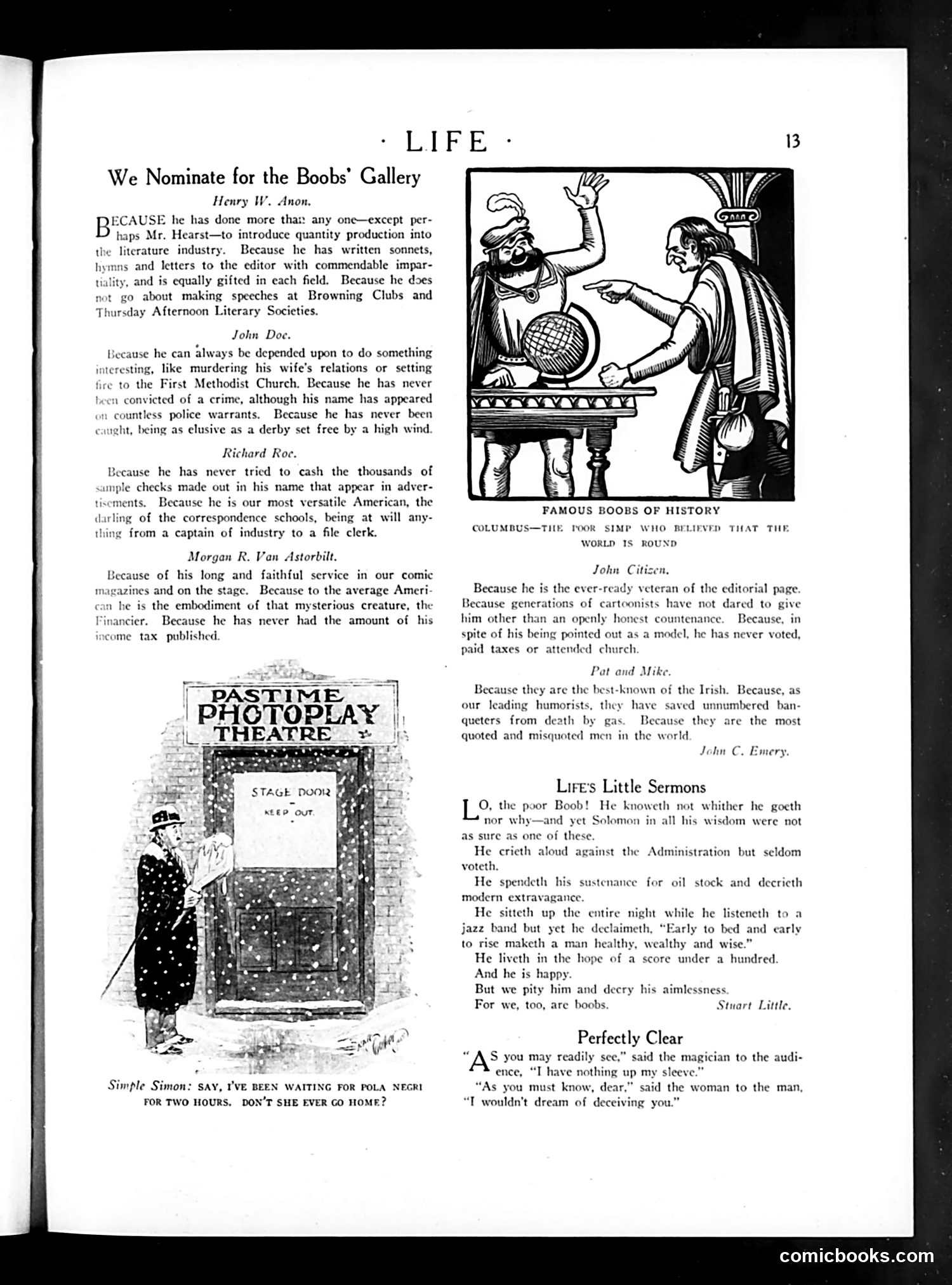
This page nominates various figures for a "Boobs' Gallery"—a humorous feature satirizing public figures the magazine considers foolish. The left column praises several men for various forms of incompetence or legal evasion: Henry W. Anon (quantity production in literature), John Doe (always available for dubious activities), Richard Roe (cashing bad checks), and Morgan R. Van Astor (comic magazine contributions). The cartoon depicts a classical scene labeled "Famous Boobs of History," showing Columbus at a table with a globe, receiving what appears to be mockery about believing the world was round—a historically inaccurate but commonly held myth. Below is a sketch of a man outside "Pastime Photoplay Theatre," captioned with a joke about waiting for a woman named Pola Negri. The page mixes character sketches with satirical observations about American society's foolish figures.
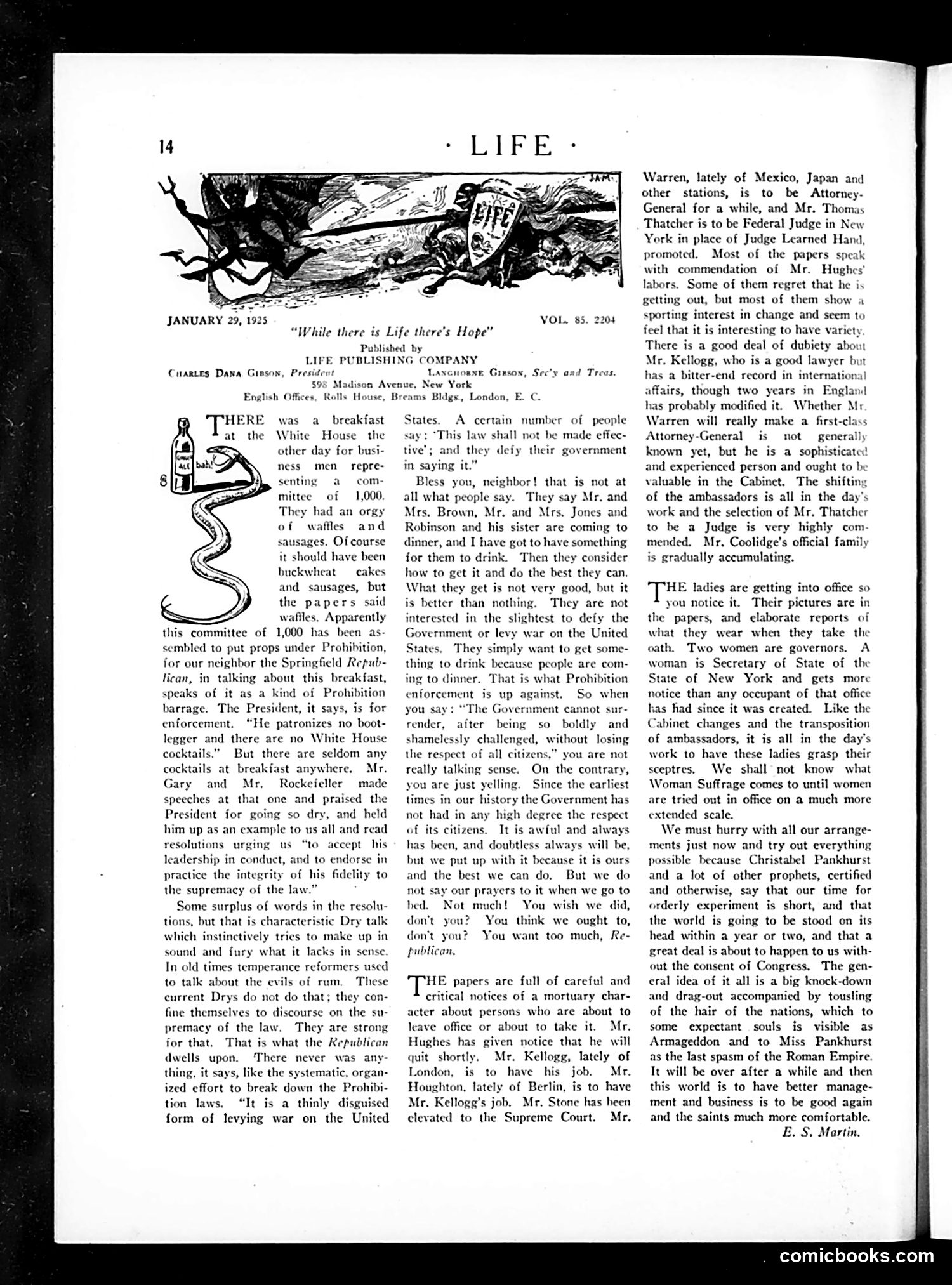
The cartoon's masthead reads "While there is Life there's Hope," with imagery of a snake and bottle, likely referencing Prohibition—the constitutional ban on alcohol (1920-1933). The accompanying article satirizes Prohibition enforcement, mocking government efforts to eliminate alcohol while citizens devise workarounds. The text criticizes both Prohibition advocates and those claiming the government lacks respect by enforcing it. The article also discusses various political appointments and women entering government office, noting the novelty of female governors and other female officials. The overall tone is sardonic, treating Prohibition as an unwinnable enforcement effort while documenting broader shifts in American governance, particularly women's increasing political participation.
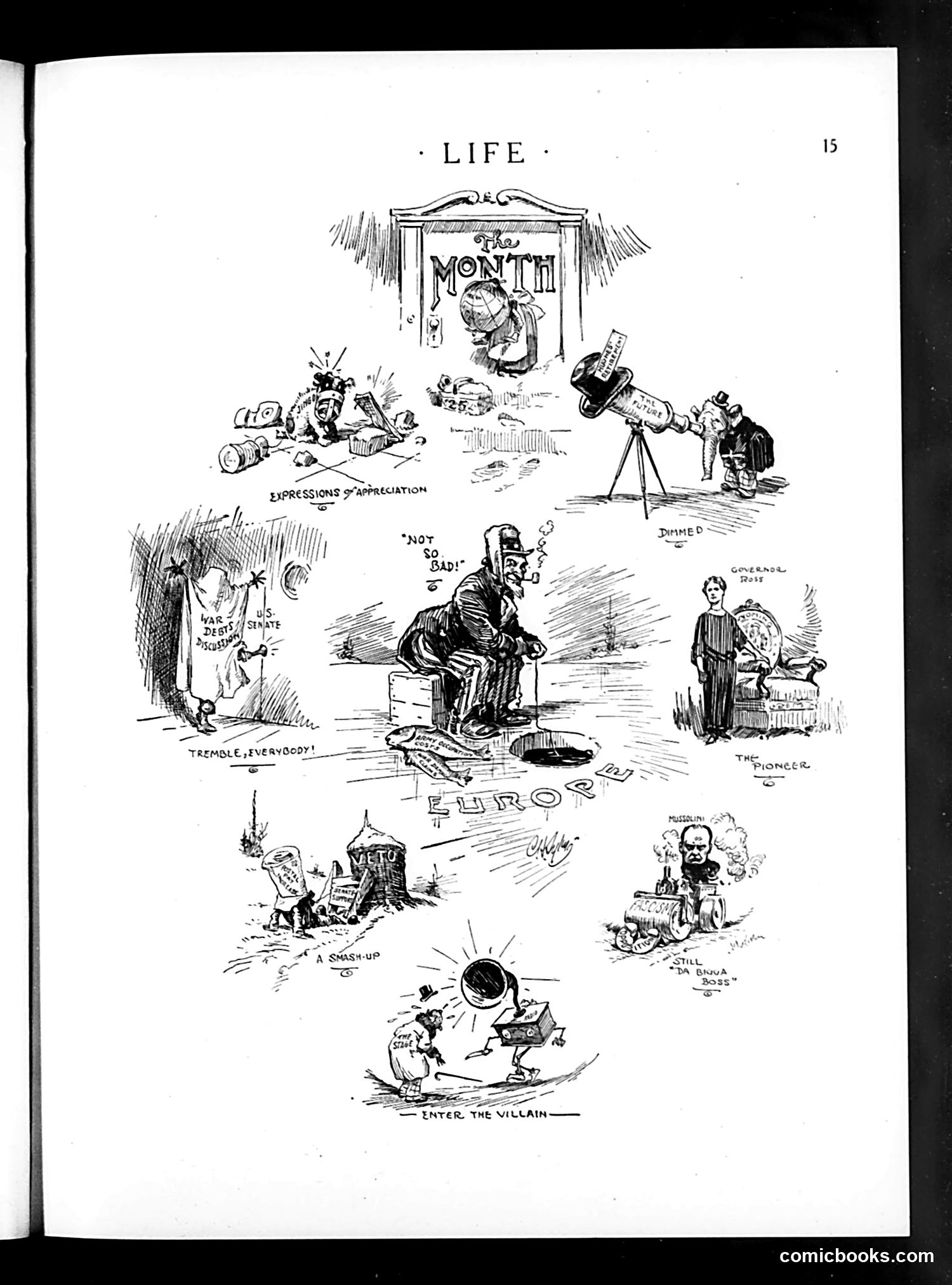
This page presents eight small political cartoons organized around a central theme of monthly happenings. The sketches include: - **"Expressions of Appreciation"** (top left): Objects and figures suggesting public recognition or reward - **"Not So Bad!"**: A figure responding to bad news - **"Dumped"** (top right): A telescope or instrument labeled as such - **"War in Senate"** (left): Political conflict imagery - **"The Pioneer"** (right): A figure with frontier/settlement references - **"A Smash-Up"** (bottom left): Apparent wreckage or destruction - **"Still da Same Boss"**: Authority figures - **"Enter the Villain"** (bottom): A dramatic entrance scene The cartoons use exaggerated character drawings typical of early 20th-century satirical journalism, mocking current events, political figures, and social situations through wordplay and visual metaphor.
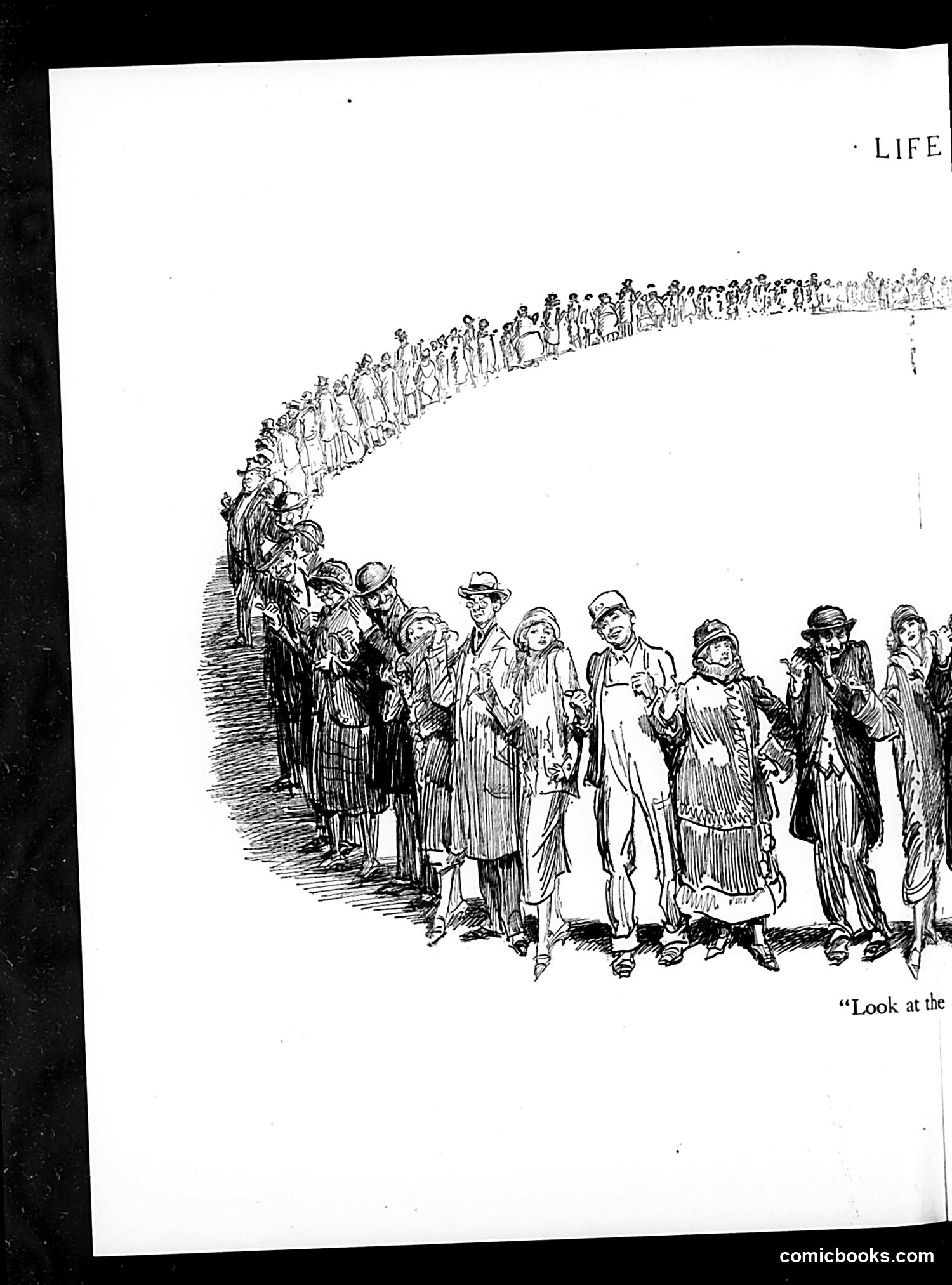
This page from *Life* magazine shows a political cartoon depicting a long queue of people stretching upward into the distance. The figures in the foreground appear to be drawn from various social classes and occupations, identifiable by their clothing and hats. The caption begins "Look at the" but is cut off, making the complete satirical point unclear. The ascending line likely represents a queue—possibly for employment, government assistance, or some public service during an economic crisis. The visual metaphor of the line extending upward suggests either endless waiting or spiritual/social aspiration. Without the complete caption and specific historical date visible, the precise target of satire remains uncertain, though the composition suggests commentary on economic hardship, social inequality, or bureaucratic systems typical of *Life* magazine's social criticism.
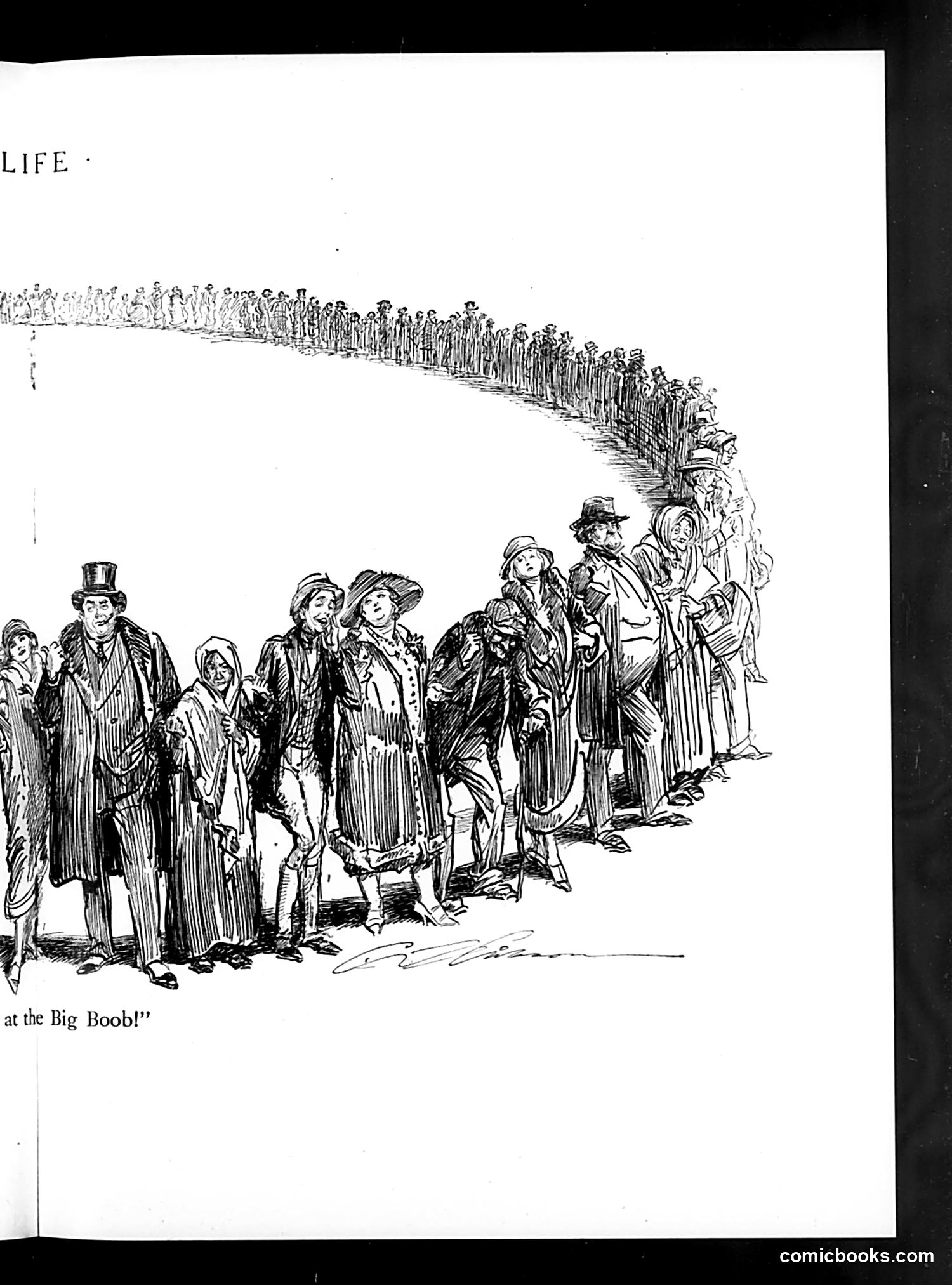
This appears to be a satirical Life magazine cartoon depicting a long queue of people following each other, with the partial caption reading "at the Big Boob!" The cartoon likely satirizes **crowd mentality or blind conformity**—a common theme in early-to-mid 20th century American satire. The figures are drawn in detailed period clothing (coats, hats), suggesting ordinary citizens. The snaking line extending far into the background emphasizes how many people mindlessly follow along. The incomplete caption "at the Big Boob!" suggests mockery of public gullibility—people gathering to witness or participate in something foolish. Without the full caption, the specific target (a public figure, event, or trend) remains unclear, but the satirical point about mass behavior is evident from the visual composition alone.
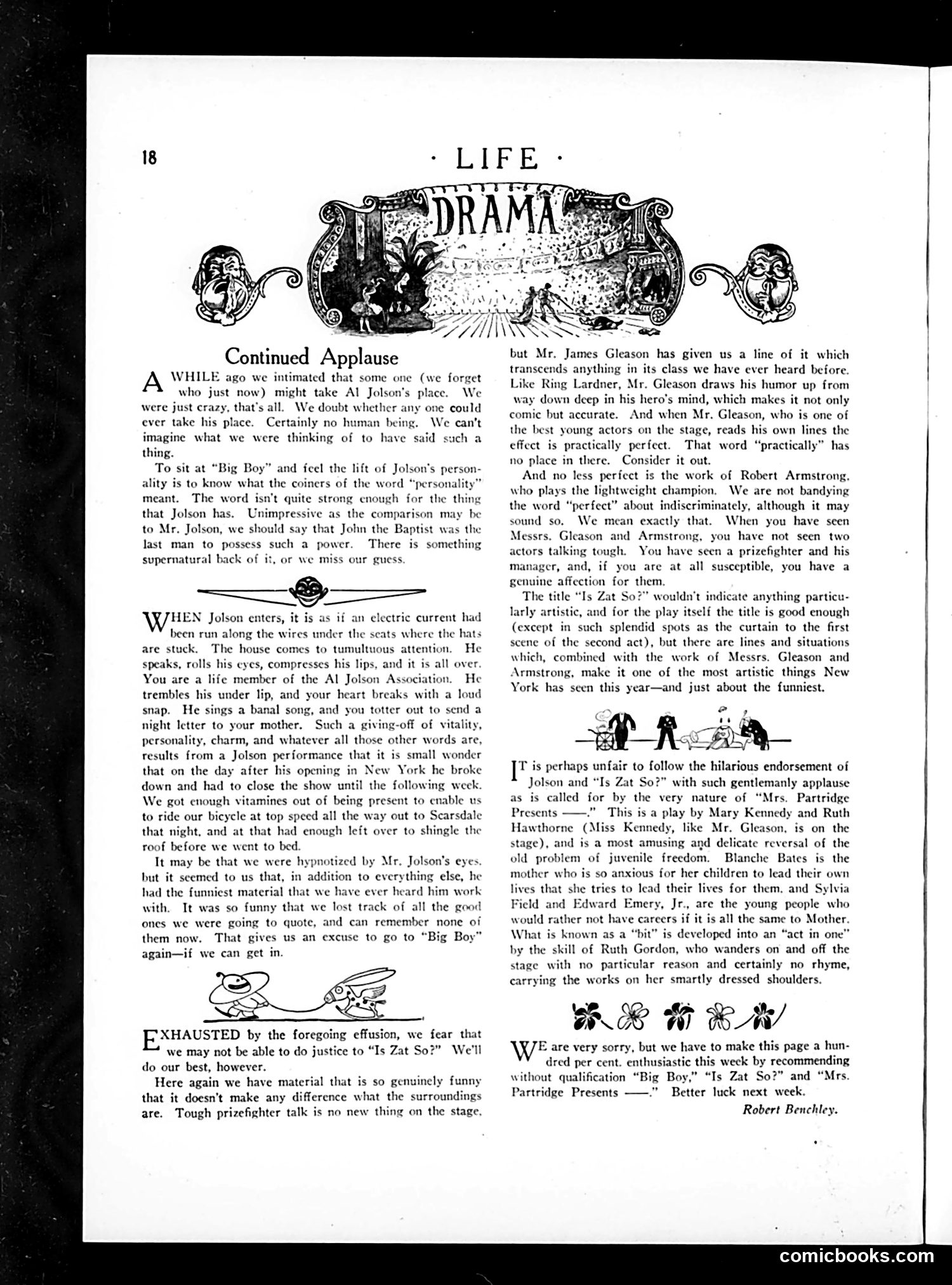
This page reviews two Broadway productions. The main criticism praises **Al Jolson** in "Big Boy," describing his magnetic stage presence with almost religious fervor—comparing his power to that of John the Baptist. The reviewer emphasizes Jolson's ability to emotionally manipulate audiences through subtle physical expressions and voice control, causing audience members to send telegrams to their mothers. The secondary review covers "Is Zat So?" by Mary Kennedy and Ruth Hawthorne, starring **James Gleason** and **Robert Armstrong**. The play uses prizefighter slang and boxing-world humor. The reviewer credits Gleason (who also wrote dialogue) with authentically capturing character psychology, drawing comparison to humorist **Ring Lardner**. Both lead actors are praised as naturalistic performers who create believable characters rather than merely "talking tough." The satire is gentle—the Jolson section mockingly exaggerates his hypnotic effect on audiences, while the "Is Zat So?" review acknowledges the play's lowbrow premise but celebrates its execution and humor.
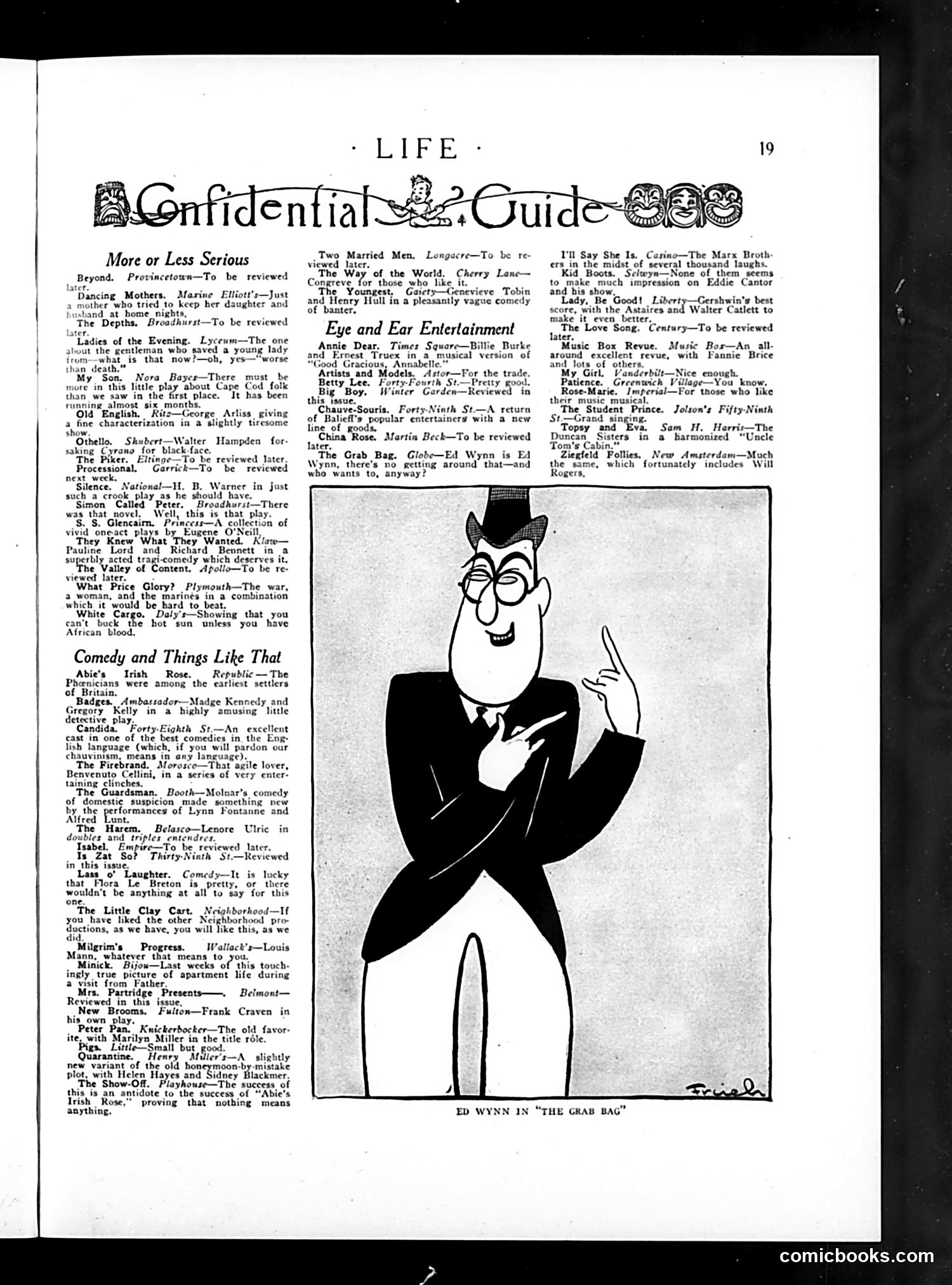
The illustration shows **Ed Wynn**, a famous vaudeville and early stage comedian known for his distinctive appearance and comedic timing. The caricature exaggerates his characteristic features—bulbous nose, wide grin, and theatrical expression—capturing his well-known persona. The cartoon appears in a "Confidential Guide" reviewing Broadway shows and entertainments. Wynn was a major star of the 1920s stage, and this drawing likely promotes or comments on one of his current theatrical performances. The humor relies on visual caricature rather than political satire. The title "The Grab Bag" suggests variety entertainment—appropriate for Wynn's style of broad, physical comedy that dominated American popular theater during this era. The exaggerated features are typical of Life magazine's satirical illustration style, poking affectionate fun at celebrity performers while celebrating their entertainment value.
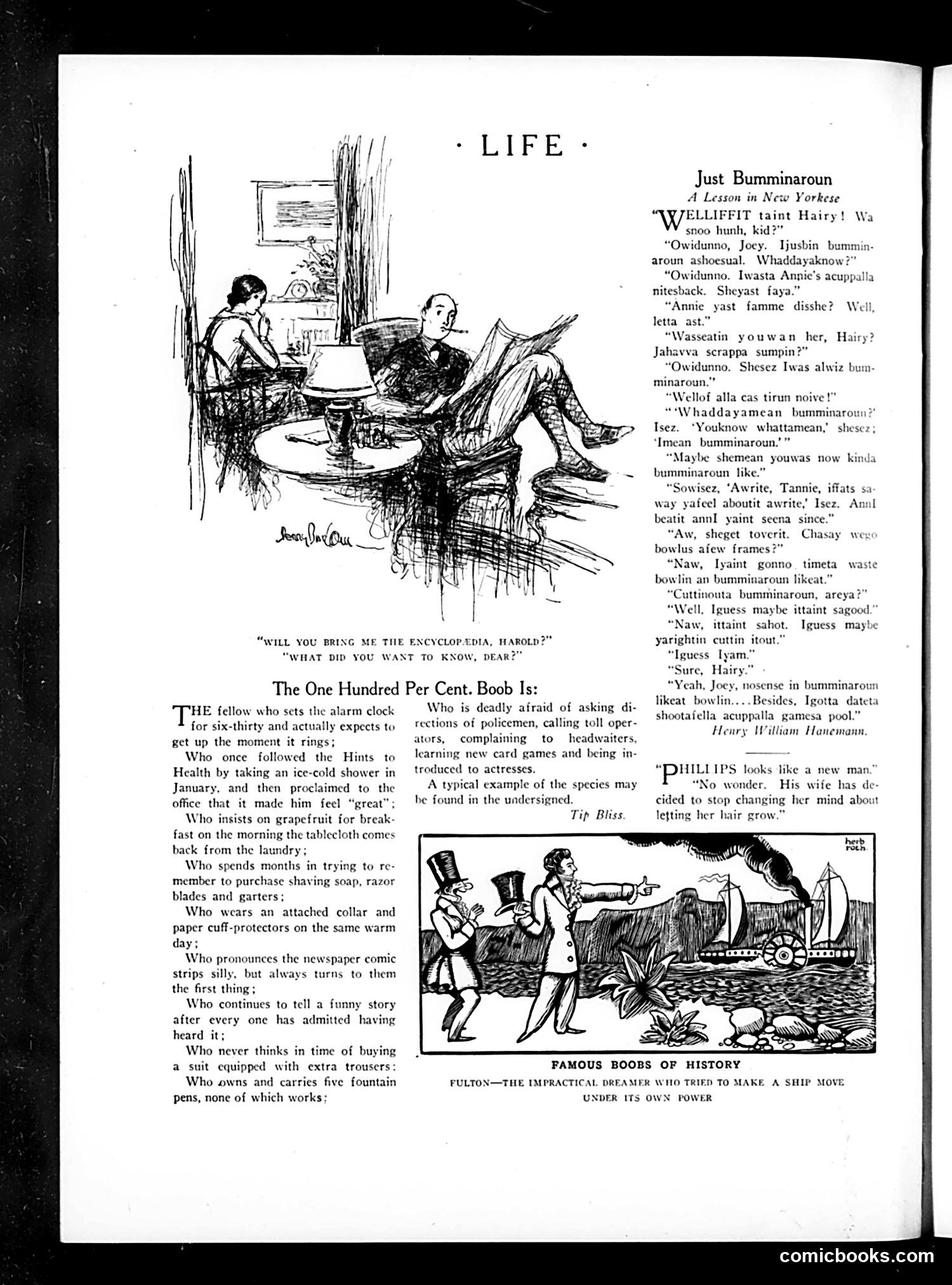
**Top Section - "The One Hundred Per Cent. Boob Is":** This is a satirical list defining the "100% boob"—a foolish everyman type. It catalogs absurd contradictions: setting an alarm but not waking up, following health fads then bragging about them, wearing mismatched accessories, avoiding minor social interactions (asking directions, complaining to waiters), and carrying non-functional fountain pens. The cartoon sketch shows a man lounging while his wife fetches an encyclopedia, embodying lazy incompetence. Credited to Tip Bliss, it's gentle mockery of ordinary male hubris and self-deception. **"Just Bumminaroun" Section:** A phonetic transcription of working-class New York slang—likely meant as humorous or condescending representation of immigrants or lower-class speech patterns. The dialogue depicts young men discussing hanging around, bowling, and dating. **Bottom - "Famous Boobs of History":** A cartoon showing Fulton attempting to make a ship move under its own power—mocking him as an impractical dreamer, inverting historical reality (Fulton developed the steamship successfully).
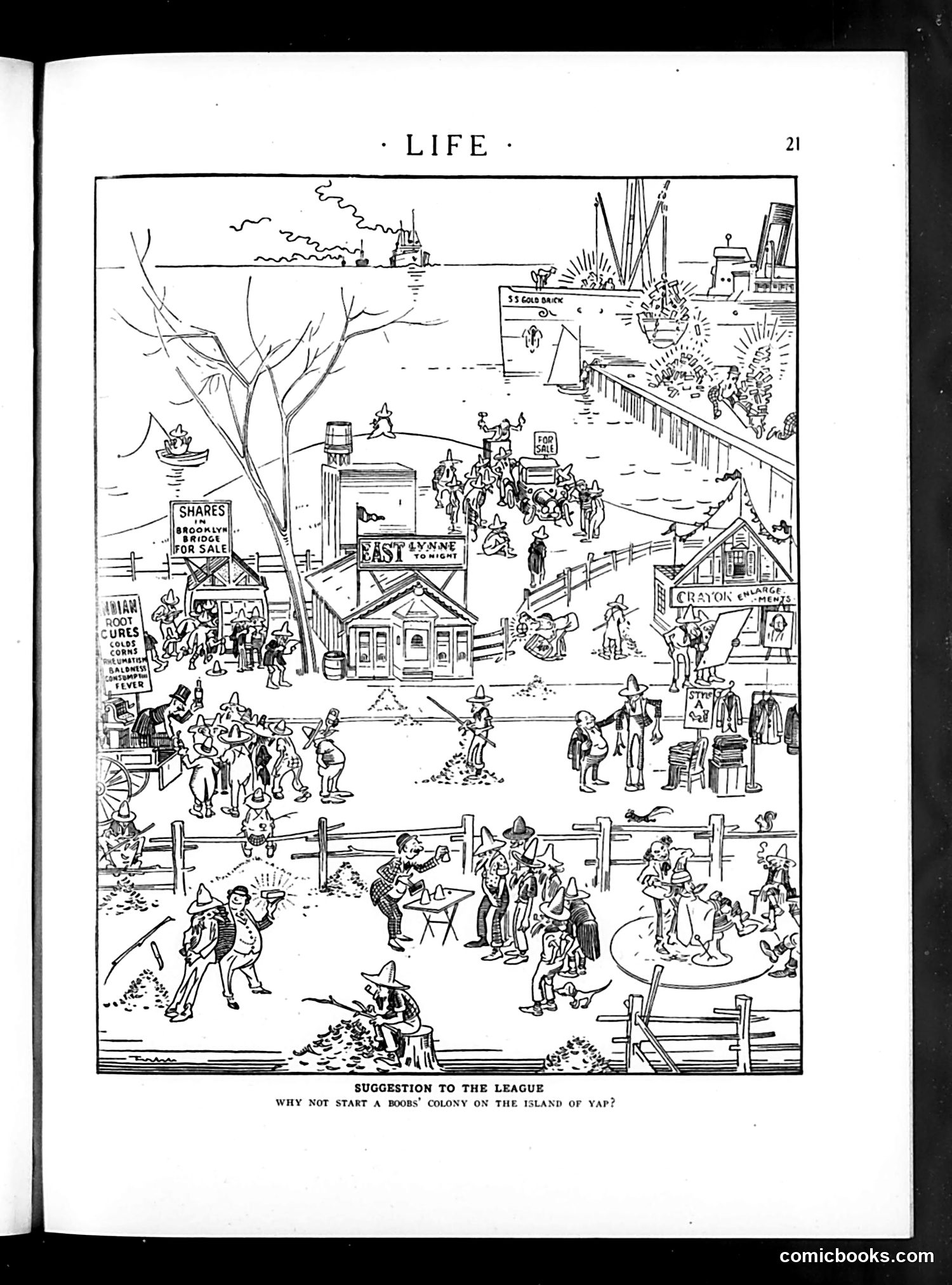
This cartoon satirizes the League of Nations by proposing an absurd solution to post-WWI problems. "Boobs' Colony" appears to be a derisive reference to foolish politicians or incompetent league members. The "Island of Yap" was a real Pacific island that became diplomatically contentious after WWI—Japan and the U.S. disputed control of it, creating actual League tensions. The cartoon depicts a bustling seaside community with various activities and commerce, suggesting that incompetent leaders should be isolated on a remote island rather than influencing international affairs. The satirical point: League of Nations decision-makers were so ineffectual that exiling them to Yap would be preferable to allowing them to govern world affairs. This reflects widespread American skepticism toward the League during the 1920s.
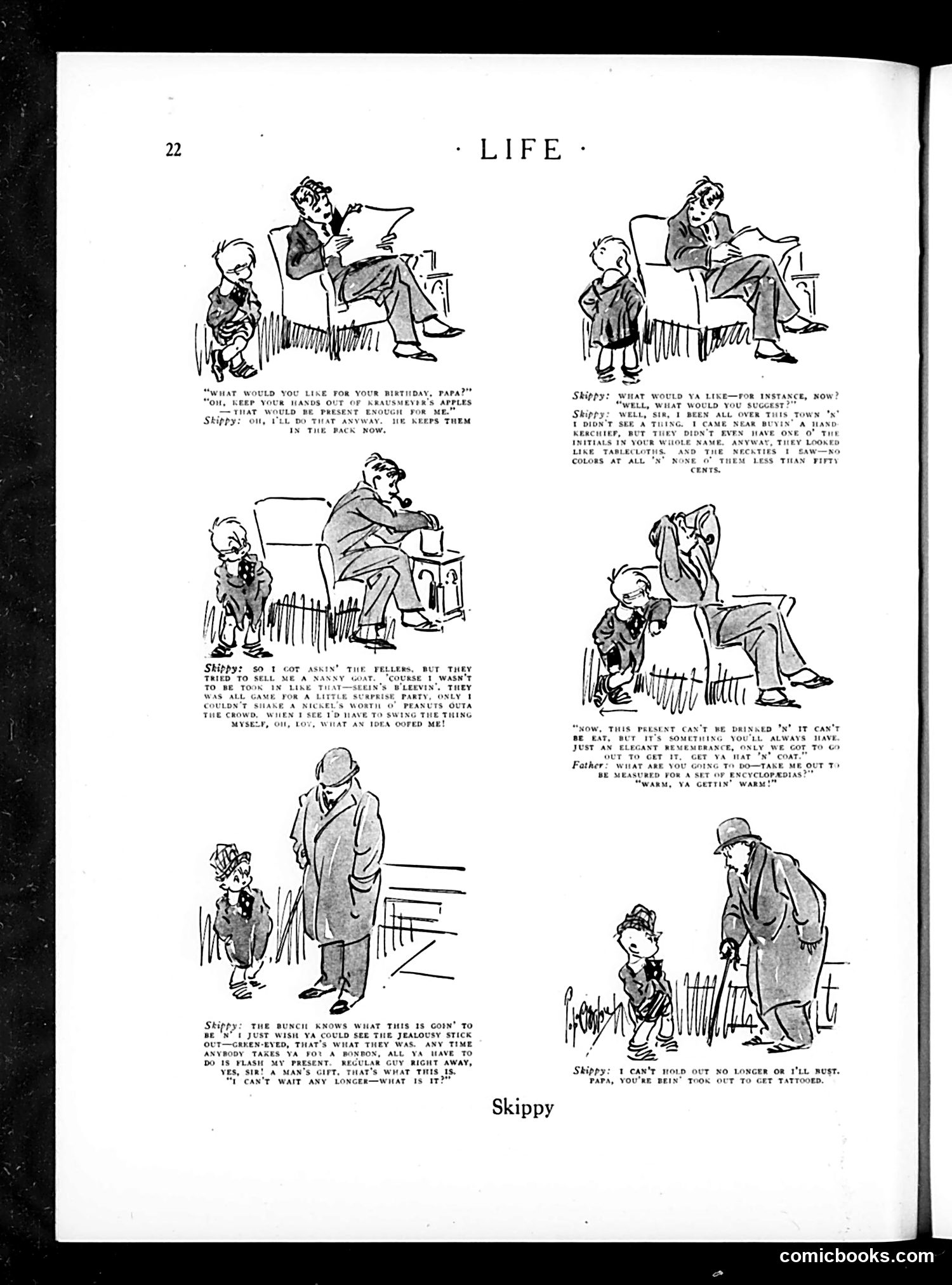
This is a comic strip featuring a young boy named Skippy pestering his father about a birthday present. The humor operates on multiple levels: **The Setup:** Skippy's father refuses to reveal what he's giving him, only stating it must stay "out of Krausmeyer's apples"—a reference to petty theft, suggesting the father wants Skippy to stop stealing fruit. **The Satire:** Skippy has spent the day shopping and complaining about consumer goods—handkerchiefs lack initialed elegance, neckties are expensive and ugly, a nanny goat was offered but rejected. The strip mocks both childhood materialism and Depression-era scarcity. **The Punchline:** After extensive buildup and Skippy's mounting impatience, the "present" is revealed: Skippy is being taken to get a **tattoo**—punishment disguised as a gift. This is darkly humorous, playing on the father's exasperation with the boy's behavior and consumer demands. The strip satirizes both spoiled childhood desires and parental frustration with modern consumer culture.
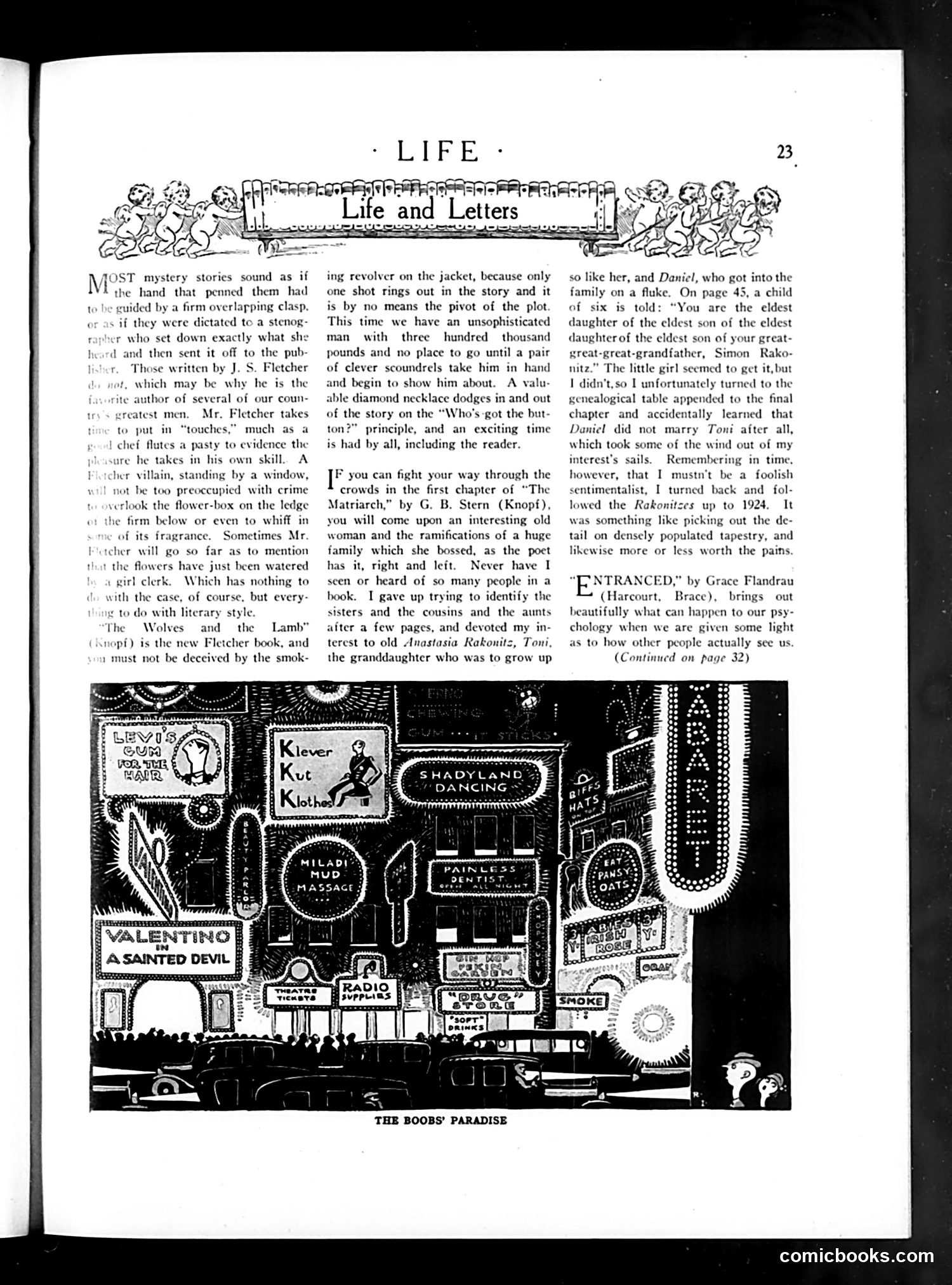
This page from Life magazine contains a literary column reviewing three books, accompanied by a large satirical illustration titled "The Boobs' Paradise." The illustration is a densely-packed, Art Deco-style cartoon depicting a glamorous 1920s entertainment district or nightlife venue. It shows numerous storefronts and attractions with signs advertising entertainment, beauty treatments, and vices—including "Shadyland Dancing," "Miladi Mud Massage," "Radio," and other establishments suggesting frivolous leisure and vanity. The style suggests this is satirizing the shallow materialism and hedonistic pleasures of the Jazz Age and consumer culture. The architectural density and crowded signage mock the overwhelming commercialization of urban entertainment. The title "The Boobs' Paradise" implies criticism of the masses and their pursuit of superficial amusements rather than intellectual or meaningful activities—a common Life magazine critique of contemporary American popular culture and consumer excess.
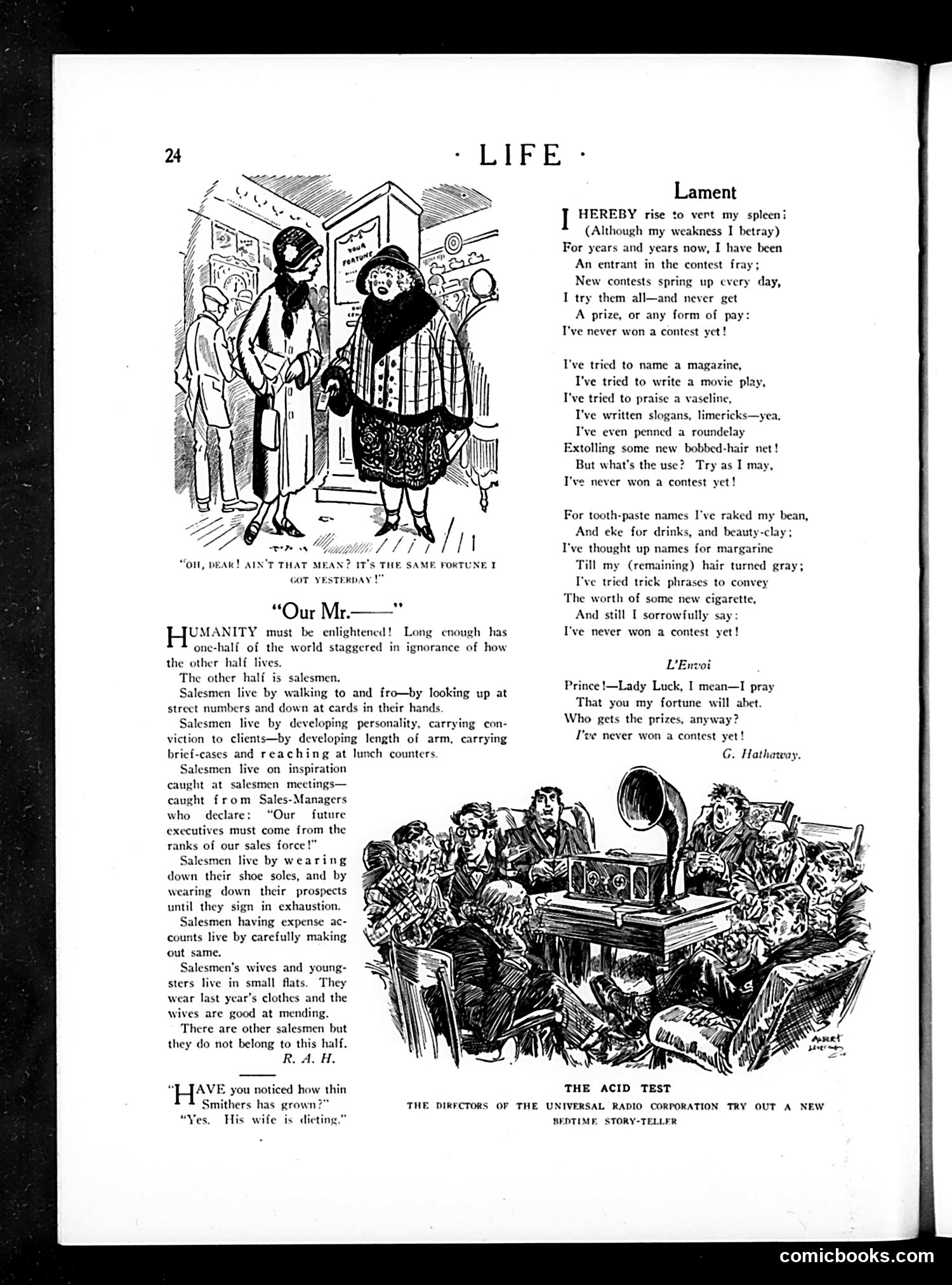
This page contains three distinct pieces of satire from Life magazine: **"Lament" (poem by G. Hathaway):** A humorous complaint about the proliferation of consumer contests in the 1920s-30s. The speaker has entered countless contests—naming products, writing slogans for magazines, vaseline, cigarettes, margarine—but never won. It satirizes both the obsessive contest-mania of the era and companies' cheap marketing tactics of crowdsourcing ideas from the public without compensation. **"Our Mr.—" (by R.A.H.):** Mocks the lives of traveling salesmen, the dominant commercial workforce of the period. It portrays them as exhausted hustlers wearing out shoe soles and wearing down customers until they buy, while their wives and children live in modest flats wearing hand-me-downs. The satire critiques both the exploitative sales culture and the financial strain on salesmen's families. **Bottom cartoon:** Shows radio executives testing a new "bedtime story-teller," likely satirizing early radio programming or corporate experimentation with new entertainment formats. The page overall satirizes commercialism, consumer culture, and working-class economic struggle.
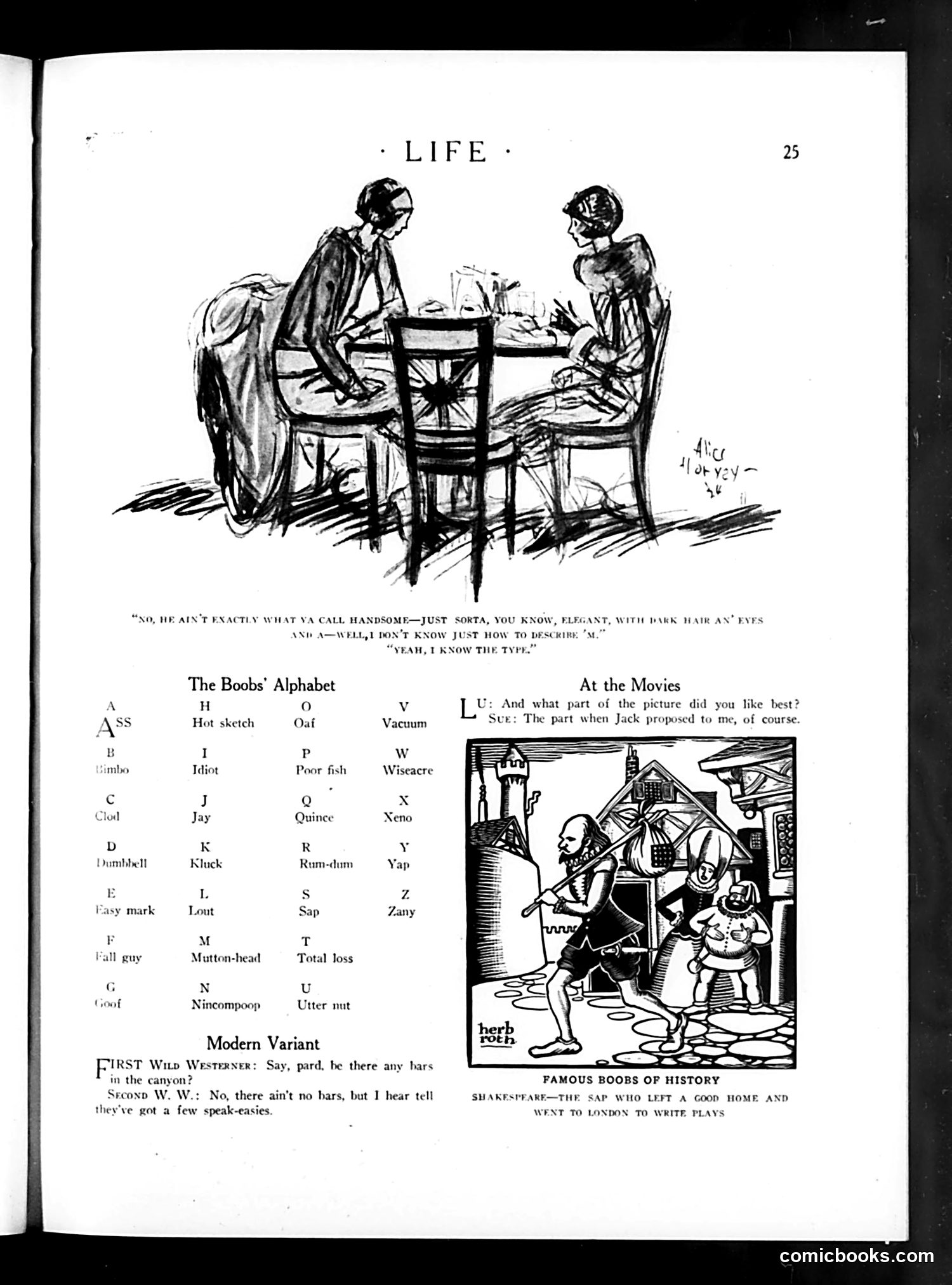
This page from Life magazine contains multiple layers of period satire targeting romantic naïveté and stupidity. The top cartoon mocks how women describe attractive men in vague, clichéd terms ("elegant, with dark hair and eyes")—the male character recognizes this as a stock type he knows well. **"The Boobs' Alphabet"** is a satirical glossary defining various types of foolish men (Ass, Dumbbell, Easy mark, Fall guy, Idiot, Jay, Kluck, Lout, Mutton-head, Nincompoop, Poor fish, Quince, Rum-dum, Sap, Total loss, Utter nut, Wiseacre, Xeno, Yap, Zany). **"At the Movies"** mocks female moviegoers' romantic sentimentality—a woman finds the proposal scene most meaningful. **"Modern Variant"** jokes about Prohibition-era speak-easies replacing legal bars. **"Famous Boobs of History"** appears to caricature Shakespeare as a foolish man who abandoned home for artistic pursuits in London—implying creative ambition equals stupidity. The overall theme: satirizing various types of male foolishness and female romantic gullibility.
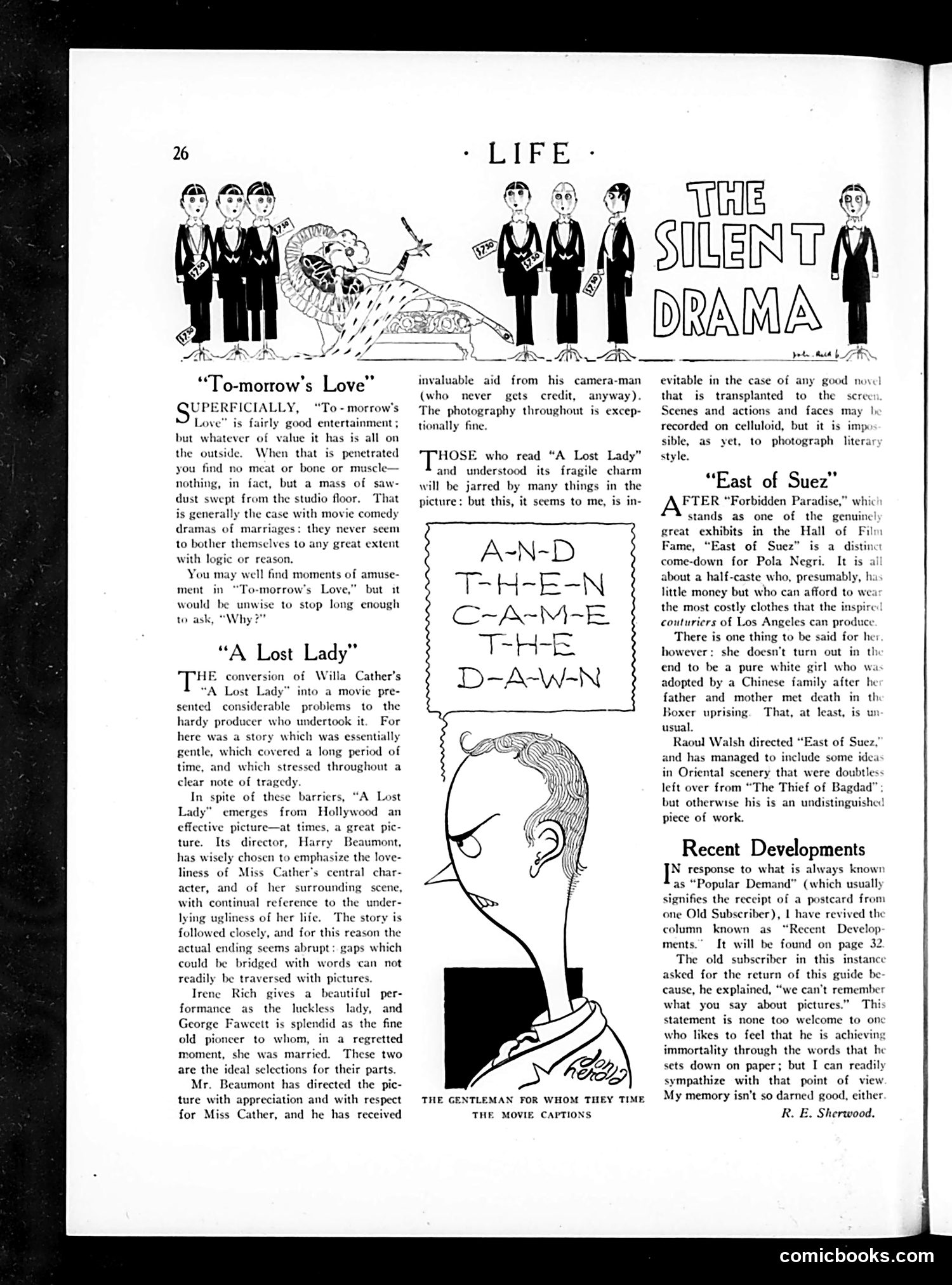
This page contains three film reviews from *Life* magazine's arts section, showcasing early 1920s cinema criticism. **"To-morrow's Love"** receives dismissive treatment—the reviewer criticizes it as superficial entertainment with no substance, comparing its hollow plot to "sawdust swept from the studio floor." The complaint concerns marriage comedies that ignore logic. **"A Lost Lady"** (adapted from Willa Cather's novel) is praised more favorably. The reviewer appreciates director Harry Beaumont's emphasis on visual beauty while capturing the story's underlying tragedy. Actors Irene Rich and George Fawcett receive commendation. However, the critic notes an inherent limitation: cinema cannot adequately photograph "literary style"—a recognition that film adaptation inevitably loses textual nuance. **"East of Suez"** featuring actress Pola Negri is criticized as disappointing, particularly following her previous success in "Forbidden Paradise." The reviewer mocks the film's clichéd orientalism and its predictable plot mechanics. The cartoon "The Silent Drama" illustrates cinema's challenge: translating literature to screen requires visual rather than verbal storytelling.
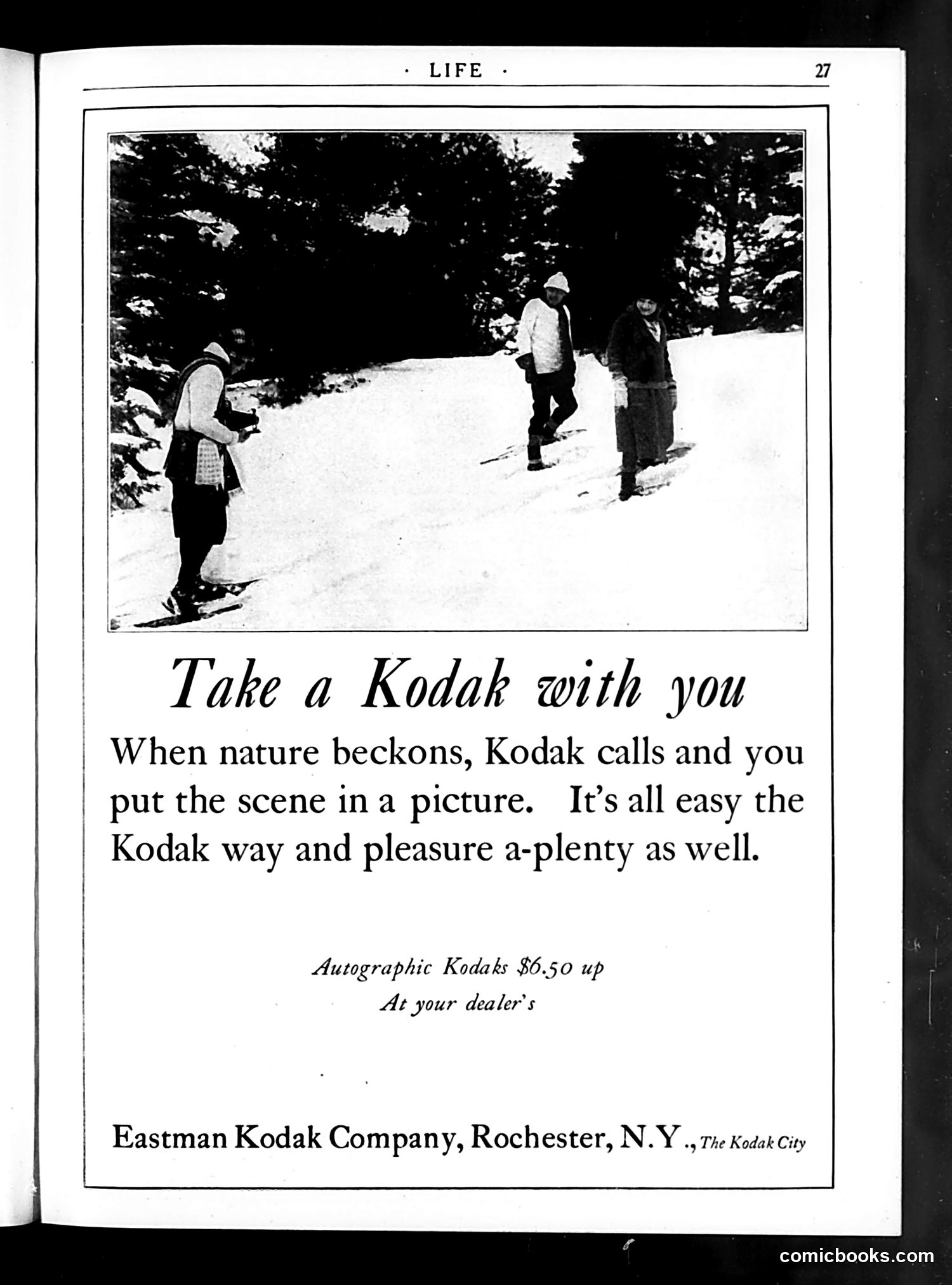
This is a straightforward **advertisement**, not satire or political commentary. It promotes Eastman Kodak Company's "Autographic Kodaks" cameras (priced at $6.50 and up). The image shows people on a snowy hillside with skis, capturing a winter recreational scene—precisely the casual, pleasurable moment the ad encourages consumers to photograph. The marketing pitch emphasizes ease and enjoyment: when nature inspires you, Kodak makes picture-taking simple and fun. The ad reflects early 20th-century consumer culture, positioning photography as an accessible leisure activity for middle-class Americans. The winter sports setting appeals to relatively affluent audiences with time and resources for outdoor recreation. There is no hidden satire here—it's genuine product promotion using period-appropriate messaging and imagery.
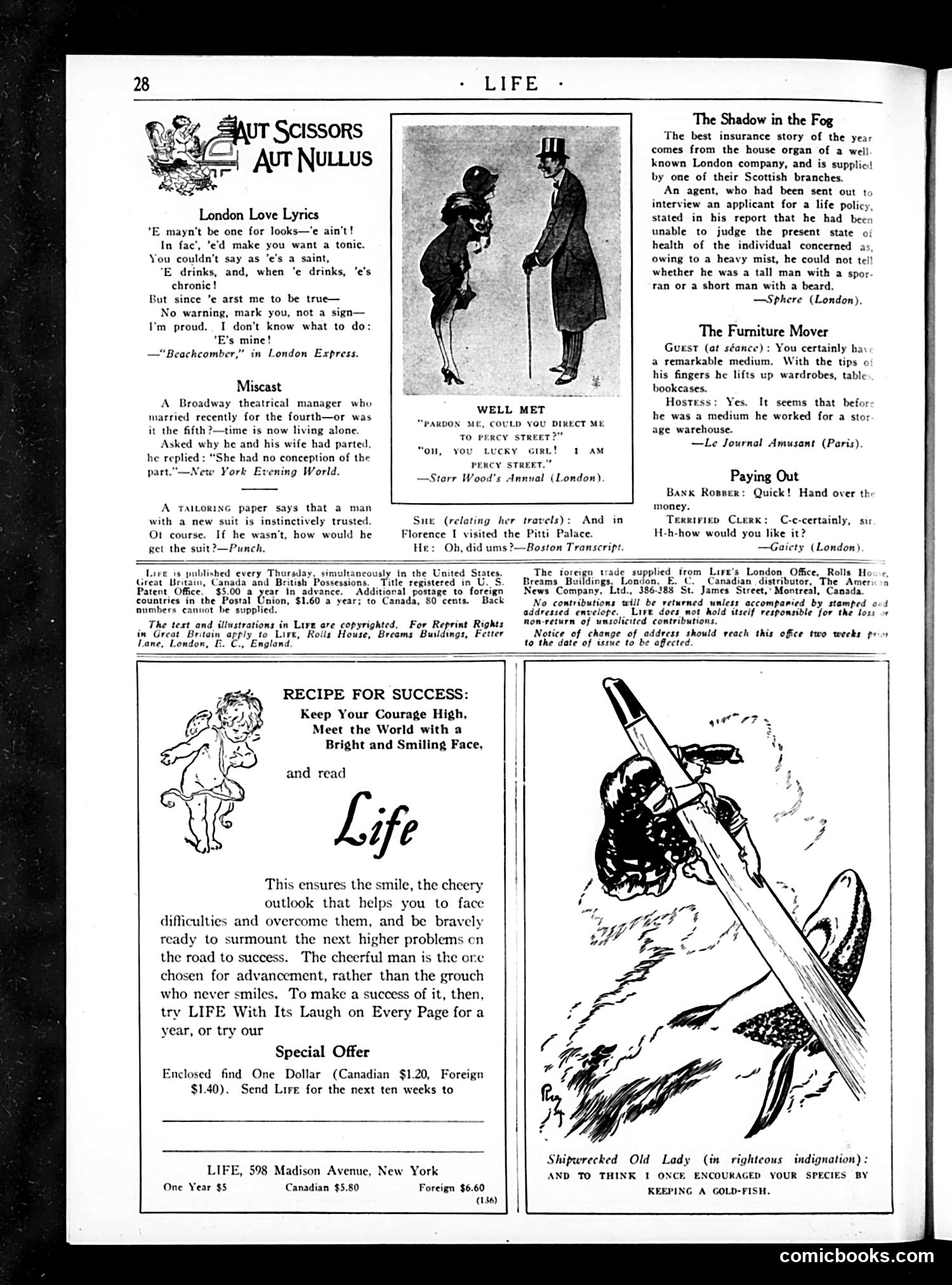
This is primarily a **humor and advertising page** from Life magazine (an American satirical weekly). The content consists of: **Humor Pieces**: Short jokes and anecdotes reprinted from various sources (London Express, Punch, Boston Transcript, etc.), typical of Life's format. These include: - "London Love Lyrics"—a working-class romance - "Miscast"—a joke about a Broadway director's failed marriages - "The Shadow in the Fog"—satirizing insurance agents unable to assess clients in fog - "The Furniture Mover"—a medium with warehouse experience **Cartoons**: A sketch titled "Well Met" shows two men in Victorian dress; another depicts a shipwrecked elderly woman in moral outrage. **Advertisement**: The bulk of the page promotes Life magazine itself, emphasizing cheerfulness and optimism as keys to success ("Keep Your Courage High"). The page reflects Life's early-20th-century format: **light satire on social conventions, marriage, insurance, spiritualism, and class differences**, drawn from contemporary British and American sources.
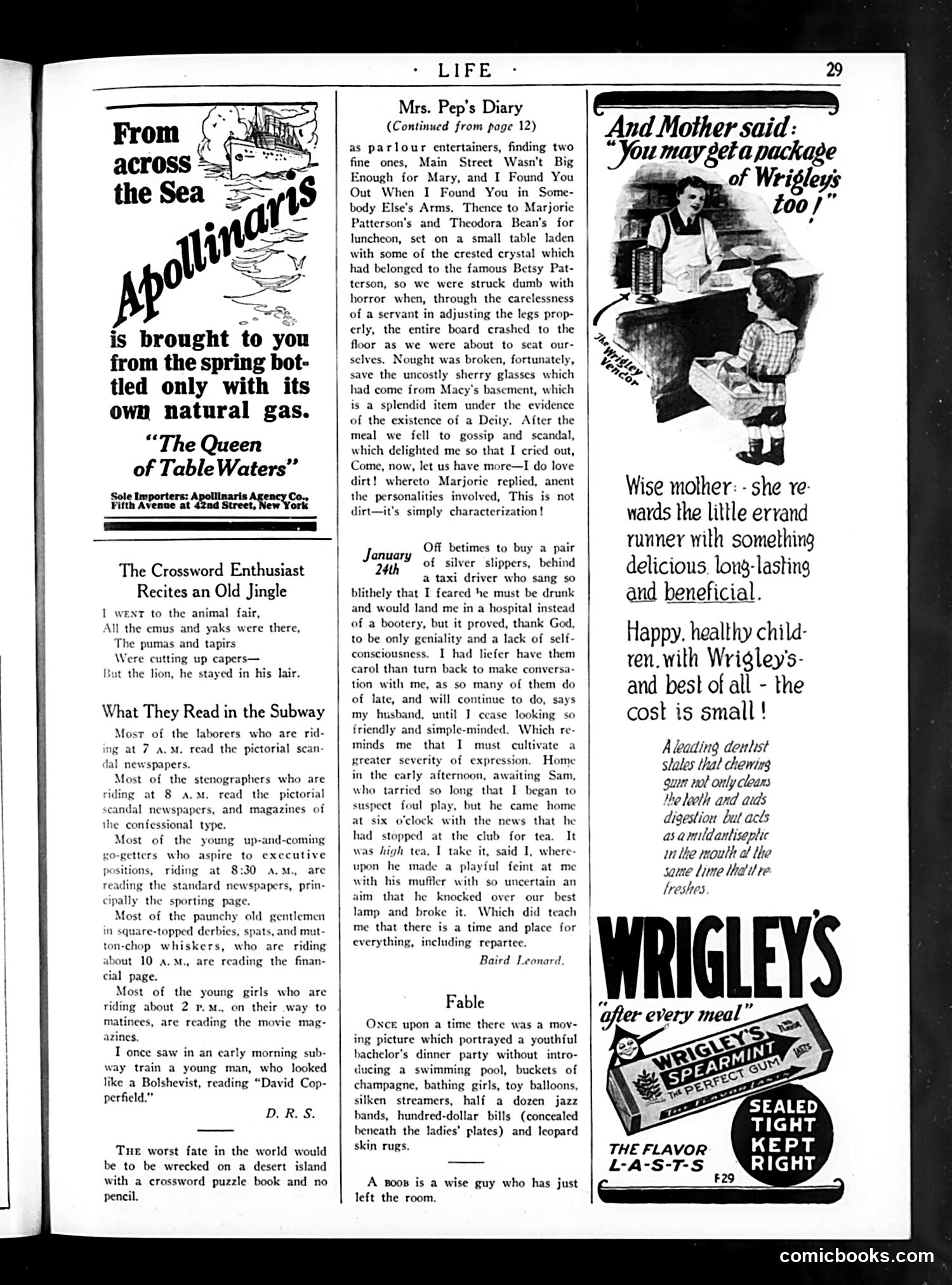
This page from *Life* magazine (likely 1920s based on style) contains satirical social commentary typical of the era: **"What They Read in the Subway"** stereotypes commuters by social class and reading habits—laborers read scandal papers, stenographers read confessional magazines, executives read financial pages, and young women read movie magazines. The joke mocks how reading choices supposedly reveal character and ambition. The final anecdote about a "Bolshevist" reading *David Copperfield* appears to be ironic commentary on radical politics. **"Mrs. Pep's Diary"** satirizes upper-class social pretension through a wealthy woman's account of entertaining and gossip, poking fun at name-dropping and the contradiction between cultivating an appearance of proper severity while actually enjoying scandal. **"Fable"** begins mocking predictable movie tropes—bachelor parties that inevitably include swimming pools, champagne, dancers, and excess. The advertisements (Apollinaris water, Wrigley's gum) are era-appropriate commercial content, not satire.
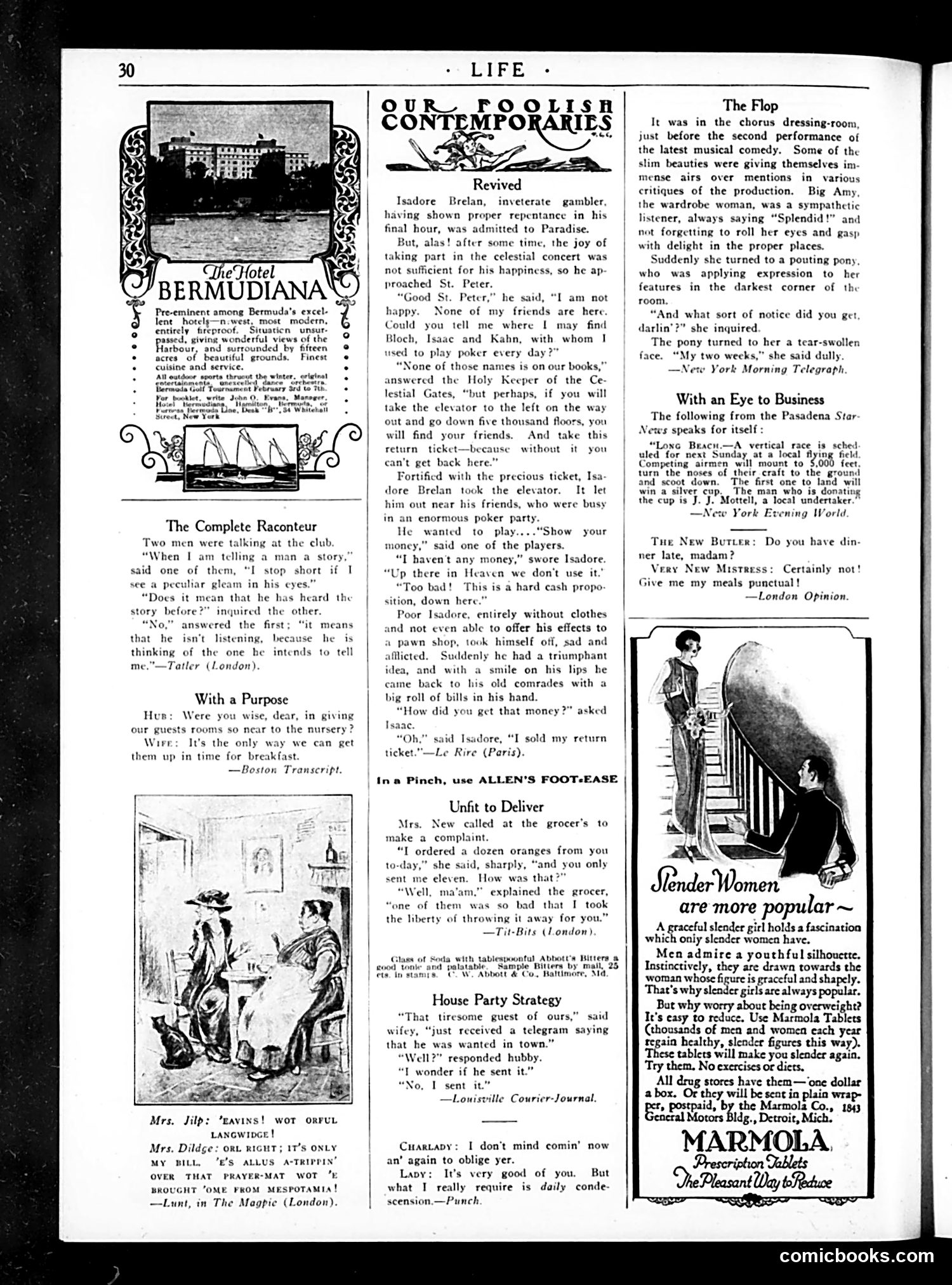
This page from *Life* magazine contains several humorous anecdotes mocking human nature and social pretensions. **"The Complete Raconteur"** satirizes boring storytellers—the "gleam" in a listener's eye signals not rapt attention but rather that they're mentally rehearsing their own anecdote to tell next. **The Isadore Brelan story** is a darkly comic Jewish joke about an inveterate gambler admitted to Paradise who discovers his poker friends are in Hell. When he tries to resume gambling in Heaven, he has no money—so he sells his return ticket to Hell and returns with cash. The satire critiques both gambling addiction and the assumption that the wicked outnumber the righteous. **"Unfit to Deliver"** mocks a grocer's thin excuse for sending eleven oranges instead of twelve—he disposed of a bad one without asking. **"House Party Strategy"** depicts a husband and wife scheming to rid themselves of a tedious houseguest by fabricating a summons telegram, then arguing over who actually sent it. The page is primarily text-based humor rather than visual satire.
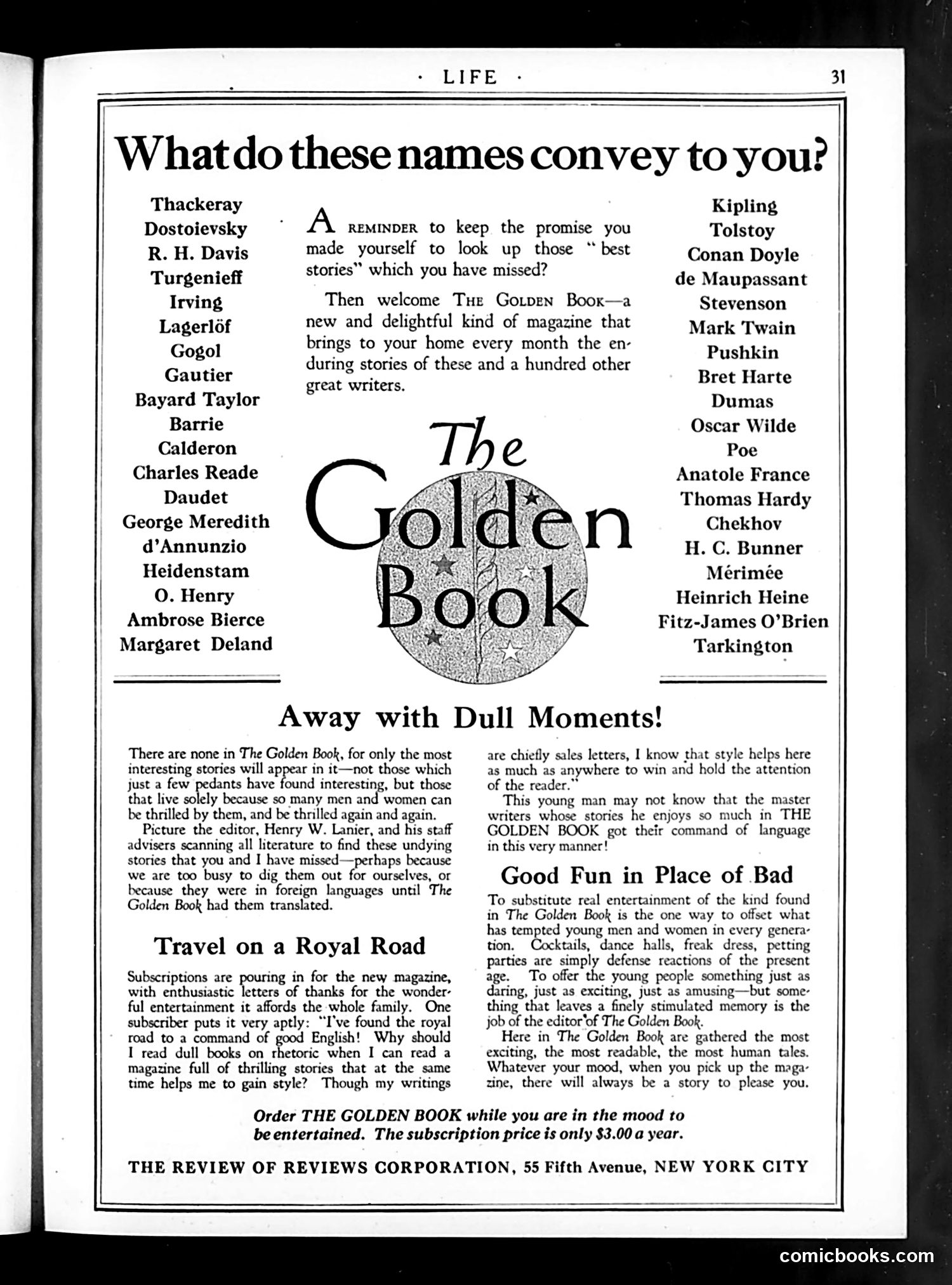
This is a full-page advertisement for *The Golden Book*, a new literary magazine. Rather than satire or political cartooning, it's a straightforward pitch to readers. The page lists celebrated classic authors—Tolstoy, Mark Twain, Oscar Wilde, Poe, etc.—to establish cultural prestige. The ad positions the magazine as a curated solution for busy people who want to read great literature but lack time to search for it themselves. The copy appeals to self-improvement (gaining "style" for business writing) and subtly critiques contemporary youth culture: cocktails, dance halls, and "petting parties" are dismissed as mere "defense reactions" of the age. *The Golden Book* offers a superior alternative—intellectual stimulation with lasting value. At $3.00 yearly, the ad emphasizes accessibility. The overall message: subscribe to gain cultural refinement and good taste without effort.
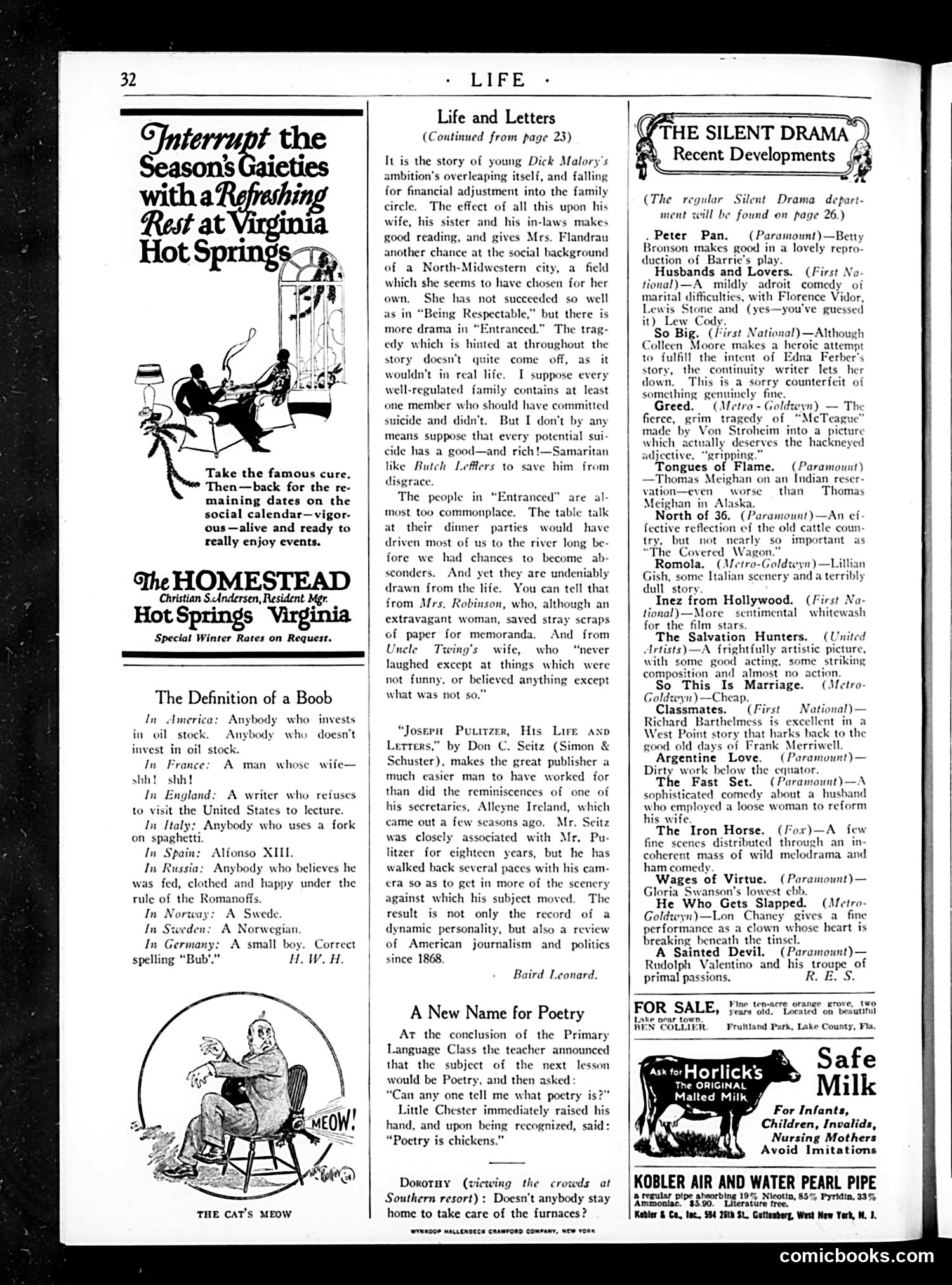
This page from *Life* magazine contains several satirical pieces: **"The Definition of a Boob"** is a nationalist/xenophobic humor section that stereotypes different nationalities. Each definition plays on perceived national traits—Italians supposedly eat spaghetti with hands, Spaniards are foolish (Alfonso XIII was Spain's king), Russians are duped by the Tsar, and Swedes and Norwegians are mutual idiots. This reflects 1920s American attitudes treating foreigners as inherently foolish. **"The Cat's Meow"** shows a cat saying "meow"—a visual pun on the phrase "the cat's meow" (slang for something excellent), mocking its overuse in contemporary speech. **"A New Name for Poetry"** presents a child defining poetry as "chickens"—absurdist humor playing on children's unexpected logic. **"Dorothy's" resort joke** satirizes wealthy Americans vacationing during winter while servants remain at home managing furnaces—critiquing class indifference during cold seasons. The page otherwise advertises Virginia Hot Springs resort and various products, representing typical 1920s magazine content mixing humor, book reviews, and advertising.
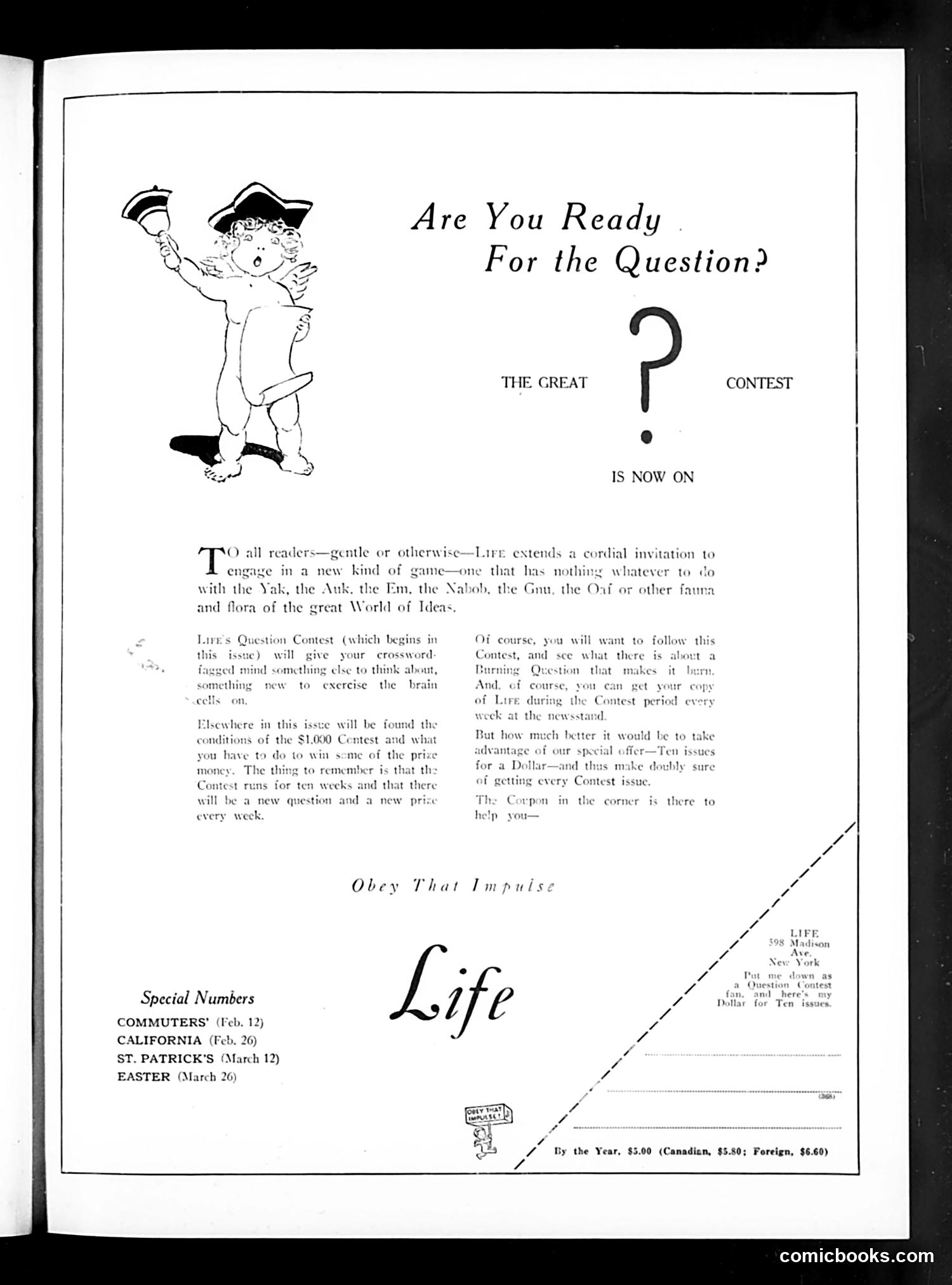
This is a promotional page announcing Life magazine's new "Question Contest"—a puzzle competition offering $1,000 in prizes. The cartoonish figure at top left (appears to be a jester or fool character) poses the challenge "Are You Ready For the Question?" The page explains that readers can enter a weekly contest to win prize money, with new questions and prizes offered each week over a ten-week period. Life offers a special deal: subscribe for ten issues at one dollar total, ensuring readers receive every contest installment. The "Obey That Impulse" heading below encourages immediate subscription. The page also lists upcoming special issues (Commuters, California, St. Patrick's, Easter). This is essentially **advertising masquerading as editorial content**—typical of Life's self-promotional style. The jester character symbolizes the playful, clever humor Life's readers expected, while the contest hook was designed to drive subscriptions during the magazine's competitive era.
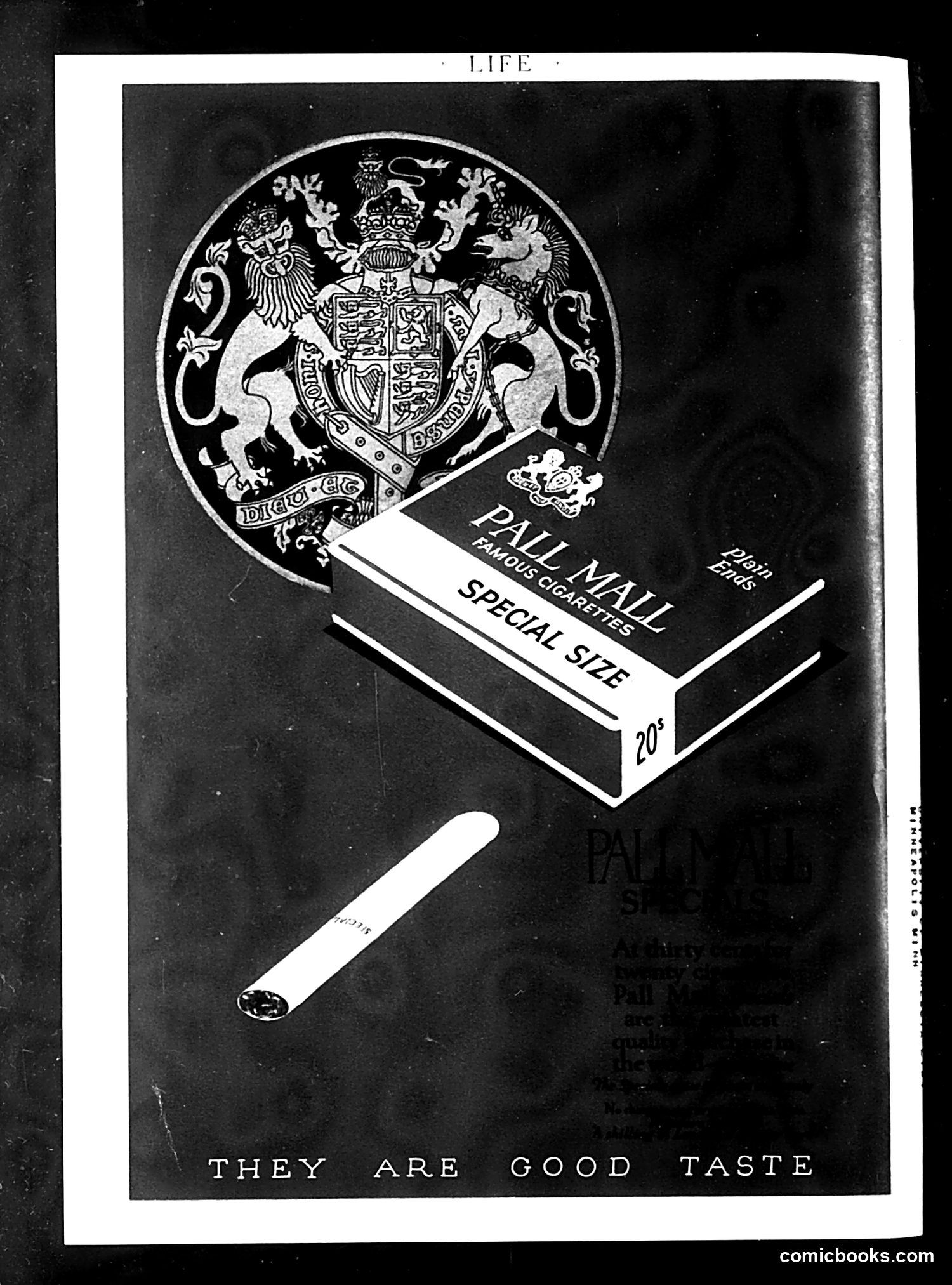
This is a vintage advertisement for Pall Mall cigarettes, not political satire. The ad displays a package of "Pall Mall Famous Cigarettes Special Size" (priced at 20¢) alongside a single cigarette, set against an ornate British royal coat of arms. The advertisement's appeal relies on associating the product with British prestige and royalty—the elaborate heraldic imagery suggests quality and sophistication. The tagline "They Are Good Taste" makes an explicit connection between smoking this brand and refined taste. This represents mid-20th-century tobacco marketing before health warnings, when cigarette advertising regularly appeared in mainstream publications and used aspirational imagery to sell the product to American consumers.

I can see this is a very dark, low-contrast image from what appears to be a historical publication. The page is predominantly black with minimal visible detail. On the left edge, there appears to be a white margin or binding, and "comicbooks.com" is visible at the bottom right corner. However, I cannot reliably make out any cartoon figures, text content, or satirical imagery that would allow me to identify specific political or social references, caricatures, or the intended humor or message. The image quality and contrast are insufficient for accurate analysis. To provide a meaningful historical interpretation as requested, I would need a clearer, higher-contrast version of this page.