
Life, 1925-01-29 · page 20 of 37
Life — January 29, 1925 — page 20: what you’re looking at
What you’re looking at
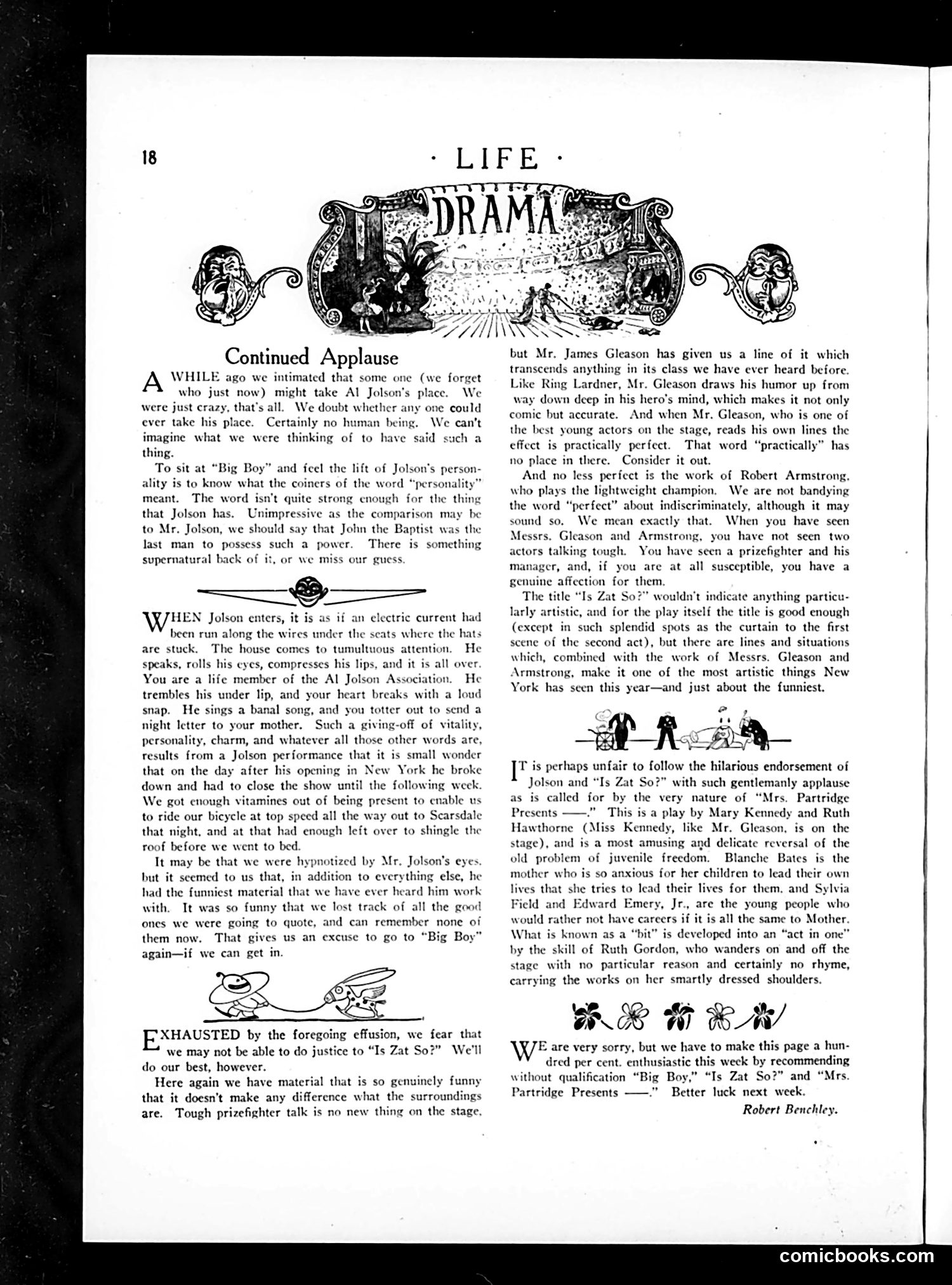
This page reviews two Broadway productions. The main criticism praises **Al Jolson** in "Big Boy," describing his magnetic stage presence with almost religious fervor—comparing his power to that of John the Baptist. The reviewer emphasizes Jolson's ability to emotionally manipulate audiences through subtle physical expressions and voice control, causing audience members to send telegrams to their mothers. The secondary review covers "Is Zat So?" by Mary Kennedy and Ruth Hawthorne, starring **James Gleason** and **Robert Armstrong**. The play uses prizefighter slang and boxing-world humor. The reviewer credits Gleason (who also wrote dialogue) with authentically capturing character psychology, drawing comparison to humorist **Ring Lardner**. Both lead actors are praised as naturalistic performers who create believable characters rather than merely "talking tough." The satire is gentle—the Jolson section mockingly exaggerates his hypnotic effect on audiences, while the "Is Zat So?" review acknowledges the play's lowbrow premise but celebrates its execution and humor.
📄 Transcribed text from this page (OCR, searchable)
Machine-transcribed from the original scan — historical spelling and the odd misread are preserved.
Continued Avelaine WHILE ago we intimated that some one (we forget who just now) might take Al Jolson’s place. We were just crazy, that’s all. We doubt whether any one could ever take his place. Certainly no human being. We can't imagine what we were thinking of to have said such a thing. To sit at “Big Boy” and feel the lift of Jolson’s person- ality is to know what the coiners of the word “personality” meant. The word isn't quite strong enough for the thing that Jolson has. Unimpressive as the comparison may be to Mr. Jolson, we should say that John the Baptist was the last man to possess such a power. There is something supernatural back or We miss our guess. —_ 8 —— WHEN Jolson enters, it is as if an electric current had been run along the wires under the seats where the hats are stuck. The house comes to tumultuous attention. He speaks, rolls his eyes, compresses his lips, and it is all ov: You are a life member of the Al Jolson Association. He trembles his under lip, and your heart breaks with a loud snap. He sings a banal song, and you totter out to send a night letter to your mother. Such a giving-off of vitality, personality, charm, and whatever all those other words are, results from a Jolson performance that it is small wonder that on the day after his opening in New York he broke down and had to close the show until the following week. We got cnough vitamines out of being present to enable us to ride our bicycle at top speed all the way out to Scarsdale that night, and at that had enough left over to shingle the roof before we went to bed. It may be that we were hypnotized by Mr. Jolson’s eyes. but it seemed to us that, in addition to everything else, he had the funniest material that we have ever heard him work with. It was so funny that we lost track of all the good ones we were going to quote, and can remember none of them now. That gives us an excuse to go to “Big Boy” again—if we can get in. <= See aos E;XHAUSTED by the foregoing effusion, we fear that we may not be able to do justice to “Is Zat So?” We'll do our best, however. Here again we have material that is so genuinely funny that it doesn’t make any difference what the surroundings are. Tough prizefighter talk is no new thing on the stage, but Mr. James Gleason has given us a line of it which transcends anything in its class we have ever heard before. Like Ring Lardner, Mr. Gleason draws his humor up from way down deep in his hero's mind, which makes it not only comic but accurate. And when Mr. Gleason, who is one of the best young actors on the stage, reads his own lines the effect is practically perfect. That word “practically” has no place in there. Consider it out. And no less perfect is the work of Robert Armstrong, who plays the lightweight champion. We are not bandying the word “perfect” about indiscriminately, although it may We mean exactly that. When you have seen Messrs. Gleason and Armstrong, you have not seen two actors talking tough. You have seen a prizefighter and his manager, and, you are at all susceptible, you have a genuine affection for them. The title “Is Zat So?” wouldn't indicate anything particu- larly artistic, and for the play itself the title is good enough (except in such splendid spots as the curtain to the first scene of the second act), but there are lines and situations which, combined with the work of Messrs. Gleason and Armstrong, make it one of the most artistic things New York has seen this year—and just about the funniest. sound so, T is perhaps unfair to follow the hilarious endorsement of Jolson and “Is Zat So?” with such gentlemanly applause as is called for by the very nature of “Mrs. Partridge This is a play by Mary Kennedy and Ruth Hawthorne (Miss Kennedy, like Mr. Gleason, is on the stage), and is a most amusing and delicate reversal of the old problem of juvenile freedom. Blanche Bates is the mother who is so anxious for her children to lead their own lives that she tries to lead their lives for them, and Sylvia Field and Edward Emery, Jr., are the young people who would rather not have careers if it is all the same to Mother. What is known as a “bit” is developed into an “act in one” by the skill of Ruth Gordon, who wanders on and off the stage with no particular reason and certainly no rhyme, carrying the works on her smartly dressed shoulders. BBW EM WE are very sorry, but we have to make this page a hun- dred per cent. enthusiastic this weck by recommending without qualification “Big Boy,” “Is Zat So?” and “Mrs. Partridge Presents ——.” Better luck next week. Robert Benchley. Presents comicbooks.com