
Life, 1925-01-29 · page 21 of 37
Life — January 29, 1925 — page 21: what you’re looking at
What you’re looking at
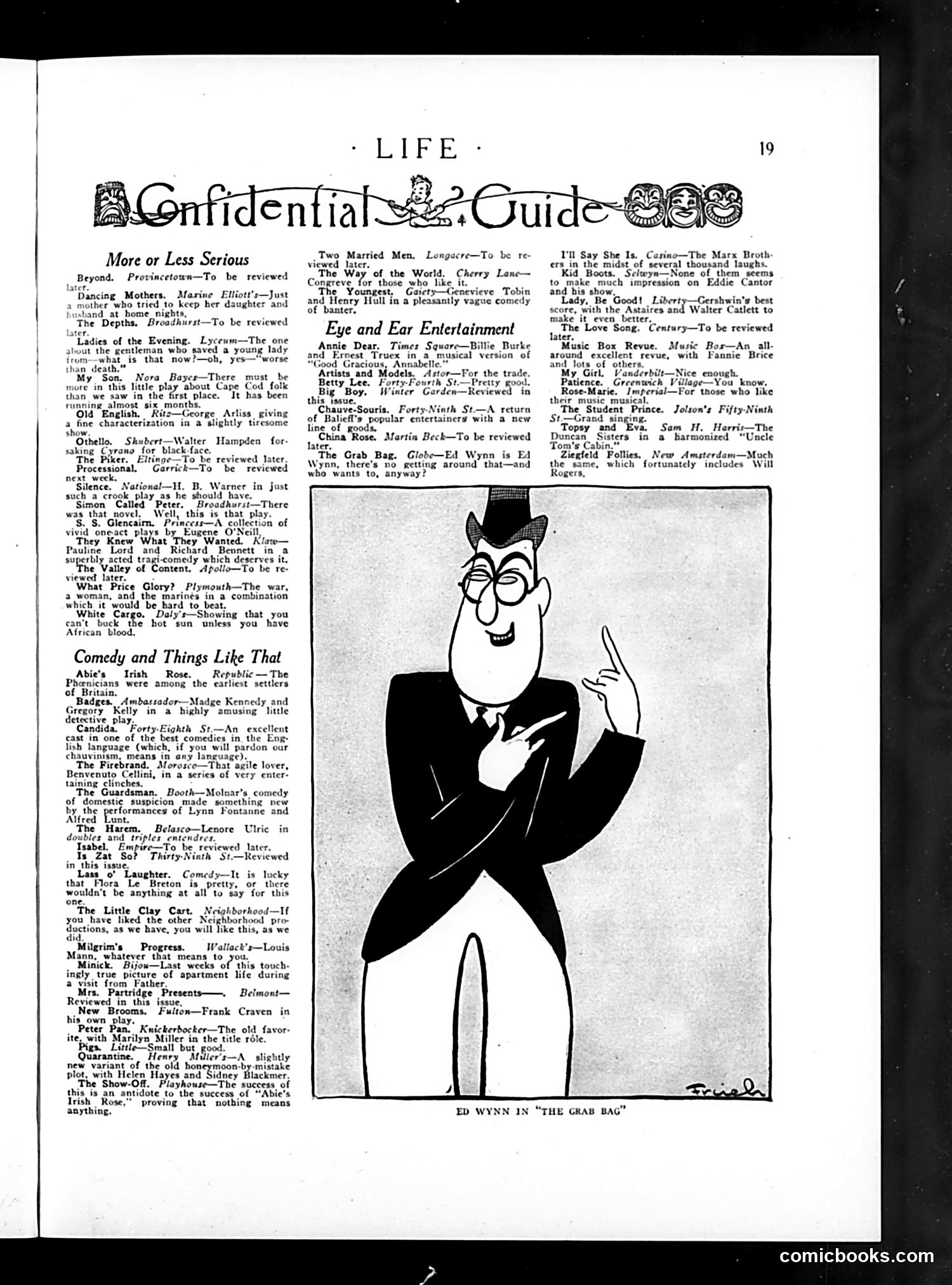
The illustration shows **Ed Wynn**, a famous vaudeville and early stage comedian known for his distinctive appearance and comedic timing. The caricature exaggerates his characteristic features—bulbous nose, wide grin, and theatrical expression—capturing his well-known persona. The cartoon appears in a "Confidential Guide" reviewing Broadway shows and entertainments. Wynn was a major star of the 1920s stage, and this drawing likely promotes or comments on one of his current theatrical performances. The humor relies on visual caricature rather than political satire. The title "The Grab Bag" suggests variety entertainment—appropriate for Wynn's style of broad, physical comedy that dominated American popular theater during this era. The exaggerated features are typical of Life magazine's satirical illustration style, poking affectionate fun at celebrity performers while celebrating their entertainment value.
📄 Transcribed text from this page (OCR, searchable)
Machine-transcribed from the original scan — historical spelling and the odd misread are preserved.
More or Less Serious Beyond, Provincetown—To be reviewed later. Dancing Mothers, . mother who tried to keep her daught husband at home nights, The Depths, Broadhirst—To be reviewed Maxine Elliott’s—Just ‘and Ladies of the Evening. Lycewm—The one the gentleman who saved a young lady what is that now?—oh, yes—"worse than death.” My Son. Nora Baycs—There must be more in this little play ‘about Cape Cod folk than we saw in the first place. It has been running almost’ six months. ; Old English. Rits—George Arliss giving a fine characterization in a slightly tiresome aber show. Othello, Shubert—Walter Hampden for- saking Cyrano for blackface. The Piker. inge—To be reviewed Jater. Processional. Garrick—To be reviewed next week, “ Silence, National—H. B. Warner in just such a crook play as he should have. Simon Called Peter. Broadhurst—There was that novel. Well, this is that play. $. S. Glencaim. Princess—A collection of vivid oneact plays by Eugene O'Neill, They Knew What They Wanted. K/aw— Pauline Lord and Richard Bennett in a superbly acted tragi-comedy which deserves it. he Valley of Content. Apollo—To be re- viewed later. What Price Glory? Plymouth—The war, a woman, and the marines in a combination which it ‘would be hard to beat. White Cargo, Daly's—Showing that you can't buck the hot sun unless you have African blood, Comedy and Things Like That Abie’s Irish Rose. Republic Phernicians were among the earliest s of Britain. Badges.” Ambassador—Madge Kennedy and Gregory Kelly in a highly amusing little detective play. Candida. Forty-Eighth St—An excellent cast in one of the best comedies in the Eng- lish language (which, if you will pardon our chauvinism, means in any language). The Firebrand. Morosco—That agile lover, Benvenuto Celli taining clinches. The Guardsman. Booth—Molnar's comedy of domestic suspicion made something new in a series of very enter- by the performances of Lynn Fontanne and Alfred Lunt. The Harem. Belasco—Lenore Ulric in doubles and triples entendres. Isabel. Empire—To be reviewed later. Is Zat So? Thirty-Ninth St.—Reviewed issue. co Laughter. Comedy—It is lucky Flora Le Breton is pretty, or there wouldn't be anything at all to say for this one. The Little Clay Cart. Neighborhood—It you have liked the other Neighborhood pro- ductions, as we have, you will like this, as we Milgrim's Progress. Wallack’s—Louis Mann, whatever that means to yor | Minick. Bijou—Last weeks of this tovch- ingly true picture of apartment life during a visit from Father. Mrs. Partridge Presents. Belmont— Reviewed in this issue. New Brooms. Fulton—Frank Craven in his own play, * _ Peter Pan. Knickerbocker—The ol ite, with Marilyn Miller in the title 1 Pigs. Littl—Small but. good. Quarantine. Henry Muller's—A_ slightly new variant of the old honeymoon-by-mistake plot, with Helen Hayes and Sidney Blackmer, The Show-Off. Playhouse—The success of this is an antidote to the success of “Abie's Irish Rose,” proving that nothing means anything. favor- Two Married Men. Longecre—To be re- viewed later. The Way of the World, Cherry Lanc— Congreve for those who like, it. The Youngest. Gaicty—Genevieve Tobin and Henry Hull in a pleasantly vague comedy of banter. Eye and Ear Entertainment Annie Dear. Times Square—Billie Burke d Ernest Truex in a musical version of wood Gracious, Annabelle. Artists and Models. Astor—For the trad Betty Lee. Forty-Fourth St.—Pretty go: Big Boy. Winter Garden—Reviewed in this Tasue. Chauve-Souris, Forty-Ninth St—A return of Balieff's popular entertainers with a new line of goods, . paotina Rose. Martin Bech—To be reviewed ater. The Grab Bag. Globe—Ed Wynn is Ed Wynn, there's no getting around that—and who wants to, anyway? ED WYNN IN “THE GRAB BA I'll Say She Is. Casino—The Marx Broth ers in the midst of several thousand laughs. Kid Boots. yn—None of them seems to make much impression on Eddie Cantor and his show, . Lady, Be Good! Liberty—Gershwin's best score, with the Astaires and Walter Catlett to make it even better. ti The Love Song. Century—To be reviewed ater. Music Box Revue. Music Bor—An_ all- around excellent revue, with Fannie Brice and lots of others. My Girl. Vanderbilt—Nice enough. Patience. Greenwich Village—You know. Rose-Marie. Jmperial—For those who like their music musical. The Student Prince. St—Grand singing. Topsy and Eva. Som H. Herris—The Duncan Sisters in a harmonized “Uncle Tom's Cabin.” Ziegfeld Follies. the same, which Rogers, Jolson's jy Ninth New Amsterdam—Much fortunately includes Will comicbooks.com