
Life, 1925-01-29 · page 16 of 37
Life — January 29, 1925 — page 16: what you’re looking at
What you’re looking at
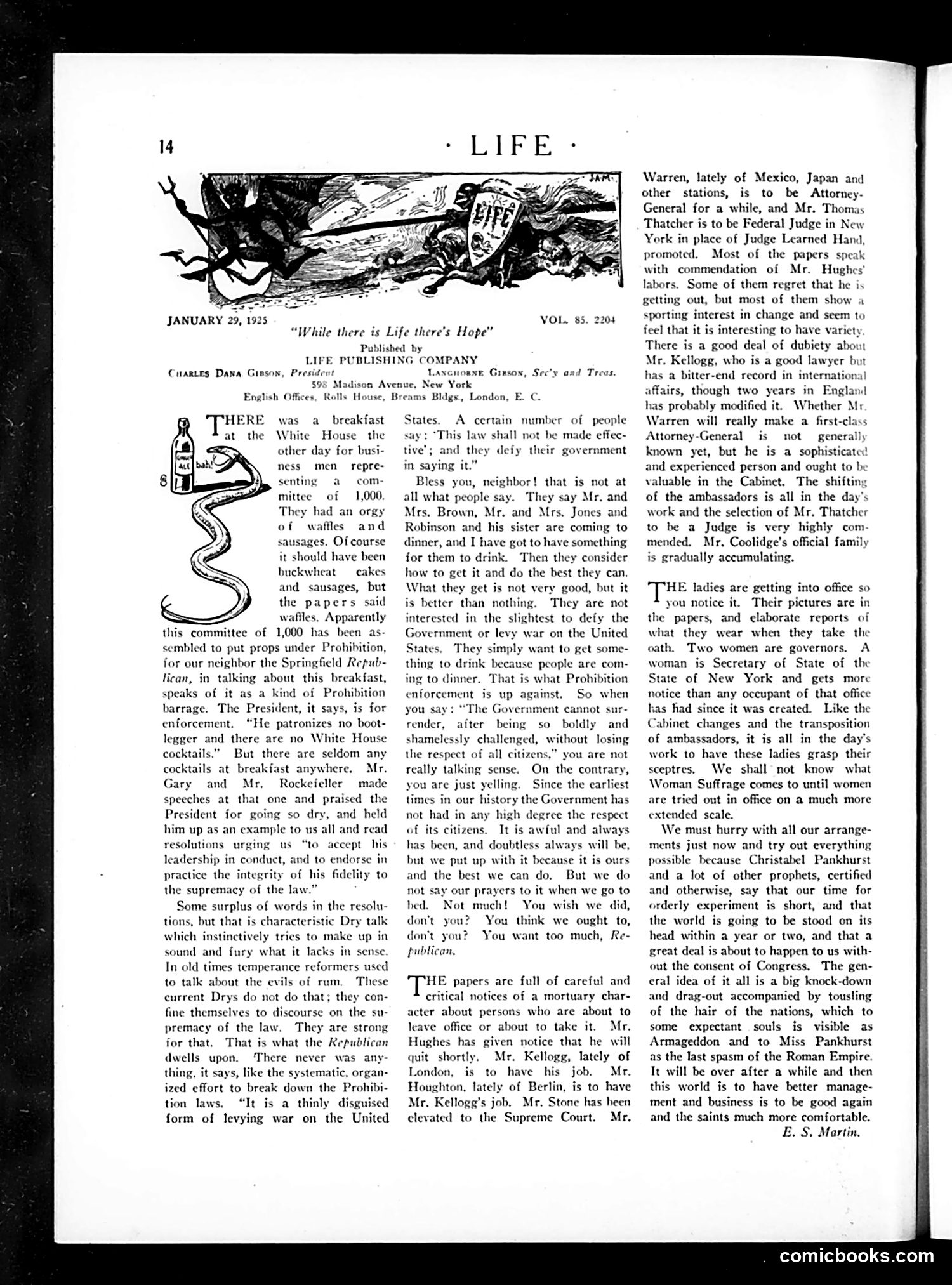
The cartoon's masthead reads "While there is Life there's Hope," with imagery of a snake and bottle, likely referencing Prohibition—the constitutional ban on alcohol (1920-1933). The accompanying article satirizes Prohibition enforcement, mocking government efforts to eliminate alcohol while citizens devise workarounds. The text criticizes both Prohibition advocates and those claiming the government lacks respect by enforcing it. The article also discusses various political appointments and women entering government office, noting the novelty of female governors and other female officials. The overall tone is sardonic, treating Prohibition as an unwinnable enforcement effort while documenting broader shifts in American governance, particularly women's increasing political participation.
📄 Transcribed text from this page (OCR, searchable)
Machine-transcribed from the original scan — historical spelling and the odd misread are preserved.
JANUARY 29, 1925 “While there is Life there's Hope” Published by LIFE PUBLISHING COMPANY Cuartes Dana Ginson, President 598 Madison Avenue, English Offices, HERE at the was a breakfast White House the other day for busi- ness repre- senting a com- mittee of — 1,000. They had an orgy of waffles and sausages. Of course it should have been buckwheat — cakes and sausages, but the papers said wafiles. Apparently this committee of 1,000 has been as- sembled to put props under Prohibition, for our neighbor the Springfield Repub- lican, in talking about this breakfast, speaks of it as a kind of Prohil barrage. The President, it says, is for enforcement. “He patronizes no boot- legger and there are no White House cocktails.” But there are seldom any cocktails at breakiast anywhere. Mr. Gary and Mr. Rockefeller made speeches at that one and praised the President for going so dry, and held him up as an example to us all and read resolutions urging us “to accept his leadership in conduct, and to endorse in practice the integrity of his fidelity to the supremacy of the law.” Some surplus of words in the resolu- tions, but that is characteristic Dry talk which instinctively tries to make up in sound and fury what it lacks in sense. In old times temperance reformers used to talk about the evils of rum. These current Drys do not do that; they con- fine themselves to discourse on the su- premacy of the law. They are strong for that. That is what the Republican dwells upon. There never was any- thing, it says, like the systematic, organ- ized effort to break down the Prohibi- tion laws. “It is a thinly disguised form of levying war on the United men Rolls House, Breams Bldgs. ANcHoRnE Grrsox, Sec’y and Treas. New York London, E. C. States. A certain number of people his law shall not be made effec- y defy their government in saying it.” Bless you, neighbor! that is not at all what people say. They say Mr. and Mrs. Brown, Mr. and Mrs. Jones and Robinson and his sister are coming to dinner, and I have got to have something for them to drink, Then they consider how to get it and do the best they can. What they get is not very good, but it is better than nothing. They are not interested in the slightest to defy the Government or levy war on the United States. They simply want to get some- thing to drink because people are com- ing to dinner. That is what Prohibition enforcement is up against. you say he Government cannot sur- render, after being so boldly and shamelessly challenged, without losing the respect of all citizens,” you are not really talking sense. On the contrary, you are just yelling. Since the earliest times in our history the Government has not had in any high degree the respect of its citizens. It is awful and alwa: has been, and doubtless always will be, but we put up with it because it is ours and the best we can do. But we do not say our pray to it when we go to hed. Not much! You wish we did, don’t you? You think we ought to, don't you? You want too much, Re- publican, So when HE papers are full of careful and critical notices of a mortuary char- acter about persons who are about to leave office or about to take it. Mr. Hughes has given notice that he will quit shortly. Mr. Kellogg, lately of London, is to have his job. Mr. Houghton, lately of Berlin, is to have Mr. Kellogg's job. Mr. Stone has heen elevated to the Supreme Court. Mr. Warren, lately of Mexico, Japan and other stations, is to be Attorney- General for a while, and Mr. Thomas Thatcher is to be Federal Judge in New York in place of Judge Learned Hand, promoted. Most of the papers speak with commendation of Mr. Hughes’ labors. Some of them regret that he is getting out, but most of them show a sporting interest in change and seem to feel that it is interesting to have variety There is a good deal of dubiety about Mr. Kellogg, who is a good lawyer but has a bitter-end record in international affairs, though two years in glan has probably modified it. Whether Mr Warren will really make a first-class Attorney-General is not generally known yet, but he is a sophisticated and experienced person and ought to be valuable in the Cabinet. The shifting of the ambassadors is all in the day's work and the selection of Mr. Thatcher to be a Judge is very highly com- mended. Mr. Coolidge’s official family is gradually accumulating. HE ladies are getting into office so ou notice it. Their pictures are in the papers, and elaborate reports of what they wear when they take the oath. Two women are governors. A woman is Secretary of State of the State of New York and gets more notice than any occupant of that office has had since it was created. Like the Cabinet changes and the transposition of ambassadors, it is all in the day's work to have these ladies grasp their sceptres. We shall not know what Woman Suffrage comes to until women are tried out in office on a much more extended scale. We must hurry with all our arrange- ments just now and try out everything possible because Christabel Pankhurst and a lot of other prophets, certified and otherwise, say that our time for orderly experiment is short, and that the world is going to be stood on its head within a year or two, and that a great deal is about to happen to us with- out the consent of Congress. The gen- eral idea of it all is a big knock-down and drag-out accompanied by tousling of the hair of the nations, which to some expectant souls is visible as Armageddon and to Miss Pankhurst as the last spasm of the Roman Empire. It will be over after a while and then this world is to have better manage- ment and business is to be good again and the saints much more comfortable. E. S. Martin. comicbooks.com