
Life, 1925-01-29 · page 28 of 37
Life — January 29, 1925 — page 28: what you’re looking at
What you’re looking at
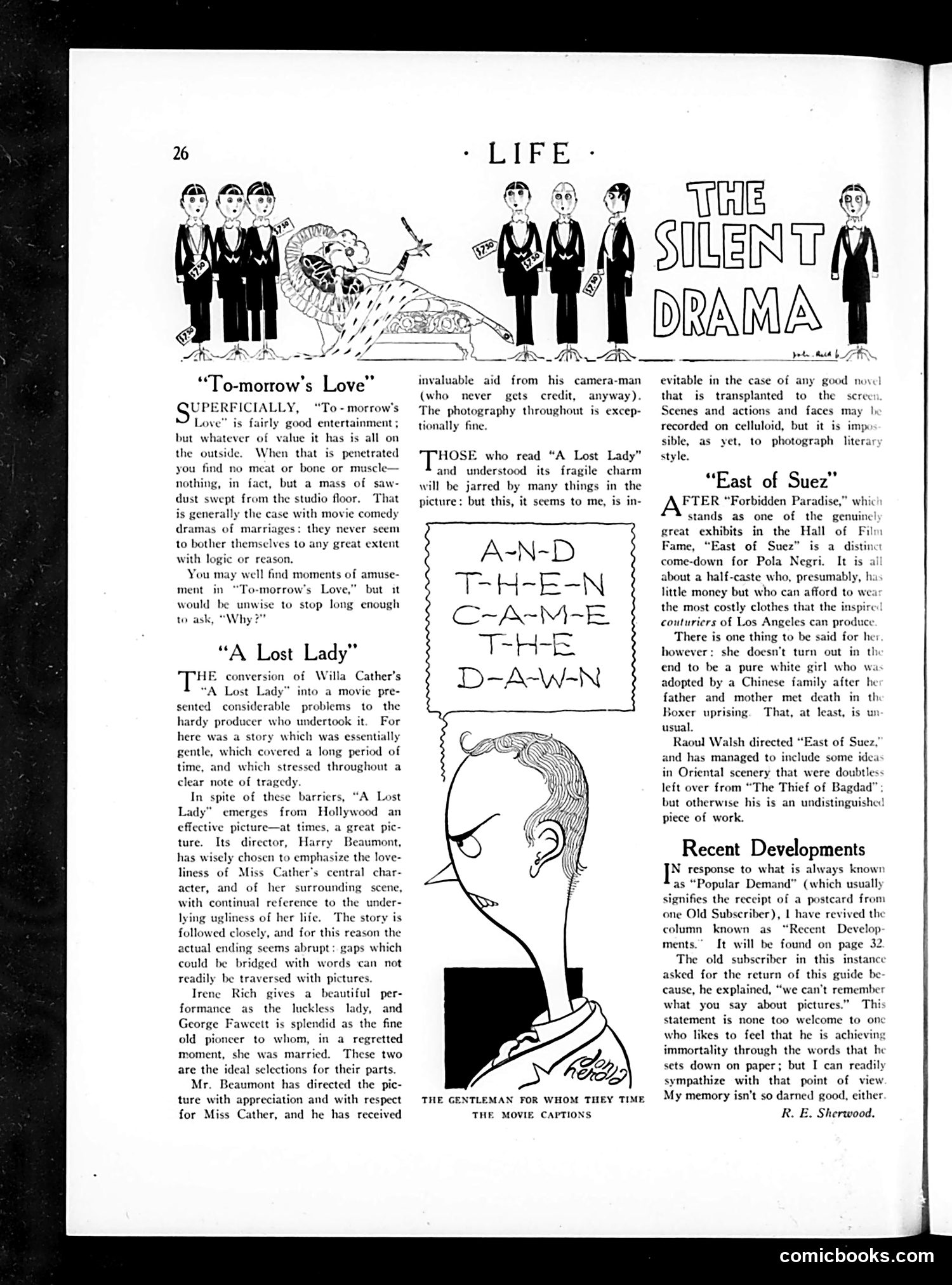
This page contains three film reviews from *Life* magazine's arts section, showcasing early 1920s cinema criticism. **"To-morrow's Love"** receives dismissive treatment—the reviewer criticizes it as superficial entertainment with no substance, comparing its hollow plot to "sawdust swept from the studio floor." The complaint concerns marriage comedies that ignore logic. **"A Lost Lady"** (adapted from Willa Cather's novel) is praised more favorably. The reviewer appreciates director Harry Beaumont's emphasis on visual beauty while capturing the story's underlying tragedy. Actors Irene Rich and George Fawcett receive commendation. However, the critic notes an inherent limitation: cinema cannot adequately photograph "literary style"—a recognition that film adaptation inevitably loses textual nuance. **"East of Suez"** featuring actress Pola Negri is criticized as disappointing, particularly following her previous success in "Forbidden Paradise." The reviewer mocks the film's clichéd orientalism and its predictable plot mechanics. The cartoon "The Silent Drama" illustrates cinema's challenge: translating literature to screen requires visual rather than verbal storytelling.
📄 Transcribed text from this page (OCR, searchable)
Machine-transcribed from the original scan — historical spelling and the odd misread are preserved.
“To-morrow’s Love” UPERFICIALLY, “To - morrow’s Love” is fairly good entertainment ; but whatever of value it has is all on the outside. When that is penetrated you find no meat or bone or muscle— nothing, in fact, but a mass of saw- dust swept from the studio floor, That is generally the case with movie comedy dramas of marriages: they never seem to bother themselves to any great extent with logic or reason. You ma. ment in well find moments of amuse- Love,” but it would be unwise to stop long enough to ask, “Why? “A Lost Lady” Willa Cather’s into a movie pre- sented considerable problems to the hardy producer who undertook it. For here was a story which was essentially gentle, which covered a long period of time, and which stressed throughout a clear note of tragedy. In spite of these barriers, “A Lost from Hollywood an effective picture—at times, a great pic- ture. Its director, Beaumont, has wisely chosen to emphasize the love- liness of Miss Cather’s central char- acter, and of her surrounding scene, with continual reference to the under- lying ugliness of her life. followed closely, and for this reason the actual ending scems abrupt: gaps which could be bridged with words can not readily be traversed with pictures. Irene Rich gives a beautiful per- formance as the luckless lady, and George Fawcett is splendid as the fine old pioneer to whom, in a regretted moment, she was married. These two are the ideal selections for their parts. Mr. Beaumont has directed the pic- ture with appreciation and with respect for Miss Cather, and he has received ‘o-morrow’s HE conversion of Lost Lady” Lady" emerges Harry The story is “1LSNENE :* 4 >} " f a, NOR |e invaluable aid from his camera-man (who never gets credit, anyway). The photography throughout is excep- tionally fine. HOSE who read “A Lost Lady” and understood its fragile charm will be jarred by many things in the picture: but this, it seems to me, is in- THE GENTLEMAN FOR WHOM THEY TIME THE MOVIE CAPTIONS AY — TE © SIUENT DRAMA | pete ip evitable in the case of any good 1 that is transplanted to the scree Scenes and actions and faces may | recorded on celluloid, but it is imp: sible, as yet, to photograph literary style. “East of Suez” A FTER “Forbidden Paradise,” whic stands as one of the genuine! great exhibits in the Hall of Fil Fame, “East of Suez” is a distinc come-down for Pola Negri. It is a about a half-caste who, presumably, ha little money but who can afford to wea the most costly clothes that the inspire couturiers of Los Angeles can produce There is one thing to be said for he however: she doesn’t turn out in the end to be a pure white girl who wa adopted by a Chinese family after he father and mother met death in th Boxer uprising. That, at least, is un usual. Raoul Walsh directed “East of Suez,’ and has managed to include some idea in Oriental scenery that were doubtless left over from “The Thief of Bagdad”; but otherwise his is an undistinguished piece of work. Recent Developments N response to what is always known as “Popular Demand” (which usually signifies the receipt of a postcard from one Old Subscriber), 1 have revived the column known as “Recent Develop ments.” It will be found on page 32 The old subscriber in this instance asked for the return of this guide be- cause, he explained, “we can't remember what you say about pictures.” This statement is none too welcome to onc who likes to feel that he is achiev immortality through the words that he sets down on paper; but I can readily sympathize with that point of view. My memory isn't so darned good, either R. E. Sherwood. comicbooks.com