
A complete issue · 36 pages · 1924
Life — September 18, 1924
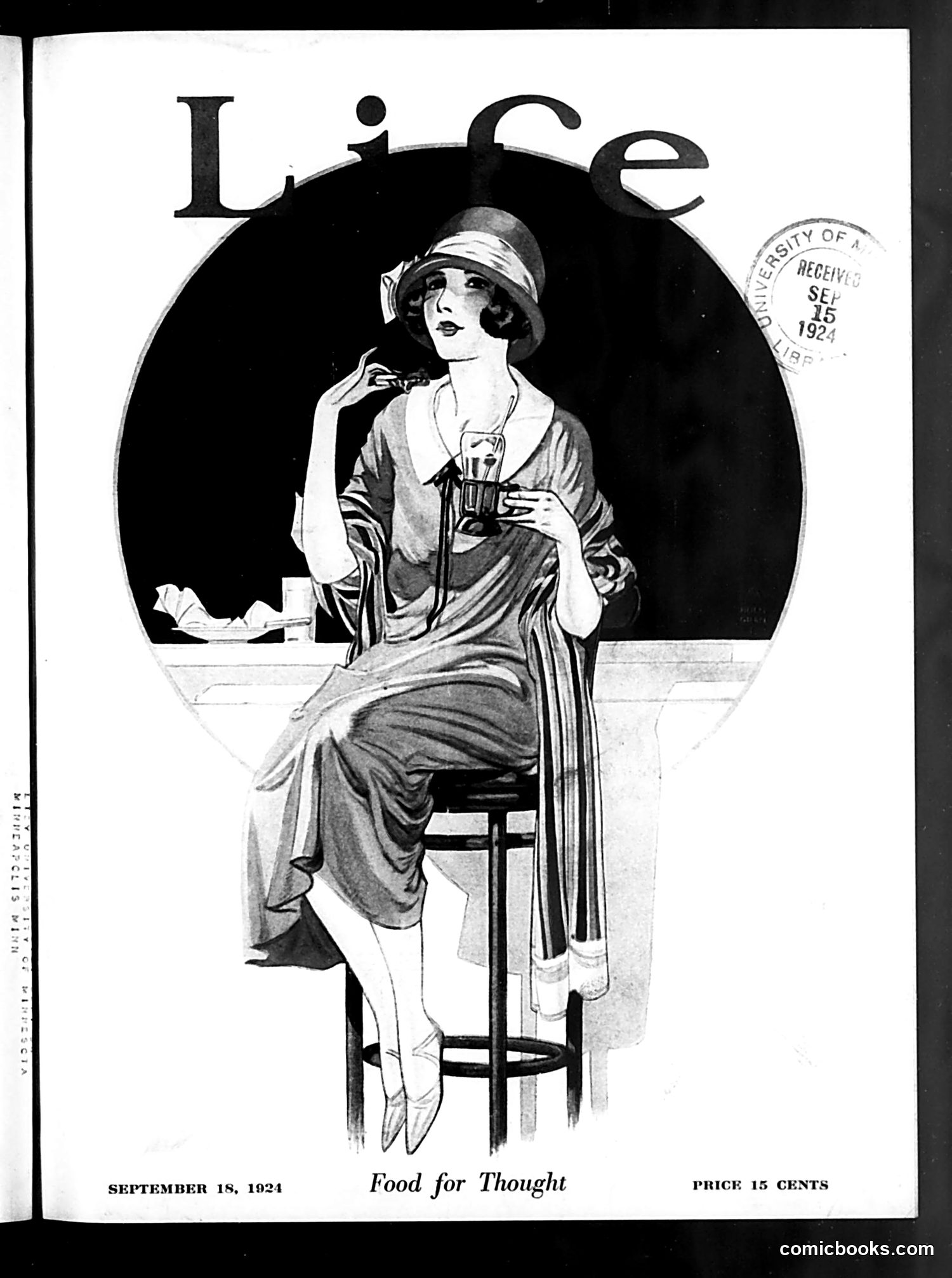
This is a *Life* magazine cover titled "Food for Thought," priced at 15 cents. It depicts a fashionable woman of the 1920s seated at what appears to be a vanity or dressing table, wearing a draped, flowing dress and a cloche hat—typical flapper fashion of the era. She's holding a cigarette or similar item, gazing at her reflection in a large circular mirror. The satire likely targets the "New Woman" of the 1920s: the liberated, style-conscious flapper who rejected Victorian conventions. The phrase "Food for Thought" suggests commentary on modern women's priorities—appearance, fashion, and leisure over domestic or intellectual pursuits. The self-absorbed pose reinforces the era's anxious cultural debates about changing gender roles and youth culture during the Jazz Age.
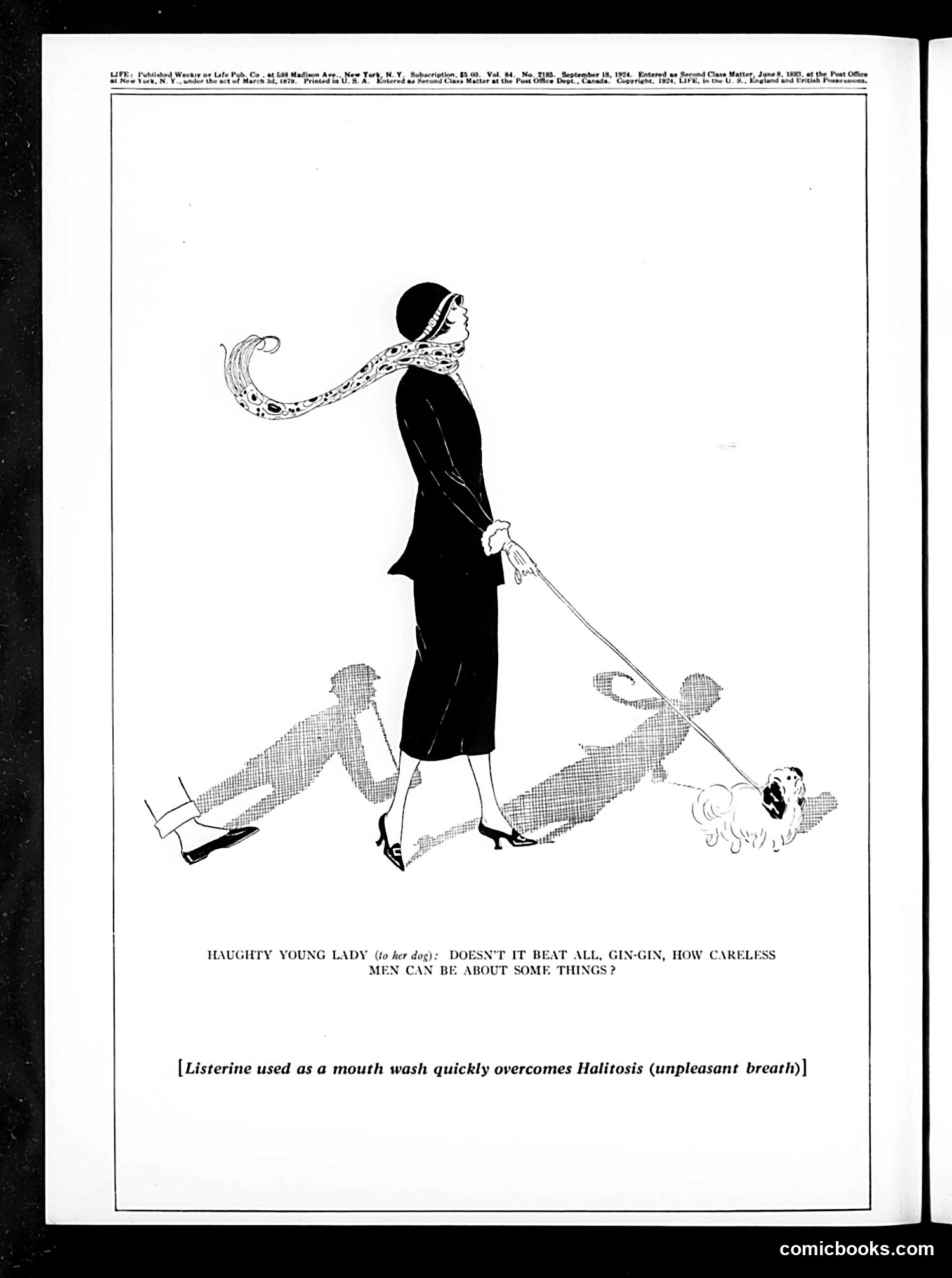
This is a vintage advertisement for Listerine mouthwash disguised as satirical commentary. The illustration depicts a fashionable young woman from approximately the 1920s-30s, styled elegantly with a cloche hat and long scarf, walking a small dog while being pulled along by two men (shown in shadow/crosshatch). The caption quotes the "haughty young lady" making a sarcastic remark about men's carelessness regarding "some things"—a euphemistic reference to personal hygiene. The advertisement then explains that Listerine solves "halitosis" (bad breath), implying the woman's romantic prospects depend on men using the product. This reflects period advertising that used shame and social embarrassment as marketing tactics, particularly targeting women's anxieties about attracting men.

This is **not a cartoon or satire page**, but rather a **straightforward advertisement** for Hupmobile automobiles, published in *Life* magazine. The ad showcases internal car components (particularly a "Counter Shaft Gear") to educate consumers about mechanical quality and engineering. The central message—"Invisible Car-Costs Mean Low Owner-Costs"—argues that superior internal construction, though unseen, justifies the Hupmobile's price and reduces long-term maintenance expenses. The ad targets educated buyers by explaining technical differences between vehicles and encouraging dealership visits to learn "why one car costs more than another." It's an early example of value-based marketing, positioning Hupmobile as a quality investment rather than simply a cheap purchase. There is no political satire or social commentary here.
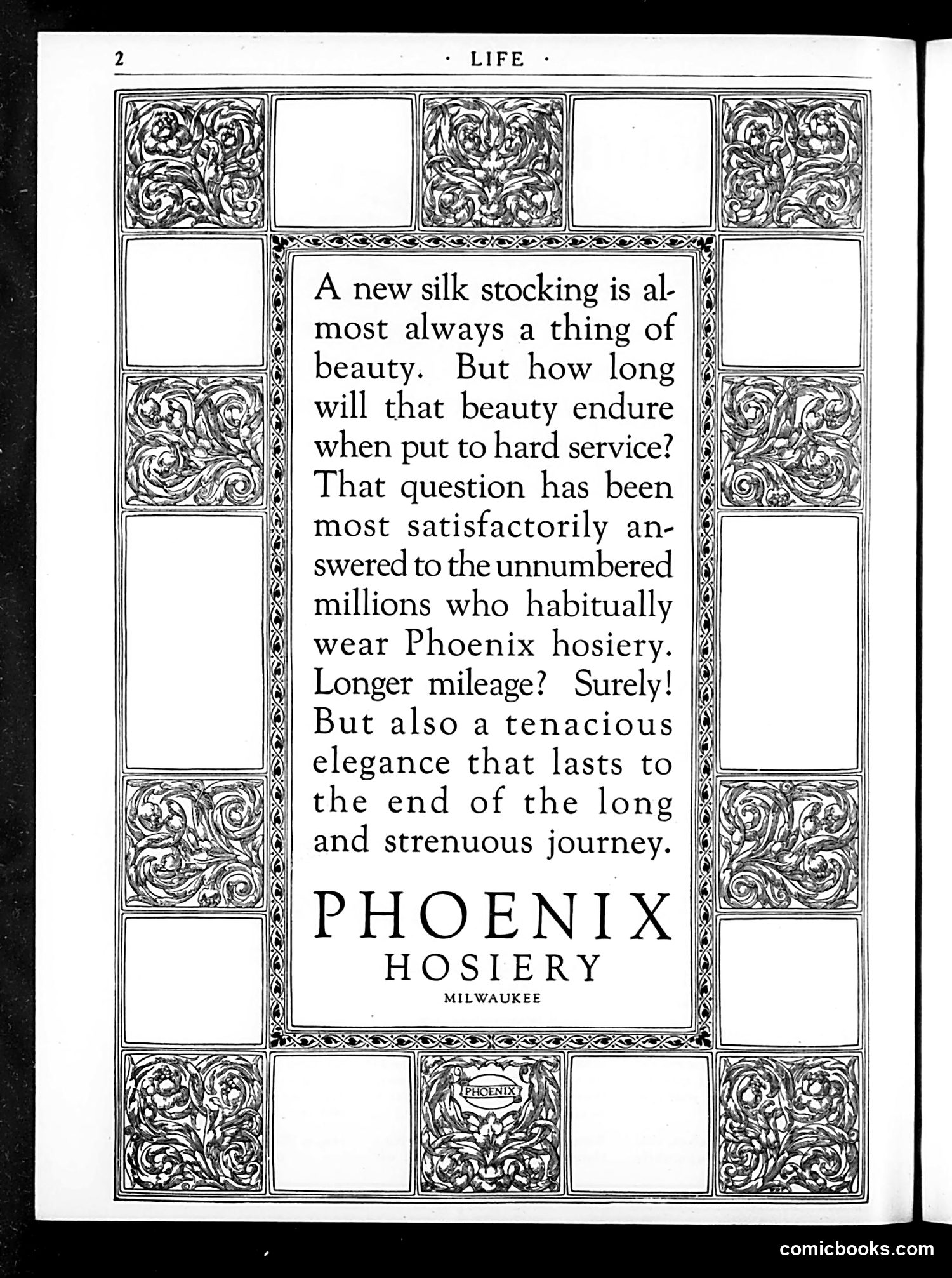
This page is primarily an **advertisement**, not satire or political commentary. It's a vintage ad for Phoenix Hosiery from Milwaukee promoting silk stockings. The ad uses ornamental Art Deco-style borders typical of early-20th-century magazine design. The text makes a straightforward sales pitch: silk stockings are beautiful but need durability. Phoenix brand allegedly offers both—longer wear combined with "tenacious elegance." The claim that "unnumbered millions" wear Phoenix hosiery is typical marketing hyperbole. There's no cartoon or caricature present; the ornamental frames are purely decorative design elements. This reflects the era when hosiery was a significant fashion concern and luxury item for women.
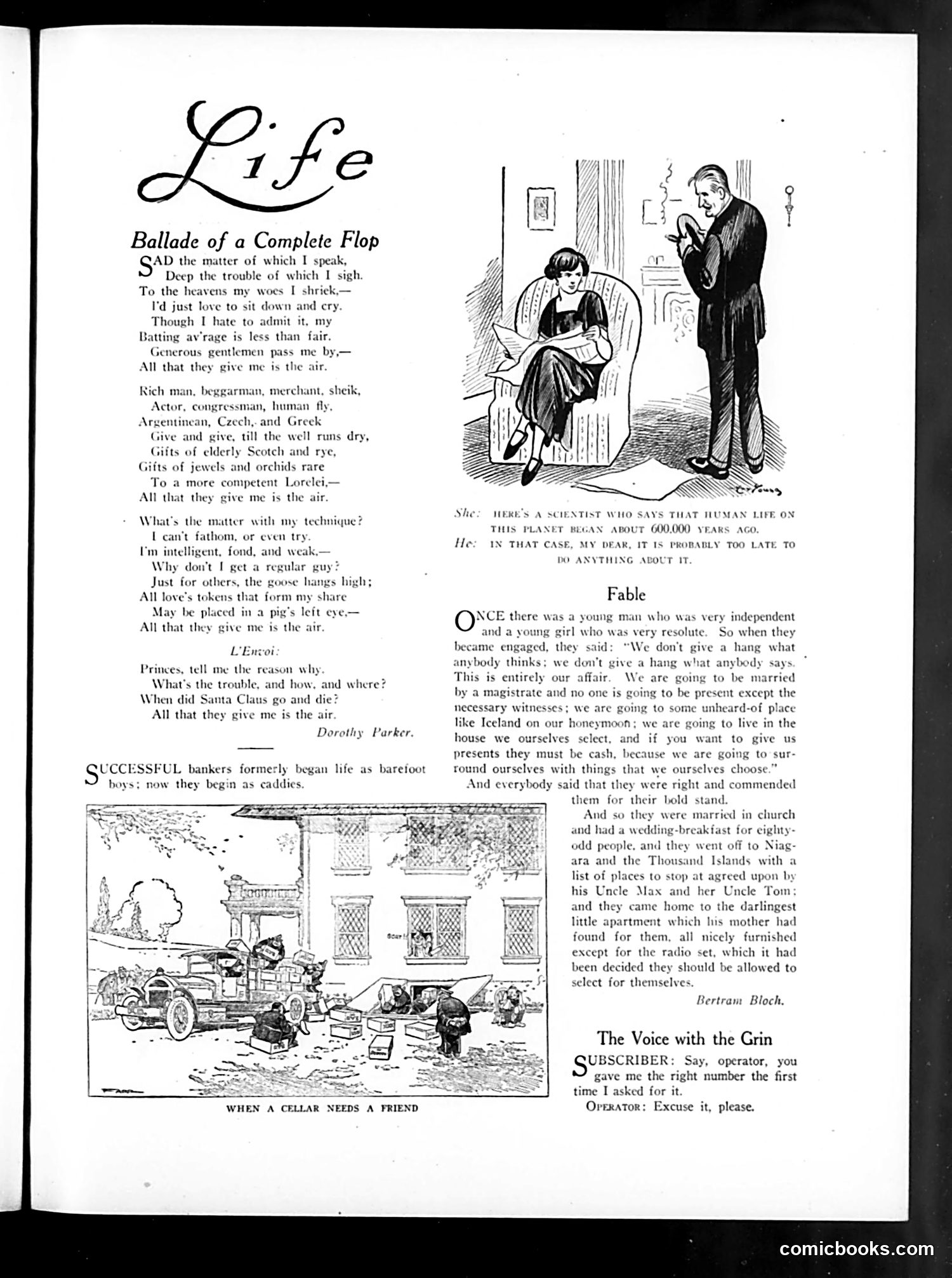
This page contains three separate humorous pieces: 1. **"Ballade of a Complete Flop"** (left): A poem by Dorothy Parker lamenting creative failure—the speaker claims to have given everything to their work but received only "air" in return. It satirizes artistic struggle and rejection. 2. **"Fable"** (center-right): A story by Bertram Bloch mocking a young couple's pretentious, independent approach to marriage. They reject conventional advice and select their own furnishings, only to end up with mismatched, chaotic décor—satirizing youthful arrogance. 3. **"When a Cellar Needs a Friend"** (bottom): A cartoon with caption about bankers, suggesting they historically began as barefoot boys but now start as "caddies"—likely satirizing class mobility or the commercialization of banking. The page represents Life's typical satirical commentary on contemporary social attitudes and human folly.
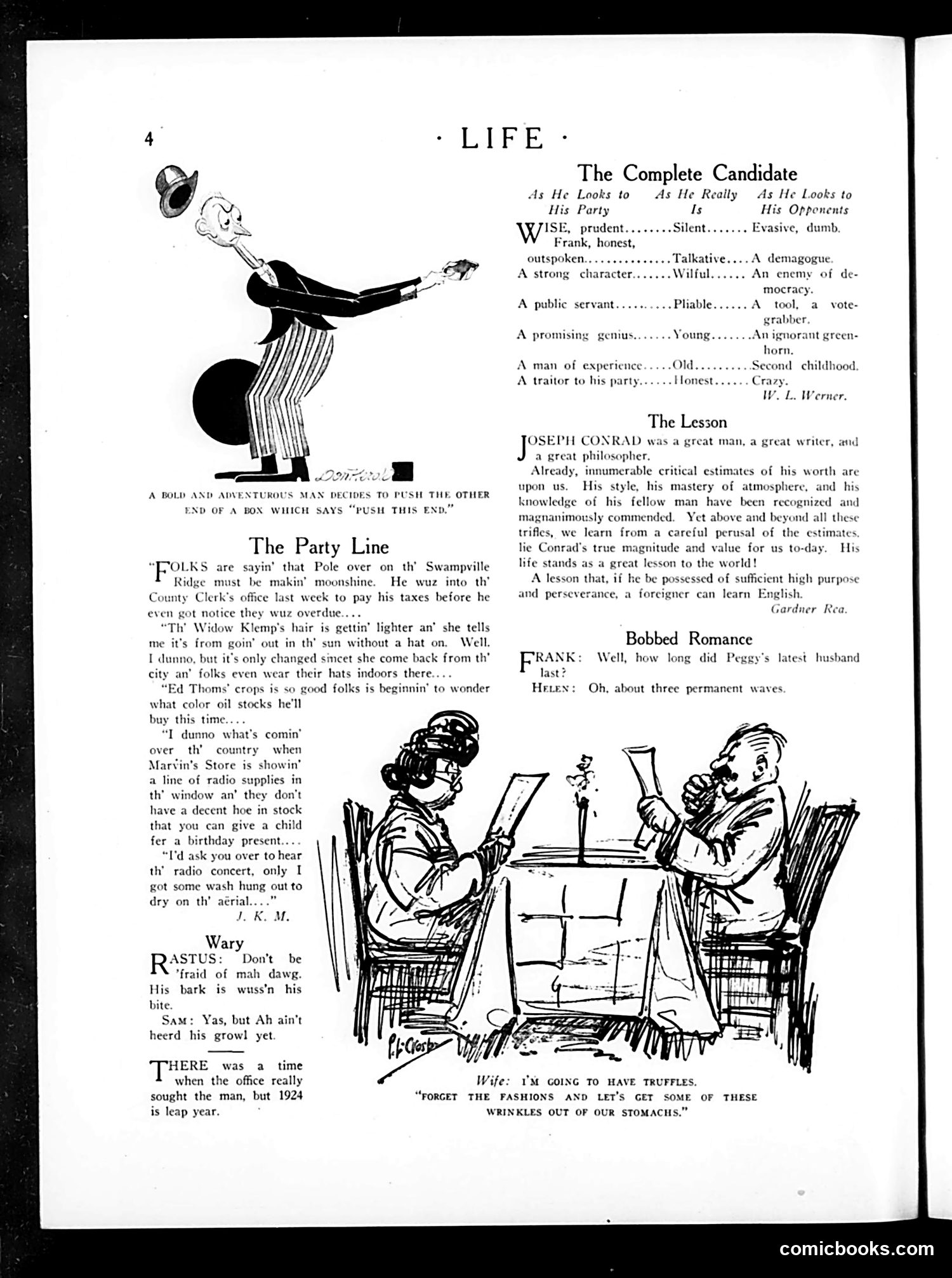
This page contains three separate satirical pieces from *Life* magazine: 1. **Top cartoon**: Shows a man in striped pants pushing a box labeled "PUSH THIS END"—a visual gag about following obvious instructions backward or counterintuitively. 2. **"The Party Line"**: A dialect humor piece mocking rural or working-class speech patterns. It jokes about local gossip, financial troubles, and radio entertainment—typical 1920s small-town concerns. The humor relies on phonetic misspellings ("dunno," "comin'") to satirize non-standard English. 3. **"Bobbed Romance"**: A cartoon satirizing modern marriage. The wife mentions "three permanent waves" while discussing her husband's brief duration—implying women invested more in their appearance than in relationship stability, a common 1920s joke about changing gender dynamics and "bobbed" (short-haired) modern women.
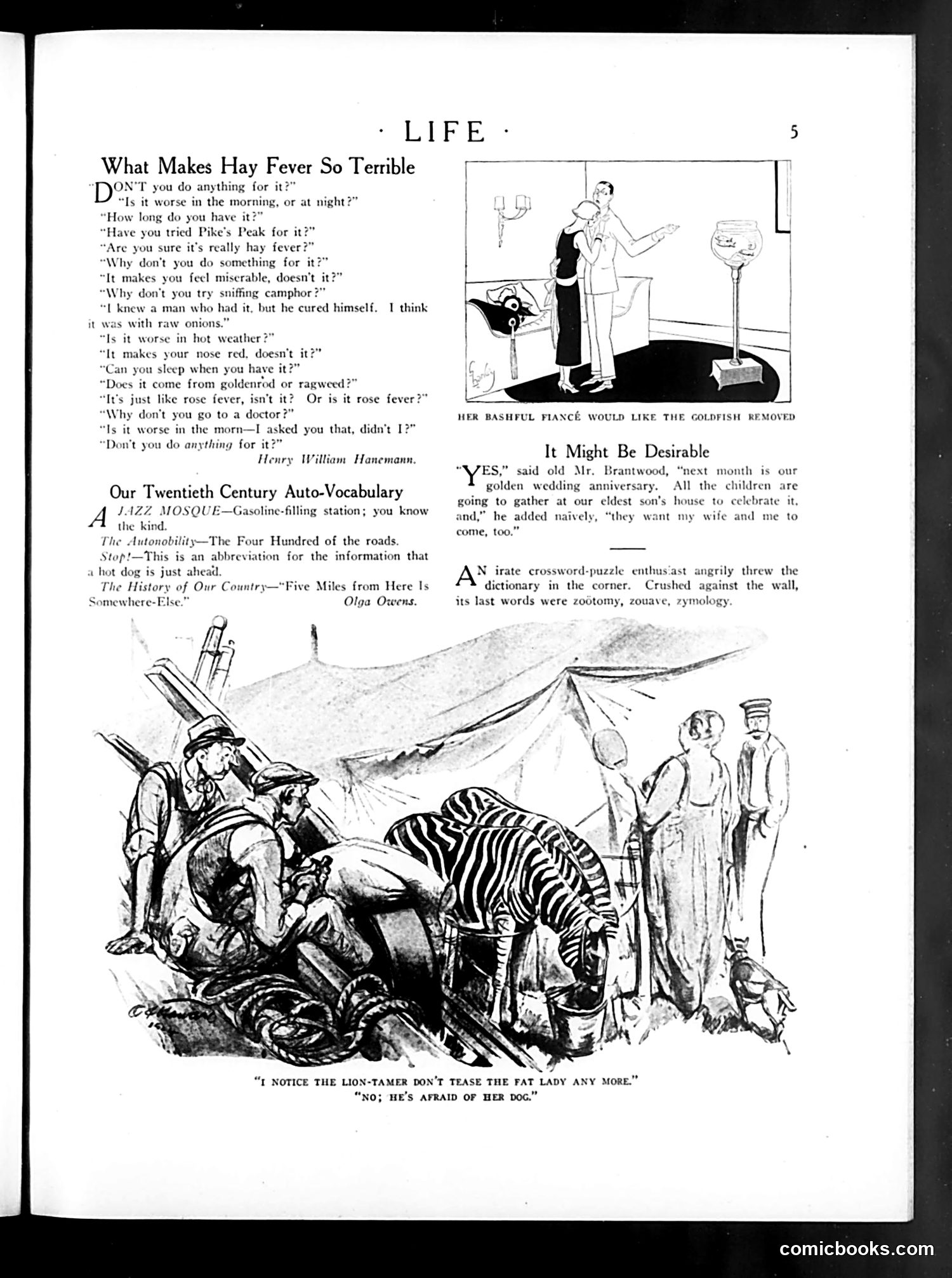
**Top cartoon** ("Her Bashful Fiancé Would Like the Goldfish Removed"): A social comedy about an awkward suitor. The joke relies on the absurd notion that a nervous fiancé would be bothered by a goldfish's presence during an intimate moment—suggesting his anxiety is so extreme he finds fault with trivial details rather than addressing the real situation. **Bottom cartoon** (circus scene with zebra): Depicts a lion-tamer and circus performers with a zebra. The caption reveals the humor: the lion-tamer no longer teases a "fat lady" because he fears her dog—inverting the expected power dynamic. The joke plays on circus sideshow stereotypes while suggesting even intimidating performers have something to fear. Both represent typical early-20th-century satirical humor about social awkwardness and absurd reversals.
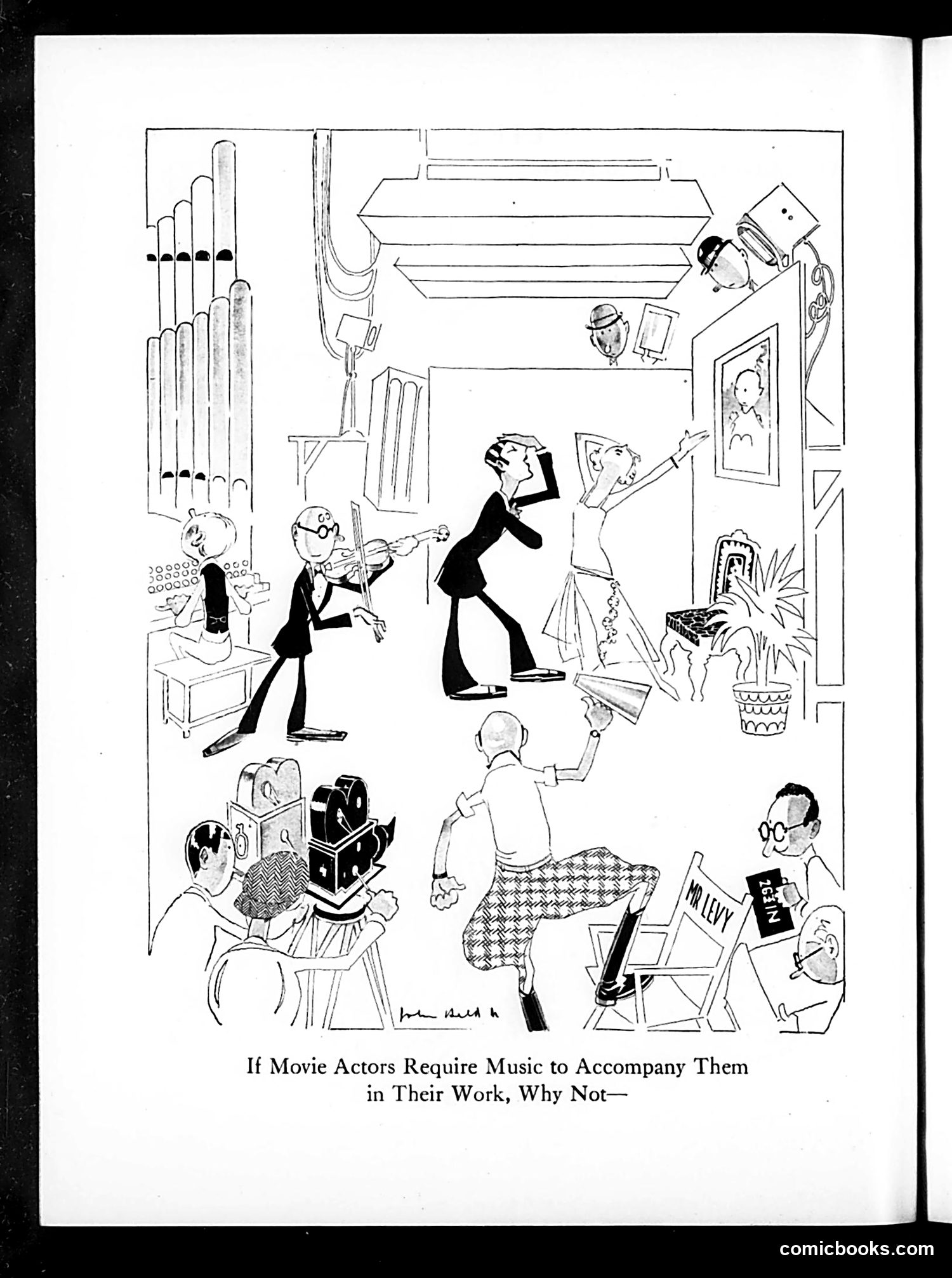
This satirical cartoon mocks the practice of adding live musical accompaniment to silent films. The caption asks: "If Movie Actors Require Music to Accompany Them in Their Work, Why Not—" The joke shows everyday people performing mundane activities (working at desks, operating machinery, dancing, reading) while musicians play alongside them—a violinist, conductor, and pianist provide constant musical accompaniment to their ordinary tasks. The satire suggests that if silent film actors need orchestral accompaniment to make their performances engaging, then logically all human activities should have live musical scores. It's absurdist humor critiquing the perceived necessity of music in silent cinema by extending the concept to ridiculous extremes. This reflects early cinema practices when live orchestras accompanied film screenings.
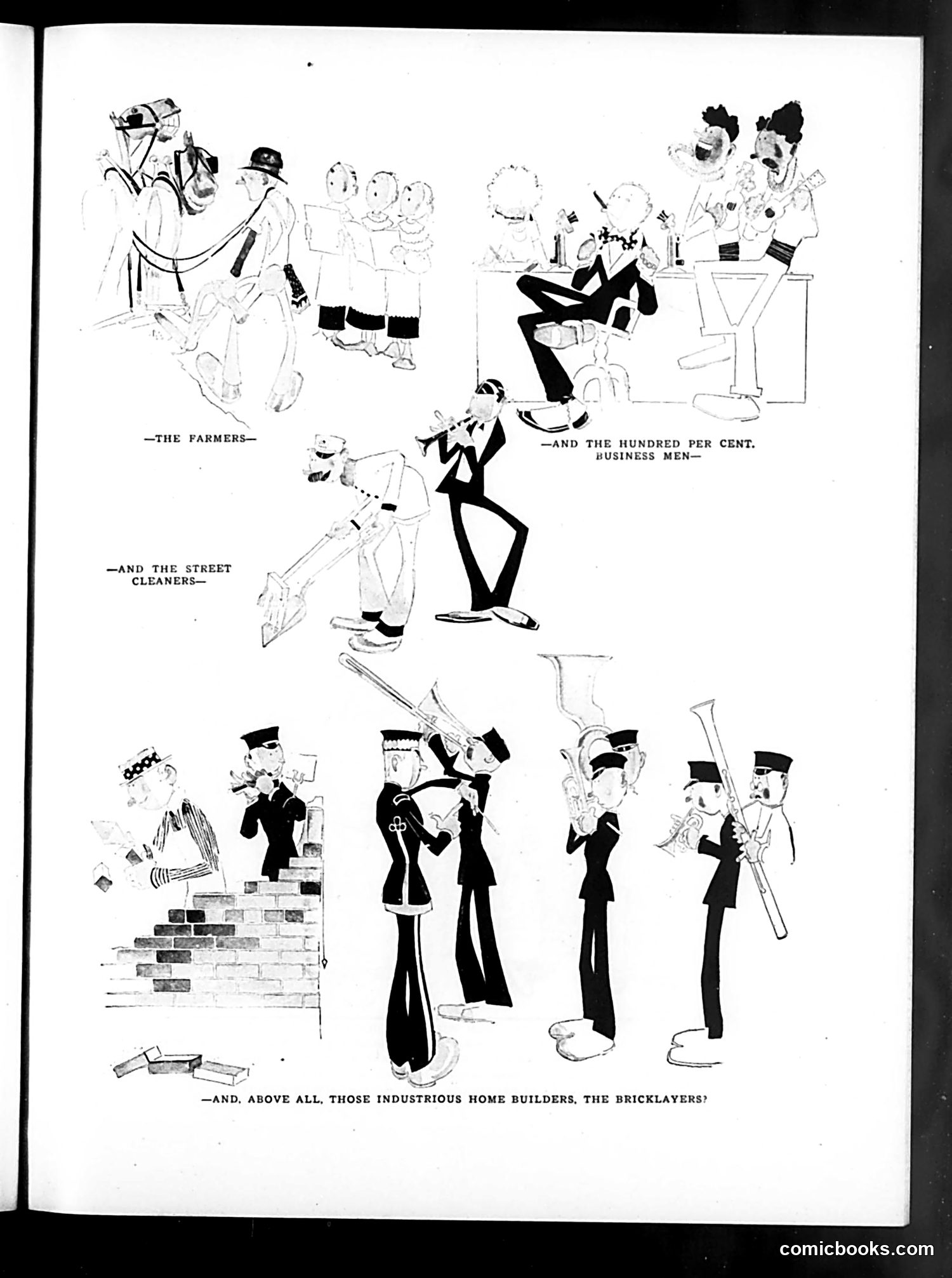
This satirical page celebrates different occupational groups through caricatured illustrations. The layout identifies: - **"The Farmers"** (top left): Rural workers with produce - **"And the Street Cleaners"** (bottom left): Labor workers with brooms - **"And the Hundred Per Cent. Business Men"** (top right): Well-dressed figures at a table, appearing to celebrate or conduct business - **"And, Above All, Those Industrious Home Builders, The Bricklayers"** (bottom): Construction workers in formal dress holding tools The satire appears to mock the pretensions of "hundred per cent. business men" by elevating working-class professions (farmers, cleaners, bricklayers) as worthy of equal or superior respect. The contrast between formal attire and manual labor suggests irony about who truly contributes to society. This reflects early 20th-century class commentary typical of *Life* magazine's satirical tradition.
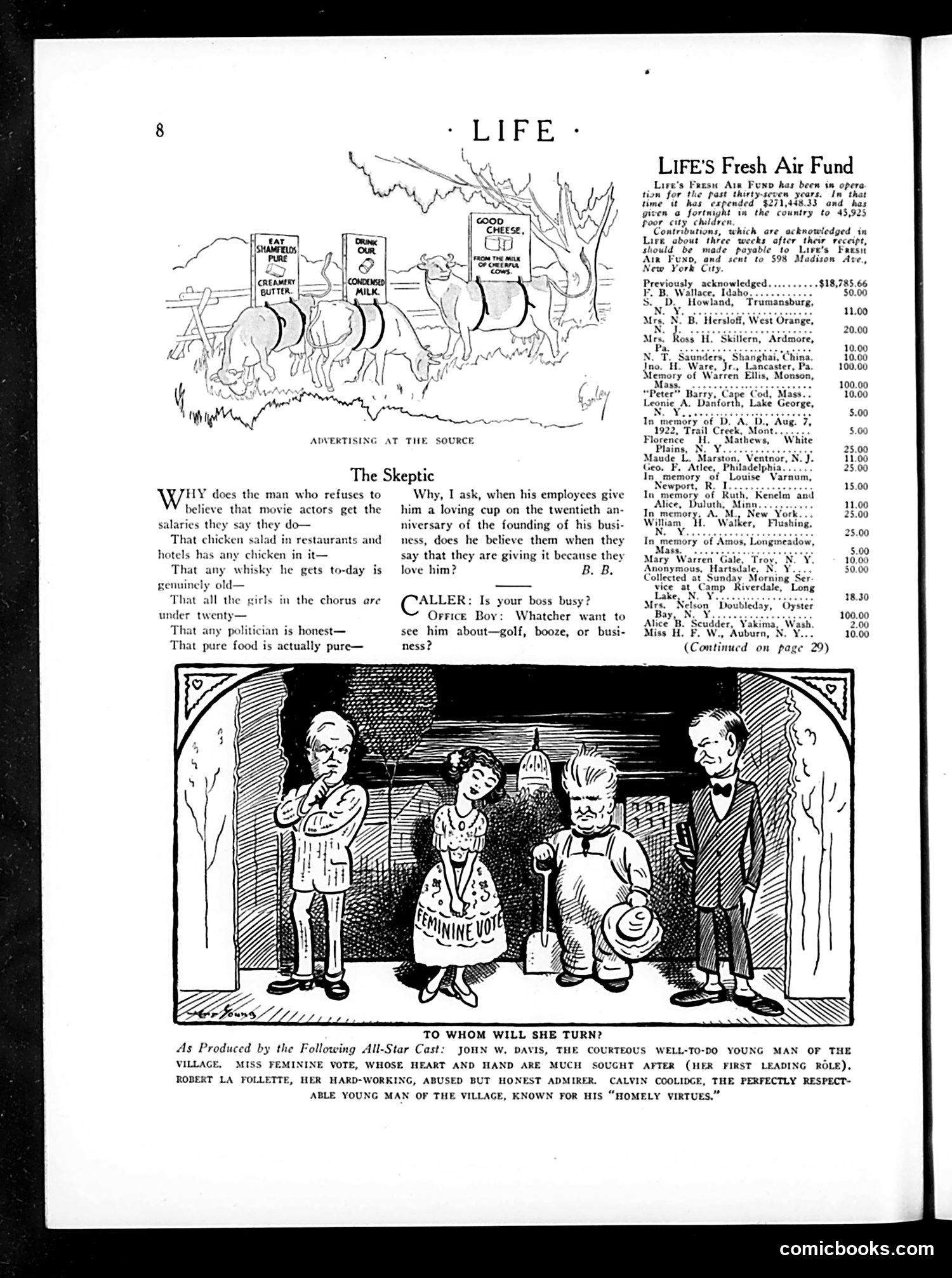
This page contains two distinct pieces: **"The Skeptic"** - A humorous poem listing contradictions in human behavior: people disbelieve movie actors' charity claims yet believe restaurants' food quality claims; they doubt politicians' honesty but trust that expensive whisky is genuine. **"To Whom Will She Turn?"** - A cartoon illustration with caption about a village drama, featuring "Feminine Vote" (a woman character marked with a suffrage sash) flanked by male suitors, presumably representing competing political interests vying for women's votes. This clearly references women's suffrage activism. The page also contains **"Life's Fresh Air Fund,"** a charitable donation list acknowledging contributions to what appears to be a health/wellness initiative. The content reflects early-20th-century American concerns: suffrage rights, consumer skepticism, and charitable giving.
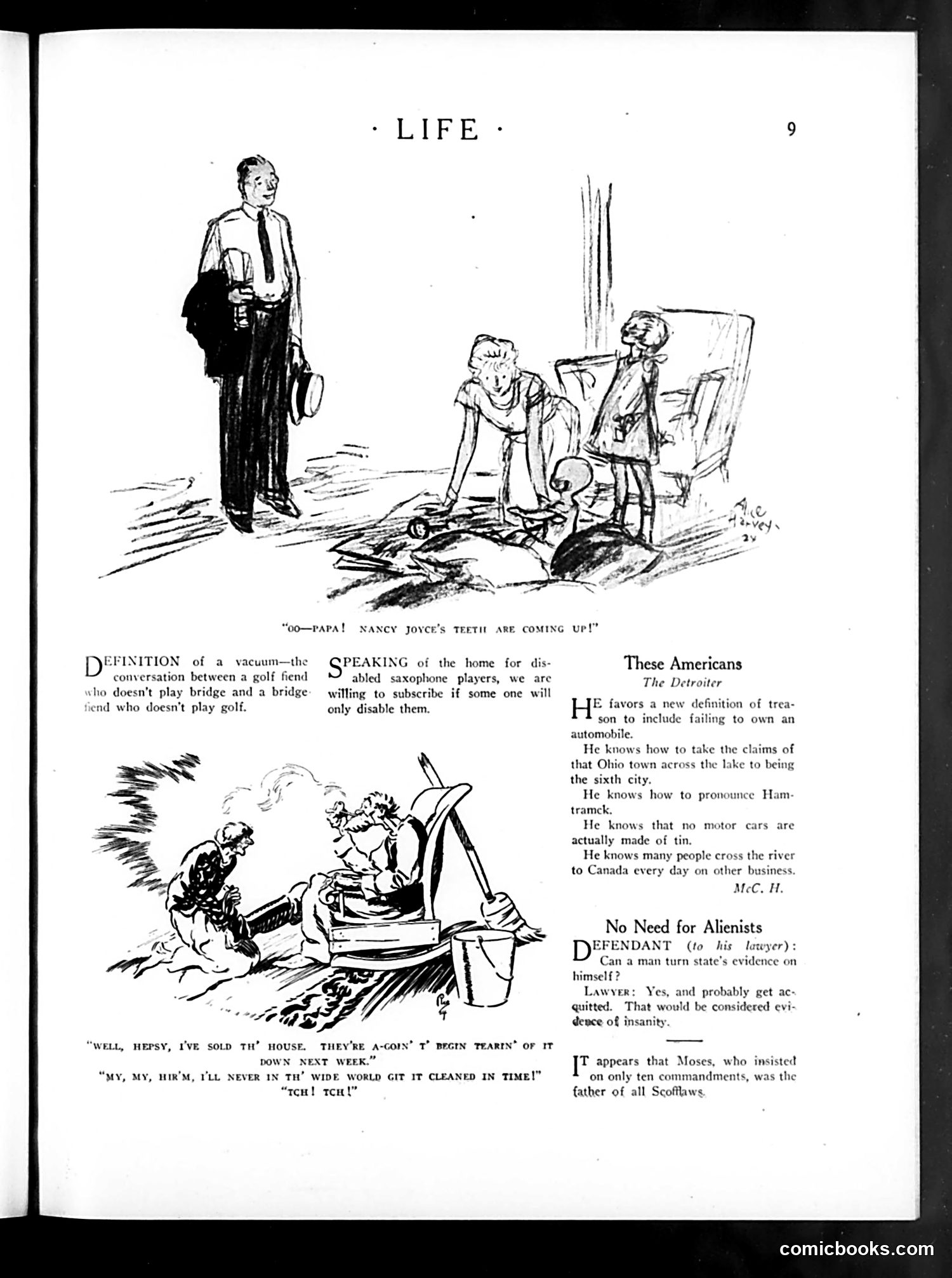
This page contains three separate satirical pieces from Life magazine: **Top cartoon**: Shows a well-dressed man observing children playing with toys. The caption "Go, Papa! Nancy Joyce's teeth are coming up!" is a joke about baby teeth emerging—the man appears to be their father witnessing child development. **Middle cartoon**: Depicts someone moving furniture with the caption about selling a house and beginning to cry about cleaning it. This mocks the exhausting reality of selling homes—the emotional and practical difficulties beneath the transaction. **Text sections**: "These Americans" describes an Ohio resident's automotive knowledge; "No Need for Alienists" presents a lawyer's exchange about evidence and insanity; the final note about Moses and commandments is a biblical reference. Overall, these are light domestic humor pieces typical of Life's satirical content, poking fun at everyday American life, parenting, home ownership, and legal absurdities.
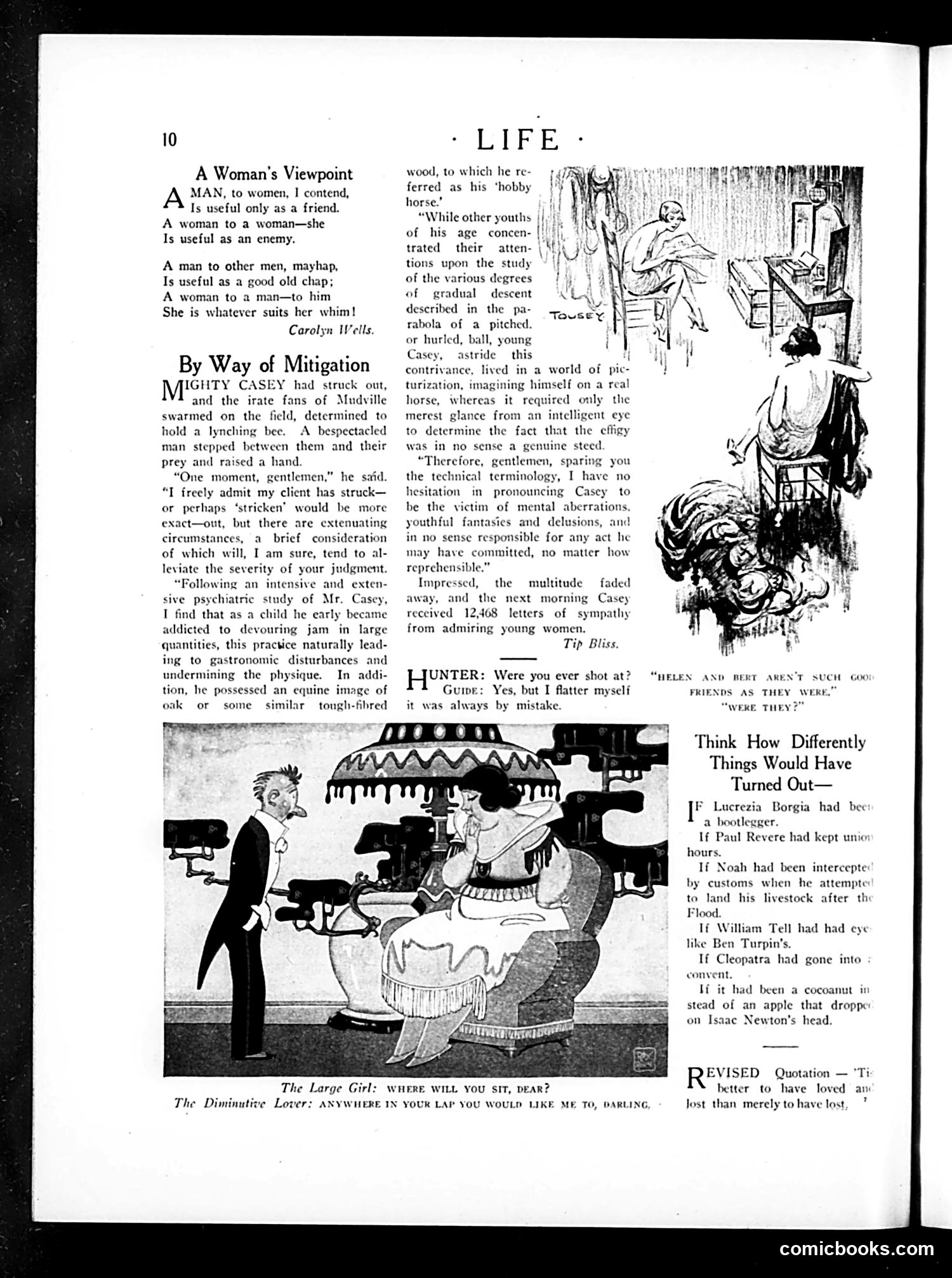
This page contains humor columns and illustrations typical of early 20th-century *Life* magazine's satirical style. **Top section** ("A Woman's Viewpoint"): A witty poem by Carolyn Wells presenting women's perspectives on men—claiming men are useful primarily as friends or "good old chaps," while women are whatever suits her whim. It's light satire on gender relations. **"By Way of Mitigation"**: A humorous defense of a character named Casey, who imagined himself as a "real horse" rather than an effigy. The author argues Casey's "mental aberrations" deserve sympathy rather than judgment. **Lower cartoons**: Show domestic and romantic scenes with exchanges between men and women, featuring typical *Life* magazine humor about courtship and relationships—notably the image labeled "The Diminutive Lover" with flirtatious dialogue. The page exemplifies early 1900s genteel satire focused on social manners and relations between genders.
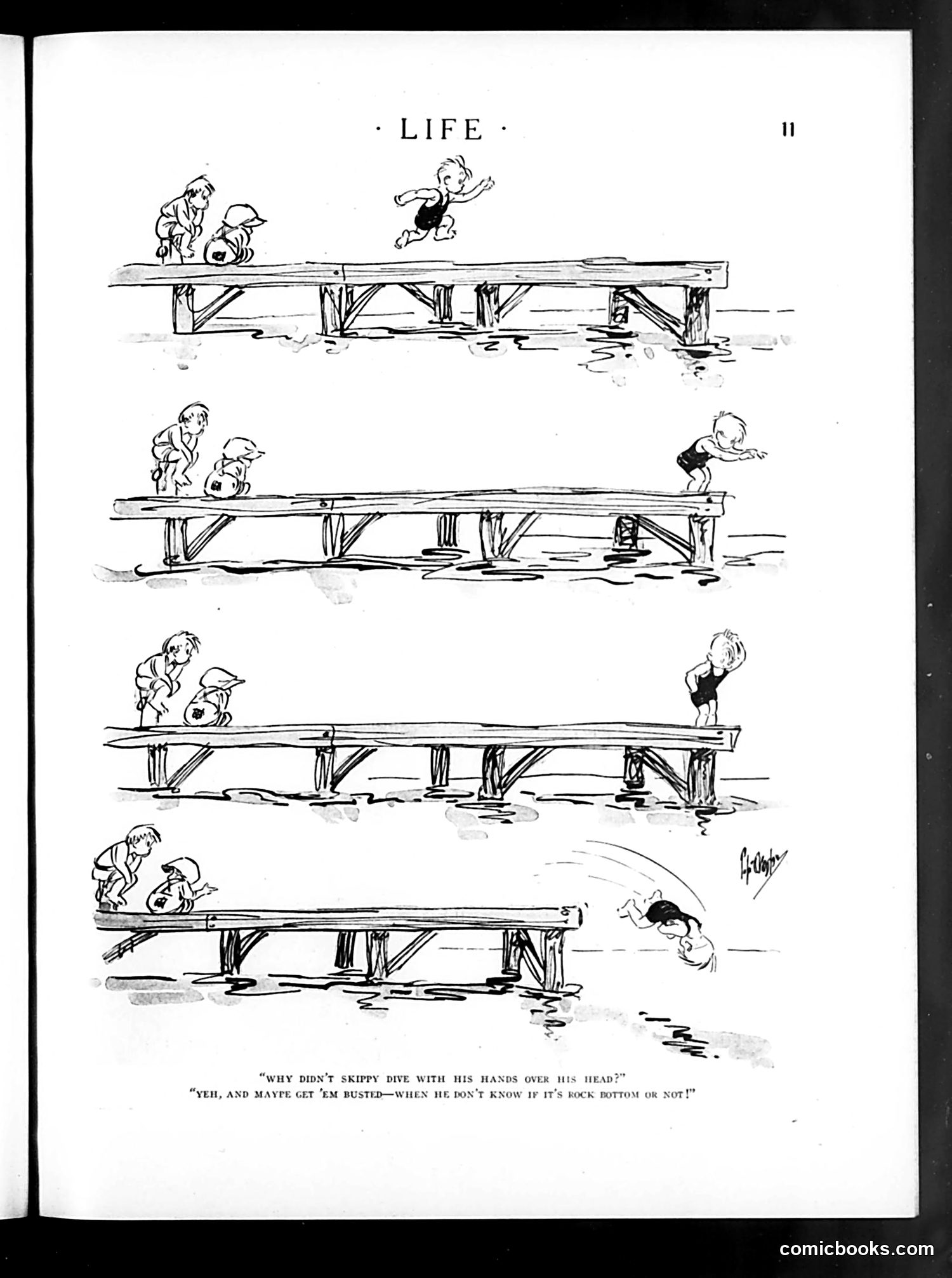
This is a humorous four-panel sequence titled "LIFE" showing children on a wooden dock or pier. The comic illustrates a child named Skippy attempting increasingly risky dives while two adults watch nervously from the left. The sequence escalates from a standing dive to a progressively more dangerous belly-flop into water, ending with the child falling off the dock entirely. The caption's dialogue addresses safety concerns: one adult questions why Skippy didn't use proper diving technique ("dive with his hands over his head"), while the other responds that they "maybe get 'em busted—when he don't know if it's rock bottom or not!" The satire mocks parental anxiety about children's water safety and the tension between allowing kids physical freedom versus protecting them from injury.
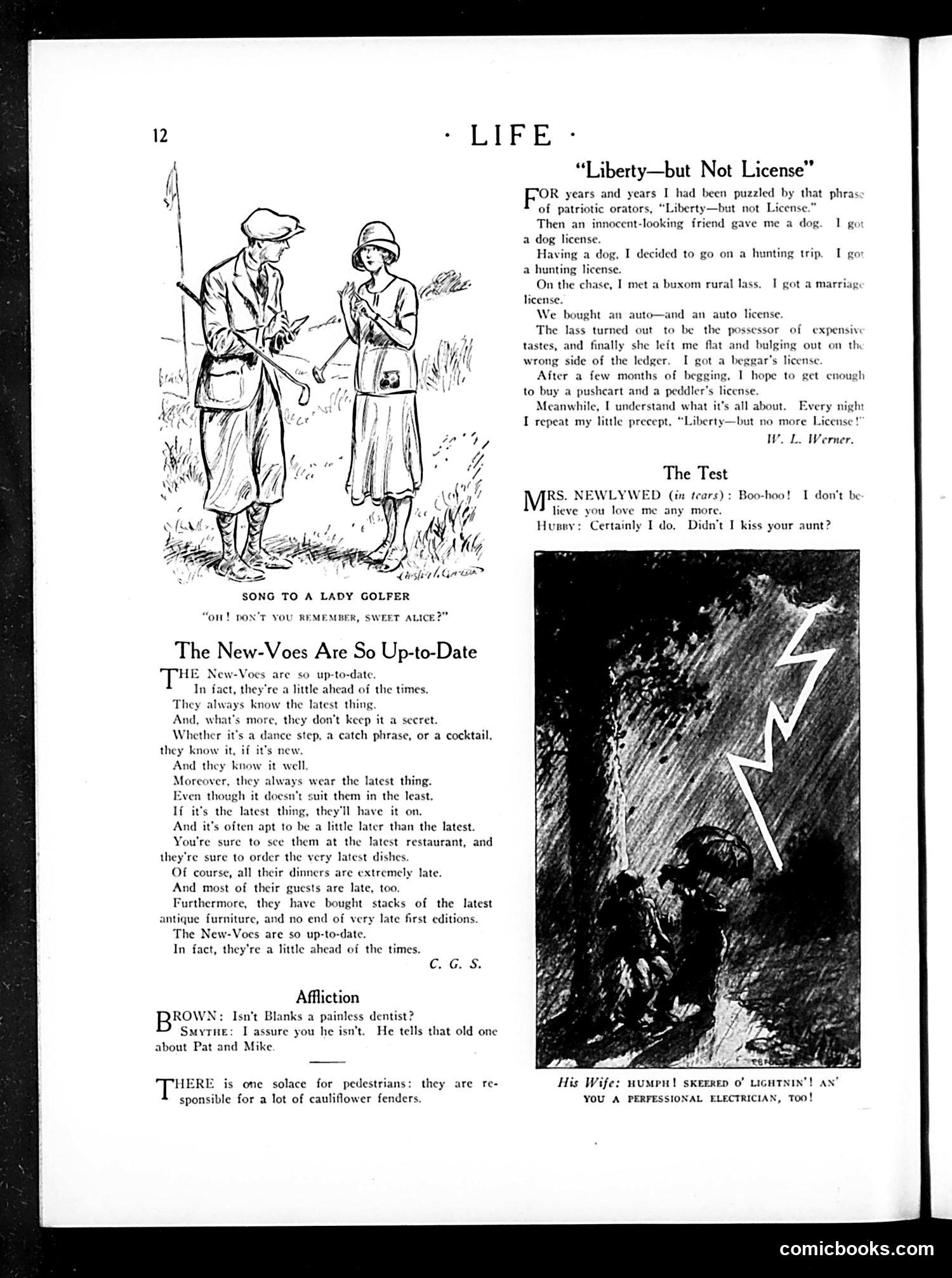
This page contains several pieces of social humor typical of early 20th-century Life magazine: 1. **"Liberty—but Not License"** (by W. L. Werner): A humorous essay about how acquiring various licenses (dog, hunting, marriage, auto) gradually constrains one's freedom. The joke satirizes how modern bureaucracy creates endless licensing requirements that paradoxically limit the "liberty" they nominally protect. 2. **"Song to a Lady Golfer"**: A sketch showing a man and woman on a golf course, with the caption referencing a musical quotation ("Oh! Don't You Remember, Sweet Alice?"). 3. **"The New-Voes Are So Up-to-Date"** (by C.G.S.): Satirizes nouveau-riche ("New-Voes") social climbers who obsessively pursue the latest fashions, restaurants, furniture, and trends—always staying conspicuously ahead of current fashion to demonstrate wealth and sophistication. The page represents genteel, urbane humor mocking middle/upper-class American social pretensions.
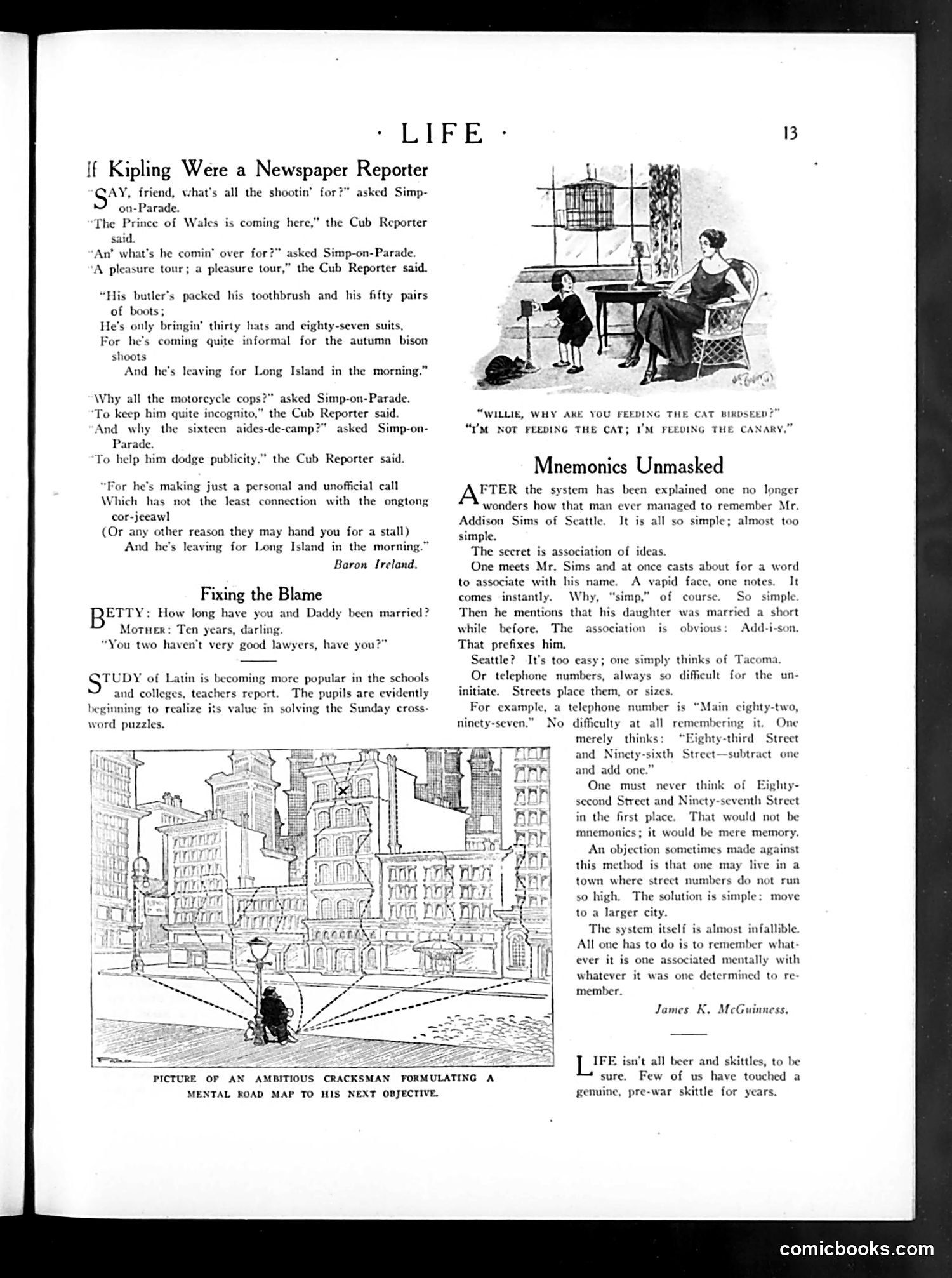
This page contains several satirical pieces typical of Life magazine's humor: **"If Kipling Were a Newspaper Reporter"** parodies Rudyard Kipling's literary style by applying it to mundane celebrity news—the Prince of Wales's visit. The joke satirizes how reporters sensationalize routine events. **"Fixing the Blame"** is a brief dialogue joke about a couple married ten years without hiring lawyers, mocking the frequency of divorce in that era. **"Mnemonics Unmasked"** explains memory techniques for remembering names and numbers—practical advice presented as insider secrets. The example about "Addison Sims of Seattle" demonstrates how mental associations work. The cartoon below shows a man with a complex mental map for navigation, satirizing overwrought problem-solving methods. Overall, the page humorously addresses early 20th-century concerns about celebrity culture, marital instability, and modern urban life.
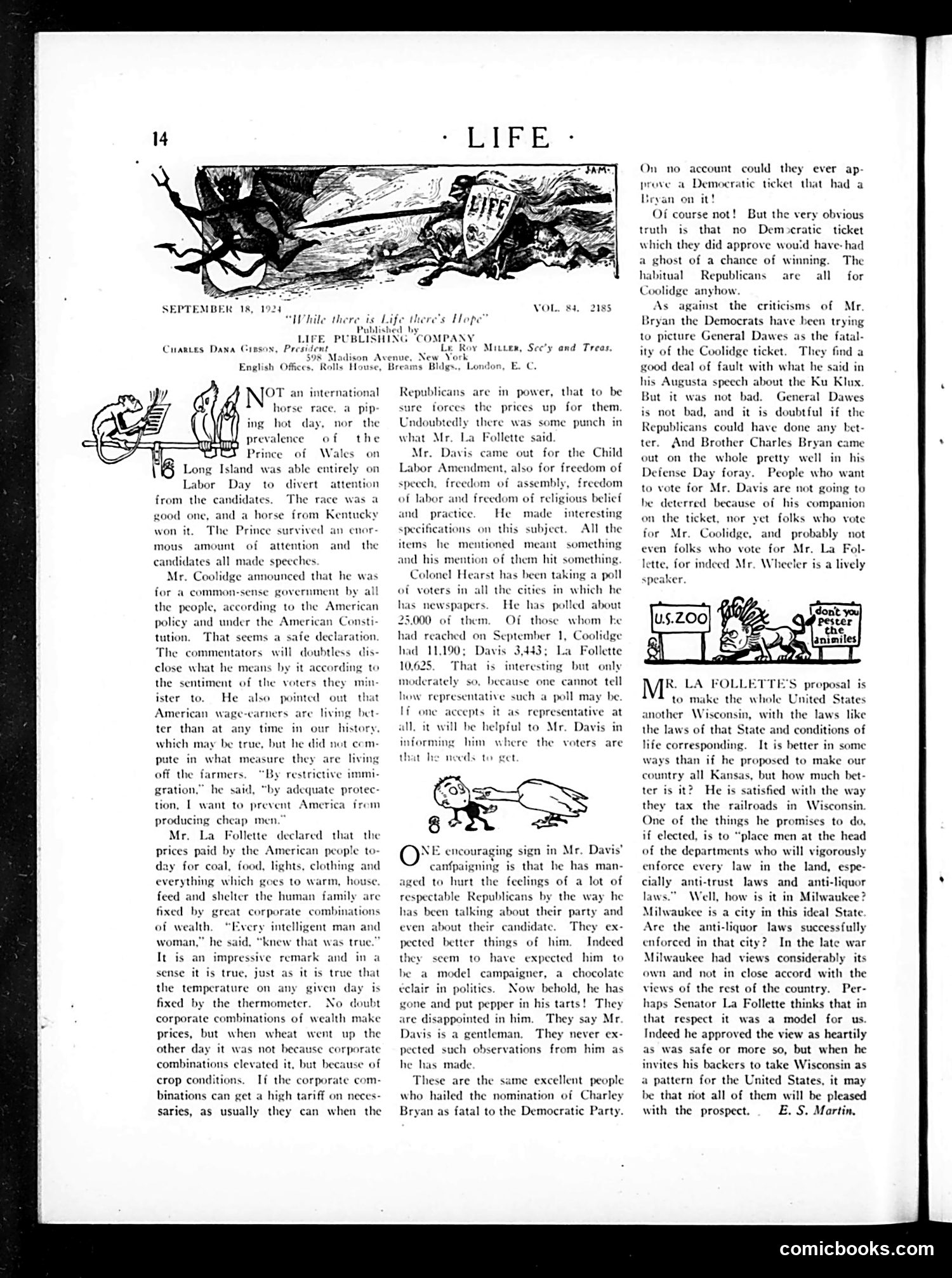
This page satirizes the 1924 U.S. presidential campaign. The main cartoon depicts a horse from Kentucky that "survived an enormous amount of attention" alongside other candidates—a joke about competing for voter attention during the campaign season. The text discusses Republican candidate General Davis's campaign for the Child Labor Amendment and other issues. It mocks Democratic criticism of Davis and defends his character against attacks. The article also critiques Mr. La Follette's proposal to make Wisconsin's laws a national model, questioning whether this would genuinely improve conditions. The cartoons (including small sketches of political figures) use visual humor to reinforce commentary on campaign promises and candidate credibility during this election cycle.
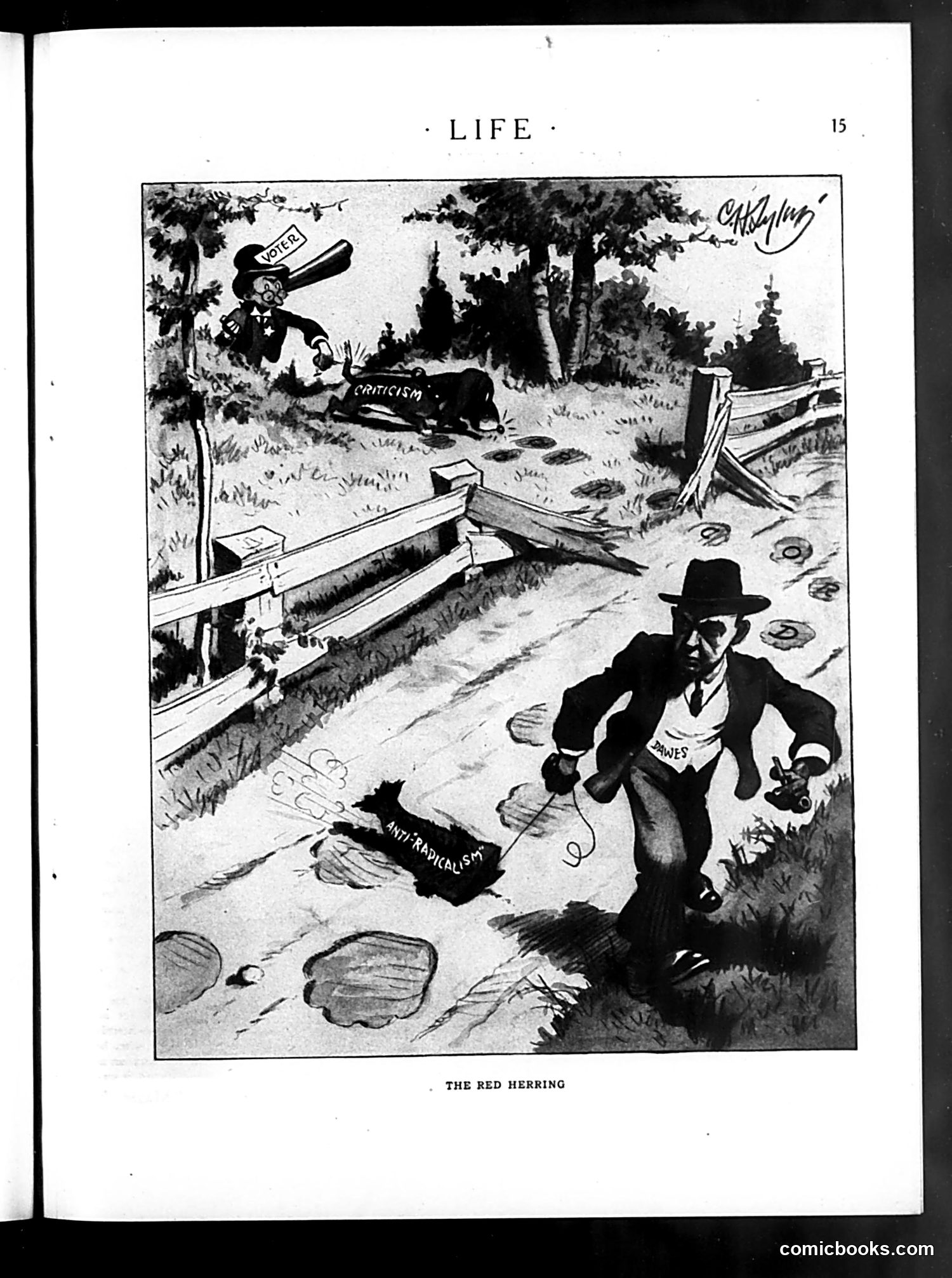
This satirical cartoon depicts a man labeled "BUSINESS" being chased or distracted by a figure holding "VOTING" while being pursued by a bear labeled "CRITICISM." The scattered footprints and broken fence suggest chaos and misdirection. The title "The Red Herring" is key: it's a metaphor for a misleading distraction. The cartoon appears to critique how business interests use voting or democratic processes as a distraction from legitimate criticism of their practices. The bear representing "criticism" pursues, while business is being led away by "voting"—suggesting that voting is being employed as a false trail to divert attention from actual accountability. The overall message critiques political manipulation of democratic participation.
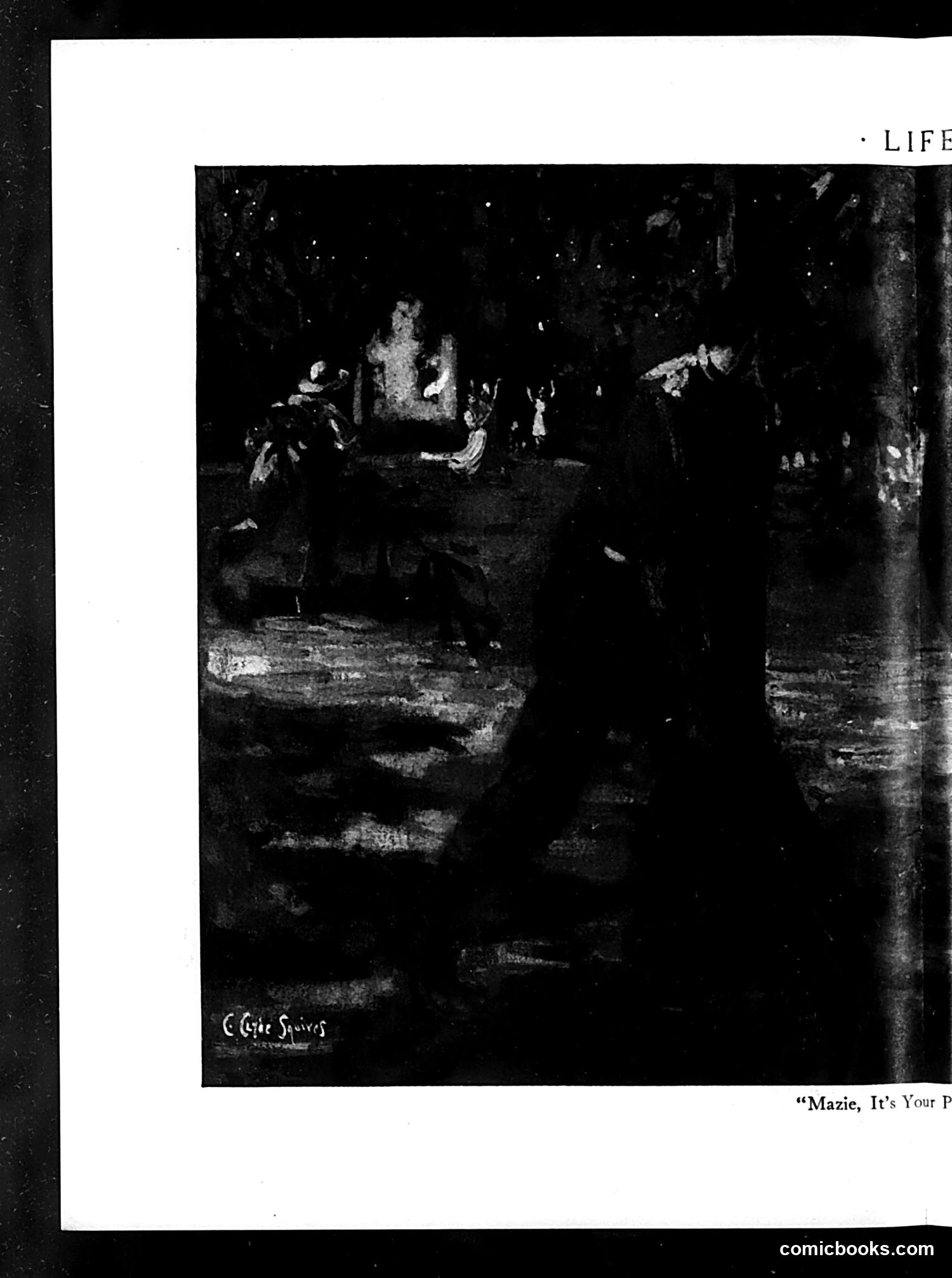
This appears to be a dramatic nighttime scene from an early 20th-century Life magazine. The photograph (credited to C. Cole Sawing, visible in lower left) shows figures gathered around what seems to be a fire or light source in darkness, with silhouettes of trees or structures framing the scene. The partial caption "Mazie, It's Your P" is incomplete, making the specific reference unclear. Without the full text, I cannot definitively identify who "Mazie" is or what political or social satire this depicts. The image's theatrical, staged quality suggests it may be commentary on a public event, performance, or social situation of the period, but determining the exact subject requires the complete caption text.
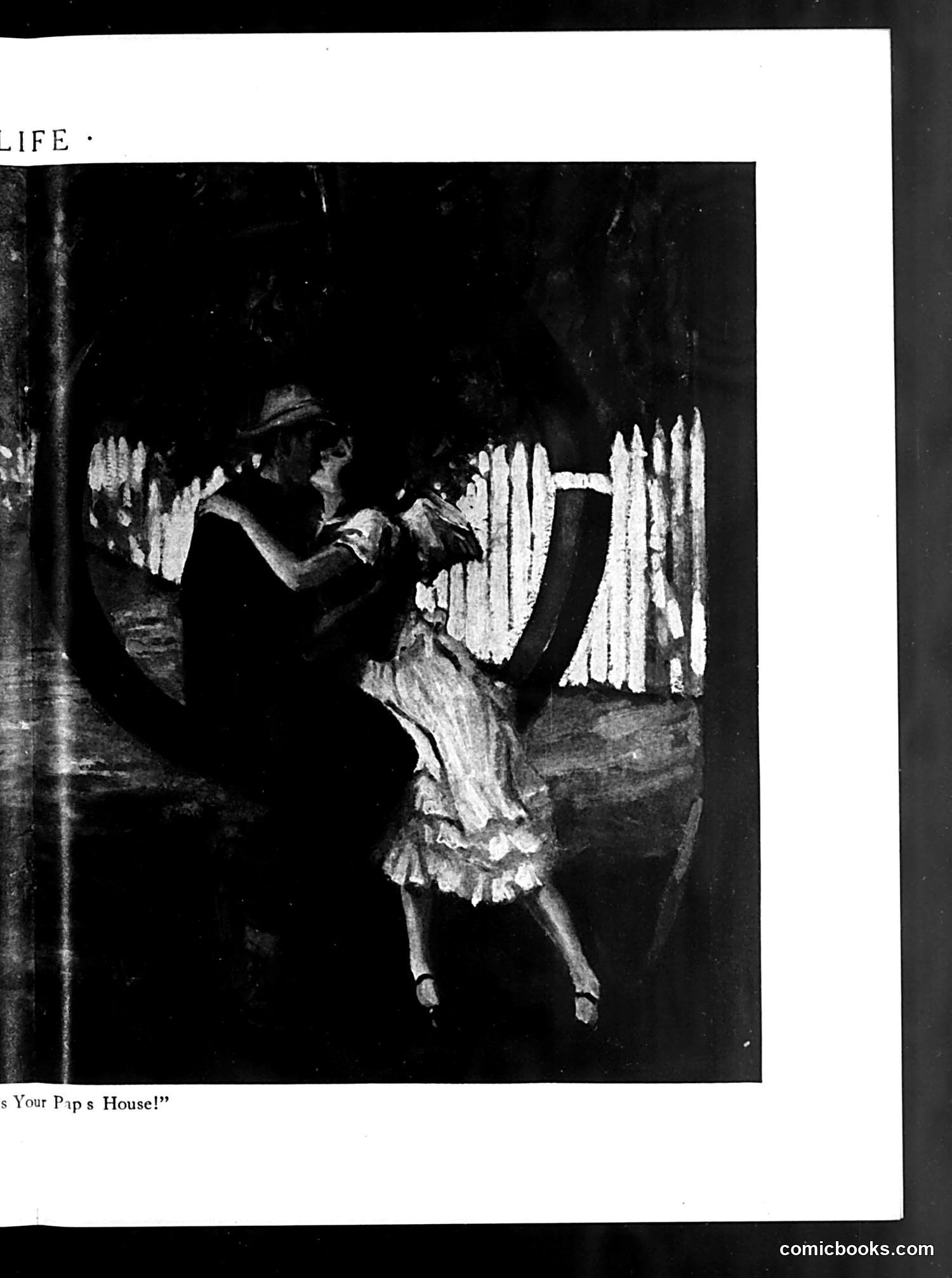
This appears to be a page from *Life* magazine showing a black and white photograph or illustration of a domestic scene. The visible caption reads "s Your Pip's House!" (likely "This Your Pip's House!" with text cut off). The image depicts a man in a hat and suit gesturing toward a woman in a light-colored dress who stands near what appears to be laundry hanging on a line. The scene suggests domestic life or housekeeping, presented in a satirical context typical of *Life* magazine's social commentary. Without the complete caption or article text, the specific satire's target remains unclear—it could reference domestic stereotypes, marital dynamics, or a contemporary social issue of the publication's era. The formal presentation style suggests this critiques some aspect of American home life or gender roles.
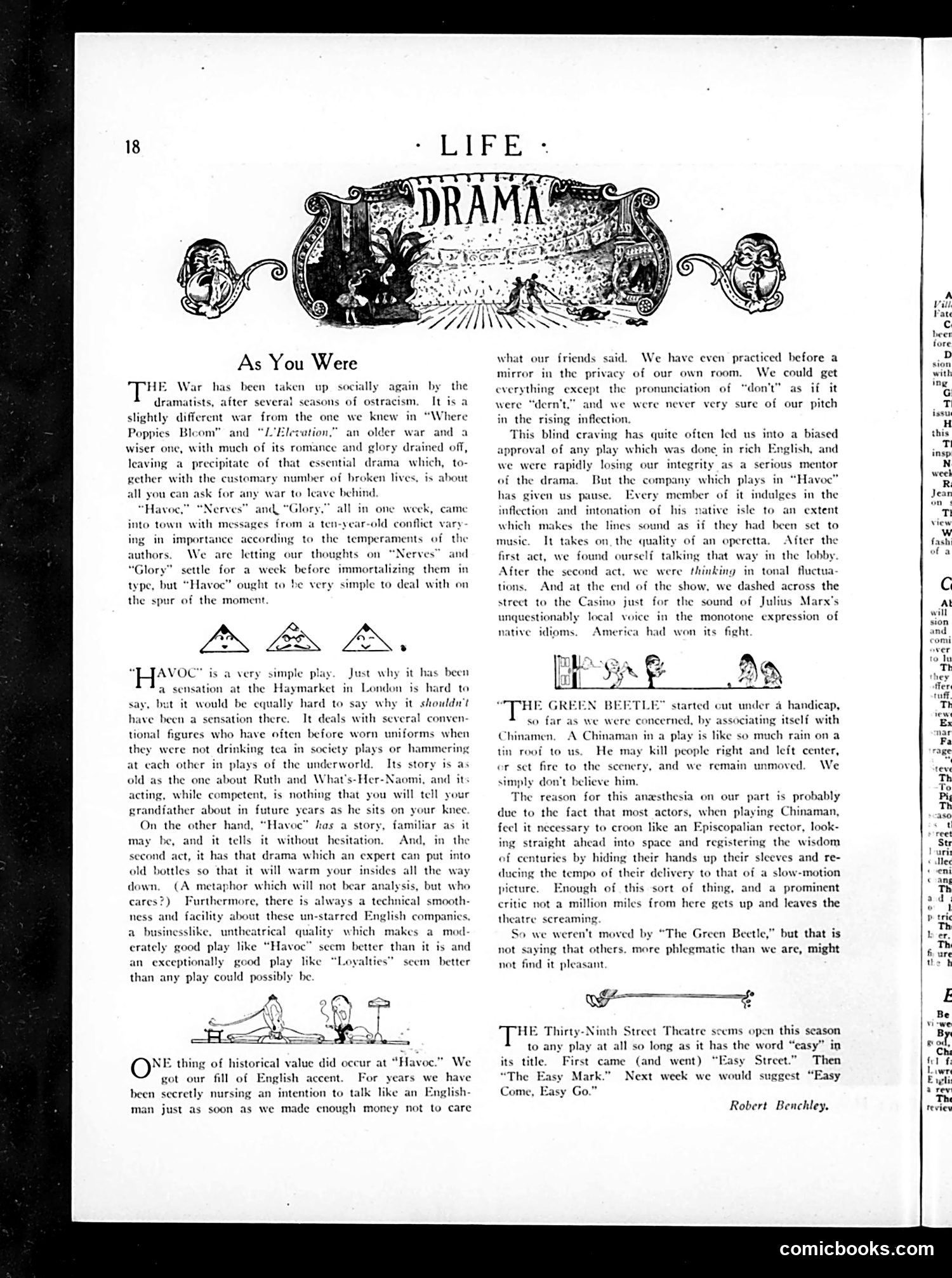
This page reviews three recent Broadway plays dealing with war themes: "Havoc," "The Green Beetle," and productions at the Thirty-Ninth Street Theatre. The author critiques "Havoc" as a competently executed but conventional play that relies on familiar dramatic formulas. A notable observation: the English cast's exaggerated accent and inflection become so pronounced they make dialogue sound like operetta—the reviewer and fellow audience members found themselves unconsciously imitating this theatrical English speech afterward. "The Green Beetle" is dismissed as ineffective because it involves Chinese characters. The reviewer explains that audiences simply don't find stage Chinamen believable, as most actors resort to unconvincing stereotypical "crooning" vocal delivery rather than authentic portrayal. The cartoonish illustrations appear to be simple theatrical vignettes. The satire targets both theatrical artificiality and the conventions of 1920s drama criticism—audiences' susceptibility to accent and cultural stereotypes over genuine dramatic merit.
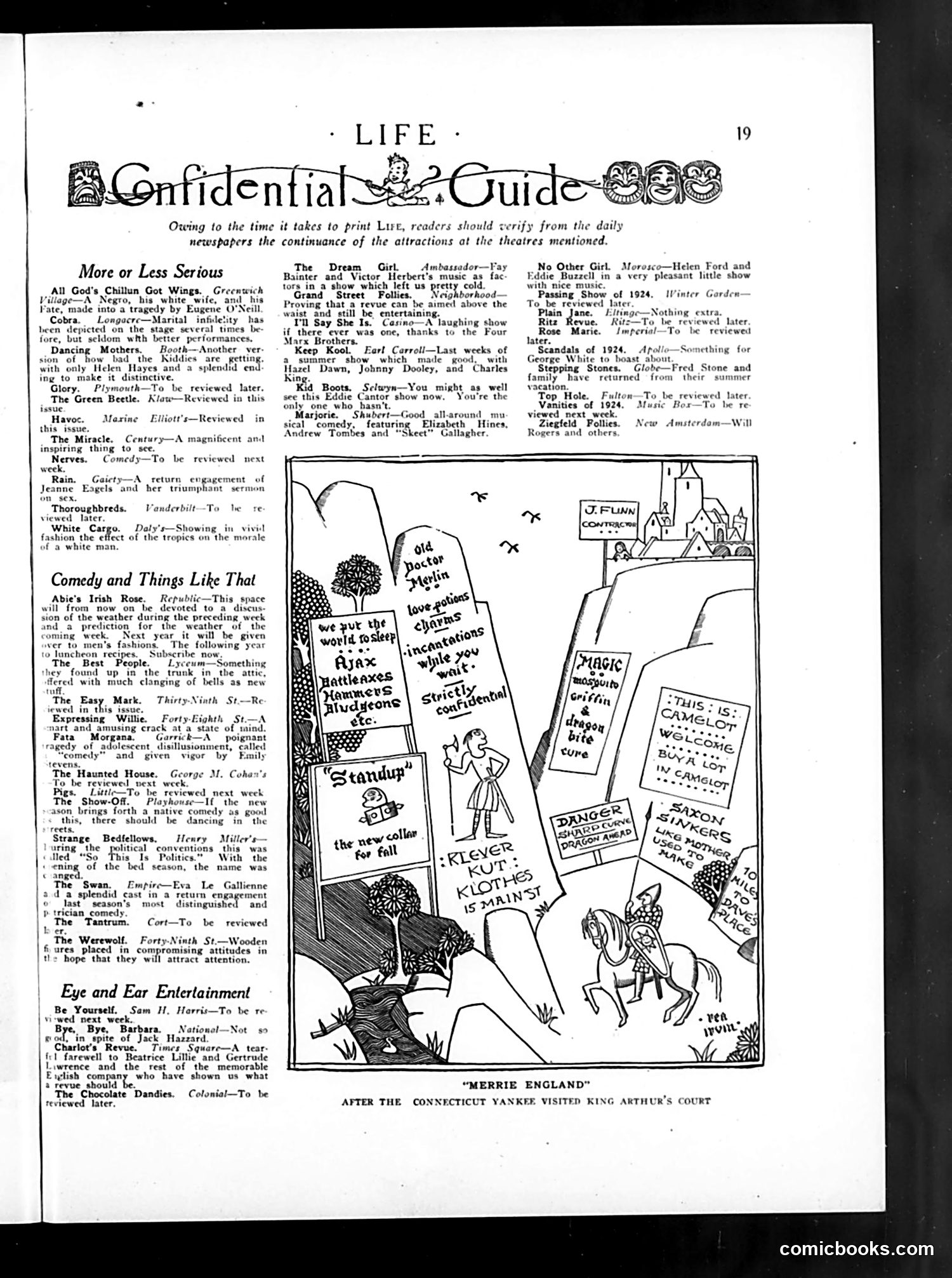
This full-page cartoon satirizes the recent visit of an American (identified as "Connecticut Yankee" in the caption) to King Arthur's court—likely referencing Mark Twain's 1889 novel *A Connecticut Yankee in King Arthur's Court*. The cartoon depicts the American tourist surrounded by modern American commercial signage and advertisements (hotels, stores, medicines, clothing shops) intruding upon a medieval English landscape. A figure labeled "Klever Rut Kloches" advertises cheap clothing, while various American business signs compete for attention against castles and period elements. **The satire's point**: American commercialism and vulgar business culture are so aggressive and pervasive that they literally colonize even England's romantic historical past. The "Connecticut Yankee" brings not technological progress (as in Twain's novel) but rather cheap advertising and mercenary capitalism that cheapens and commodifies traditional culture. This reflects 1920s anxieties about American cultural and commercial dominance spreading abroad, treating even iconic European heritage as another market to exploit.
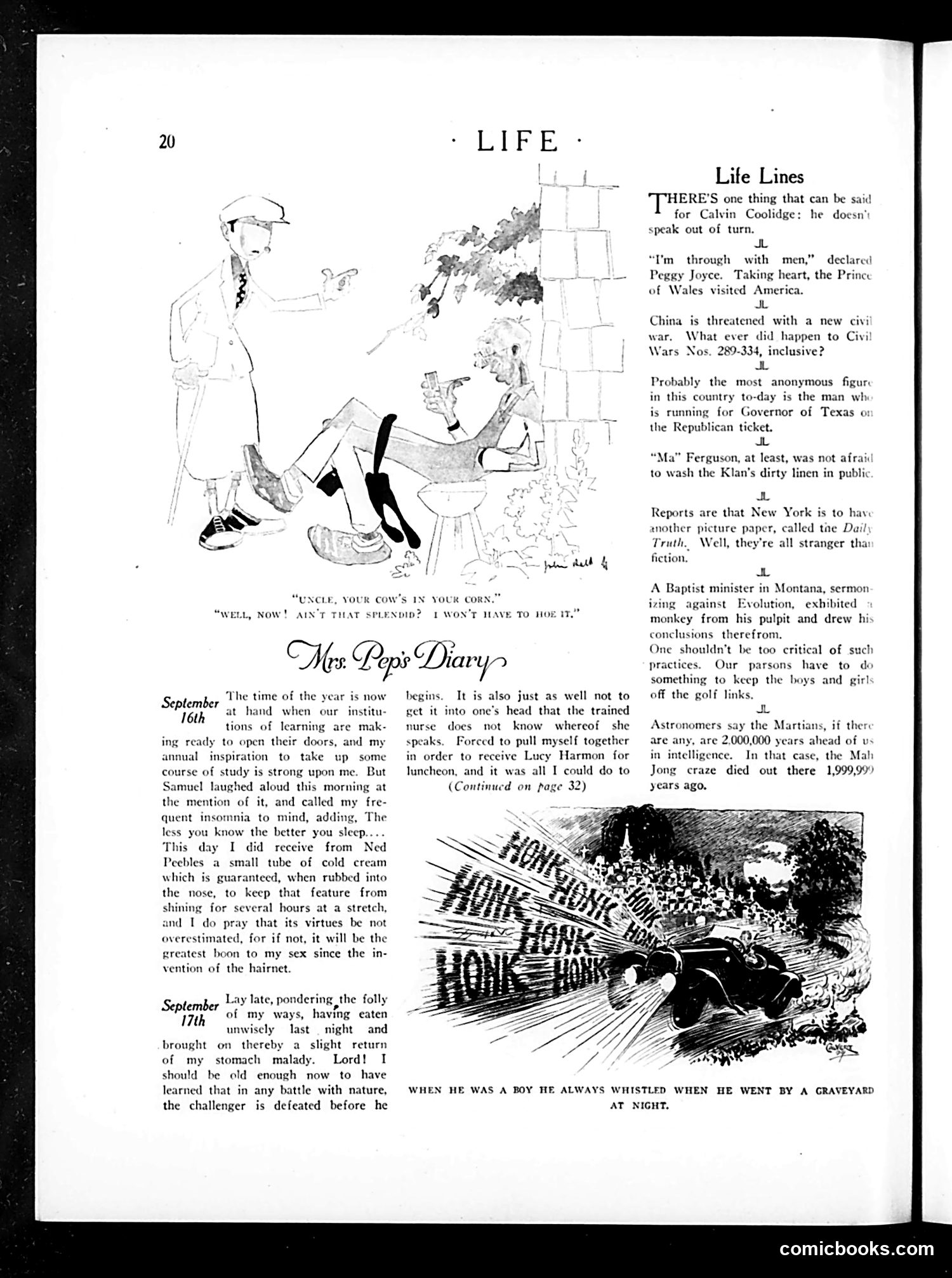
This page from Life magazine contains brief political and social commentary ("Life Lines") typical of 1920s American satirical journalism, plus a rural cartoon and Mrs. Pep's diary excerpt. **Key references:** - **Calvin Coolidge**: Silent president, mocked for his taciturnity - **Peggy Joyce**: Socialite actress known for romantic scandals; the joke implies even she couldn't interest men - **Prince of Wales**: British royal who visited America; implied to be romantically interested - **"Ma" Ferguson**: Texas politician (likely Miriam Ferguson) contrasted with the anonymous Republican gubernatorial candidate; Ferguson apparently opposed the KKK publicly - **Baptist minister with monkey**: References the Scopes "Monkey Trial" evolution debate (1925) - **Martians**: Topical reference to contemporary astronomy speculation **The cartoons** are gentle domestic humor—a farmer amused his cow ate his corn (no hoeing needed), and a boy whistling past graveyards (folk superstition). The diary offers mundane observations on college, beauty care, and digestion, reflecting period women's magazine conventions.
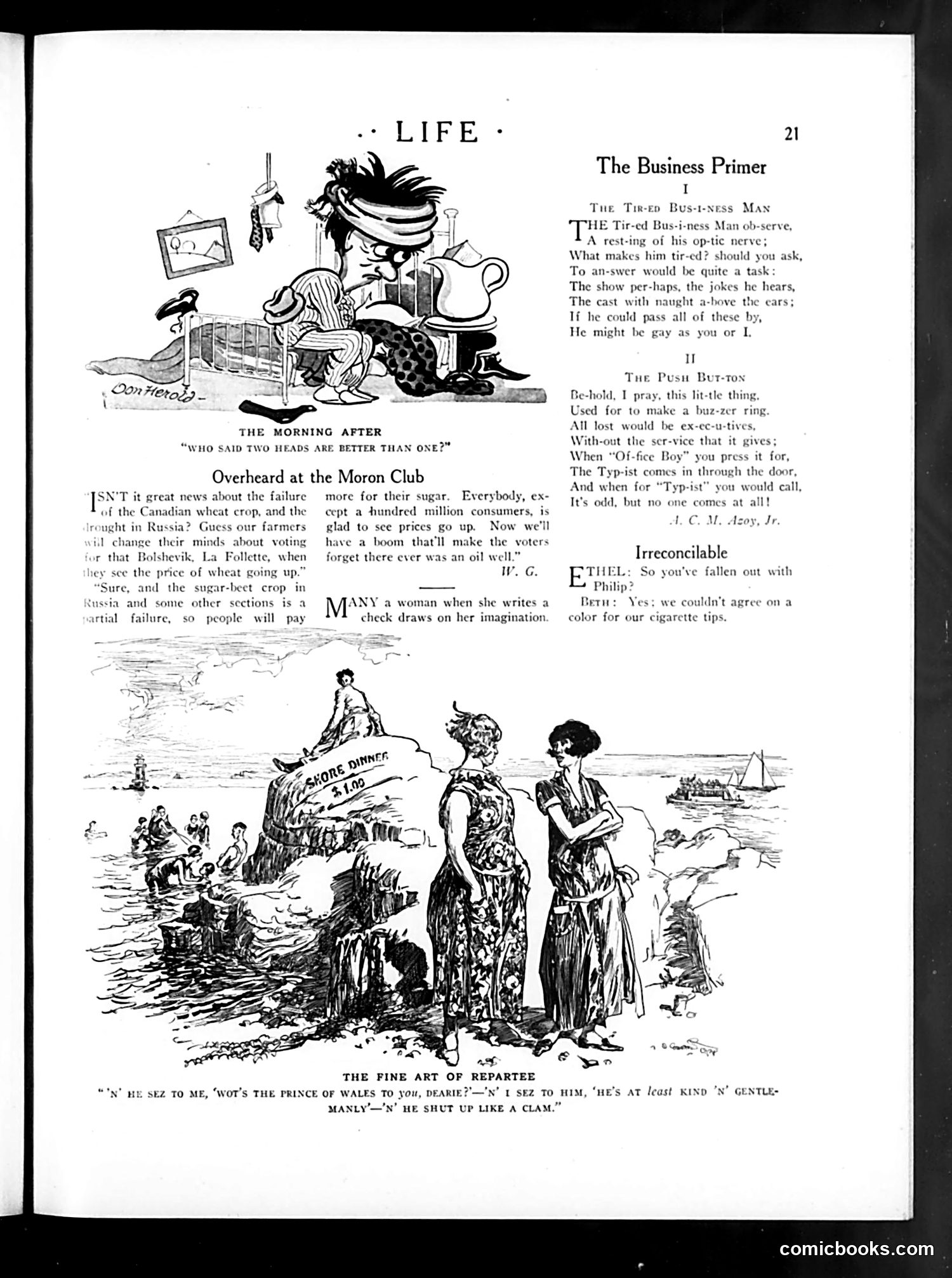
**Top cartoon** ("The Morning After"): Depicts businessmen at a "Moron Club" cynically celebrating crop failures—Canadian wheat, Russian drought, sugar-beet shortage—because scarcity drives up prices, benefiting them financially while consumers suffer. The satire targets profiteering and indifference to ordinary people's hardship. References to "La Follette" (likely Senator Robert La Follette, a Progressive) and "oil well" suggest contemporary political/economic debates about corporate greed versus populist interests. **"The Business Primer"**: Light verse mocking tired businessmen exhausted by entertainment and office routines, and absurdly dysfunctional office buzzers that summon the wrong person. **"Irreconcilable"**: A brief joke about a couple disagreeing over cigarette tip colors—trivial marital discord played for laughs. **"The Fine Art of Repartee"**: A seaside scene where witty verbal sparring occurs (full joke unclear from visible text). Overall, the page satirizes business culture, consumer indifference, and social absurdities of the era.
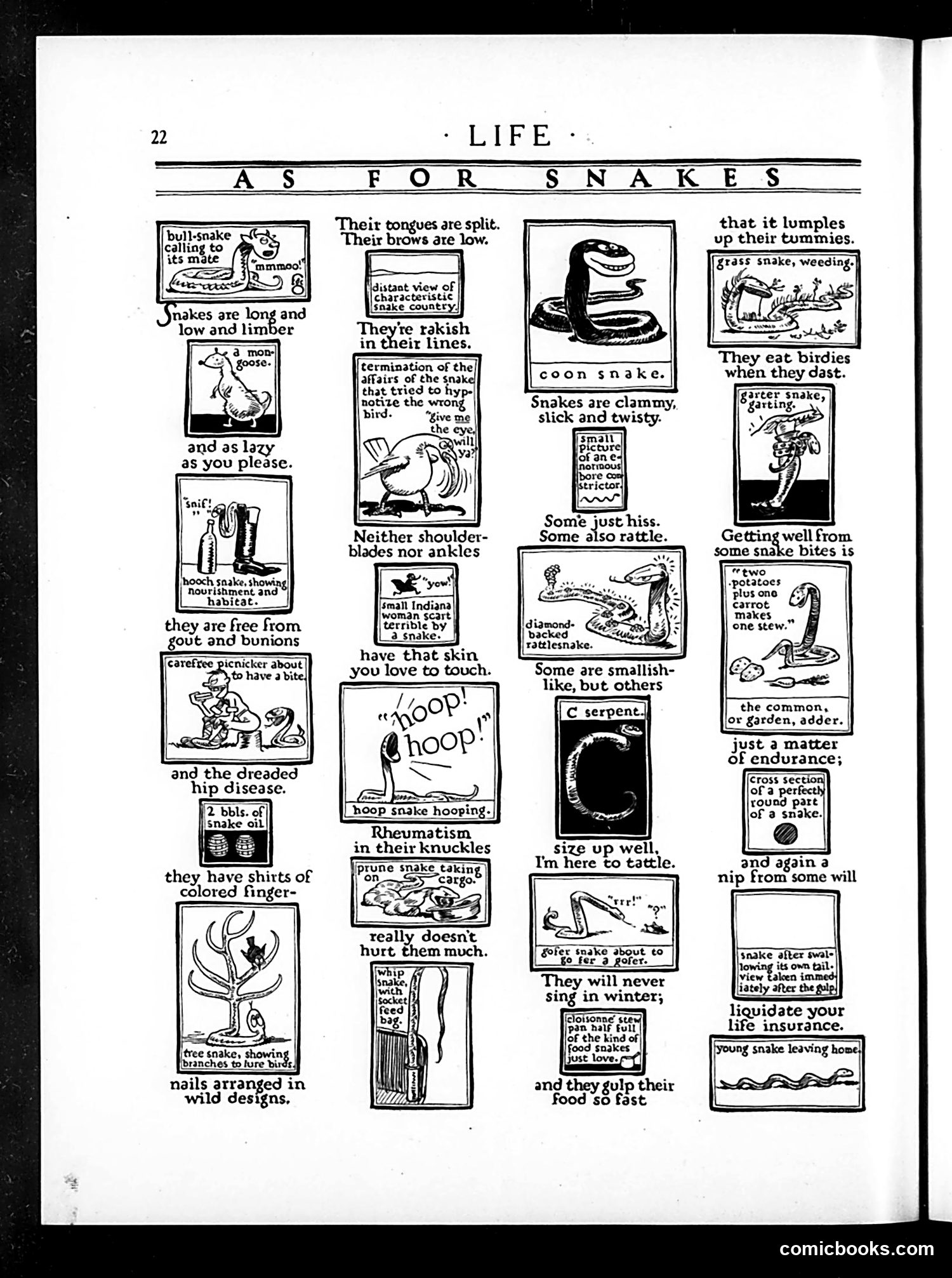
This is a humorous illustrated alphabet entry (or educational parody) about snakes, using absurdist wordplay and crude woodcut-style drawings typical of early 20th-century Life magazine satire. The page mocks both snakes themselves and human attitudes toward them through exaggerated characteristics: snakes are "lazy," "clammy," have "split tongues" and "low brows," suffer from "rheumatism in their knuckles," and eat quickly. Dark humor emerges in references to snake bites causing death ("liquidate your life insurance") and the "dreaded hip disease." The satire appears directed at nature writing and popular misconceptions rather than political targets. Small vignettes describe snake varieties (coon snake, hoop snake, garter snake, garden adder) with comic non-sequiturs about their behavior and the folk remedies people use. The overall effect is absurdist humor—treating snakes as if they were bumbling characters with human foibles, combining genuine zoological details with pure invention for comedic effect.
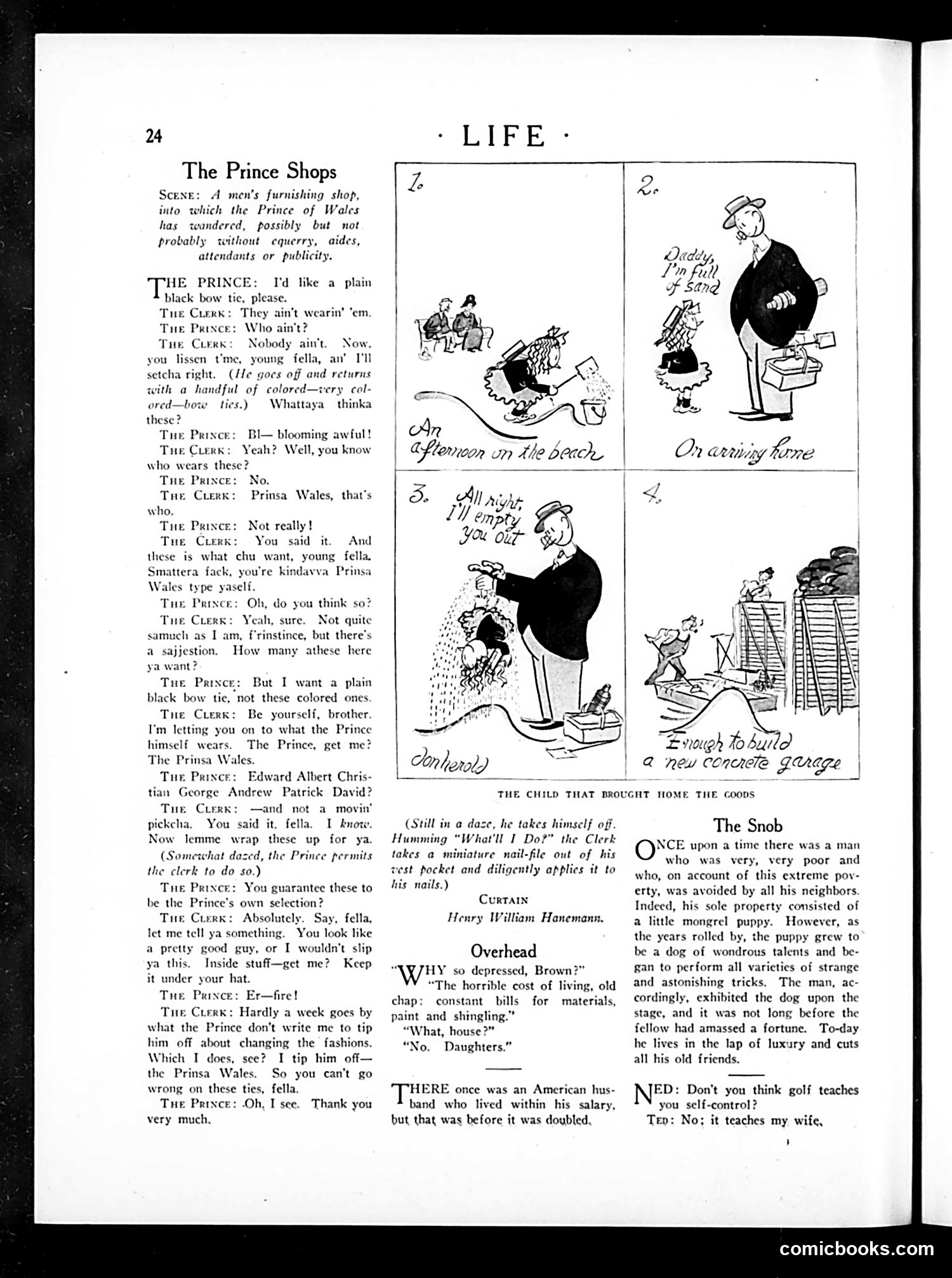
This satirical dialogue mocks the Prince of Wales (later Edward VIII, identified by his full name in the text) and fashion snobbery. **The Setup:** A haberdashery clerk recognizes the Prince and pressures him to abandon his sensible preference for a plain black bow tie, instead selling him gaudy colored ones by claiming "the Prince himself wears" them. The clerk flatters the Prince by saying he "looks like" royalty and promises insider fashion tips. **The Joke:** The satire works on multiple levels—it ridicules both the Prince's passive acceptance of fashion advice from a shopkeeper and the clerk's transparent manipulation through name-dropping and flattery. The broader point: even royalty can be duped by commercial persuasion and fashion conformity. The accompanying comic strips ("The Child That Brought Home the Goods," "The Snob," "Overhead") offer additional social commentary on materialism, class pretension, and domestic economics—typical Life magazine fare satirizing 1920s American society.
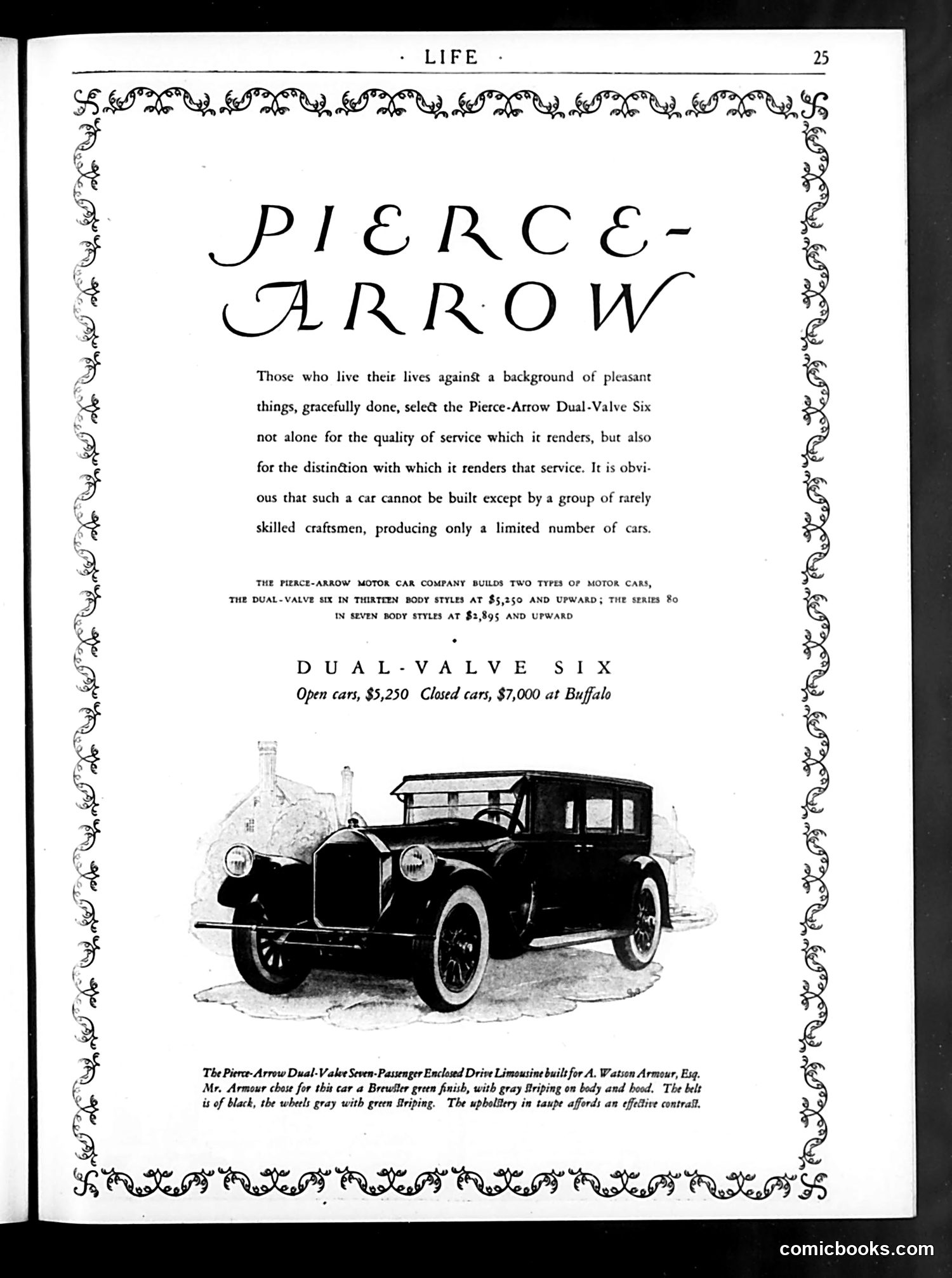
This is not a cartoon but a **luxury automobile advertisement** from Life magazine's early 20th century. The page promotes the Pierce-Arrow Dual-Valve Six, a high-end car positioned for wealthy elites. The text appeals to class consciousness, emphasizing that the car serves those "who live their lives against a background of pleasant things, gracefully done"—coded language targeting the affluent. It stresses exclusivity: limited production by "rarely skilled craftsmen" justifies premium pricing ($5,250–$7,000, substantial sums in this era). The specific example—a custom vehicle built for A. Watson Armour (member of the wealthy Armour meatpacking family)—reinforces aspirational marketing. Detailed mention of color choices and upholstery signals bespoke luxury. This reflects the **Gilded Age** automobile market, where cars symbolized wealth and status rather than mere transportation.
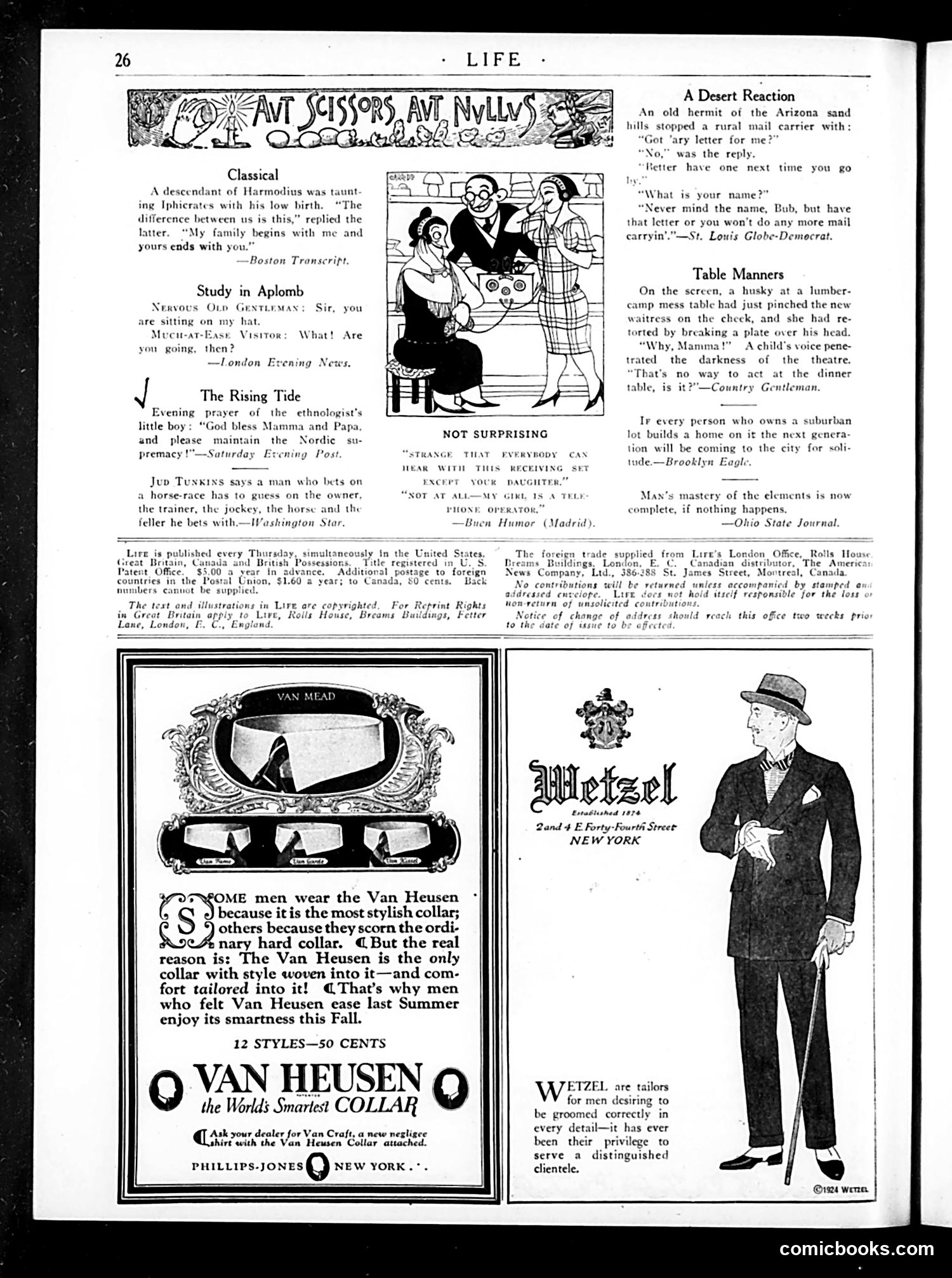
This page contains six brief humorous anecdotes typical of early 20th-century American humor, plus advertisements for men's collars and tailoring services. The jokes mock various social situations: a hermit's isolation from mail delivery, class pretension in classical references, awkward restaurant etiquette, proprietary concerns over suburban development, radio technology gaps, and betting on horse races. "The Rising Tide" satirizes ethnic anxieties of the era—a child's evening prayer requesting maintenance of "Nordic supremacy" reflects contemporary concerns about immigration and demographic change that were prominent in American discourse of this period. The cartoons lack political figures or specific caricatures; instead, they offer observational humor about everyday American life—rural isolation, manners, technology adoption, and social stratification. The advertisements reinforce the magazine's target audience: educated, middle-class men concerned with proper grooming and social presentation.
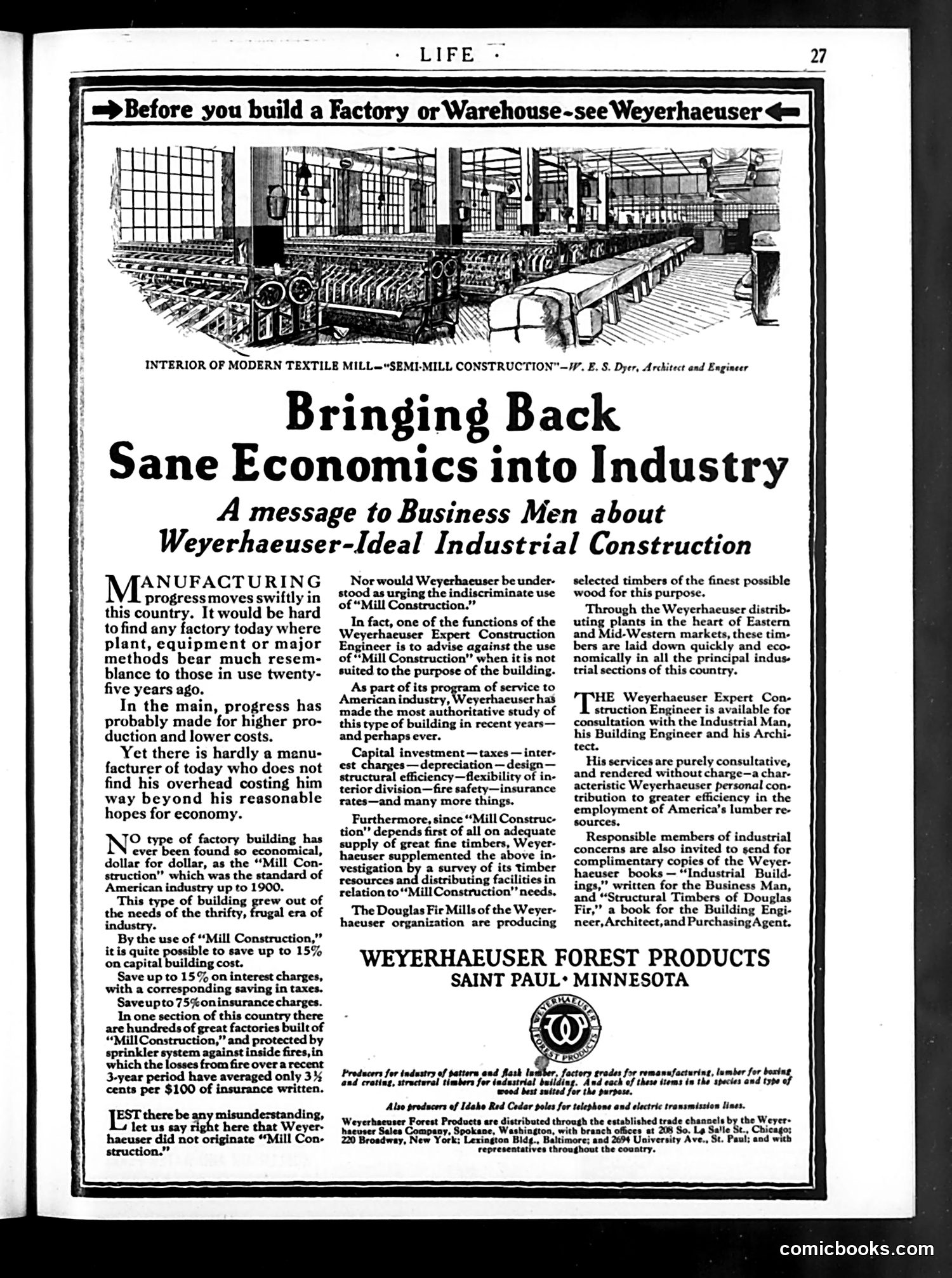
This is **not a cartoon** but rather a **full-page advertisement** for Weyerhaeuser Forest Products, disguised as business journalism. The page promotes "Mill Construction"—a timber-framed industrial building method standard before 1900 that Weyerhaeuser claims offers substantial savings (15% on construction, 75% on insurance). The illustrated textile mill interior showcases this aesthetic. The ad's rhetorical strategy targets early-20th-century **business anxiety**: manufacturers worried about overhead costs despite industrial progress. Weyerhaeuser positions itself as an authority—offering free expert consultation, timber surveys, and educational books to "bring back sane economics." Notably, the company disclaims *inventing* Mill Construction while implying it deserves credit for reviving it. This is classic advertising positioning: offering "objective" expertise while steering clients toward products (Douglas fir timber) the company controls through mills and distribution networks. For modern readers: this exemplifies how early corporate advertising mimicked editorial content to build brand authority.
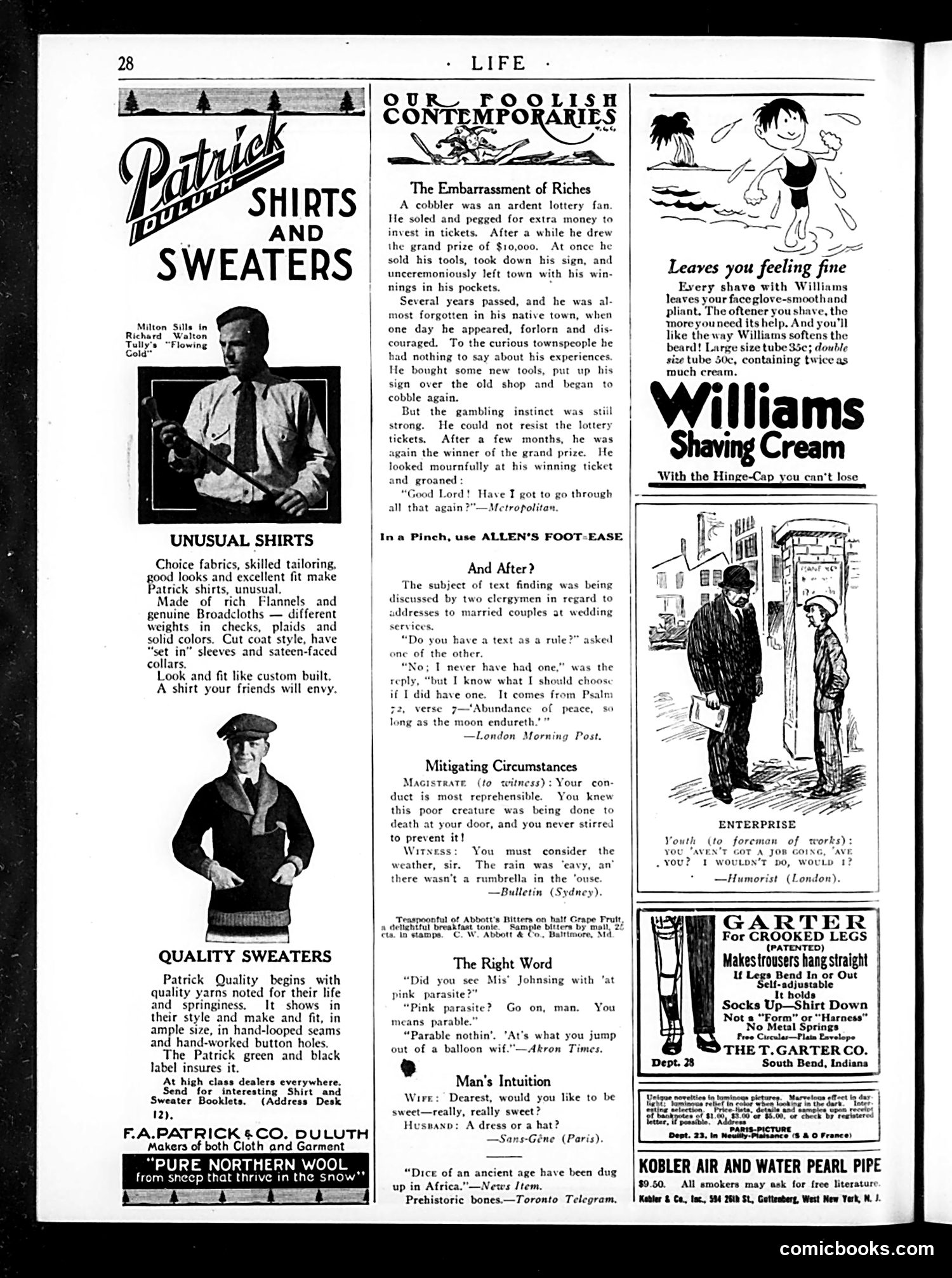
This is primarily a **commercial advertising page** with interspersed humorous anecdotes typical of Life magazine's format. The main content features Patrick brand shirts and sweaters (top left), with Williams Shaving Cream and other product ads. The humor section, titled "Our Foolish Contemporaries," contains brief satirical stories mocking human folly: - A cobbler wins the lottery twice but remains dissatisfied, suggesting wealth doesn't guarantee happiness - Clergymen discuss wedding vows with dry wit - A witness avoids helping a dying person due to rain—social commentary on indifference - Brief jokes about misheard words and gender differences ("a dress or a hat?") These pieces mock predictable human behaviors: greed, laziness, and miscommunication. The "Enterprise" cartoon (bottom right) appears to show a youth seeking work. The page reflects early 20th-century magazine conventions: advertising mixed with short satirical commentary targeting middle-class readers' shared experiences and pretensions.
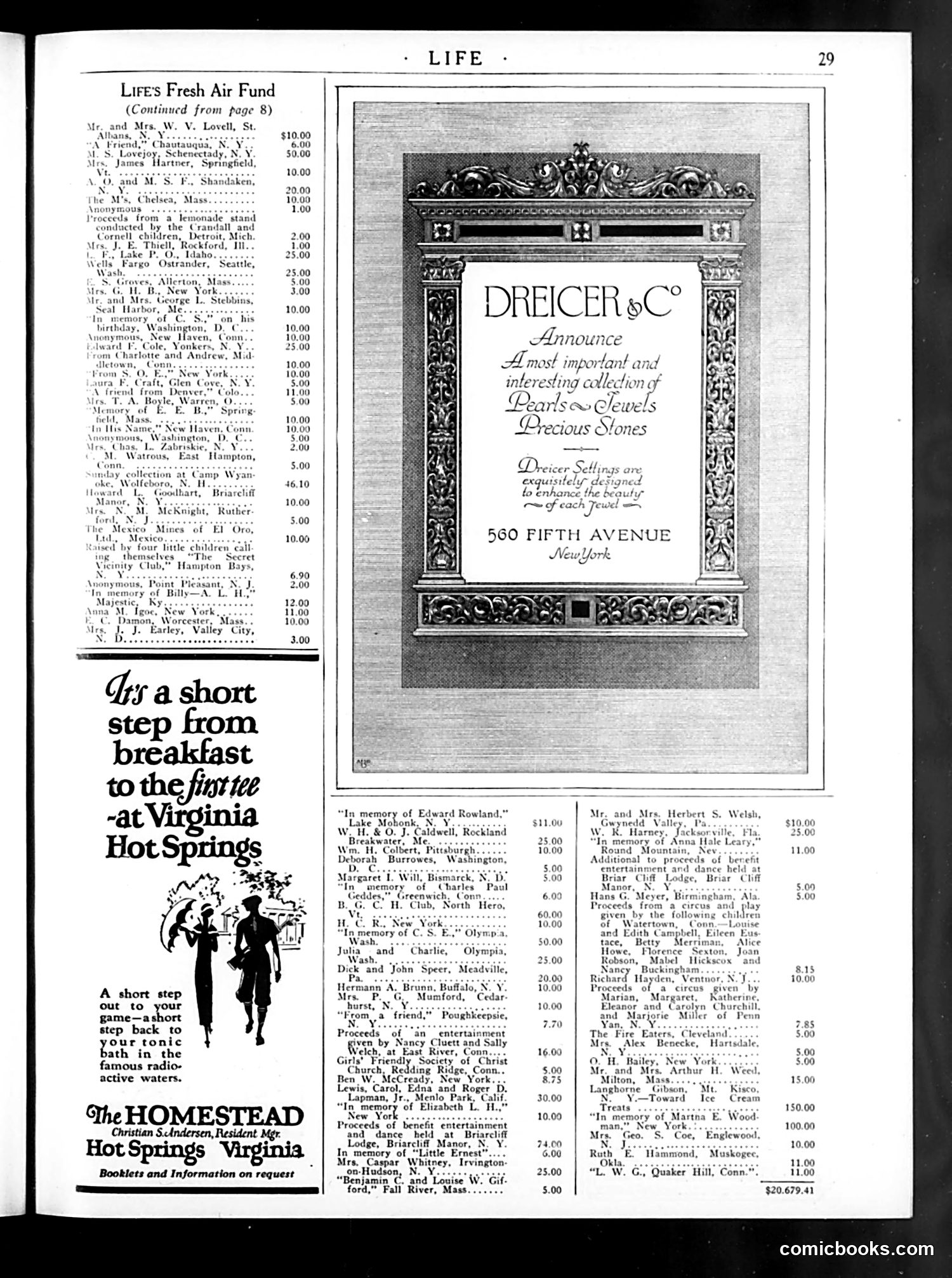
This page is primarily **advertising and fundraising**, not political satire. The dominant content is: 1. **Life's Fresh Air Fund continuation** — a charitable listing of donors and donation amounts supporting children's access to outdoor recreation (a common early 20th-century Progressive Era cause). 2. **Dreicer & Co. advertisement** — an elegant jewelry store on Fifth Avenue promoting pearls, jewels, and precious stones with ornate Art Deco framing. 3. **The Homestead resort advertisement** — promoting Virginia Hot Springs as a health destination, with imagery of a couple taking a leisurely walk. The tagline emphasizes it's "a short step" from breakfast to enjoying the famous radioactive mineral waters, positioning the spa as a quick, tonic remedy. There is no political cartoon visible. The page reflects early 20th-century American consumer culture, charitable giving practices, and wellness tourism trends of the era.
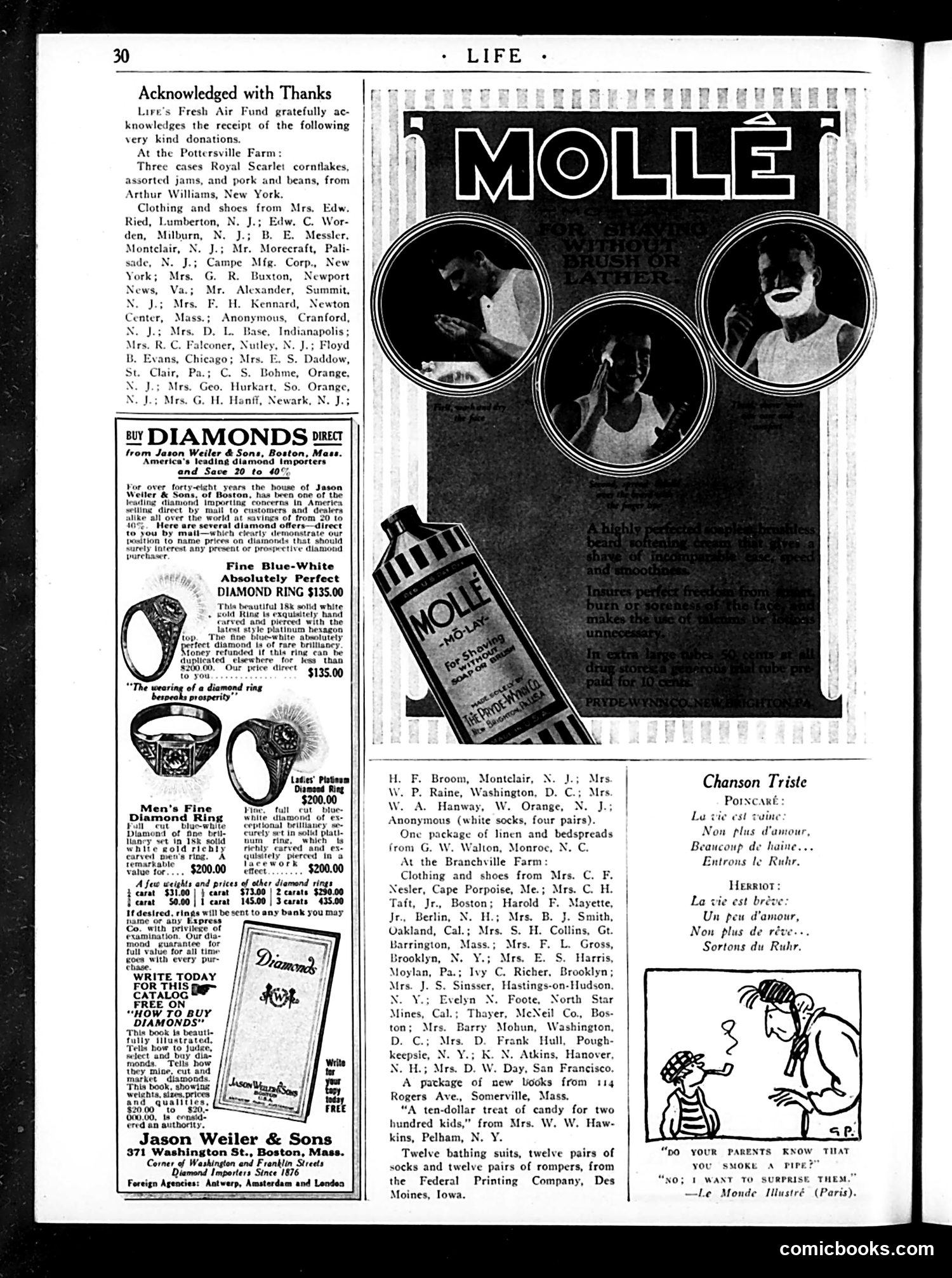
This page is primarily **fundraising documentation** for Life's Fresh Air Fund, listing donations to rural farms serving underprivileged children. The bulk is acknowledgments of contributors and a diamond ring advertisement. The only cartoon appears bottom-right: a simple line drawing of a child being confronted by an adult about smoking pipes. The child's reply—"No; I want to surprise them"—is a mild joke about children's mischief and parental oversight, typical of early 20th-century humor. The "Chanson Triste" section (center-right) references Franco-German tensions over the Ruhr region, likely from the 1920s occupation period. It contrasts Poincaré's hardline French stance ("No more love, much hate / Let's enter the Ruhr") with Herriot's softer approach ("A little love, no more dreams / Let's leave the Ruhr")—political satire wrapped in French verse. The page otherwise reflects period concerns: charitable work, consumer goods advertising, and European political conflict.
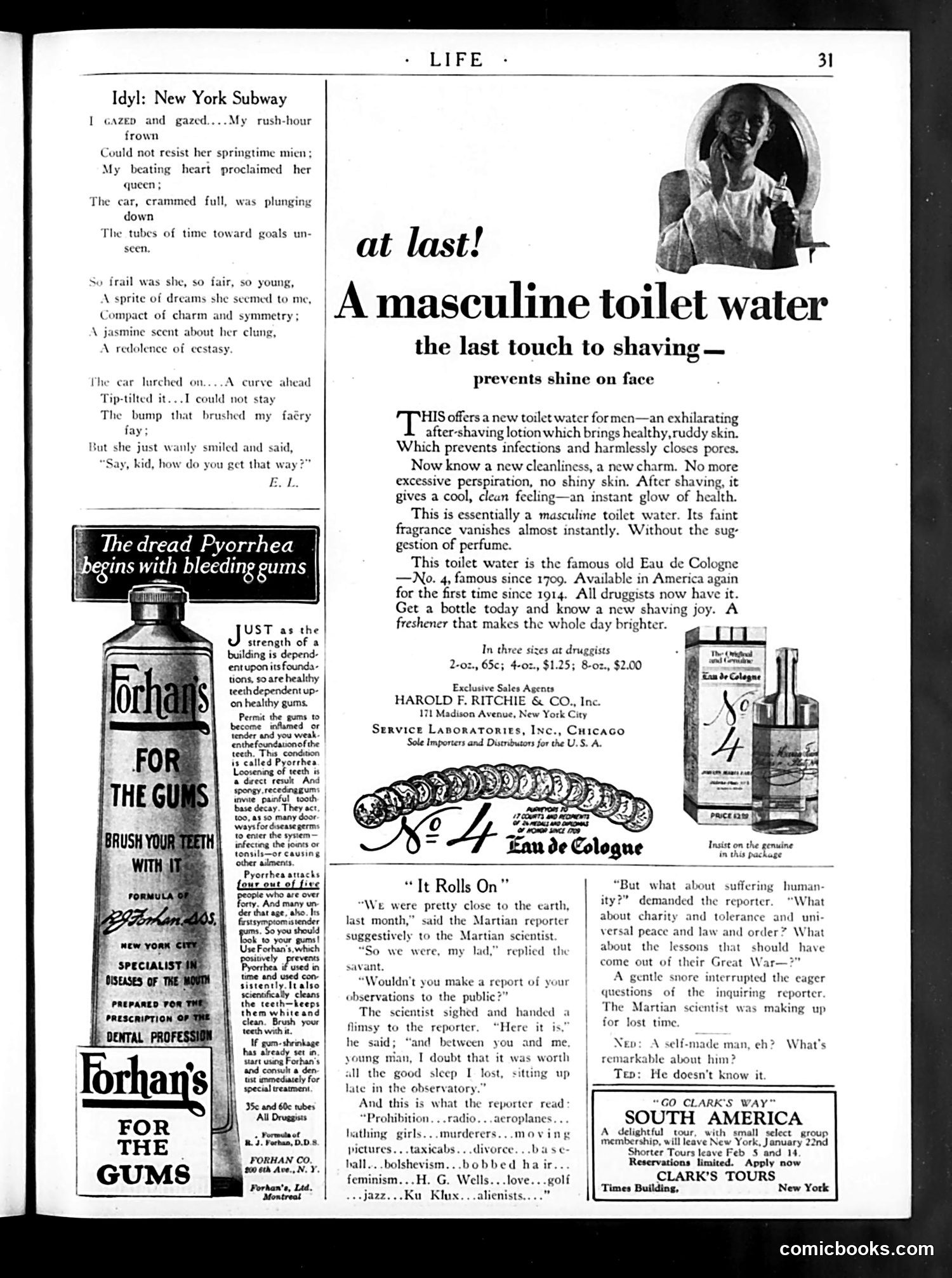
This page primarily contains **advertisements** and a light satirical piece, not political cartoons. The main content is an ad for "Eau de Cologne No. 4," a masculine toilet water marketed as preventing skin shine after shaving—reflecting early 20th-century male grooming anxieties. Below that is a brief humorous sketch titled **"It Rolls On,"** depicting Martian observers discussing Earth. The joke satirizes modern civilization: a Martian reporter asks a scientist about humanity's progress regarding charity, peace, and lessons from "their Great War" (WWI). The scientist dismisses the question, having fallen asleep—suggesting Earth's developments are trivial and repetitive. The "report" lists contemporary concerns: prohibition, radio, airplanes, divorce, Bolshevism, bobbed hair, flappers, jazz, and the KKK. The satire suggests that despite technological progress, humanity hasn't fundamentally improved. The page also advertises **Forhan's for the Gums**, a dental product addressing pyorrhea (gum disease).
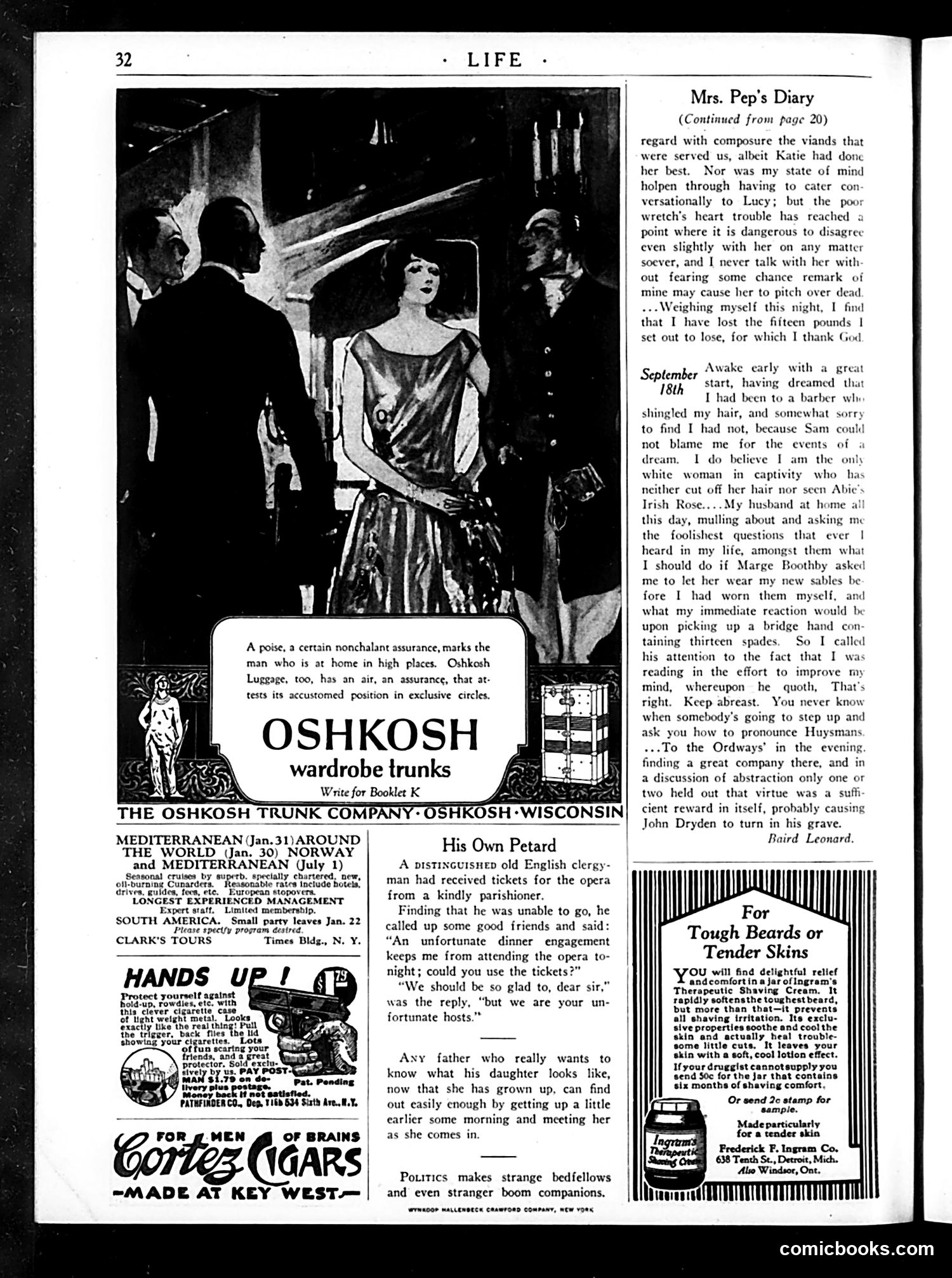
This page features a fictionalized diary entry about upper-class social life. "Mrs. Pep" describes domestic concerns (weight loss, a husband asking foolish questions) and social visits, including a reference to "Abie's Irish Rose"—a popular 1920s play stereotyping Irish-Jewish romance that was frequently mocked. The small story "His Own Petard" is a brief morality joke: an English clergyman tries to avoid a dinner by claiming he has opera tickets, giving them away—only to have his lie backfire when his friends refuse to use them either, trapping him in his own excuse. The page is primarily devoted to period advertisements (Oshkosh trunks, Cortez cigars, travel tours, grooming products), which dominated *Life* magazine during this era. The satirical content is gentle domestic humor rather than political commentary—typical of 1920s-era *Life*.
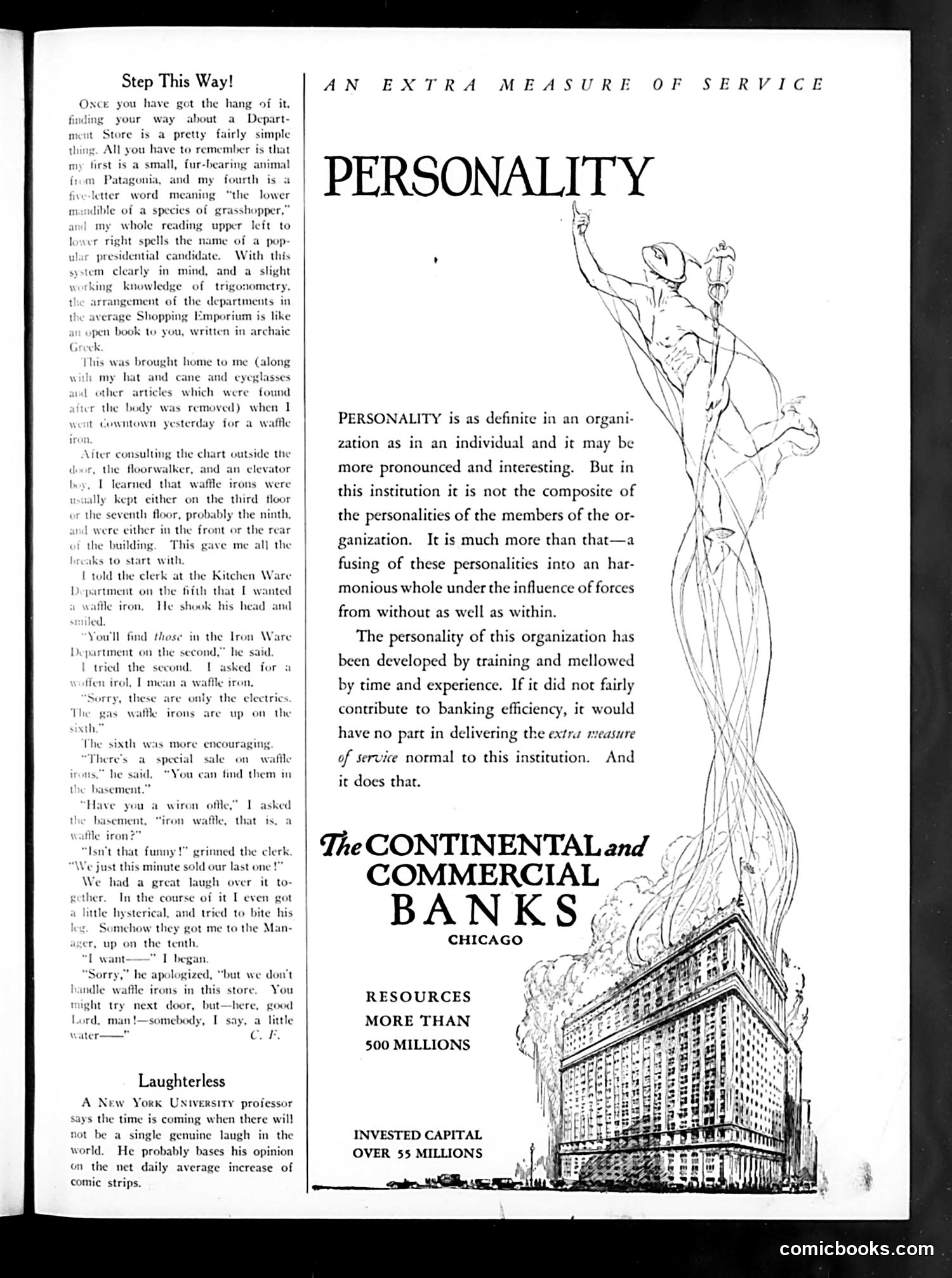
This page combines satirical humor with banking advertising. The left column presents "Step This Way!"—a comedic narrative about a customer searching a department store for a waffle iron. The joke unfolds through bureaucratic absurdity: the item exists in multiple locations (third floor, seventh floor, ninth floor, second floor, sixth floor, basement) yet is perpetually unavailable. The store manager's exasperation suggests the customer's frustration mirrors the chaotic inefficiency of modern retail. The bottom section, "Laughterless," satirizes mass culture, with a NYU professor claiming comic strips are destroying genuine humor—a meta-joke about Life's own comedic medium. The right page advertises The Continental and Commercial Bank of Chicago, using a classical allegorical figure to represent institutional "personality" and reliability—contrasting sharply with the department store's comedic chaos. The advertisement claims this bank's organizational personality contributes to banking efficiency and superior service. The juxtaposition appears intentional: Life mocks commercial inefficiency while selling financial stability.
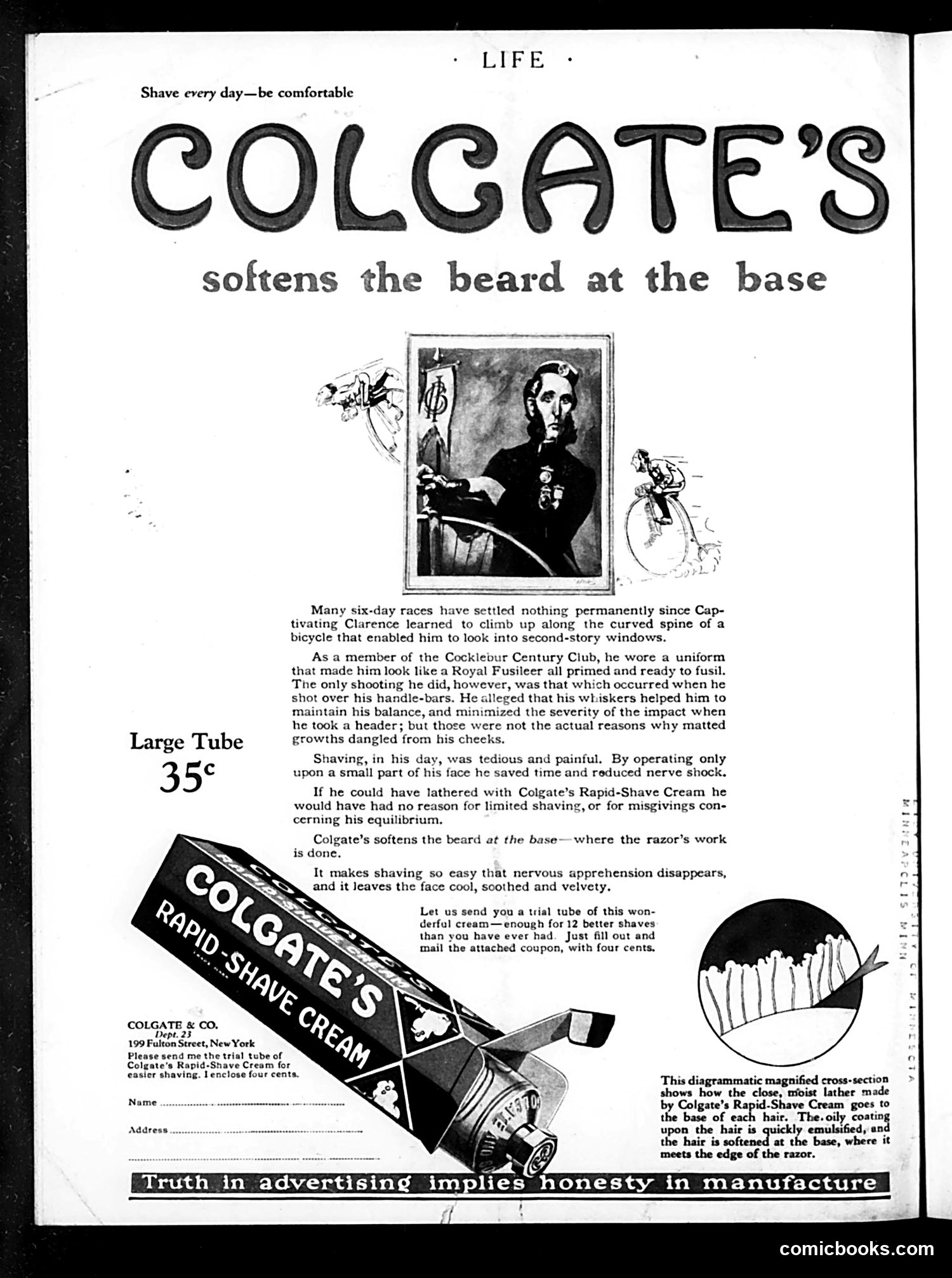
This is primarily a **shaving cream advertisement** rather than political satire. The narrative component is a humorous product endorsement dressed as a short story. The text describes "Captivating Clarence," a cyclist in the "Cocklebur Century Club" (appears to be a cycling club) who rode bicycles in six-day races—a real endurance sport popular in the early 20th century. The joke is that Clarence allegedly refused to shave completely, claiming his beard helped him maintain balance on his bicycle and cushioned falls. The advertisement's point: this excuse is ridiculous. If Clarence had used Colgate's Rapid-Shave Cream, which softens beard hair at the base, he would have had no reason to avoid regular shaving. The ad includes a magnified cross-section diagram showing how the lather penetrates to the hair's base for easier shaving. The page represents typical early-20th-century advertising strategy: embedding product promotion within amusing fictional narratives to make ads more memorable and entertaining to magazine readers.