
Life, 1924-09-18 · page 12 of 36
Life — September 18, 1924 — page 12: what you’re looking at
What you’re looking at
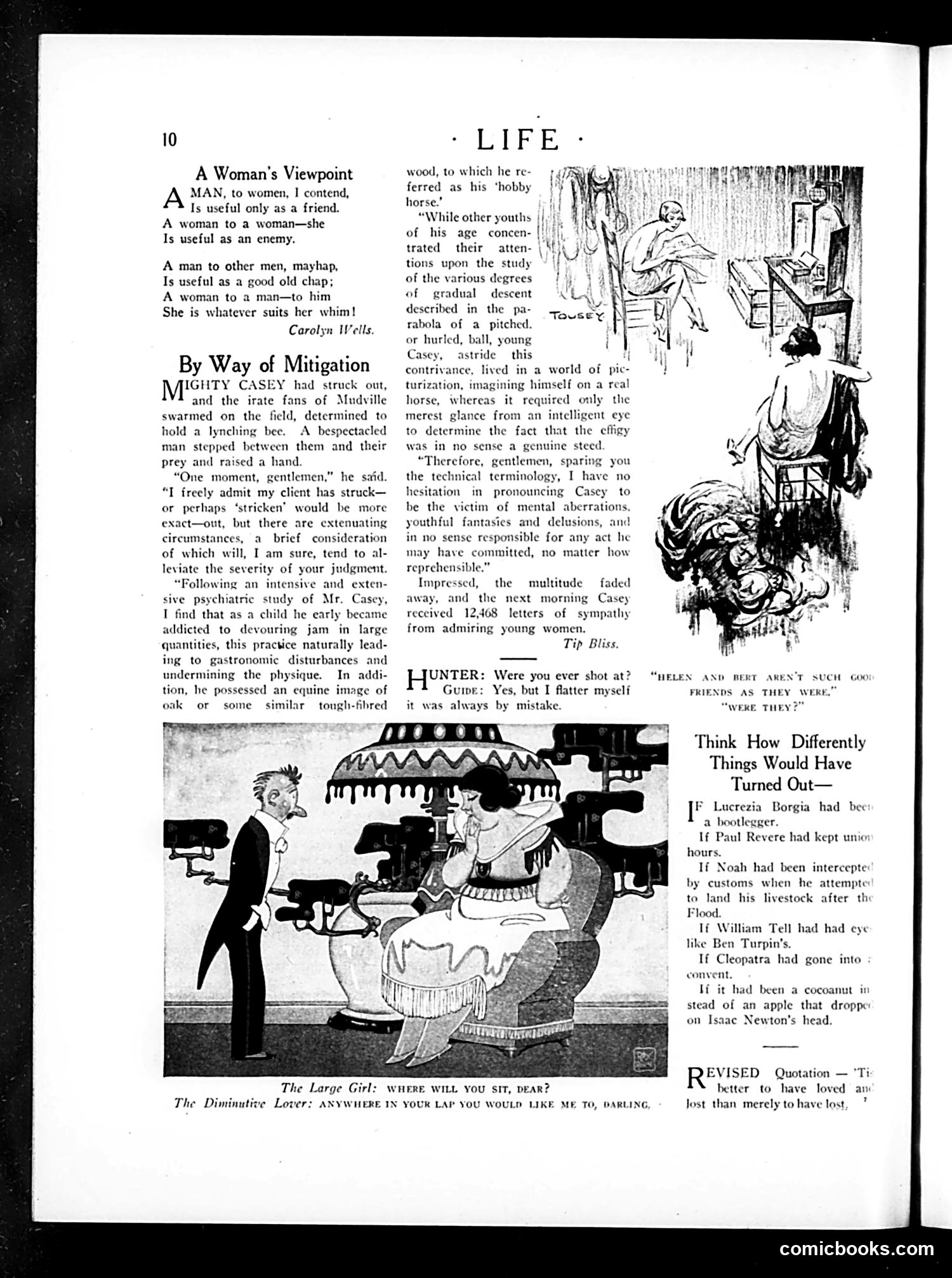
This page contains humor columns and illustrations typical of early 20th-century *Life* magazine's satirical style. **Top section** ("A Woman's Viewpoint"): A witty poem by Carolyn Wells presenting women's perspectives on men—claiming men are useful primarily as friends or "good old chaps," while women are whatever suits her whim. It's light satire on gender relations. **"By Way of Mitigation"**: A humorous defense of a character named Casey, who imagined himself as a "real horse" rather than an effigy. The author argues Casey's "mental aberrations" deserve sympathy rather than judgment. **Lower cartoons**: Show domestic and romantic scenes with exchanges between men and women, featuring typical *Life* magazine humor about courtship and relationships—notably the image labeled "The Diminutive Lover" with flirtatious dialogue. The page exemplifies early 1900s genteel satire focused on social manners and relations between genders.
📄 Transcribed text from this page (OCR, searchable)
Machine-transcribed from the original scan — historical spelling and the odd misread are preserved.
A Woman's Viewpoint MAN, to women, | contend, Is useful only as a friend. A woman to a woman—she Is useful as an enemy. A man to other men, mayhap, Is useful as a good old chap; A woman to a man—to him She is whatever suits her whim! Carolyn Wells. By Way of Mitigation IGHTY CASEY had struck out, and the irate fans of Mudville swarmed on the field, determined to hold a lynching bee. A bespectacled man stepped between them and their prey and raised a hand. “One moment, gentlemen,” he said. “I freely admit my client has struck— or perhaps ‘stricken’ would be more ct—out, but there are extenuating circumstances, a brief consideration of which will, I am sure, tend to al- leviate the severity of your judgment. “Following an intensive and exten- sive psychiatric study of Mr. Casey, I find that as a child he early became addicted to devouring jam in lar; quantities, this practice naturally lead- ing to gastronomic disturbances and undermining the physique. In addi- tion, he possessed an equine in oak or some similar tough-fibred wood, to which he re- ( ferred as his ‘hobby horse.’ “While other youths || of his age concen- {! trated their atten- | Mi) tions upon the study / |} of the various degrees t of gradual descent described in the pa- rabola of a pitched. or hurled, ball, young Casey, astride — this ance, lived in a world of pic- turization, imagining himself on a real horse, whereas it required only the merest glance from an intelligent eye to determine the fact that the effigy was in no sense a genuine steed “Therefore, gentlemen, sparing you the technical terminology, I have no hesitation in pronouncing Casey to be the victim of mental aberrations, youthful fantasies and delusions, and in no sense responsible for any act he may have committed, no matter how reprehensible.” Impressed, the multitude faded and the next morning Casey received 12,468 letters of sympathy from admiring young women. Tip Bliss. away, UNTER: Were you ever shot at? Guive: Yes, but I flatter m: it was alw by mistake. The Large Girl: Were WILL you SIT, DEAR? The Diminutive Lover: ANYWHERE IN YOUR LAP YOU WOULD LIKE ME TO, DARLING, “HELEN AND BERT AREN'T SUCH FRIENDS AS THEY WERE.” “WERE THEY?” G00! Think How Differently Things Would Have Turned Out— Ir Lucrezia Borgia had_ bee a bootlegger. If Paul Revere had kept union hours. If Noah had been intercepte by customs when he attempte to land his livestock after th Flood. If William Tell had had cye like Ben Turpin's. If Cleopatra had gone into convent. li it had been a cocoanut in stead of an apple that droppe on Isaac Newton's head. EVISED Quotation — ‘Ti better to have loved ani Jost than merely to have lost comicbooks.com