
Life, 1924-09-18 · page 16 of 36
Life — September 18, 1924 — page 16: what you’re looking at
What you’re looking at
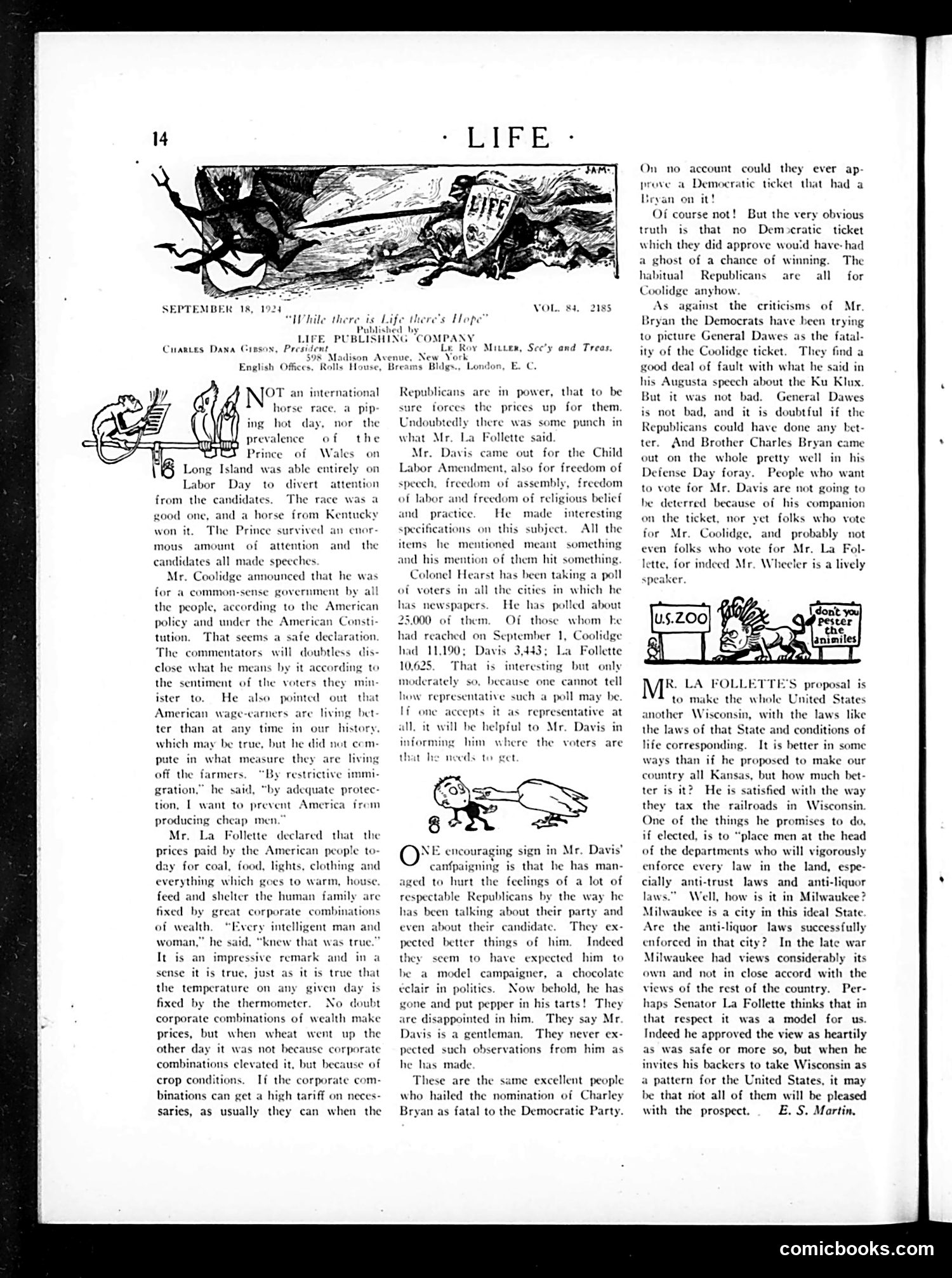
This page satirizes the 1924 U.S. presidential campaign. The main cartoon depicts a horse from Kentucky that "survived an enormous amount of attention" alongside other candidates—a joke about competing for voter attention during the campaign season. The text discusses Republican candidate General Davis's campaign for the Child Labor Amendment and other issues. It mocks Democratic criticism of Davis and defends his character against attacks. The article also critiques Mr. La Follette's proposal to make Wisconsin's laws a national model, questioning whether this would genuinely improve conditions. The cartoons (including small sketches of political figures) use visual humor to reinforce commentary on campaign promises and candidate credibility during this election cycle.
📄 Transcribed text from this page (OCR, searchable)
Machine-transcribed from the original scan — historical spelling and the odd misread are preserved.
SEPTEMBER 18, LIFE Cartes Dana Ginsoy, President 598 Madison Avenue, English Offices, Rolls House, Brea’ OT an international a pip ing hot day, nor the prevalence f the Prince of Wales on Long Island was able entirely on Labor Day to divert attention from the candidates. The race was a and a horse from Kentucky horse race. good one won it. The Prince survived an enor- mous amount of attention and the candidates all made speeches Mr. Coolidge announced that he was for a common-sense government by the people, according to the American policy and under the American Consti- tution. That seems a safe declaration The commentators will doubtless di close what he means by it according to the sentiment of the voters they min ister to. He also pointed out th American wage-carners are living bet ter than at any which may be true, but he did not com- pute in what measure they are living off the farmers, $y restrictive immi- “he said, “by adequate protec- tion, | want to prevent America frem time in our history, producing cheap men.” Mr. La Follette de that the prices paid by the American people to- day for coal, food, lights, clothing and erything which g feed and shelter the human family are fixed by great corporate combinations of wealth very intelligent man and woman,” he said, “knew that was true.” clared ps to warm, house. It is an impressive remark and in a sense it is true, just as it is true that the temperature on any fixed by the thermometer.) corporate combinations of wealth make prices, but when wheat went up the other day it was not be orate combinations clevated it, but because of crop conditions. If the corporate com- binations can get a high tariff on neces- saries, as usually they can when the iven day is loubt PUBLISHING COMPANY Le Roy Kew York s Bldgs., L Mitten, Sce’y and Treas. Republicans are in power, that to be prices up for them. Undoubtedly there was some punch in what Mr. La Follette said. Mr. for the Child abor Amendment, also for freedom of sure forces the Davis came out speech, freedom of assembly, freedom of labor and freedom of religious belief and practice. He specifications on this subject interesting All the something made items he mentioned meant and his mention of them hit something Colonel Hearst has been taking a poll ot voters in all the cities in which he has newspapers. He has polled about 25,000 of them. Of those whom ke had reached on September 1, Coolidge had 11,190; Davis 3,443; La Follette 10,625. That is but only moderately so, because one cannot tell how representative such a poll may be interesting If one accepts it as representative at all, it will be helpful to Mr. Davis in ming where the that he needs to get him voters are NE encouraging sign in Mr. Davis’ canfpaigning is that he has man- aged to hurt the feelings of a lot of respectable Republicans by the way he has been talking about their party and even about their candidate. They pected better things of him. Indeed they seem to have expected him to model campaigner, a chocolate éclair in politics. Now behold, he has and put pepper in his tarts! They are disappointed in him. They say Mr Davis is a gentleman. They never pected such observations from him as he has made. he a gone These are the same excellent people who hailed the nomination of Charley Bryan as fatal to the Democratic Party. On no account could they ever ap- prove a Democratic ticket that had a Bryan on it! Of course not! But the very obvious truth is that no Democratic ticket which they did approve wou'd have- had a ghost of a chance of winning. The habit Republicans are all for Coolidge anyhow. As against the criticisms of Mr. Bryan the Democrats have been trying to picture General Dawes as the fatal- ity of the Coolidge ticket. They find a good deal of fault with what he said in his Augusta speech about the Ku Klux. But it was not bad. General Dawes is not bad, and it is doubtful if the Republicans could have done any bet- And Brother Charles Bryan came out on the whole pretty well in his Defense Day foray. Peo to vote for Mr. Davis are not going to he deterred because of his companion on the ticket, nor yet folks who vote for Mr. Coolidge, and probably not even folks who vote for Mr. La Fol- for indeed Mr, Wheeler is a lively ter. ‘¢ who want LA FOLLETTE’S proposal is to make the whole United States another Wisconsin, with the laws like the laws of that State and conditions of life corresponding. It is better in some ways than if he proposed to make our country all Kansas, but how much bet- ter is it? He is satisfied with the way they tax the railroads in Wisconsin. One of the things he promises to do, if elected, is to “place men at the head of the departments who will vigorously enforce every law in the land, espe- cially anti-trust laws and anti-liquor Well, how is it in Milwaukee? Milwaukee is a city in this ideal State. Are the anti-liquor laws successfully enforced in that city? In the late war Milwaukee had views considerably its own and not in close accord with the views of the rest of the country. Per- haps Senator La Follette thinks that in that respect it was a model for us. Indeed he approved the view as heartily as was safe or more so, but when he invites his backers to take Wisconsin as a pattern for the United States, it may be that riot all of them will be pleased with the prospect. E. S. Martin, laws.” comicbooks.com