
Life, 1924-09-18 · page 20 of 36
Life — September 18, 1924 — page 20: what you’re looking at
What you’re looking at
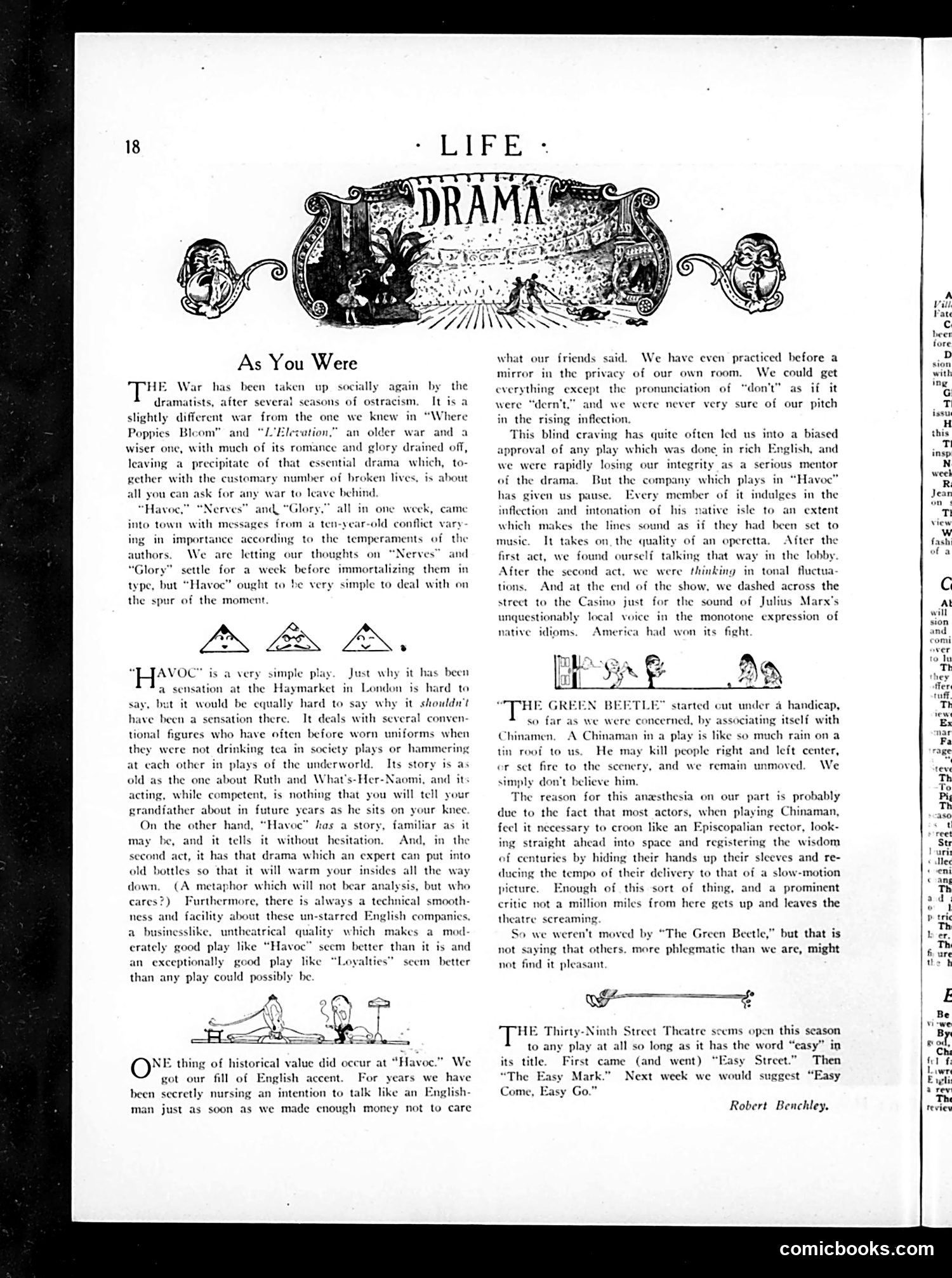
This page reviews three recent Broadway plays dealing with war themes: "Havoc," "The Green Beetle," and productions at the Thirty-Ninth Street Theatre. The author critiques "Havoc" as a competently executed but conventional play that relies on familiar dramatic formulas. A notable observation: the English cast's exaggerated accent and inflection become so pronounced they make dialogue sound like operetta—the reviewer and fellow audience members found themselves unconsciously imitating this theatrical English speech afterward. "The Green Beetle" is dismissed as ineffective because it involves Chinese characters. The reviewer explains that audiences simply don't find stage Chinamen believable, as most actors resort to unconvincing stereotypical "crooning" vocal delivery rather than authentic portrayal. The cartoonish illustrations appear to be simple theatrical vignettes. The satire targets both theatrical artificiality and the conventions of 1920s drama criticism—audiences' susceptibility to accent and cultural stereotypes over genuine dramatic merit.
📄 Transcribed text from this page (OCR, searchable)
Machine-transcribed from the original scan — historical spelling and the odd misread are preserved.
As You Were HE War has been taken up socially again by the dramatists, after seve slightly different war from the one we knew in “Where seasons of ostracism. It is a Poppies Bleom” and “1 ation,” an older war and a wiser one, with much of its romance and glory drained off, leaving a precipitate of that essential drama which, to- her with the customary number of broken lives, is about ny war to leave behind and “Glory,” all in one week, came ages from a ten car-old conflict vary into town with mes: ing in importance according to the temperaments of the uthors. We are letting our thoughts on “Nerves” and Glory” settle for a week before immortalizing them in type, but “Havoc” ought to be very simple to deal with on the spur of the moment. LN 2X 4X, AVOC" is a very simple play. Just why it has been a sensation at the Haymarket in London is hard to but it would be equally hard to say why it shouldn't have been a sensation there. It deals with several conven- tional figures who ¢ often before worn uniforms when they were not drinking tea in society plays or hammering say at cach other in plays of the underworld. Its story is as old as the one about Ruth and What's-Her-Naomi, and its acting, while competent, is nothing that you will tell your grandfather about in future years as he sits on your knee. On the other hand, “Havoc” has a story, familiar as it may be, and it tells it without hesitation. And, in the second act, it has that drama which an expert can put into old bottles so that it will warm your insides all the way down. (A metaphor which will not bear analysis, but who cares?) Furthermore, there is always a technical smooth- ness and facility about these un-starred English companies, a businesslike, untheatrical quality which makes a mod- erately good play like “Havoc” scem better than it is and an exceptionally good play like “Loyalties” seem better could possibly be. than any play 2 thing of historical value did occur at “Havoc.” We got our fill of English accent. For years we have been sceretly nursing an intention to talk like an English- man just as soon as we made cnough money not to care what our friends mirror in the priv everything except the pronunciation of “don't” as if it and we were never very sure of our pitch id. We have even practiced before a of our own room. We could get were “dern’t, in the rising inflection. This blind craving has quite often led us into a biased approval of any play which was done, in rich English, and we were rapidly losing our integrity as a serious mentor of the drama. But the company which plays in “Havoc” ven us pause. Every member of it indulges in the inflection and intonation of his native isle to an extent which makes the lines sound as if they had been set to music. It takes on the quality of an operetta, After the first act, we found ourself talking that way in the lobby. After the second act. we were thinking in tonal fluctua tions, And at the end of the show, we dashed across the ir the sound of Julius M the monotone expres: native idioms. America had won its fight 8 Di > GREEN BEET started cut under a handicap, so far as we were concerned, by associating itself with Chinamen, A Chinaman in a play is like so much rain ona tin roof to us. He may kill people right and left center, er set fire to the scenery, and we remain unmoved. We simply don’t believe him. The reason for this anxsthesia on our pa due to the fact that most actors, when playing Chinaman, feel it necessary to croon like an Episcopalian rector, look- ing straight ahead into space and registering the wisdom of centuries by hiding their hands up their sleeves and re- ducing the tempo of their delivery to that of a slow-motion picture. Enough of this sort of thing, and a prominent critic not a million miles from here gets up and leaves the theatre screaming. So we weren't moved by “The Green Beetle,” but that is not saying that others. more phlegmatic than we are, might not find it pleasant HE Thirty-Ninth Strect Theatre scems open this season to any play at all so long as it has the word “easy” in its title. st came (and went) asy Street.” Then “The Easy Mark.” Next week we would suggest “Easy Come, Easy Go.” has § x's street to the Casino just f unquestionably local voice ion of t is probably Robert Benchley. comicbooks.com