
A complete issue · 34 pages · 1923
Life — November 22, 1923
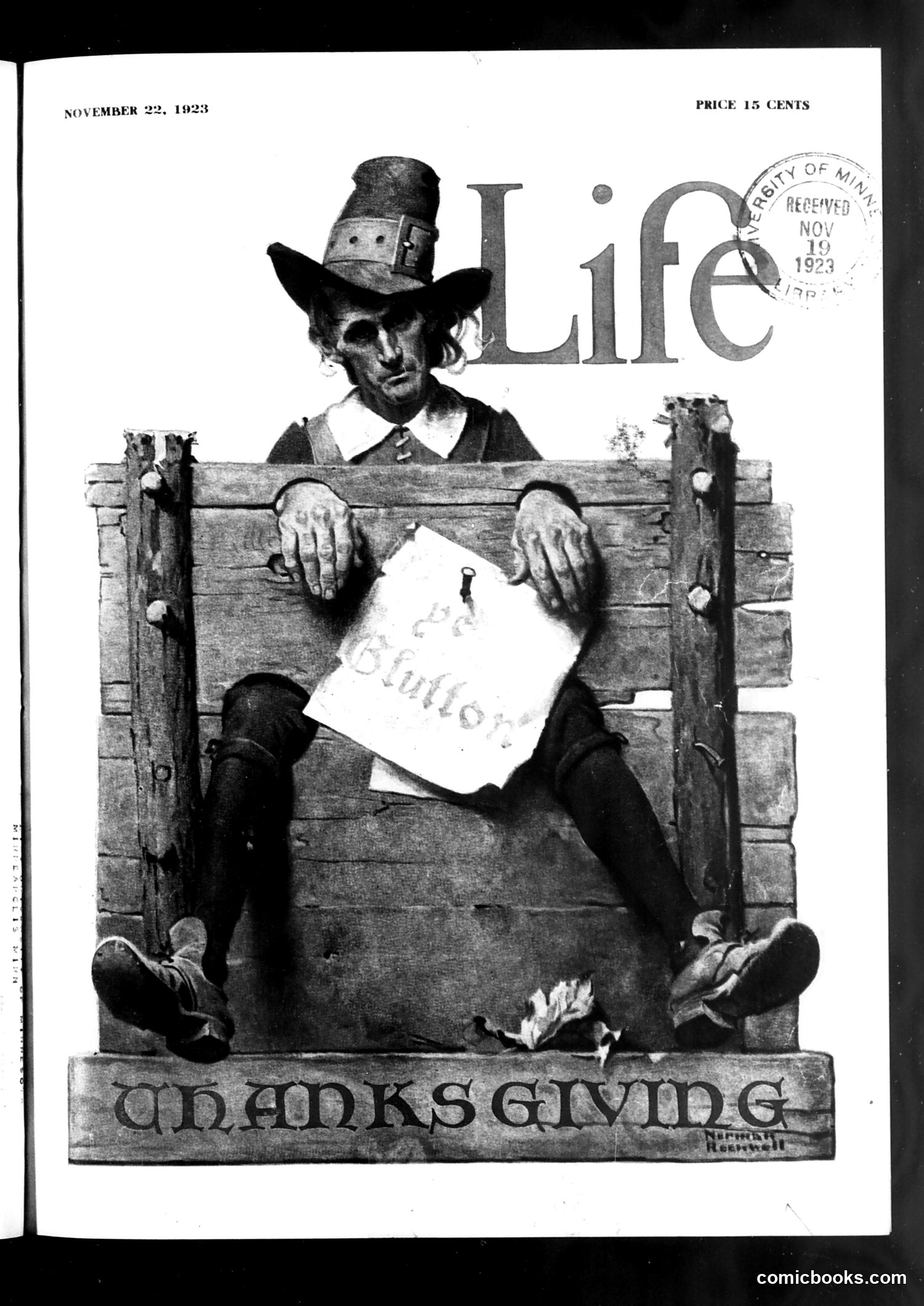
This is a Thanksgiving-themed cover from Life magazine (November 22, 1923). The illustration, signed by Rockwell, depicts a gaunt, impoverished figure sitting in a wooden crate, holding a note that appears to read "homeless." The character wears ragged clothes and a tall hat, presented as an ironic contrast to the holiday's traditional abundance. The satire critiques the gap between Thanksgiving's ideals of gratitude and plenty versus the reality of homelessness and poverty in 1920s America. The figure's exaggerated features and the juxtaposition of sitting in a crate—rather than around a feast table—underscores economic hardship during the post-World War I era. The title "Unamsgiving" (partially visible) reinforces the sardonic commentary on inequality during an ostensibly prosperous decade.
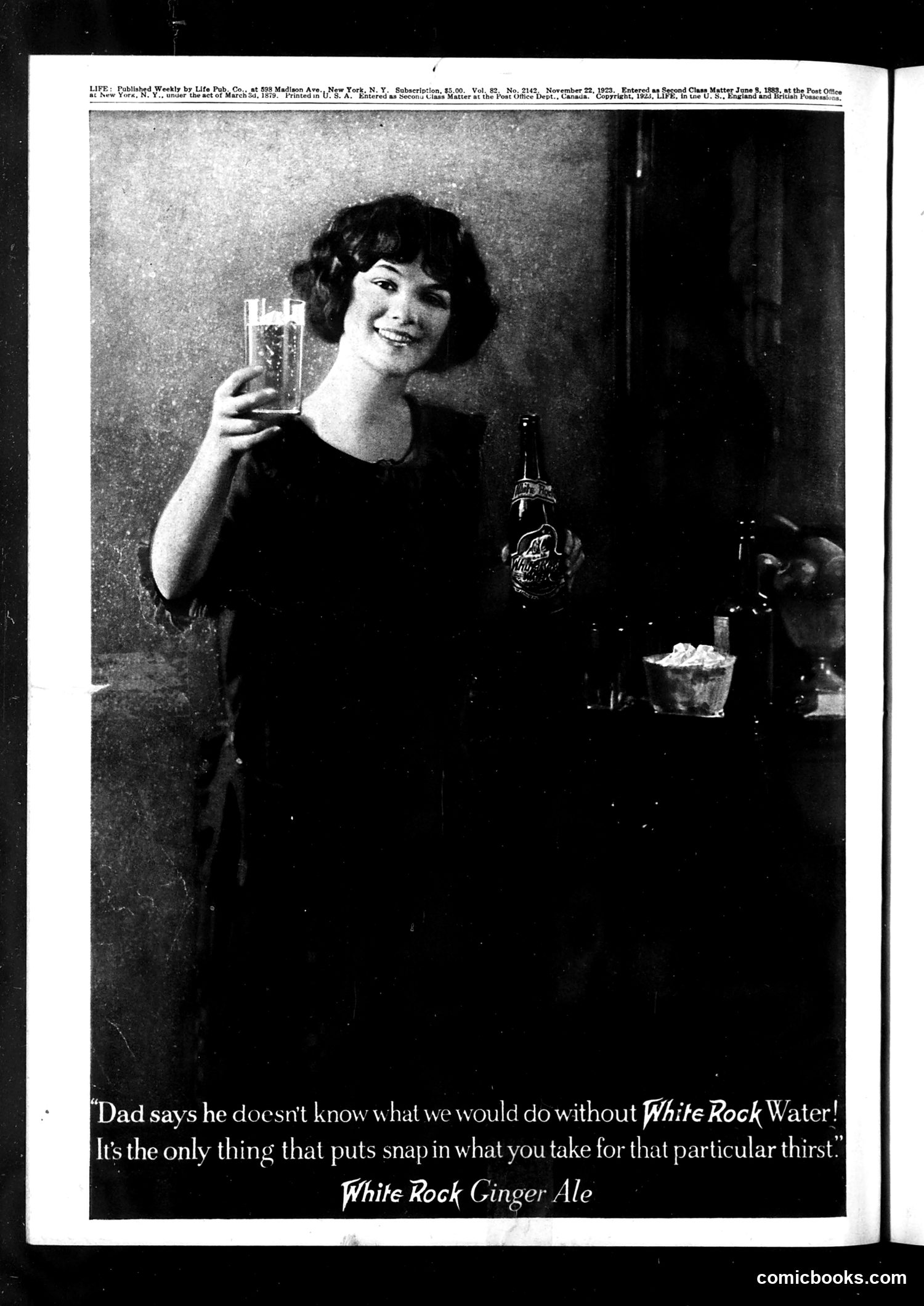
This is primarily **advertising content**, not satire or political commentary. The page features a 1920s advertisement for White Rock Ginger Ale and White Rock Water. The image shows a woman holding a glass of the beverage with a pleased expression, posed next to bottles and what appears to be a serving dish. The advertisement uses a domestic/family angle, with the quoted testimonial attributed to "Dad," suggesting the product's appeal to household consumption. The "snap" reference indicates the beverage's perceived refreshing quality. This represents typical early 20th-century product advertising that emphasized family endorsement and practical household utility rather than conveying political or satirical messages. The photographic style and typography are period-consistent with 1920s magazine advertising.
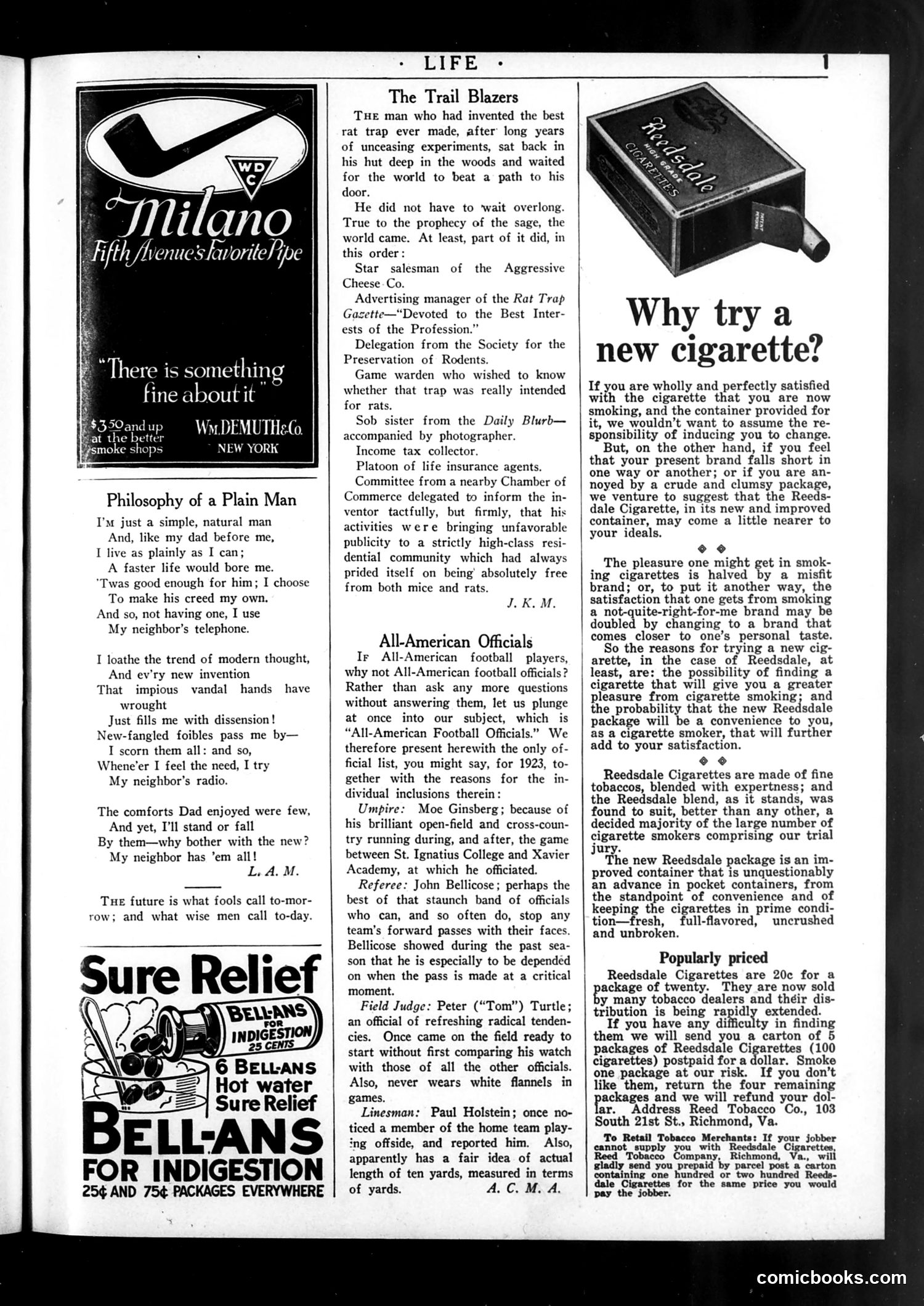
This page is primarily **advertising and humor columns** rather than political satire. The advertisements include Milano pipes, Reeddale Cigarettes, and Bellans indigestion relief. The Reeddale ad notably emphasizes its "improved container" as a reason to switch brands—a consumer marketing pitch. The humor section titled "The Trail Blazers" satirizes the common saying about building a better mousetrap: the inventor waits for the world to beat a path to his door, but instead receives visits from salesmen, tax collectors, and bureaucrats—a joke about unwanted commercial and governmental intrusion following success. "Philosophy of a Plain Man" humorously defends using a neighbor's telephone rather than getting one's own, reflecting early-20th-century attitudes toward shared utilities. The "All-American Officials" piece appears to discuss football officials' qualifications.
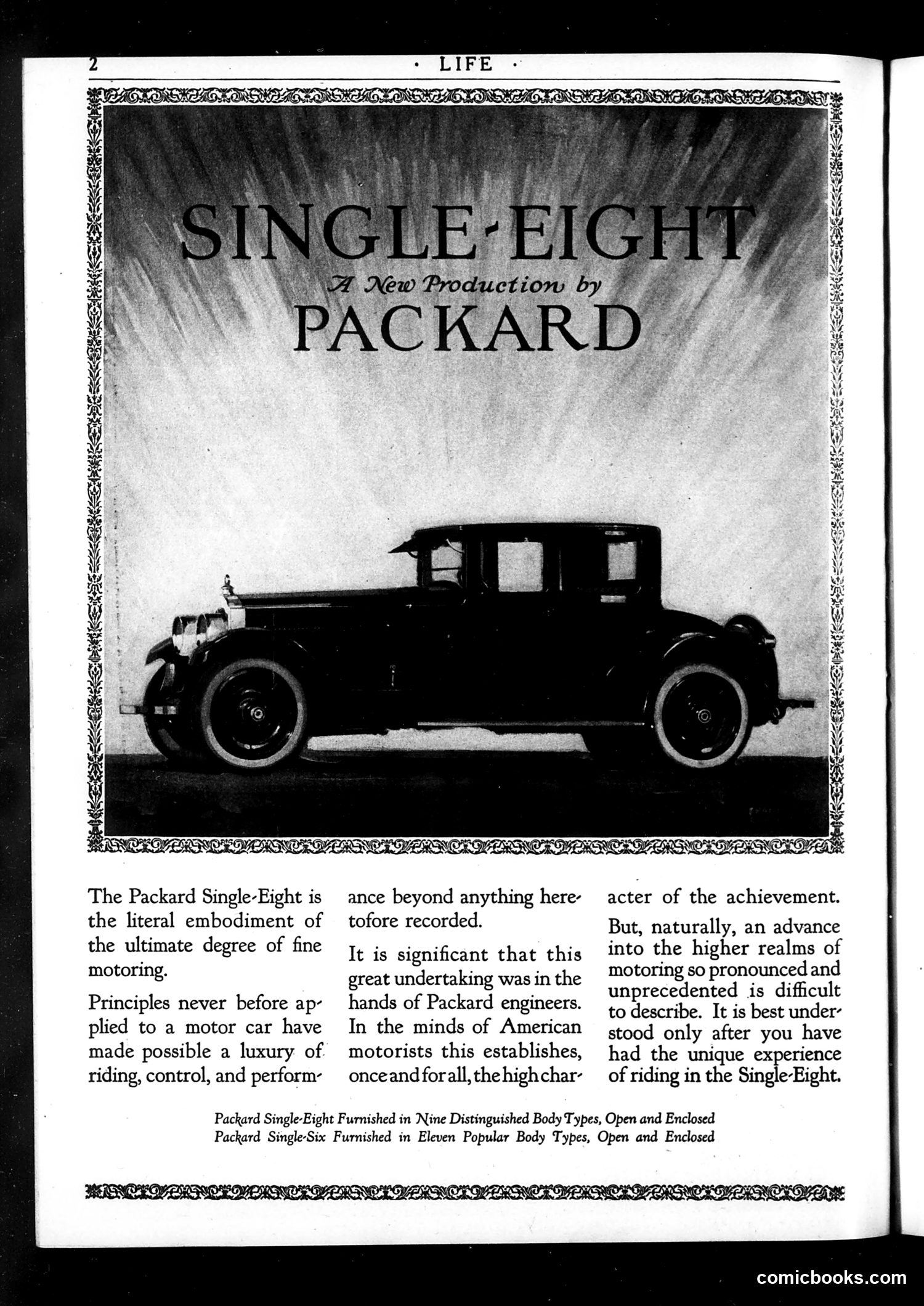
This page is **not a political cartoon or satire**—it's a straightforward advertisement for the Packard Single-Eight automobile, published in *Life* magazine. The ad emphasizes that Packard engineers have achieved unprecedented advances in luxury, control, and performance. The text claims the Single-Eight represents "the ultimate degree of fine motoring" and that "principles never before applied to a motor car" made this possible. The image shows a side profile of the elegant, enclosed automobile against a radiating background. The ad notes the Single-Eight came in nine body types and the Single-Six in eleven types. This reflects early 20th-century automotive advertising's focus on engineering innovation and luxury as status markers for affluent buyers.
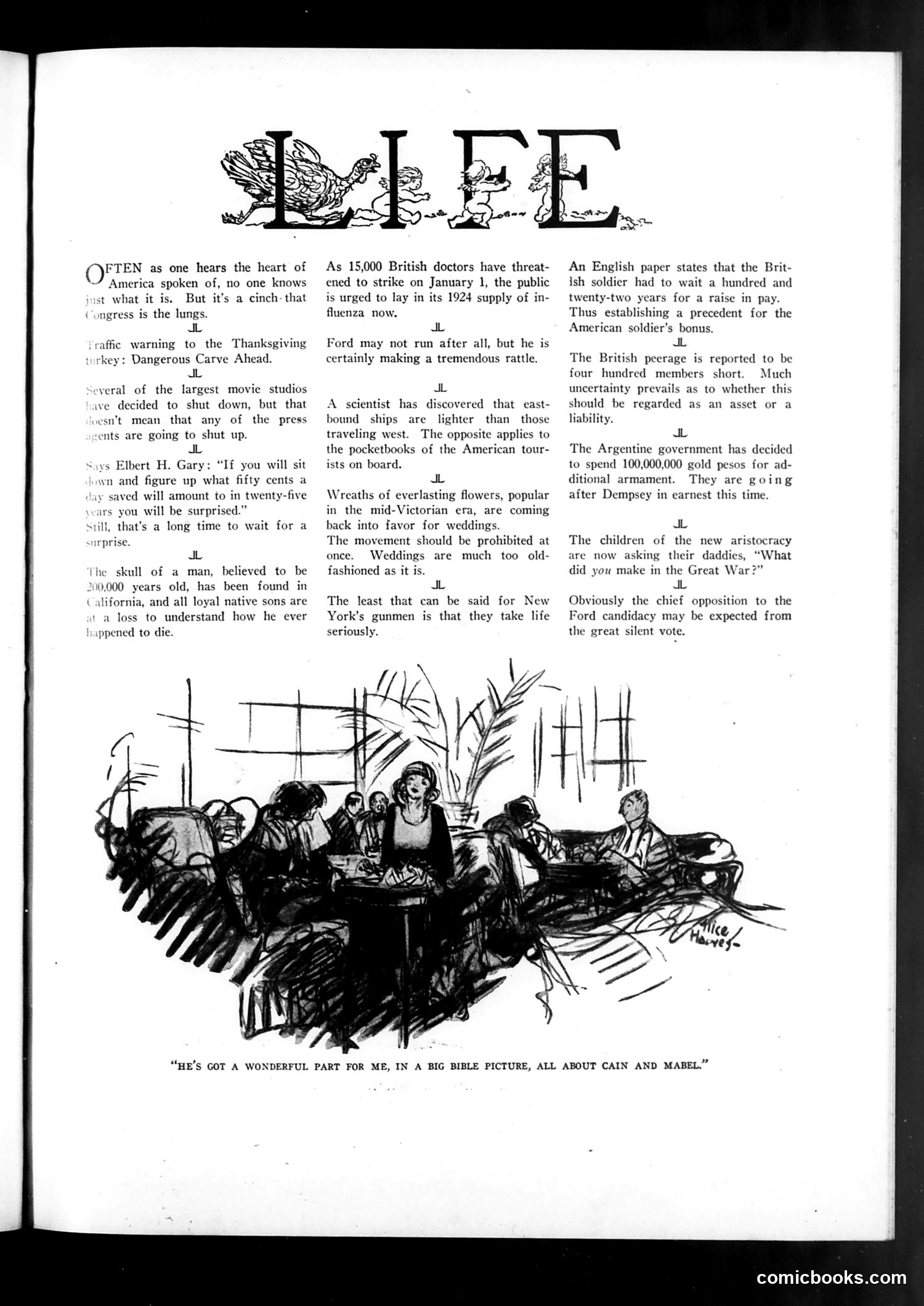
This page contains satirical news briefs and one cartoon. The cartoon depicts a woman at a dinner table surrounded by men, with the caption: "He's got a wonderful part for me, in a big Bible picture, all about Cain and Mabel." The joke appears to mock Hollywood's tendency to adapt or misrepresent Biblical stories for commercial entertainment. "Cain and Mabel" plays on the actual Biblical story of Cain and Abel, suggesting filmmakers might carelessly rename or alter religious narratives for box-office appeal. The woman's eager response to a "part" in such a project satirizes both the film industry's opportunism and actors' willingness to participate in dubious productions. The surrounding text items discuss 1920s topics including doctor strikes, Ford automobiles, and Argentine politics—typical Life magazine fare mixing humor with contemporary events.
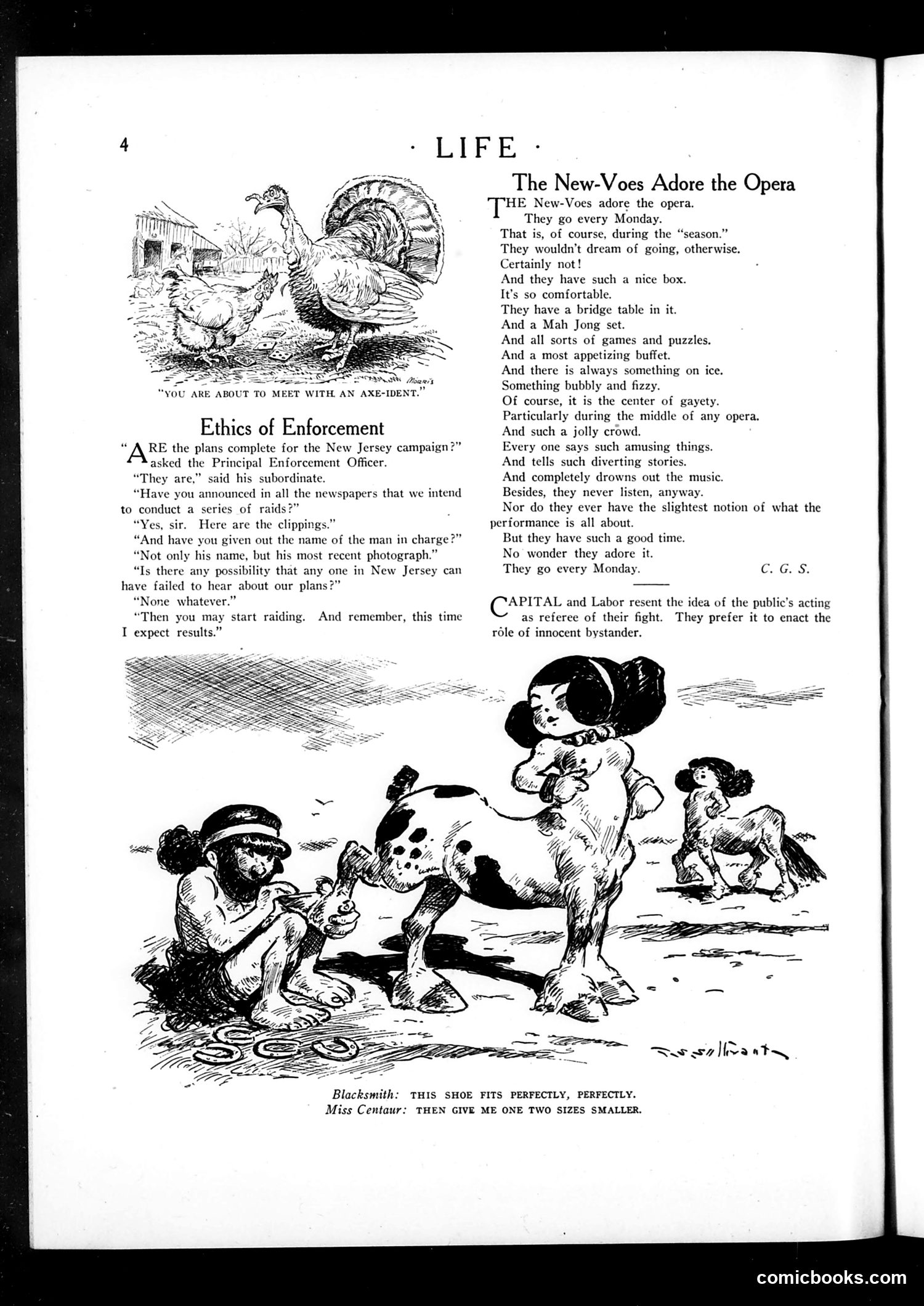
This page contains three distinct pieces: 1. **"The New-Voes Adore the Opera"** (top right): A humorous poem mocking wealthy New York society women ("New-Voes") who attend the opera primarily for socializing rather than appreciating the music. They're depicted as indifferent to the actual performance, instead enjoying the fashionable venue, refreshments, and gossip. 2. **"Ethics of Enforcement"** (middle left): A satirical dialogue about a New Jersey police raid campaign. The Principal Enforcement Officer boasts about planned raids, but the humor suggests ineffectiveness or corruption—"expecting results" implies previous failures. 3. **"Blacksmith/Miss Centaur" cartoon** (bottom): A slapstick illustration depicting a blacksmith fitting a shoe on a centaur (half-woman, half-horse mythological creature), with the centaur requesting two smaller sizes. The joke plays on the absurdity of the situation.
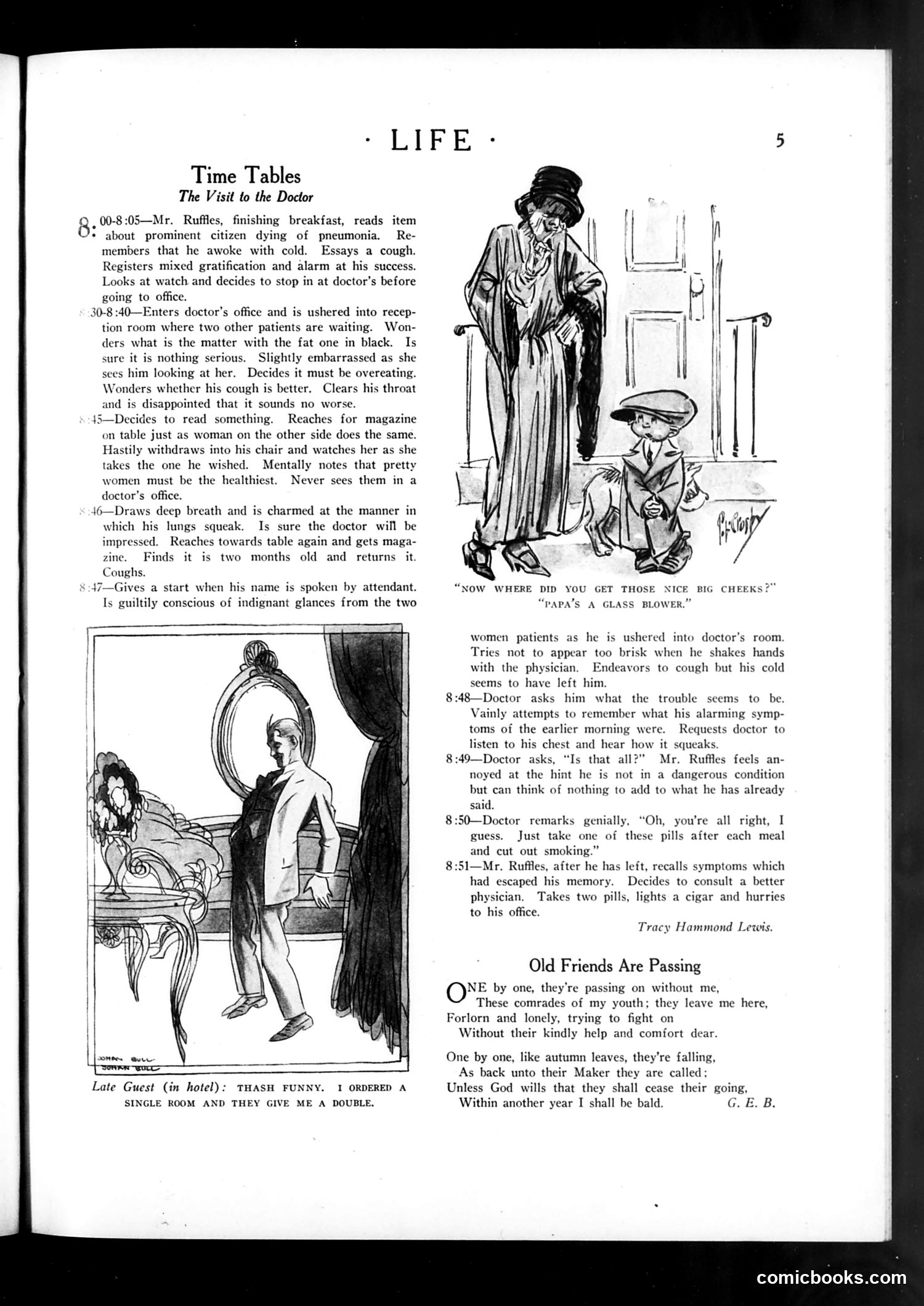
This satirical piece mocks a hypochondriac named Mr. Ruffles who visits a physician about pneumonia symptoms. The humor derives from his exaggerated anxiety contrasting with the doctor's dismissive pragmatism. Key satirical points: 1. **The patient's neurosis**: Ruffles obsesses over minor symptoms, imagining catastrophic illness despite the doctor's reassurance. 2. **Medical condescension**: The physician treats him dismissively, prescribing simple remedies (pills and rest) rather than engaging seriously. 3. **Class/gender observation**: The text notes how anxious women patients appear healthier than hypochondriac men. 4. **Social commentary**: The cartoons illustrate the absurdity of excessive health anxiety—a timeless satirical target mocking those who transform minor ailments into existential crises. The accompanying hotel cartoon provides comic relief through unrelated wordplay.
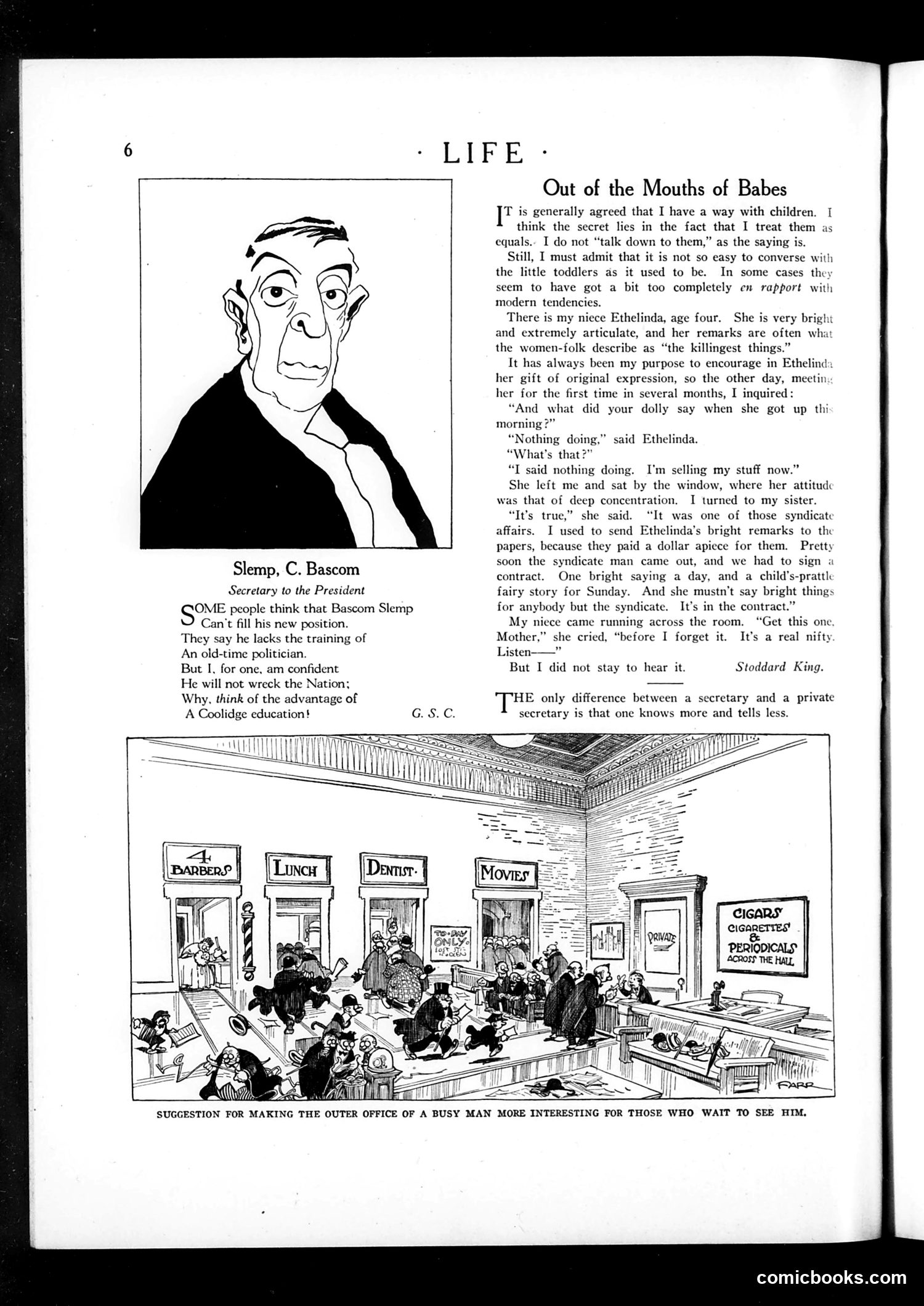
This page contains two distinct satirical pieces: **Top Section**: A caricatured portrait of "Slemp, C. Bascom" identified as "Secretary to the President." The accompanying poem mocks him as an unqualified politician who gained his position through party loyalty rather than merit, with the final line sarcastically suggesting a "Coolidge education" as his advantage. **Bottom Section**: A cartoon depicting a crowded hallway outside various professional offices (barber, lunch, dentist, movies, cigars). The caption suggests this cluttered waiting area represents how a "busy man's office" appears to those visiting him—a satirical commentary on inefficiency and poor office management in the early 20th century. Both pieces use humor to critique government incompetence and workplace disorganization.
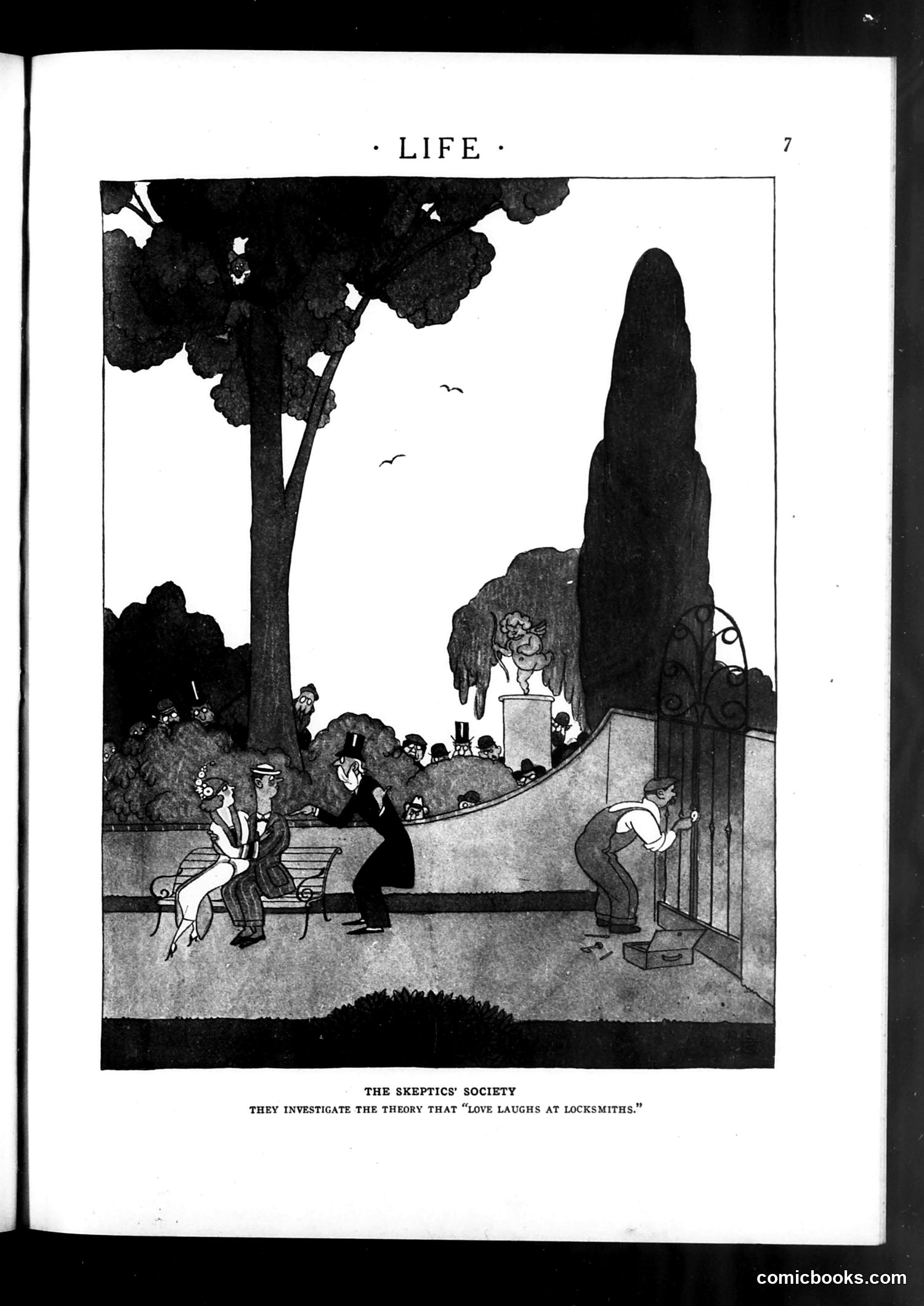
This satirical cartoon depicts members of "The Skeptics' Society" investigating the theory that "love laughs at locksmiths." The scene shows a park or public garden with well-dressed figures observing a couple on a bench—apparently a romantic encounter. A man peers through what appears to be a telescope or viewing device on the right, while onlookers in the background watch intently. The joke targets both romantic skepticism and Victorian-era social observation: the "skeptics" are literally investigating whether love truly overcomes practical barriers (locksmiths = locked doors/social propriety). The cartoon mocks both cynical disbelief in romance and the era's tendency toward voyeuristic social commentary. The formal dress and setting emphasize the absurdity of such "scientific" scrutiny of intimate human behavior.
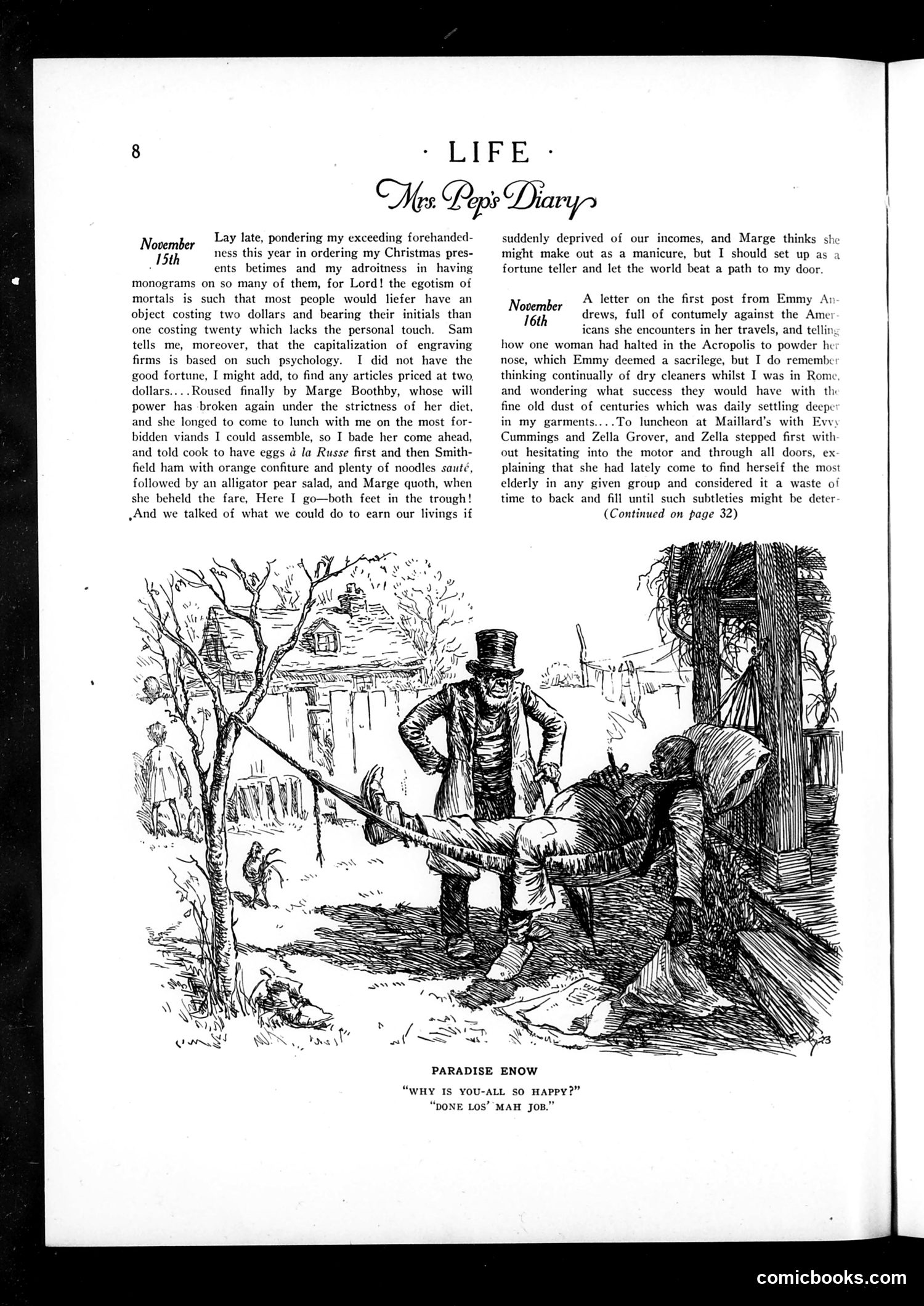
This cartoon illustrates a winter scene with the caption "Why is you-all so happy?" / "Done los' mah job." The humor relies on dialect comedy and class commentary common to early 20th-century American satire. A man in tattered clothing celebrates having lost his employment, suggesting that poverty or joblessness paradoxically brings contentment—possibly because it frees him from labor obligations or removes pretense. The "Paradise Enow" title references contentment with simple circumstances. The cartoon likely satirizes either working-class resilience or, conversely, mocks those perceived as lazy or content in destitution. The dialect spelling ("you-all," "los'," "mah") reflects the period's stereotyping of rural or Southern workers, which was typical of *Life* magazine's satirical approach during this era.
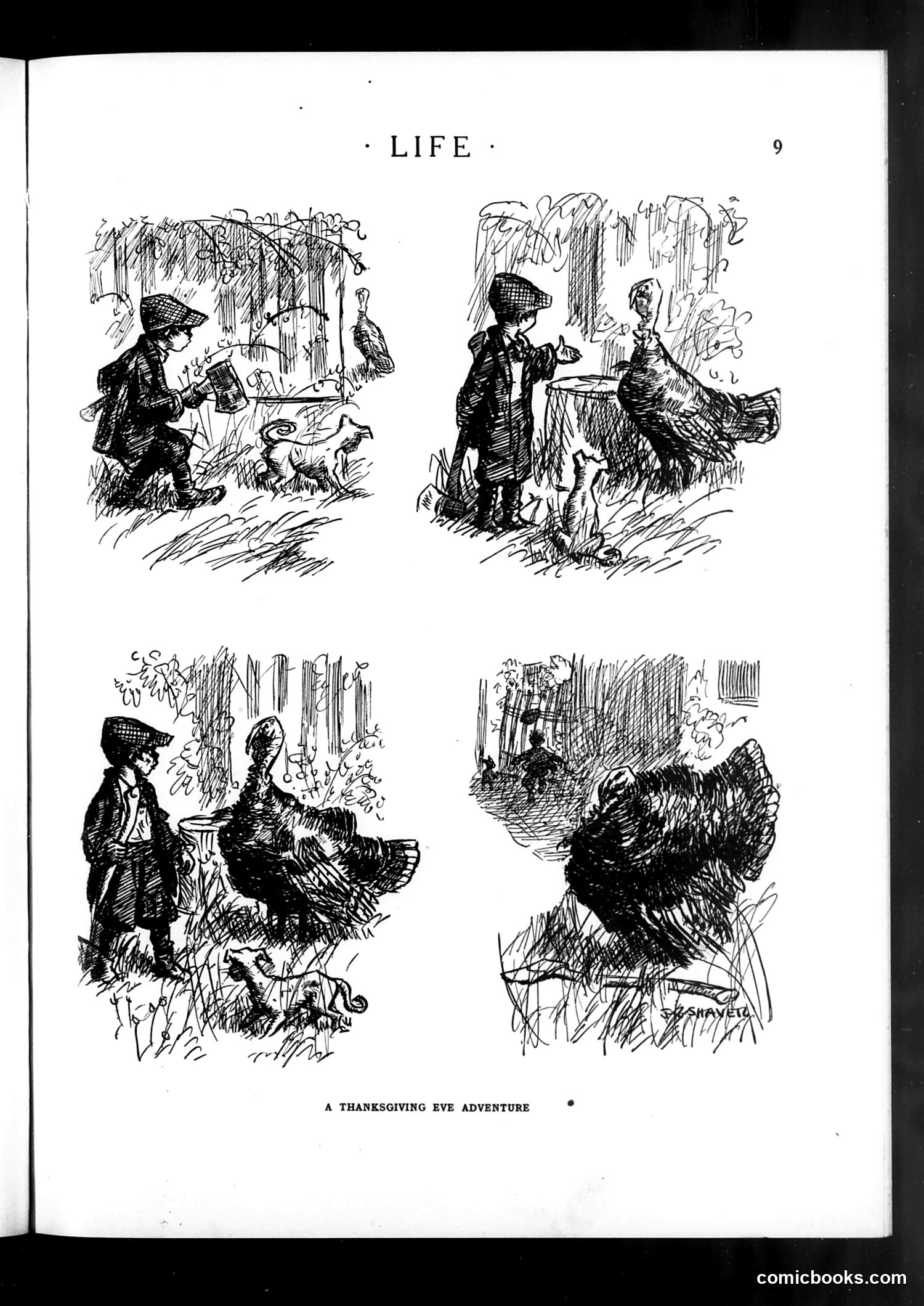
This four-panel satirical comic depicts a young boy's mischievous encounter with a turkey on the eve of Thanksgiving. The sequence shows: 1. The boy discovering a turkey near a willow tree 2. The boy confronting the bird 3. An apparent chase or struggle between boy and turkey 4. What appears to be a chaotic finale The satire plays on the dark humor of Thanksgiving's purpose—the turkey's fate as a holiday meal—juxtaposed with a child's innocent adventure. The comic treats the turkey as an active participant in the drama rather than a passive victim, creating comedic tension. This reflects early-20th-century Life magazine's characteristic blend of slapstick humor and gentle social commentary, using holiday traditions as material for absurdist, family-friendly entertainment.
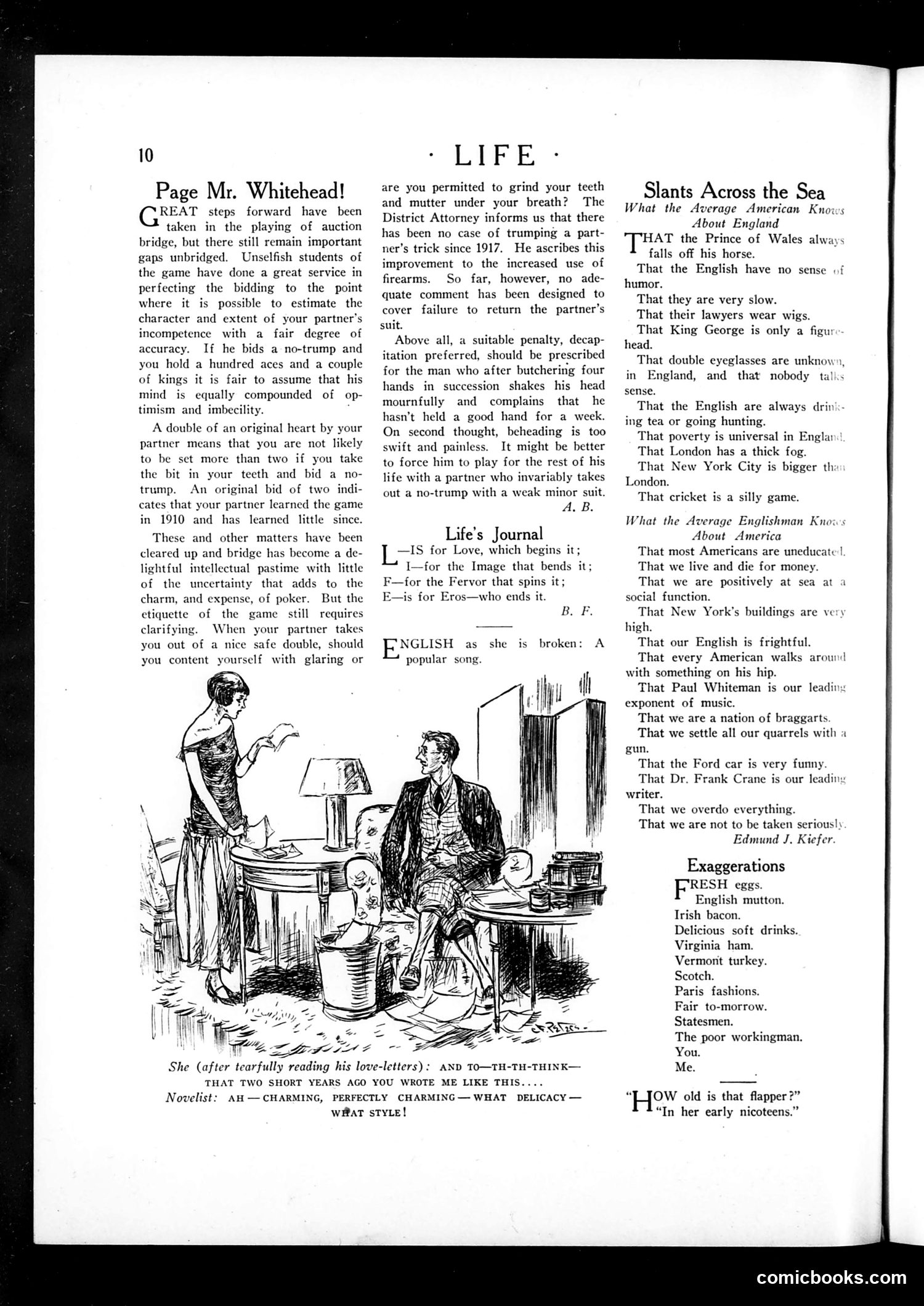
This page contains humorous social commentary rather than political cartoons. The main illustration depicts a woman reading love letters aloud to a man, with the caption suggesting romantic correspondence from years past. The joke plays on the contrast between the woman's affected, dramatic reading style ("ah—charming, perfectly charming—what delicacy—what style!") and the implied mediocrity of the actual letters. The surrounding text sections mock British and American stereotypes. "Slants Across the Sea" presents exaggerated generalizations about English people (slow lawyers, thick fog in London, universal poverty). "What the Average Englishman Knows About America" similarly satirizes American traits through stereotypes about money, New York's height, and gun violence. The final "Exaggerations" section lists foods and concepts Americans overstate the quality of.
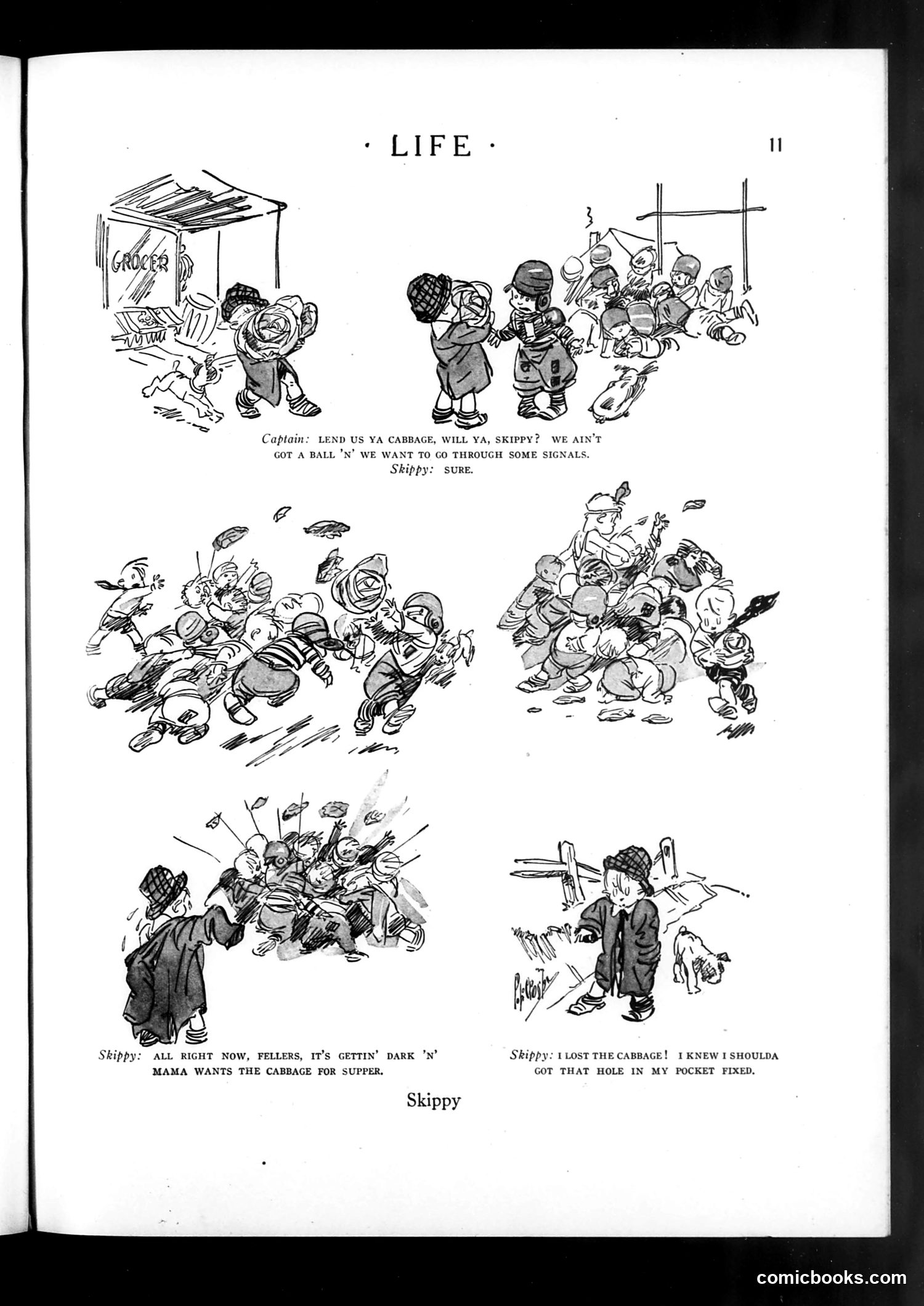
This page presents a sequential comic strip titled "Skippy" depicting a children's street game gone wrong. The narrative follows: 1. A captain enlists "Skippy" to borrow a grocery cart to play a street game 2. Children commandeer the cart for their game 3. The game descends into chaos as children scatter and fight 4. Skippy loses control of the cart entirely 5. Skippy laments the lost cart to his mother, discovering a hole in his pocket The satire targets urban children's mischief and irresponsibility. The humor derives from Skippy's predicament—he loses his mother's grocery cart to neighborhood chaos, then discovers his only explanation (a hole in his pocket) proves his carelessness. It's gentle social commentary on childhood troublemaking in working-class urban neighborhoods, typical of early 20th-century Life magazine's humor.
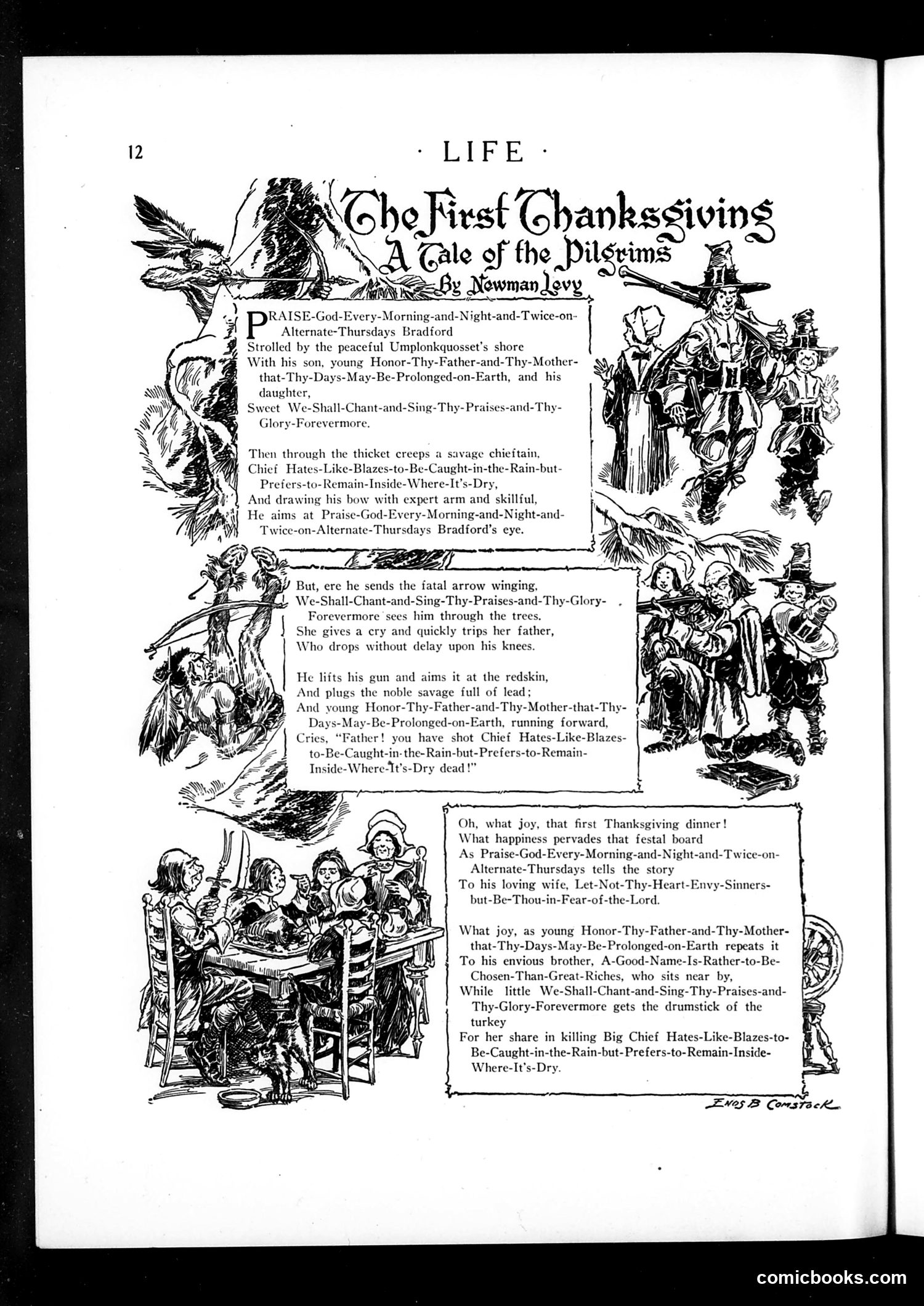
This is a humorous illustrated poem satirizing Pilgrims and Native Americans through absurdly long, Puritan-style names. The narrative describes a conflict where Chief "Hates-Like-Blazes-to-Be-Caught-in-the-Rain-but-Prefers-to-Remain-Inside-Where-It's-Dry" shoots at settler "Praise-God-Every-Morning-and-Night-and-Twice-on-Alternate-Thursdays Bradford," who then shoots back. The settler's family celebrates their "first Thanksgiving dinner" afterward, with children bearing similarly ridiculous compound names. The satire mocks both the verbose Puritan naming conventions of early colonists and contemporary stereotypes of Native Americans. The joke relies on the contrast between elevated historical mythology of Thanksgiving and the comic violence underlying the Pilgrims' actual colonization of Native lands.
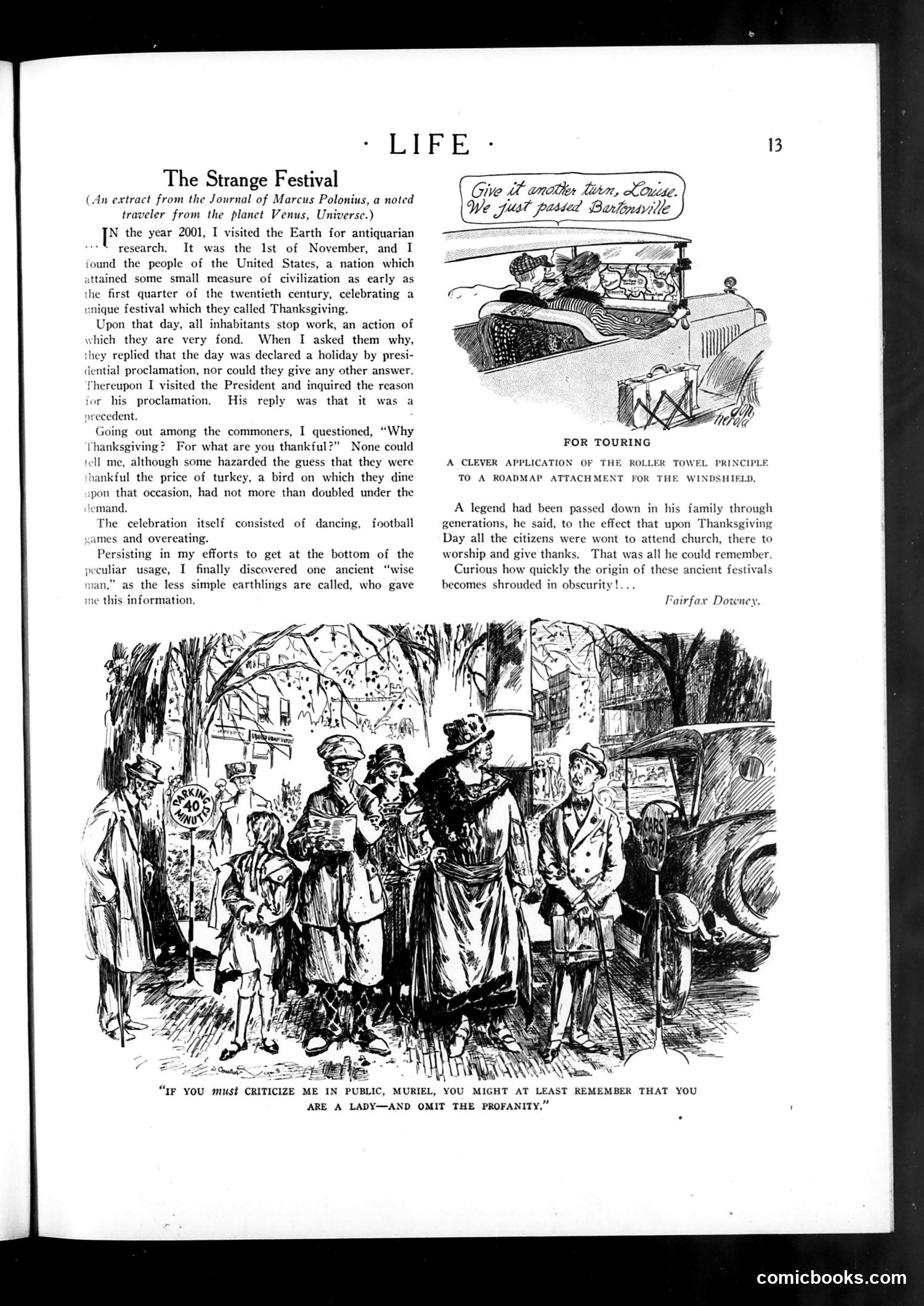
This page contains two satirical pieces about American Thanksgiving traditions. **"The Strange Festival"** (top) is a fictional account from a supposed extraterrestrial visitor observing Earth in 2001. The joke mocks Americans' inability to explain Thanksgiving's actual purpose—they can only point to it being a "holiday by presidential proclamation." The satire suggests Americans celebrate without understanding why, merely following tradition. The accompanying car illustration shows a practical "clever application of the roller towel principle to a roadmap attachment for the windshield"—a humorous fake invention. **The bottom cartoon** depicts a street scene where a woman publicly criticizes a man, with his response: "If you must criticize me in public, Muriel, you might at least remember that you are a lady—and omit the profanity." The joke relies on the irony of a man lecturing a woman about ladylike behavior while she's apparently cursing at him in the street.
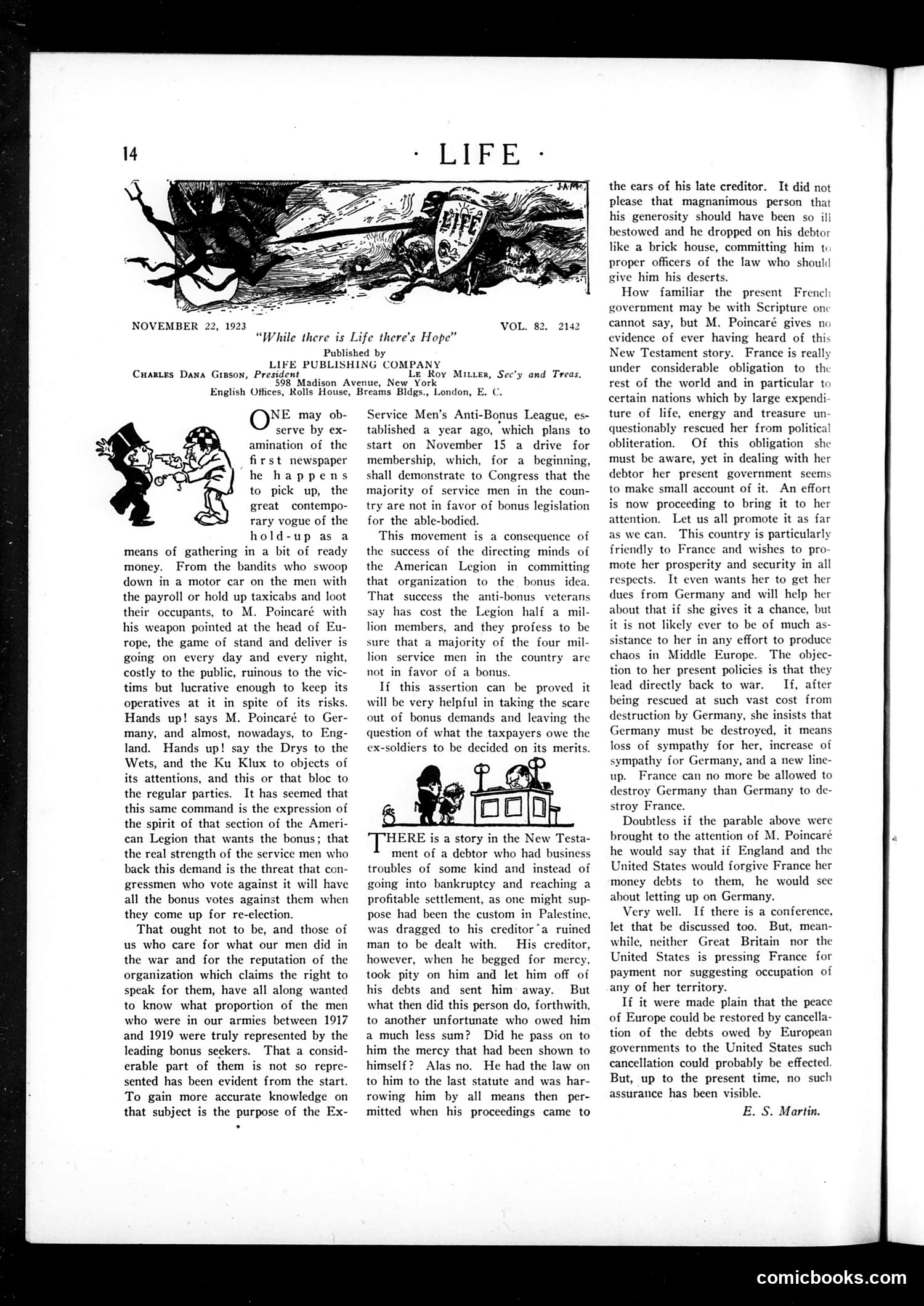
This page discusses the American Legion's anti-bonus campaign, opposing a proposed bonus for WWI veterans. The small cartoon shows two figures (likely a politician and veteran) in confrontation, reflecting the contentious debate. The main article criticizes the bonus movement, arguing that service men shouldn't receive extra compensation beyond their salaries. The text references the Legion's successful 1922 campaign against bonus legislation and notes growing pressure to reconsider. A secondary article discusses international debt: a debtor unable to pay his creditor becomes a parable for France's financial obligations to Britain and the United States following WWI. The satire suggests that forgiving debts might benefit Europe and prevent future conflict, contrasting with hardline creditor nations' positions.
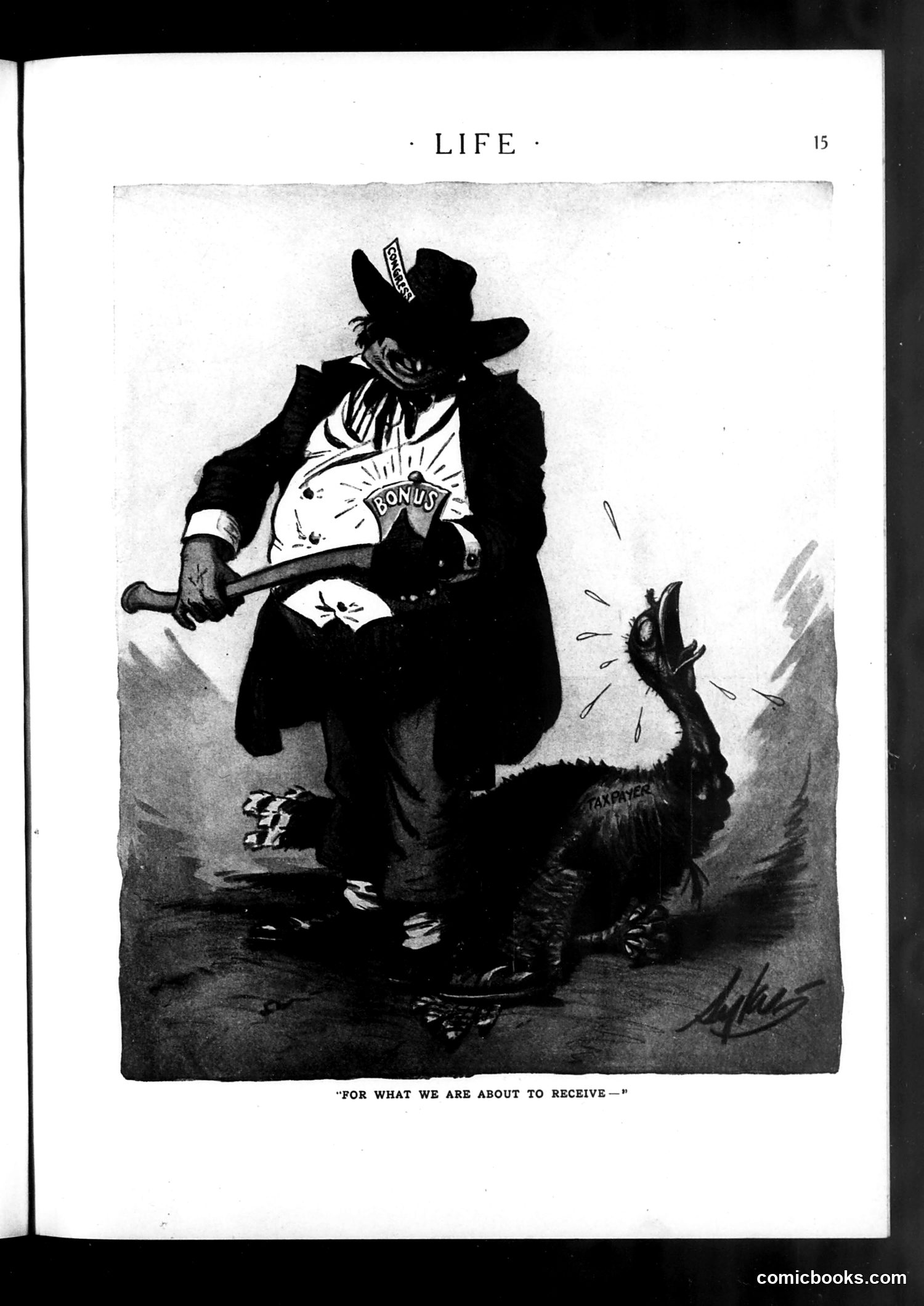
This **Life** magazine cartoon depicts a figure in formal attire and top hat labeled "BONUS" on his chest, wielding a club over a cowering creature labeled "TAXPAYER." The caption reads "FOR WHAT WE ARE ABOUT TO RECEIVE—" The satire critiques government spending, likely referencing a specific bonus program (possibly the World War I veterans' bonus debates of the 1920s-30s). The "BONUS" figure represents government distribution of funds, while the "TAXPAYER" is portrayed as victimized by this spending—depicted as a small, frightened creature about to receive a blow. The joke suggests taxpayers will suffer economically from bonus payments, framing government expenditure as harmful to ordinary citizens rather than beneficial. This reflects anti-spending, fiscally conservative political sentiment of the era.
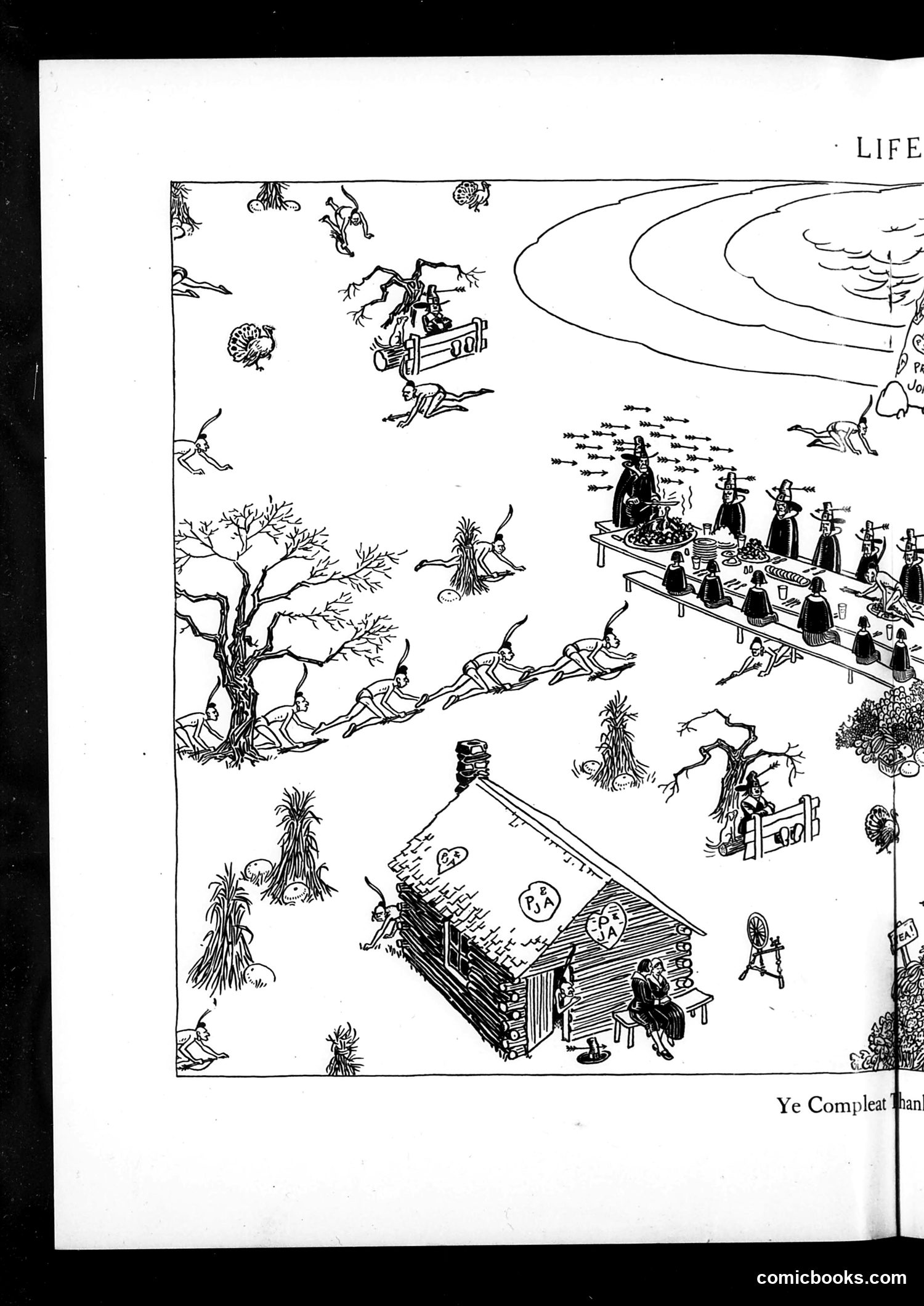
This appears to be a satirical illustration from Life magazine depicting a colonial or frontier settlement scene. The image shows various figures engaged in daily activities: a log cabin with inhabitants, people chasing or fleeing (possibly depicting conflict), a group gathered around what appears to be a cauldron or cooking pot on the right side, bare trees, corn stalks, and figures scattered throughout the landscape. The partial caption "Ye Compleat fran" (likely "Ye Compleat Frontiersman" or similar) suggests this is mocking or depicting frontier life, possibly satirizing romanticized notions of American colonial expansion or settlement. However, without the complete text or publication date visible, the specific political or social target remains unclear. The style and subject matter suggest early-to-mid 20th century commentary on American frontier mythology.
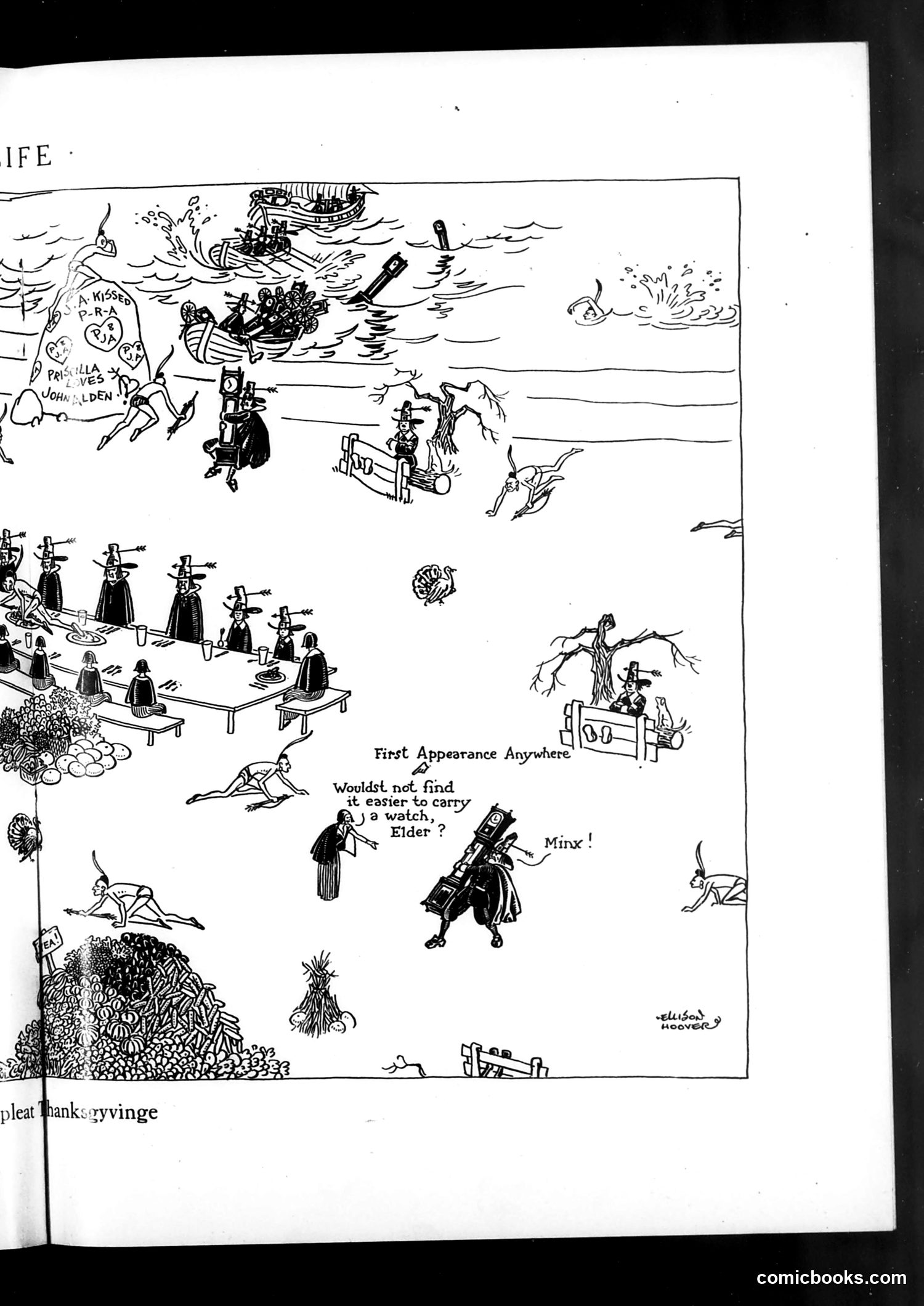
This appears to be a satirical illustration depicting a chaotic underwater or seaside scene with multiple narrative elements. The central exchange between figures asks "Wouldst not find it easier to carry a watch, Elder?" with the response "Minx!"—suggesting a clash between traditional propriety and modern irreverence. The scene includes boats, drowning or swimming figures, formal-dressed observers, and various domestic objects scattered about, likely satirizing social upheaval or generational conflict. The "First Appearance Anywhere" caption suggests this depicts a novel or absurd scenario being presented to readers. The cartoon's humor appears to target the friction between old-fashioned values (represented by the "Elder") and modern, irreverent youth culture ("Minx"), rendered through surreal imagery typical of Life magazine's satirical style. Without the publication date, precise historical context remains unclear.
This page reviews three Broadway productions from the 1920s. The header illustration shows a theatrical stage scene labeled "DRAMA." **"Cyrano de Bergerac"**: Walter Hampden revived this classic French play, and unusually for a revival, it's financially successful. The critic praises Hampden's risk-taking and performance alongside Carroll McComas, noting this success deserves genuine credit rather than the perfunctory praise typically given failed revivals. **"The Deep Tangled Wildwood"**: Written by Kaufman and Connelly, this play contrasts rural simplicity with urban corruption—a country village becomes a boom-town imitating New York's superficiality. The reviewer finds the premise excellent but the execution disappointing, with uneven farce overshadowing sophisticated comedy. **"Shuffle Along" and "Runnin' Wild"**: These are Black theatrical productions. The critic notes they suffer from aspiring to be "Broadway instead of Negro," suggesting they're abandoning authentic African American performance traditions to imitate white Broadway standards—a critique of assimilationist ambition.
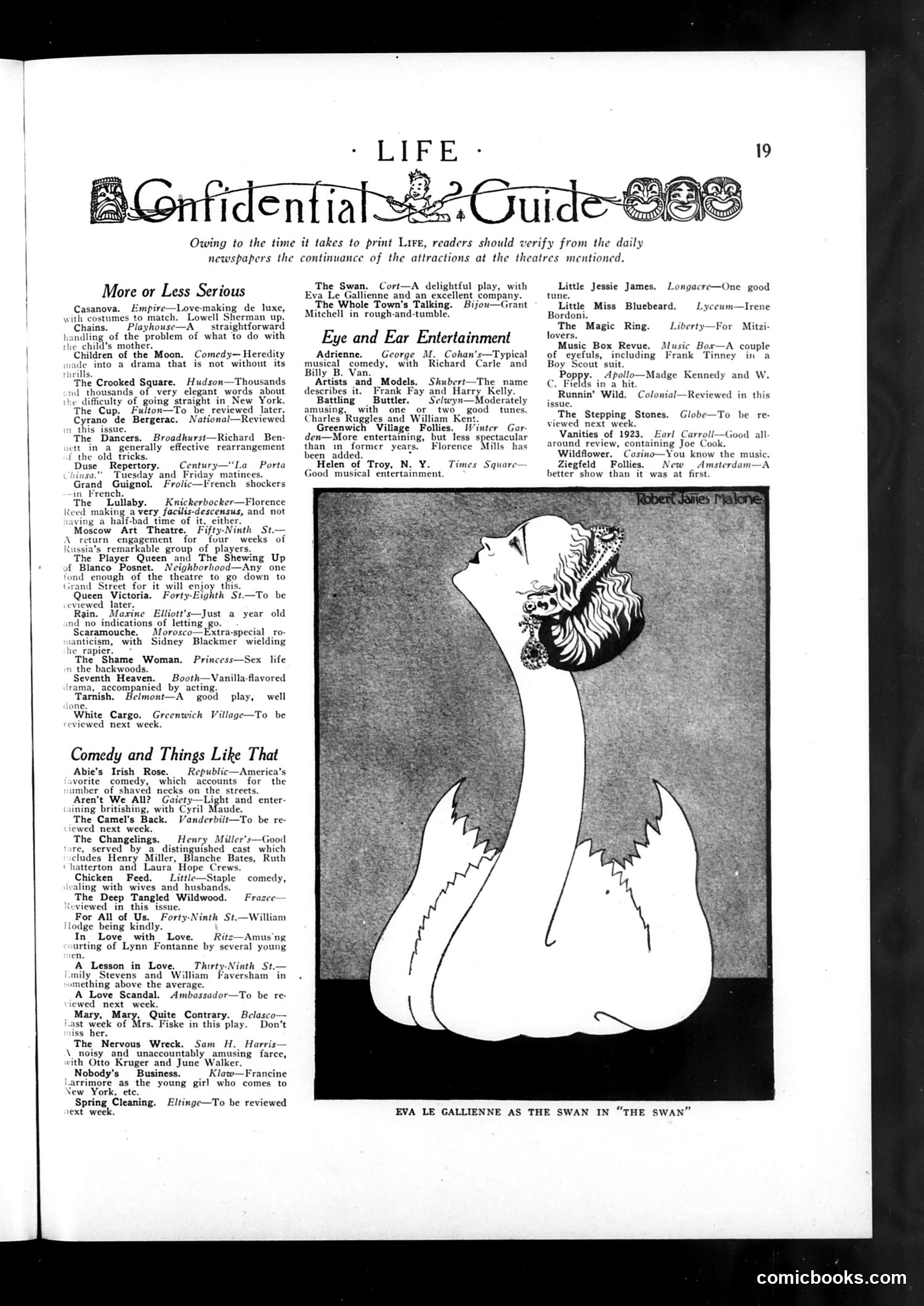
This page from *Life* magazine is a theater guide listing current Broadway productions. The image shows **Eva Le Gallienne in costume as the Swan** from the play *"The Swan,"* performed at the Cort Theatre. The accompanying text describes *"The Swan"* as "a delightful play, with Eva Le Gallienne and an excellent company"—a straightforward theatrical recommendation, not satire. Le Gallienne was a prominent American actress of the 1920s. The illustration depicts her in an elegant, stylized pose wearing what appears to be a feathered or ruffled costume, consistent with a classical theatrical role. The drawing style is typical of *Life*'s theatrical coverage from this era. This page functions as an entertainment guide rather than political or social satire—it's essentially a curated listing of what's playing on Broadway, helping readers decide what to see.
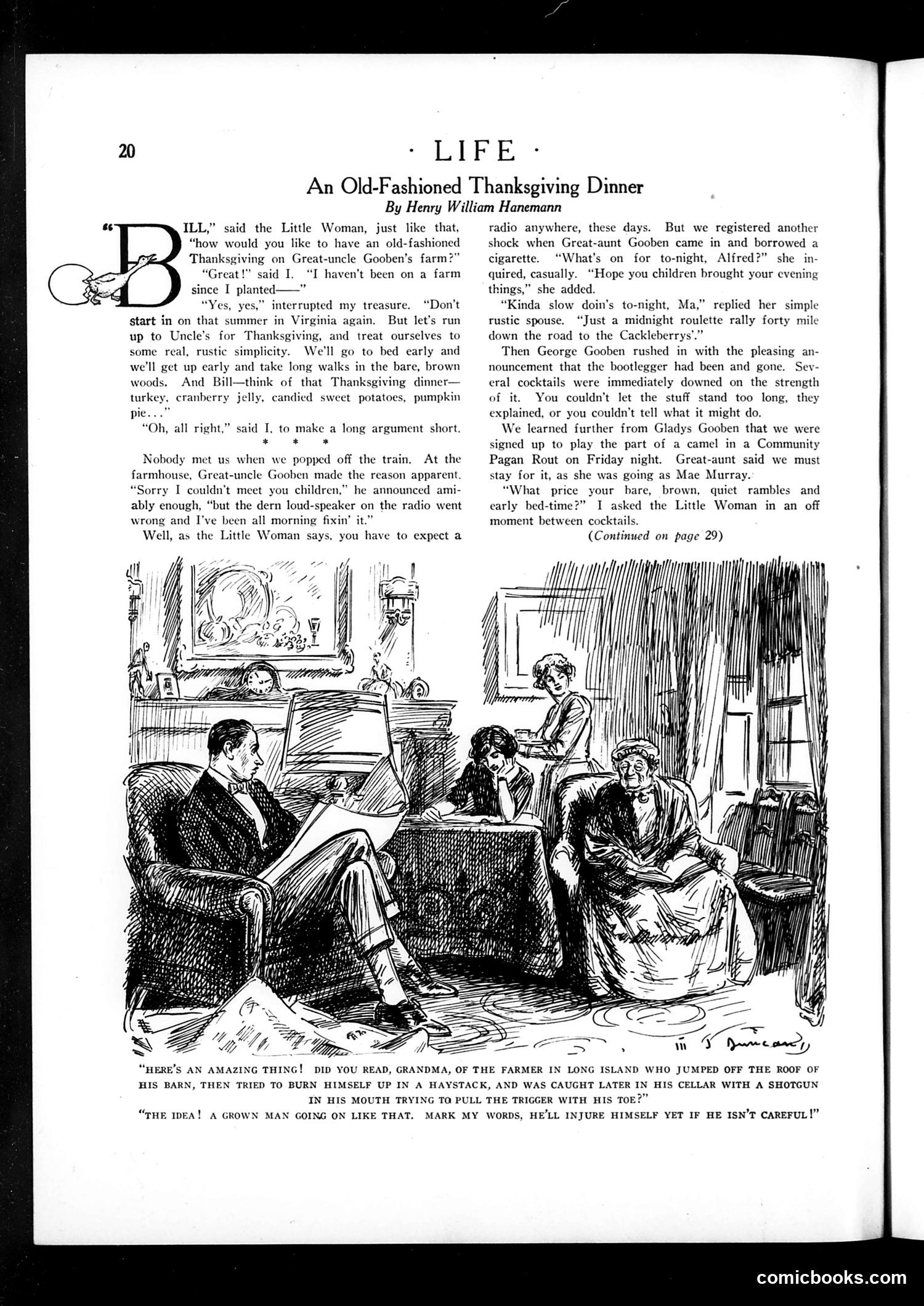
This story satirizes the romanticization of rural "simple living" during the Prohibition era (1920s-early 1930s). The narrator and his wife seek an authentic farmhouse Thanksgiving, expecting rustic simplicity and early bedtimes. Instead, they discover their supposedly old-fashioned relatives living modern, hedonistic lives: the "dern" radio constantly breaks down; Great-aunt Gooben casually borrows cigarettes; the farm hosts illegal "midnight roulette rallies"; a bootlegger regularly visits; and cocktails are consumed constantly (the joke being they can't store illegal alcohol safely). The secondary cartoon at bottom mocks rural self-harm stories in newspapers—grandma dismisses a farmer's multiple suicide attempts as mere carelessness rather than desperation, a darkly comic commentary on how sensationalized media reports desensitize readers. The satire targets both city dwellers' nostalgic fantasies about rural virtue and the reality that Depression-era farms participated fully in illegal drinking and modern vices.
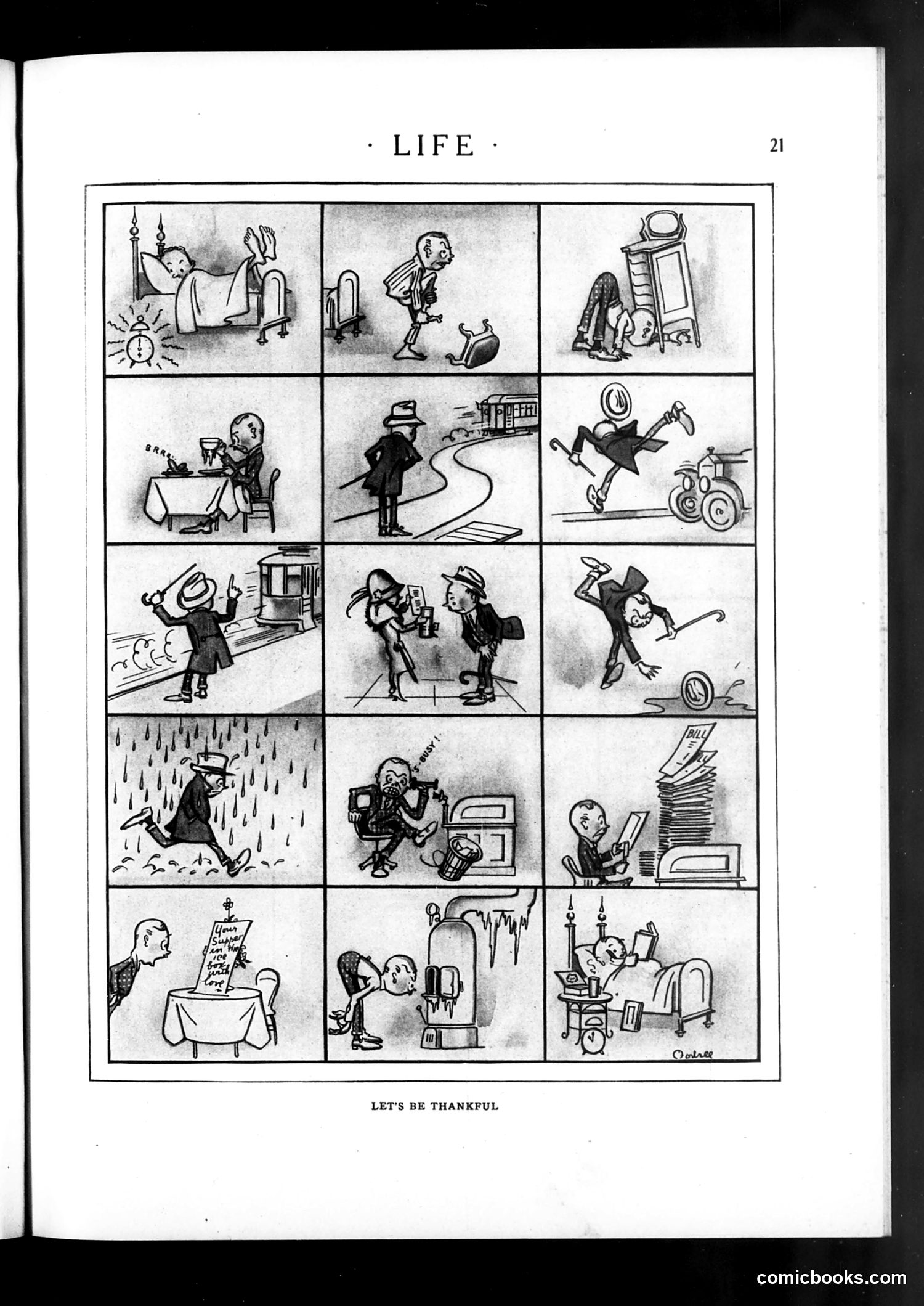
This is a 15-panel satirical comic depicting various life situations, likely from the early-to-mid 20th century based on the art style. The title "Let's Be Thankful" suggests ironic commentary on gratitude. The panels show everyday scenarios: a man in bed with morning light, someone playing sports, a child with toys, dining, farming in rain, working at a desk with stacks of papers, praying at a table, and domestic scenes. The repeated appearance of similar-looking figures across panels suggests this traces one person's life journey. The satire appears to mock the American experience—showing toil, labor, natural disasters, and bureaucratic drudgery—yet the title insists we should be "thankful" for these hardships. It's darkly humorous social commentary on the burdens of ordinary life presented as blessings.
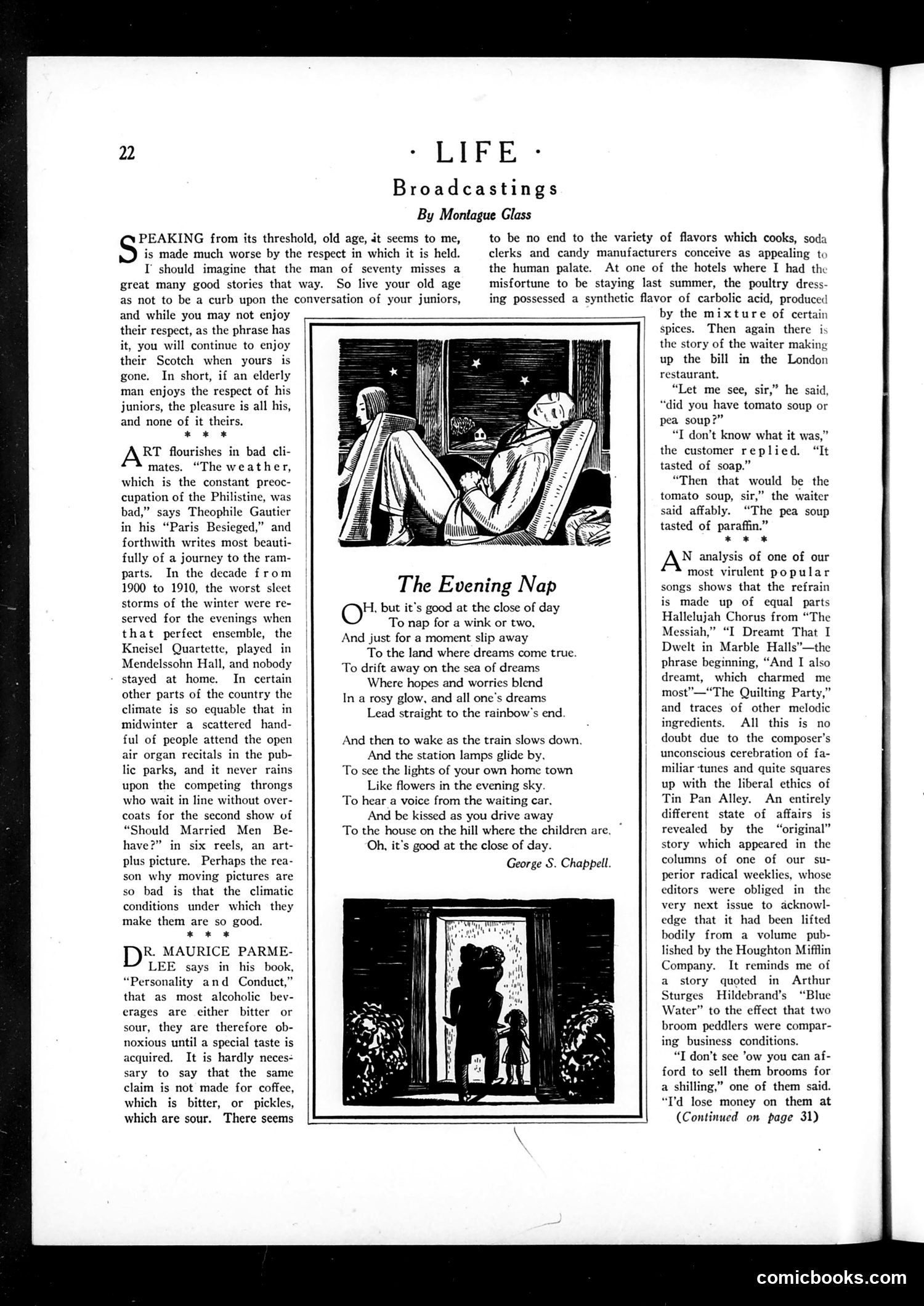
This page contains three separate satirical essays by "Montague Glass" addressing social observations: 1. **On Old Age**: The author argues that elderly people are more respected but less socially included—they're excluded from irreverent conversation. He suggests older people should relax this formality to actually enjoy themselves and their juniors' company. 2. **On Art and Weather**: A humorous observation that great art emerges from hardship (bad weather), yet people still attend outdoor concerts and stand in line for silent films despite terrible conditions—suggesting perhaps the art isn't as good as claimed. 3. **On Taste and Beverages**: Using Dr. Maurice Parmelee's logic, the author notes that bitter/sour things (alcohol, coffee, pickles) are tolerated because we acquire a taste, while absurd food combinations are accepted without question—as in a restaurant where "tomato soup" tastes inexplicably of soap. The two illustrations show domestic nighttime scenes. The humor is gentle, observational social critique typical of *Life* magazine's early 20th-century style—commenting on manners, taste, and human behavior rather than political satire.
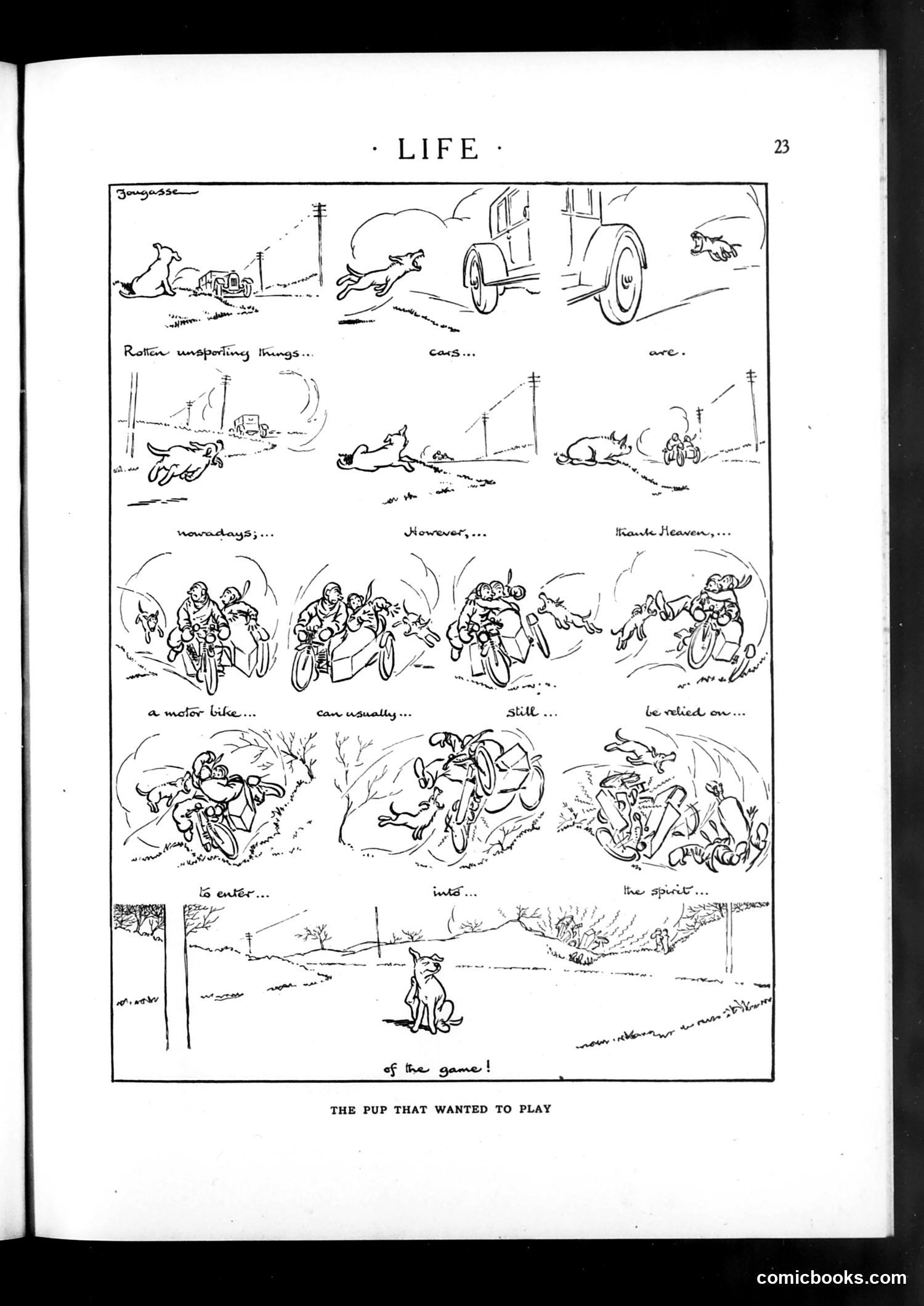
This is a humorous single-panel cartoon showing a dog's attempts to join in various activities. The narrative follows the pup through sequential scenes: rolling unsporting things, chasing cars, avoiding wire, jumping into "Sundays" (likely family outings), encountering motor bikes, can usually still activities, and being "relieved on" before finally sitting alone, "out of the game." The satire depicts a young, enthusiastic dog persistently trying to participate in human society and recreation—only to be repeatedly rejected, discouraged, or excluded. Each panel shows the pup's failures: cars won't let it hitch rides, bicycles knock it aside, family activities exclude it. The joke is sympathetic social commentary on how eager outsiders or underdogs are systematically shut out from participation, no matter how much they want to belong. It's a gentle critique of exclusion masquerading as innocent humor about a dog's misadventures.
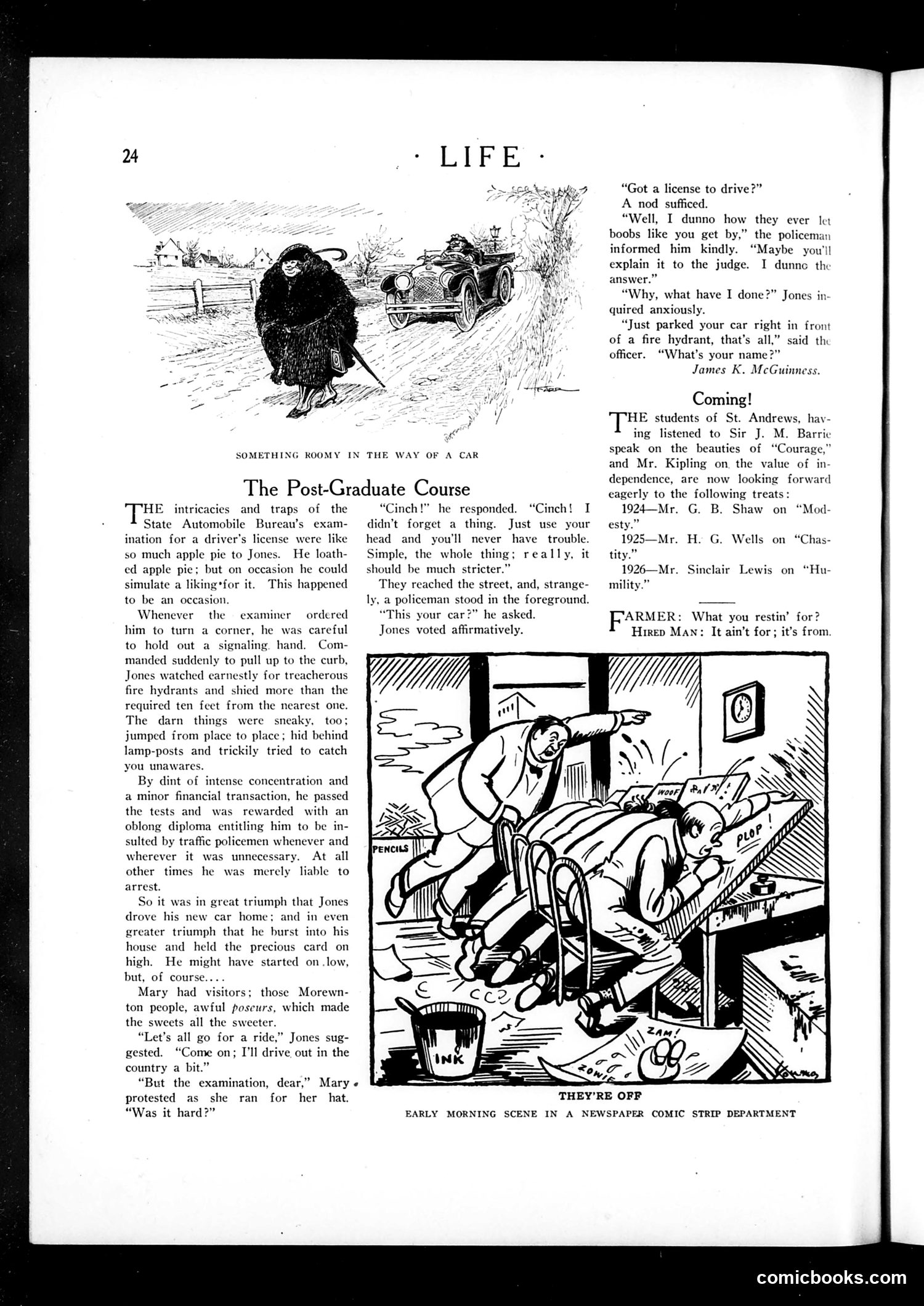
This page satirizes newly licensed drivers and their overconfidence. The main story follows Jones, who passes his driving test through luck and bribery ("a minor financial transaction"), then immediately parks illegally in front of a fire hydrant—precisely what he'd carefully avoided during his exam. The joke: he passed the test but learned nothing about actual driving safety. The cartoon's broader satire mocks the State Automobile Bureau's examination as insufficient. Jones represents the "boob" who shouldn't have a license, yet the system fails to prevent his licensing. A secondary joke lists famous intellectuals (Shaw, Wells, Sinclair Lewis) scheduled to lecture on virtues like "Modesty," "Chastity," and "Humility"—presumably speakers known for lacking these qualities—suggesting pretentious hypocrisy in high culture. The bottom comic strip joke is unclear without fuller context, but appears to mock newspaper comic artists.
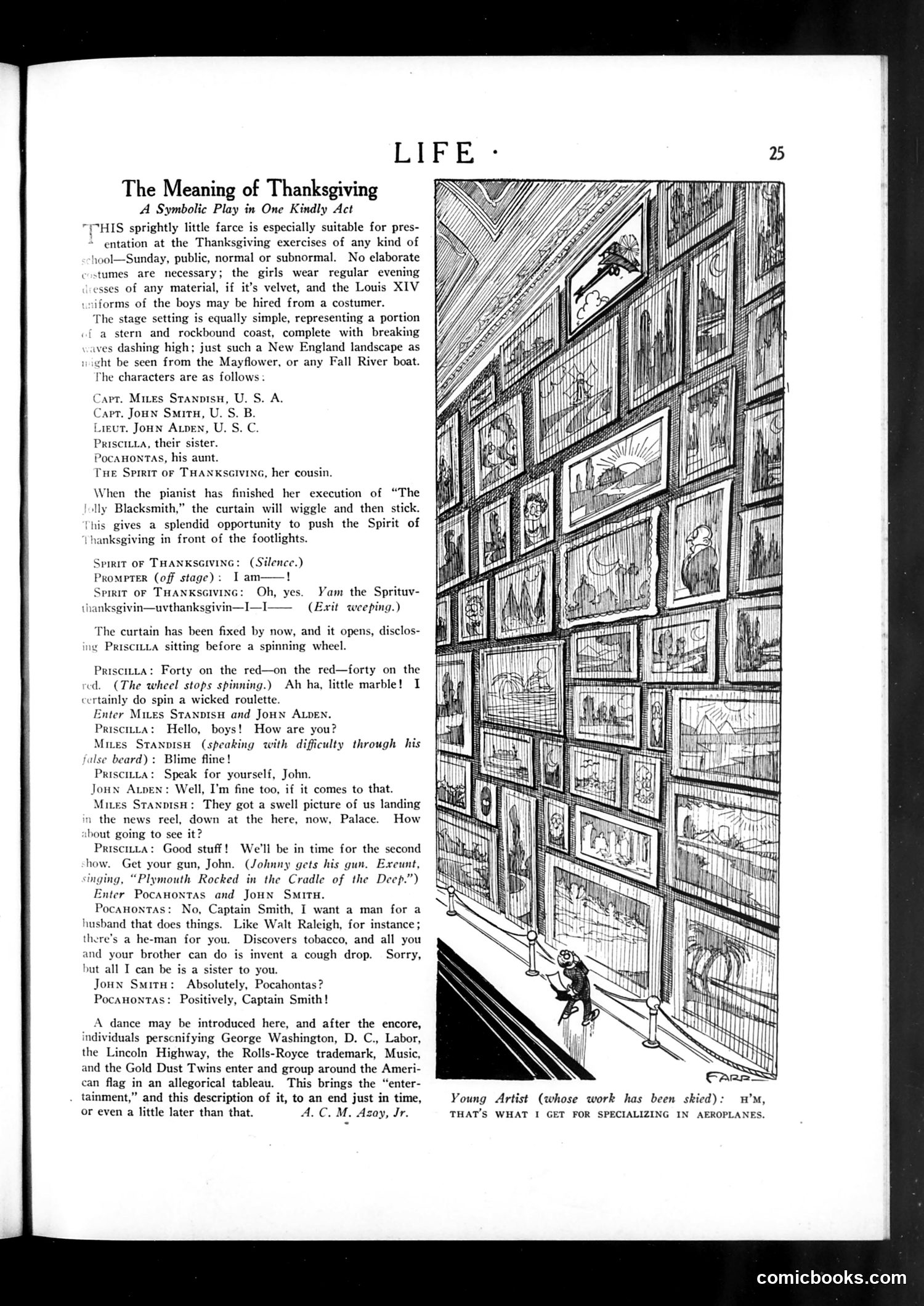
This page presents a humorous one-act play script meant for school Thanksgiving performances. The satire mocks how educational institutions sanitize and trivialize American history through theatrical presentations. The play absurdly conflates historical figures (Pocahontas, Captain Smith, Miles Standish, John Alden) with modern entertainments—characters attend movie newsreels, spin roulette wheels, and reference products like Rolls-Royce. The "Spirit of Thanksgiving" character forgets her lines entirely, weeping offstage. The finale reduces American history to abstract allegorical figures (George Washington, Labor, the Lincoln Highway, the Gold Dust Twins) grouped around a flag—reducing meaningful historical meaning to hollow pageantry. The cartoon below (by Farb) shows a young artist's work hung in an unfavorable gallery position, captioning the broader theme: specialization in aeroplanes won't guarantee recognition. This mirrors the script's critique of how institutions reduce complex history to marketable, digestible theatrical entertainment.
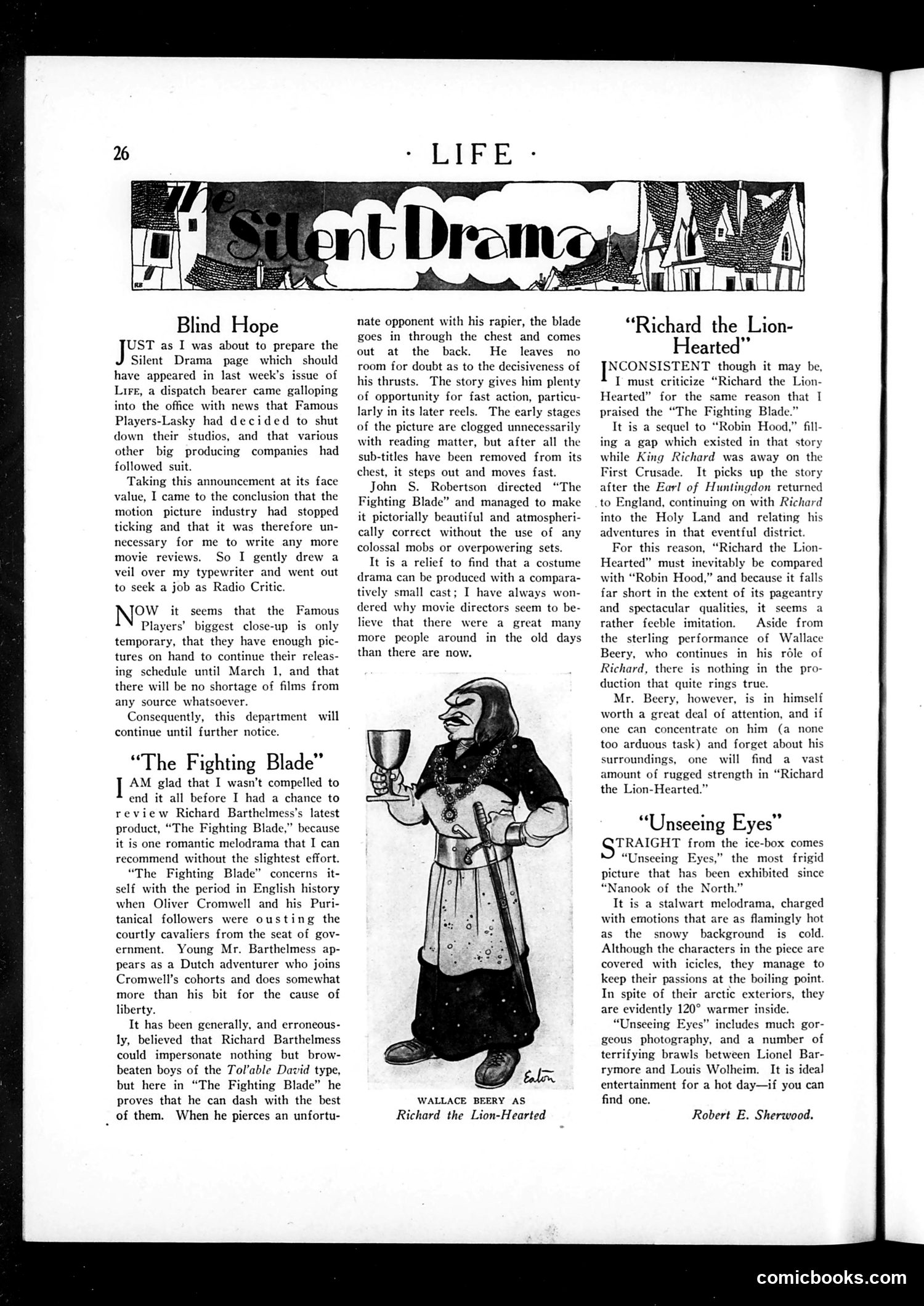
This is a film review column from Life magazine's "Silent Drama" section. The page contains three reviews of silent films: **"The Fighting Blade"** stars Richard Barthelmess in a historical drama set during Oliver Cromwell's English Civil War period. The reviewer praises it as a successful melodrama that proves Barthelmess can play action roles beyond the downtrodden characters he's known for. **"Richard the Lion-Hearted"** stars Wallace Beery as a sequel to "Robin Hood." The reviewer criticizes it for being a pale imitation of its predecessor—lacking spectacle despite Beery's strong performance. The film picks up Richard's story after his return from the Crusades. The opening "Blind Hope" section humorously describes the author's initial panic when Famous Players-Lasky studios announced closure, forcing him to consider seeking radio criticism work. He's relieved to learn the shutdown was temporary. The cartoon illustration shows Beery in costume as Richard, holding a goblet—promoting the film being reviewed.
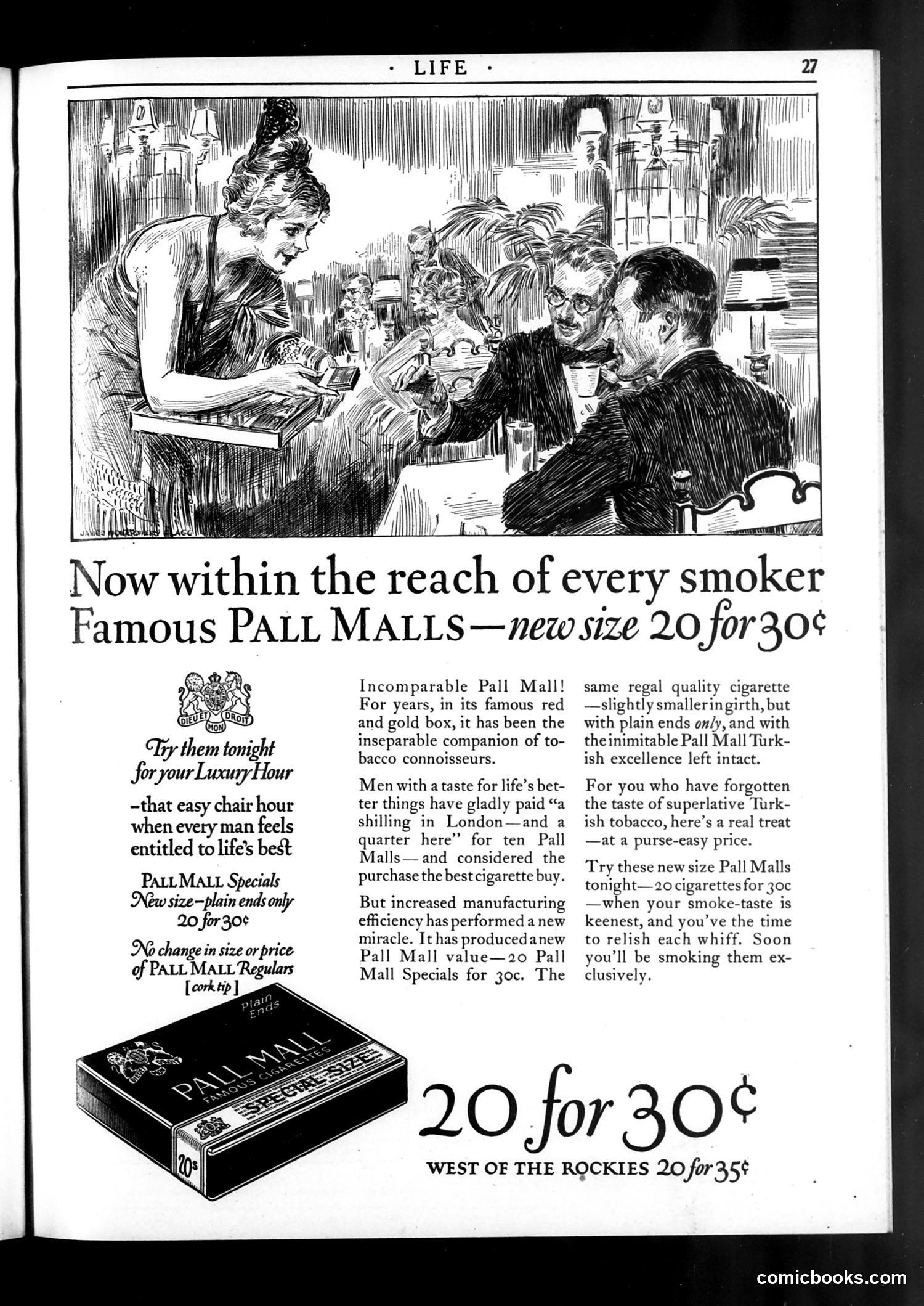
This is a Pall Mall cigarette advertisement, not political satire. The page depicts a social scene where a waitress serves cigarettes to well-dressed men in what appears to be an upscale establishment, reinforcing the product's association with sophistication and leisure. The ad emphasizes that Pall Mall has traditionally been expensive ("a shilling in London—a quarter here"), positioning it as a luxury good for men of refined taste. The innovation being advertised is that manufacturing efficiency now allows the company to offer a smaller version—"20 for 30¢"—making the premium brand accessible to ordinary smokers. The phrase "For the man tonight for your Luxury Hour" frames cigarette smoking as an affordable indulgence. No caricatures or political references are present. This reflects early-20th-century advertising that openly promoted smoking without health warnings, targeting male consumers' aspirations toward genteel living.
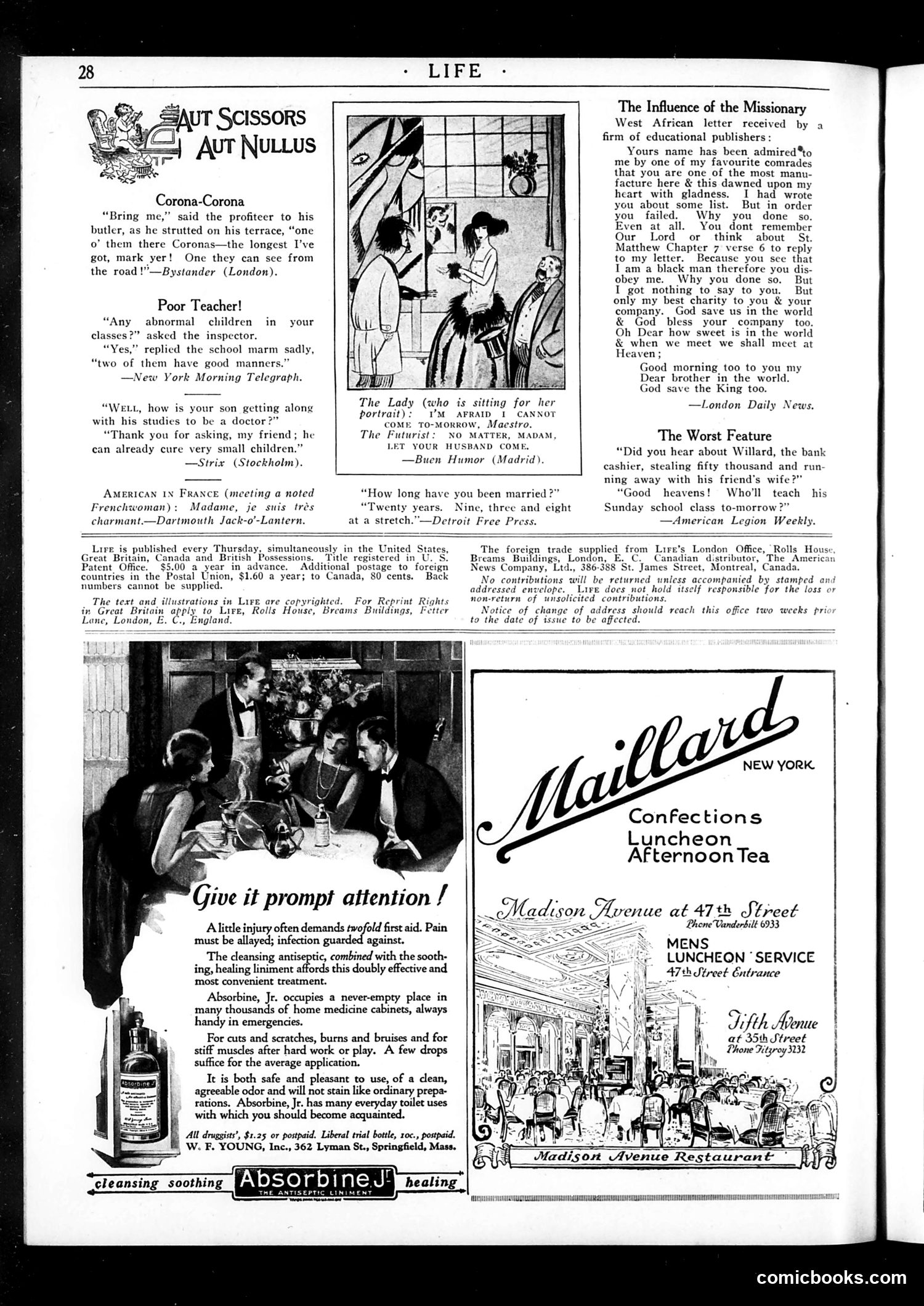
This page contains multiple brief satirical items typical of Life's humor format: **"Corona-Corona"**: Mocks war profiteers' ostentatious displays of wealth. A profiteer orders the longest cigars specifically so people can see them from the road—satirizing nouveau-riche materialism during wartime. **"Poor Teacher"**: A school inspector asks about abnormal children; the teacher proudly notes two have "good manners"—the joke being that good manners in abnormal children is unexpected or ironic. **"The Influence of the Missionary"**: Reprints a letter from a West African missionary student complaining about an educational publisher's failure to respond. The satire lies in the letter's broken English and the student's accusation that the publisher ignores him because he's Black, while expecting charity—exposing hypocrisy in missionary/colonial education. **"The Worst Feature"**: When a bank cashier embezzles and elopes, the concern isn't the crime but "who'll teach his Sunday school class?"—satirizing misplaced priorities and social hypocrisy. The page is primarily advertising otherwise.
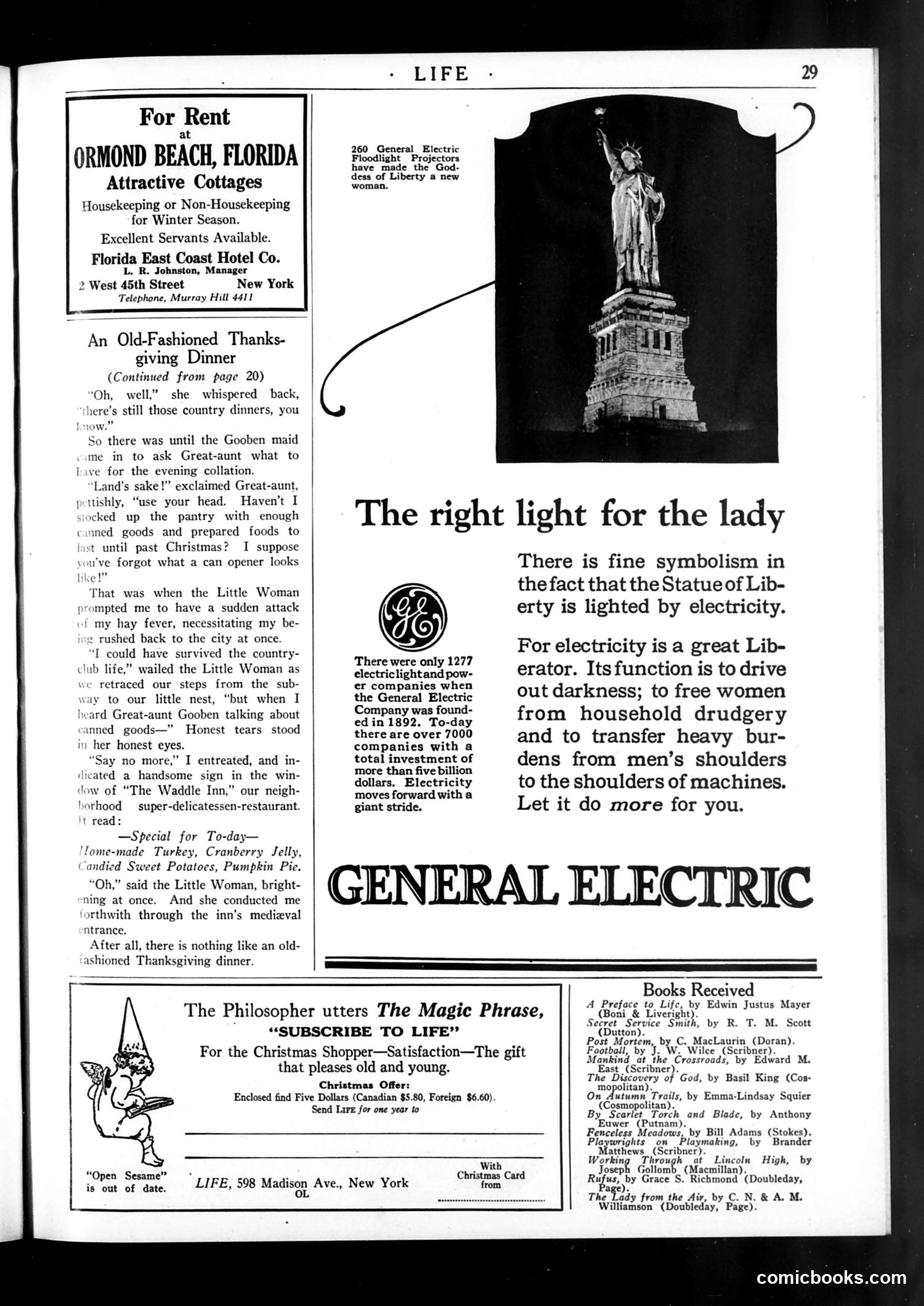
This page is primarily **advertising and book reviews**, not political satire. The main content includes: **The Statue of Liberty advertisement** (General Electric): Uses patriotic symbolism to market electricity as a "liberator" of women from household drudgery. The pitch argues electricity transfers heavy labor "from men's shoulders to the shoulders of machines"—a gendered appeal promising domestic freedom through technology. **"An Old-Fashioned Thanksgiving Dinner"**: A humorous domestic story (continued from prior issue) about a couple escaping rigid country-club life by retreating to a casual restaurant, mocking pretentious social expectations. **Other advertisements**: Florida resort rentals and a Christmas gift subscription offer for *Life* magazine itself. The page reflects 1920s consumer culture marketing electricity and leisure to middle-class readers, alongside period advertising conventions. No specific political figures or major satirical cartoons appear—it's a typical magazine layout mixing editorial content with ads.
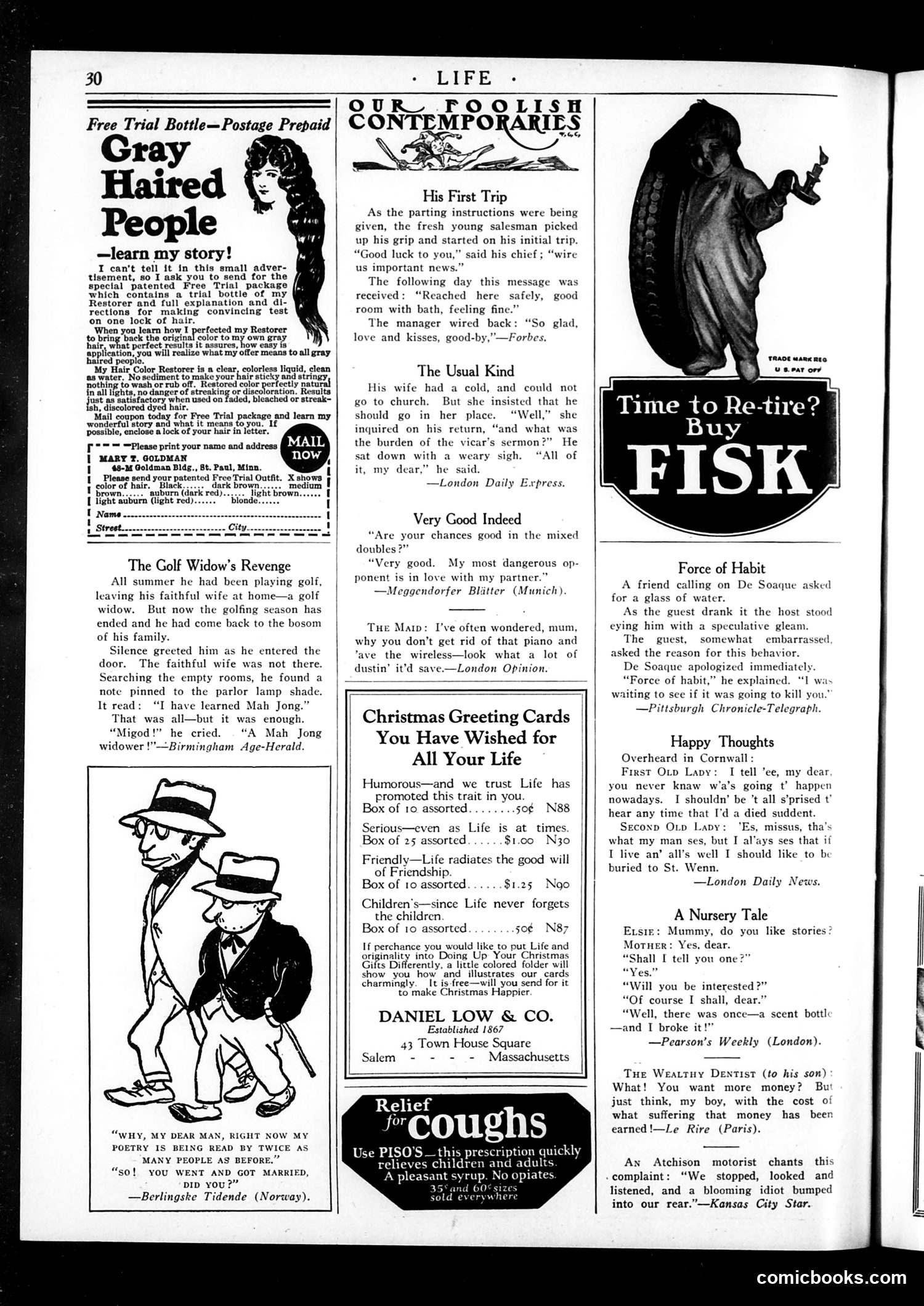
This page contains several brief satirical anecdotes typical of Life magazine's humor: **"The Golf Widow's Revenge"**: A husband abandons his wife all summer to play golf. When the season ends and he returns home, he finds she's learned Mah Jong (a Chinese tile game then fashionable among American women). The joke satirizes marital tit-for-tat—she's now the one absorbed in her hobby, abandoning him as he abandoned her. **"The Usual Kind"**: A wife too ill to attend church sends her husband instead. He returns describing the sermon's burden. The implicit joke suggests he's avoiding naming any actual content—typical marital evasion. **Other brief anecdotes** humorously capture domestic and social situations common to the era (1920s-era based on Mah Jong reference). The page is primarily **advertising**, including promotions for gray-hair restorer, Christmas cards, and cough syrup. The cartoons are minor supporting content rather than the page's focus.
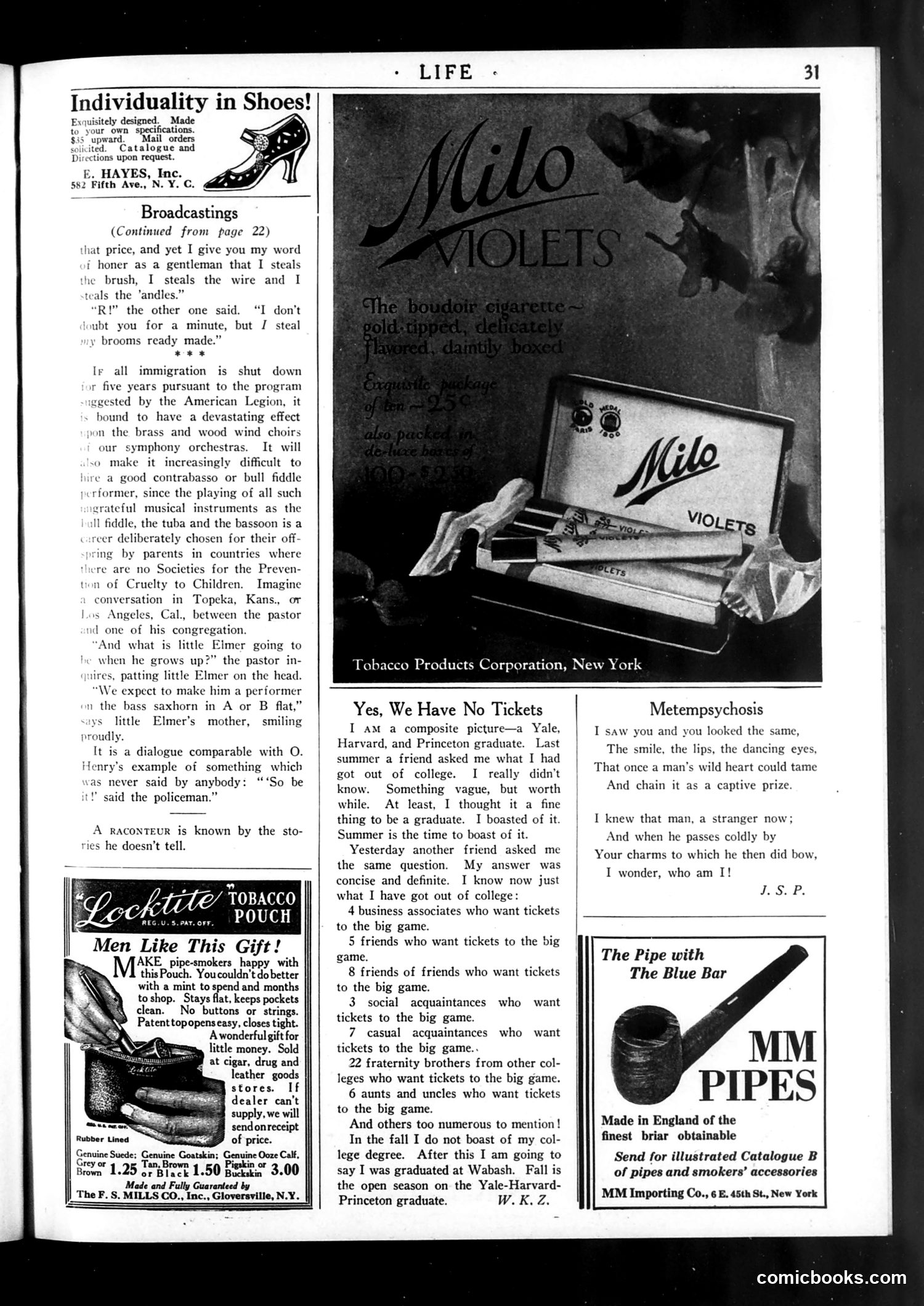
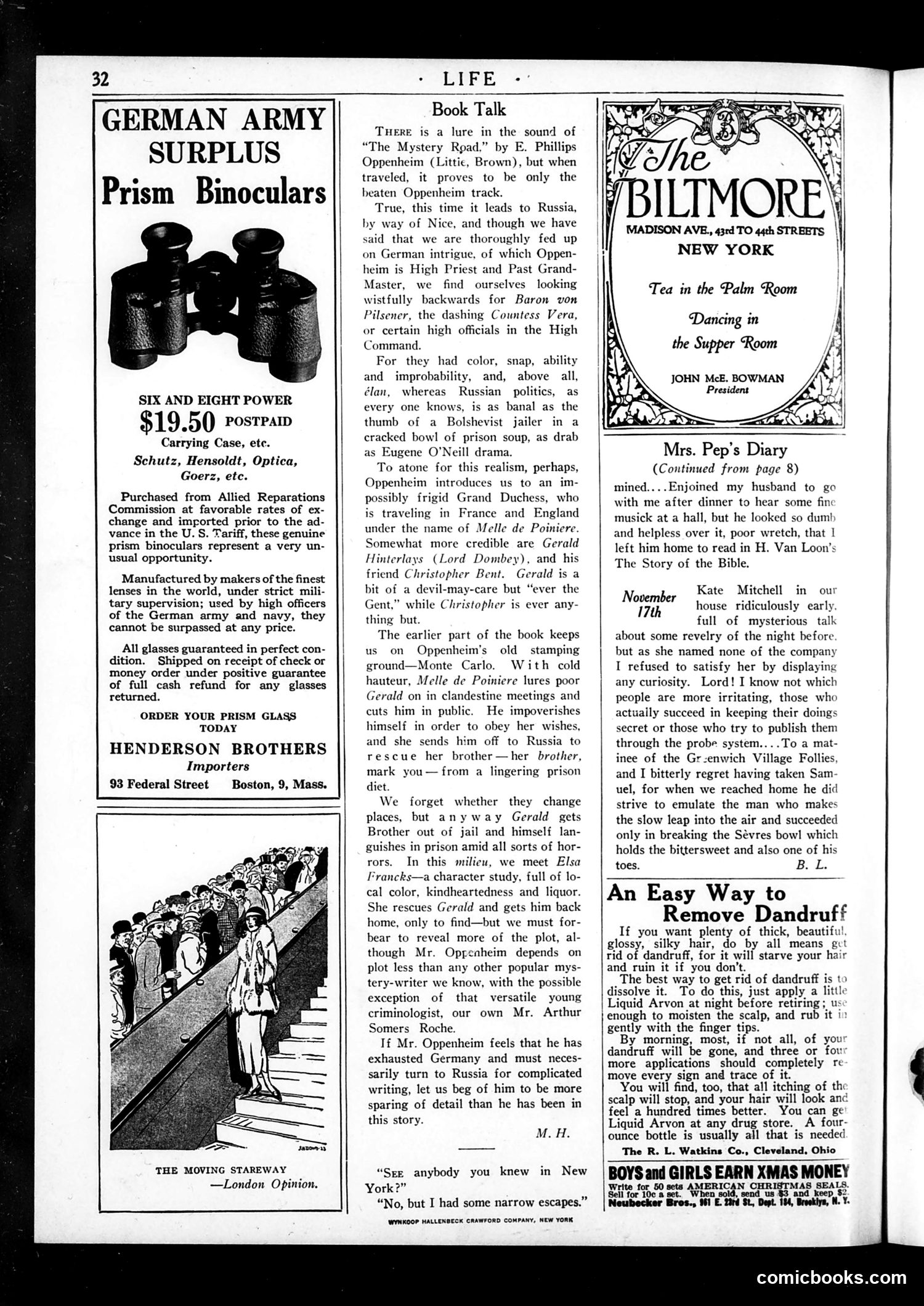
This page mixes advertisements with book reviews and a humorous diary column—typical of Life magazine's format. **The main cartoon** ("The Moving Stairway") at bottom left shows figures on what appears to be an escalator or moving stairs, with the caption attributing the joke to "London Opinion." The cartoon itself is unclear without additional context, but the caption joke—"See anybody you knew in New York?" / "No, but I had some narrow escapes"—suggests social satire about crowded urban life or accidental encounters. **Key non-cartoon content**: An ad for German Army surplus binoculars (post-WWI reparations goods), and a book review mocking E. Phillips Oppenheim's spy novels for recycling tired German-intrigue plots while ignoring more contemporary Russian politics. The "Mrs. Pep's Diary" is light satirical social commentary about upper-class leisure activities and marital dynamics. The page reflects post-WWI America: disposal of German military equipment, skepticism toward Russian politics (likely post-Revolution), and upper-class leisure culture.