
Life, 1923-11-22 · page 20 of 34
Life — November 22, 1923 — page 20: what you’re looking at
What you’re looking at
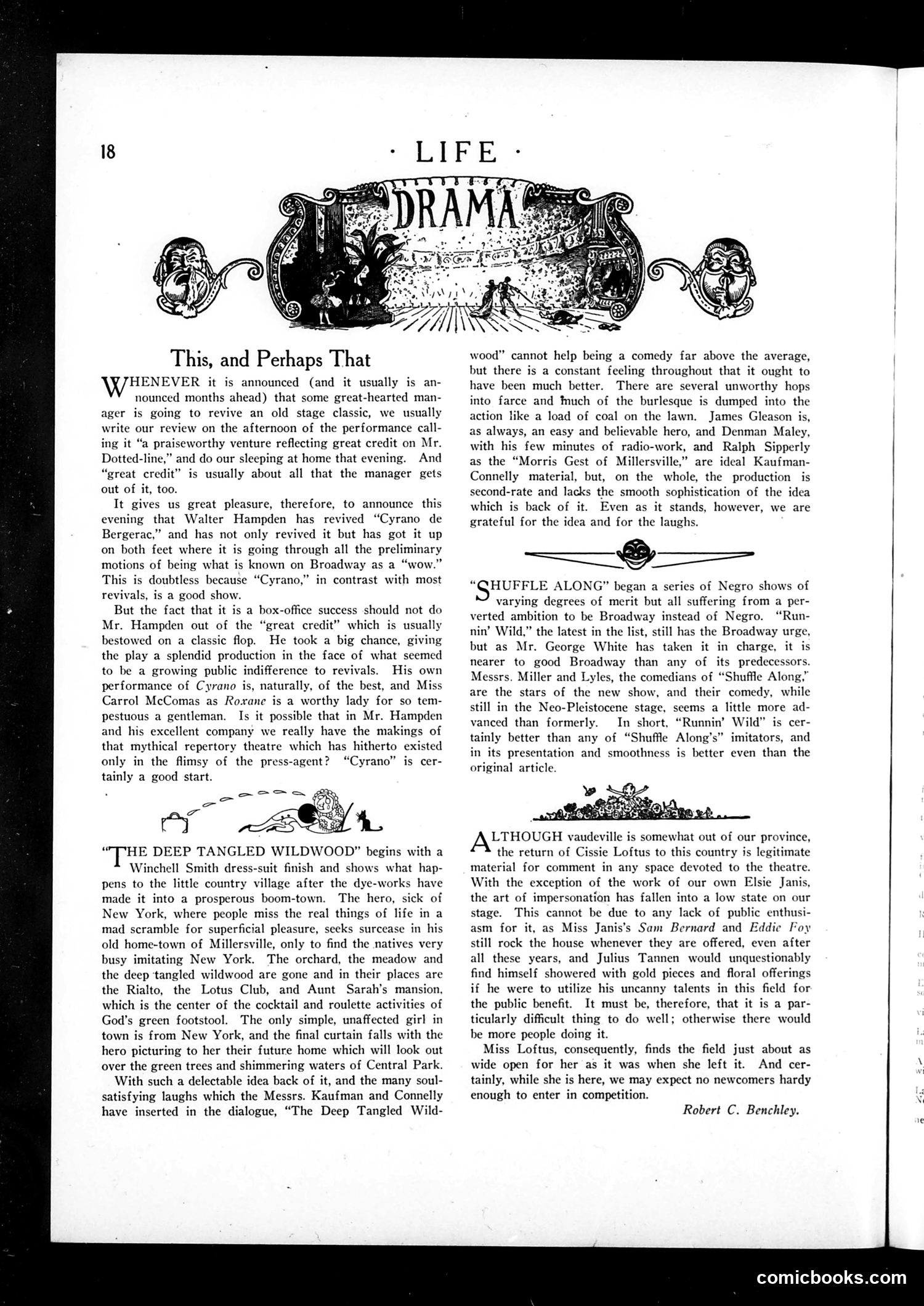
This page reviews three Broadway productions from the 1920s. The header illustration shows a theatrical stage scene labeled "DRAMA." **"Cyrano de Bergerac"**: Walter Hampden revived this classic French play, and unusually for a revival, it's financially successful. The critic praises Hampden's risk-taking and performance alongside Carroll McComas, noting this success deserves genuine credit rather than the perfunctory praise typically given failed revivals. **"The Deep Tangled Wildwood"**: Written by Kaufman and Connelly, this play contrasts rural simplicity with urban corruption—a country village becomes a boom-town imitating New York's superficiality. The reviewer finds the premise excellent but the execution disappointing, with uneven farce overshadowing sophisticated comedy. **"Shuffle Along" and "Runnin' Wild"**: These are Black theatrical productions. The critic notes they suffer from aspiring to be "Broadway instead of Negro," suggesting they're abandoning authentic African American performance traditions to imitate white Broadway standards—a critique of assimilationist ambition.
📄 Transcribed text from this page (OCR, searchable)
Machine-transcribed from the original scan — historical spelling and the odd misread are preserved.
This, and Perhaps That HENEVER it is announced (and it usually is an- nounced months ahead) that some great-hearted man- ager is going to revive an old stage classic, we usually write our review on the afternoon of the performance call- ing it “a praiseworthy venture reflecting great credit on Mr. Dotted-line,” and do our sleeping at home that evening. And “great credit” is usually about all that the manager gets out of it, too. It gives us great pleasure, therefore, to announce this evening that Walter Hampden has revived “Cyrano de Bergerac,” and has not only revived it but has got it up on both feet where it is going through all the preliminary motions of being what is known on Broadway as a “wow.” This is doubtless because “Cyrano,” in contrast with most revivals, is a good show. But the fact that it is a box-office success should not do Mr. Hampden out of the “great credit” which is usually bestowed on a classic flop. He took a big chance, giving the play a splendid production in the face of what seemed to be a growing public indifference to revivals. His own performance of Cyrano is, naturally, of the best, and Miss Carrol McComas as Roane is a worthy lady for so tem- pestuous a gentleman. Is it possible that in Mr. Hampden and his excellent company we really have the makings of that mythical repertory theatre which has hitherto existed only in the flimsy of the press-agent? “Cyrano” is cer- tainly a good start. aoe a a ‘—) hw “THE DEEP TANGLED WILDWOOD” begins with a Winchell Smith dress-suit finish and shows what hap- pens to the little country village after the dye-works have made it into a prosperous boom-town. The hero, sick of New York, where people miss the real things of life in a mad scramble for superficial pleasure, seeks surcease in his old home-town of Millersville, only to find the natives very busy imitating New York. The orchard, the meadow and the deep tangled wildwood are gone and in their places are the Rialto, the Lotus Club, and Aunt Sarah’s mansion, which is the center of the cocktail and roulette activities of God’s green footstool. The only simple, unaffected girl in town is from New York, and the final curtain falls with the hero picturing to her their future home which will look out over the green trees and shimmering waters of Central Park. With such a delectable idea back of it, and the many soul- satisfying laughs which the Messrs. Kaufman and Connelly have inserted in the dialogue, “The Deep Tangled Wild- wood” cannot help being a comedy far above the average, but there is a constant feeling throughout that it ought to have been much better. There are several unworthy hops into farce and much of the burlesque is dumped into the action like a load of coal on the lawn. James Gleason is, as always, an easy and believable hero, and Denman Maley, with his few minutes of radio-work, and Ralph Sipperly as the “Morris Gest of Millersville,” are ideal Kaufman- Connelly material, but, on the whole, the production is second-rate and lacks the smooth sophistication of the idea which is back of it. Even as it stands, however, we are grateful for the idea and for the laughs. —.8—— “QHUFFLE ALONG” began a series of Negro shows of varying degrees of merit but all suffering from a per- verted ambition to be Broadway instead of Negro. “Run- nin’ Wild,” the latest in the list, still has the Broadway urge, but as Mr. George White has taken it in charge, it is nearer to good Broadway than any of its predecessors. Messrs. Miller and Lyles, the comedians of “Shuffle Along,” are the stars of the new show, and their comedy, while still in the Neo-Pleistocene stage, seems a little more ad- vanced than formerly. In short, “Runnin’ Wild” is cer- tainly better than any of “Shuffle Along’s” imitators, and in its presentation and smoothness is better even than the original article. ALTHOUGH vaudeville is somewhat out of our province, the return of Cissie Loftus to this country is legitimate material for comment in any space devoted to the theatre. With the exception of the work of our own Elsie Janis, the art of impersonation has fallen into a low state on our stage. This cannot be due to any lack of public enthusi- asm for it, as Miss Janis’s Sam Bernard and Eddie Foy still rock the house whenever they are offered, even after all these years, and Julius Tannen would unquestionably find himself showered with gold pieces and floral offerings if he were to utilize his uncanny talents in this field for the public benefit. It must be, therefore, that it is a par- ticularly difficult thing to do well; otherwise there would be more people doing it. Miss Loftus, consequently, finds the field just about as wide open for her as it was when she left it. And cer- tainly, while she is here, we may expect no newcomers hardy enough to enter in competition. Robert C. Benchley. comicbooks.com