
Life, 1923-11-22 · page 16 of 34
Life — November 22, 1923 — page 16: what you’re looking at
What you’re looking at
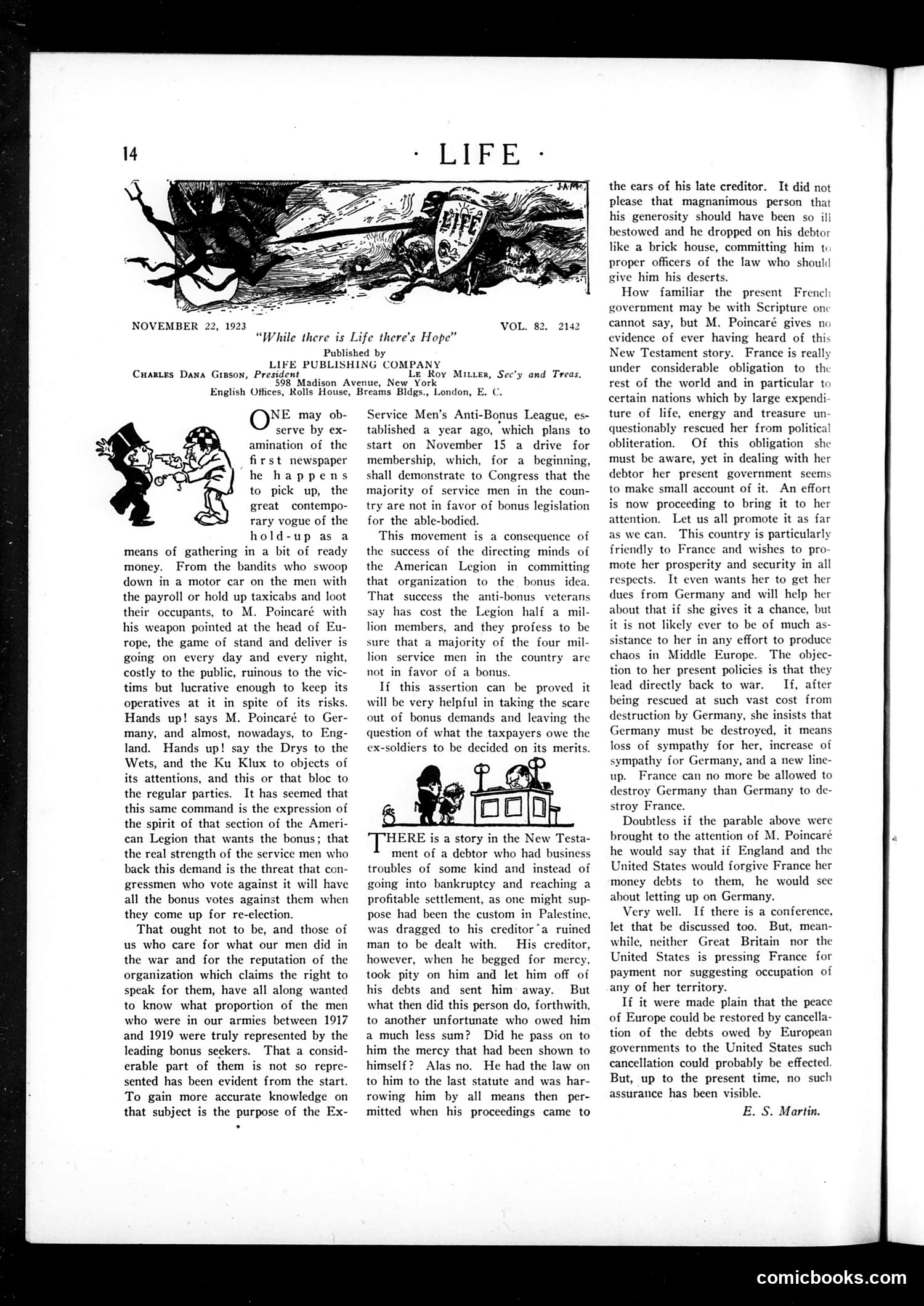
This page discusses the American Legion's anti-bonus campaign, opposing a proposed bonus for WWI veterans. The small cartoon shows two figures (likely a politician and veteran) in confrontation, reflecting the contentious debate. The main article criticizes the bonus movement, arguing that service men shouldn't receive extra compensation beyond their salaries. The text references the Legion's successful 1922 campaign against bonus legislation and notes growing pressure to reconsider. A secondary article discusses international debt: a debtor unable to pay his creditor becomes a parable for France's financial obligations to Britain and the United States following WWI. The satire suggests that forgiving debts might benefit Europe and prevent future conflict, contrasting with hardline creditor nations' positions.
📄 Transcribed text from this page (OCR, searchable)
Machine-transcribed from the original scan — historical spelling and the odd misread are preserved.
NOVEMBER 22, 1923 VOL. 82. “While there is Life there's Hope” Published by LIFE PUBLISHING COMPANY Cuartes Dana Gipson, President Le Roy Miter, Sec’y and Treas, 8 Madison Avenue, New York English Offices, Rolls House, Breams Bldgs., London, E. C. NE may ob- serve by ex- amination of the ania) first newspaper he happens to pick up, the great contempo- rary vogue of the hold-up as a means of gathering in a bit of ready money. From the bandits who swoop down in a motor car on the men with the payroll or hold up taxicabs and loot their occupants, to M. Poincaré with his weapon pointed at the head of rope, the game of stand and deliver is going on every day and every night, costly to the public, ruinous to the vic- tims but lucrative enough to keep its operatives at it in spite of its risks. Hands up! says M. Poincaré to Ger- many, and almost, nowadays, to Eng- land. Hands up! say the Drys to the Wets, and the Ku Klux to objects of its attentions, and this or that bloc to the regular parties. It has seemed that this same command is the expression of the spirit of that section of the Ameri- can Legion that wants the bonus; that the real strength of the service men who back this demand is the threat that con- gressmen who vote against it will have all the bonus votes against them when they come up for re-election. That ought not to be, and those of us who care for what our men did in the war and for the reputation of the organization which claims the right to speak for them, have all along wanted to know what proportion of the men who were in our armies between 1917 and 1919 were truly represented by the leading bonus seekers. That a consid- erable part of them is not so repre- sented has been evident from the start. To gain more accurate knowledge on that subject is the purpose of the Ex- Service Men’s Anti-Bonus League, es- tablished a year ago, which plans to start on November 15 a drive for membership, which, for a beginning, shall demonstrate to Congress that the majority of service men in the coun- try are not in favor of bonus legislation for the able-bodied. This movement is a consequence of the success of the directing minds of the American Legion in committing that organization to the bonus idea. That success the anti-bonus veterans say has cost the Legion half a mil- lion members, and they profess to be sure that a majority of the four mil- lion service men in the country are not in favor of a bonus. If this assertion can be proved it will be very helpful in taking the scare out of bonus demands and leaving the question of what the taxpayers owe the ex-soldiers to be decided on its merits. “THERE is a story in the New Testa- ment of a debtor who had business troubles of some kind and instead of going into bankruptcy and reaching a profitable settlement, as one might sup- pose had been the custom in Palestine, dragged to his creditor’a ruined man to be dealt with. His creditor, however, when he begged for mercy, took pity on him and let him off of his debts and sent him: away. But what then did this person do, forthwith, to another unfortunate who owed him a much less sum? Did he pass on to him the mercy that had been shown to himself? Alas no. He had the law on to him to the last statute and was har- rowing him by all means then per- mitted when his proceedings came to the ears of his late creditor. It did not please that magnanimous person that his generosity should have been so ill bestowed and he dropped on his debtor like a brick house, committing him t: proper officers of the law who should give him his deserts. How familiar the present Frencl government may be with Scripture onc cannot say, but M. Poincaré gives no evidence of ever having heard of this New Testament story. France is really under considerable obligation to thc rest of the world and in particular to certain nations which by large expendi ture of life, energy and treasure un- questionably rescued her from political obliteration. Of this obligation she must be aware, yet in dealing with her debtor her present government seems to make small account of it. An effort is now proceeding to bring it to her attention. Let us all promote it as far as we can. This country is particularly friendly to France and wishes to pro- mote her prosperity and security in all respects. It even wants her to get her dues from Germany and will help her about that if she gives it a chance, but it is not likely ever to be of much as- sistance to her in any effort to produce chaos in Middle Europe. The objec- tion to her present policies is that they lead directly back to war. If, after being rescued at such vast cost from destruction by Germany, she insists that Germany must be destroyed, it means loss of sympathy for her, increase of sympathy for Germany, and a new line- up. France can no more be allowed to destroy Germany than Germany to de- stroy France. Doubtless if the parable above were brought to the attention of M. Poincaré he would say that if England and the United States would forgive France her money debts to them, he would see about letting up on Germany. Very well. If there is a conference, let that be discussed too. But, mean- while, neither Great Britain nor the United States is pressing France for payment nor suggesting occupation of any of her territory. If it were made plain that the peace of Europe could be restored by cancella- tion of the debts owed by European governments to the United States such cancellation could probably be effected. But, up to the present time, no such assurance has been visible. E. S. Martin. comicbooks.com