
Life, 1923-11-22 · page 24 of 34
Life — November 22, 1923 — page 24: what you’re looking at
What you’re looking at
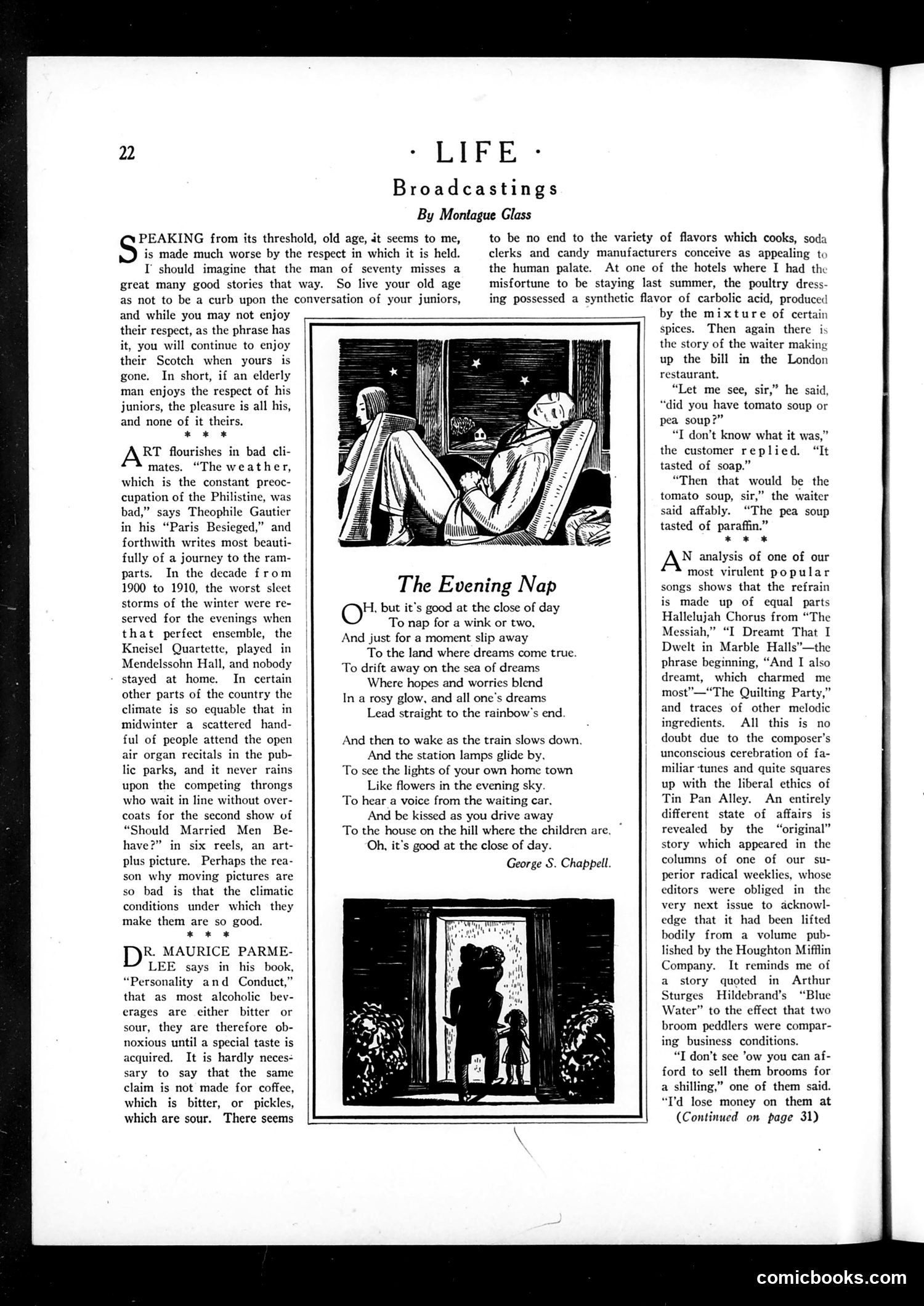
This page contains three separate satirical essays by "Montague Glass" addressing social observations: 1. **On Old Age**: The author argues that elderly people are more respected but less socially included—they're excluded from irreverent conversation. He suggests older people should relax this formality to actually enjoy themselves and their juniors' company. 2. **On Art and Weather**: A humorous observation that great art emerges from hardship (bad weather), yet people still attend outdoor concerts and stand in line for silent films despite terrible conditions—suggesting perhaps the art isn't as good as claimed. 3. **On Taste and Beverages**: Using Dr. Maurice Parmelee's logic, the author notes that bitter/sour things (alcohol, coffee, pickles) are tolerated because we acquire a taste, while absurd food combinations are accepted without question—as in a restaurant where "tomato soup" tastes inexplicably of soap. The two illustrations show domestic nighttime scenes. The humor is gentle, observational social critique typical of *Life* magazine's early 20th-century style—commenting on manners, taste, and human behavior rather than political satire.
📄 Transcribed text from this page (OCR, searchable)
Machine-transcribed from the original scan — historical spelling and the odd misread are preserved.
PEAKING from its threshold, old age, it seems to me, is made much worse by the respect in which it is held. I’ should imagine that the man of seventy misses a great many good stories that way. So live your old age as not to be a curb upon the conversation of your juniors, and while you may not enjoy their respect, as the phrase has it, you will continue to enjoy their Scotch when yours is gone. In short, if an elderly man enjoys the respect of his juniors, the pleasure is all his, and none of it theirs. * * * RT flourishes in bad cli- mates. “The weather, which is the constant preoc- cupation of the Philistine, was bad,” says Theophile Gautier in his “Paris Besieged,” and forthwith writes most beauti- fully of a journey to the ram- parts. In the decade from 1900 to 1910, the worst sleet storms of the winter were re- served for the evenings when that perfect ensemble, the Kneisel Quartette, played in Mendelssohn Hall, and nobody stayed at home. In certain other parts of the country the climate is so equable that in midwinter a scattered hand- ful of people attend the open air organ recitals in the pub- lic parks, and it never rains upon the competing throngs who wait in line without over- coats for the second show of “Should Married Men Be- have?” in six reels, an art- plus picture. Perhaps the rea- son why moving pictures are so bad is that the climatic conditions under which they make them are so good. ee R. MAURICE PARME- LEE says in his book, “Personality and Conduct,” that as most alcoholic bev- erages are either bitter or sour, they are therefore ob- noxious until a special taste is acquired. It is hardly neces- sary to say that the same claim is not made for coffee, which is bitter, or pickles, which are sour. There seems LIFE = Broadcastings By Montague Glass The Evening Nap O* but it’s good at the close of day To nap for a wink or two, And just for a moment slip away To the land where dreams come true. To drift away on the sea of dreams Where hopes and worries blend In a rosy glow, and all one’s dreams Lead straight to the rainbow’s end. And then to wake as the train slows down. And the station lamps glide by. To see the lights of your own home town Like flowers in the evening sky. To hear a voice from the waiting car, And be kissed as you drive away To the house on the hill where the children are, © Oh, it’s good at the close of day. George S. Chappell. to be no end to the variety of flavors which cooks, soda clerks and candy manufacturers conceive as appealing to the human palate. At one of the hotels where I had the misfortune to be staying last summer, the poultry dress- ing possessed a synthetic flavor of carbolic acid, produced by the mixture of certain spices. Then again there is the story of the waiter making up the bill in the London restaurant. “Let me see, sir,” he said, “did you have tomato soup or pea soup?” “T don’t know what it was,” the customer replied. “It tasted of soap.” “Then that would be the tomato soup, sir,” the waiter said affably. “The pea soup tasted of paraffin.” + -* N analysis of one of our most virulent popular songs shows that the refrain is made up of equal parts Hallelujah Chorus from “The Messiah,” “I Dreamt That I Dwelt in Marble Halls”"—the phrase beginning, “And I also dreamt, which charmed me most”—“The Quilting Part: and traces of other melodic ingredients. All this is no doubt due to the composer’s unconscious cerebration of fa- miliar tunes and quite squares up with the liberal ethics of Tin Pan Alley. An entirely different state of affairs is revealed by the “original” story which appeared in the columns of one of our su- perior radical weeklies, whose editors were obliged in the very next issue to acknowl- edge that it had been lifted bodily from a volume pub- lished by the Houghton Mifflin Company. It reminds me of a story quoted in Arthur Sturges Hildebrand’s “Blue Water” to the effect that two broom peddlers were compar- ing business conditions. “I don’t see ow you can af- ford to sell them brooms for a shilling,” one of them said. “I'd lose money on them at (Continued on page 31) comicbooks.com