
Life, 1923-11-22 · page 28 of 34
Life — November 22, 1923 — page 28: what you’re looking at
What you’re looking at
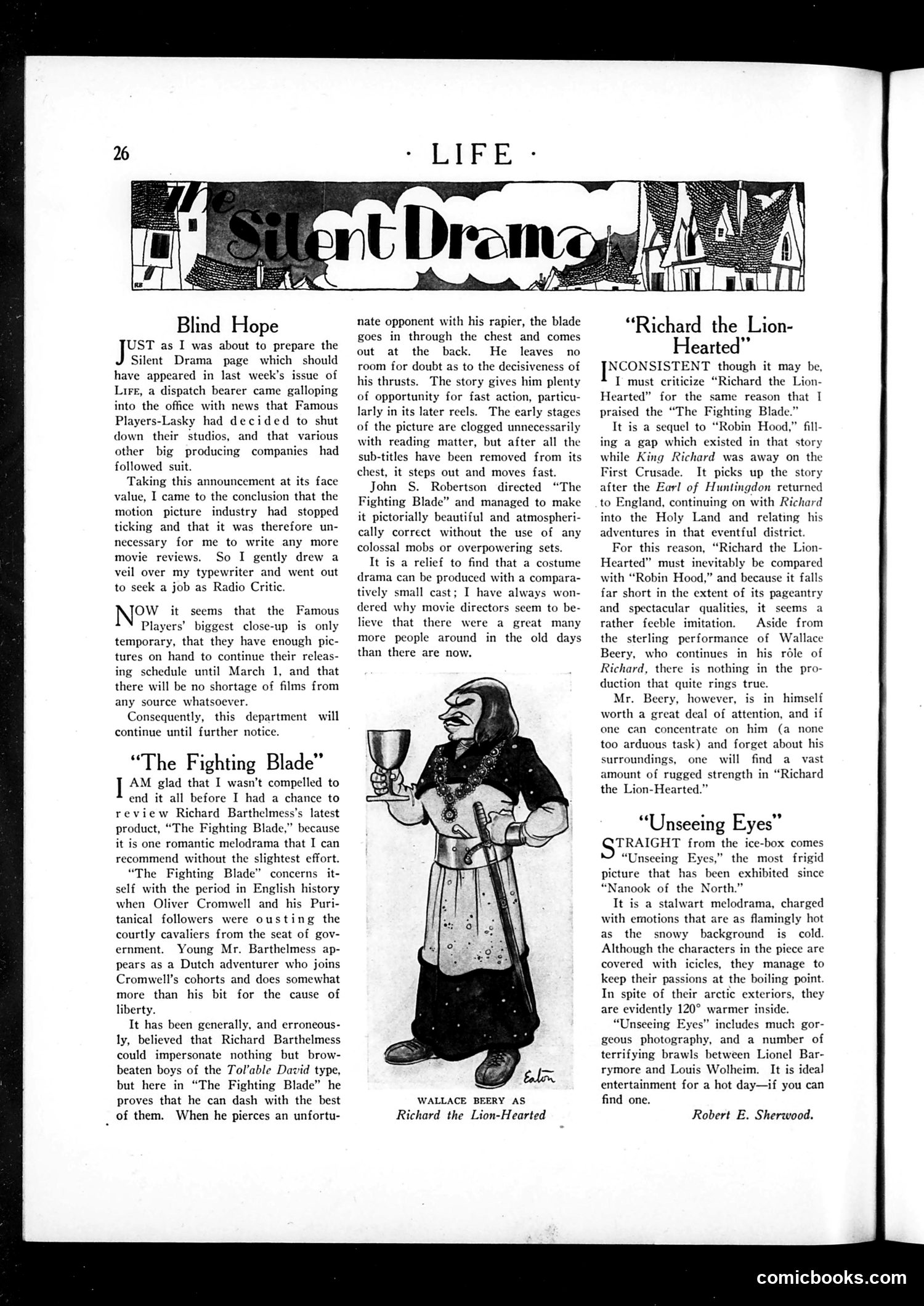
This is a film review column from Life magazine's "Silent Drama" section. The page contains three reviews of silent films: **"The Fighting Blade"** stars Richard Barthelmess in a historical drama set during Oliver Cromwell's English Civil War period. The reviewer praises it as a successful melodrama that proves Barthelmess can play action roles beyond the downtrodden characters he's known for. **"Richard the Lion-Hearted"** stars Wallace Beery as a sequel to "Robin Hood." The reviewer criticizes it for being a pale imitation of its predecessor—lacking spectacle despite Beery's strong performance. The film picks up Richard's story after his return from the Crusades. The opening "Blind Hope" section humorously describes the author's initial panic when Famous Players-Lasky studios announced closure, forcing him to consider seeking radio criticism work. He's relieved to learn the shutdown was temporary. The cartoon illustration shows Beery in costume as Richard, holding a goblet—promoting the film being reviewed.
📄 Transcribed text from this page (OCR, searchable)
Machine-transcribed from the original scan — historical spelling and the odd misread are preserved.
Blind Hope UST as I was about to prepare the Silent Drama page which should have appeared in last week’s issue of Lire, a dispatch bearer came galloping into the office with news that Famous Players-Lasky had decided to shut down their studios, and that various other big producing companies had followed suit. Taking this announcement at its face value, I came to the conclusion that the motion picture industry had stopped ticking and that it was therefore un- necessary for me to write any more movie reviews. So I gently drew a veil over my typewriter and went out to seek a job as Radio Critic. OW it seems that the Famous Players’ biggest close-up is only temporary, that they have enough pic- tures on hand to continue their releas- ing schedule until March 1, and that there will be no shortage of films from any source whatsoever. Consequently, this department continue until further notice. “The Fighting Blade” AM glad that I wasn’t compelled to end it all before I had a chance to review Richard Barthelmess's latest product, “The Fighting Blade,” because it is one romantic melodrama that I can recommend without the slightest effort. “The Fighting Blade” concerns it- self with the period in English history when Oliver Cromwell and his Puri- tanical followers were ousting the courtly cavaliers from the seat of gov- ernment. Young Mr. Barthelmess ap- pears as a Dutch adventurer who joins Cromwell’s cohorts and does somewhat more than his bit for the cause of liberty. It has been generally, and erroneous- ly, believed that Richard Barthelmess could impersonate nothing but brow- beaten boys of the Tol’able David type, but here in “The Fighting Blade” he proves that he can dash with the best of them. When he pierces an unfortu- will nate opponent with his rapier, the blade goes in through the chest and comes out at the back. He leaves no room for doubt as to the decisiveness of his thrusts. The story gives him plenty of opportunity for fast action, particu- larly in its later reels. The early stages of the picture are clogged unnecessarily with reading matter, but after all the sub-titles have been removed from its chest, it steps out and moves fast. John S. Robertson directed “The Fighting Blade” and managed to make it pictorially beautiful and atmospheri- cally correct without the use of any colossal mobs or overpowering sets. It is a relief to find that a costume drama can be produced with a compara- tively small c: I have always won- dered why movie directors seem to be- lieve that there were a great many more people around in the old days than there are now. WALLACE BEERY AS Richard the Lion-Hearted “Richard the Lion- Hearted” NCONSISTENT though it may be, I must criticize “Richard the Lion- Hearted” for the same reason that I praised the “The Fighting Blade. It is a sequel to “Robin Hood,” fill- ing a gap which existed in that story while King Richard was away on the First Crusade. It picks up the story after the Earl of Huntingdon returned to England, continuing on with Richard into the Holy Land and relating his adventures in that eventful district. For this reason, “Richard the Lion- Hearted” must inevitably be compared with “Robin Hood,” and because it falls far short in the extent of its pageantry and spectacular qualities, it seems a rather feeble imitation. Aside from the sterling performance of Wallace Beery, who continues in his réle of Richard, there is nothing in the pro- duction that quite rings true. Mr. Beery, however, is in himself worth a great deal of attention, and if one can concentrate on him (a none too arduous task) and forget about his surroundings, one will find a vast amount of rugged strength in “Richard the Lion-Hearted.” : ” “Unseeing Eyes TRAIGHT from the ice-box comes “Unseeing Eyes,” the most frigid picture that has been exhibited since “Nanook of the North.” It is a stalwart melodrama, charged with emotions that are as flamingly hot as the snowy background is cold. Although the characters in the piece are covered with icicles, they manage to keep their passions at the boiling point. In spite of their arctic exteriors, they are evidently 120° warmer inside. “Unseeing Eyes” includes muck gor- geous photography, and a number of terrifying brawls between Lionel Bar- rymore and Louis Wolheim. It is ideal entertainment for a hot day—if you can find one. Robert E. Sherwood. comicbooks.com