
A complete issue · 36 pages · 1923
Life — August 16, 1923
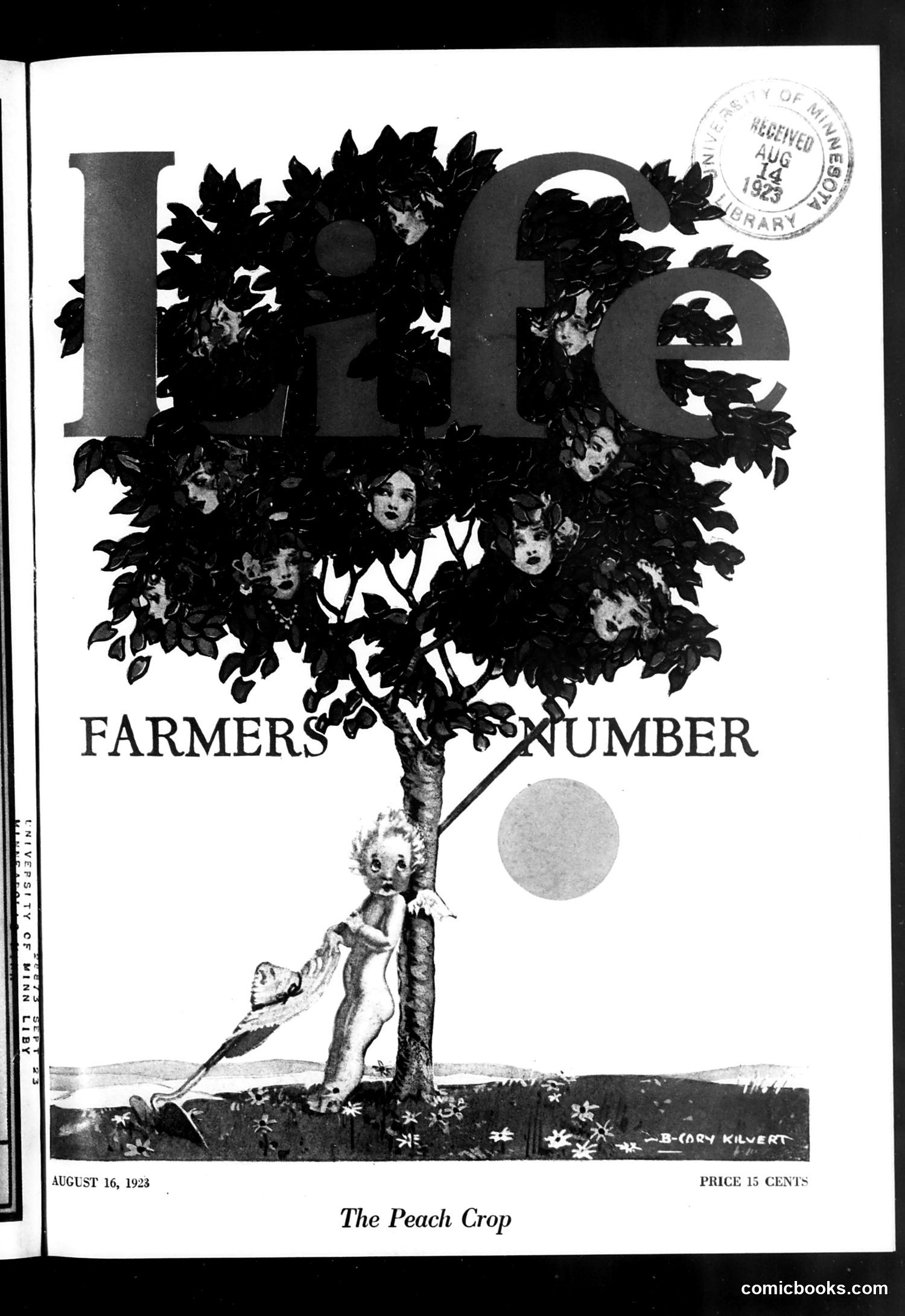
This cover illustrates an allegorical cartoon about agricultural economics. A stylized tree labeled "life" bears human faces among its foliage—likely representing various social classes or demographics. Two figures (appearing to be laborers or farmers) prop up the tree's trunk, suggesting they provide essential support to the broader society. The title "The Peach Crop" and subtitle reference agriculture, a major American industry in the 1920s. The cartoon appears to satirize economic interdependence during this period: that working-class laborers literally sustain the "life" and prosperity of the nation, yet their contributions may be undervalued or taken for granted. The artwork is credited to "B. Gary Kilvert."
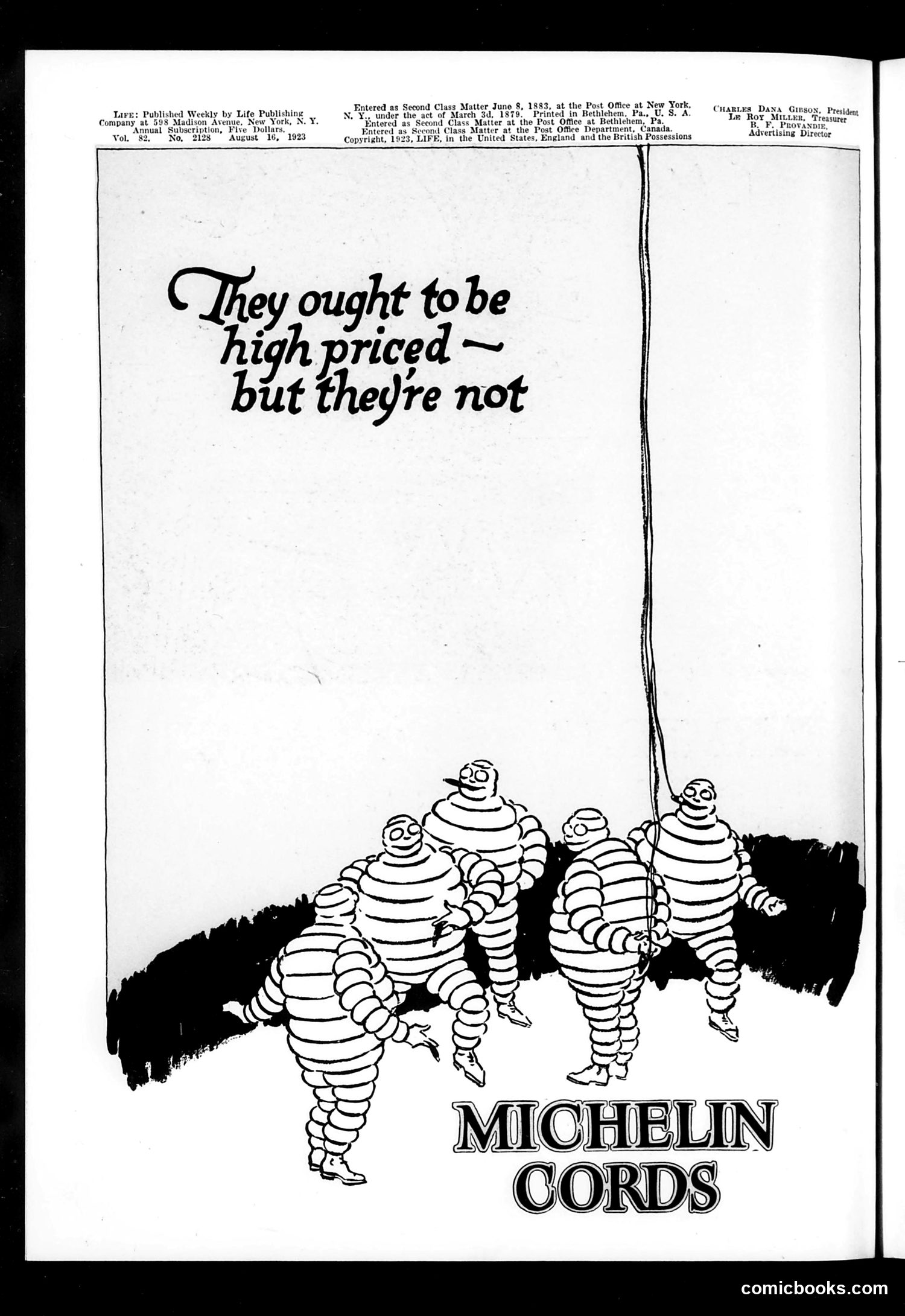
This is a **Michelin Tire advertisement** from Life magazine (August 16, 1923). The famous Michelin Man mascot—the pudgy, tire-segment character known as "Bibendum"—appears here with several companions, likely representing different tire products or qualities. The advertisement's headline claims "They ought to be high priced—but they're not," positioning Michelin tires as premium products offered at affordable prices. This was a common early 20th-century advertising strategy: suggesting a product's superior quality while emphasizing its reasonable cost, appealing to middle-class consumers seeking value. The cartoon functions purely as **commercial messaging** rather than political satire, using the Michelin mascot's recognizable charm to sell automotive products during the automobile boom era.
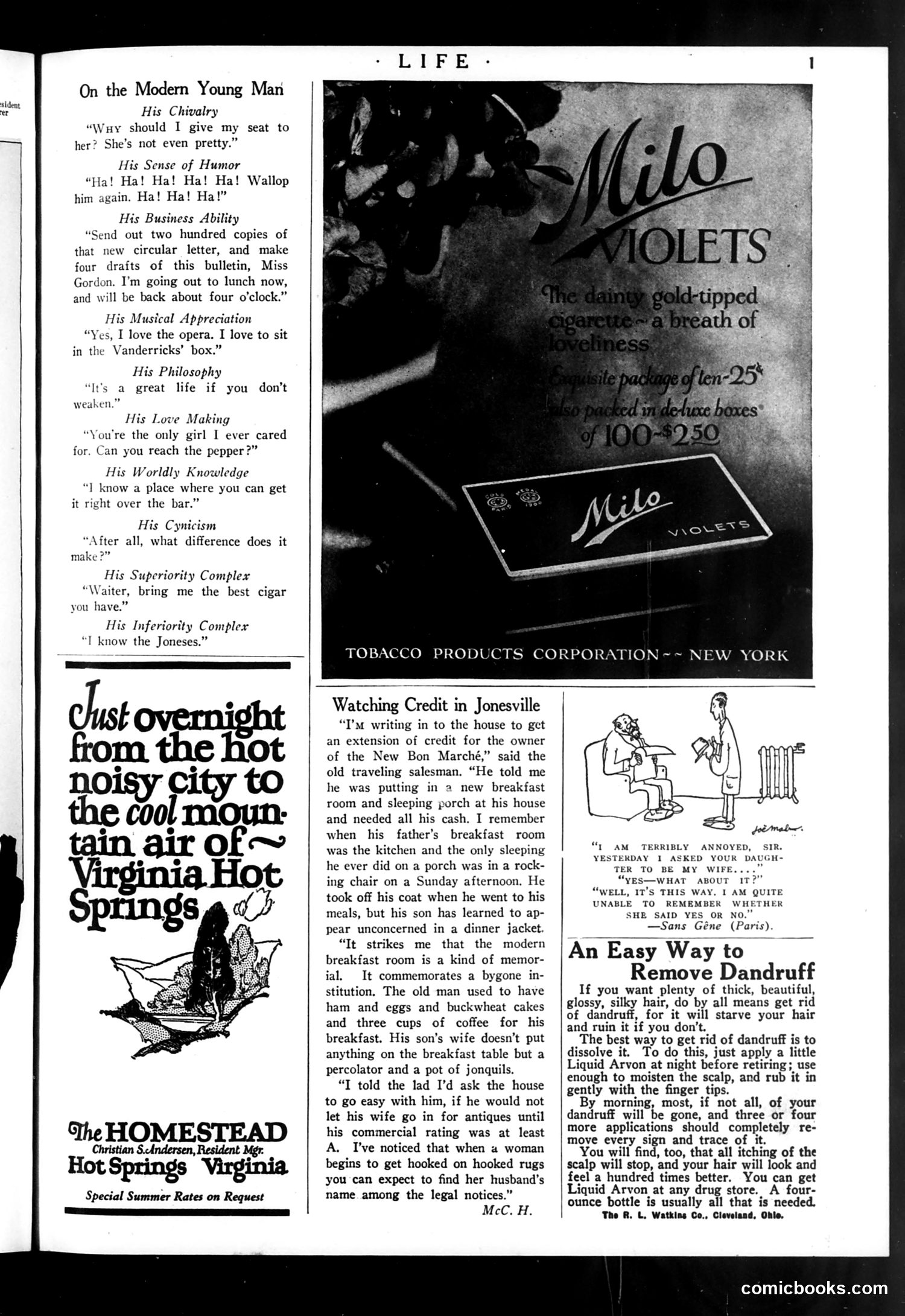
This page is primarily **advertising and advice columns** rather than political satire. The content includes: **Advertisements:** - Milo Violets cigars (top right) - The Homestead resort in Virginia Hot Springs (left) - Liquid Arvon dandruff treatment (bottom right) **Satirical Content:** The left column titled "On the Modern Young Man" presents brief character sketches mocking contemporary masculine stereotypes—his superficiality about women, affected humor, and various pretensions. This appears to be gentle social satire about 1920s-era male behavior rather than political commentary. **Advice Column:** "Watching Credit in Jonesville" discusses household economics and marital dynamics regarding domestic spending. The page reflects early 20th-century consumer culture and gender roles rather than addressing specific political events or figures.
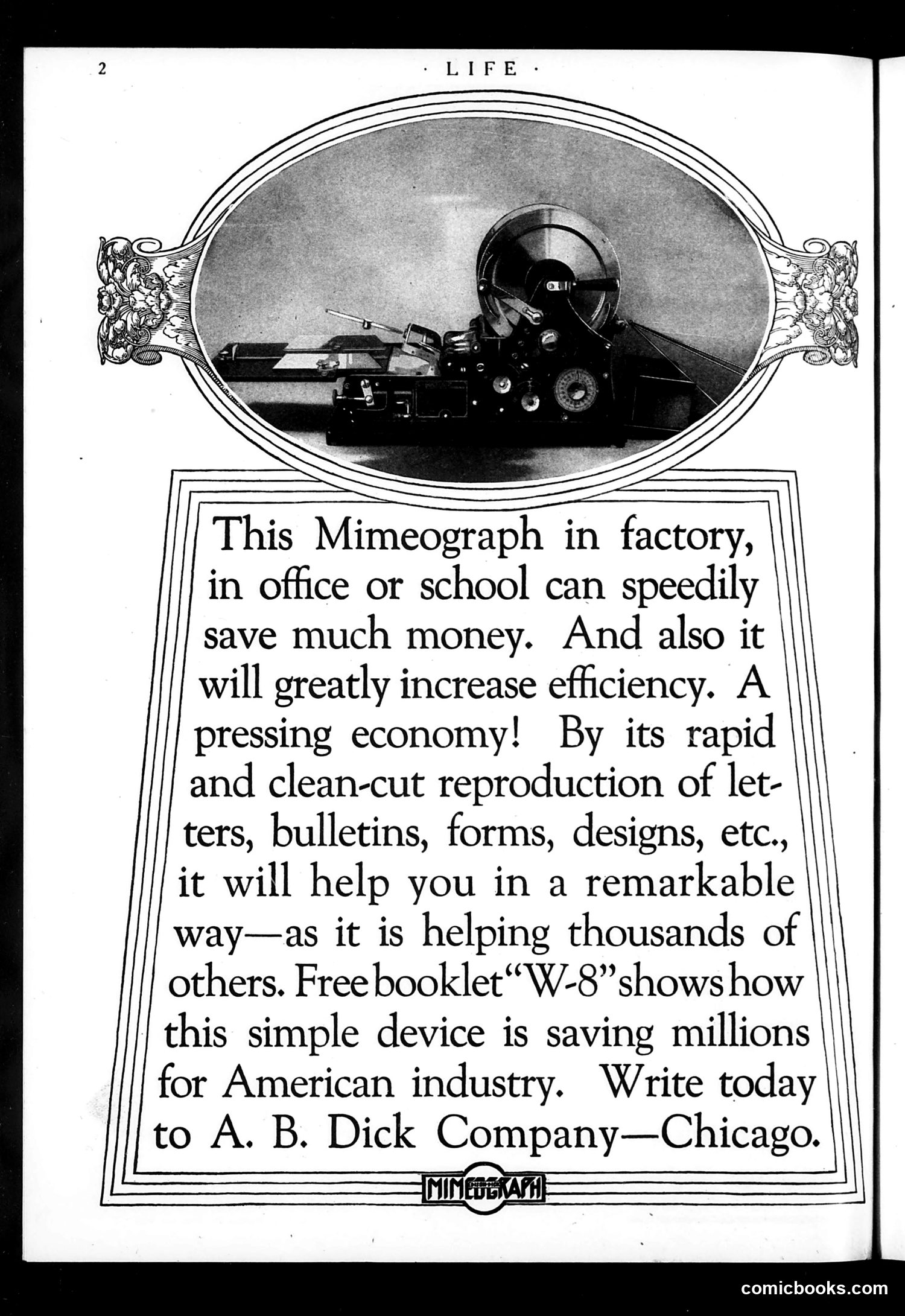
This page is primarily **advertising, not satire or political cartoon**. It's a product advertisement from the A. B. Dick Company of Chicago for a mimeograph machine. The image shows the mimeograph device itself—a mechanical copying machine with a large drum mechanism. The ad copy emphasizes practical business benefits: cost savings, efficiency improvements, and rapid reproduction of documents like letters, forms, and bulletins. The appeal to "American industry" and claims that it's "helping thousands" and "saving millions" reflect early 20th-century industrial-era marketing that positioned office technology as progress. There's no apparent satire here—it's a straightforward promotional piece from the era when mimeographs were revolutionary office equipment.
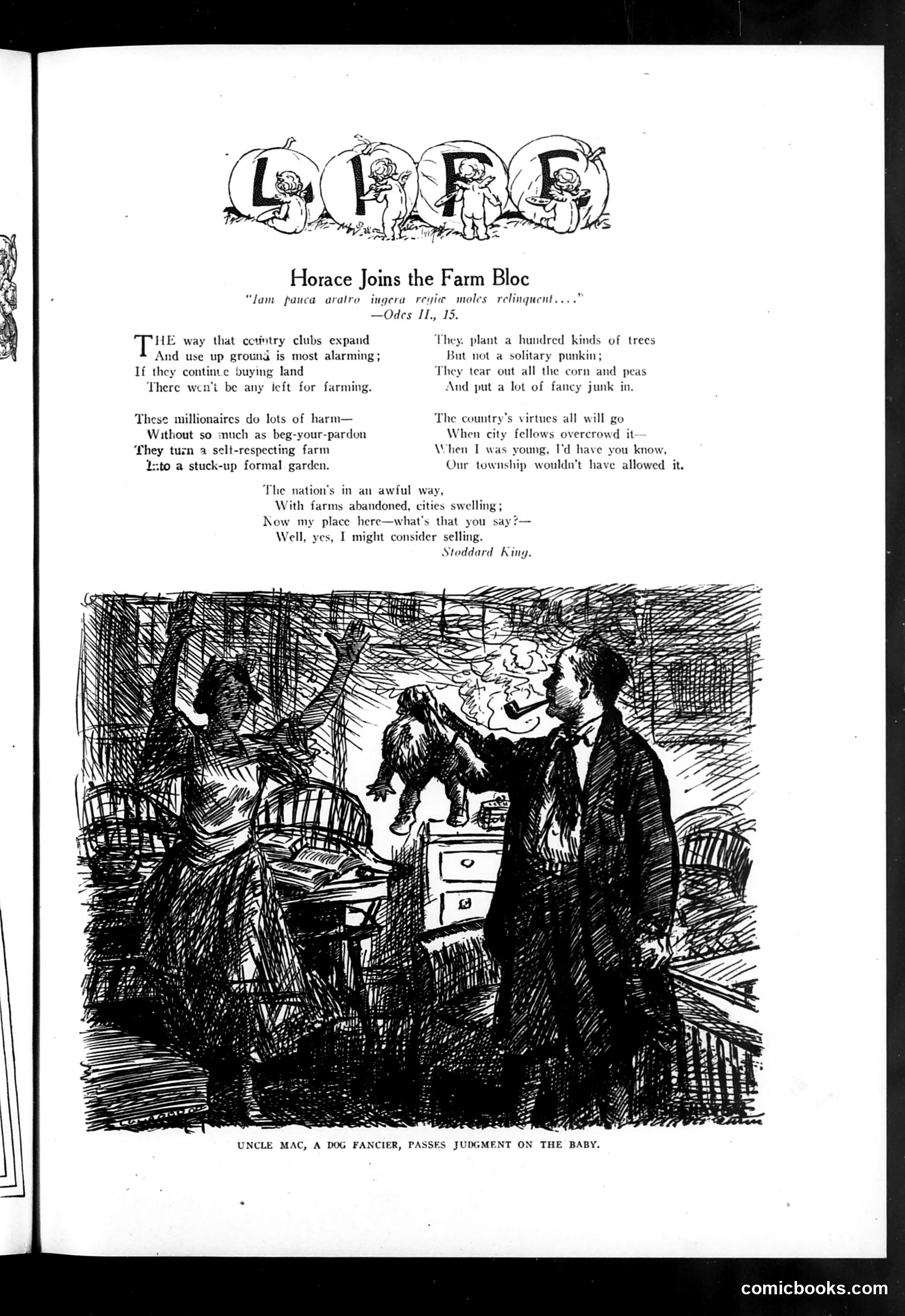
This satirical piece criticizes wealthy urbanites who adopt farming as a fashionable hobby. The poem's central complaint: millionaires purchase farmland, convert it to ornamental gardens, and abandon actual agriculture—removing productive acreage from use. The Latin epigraph and reference to "Stoddard King" suggests this targets a specific contemporary figure, likely a wealthy socialite or writer. The cartoon below depicts "Uncle Mac, a dog fancier, passes judgment on the baby"—showing a man with a dog in what appears to be an urban interior, seemingly commenting on the absurdity of city dwellers playing at rural life. The satire warns that such urban sprawl and abandonment of farming threatens the nation's agricultural foundation and self-sufficiency.
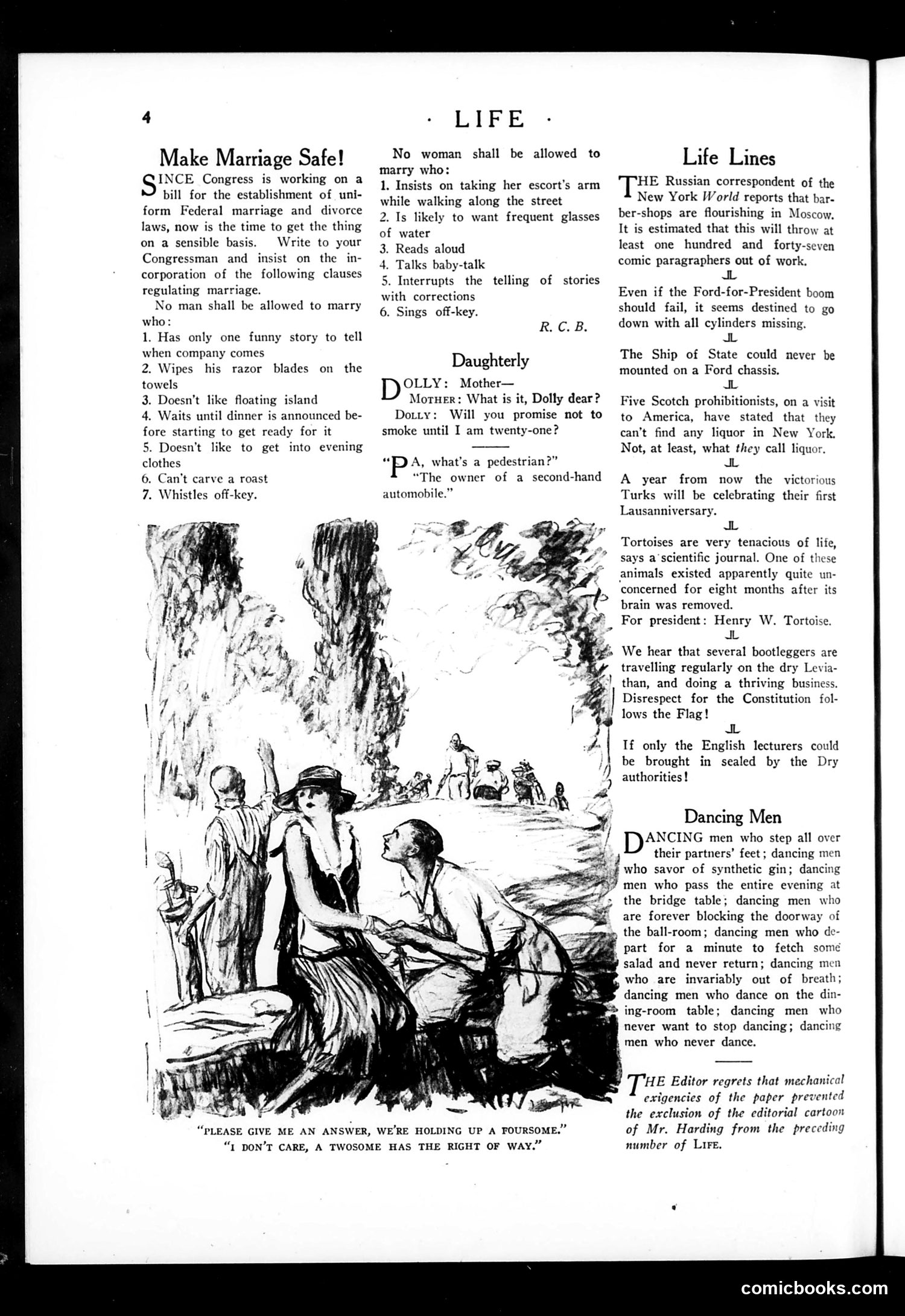
This page contains several satirical pieces mocking social customs and contemporary issues: **"Make Marriage Safe!"** proposes humorous congressional regulations for eligible men and women, satirizing both marriage difficulties and legislative overreach—likely referencing divorce law debates of the era. **"Life Lines"** comprises brief topical jokes, including references to Ford automobiles (the "Ford-for-President" boom suggests Henry Ford's political visibility), prohibition enforcement, and Scottish visitors unable to find liquor in America despite its illegality—mocking Prohibition's notorious failure. **The cartoon** shows people asking directions, with the caption joking about "a twosome has the right of way"—satirizing crowded streets and traffic confusion. **"Dancing Men"** humorously catalogs different types of male dancers, ending with "men who never dance"—social satire on dancing culture and masculine behavior.
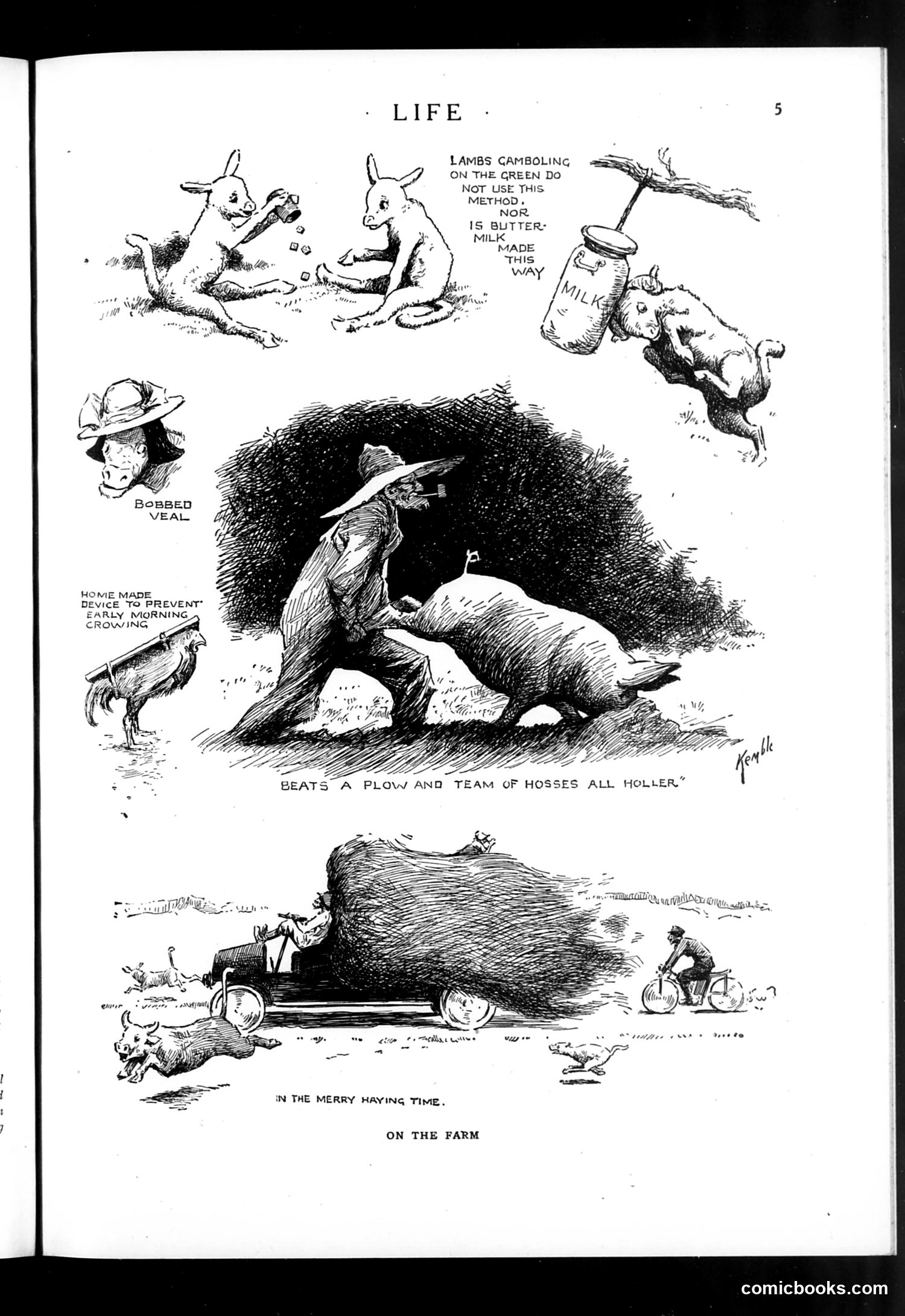
This page presents rural humor through multiple vignettes. The top sections show lambs and a calf being fed milk, with captions mocking inefficient farming methods. A "bobbed veal" illustration appears to reference the 1920s "bobbed hair" trend, applying it humorously to livestock. The central image depicts a farmer emerging from a cave or dugout, captioned as beating "a plow and team of horses all holler"—likely satirizing exaggerated rural boasting or frontier tall tales. The bottom illustration shows a truck overloaded with hay during harvest season, with a cyclist and dog nearby, captioned "In the merry haying time." This depicts the chaos and comedy of agricultural work. Overall, the page uses rustic humor to gently mock farm life, rural exaggeration, and agricultural inefficiency typical of early 20th-century satirical magazine content.
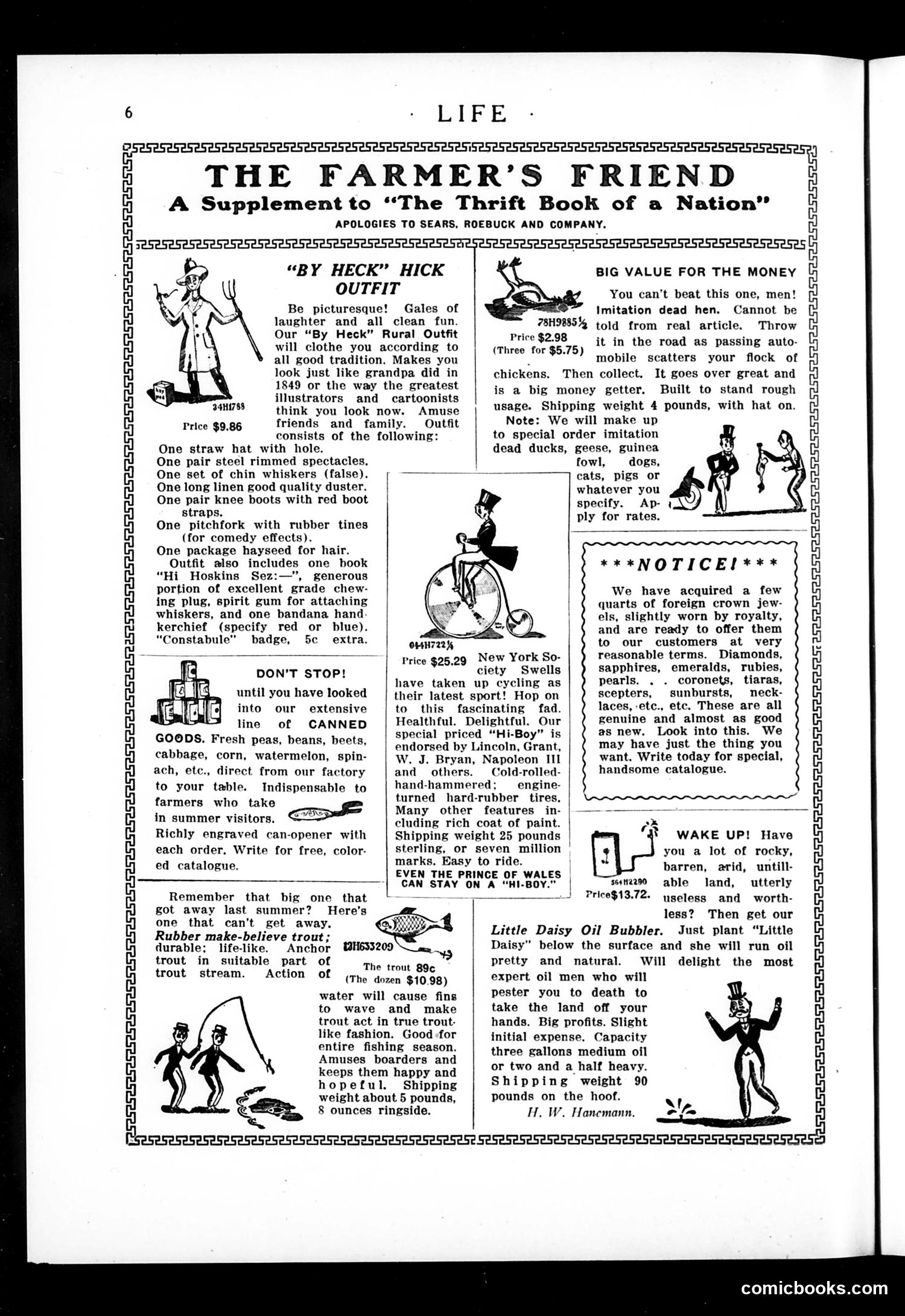
This is primarily an **advertising page**, not a political cartoon. It's a supplement promoting novelty mail-order products to rural audiences, with the title sarcastically framing these items as helpful to farmers. The ads include costume/disguise outfits ("By Heck" Hick Outfit), taxidermied animals (dead birds marketed as decoys), a tricycle endorsed by "the Prince of Wales," and an oil gimmick called "Little Daisy Oil Bubbler." The satire targets gullible rural consumers through exaggerated claims and celebrity endorsements. The magazine mocks farmers' purchasing habits by offering impractical novelties while pretending they're practical farm solutions. The tone is condescending urban humor aimed at rural "country folk."
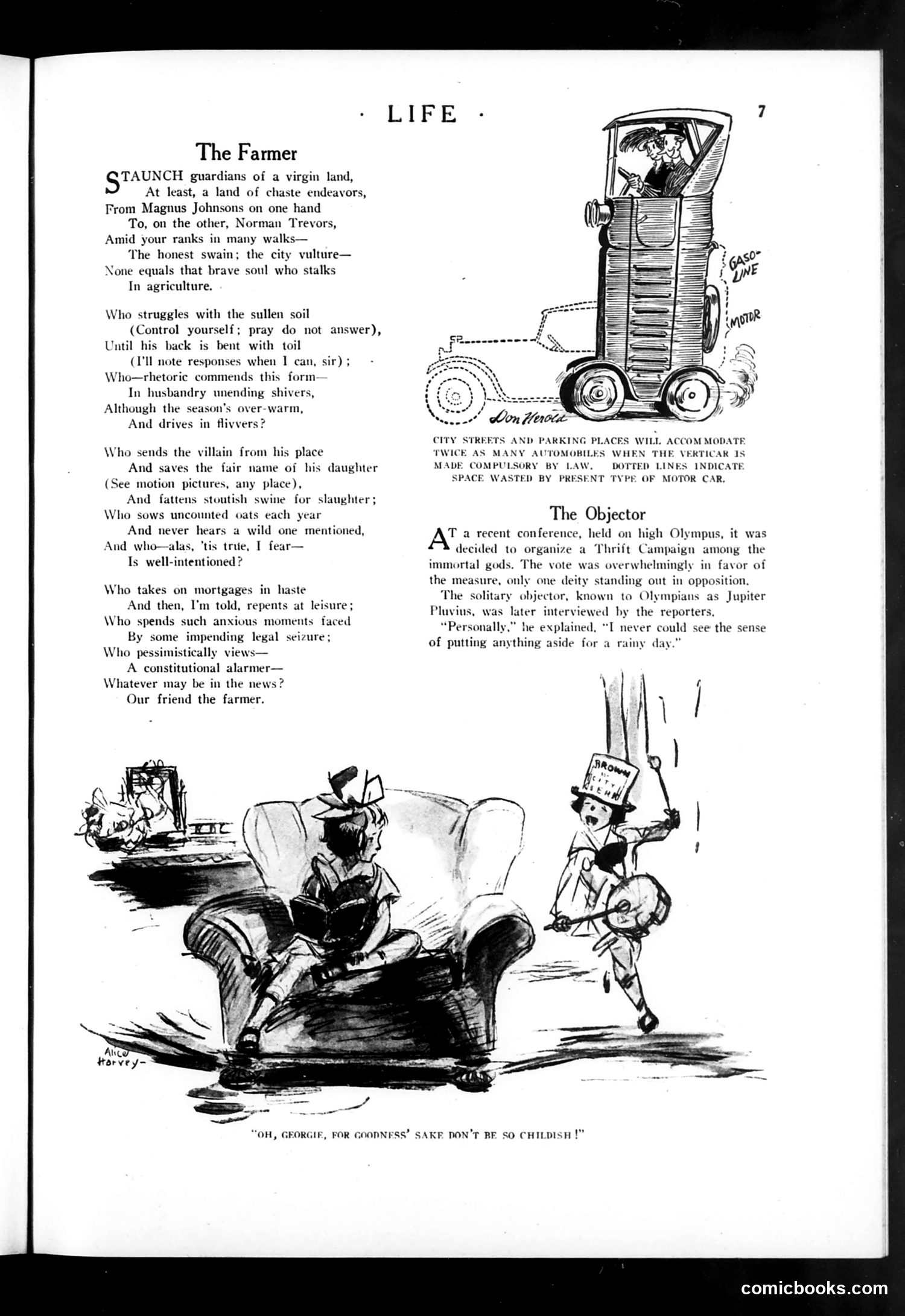
**"The Farmer" Poem**: This celebratory verse praises farmers as noble guardians of the land, contrasting their honest labor against city corruption and legal entanglement. It lauds agricultural work as morally superior to urban professions. **"The Objector" Cartoon**: The lower illustration satirizes an objector at a conference of the "immortal gods" (likely the League of Nations or similar body). The cartoon mocks someone—identified as "Jupiter Pluvius"—who opposes practical measures, claiming he cannot support "putting anything aside for a rainy day." The figure running away labeled "BROWNS" appears distressed. The satire targets impractical idealism that refuses compromise, using mythological language for humorous effect. Both pieces appear critical of contemporary attitudes toward progress and responsibility.
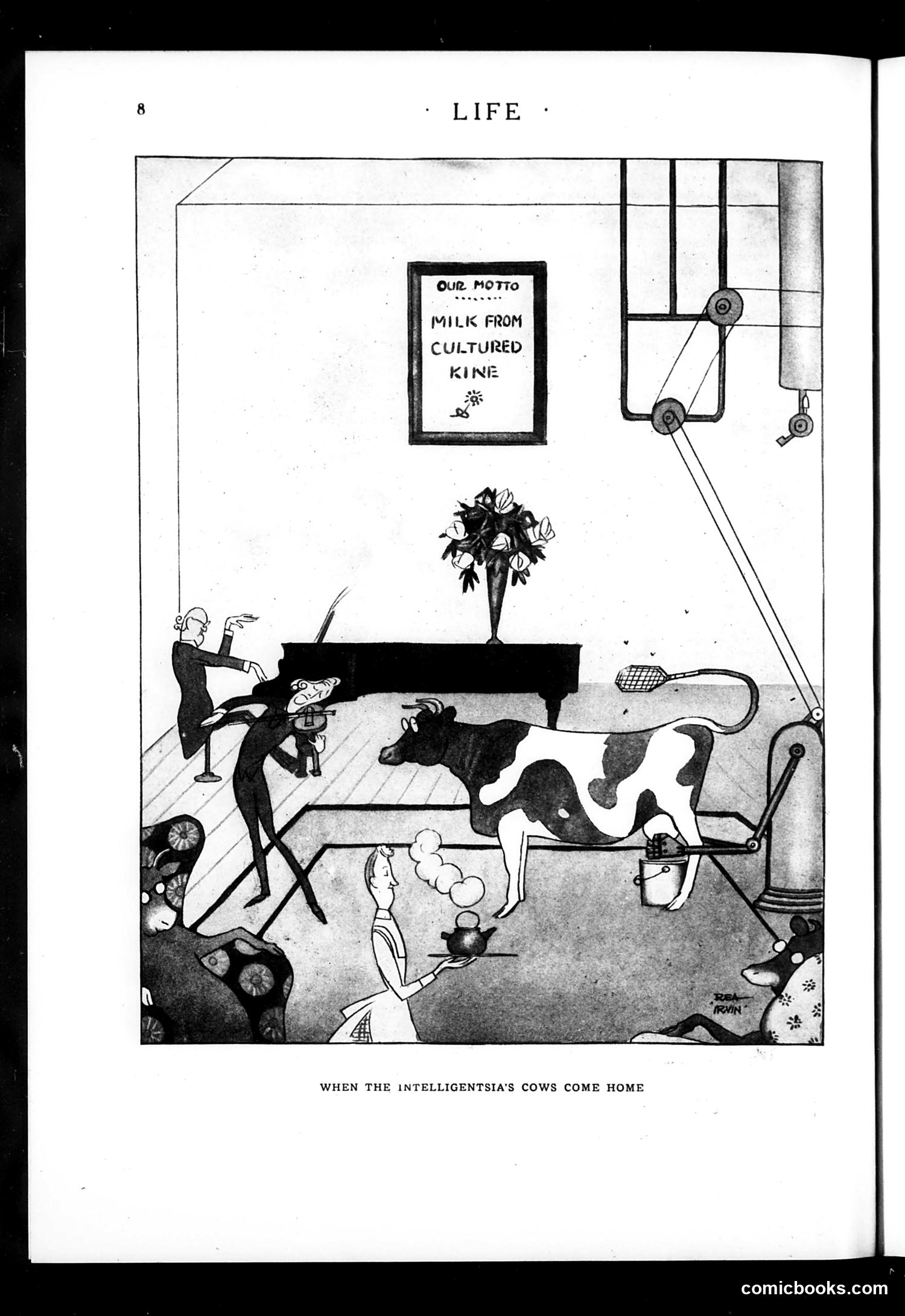
This is a satirical cartoon titled "When the Intelligentsia's Cows Come Home," depicting a chaotic domestic scene where a cow has been brought into an apartment. The motto displayed reads "Milk From Cultured Kine" (kine being an archaic plural of cow). The satire targets intellectuals or the "intelligentsia" who presumably advocate for avant-garde or experimental ideas—here, the absurd notion of keeping dairy cows indoors as part of cultured living. The scene shows the resulting chaos: the cow disrupts the home, knocking over household items, while residents attempt to manage the disaster through mechanical milking apparatus. The joke mocks impractical idealism and the gap between intellectual theory and practical reality, suggesting that fashionable intellectual movements produce ridiculous consequences when actually implemented.
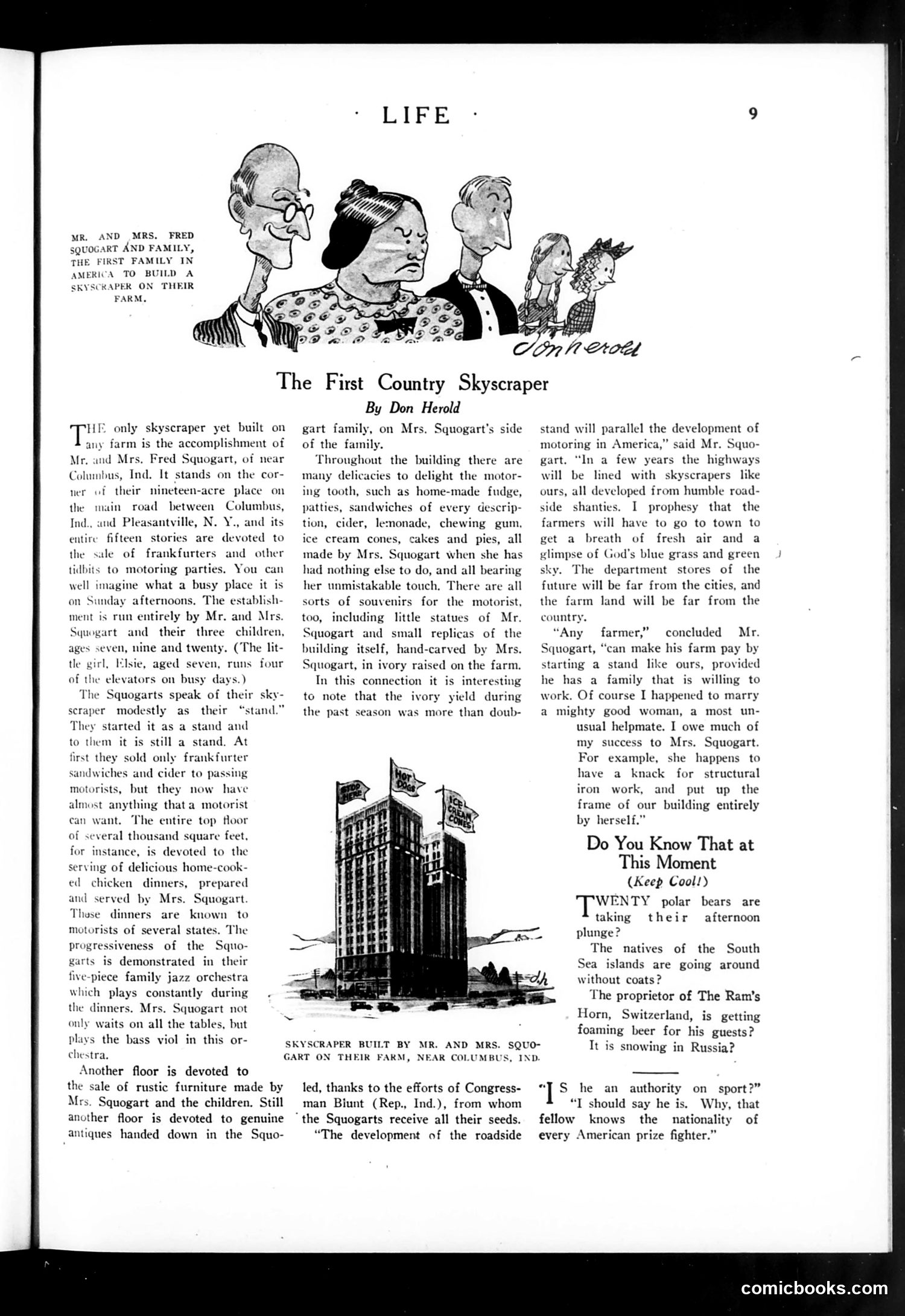
This satirical article by Don Herold mocks the Squogarts, a farm family near Columbus, Indiana, who built a 15-story structure on their property—likely the earliest tall building on farmland rather than in a city. The cartoon caricatures Mr. and Mrs. Fred Squoggart and their children with exaggerated features. The satire targets rural ambition and commercialism: the Squogarts operate a roadside stand selling food and souvenirs to motorists, with their skyscraper serving as their "stand." Herold humorously predicts highways will someday line up with farm-based skyscrapers, suggesting the absurdity of commercializing rural America and foreshadowing suburban sprawl—a prescient social commentary on development patterns that would define mid-20th-century America.
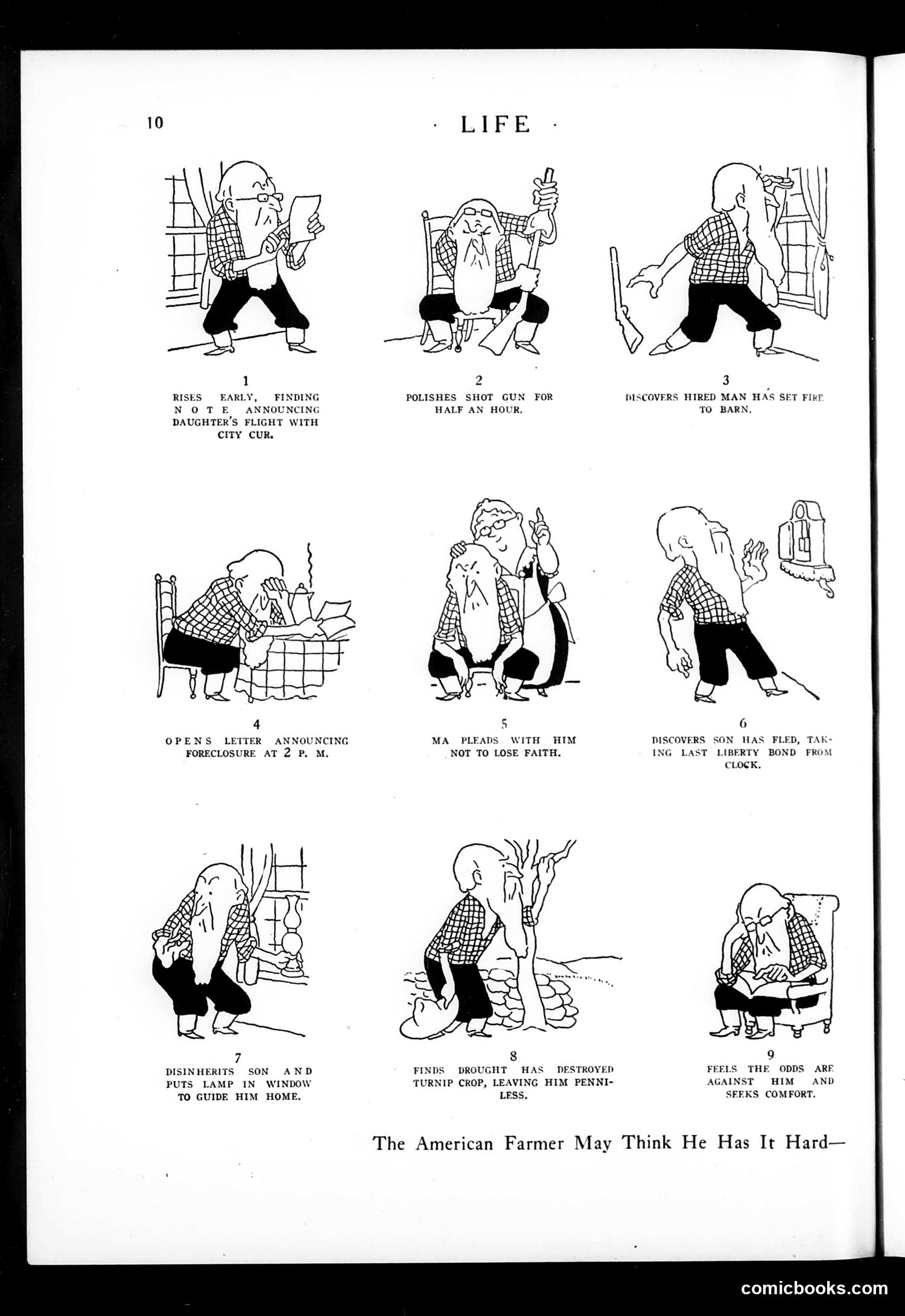
This is a nine-panel satirical comic strip depicting "The American Farmer" experiencing a series of escalating misfortunes. The narrative follows a single character through catastrophes: his daughter elopes, he sells his shotgun out of necessity, discovers a hired hand has burned his barn, receives foreclosure notice, loses his son to debt, and faces his crop destroyed and inheritance depleted. The final panel shows him defeated, seeking comfort. The title—"The American Farmer May Think He Has It Hard"—suggests ironic commentary on rural economic hardship, likely referencing Depression-era agricultural crisis. The strip presents farming as a progressively catastrophic lifestyle, using dark humor to critique the economic vulnerability of American agricultural workers during this period.
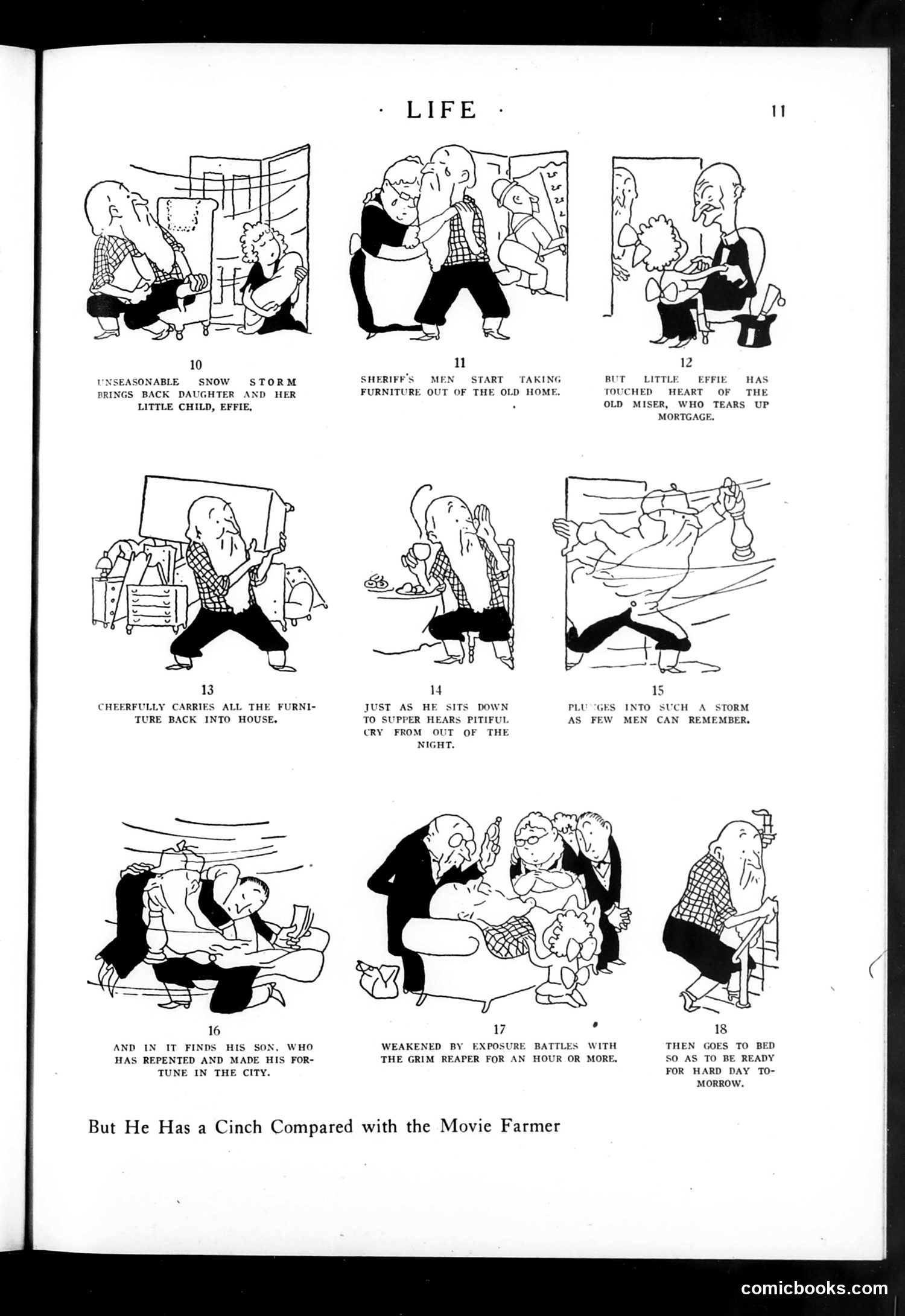
This is a humorous narrative comic strip depicting a man's misadventure during an unreasonable snowstorm. The sequence shows: 1. A snow storm forces him to retrieve his daughter and child 2. A sheriff evicts him from his home 3. He moves furniture in terrible weather 4. He struggles through the storm carrying belongings 5. He encounters exposure and hardship 6. He finds his son in the city 7. He battles "the grim reaper" (personified Death) through exposure 8. He finally reaches bed, exhausted The caption's punchline—"But He Has a Cinch Compared with the Movie Farmer"—suggests this is satirizing Depression-era hardship narratives, particularly those romanticized in farm-life films. The joke implies that real urban struggles during harsh winters rival or exceed the stereotypical farmer's hardships depicted in cinema, undercutting popular nostalgic narratives about rural life.
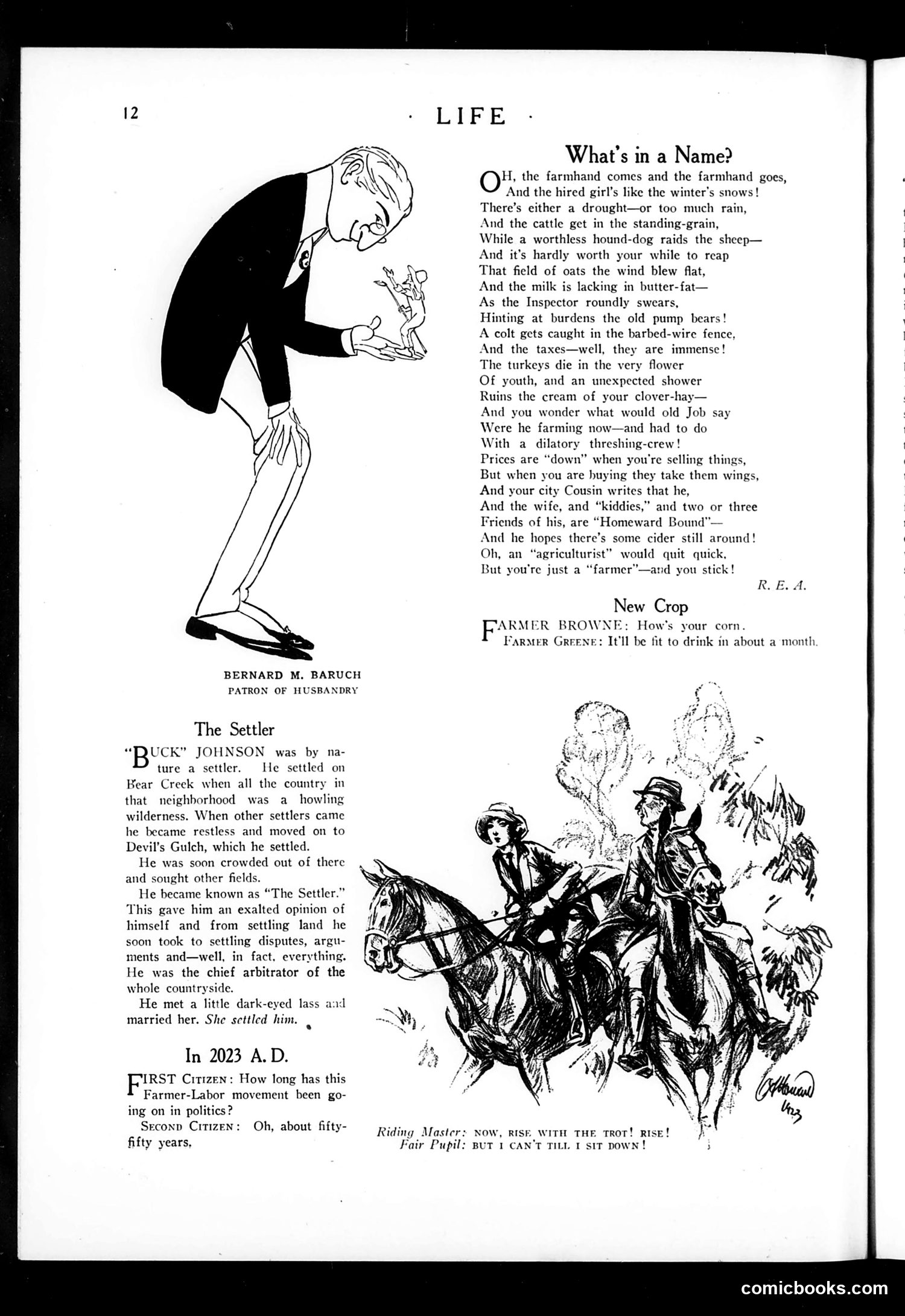
This poem by R.E.A. satirizes the difficult life of farmers through the early 20th century. It catalogs rural hardships: droughts, livestock losses, taxes, and crop failures. The key joke appears in the final lines: a farmer's city cousin romanticizes "going back to the land" and becoming an "agriculturist," but the actual farmer knows he's just stuck as a "farmer." The satire mocks the gap between idealized notions of farming and its harsh economic reality. The accompanying cartoon by Bernard M. Baruch titled "Patron of Husbandry" shows a well-dressed gentleman with wilted flowers, symbolizing how removed wealthy or urban people are from actual agricultural labor. The page presents contrasting rural sketches about settlers and farming life, emphasizing the disconnect between romantic ideals and rural hardship.
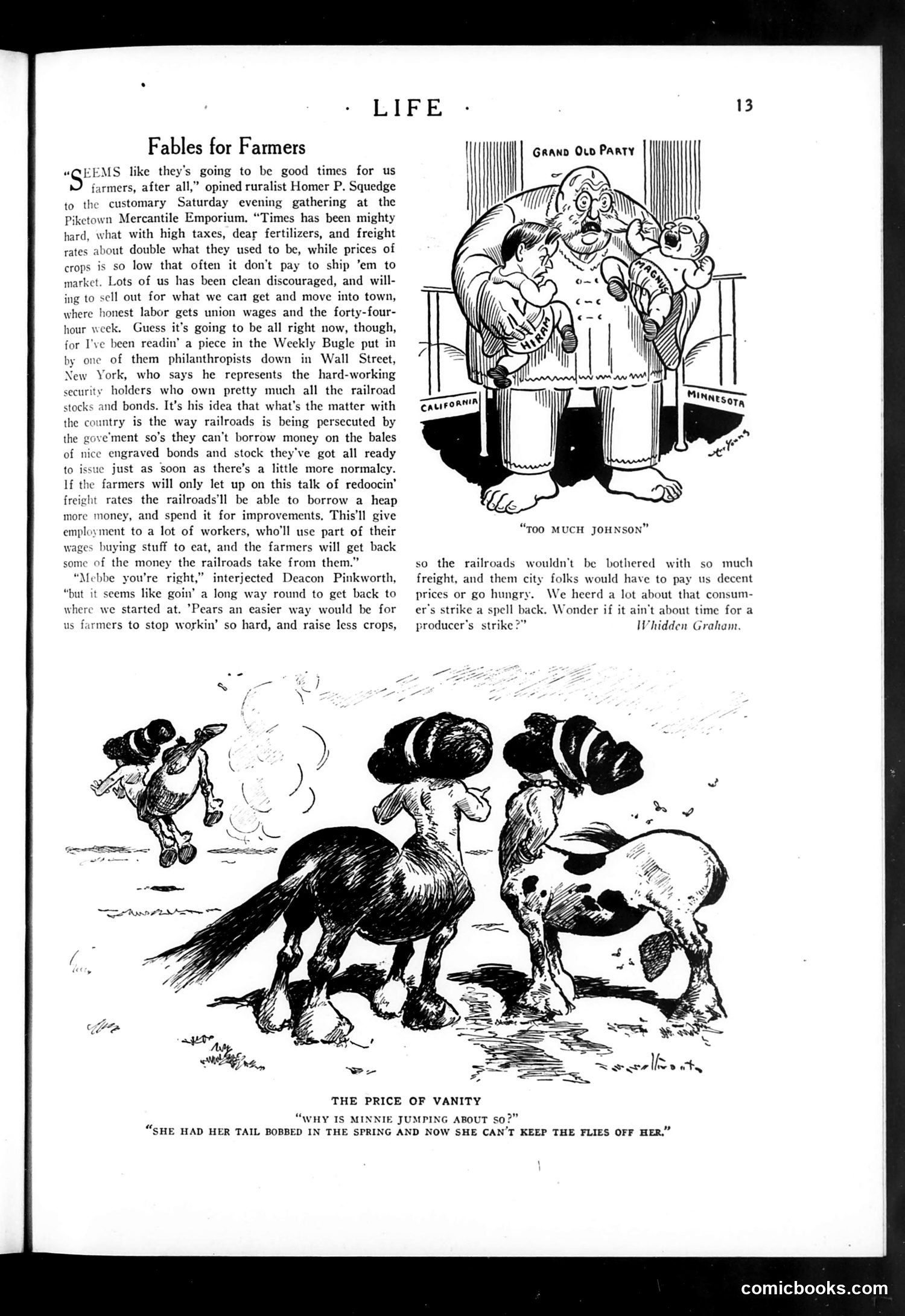
**Top Cartoon ("Grand Old Party"):** Shows fat railroad executives and politicians gathered around a table labeled with state names (California, Minnesota). The caption "Too Much Johnson" suggests they're discussing railroad monopolies and freight rates—the "Grand Old Party" (Republicans) protecting railroad interests. **Article Context:** Farmer Homer P. Squedge discusses how high taxes, fertilizer costs, and freight rates burden farmers while crop prices remain low. The piece satirizes railroad monopolies' influence over government policy, suggesting farmers should reduce production to force price increases—a producer's strike concept. **Bottom Cartoon ("The Price of Vanity"):** A horse had her tail docked for vanity, now suffers from flies. This fable warns against prideful decisions with negative consequences—likely paralleling farmers' economic suffering from poor policy choices.
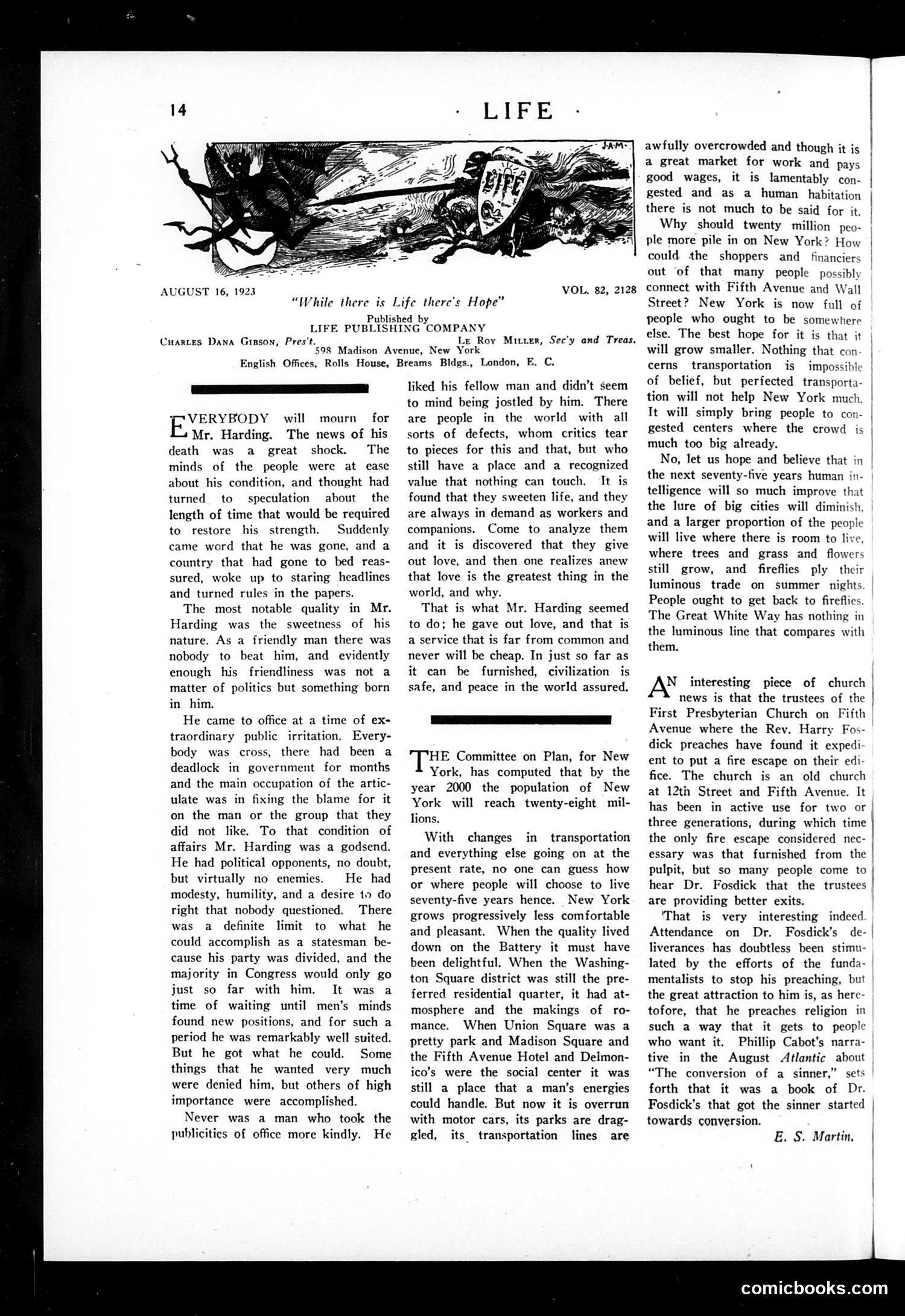
The page features an editorial mourning President Warren G. Harding's recent death. The small illustration at top shows what appears to be a symbolic or allegorical figure—likely Death or Fate—approaching a prone figure (Harding). The text praises Harding's personal qualities: his friendliness, lack of enemies, and modest nature. However, it notes his presidency was marked by government deadlock and gridlock, with Harding struggling to accomplish meaningful change despite good intentions. The editorial reflects contemporary ambivalence toward Harding: respected as a decent man personally, but politically ineffectual. His death on August 2, 1923, occurred during a scandals-plagued administration (Teapot Dome would soon emerge). The piece emphasizes his character while tacitly acknowledging his presidential failures.
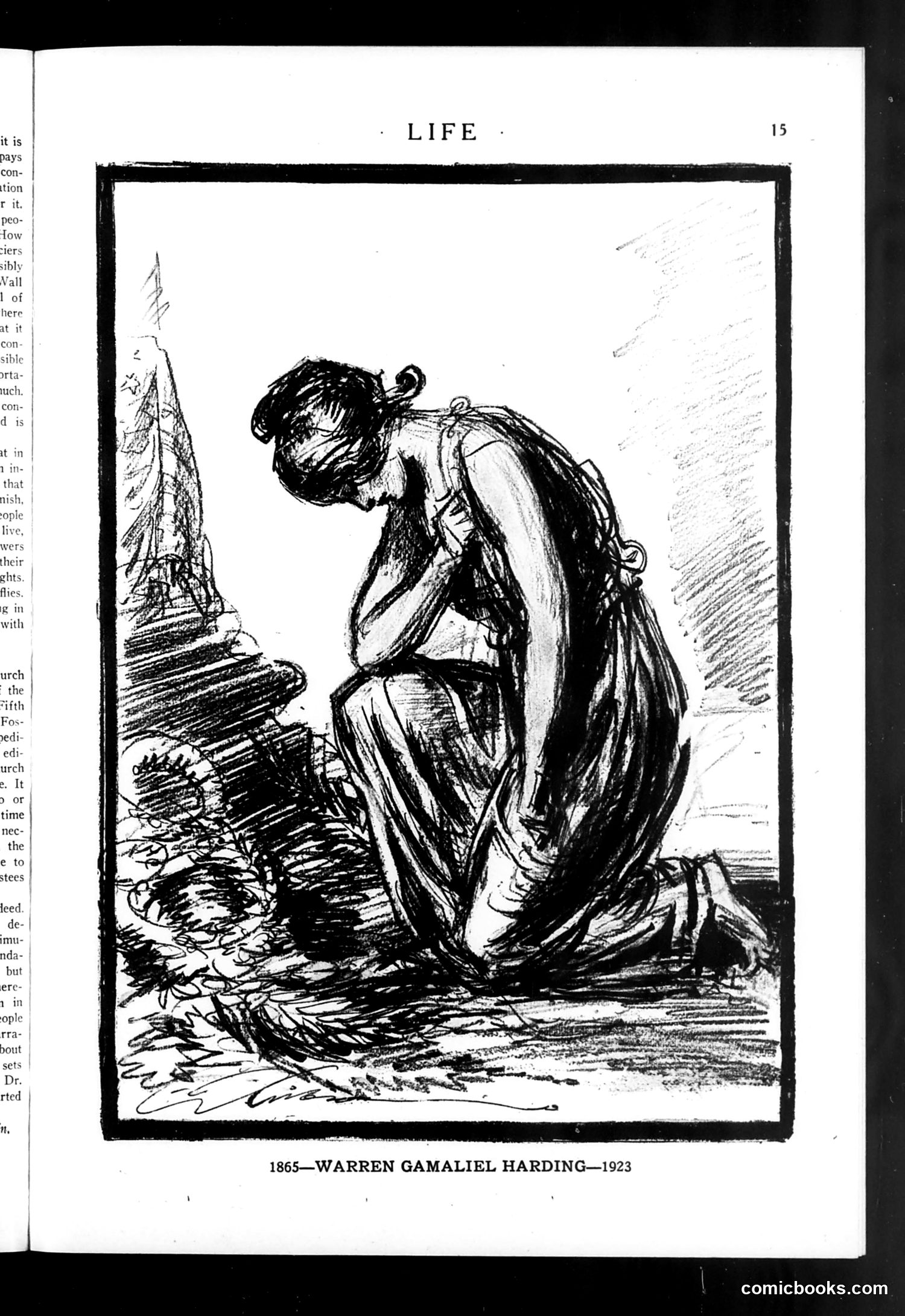
This is a memorial illustration for **Warren G. Harding**, the 29th U.S. President, who died in office in 1923. The image shows a kneeling female figure (likely representing America or the nation in mourning) beside a ship, rendered in a classical allegorical style. The dates "1865—WARREN GAMALIEL HARDING—1923" mark his birth and death. The ship in the background appears to reference his role as commander-in-chief or the nation's leadership during his presidency (1921-1923). This is a serious, reverent tribute rather than satire—typical of how Life magazine sometimes memorialized significant political figures upon their death. The classical artistic treatment emphasizes the solemnity of the occasion rather than offering political commentary or criticism of Harding's administration.
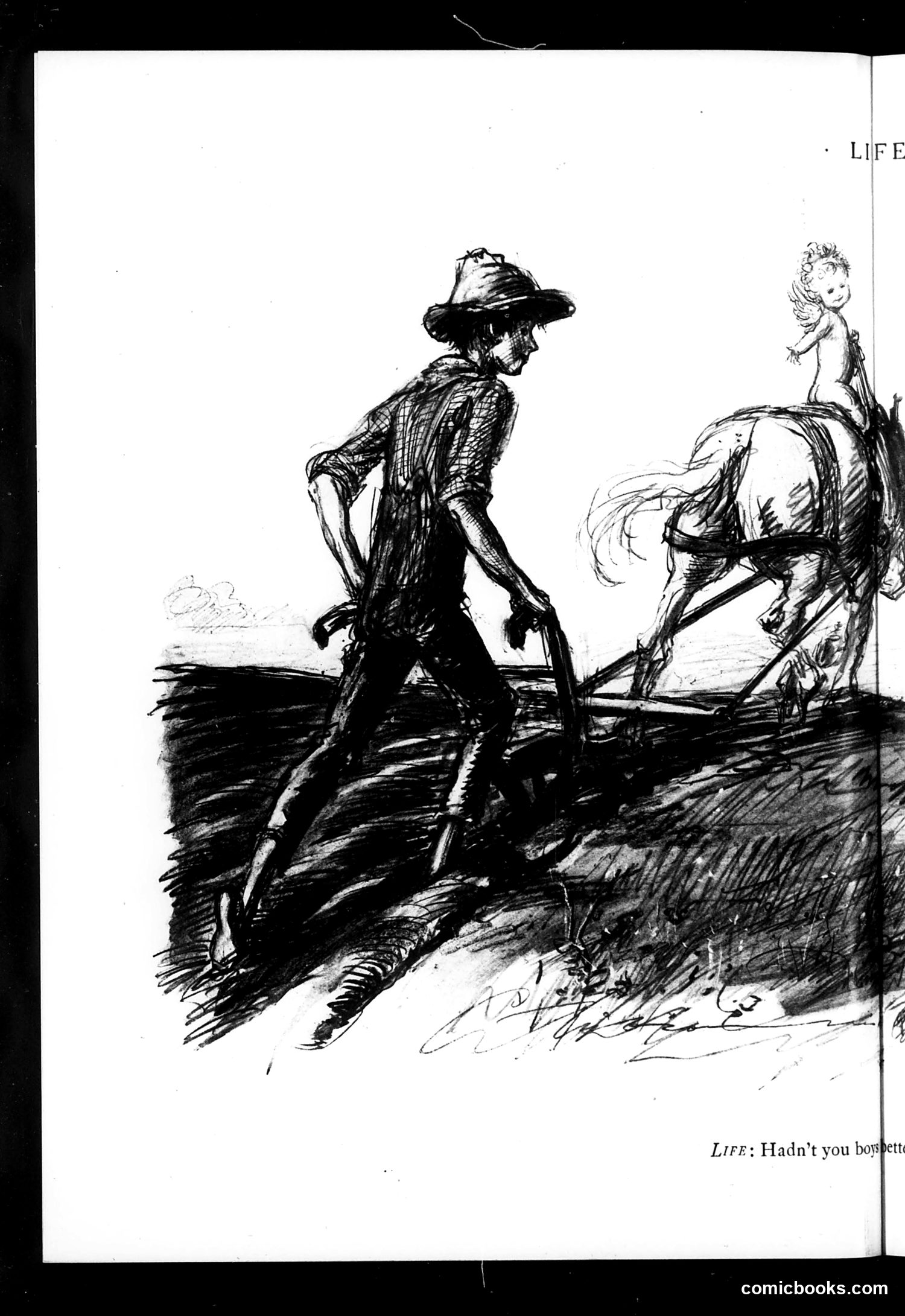
This appears to be a satirical cartoon from *Life* magazine showing a farmer plowing a field while a young boy sits on a horse nearby. The caption reads "LIFE: Hadn't you boys better—" (text cut off). The satire likely comments on rural labor or child labor practices. The farmer, depicted through heavy cross-hatching, represents manual agricultural work, while the well-dressed boy on horseback suggests privilege or leisure. The incomplete caption implies a suggestion or criticism about the boys' activities—possibly mocking either the farmer's concerns about idle youth or critiquing class disparities between privileged children and working-class families. Without the complete caption or publication date visible, the specific political context remains unclear.
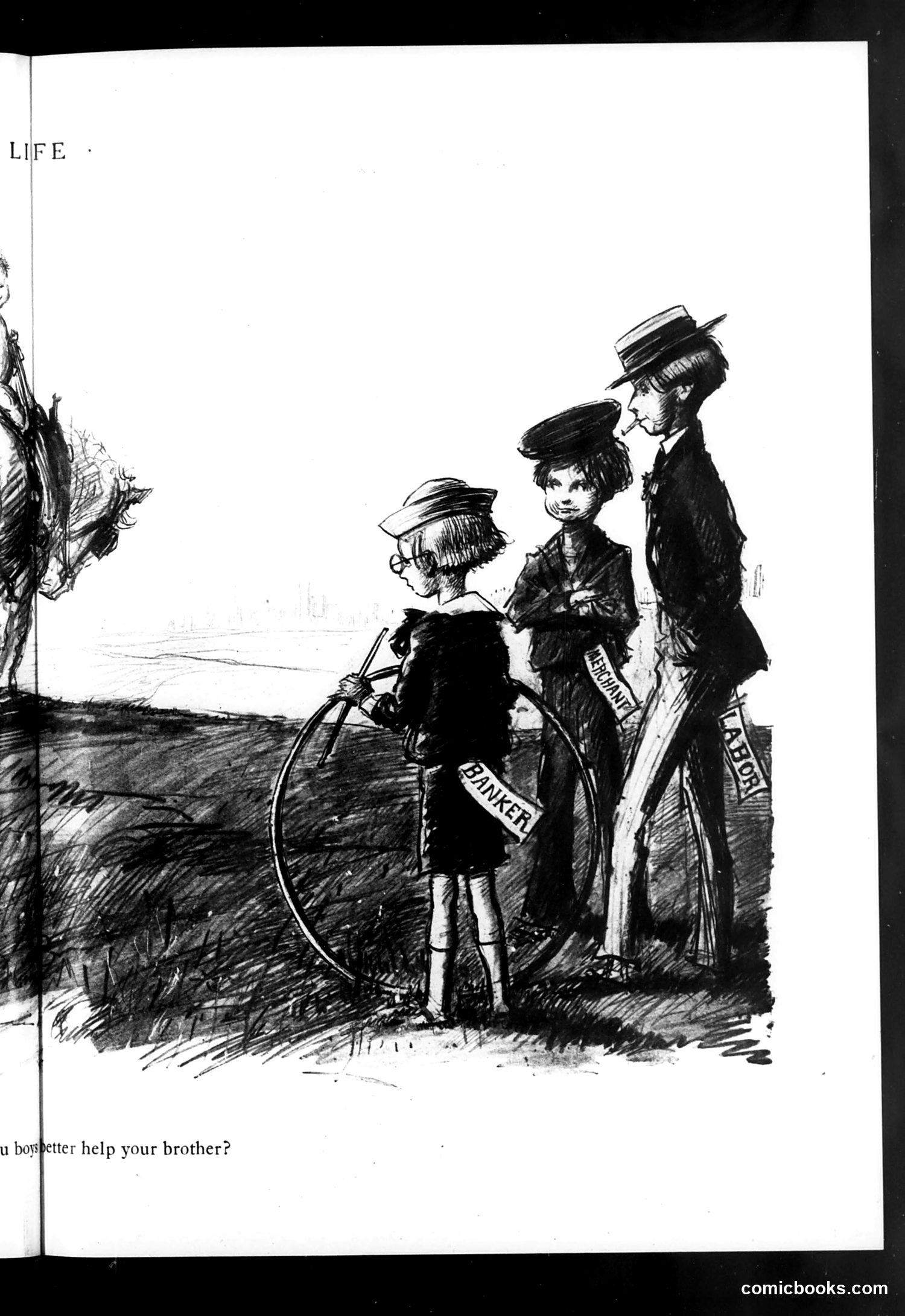
This page from *Life* magazine shows a political cartoon featuring three well-dressed men in hats observing a boy with a bicycle labeled "BANKER." The partially visible text at bottom reads "u boy better help your brother?" The satire appears to address economic inequality and class responsibility during a period of financial hardship—likely the Great Depression era. The "banker" figure (depicted as a child or diminished character) may represent the banking industry's reduced circumstances or culpability. The question posed suggests criticism of the wealthy or privileged classes' failure to assist those struggling economically. The cartoon's specific political targets and exact date remain unclear from the visible text alone.
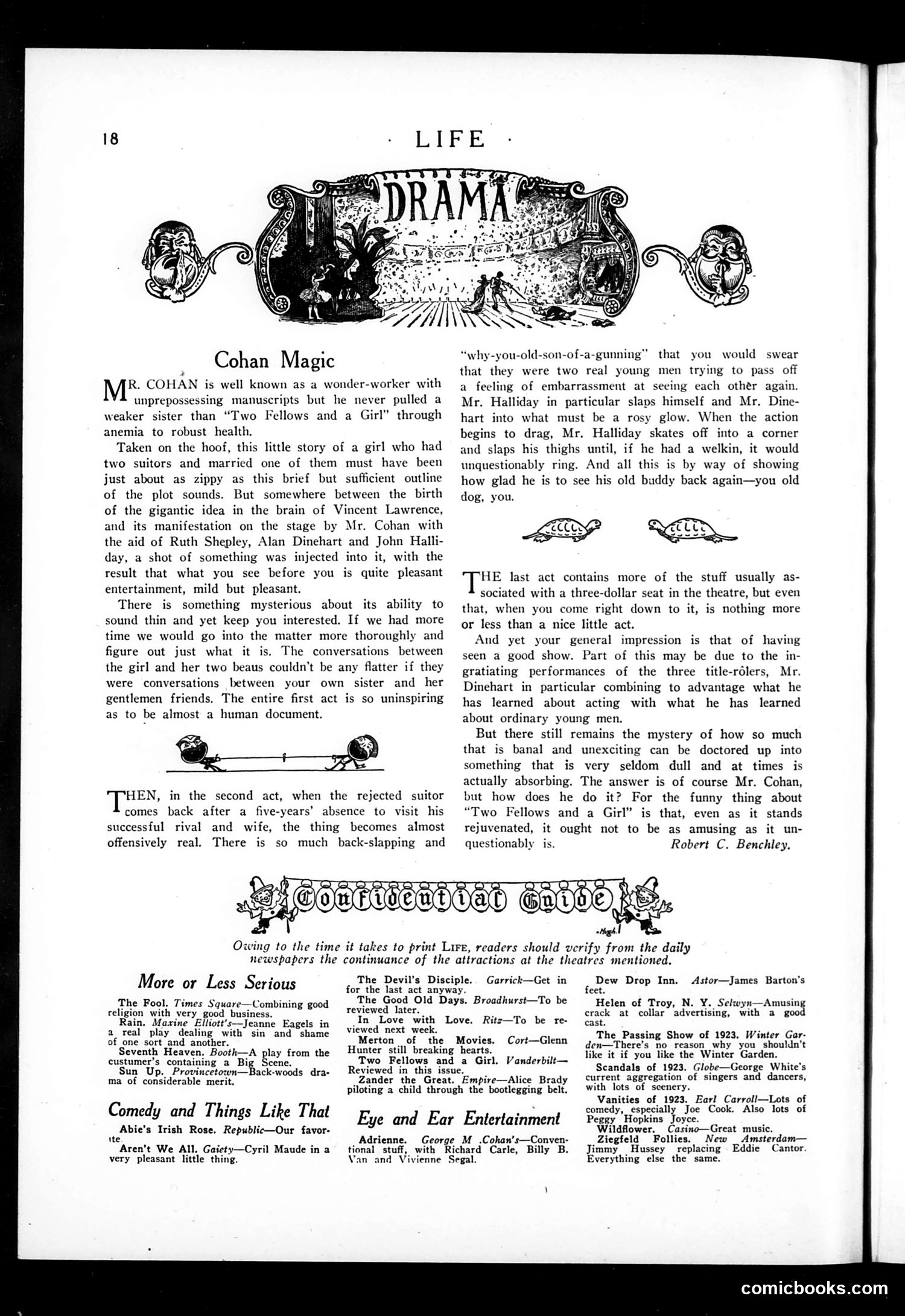
This is a theater review by Robert C. Benchley of George M. Cohan's production "Two Fellows and a Girl." **The Main Point:** Benchley praises Cohan's mysterious ability to transform unpromising material into entertaining theater. He notes the play's plot—a girl choosing between two suitors—is banal on paper, and even the dialogue is flat. Yet through Cohan's direction and strong performances by Ruth Shepley, Alan Dinehart, and John Halliday, it becomes genuinely engaging. **The Satire:** Benchley humorously describes the second act's exaggerated male bonding—excessive back-slapping and thigh-slapping between the suitor and his rival—mocking theatrical conventions of masculine reunion scenes. He admits he cannot fully explain why such thin material works so well, crediting Cohan's unexplainable theatrical "magic." **Context for Modern Readers:** This represents 1920s theater criticism celebrating a producer-director's craft. The three small decorative illustrations are generic theatrical vignettes, not specific caricatures.
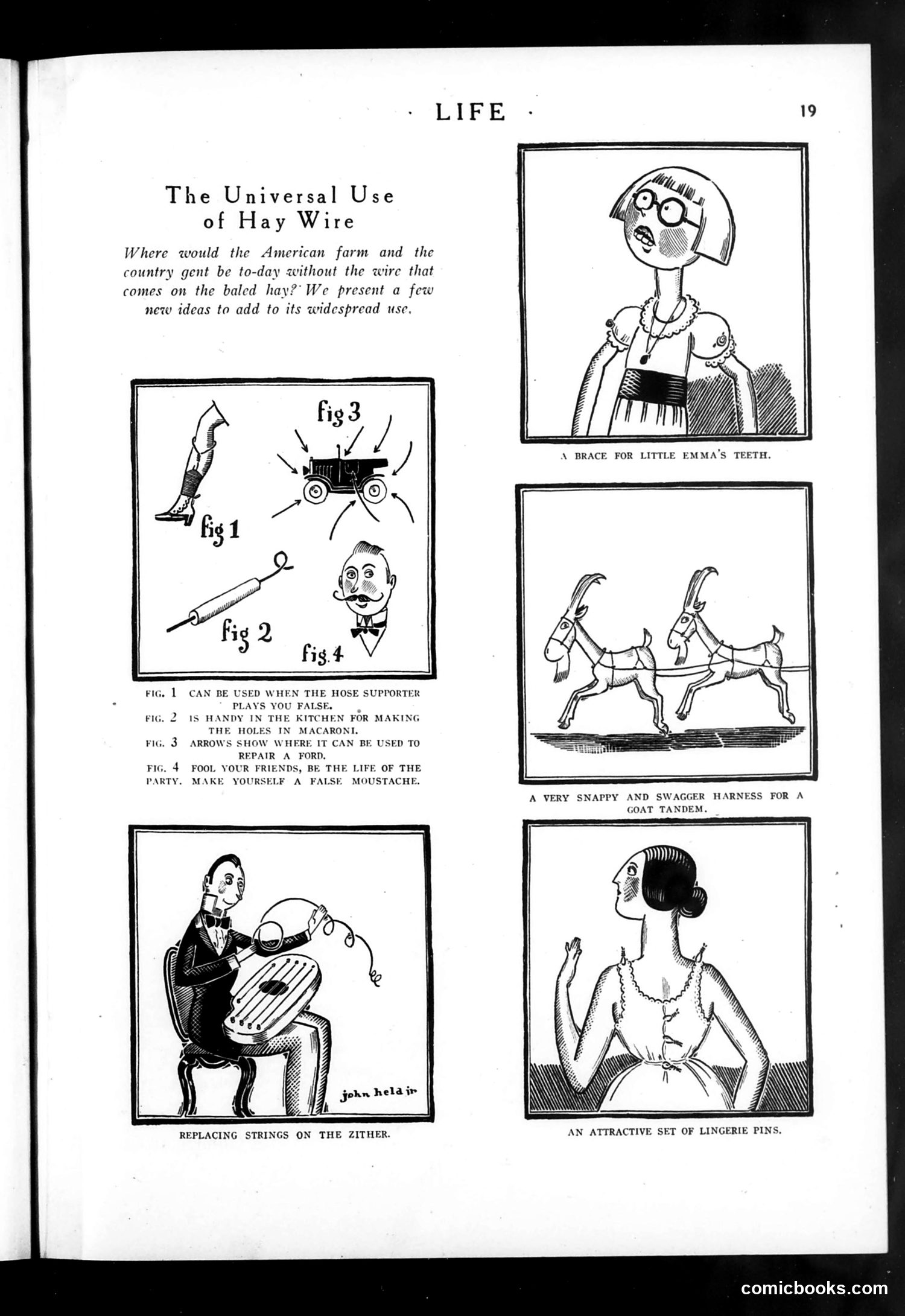
This satirical piece humorously catalogs absurd repurposings of baling wire—the wire bundling hay bales on farms. The joke targets rural American ingenuity and makeshift resourcefulness during an era when farmers routinely improvised repairs. The suggested "uses" are deliberately ridiculous: a leg brace, kitchen tool for making pasta holes, toy for children, false mustache for party pranks, zither strings, dental braces, goat harness, and lingerie pins. Each illustration depicts these absurd applications with deadpan formality. The satire mocks both farmer thriftiness and the broader American tendency to repurpose materials creatively out of necessity or frugality. By presenting these impractical ideas as serious "innovations," *Life* magazine gently ridicules rural culture while celebrating the inventive spirit—a common theme in early 20th-century American humor.
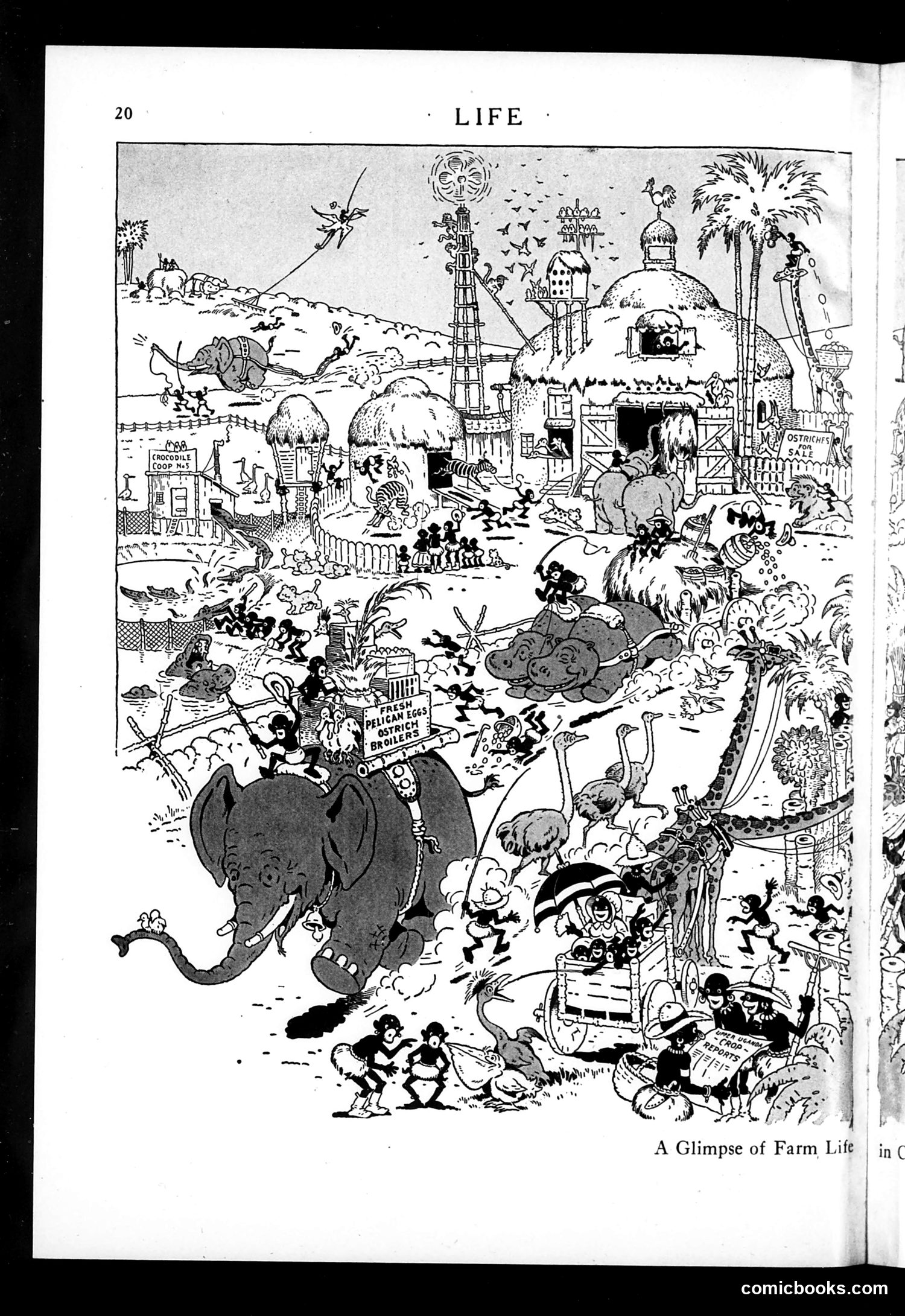
This is a densely-packed satirical illustration depicting an exaggerated, chaotic farm scene. The cartoon shows various animals and farm activities in deliberately absurd and disorganized fashion—elephants, ostriches, and other unlikely creatures mixed among traditional farm elements like barns and fences. The satire appears to mock either: - Inefficient or poorly-managed agricultural practices - Romanticized or unrealistic depictions of farm life in popular culture - The general chaos of farm operations The style is typical of early-to-mid 20th century Life magazine humor—whimsical, crowded with detail, relying on visual absurdity rather than explicit text. Without additional context about the publication date or contemporary agricultural discussions, the specific target of criticism remains somewhat unclear, though the overall point seems to be poking fun at agricultural reality versus perception.
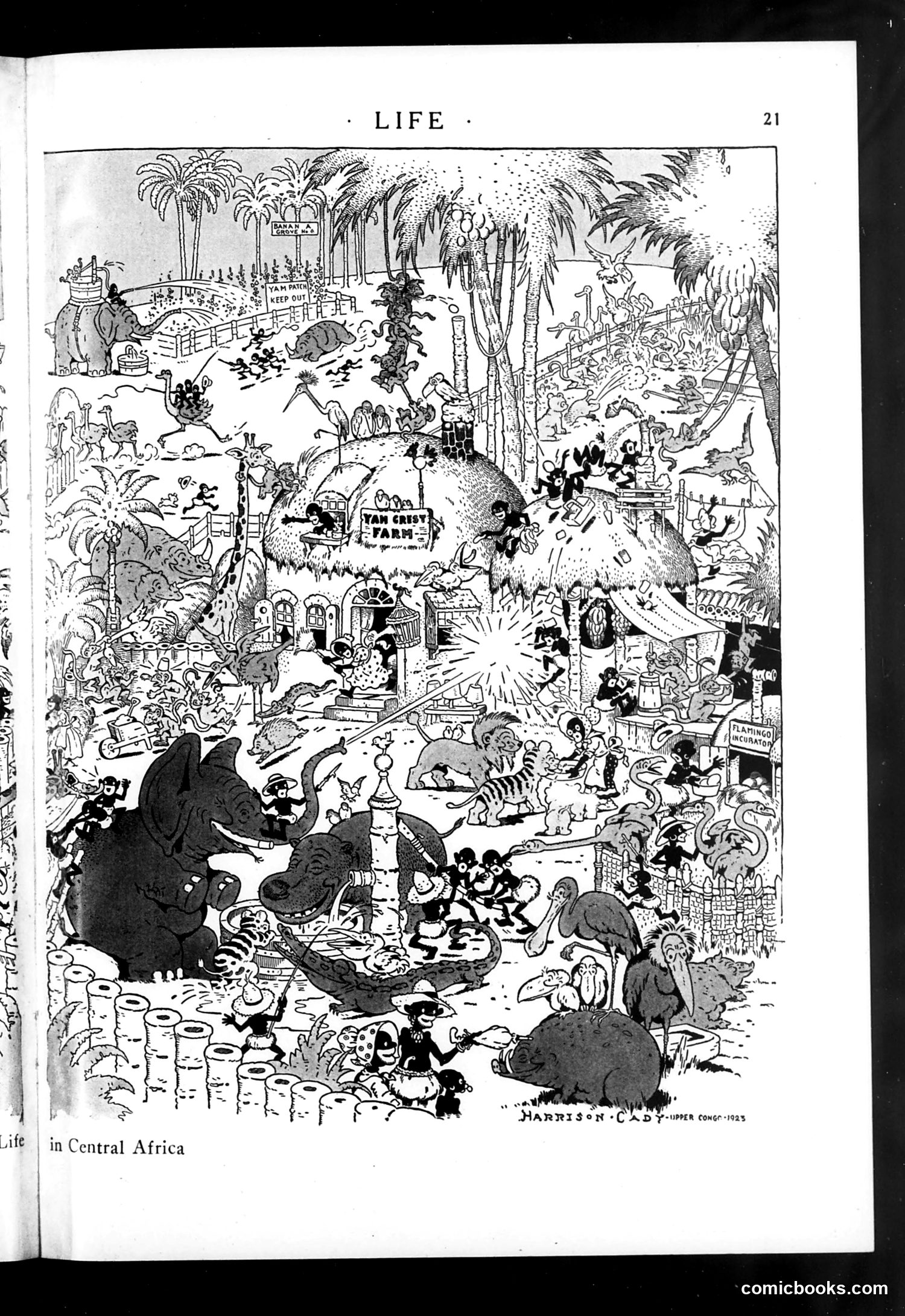
This is a satirical illustration by Harrison Cady from 1925 depicting an imaginary Central African settlement. The cartoon presents an exaggerated, fantastical scene mixing animals (elephants, hippos, various creatures) with human figures engaged in leisure activities around structures labeled "Van Patton Farm" and "Flamingo Farm." The satire likely mocks Western fantasies and misconceptions about Africa—depicting it as a whimsical, primitive theme park rather than a real place. The "farms" suggest commercialized tourism or colonial exploitation framed as entertainment. The densely packed, chaotic composition filled with caricatured activity reflects early 20th-century attitudes portraying Africa as exotic spectacle for American amusement rather than serious engagement with actual African societies.
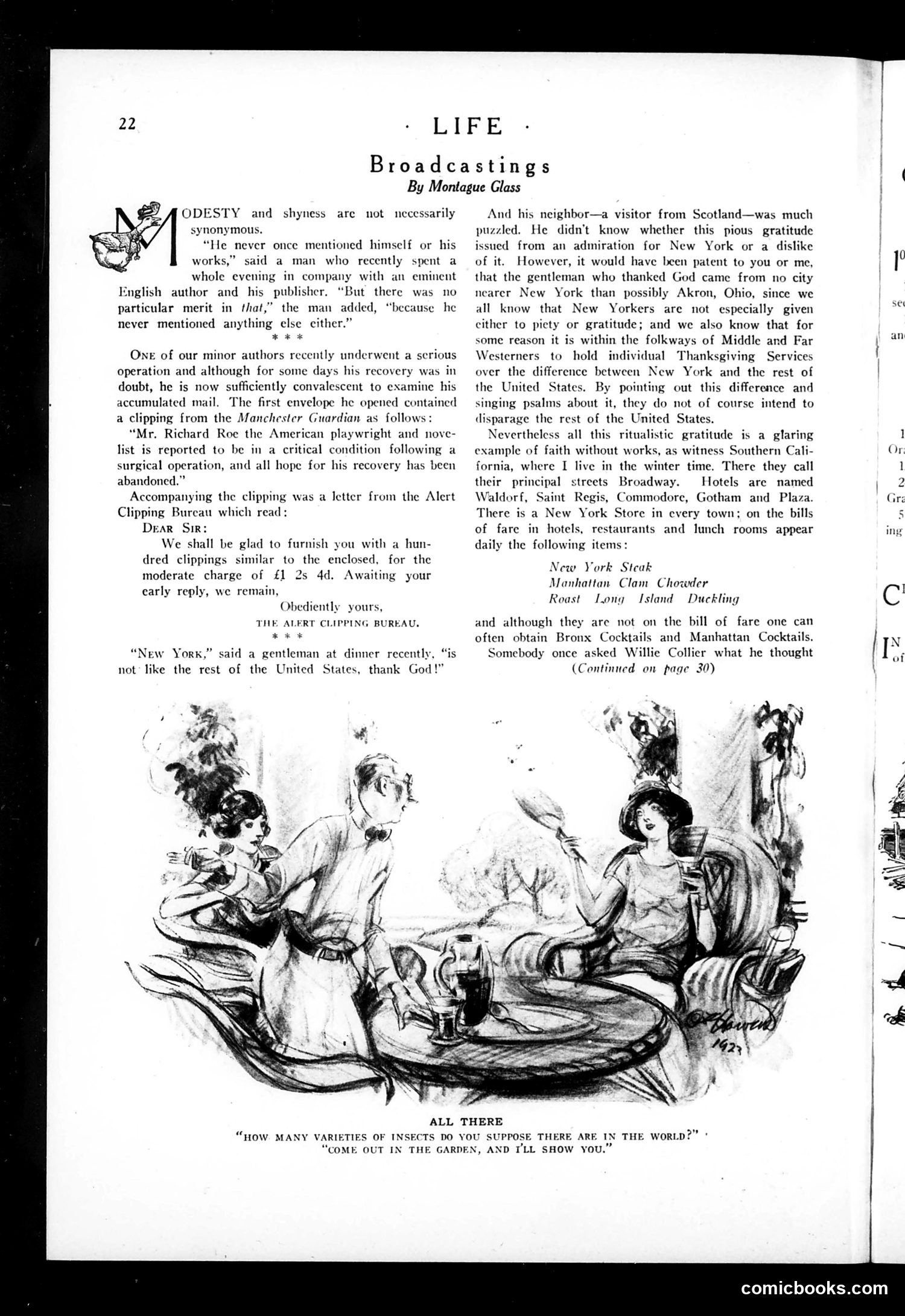
This page from *Life* magazine contains satirical commentary by Montague Glass on American regional attitudes and pretension, particularly regarding New York City. **The Main Satire:** The piece mocks Midwesterners and Far Westerners who simultaneously disparage New York while obsessively imitating it. Glass describes Southern California as a prime example: residents name their streets "Broadway," hotels after New York landmarks (Waldorf, Plaza, Commodore), and restaurants feature "New York Steak" and "Manhattan Clam Chowder" on menus—yet claim to prefer their region over New York. **The Cartoon Below:** The illustration shows a social gathering where one gentleman boasts that New York is "not like the rest of the United States, thank God!"—expressing both superiority and disdain. A Scottish visitor (noted in the text) finds this puzzling, as the speaker likely isn't even from New York but probably from Ohio. **The Joke:** This is "faith without works"—claiming to reject New York while mimicking it obsessively. The underlying satire critiques American regional pretension and the cultural dominance of New York City in the early 20th century.
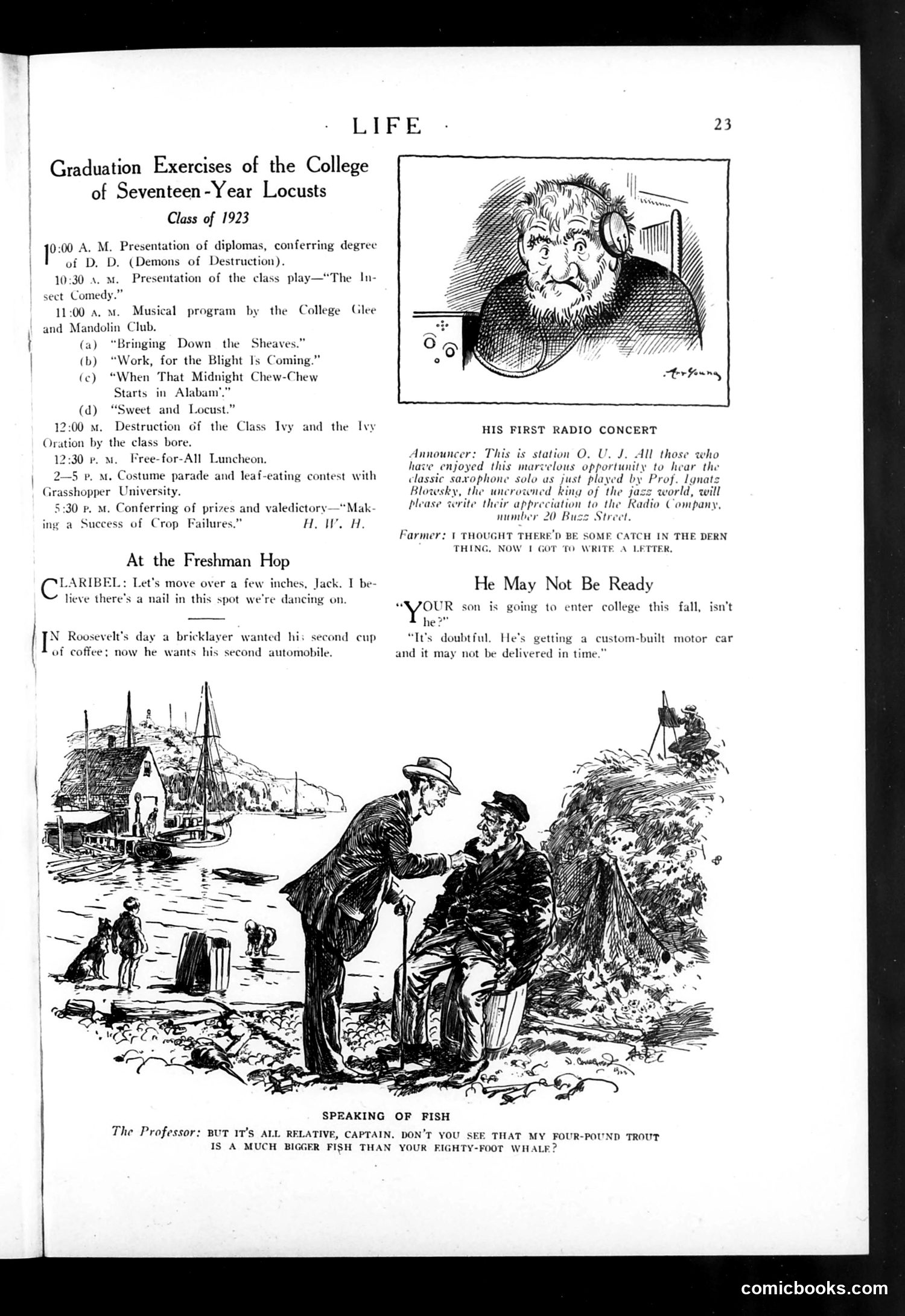
This page contains multiple satirical pieces mocking early 1920s American life: **"College of Seventeen-Year Locusts"** parodies college graduations by presenting locusts (insects that swarm and destroy crops) receiving degrees in "Demons of Destruction." The joke references the biblical plague of locusts and satirizes both the destructive nature of insects and, likely, youthful recklessness or post-WWI social disruption. **"His First Radio Concert"** mocks the farmer's frustration with new technology—radio broadcasts—which interrupts his work and forces him to write letters of appreciation he doesn't want to send. **"He May Not Be Ready"** jokes about consumer excess: a parent's son can't attend college because his custom-built automobile won't arrive in time—prioritizing luxury goods over education. **"Speaking of Fish"** satirizes pretentious rationalization. A professor argues his small trout is "bigger" than a whale through relative reasoning, mocking academic sophistry. The overall theme: satirizing rapid technological change, materialism, and absurd modern priorities in 1920s America.
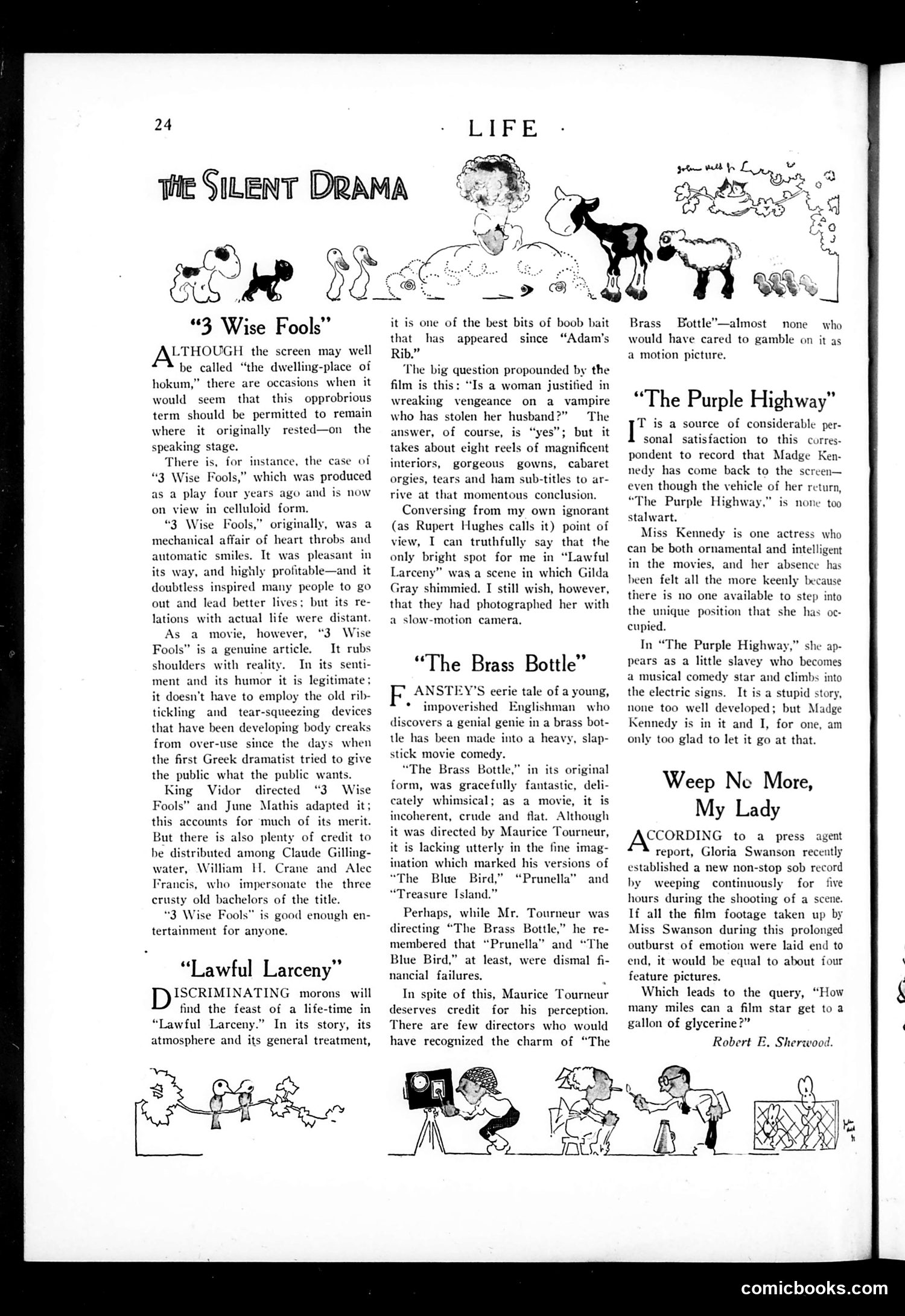
This page reviews four silent films from the early 1920s. The critic systematically praises and criticizes contemporary movies: **"3 Wise Fools"** - Originally a stage play, now a film. The reviewer credits director King Vidor and adaptor June Mathis for making it genuinely entertaining rather than melodramatic hokum, praising actors like Claude Gillingwater and William H. Crane. **"Lawful Larceny"** - Criticized as "boob bait" pandering to unsophisticated audiences with a predictable morality tale. The only bright spot mentioned is actress Gilda Gray's shimmy dance. **"The Brass Bottle"** - An adaptation of Anstey's fantasy story, faulted for becoming crude and incoherent on screen despite director Maurice Tourneur's earlier successes with "The Blue Bird" and "Prunella." **"The Purple Highway"** - Praised for featuring the return of actress Madge Kennedy, who the critic values for being both ornamental and intelligent—a rare quality he finds lacking in contemporary cinema. The tone reflects 1920s film criticism's condescension toward popular audiences while acknowledging entertainment value.
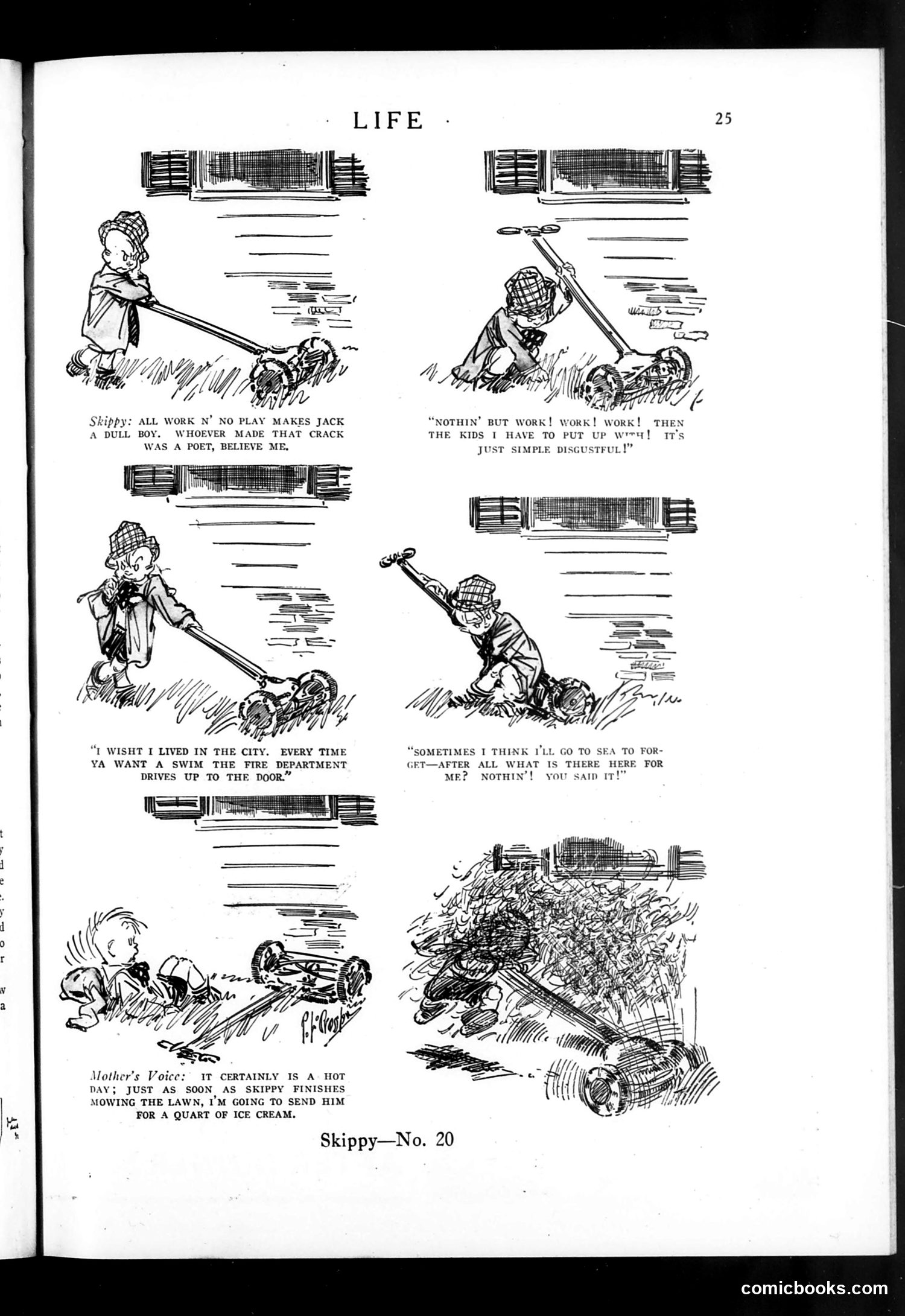
This is a comic strip (Skippy, No. 20) from *Life* magazine depicting a boy's complaints about chores and parental demands versus his desire for leisure and adventure. **The Setup:** Skippy quotes the maxim "all work and no play makes Jack a dull boy," then catalogs his grievances: he wishes he lived in the city where swimming happens automatically (via fire department), resents mowing the lawn, and fantasizes about running away to sea to escape domestic obligations. **The Satire:** The strip humorously contrasts children's romanticized escape fantasies with mundane reality. A mother's voice interrupts, revealing she'll reward his lawn-mowing with ice cream—suggesting his complaints are performative drama rather than genuine suffering. **Cultural Context:** This reflects early 20th-century American attitudes toward childhood duties, parental authority, and the "work-builds-character" ethos. The boy's theatrical complaints satirize youthful melodrama while parents remain unmoved and practical. The humor works for modern readers as timeless: children exaggerating their hardships while adults see minor chores as fair exchange for rewards.
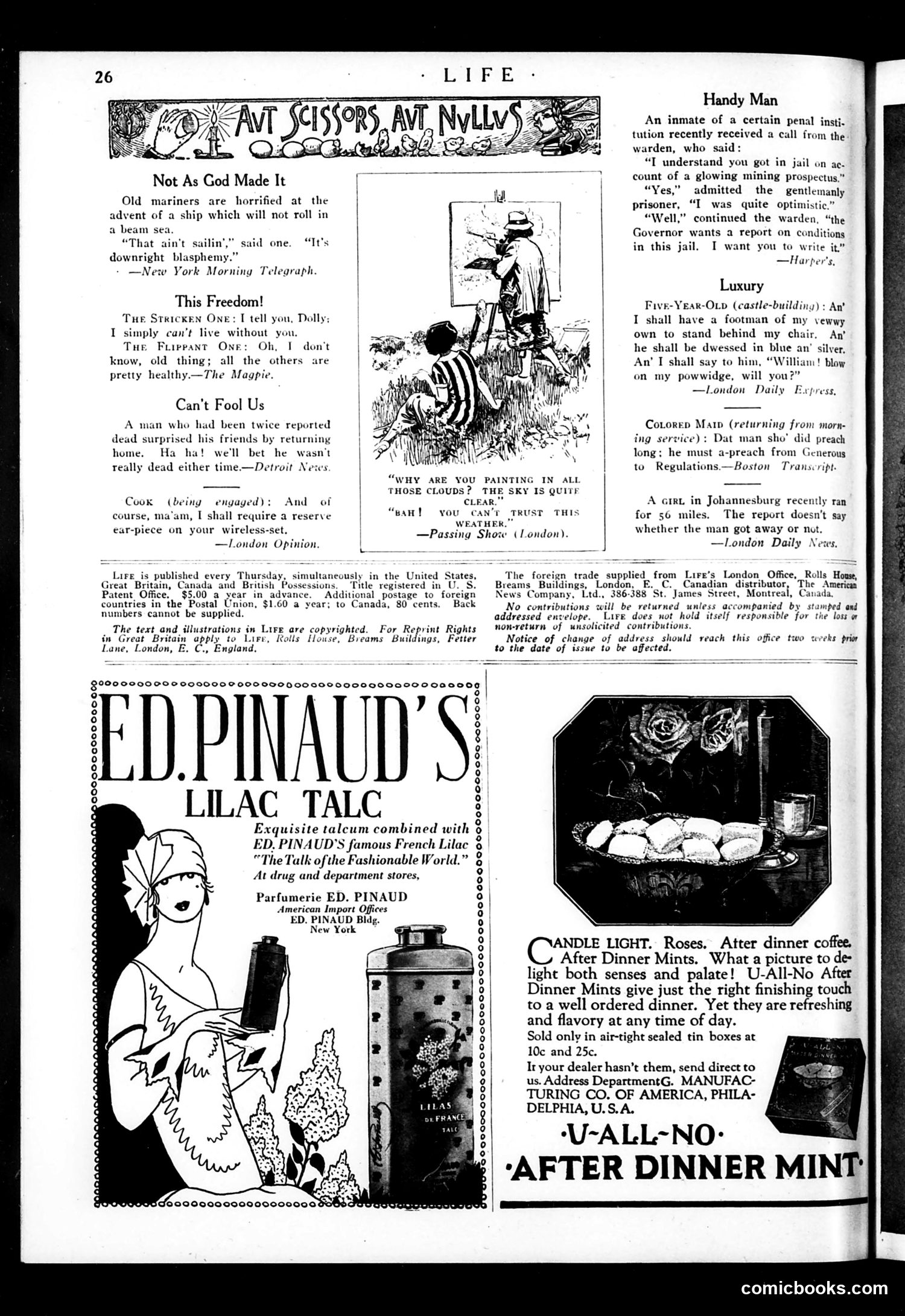
This page from *Life* magazine contains several short satirical jokes typical of early 20th-century humor: **"Not As God Made It"** mocks traditionalist sailors who view modern non-rolling ships as unnatural and contrary to sailing culture. **"This Freedom"** jokes about modern romantic relationships, contrasting a clingy suitor with an independent woman—likely commentary on changing gender dynamics of the era. **"Can't Fool Us"** uses dark humor about a man reported dead twice, suggesting wartime casualty reports were unreliable. **The central cartoon** shows a figure painting clouds while another complains about the weather—a visual pun on inability to control nature. **Other brief items** include jokes about wireless telephone etiquette and a humorous anecdote about a South African runner. The page is primarily filled with **advertisements** for cosmetics (ED. Pinaud's Lilac Talc) and after-dinner mints, typical of *Life*'s mixed content format. The humor reflects pre-WWI sensibilities about technology, propriety, and social change.
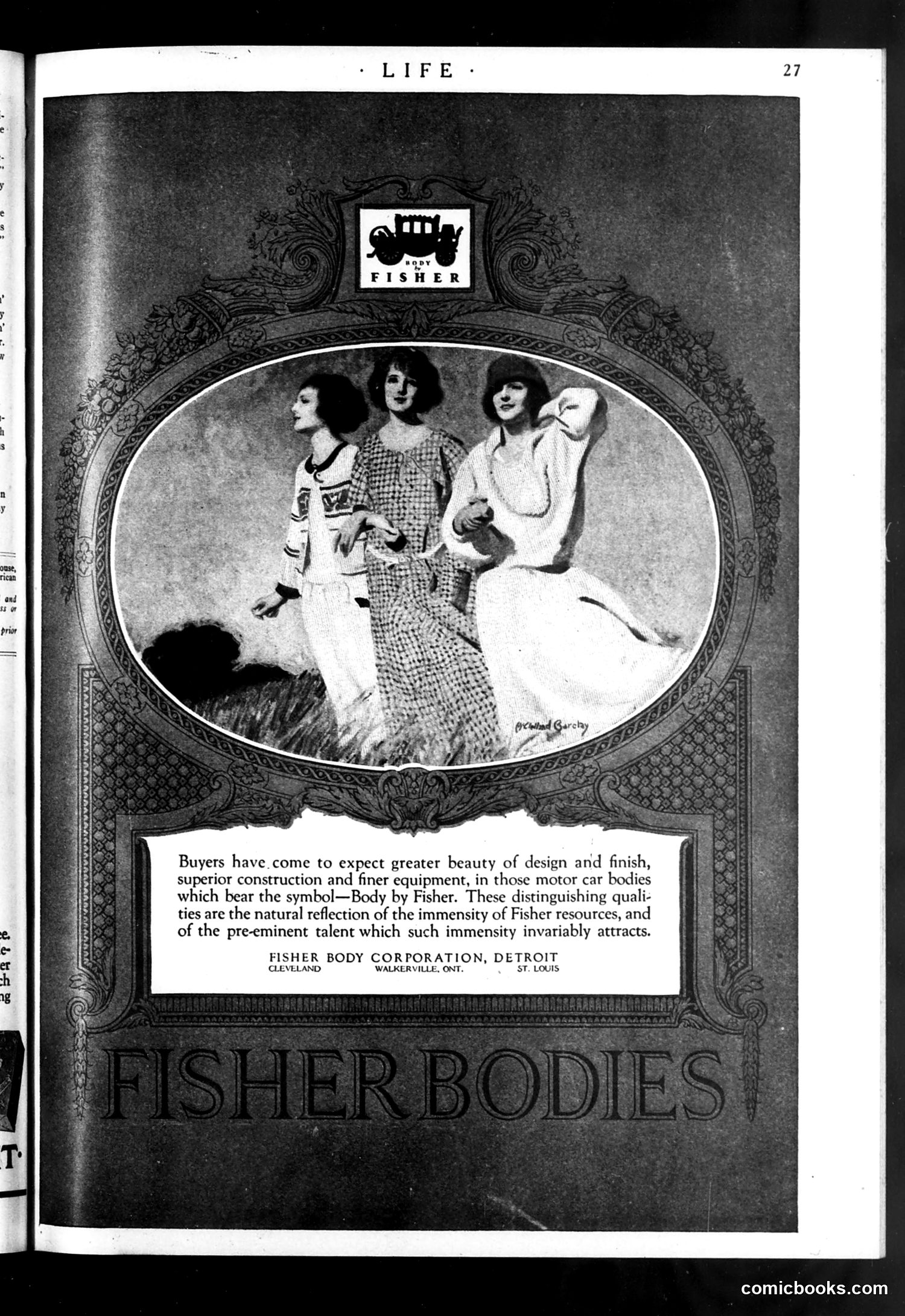
This is a **Fisher Body Corporation advertisement**, not political satire. Fisher was a major automotive body manufacturer that supplied car bodies to General Motors and other manufacturers. The ad features four stylishly dressed women in 1920s fashion, emphasizing the elegance and quality associated with Fisher-bodied automobiles. The ornate art deco frame and refined imagery appeal to buyers seeking luxury and sophistication. The accompanying text argues that Fisher's "immensity of resources" and superior talent naturally produce beautiful, well-constructed car bodies—a prestige brand message positioning Fisher bodies as markers of quality and taste for discerning automobile buyers.
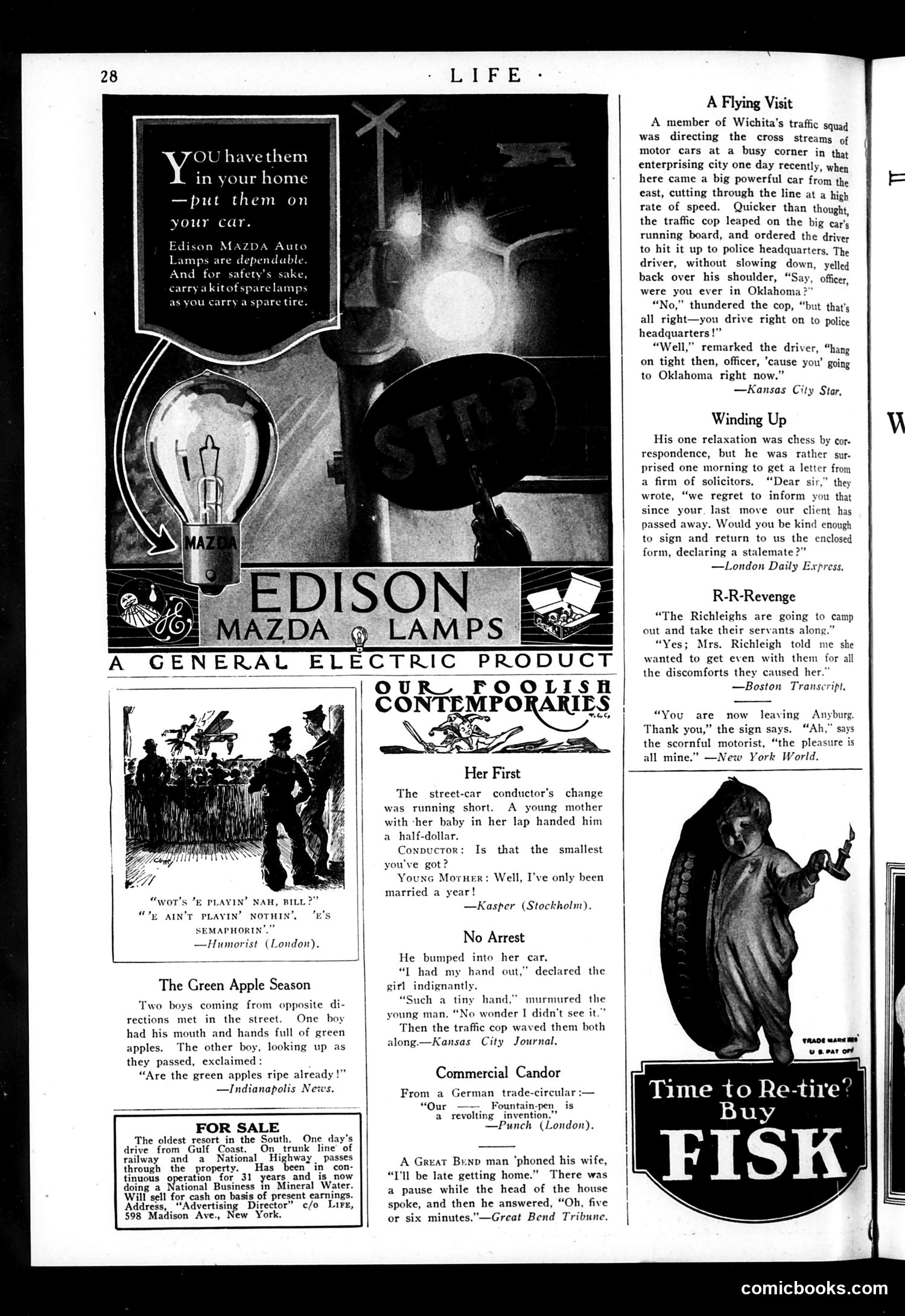
This page contains primarily **short humorous anecdotes** rather than political cartoons, reflecting early 20th-century American comic sensibilities. The main pieces joke about: 1. **"A Flying Visit"** (Kansas City Star): A speeding motorist evades a traffic cop by claiming he's heading to Oklahoma—a jab at Oklahoma's reputation for lawlessness or recklessness during the oil boom era. 2. **"Her First"** and other domestic humor: Wife jokes and newly-married couple humor were stock comedy material. 3. **Traffic and motoring humor**: Multiple anecdotes mock absent-minded drivers and the confusion of early automobile culture. 4. **Class humor**: "R-R-Revenge" involves servants—reflecting period anxieties about domestic staff relations. The page also features an **Edison Mazda Lamps advertisement** (General Electric product) and a "For Sale" notice for a Southern mineral water resort. The humor is gentle, observational, and reflects concerns of the 1910s-1920s: automobile safety, modern conveniences, and domestic life. No specific political figures or events are referenced.
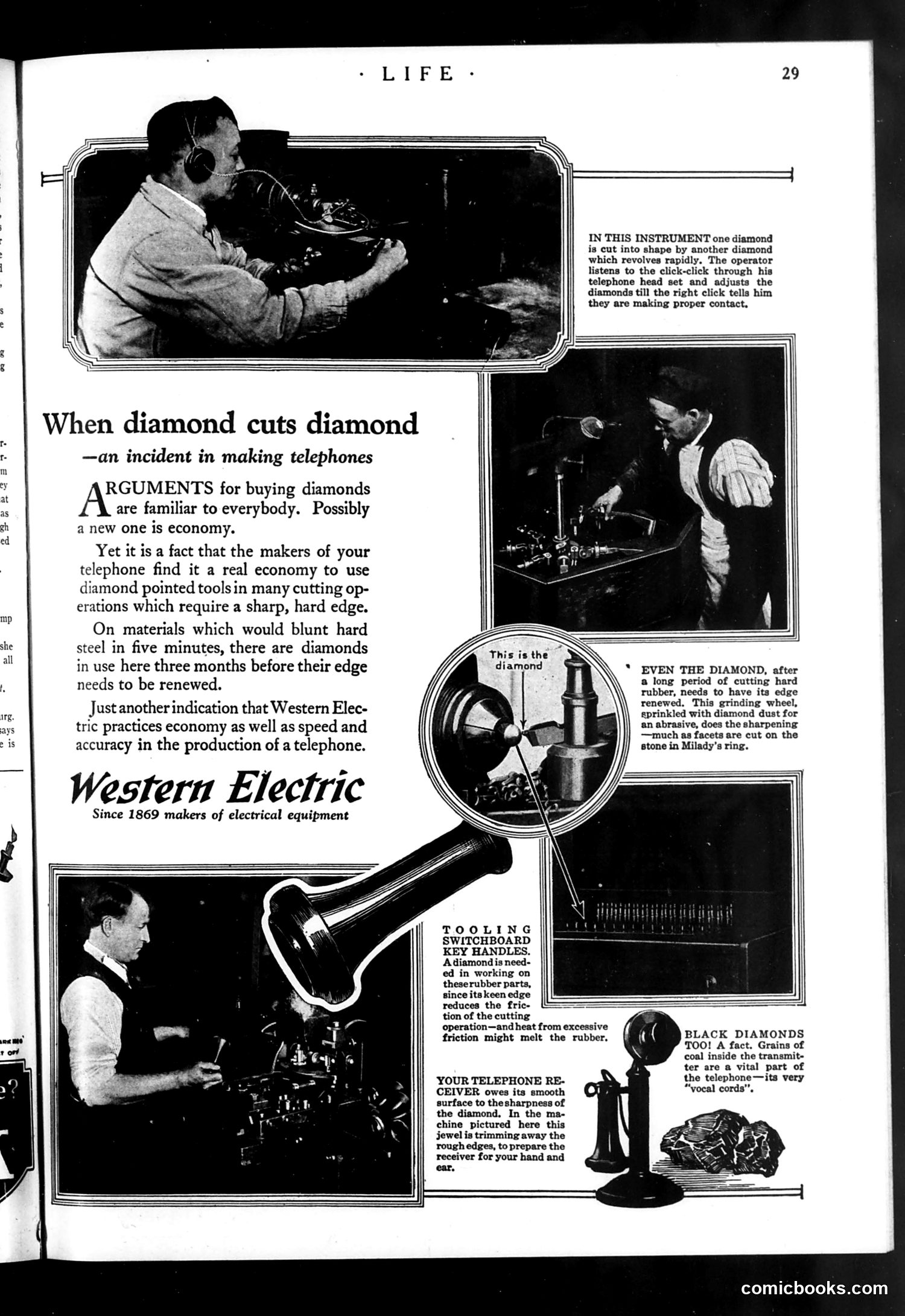
This is **not a political cartoon but a corporate advertisement** for Western Electric, the major telephone equipment manufacturer. The page promotes Western Electric's use of industrial diamonds in telephone manufacturing—demonstrating economic efficiency and precision engineering. Multiple photographs show workers using diamond-tipped tools to cut and finish telephone components with superior sharpness and durability compared to steel tools. The "joke" in the headline "When diamond cuts diamond" is wordplay: literally, one diamond tool cuts another diamond, while idiomatically the phrase suggests shrewd negotiation. The ad argues that using expensive diamonds is actually economical because they last three months versus five minutes for steel on hard materials, reducing replacement costs. The referenced "Milady's ring" compares industrial diamond use to jewelry diamonds, making the technology relatable to general readers. This represents early 20th-century corporate messaging emphasizing scientific precision and cost-effectiveness in manufacturing.
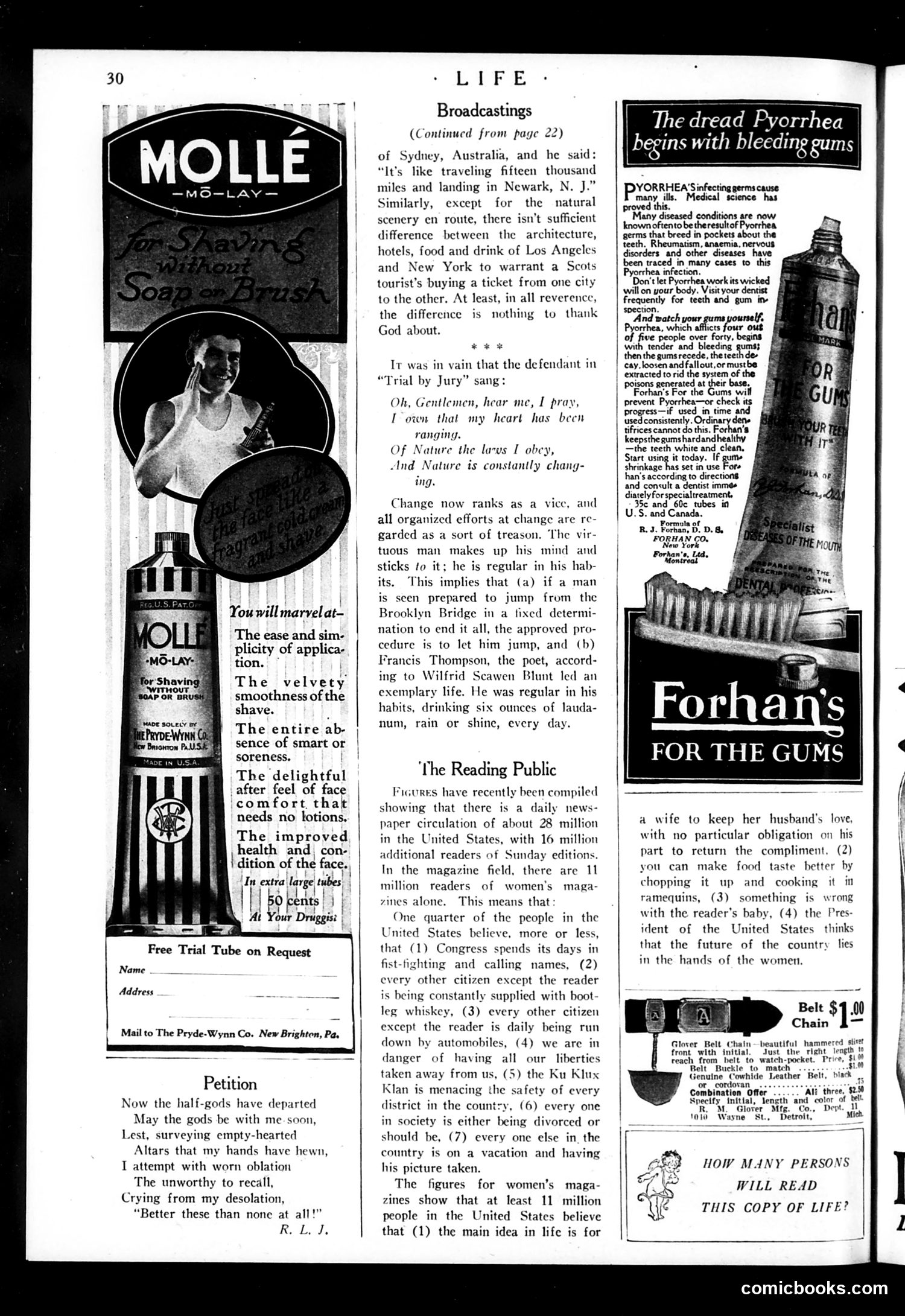
This page from *Life* magazine combines advertising and editorial content typical of the 1920s-30s era. The **Molle shaving cream advertisement** (left) uses standard period marketing language emphasizing "smoothness" and "comfort." The main editorial content discusses American reading habits and media consumption. The author satirizes how newspapers and magazines—with circulation reaching roughly 28 million daily readers—shape public perception through sensationalism. He suggests that average Americans believe exaggerated claims about Congress fighting, bootleg whiskey distribution, automobile accidents, the Ku Klux Klan threat, divorce, and constant vacationing. The **Forhan's toothpaste advertisement** warns about pyorrhea (gum disease), claiming it causes serious health conditions like rheumatism and anemia—a common medical claim of that era (now considered dubious). The page also includes a poem ("Petition") criticizing society's demand for conformity and resistance to change, possibly referenced in the editorial's discussion of virtue and habit. The satire targets both media sensationalism and public gullibility regarding health and social problems.
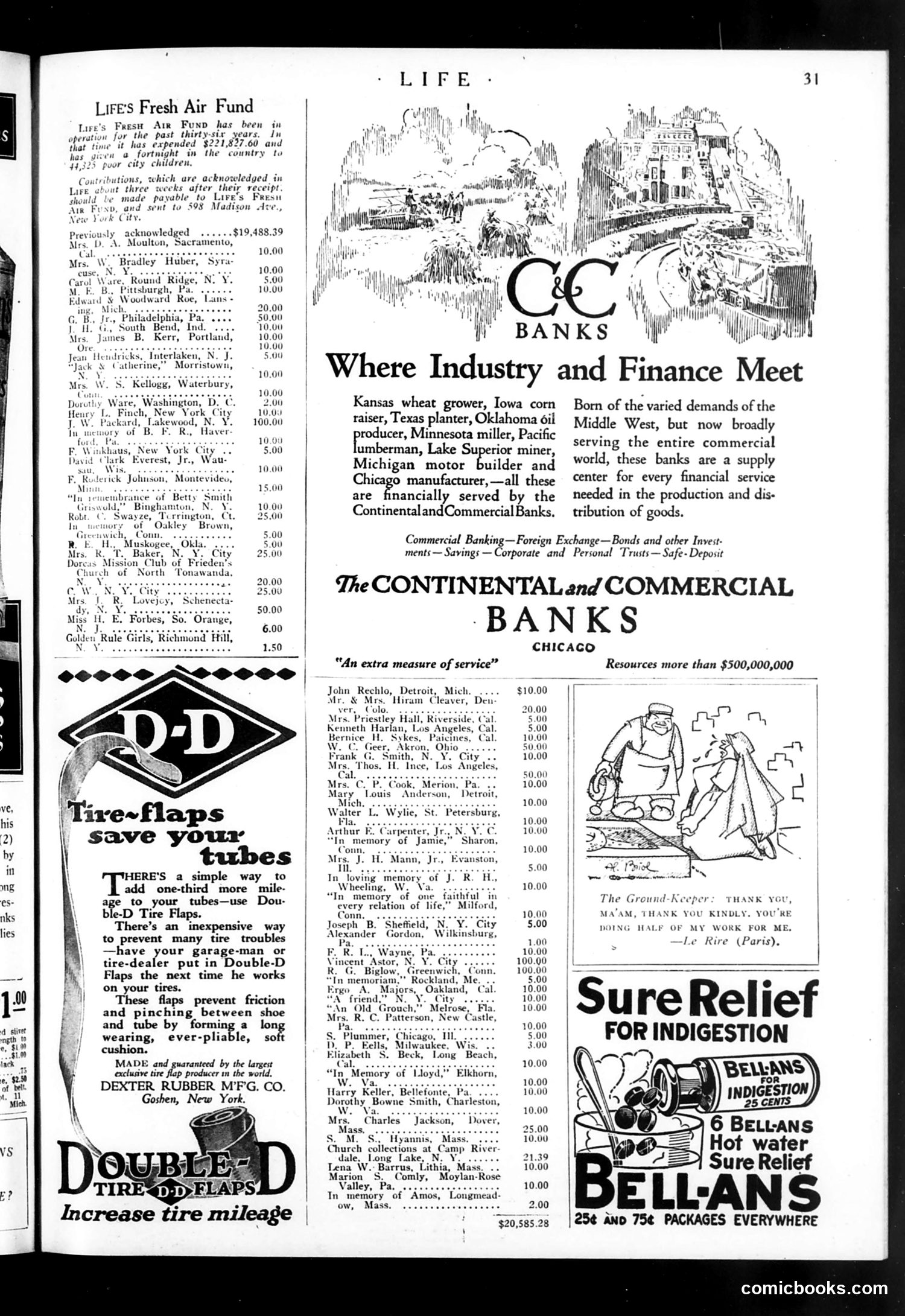
This page is primarily **advertising and fundraising**, not political satire. The main content consists of: 1. **Life's Fresh Air Fund** (left column): A charity drive listing donors who contributed to send poor city children to the countryside. This was a genuine philanthropic initiative by Life magazine. 2. **Double-D Tire Flaps advertisement**: A practical product ad for tire protection devices. 3. **Continental and Commercial Banks advertisement** (center-right): A major bank promoting its services to Midwest agricultural and industrial producers, with an illustration showing a farmer and woman. 4. **Bellans indigestion relief advertisement** (bottom right): A patent medicine ad. 5. **A cartoon** (small, center-right): Shows a groundskeeper thanking a woman for doing half his work—a mild, non-political humorous illustration credited to *le Rire*, a French publication. **No significant political satire or caricature is present.** This is a standard magazine page mixing charitable giving records with commercial advertisements typical of early 20th-century publications.
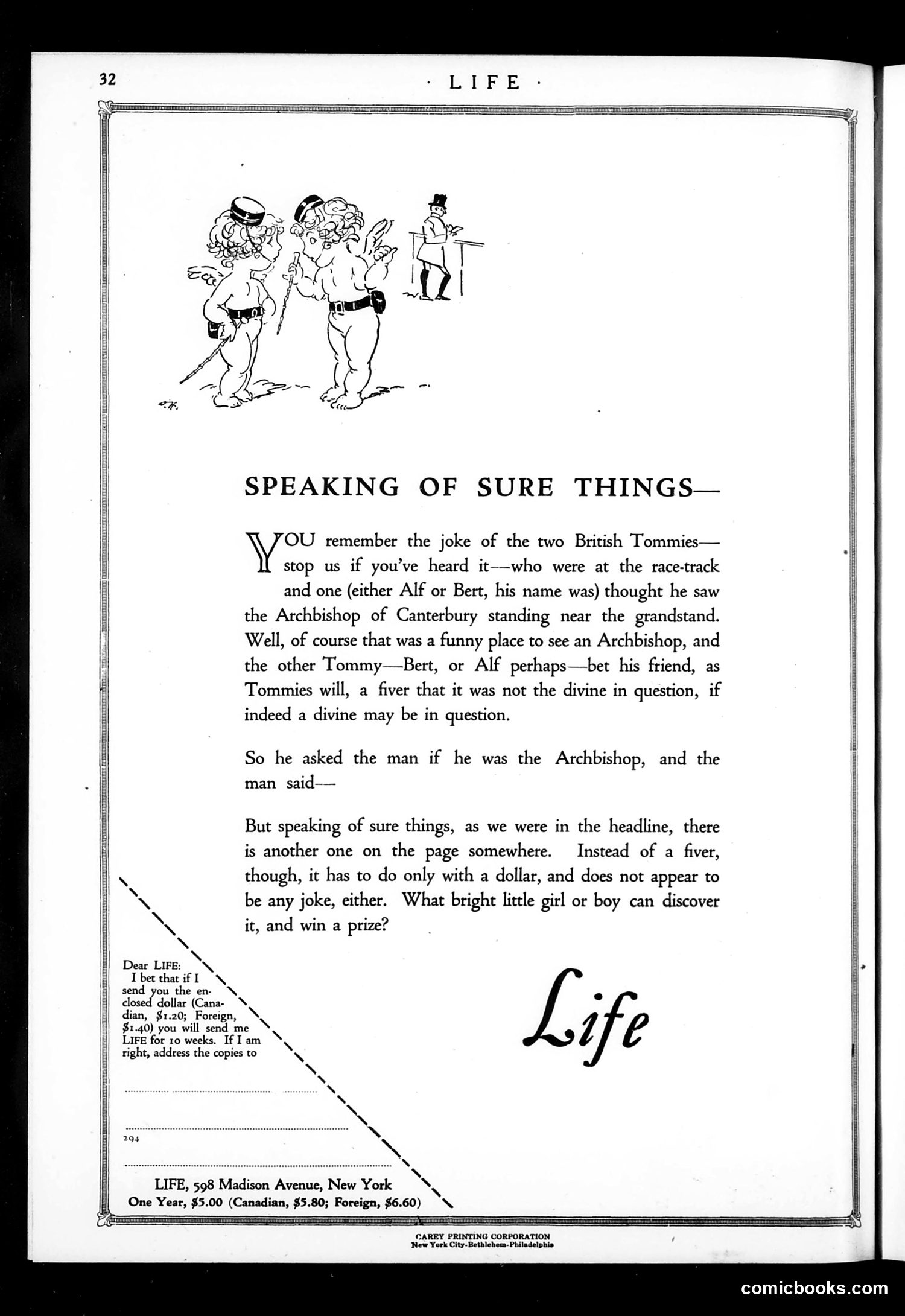
This page presents a humorous column introducing an anecdote about two British soldiers ("Tommies") at a racetrack who bet on whether a nearby man is the Archbishop of Canterbury—an absurd scenario that plays on the unexpected juxtaposition of a high church official in a gambling venue. The column then pivots to invite readers to find a "sure thing" puzzle hidden elsewhere on the page, promising a prize. This refers to the subscription offer visible below: if readers send a dollar (or more for foreign/Canadian rates), Life will send them ten weeks of the magazine—framed as a "bet" or "sure thing" rather than a straightforward transaction. The satire gently mocks both the credulous reader willing to gamble on subscriptions and the magazine's own marketing tactics. The cartoon illustrations (showing figures in period dress) support the lighthearted, comedic tone. This appears designed to boost subscriptions through playful reader engagement.
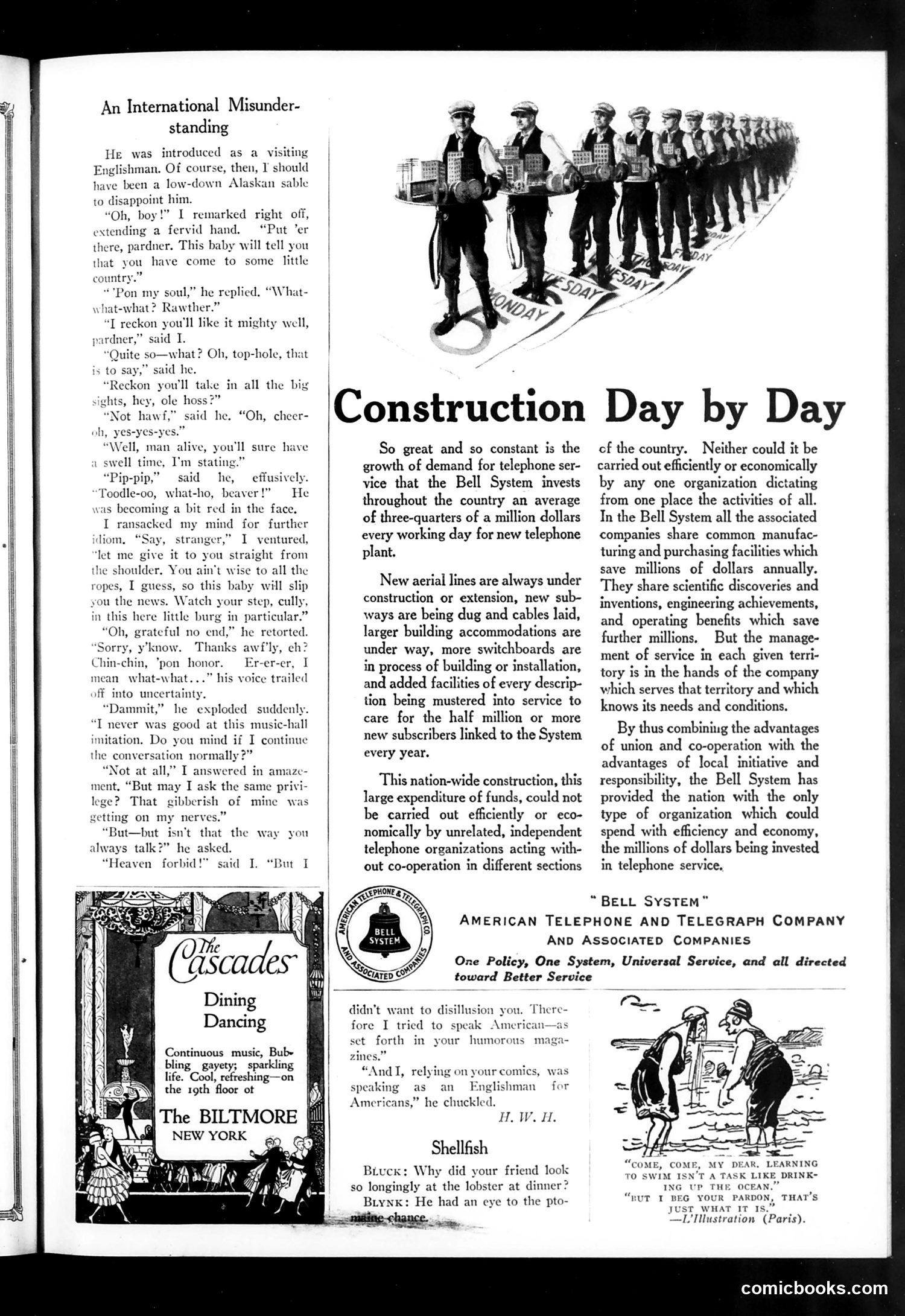
This brief comic sketch satirizes Anglo-American cultural stereotypes. An American narrator, attempting to impress a visiting Englishman, adopts exaggerated frontier slang ("pardner," "cully," "top-hole"), believing this represents authentic American speech. The Englishman responds with equally theatrical British affectations ("Rawther," "Pip-pip," "Chin-chin"). The joke's twist: both abandon their caricatured dialects to communicate normally, revealing that the exaggerated speech patterns were mutual performances—neither actually talks that way. The satire mocks how Americans and British stereotype each other's speech and manners, creating absurd communication barriers based on false assumptions about national character. The humor relies on readers recognizing period slang conventions and the widespread early-20th-century fascination with national character types.
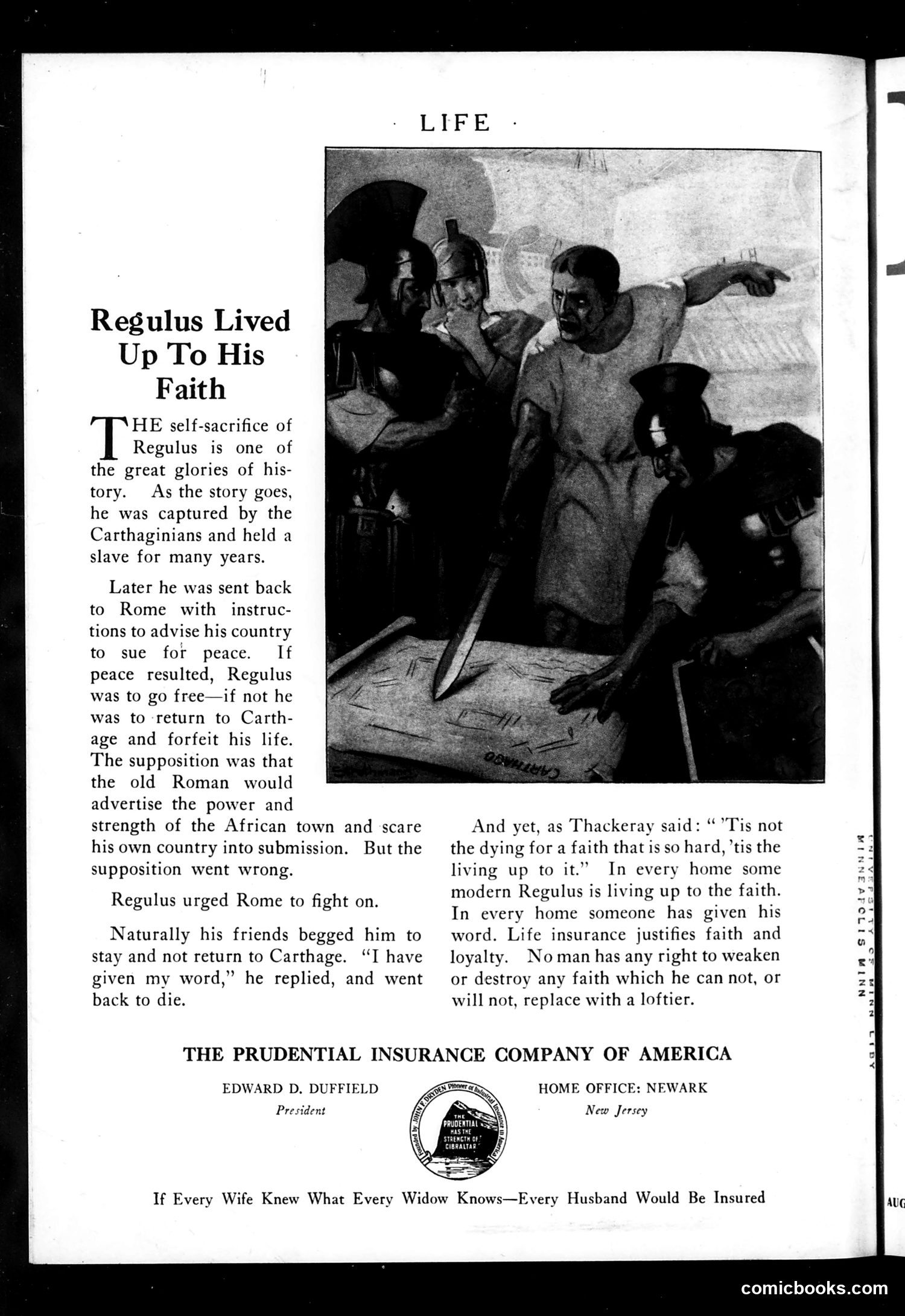
This is a **Life magazine advertisement** for Prudential Insurance, not a political cartoon. It uses the classical story of Roman general Regulus—who kept his word and returned to Carthage to face execution despite being freed—as a moral parable for buying life insurance. The ad equates personal honor and faith-keeping with financial responsibility. The implicit argument: just as Regulus lived up to his word, modern men should honor their obligations to their families by purchasing life insurance. The closing tagline ("If Every Wife Knew What Every Widow Knows") appeals to wives' anxiety about financial security after their husbands' deaths. The illustration depicts Regulus advising Roman leaders, establishing his character as trustworthy and honorable—qualities the advertiser wants associated with Prudential's product. This is straightforward corporate advertising using classical virtue to sell insurance, not satire or political commentary.