
Life, 1923-08-16 · page 20 of 36
Life — August 16, 1923 — page 20: what you’re looking at
What you’re looking at
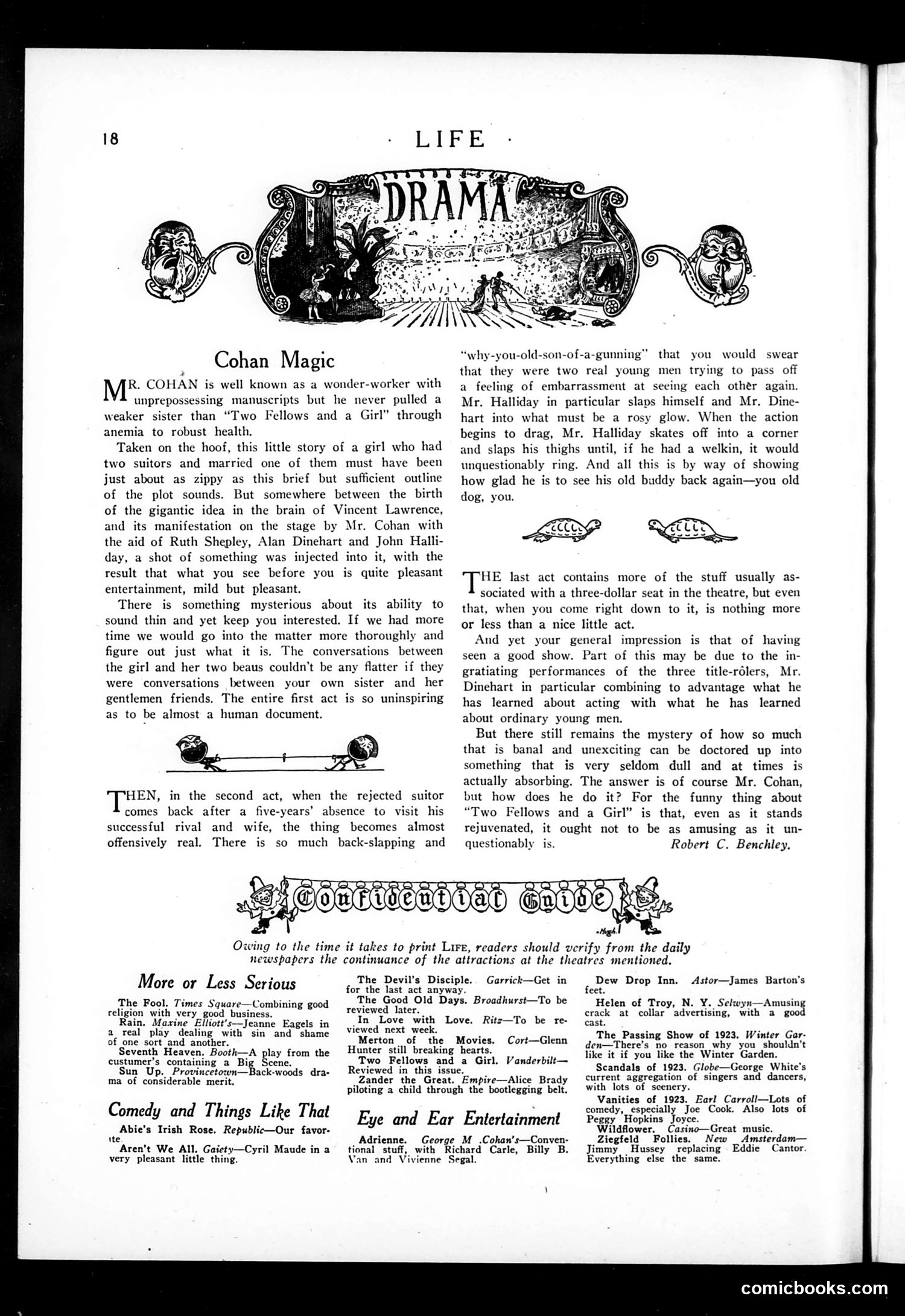
This is a theater review by Robert C. Benchley of George M. Cohan's production "Two Fellows and a Girl." **The Main Point:** Benchley praises Cohan's mysterious ability to transform unpromising material into entertaining theater. He notes the play's plot—a girl choosing between two suitors—is banal on paper, and even the dialogue is flat. Yet through Cohan's direction and strong performances by Ruth Shepley, Alan Dinehart, and John Halliday, it becomes genuinely engaging. **The Satire:** Benchley humorously describes the second act's exaggerated male bonding—excessive back-slapping and thigh-slapping between the suitor and his rival—mocking theatrical conventions of masculine reunion scenes. He admits he cannot fully explain why such thin material works so well, crediting Cohan's unexplainable theatrical "magic." **Context for Modern Readers:** This represents 1920s theater criticism celebrating a producer-director's craft. The three small decorative illustrations are generic theatrical vignettes, not specific caricatures.
📄 Transcribed text from this page (OCR, searchable)
Machine-transcribed from the original scan — historical spelling and the odd misread are preserved.
Cohan Magic R. COHAN is well known as a wonder-worker with unprepossessing manuscripts but he never pulled a weaker sister than “Two Fellows and a Girl” through anemia to robust health. Taken on the hoof, this little story of a girl who had two suitors and married one of them must have been just about as zippy as this brief but sufficient outline of the plot sounds. But somewhere between the birth of the gigantic idea in the brain of Vincent Lawrence, and its manifestation on the stage by Mr. Cohan with the aid of Ruth Shepley, Alan Dinehart and John Halli- day, a shot of something was injected into it, with the result that what you see before you is quite pleasant entertainment, mild but pleasant. There is something mysterious about its ability to sound thin and yet keep you interested. If we had more time we would go into the matter more thoroughly and figure out just what it is. The conversations between the girl and her two beaus couldn't be any flatter if they were conversations between your own sister and her gentlemen friends. The entire first act is so uninspiring as to be almost a human document. HEN, in the second act, when the rejected suitor comes back after a five-years’ absence to visit his successful rival and wife, the thing becomes almost offensively real. There is so much back-slapping and {COMA RD “why-you-old-son-of-a-gunning” that you would swear that they were two real young men trying to pass off a feeling of embarrassment at seeing each othér again. Mr. Halliday in particular slaps himself and Mr. Dine- hart into what must be a rosy glow. When the action begins to drag, Mr. Halliday skates off into a corner and slaps his thighs until, if he had a welkin, it would unquestionably ring. And all this is by way of showing how glad he is to see his old buddy back again—you old dog, you. LEESY RED _ HE last act contains more of the stuff usually as- sociated with a three-dollar seat in the theatre, but even that, when you come right down to it, is nothing more or less than a nice little act. And yet your general impression is that of having seen a good show. Part of this may be due to the in- gratiating performances of the three title-rdlers, Mr. Dinehart in particular combining to advantage what he has learned about acting with what he has learned about ordinary young men. But there still remains the mystery of how so much that is banal and unexciting can be doctored up into something that is very seldom dull and at times is actually absorbing. The answer is of course Mr. Cohan, but how does he do it? For the funny thing about “Two Fellows and a Girl” is that, even as it stands rejuvenated, it ought not to be as amusing as it un- questionably is. Robert C. Benchley. Owing to the time it takes to print Lire, readers should verify from the daily newspapers the continuance of the attractions at the theatres mentioned. More or Less Serious The Fool. Times Square—Combining good religion with very good business. Rain. Marine Elliott’s—Jeanne Eagels in a real play dealing with sin and shame of one sort and another. Seventh Heaven. Booth—A play from the custumer’s containing a Big Scene. Sun Up. Provincetown—Back-woods dra- ma of considerable merit. Comedy and Things Like That Abies Irish Rose. Republic—Our favor- Aren’t We All. Gaiety—Cyril Maude in a very pleasant little thing. tt The Devil's Disciple. for the last act anyway. The Good Old Days. Broadhurst—To be reviewed later. In Love with Love. viewed next week. Merton of the Movies. Cort—Glenn Hunter still breaking hearts. Two Fellows and a Girl. Vanderbilt— Reviewed in this issue. Zander the Great. Empire—Alice Brady piloting a child through the bootlegging belt. Garrick—Get in Ritz—To be re- Eye and Ear Entertainment Adrienne. George M .Cohan’s—Conven- tional stuff, with Richard Carle, Billy B. Van and Vivienne Segal. Dew Drop Inn. feet. Helen of Troy, crack at cast. The Passing Show of 1923, Winter Gar- den—There’s no reason why you shouldn’t like it if you like the Winter Garden. Scandals of 1923. Globe—George White's current aggregation of singers and dancers, with lots of scenery. Vanities of 1923. Earl Carroll—Lots of comedy, especially Joe Cook. Also lots of Peggy ‘Hopkins Joyce. Wildflower, Casino—Great music. Ziegfeld Follies. New Amsterdam— Jimmy Hussey replacing Eddie Cantor. Everything else the same. Astor—James Barton's N. Y. Selwyn—Amusing collar ‘advertising, with a good comicbooks.com