
Life, 1923-08-16 · page 35 of 36
Life — August 16, 1923 — page 35: what you’re looking at
What you’re looking at
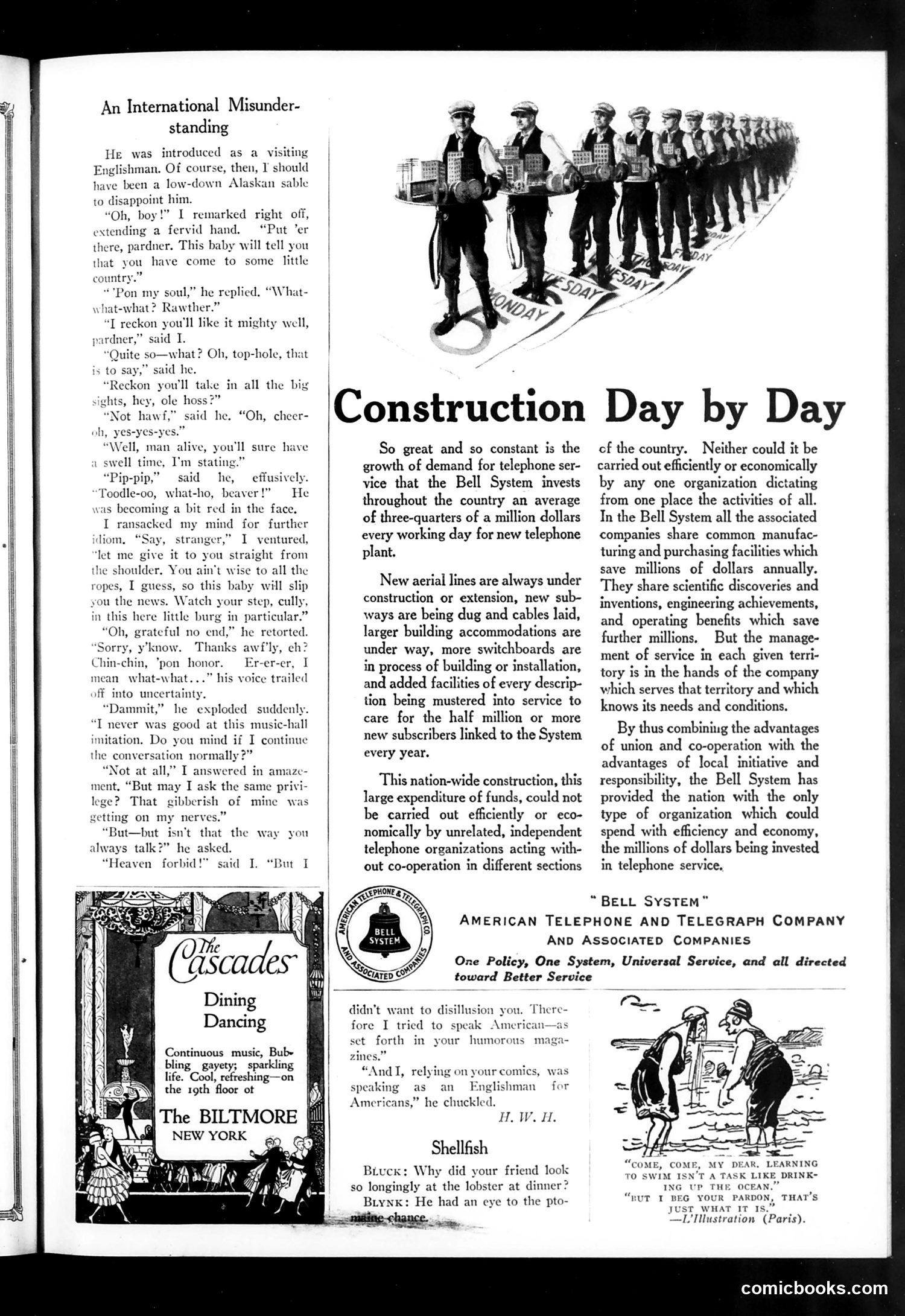
This brief comic sketch satirizes Anglo-American cultural stereotypes. An American narrator, attempting to impress a visiting Englishman, adopts exaggerated frontier slang ("pardner," "cully," "top-hole"), believing this represents authentic American speech. The Englishman responds with equally theatrical British affectations ("Rawther," "Pip-pip," "Chin-chin"). The joke's twist: both abandon their caricatured dialects to communicate normally, revealing that the exaggerated speech patterns were mutual performances—neither actually talks that way. The satire mocks how Americans and British stereotype each other's speech and manners, creating absurd communication barriers based on false assumptions about national character. The humor relies on readers recognizing period slang conventions and the widespread early-20th-century fascination with national character types.
📄 Transcribed text from this page (OCR, searchable)
Machine-transcribed from the original scan — historical spelling and the odd misread are preserved.
An International Misunder- standing He was introduced as a visiting Englishman. Of course, then, I should have been a low-down A! 1 sable to disappoint him. “Oh, boy!” L remarked right off, extending a fervid hand. “Put ’er there, pardner. This baby will tell you that you have come to some little country.” “*Pon my soul,” he replied. “What- what-what? Rawther.” I reckon you'll like it mighty well, vardner,” said I. ite so—what? Oh, top-hole, that to say, Reckon you'll said he. ke in all the big man alive, you'll sure have 1 swell time, I'm stating.” “Pip-pip,” said he, Toodle-oo, what-ho, beaver!” He vas becoming a bit red in the face. I ransacked my mind for further idiom, ‘ I ventured, ‘let me give it to you straight from the shoulder, You ain't wise to all the ropes, I gu 0 this baby will slip you the news. Watch your step, cully, in this here little burg in particular.” “Oh, grateful no end,” he retorted. ‘Sorry, y’know. Thanks awf'ly, eh? Chin-chin, ‘pon honor. — Er-er-er, I mean what-what...” his voice trailed off into uncertainty, “Dammit,” he exploded sudder “I never was good at this music-h; imitation. Do you mind if I continue the conversation normally?” “Not at all,” I answered in amaze- ment, “But may I ask the same privi- lege? That gibberish of mine was getting on my nerves.” “But—but isn’t that the way you always talk?” he asked. forbid!" said 1. effusively. stranger,” “Heaven “But I Dining Dancing Continuous music, Bub> bling gayety; sparkling life. Cool, refreshing—on the 19th floor ot | The BILTMORE So great and so constant is the growth of demand for telephone ser- vice that the Bell System invests throughout the country an average of three-quarters of a million dollars every working day for new telephone plant. New aerial lines are always under construction or extension, new sub- ways are being dug and cables laid, larger building accommodations are under way, more switchboards are in process of building or installation, and added facilities of every descrip- tion being mustered into service to care for the half million or more new subscribers linked to the System every year. This nation-wide construction, this large expenditure of funds, could not be carried out efficiently or eco- nomically by unrelated, independent telephone organizations acting with- out co-operation in different sections AMERICAN TELEPHONE AND TELEGRAPH COMPANY Construction Day by Day of the country. Neither could it be carried out efficiently or economically by any one organization dictating from one place the activities of all. Tn the Bell System all the associated companies share common manufac- turing and purchasing facilities which save millions of dollars annually. They share scientific discoveries and inventions, engineering achievements, and operating benefits which save further millions. But the manage- ment of service in each given terri- tory is in the hands of the company which serves that territory and which knows its needs and conditions. By thus combining the advantages of union and co-operation with the advantages of local initiative and responsibility, the Bell System has provided the nation with the only type of organization which could spend with efficiency and economy, the millions of dollars being invested in telephone service, “BELL SYSTEM” AND ASSOCIATED COMPANIES One Policy, One System, Universal Service, and all directed toward Better Service didn’t want to disillusion you. There- fore I tried to speak Americ: set forth in your humorous m ‘And I, relying on your comics, was speaking as an Englishman for Americans,” he chuckled. H.W. H Shellfish Biuck: Why did your friend look so longingly at the lobster at dinner? Biynk: He had an eye to the pto- SS > THE OCEAN, “nUT I BEG YOUR PARDON, THAT'S JUST WHAT IT Is.” —L Illustration (Paris). comicbooks.com