
Life, 1923-08-16 · page 16 of 36
Life — August 16, 1923 — page 16: what you’re looking at
What you’re looking at
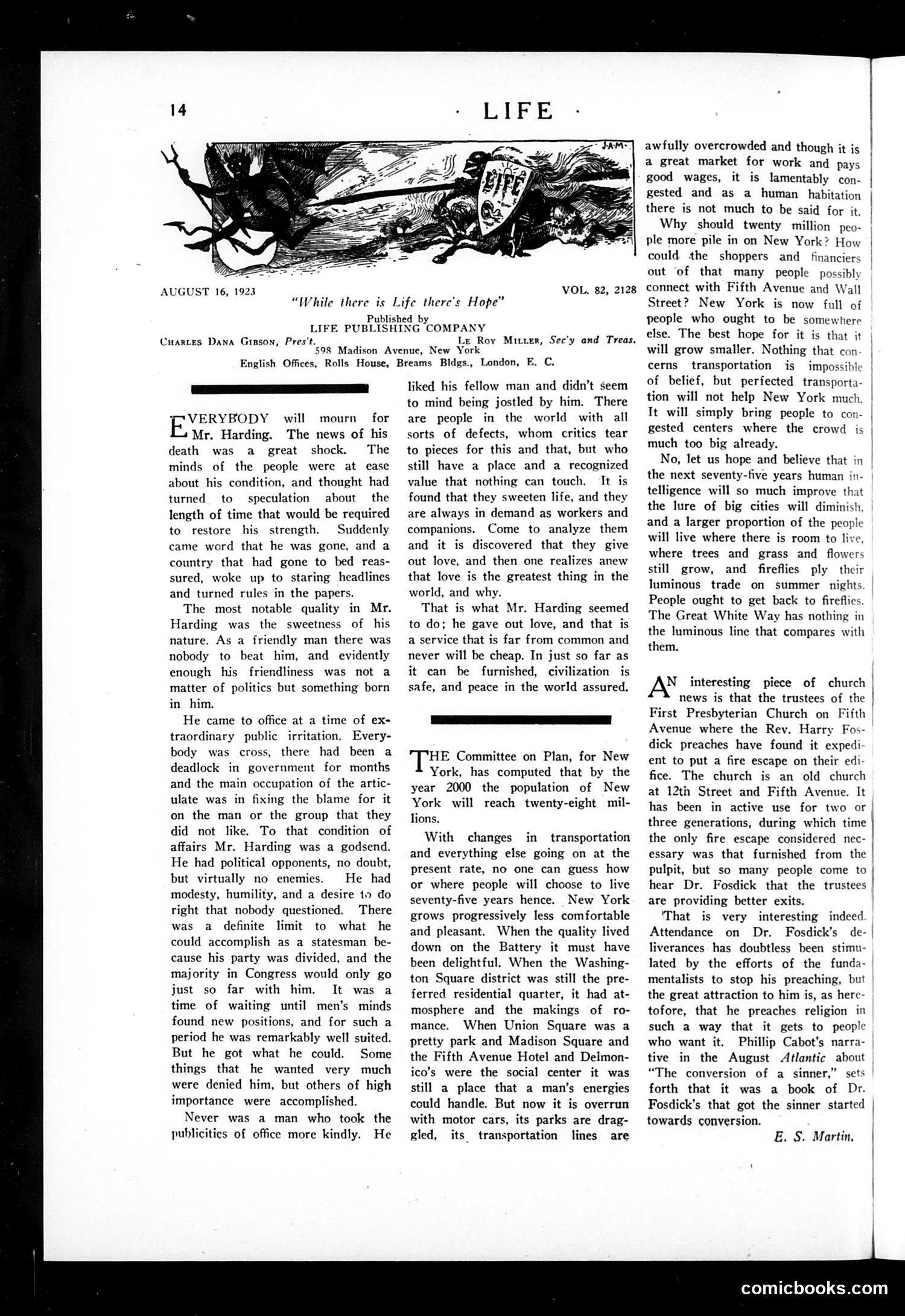
The page features an editorial mourning President Warren G. Harding's recent death. The small illustration at top shows what appears to be a symbolic or allegorical figure—likely Death or Fate—approaching a prone figure (Harding). The text praises Harding's personal qualities: his friendliness, lack of enemies, and modest nature. However, it notes his presidency was marked by government deadlock and gridlock, with Harding struggling to accomplish meaningful change despite good intentions. The editorial reflects contemporary ambivalence toward Harding: respected as a decent man personally, but politically ineffectual. His death on August 2, 1923, occurred during a scandals-plagued administration (Teapot Dome would soon emerge). The piece emphasizes his character while tacitly acknowledging his presidential failures.
📄 Transcribed text from this page (OCR, searchable)
Machine-transcribed from the original scan — historical spelling and the odd misread are preserved.
AUGUST 16, 1923 [e VOL, 82, 2128 “While there is Life there's Hope” Published by LIFE PUBLISHING COMPANY SHaRLES Dana Gipson, Pres't. Le Roy Mixer, Sec'y and Treas. 598 Madison Avenue, New York English Offices, Rolls House, Breams Bldgs., London, E. C. TCVERYBODY will mourn for Mr. Harding. The news of his death was a great shock. The minds of the people were at ease about his condition, and thought had turned to speculation about the length of time that would be required to restore strength. Suddenly came word that he was gone, and a country that had gone to bed reas- sured, woke up to staring headlines and turned rules in the papers. The most notable quality in Mr. Harding was the sweetness of his nature. As a friendly man there was nobody to beat him, and evidently enough his friendliness was not a matter of politics but something born in him. He came to office at a time of ex- traordinary public irritation. Every- body there had been a deadlock in government for months and the main occupation of the artic- ulate was in fixing the blame for it on the man or the group that they did not like. To that condition of affairs Mr. Harding was a godsend. He had political opponents, no doubt, but virtually no enemies. He had modesty, humility, and a desire to do right that nobody questioned. There was a definite limit to what he could accomplish as a statesman be- cause his party was divided, and the majority in Congress would only go just so far with him. It was a time of waiting until men’s minds found new positions, and for such a period he was remarkably well suited. But he got what he could. Some things that he wanted very much were denied him, but others of high importance were accomplished. Never was a man who took the publicities of office more kindly. He his was cross, liked his fellow man and didn’t seem to mind being jostled by him. There are people in the world with all sorts of defects, whom critics tear to pieces for this and that, but who still have a place and a recognized value that nothing can touch. It is found that they sweeten life, and they are always in demand as workers and companions. Come to analyze them and it is discovered that they give out love, and then one realizes anew that love is the greatest thing in the world, and why. That is what Mr. Harding seemed to do; he gave out love, and that is a service that is far from common and never will be cheap. In just so far as it can be furnished, civilization is safe, and peace in the world assured. 'HE Committee on Plan, for New York, has computed that by the year 2000 the population of New York will reach twenty-eight mil- lions. With changes in transportation and everything else going on at the present rate, no one can guess how or where people will choose to live seventy-five years hence. New York grows progressively less comfortable and pleasant. When the quality lived down on the Battery it must have been delightful. When the Washing- ton Square district was still the pre- ferred residential quarter, it had at- mosphere and the makings of ro- mance. When Union Square was a pretty park and Madison Square and the Fifth Avenue Hotel and Deimon- ico’s were the social center it was still a place that a man’s energies could handle. But now it is overrun with motor cars, its parks are drag- gled, its transportation lines are awfully overcrowded and though it is a great market for work and pays good wages, it is lamentably con- gested and as a human _ habitation there is not much to be said for it. Why should twenty million peo- ple more pile in on New York? How could the shoppers and financiers out of that many people possibly connect with Fifth Avenue and Wall Street? New York is now full of people who ought to be somewhere else. The best hope for it is that it will grow smaller. Nothing that cerns transportation is impossible of belief, but perfected transporta- tion will not help New York much. It will simply bring people to con- gested centers where the crowd is much too big already. No, let us hope and believe that in the next seventy-five years human in- telligence will so much improve that the lure of big cities will diminish, and a larger proportion of the people will live where there is room to live, where trees and grass and flowers still grow, and fireflies ply their luminous trade on summer nights. People ought to get back to fireflies. The Great White Way has nothing in the luminous line that compares with them. X interesting piece of church news is that the trustees of the First Presbyterian Church on Fifth Avenue where the Rev. Harry Fos- dick preaches have found it expedi ent to put a fire escape on their edi- fice. The church is an old church at 12th Street and Fifth Avenue. It has been in active use for two or three generations, during which time the only fire escape considered nec- essary was that furnished from the pulpit, but so many people come to hear Dr. Fosdick that the trustees are providing better exits. ‘That is very interesting indeed Attendance on Dr. Fosdick’s de- liverances has doubtless been stimu- lated by the efforts of the funda- mentalists to stop his preaching, but the great attraction to him is, as here- tofore, that he preaches religion in such a way that it gets to people who want it. Phillip Cabot’s narra- tive in the August Aflantic about “The conversion of a sinner,” sets forth that it was a book of Dr. Fosdick’s that got the sinner started towards conversion. E, S. Martin, | comicbooks.com