
Life, 1923-08-16 · page 26 of 36
Life — August 16, 1923 — page 26: what you’re looking at
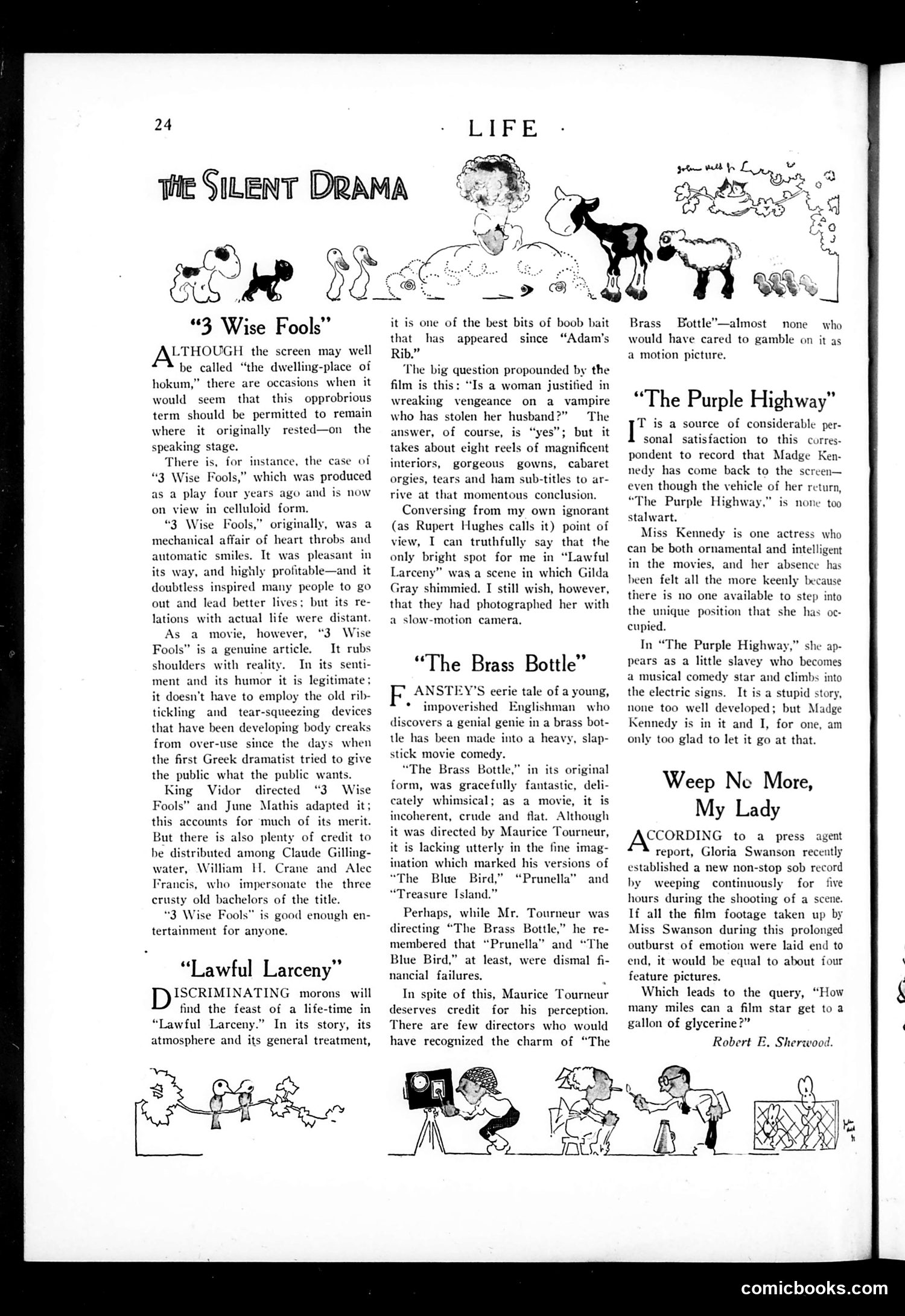
What you’re looking at
This page reviews four silent films from the early 1920s. The critic systematically praises and criticizes contemporary movies: **"3 Wise Fools"** - Originally a stage play, now a film. The reviewer credits director King Vidor and adaptor June Mathis for making it genuinely entertaining rather than melodramatic hokum, praising actors like Claude Gillingwater and William H. Crane. **"Lawful Larceny"** - Criticized as "boob bait" pandering to unsophisticated audiences with a predictable morality tale. The only bright spot mentioned is actress Gilda Gray's shimmy dance. **"The Brass Bottle"** - An adaptation of Anstey's fantasy story, faulted for becoming crude and incoherent on screen despite director Maurice Tourneur's earlier successes with "The Blue Bird" and "Prunella." **"The Purple Highway"** - Praised for featuring the return of actress Madge Kennedy, who the critic values for being both ornamental and intelligent—a rare quality he finds lacking in contemporary cinema. The tone reflects 1920s film criticism's condescension toward popular audiences while acknowledging entertainment value.
📄 Transcribed text from this page (OCR, searchable)
Machine-transcribed from the original scan — historical spelling and the odd misread are preserved.
24 THe SILENT DRAMA moe oF “3, Wise Fools” LTHOUGH the screen may well be called “the dwelling-place of hokum,” there are occasions when it would seem that this opprobrious term should be permitted to remain where it originally rested—on the speaking stage. There is, for instance, the case of “3 Wise Fools,” which was produced as a play four years ago and is now on view in celluloid form. “3 Wise Fools,” originally, was a mechanical affair of heart throbs and automatic smiles. It was pleasant in its way, and highly profitable—and it doubtless inspired many people to go out and lead better lives; but its re- lations with actual life were distant. As a however, “3 Wise Fools” is a genuine article. It rubs shoulders with reality. In its senti- ment and its humor it is legitimate; it doesn’t have to employ the old rib- tickling and tear-squeezing devices that have been developing body creaks from over-use since the days when the first Greek dramatist tried to give the public what the public wants. King Vidor directed “3 Wise Fools” and June Mathis adapted it; this accounts for much of its merit. But there is also plenty of credit to be distributed among Claude Gilling- water, William HI. Crane Alec Francis, who impersonate the three crusty old bachelors of the title. “3 Wise Fools” is good enough en- tertainment for anyone. movie, and “Lawful Larceny” ISCRIMINATING morons will find the feast of a life-time in “Lawful Larceny.” In its story, its atmosphere and its general treatment, it is one of the best bits of boob bait that has appeared since “Adam's Rib.” The big question propounded by the film is this: “Is a woman justitied in wreaking vengeance on a vampire who has stolen her husband?” ~The answer, of course, is “yes”; but it takes about eight reels of magnificent interiors, gorgeous gowns, cabaret orgies, tears and ham sub-titles to ar- rive at that momentous conclusion. Conversing from my own ignorant (as Rupert Hughes calls it) point of view, I can truthfully say that the only bright spot for me in “Lawful Larceny” was a scene in which Gilda Gray shimmied. I still wish, however, that they had photographed her with a slow-motion camera. “The Brass Bottle” ANSTEY’S eerie tale of a young, impoverished Englishman discovers a genial genie in a brass bot- tle has been made into a heavy, slap- stick movie comedy. “The Brass Bottle,” in its original form, was gracefully fantastic, deli- cately whimsical; as a movie, it is incoherent, crude and flat. Although it was directed by Maurice Tourneur, it is lacking utterly in the fine imag- ination which marked his versions of “The Blue Bird,” “Prunella” and “Treasure Island.” od who Perhaps, while Mr. Tourneur was directing “The Brass Bottle,” he membered that “Prunella” and “1 Blue Bird,” at least, were dismal fi- nancial failures. . In spite of this, Maurice Tourneur deserves credit for his perception. There are few directors who would have recognized the charm of “The Brass Bottle’—almost none who would have cared to gamble on it as a motion picture. “The Purple Highway” T is a source of considerable per- sonal satisfaction to this corres- pondent to record that Madge Ken- nedy has come back to the screen— even though the vehicle of her return, “The Purple Highway,” is none too stalwart. Miss Kennedy is one actress who can be both ornamental and intelligent in the movies, and her abs heen felt all the more keenly because there is no one available to step into the unique position that she has oc- cupied. nce has In “The Purple Highway,” she ap- pears as a little slavey who becomes a musical comedy star and climbs into the electric signs. It is a stupid story, none too well developed; but Madge Kennedy is in it and I, for one, am only too glad to let it go at that. Weep Ne More, My Lady CCORDING to a report, Gloria Swanson recently established a new non-stop sob record weeping continuously for five hours during the shooting of a scene. If all the film footage taken up by Miss Swanson during this prolonged outburst of emotion were laid end to end, it would be equal to about four feature pictures. Which leads to the query, “How many miles can a film star get to a gallon of glycerine?” Robert E, Sherwood. press agent by comicbooks.com