
A complete issue · 36 pages · 1923
Life — May 10, 1923
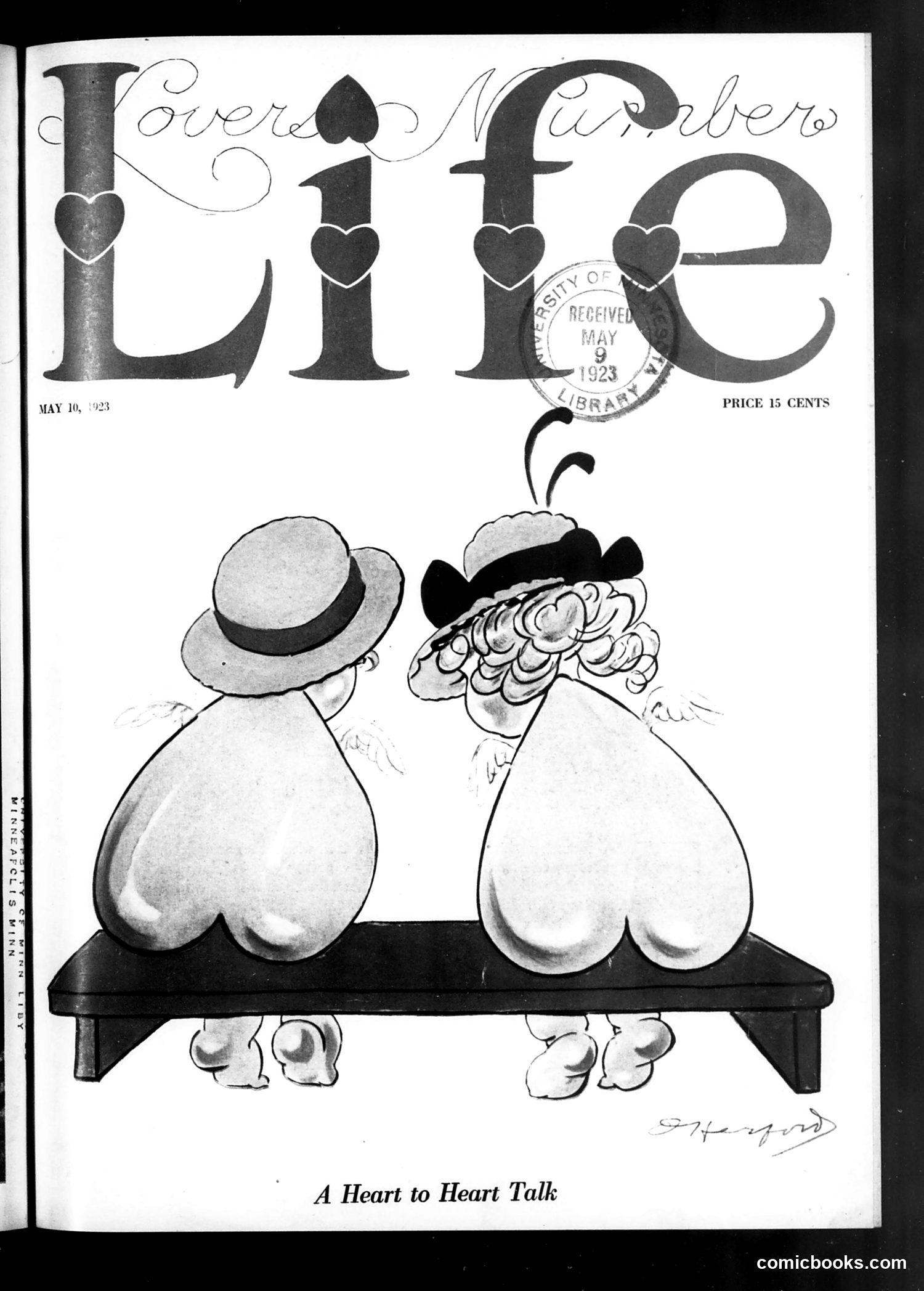
This cover satirizes romantic or marital relations through anthropomorphized figures with exaggerated body shapes sitting on a bench. The subtitle "A Heart to Heart Talk" suggests intimate conversation. The two cherub-like characters—one wearing a straw hat, the other with an elaborate hairstyle and bow—appear to represent romantic partners or spouses. Their pronounced, pear-shaped forms are the visual joke, emphasizing physical appearance in a humorous, non-realistic way typical of 1920s satirical illustration. The price of 15 cents and May 10, 1923 date place this in the Jazz Age. Without additional context, the specific social commentary remains unclear, though the piece likely comments on romantic relationships, courtship, or marital dynamics of the era through crude visual humor.
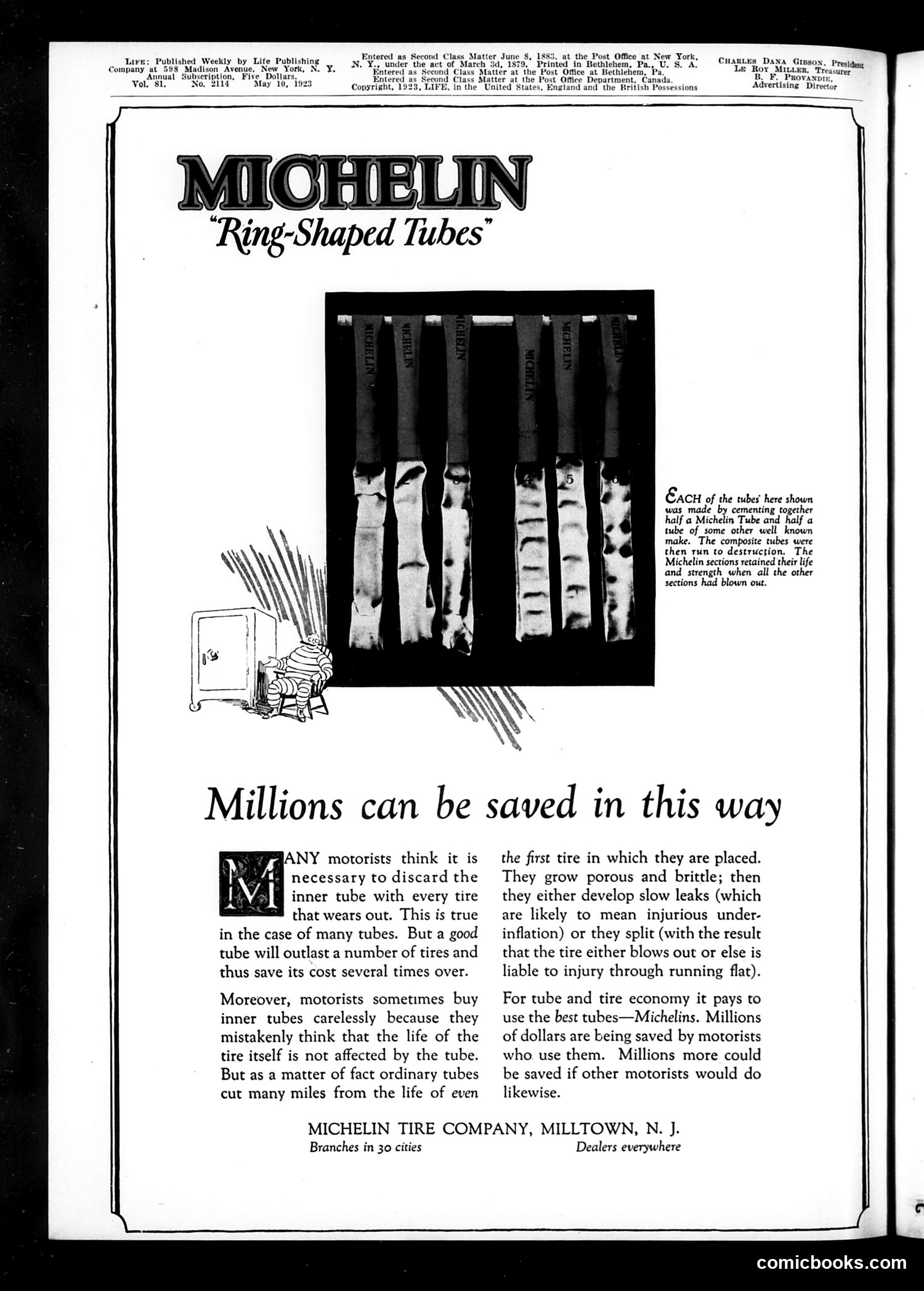
This is a **product advertisement, not satire or political commentary**. The page promotes Michelin brand inner tubes for automobile tires, marketed as superior to competitors because they last longer and can be reused multiple times. The central image shows X-ray photographs of tubes undergoing destructive testing—demonstrating that Michelin tubes (which retained integrity) outlasted composite tubes made from competing materials. The small cartoon figure appears to be a generic motorist or consumer. The advertisement's argument: buying cheap tubes wastes money because they fail quickly, while Michelin tubes justify their cost through durability. The phrase "Millions can be saved in this way" appeals to motorists' financial self-interest during the 1920s automotive boom.
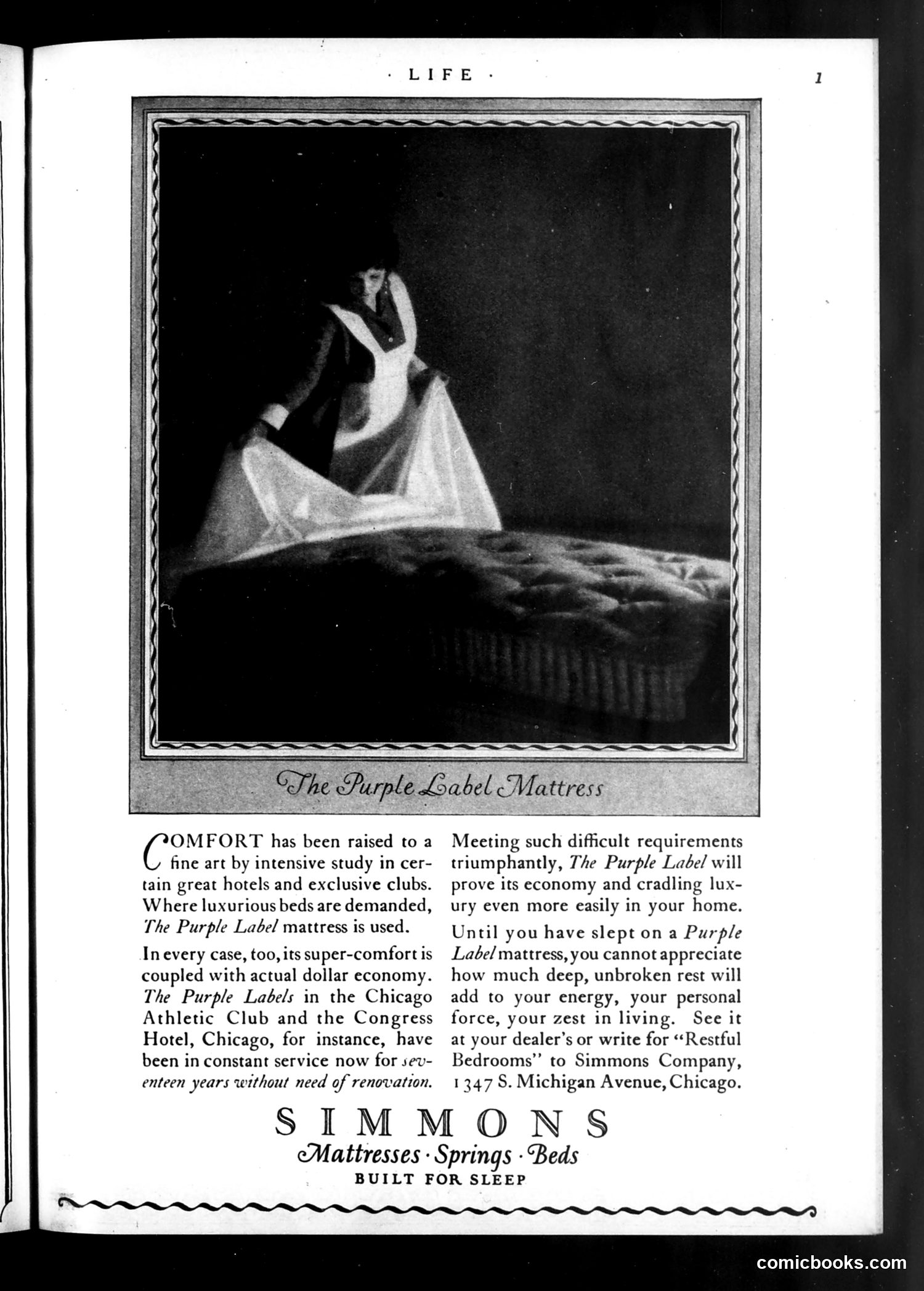
This page is primarily an **advertisement for Simmons mattresses**, not political satire. The image titled "The Purple Label Mattress" shows a stylized illustration of a woman in flowing white garments reclining on a bed, rendered in dramatic lighting typical of 1920s-1930s advertising aesthetics. The text emphasizes luxury and comfort, referencing prestigious Chicago institutions (the Athletic Club, Congress Hotel) to establish prestige. The ad promises both comfort and economy—a common marketing pitch during uncertain economic periods. There is **no political cartoon or satire present**. This appears to be a standard commercial advertisement from *Life* magazine's revenue-generating pages, using aspirational imagery to market bedding products to affluent readers.
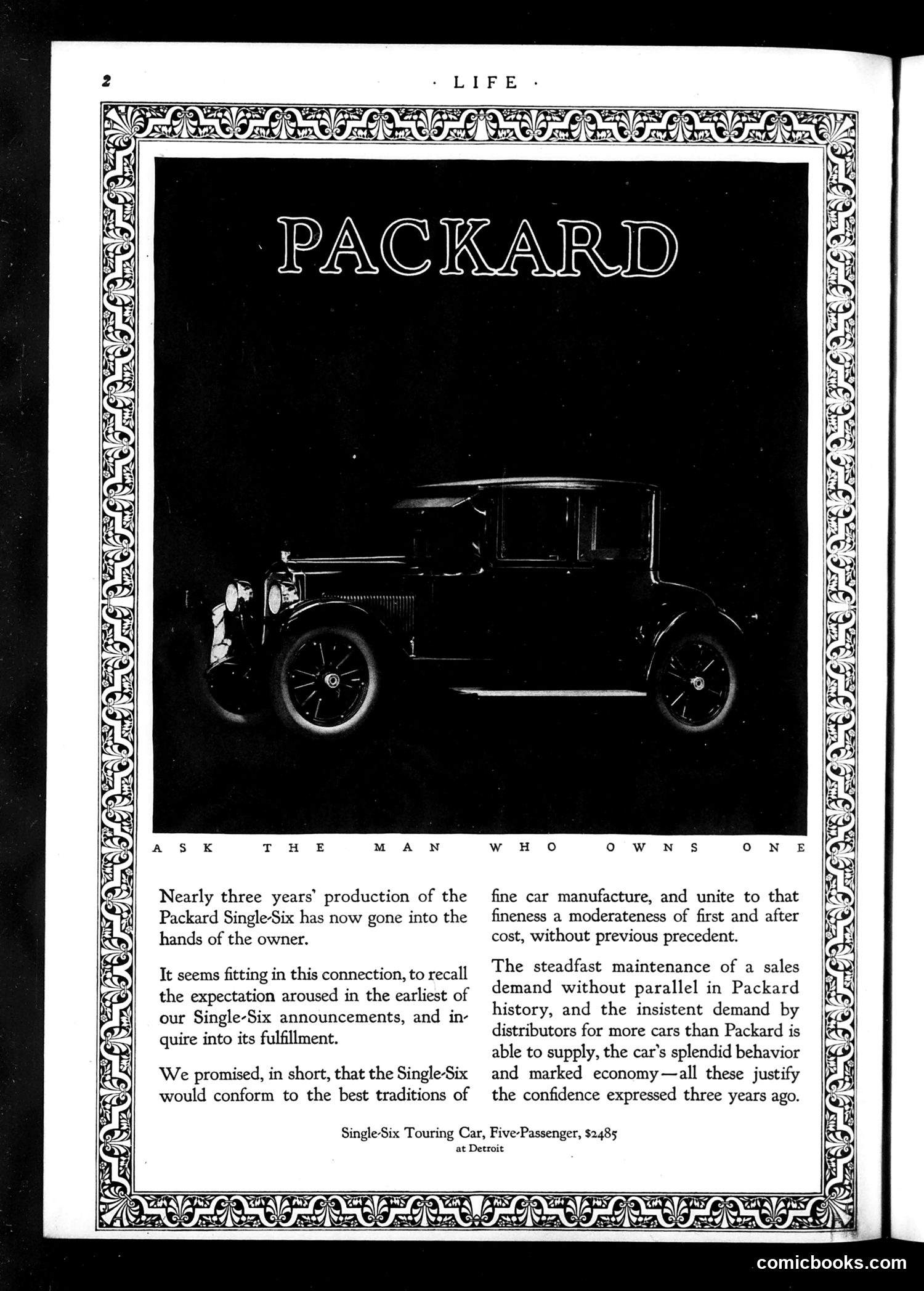
This is not a satirical cartoon but rather a **Packard automobile advertisement** from *Life* magazine. The page features a photograph of a Packard Single-Six touring car against a dark background, with the heading "ASK THE MAN WHO OWNS ONE." The text celebrates nearly three years of production of the Packard Single-Six, highlighting its quality craftsmanship and market success. It references the car's "splendid behavior and marked economy," claiming the vehicle has met expectations from original marketing claims. The ad emphasizes strong sales demand and consumer satisfaction. The price listed is $2,485 at Detroit. This represents typical early 20th-century automobile advertising emphasizing reliability and prestige rather than satire or political commentary.
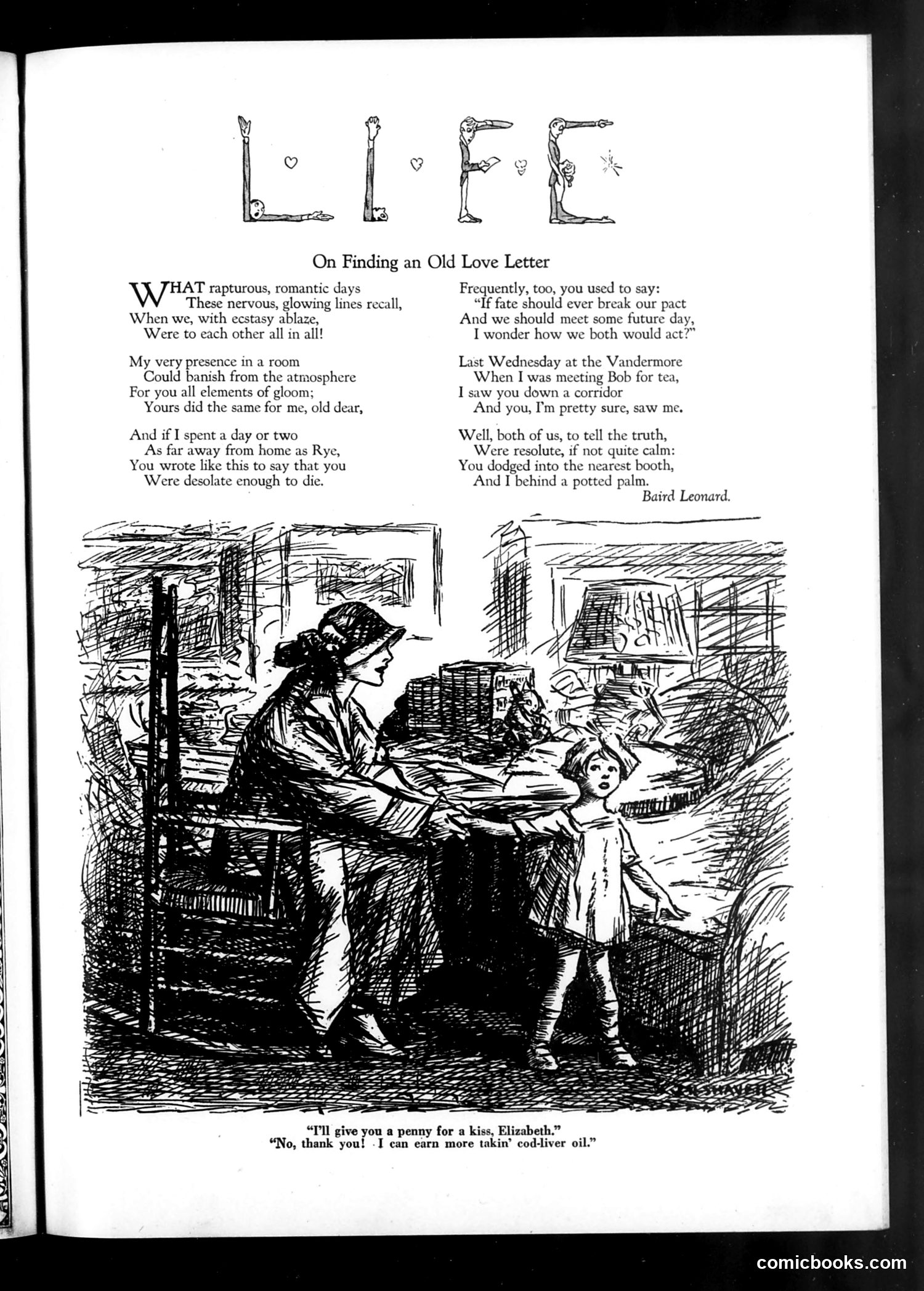
This page presents a romantic poem by Baird Leonard about rediscovering an old love letter. The poem nostalgically recalls passionate early romance—"rapturous, romantic days" with "nervous, glowing lines"—and contrasts this with a chance modern encounter where the two former lovers awkwardly avoid each other at the Vandermore hotel, hiding "behind a potted palm." The accompanying sketch illustrates this theme: a well-dressed woman and child encounter what appears to be a man on a city street. The caption's dialogue—"I'll give you a penny for a kiss, Elizabeth" / "No, thank you! I can earn more takin' cod-liver oil"—suggests a humorous commentary on changed circumstances or the practical attitudes replacing romantic sentiment.
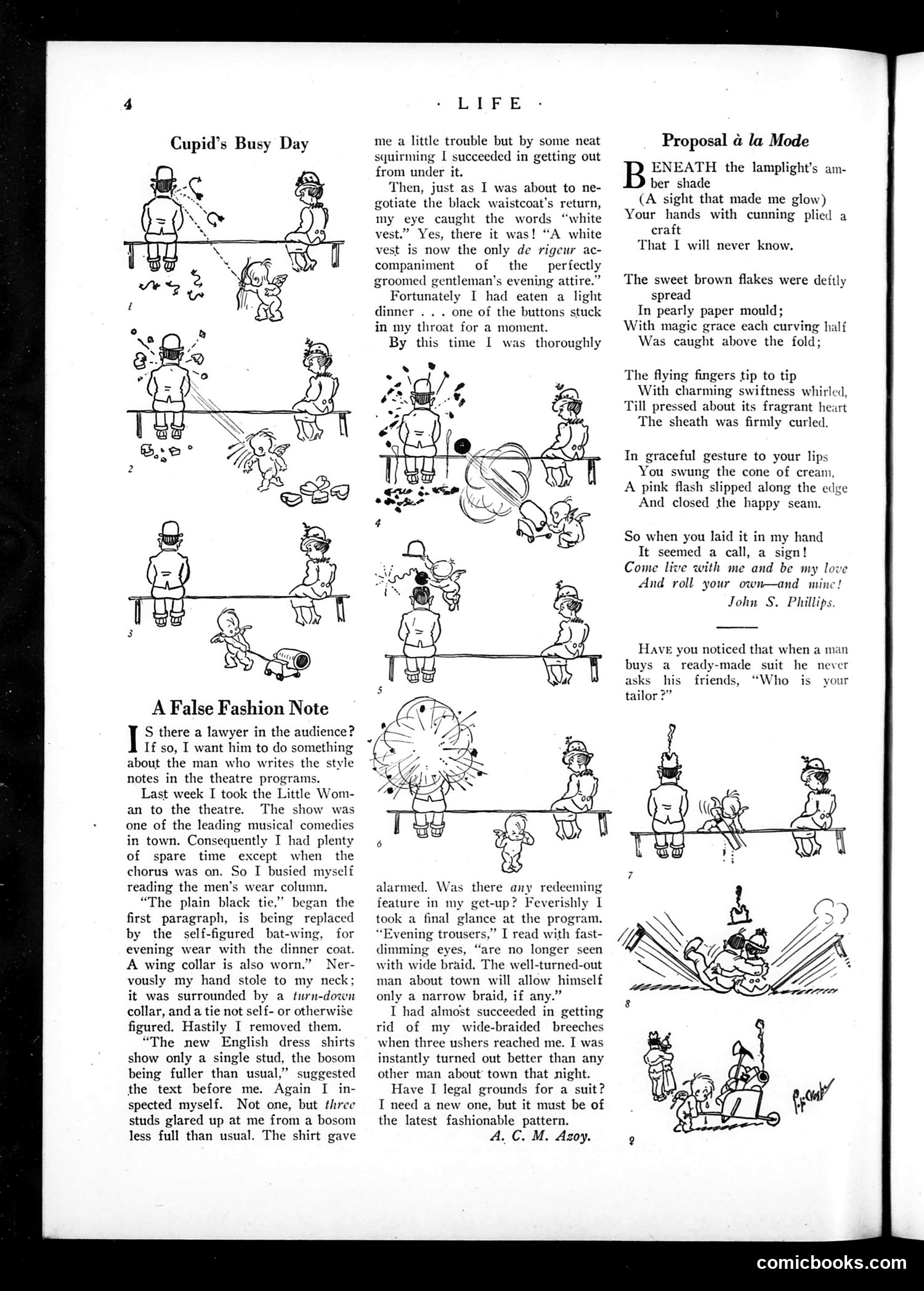
This page contains three separate pieces: **"Cupid's Busy Day"** (illustrated strip): A humorous sequence showing Cupid causing romantic chaos among seated couples through mischievous intervention—typical early 20th-century sentimental humor about love and matchmaking. **"Proposal à la Mode"** (poem): A romantic verse about presenting a cream-filled pastry as a love token, playing on the double meaning of "sweetness" in romance and dessert. **"A False Fashion Note"** (article): Satirizes men's fashion advice columnists in theater programs. The author humorously complains about style recommendations—particularly mocking suggestions to wear white vests with dinner jackets and English dress shirts. The satire targets the pretentiousness of fashion arbiters telling readers what's fashionable, while questioning their actual expertise. The overall theme emphasizes social satire and romantic comedy typical of Life magazine's satirical humor from this era.
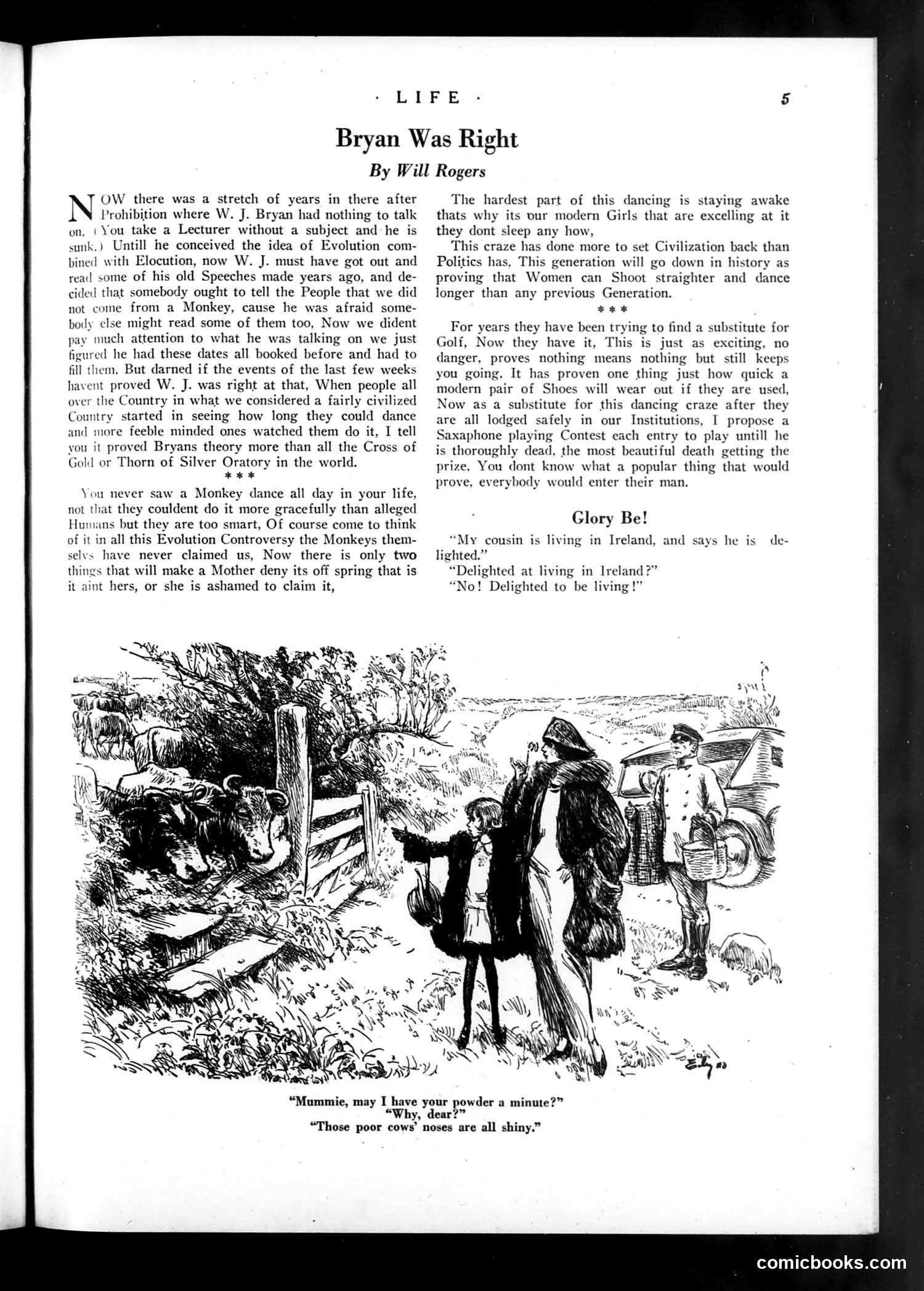
This page from *Life* magazine contains satirical commentary by Will Rogers on 1920s social trends. The main article, "Bryan Was Right," references William Jennings Bryan and discusses the "Evolution Controversy"—likely the Scopes Monkey Trial debates about teaching evolution in schools. Rogers sardonically argues that recent events (the page mentions Prohibition's repeal and women's newfound freedoms) prove Bryan's warnings correct: modern civilization is declining. He mocks contemporary trends like women dancing, wearing shoes out quickly, and playing saxophone as evidence of moral decay. The cartoon below depicts a rural scene with the caption about "cows' noses" being shiny—likely satirizing rural/agricultural concerns amid rapid modernization. The satire targets both conservative alarm about social change and the absurdity of blaming civilization's problems on new fashions and pastimes.
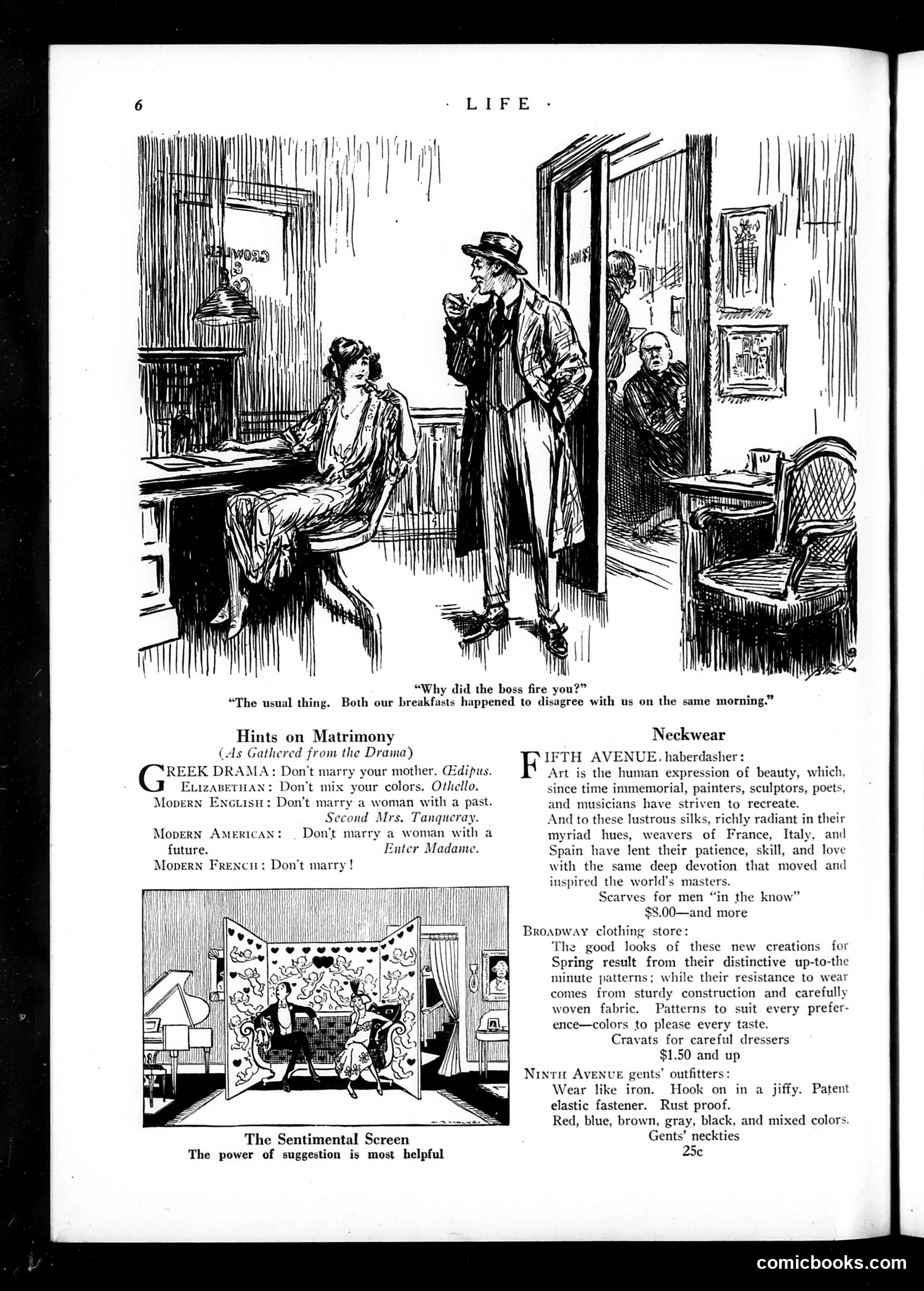
This page contains two main elements: **Top Cartoon**: A domestic scene showing a woman at a desk confronting a man about job loss. The caption reveals both lost their jobs because "our breakfasts happened to disagree with us on the same morning"—a joke about simultaneous indigestion causing workplace absences. The humor targets early 20th-century employment precarity and suggests workers could be fired for minor infractions. **Bottom Section**: "The Sentimental Screen" illustration depicts a theatrical scene, captioning that "the power of suggestion is most helpful." This likely satirizes melodramatic theater or early cinema's emotional manipulation. The remainder comprises fashion and neckwear advertisements from Fifth Avenue, Broadway, and Ninth Avenue retailers, pricing items from $1.50 upward—typical period magazine advertising.
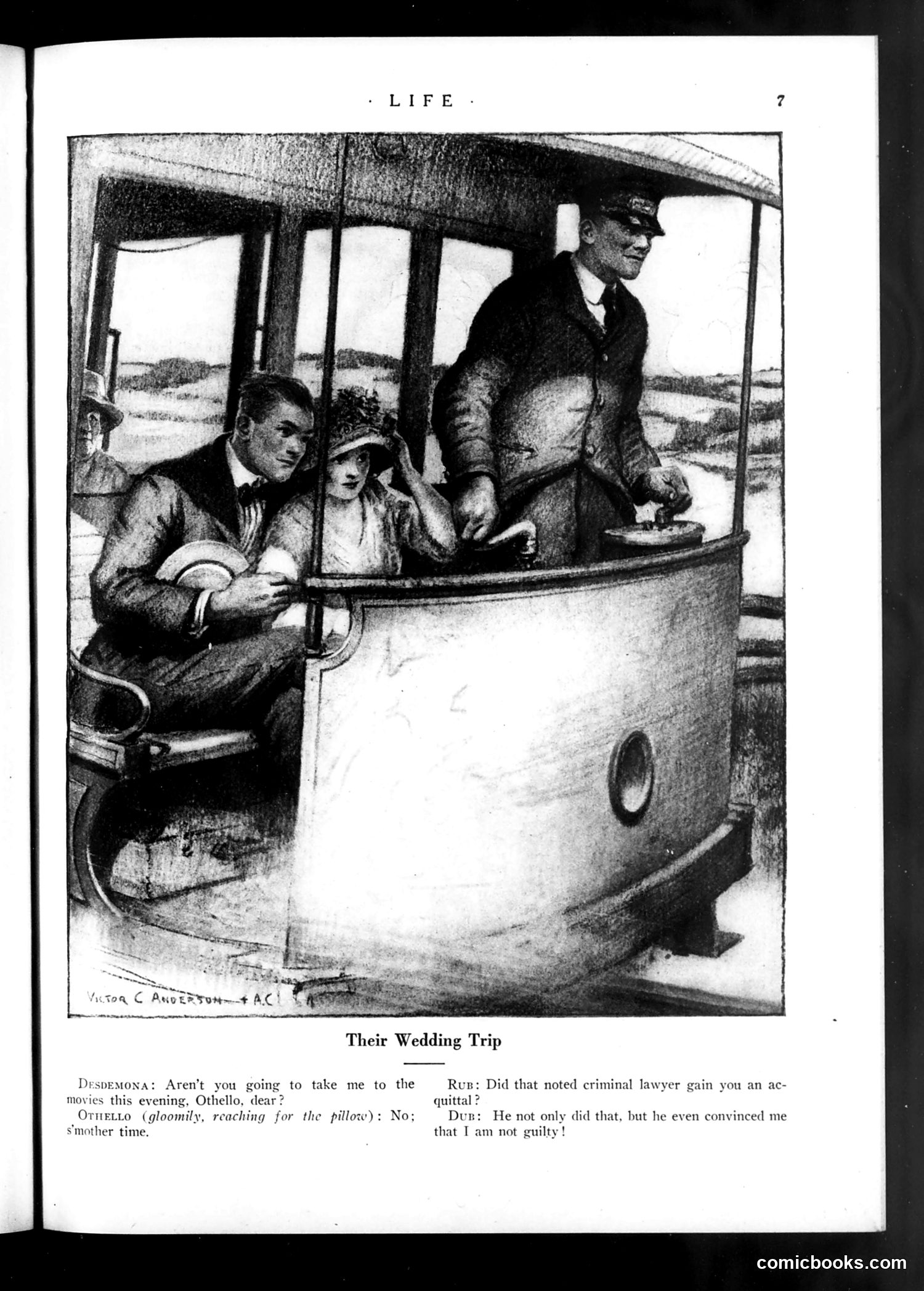
This illustrated joke depicts a newlywed couple in an early automobile with a chauffeur and another passenger. The satirical dialogue plays on the contrast between romantic expectations and marital reality. **The joke:** Desdemona asks Othello if he'll take her to the movies, but he declines, saying he'd "rather" do something else (reaching for a pillow, suggesting sleep/inattention). When she complains, Othello boasts that his criminal lawyer got him acquitted of charges and "even convinced me that I am not guilty!" The humor relies on references to Shakespeare's *Othello*—using those character names—and satirizes newlywed dynamics: the husband's dismissiveness toward his bride's desires, and his self-satisfaction despite obvious guilt. The automobile setting emphasizes modernity, contrasting with the classical literary reference.
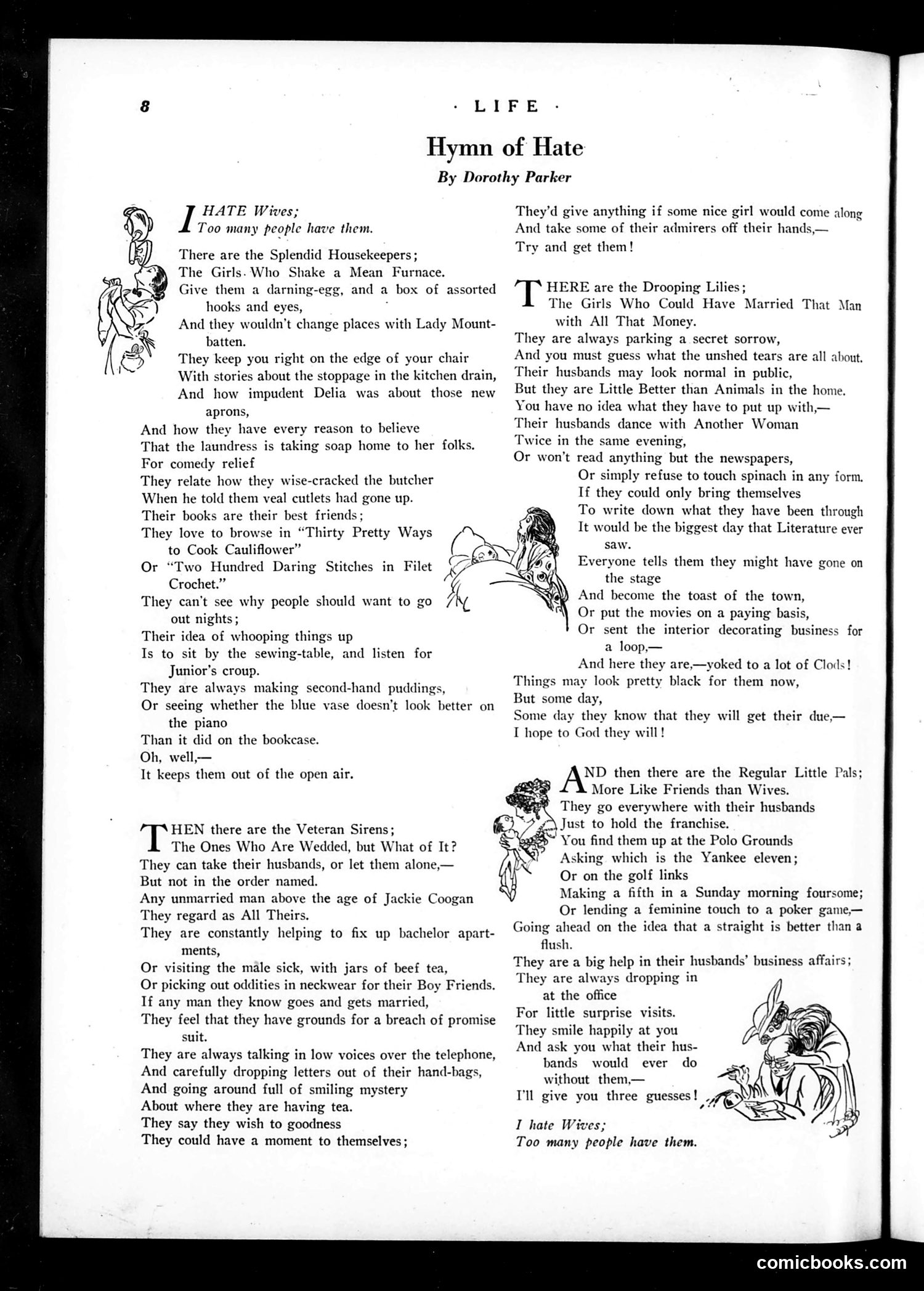
This satirical poem targets different categories of wives through bitter, humorous critique. Parker catalogs women she despises: Splendid Housekeepers who bore people with domestic minutiae; Drooping Lilies who play the victim while their husbands pursue other women; and Regular Little Pals who present themselves as ideal helpmates in business and social life. The satire mocks not individual women but rather the *types* and pretenses—women performing exaggerated domestic roles, feigning martyrdom, or presenting false competence. Parker's wit lies in exposing the gap between how these wives present themselves and their actual nature. The refrain "I hate Wives; Too many people have them" frames marriage itself as the problem, suggesting wives as social constructs rather than individuals. The illustrated vignettes reinforce each stereotype through caricature.
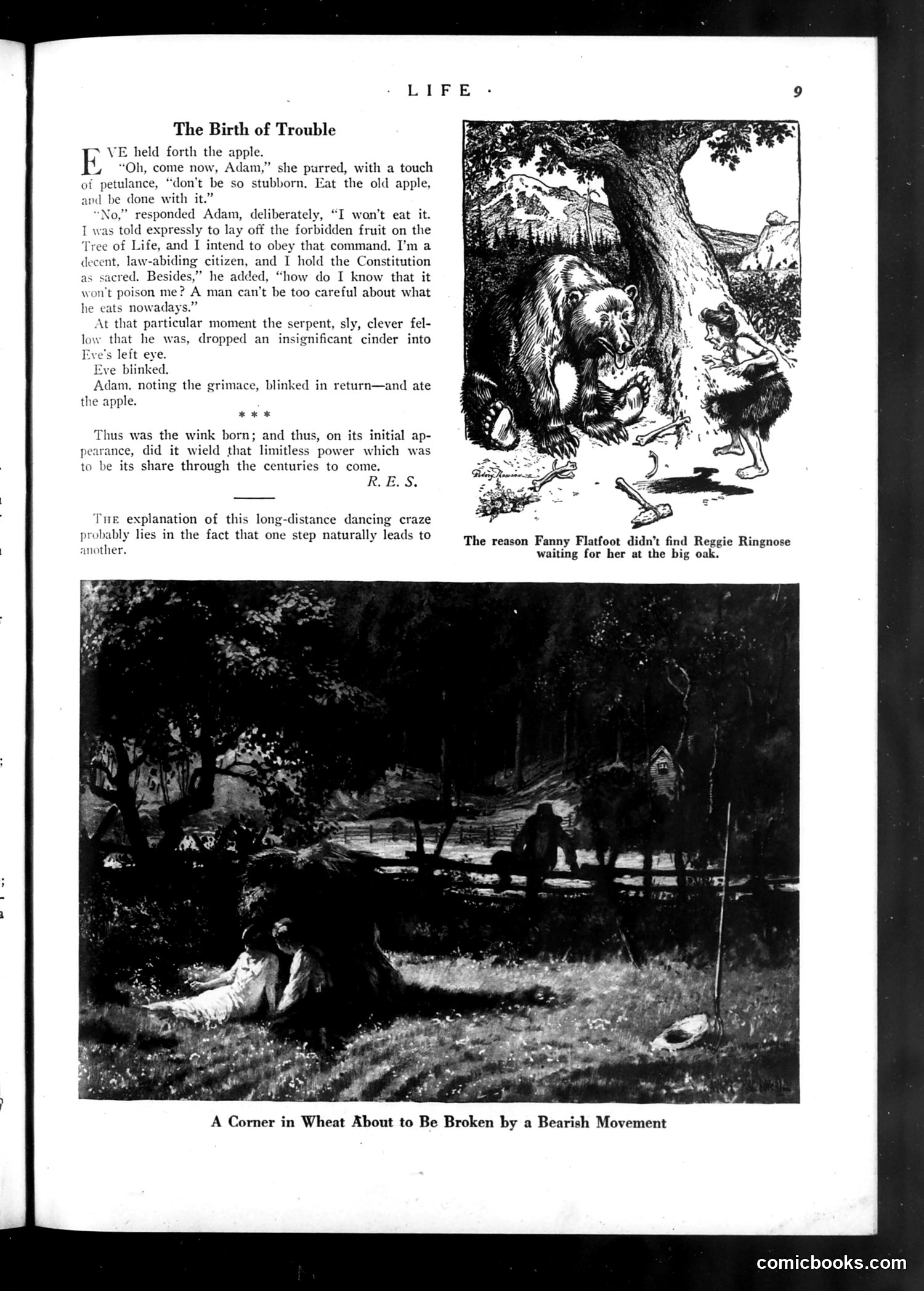
This page contains "The Birth of Trouble," a satirical retelling of the Adam and Eve story. The narrative presents Adam as a stubbornly law-abiding citizen citing the Constitution, while Eve—portrayed as sly and clever—tempts him with the forbidden fruit anyway. A serpent deliberately drops a cinder in Adam's eye, causing him to blink and inadvertently signal Eve to eat the apple. The satire suggests that mankind's downfall resulted not from rational choice but from a combination of feminine cunning and accidental circumstance. The accompanying illustrations show anthropomorphic animals (likely representing humans in animal form, common in period satire), with a lower image depicting a pastoral scene titled "A Corner in Wheat About to Be Broken by a Bearish Movement"—likely referencing financial market speculation.
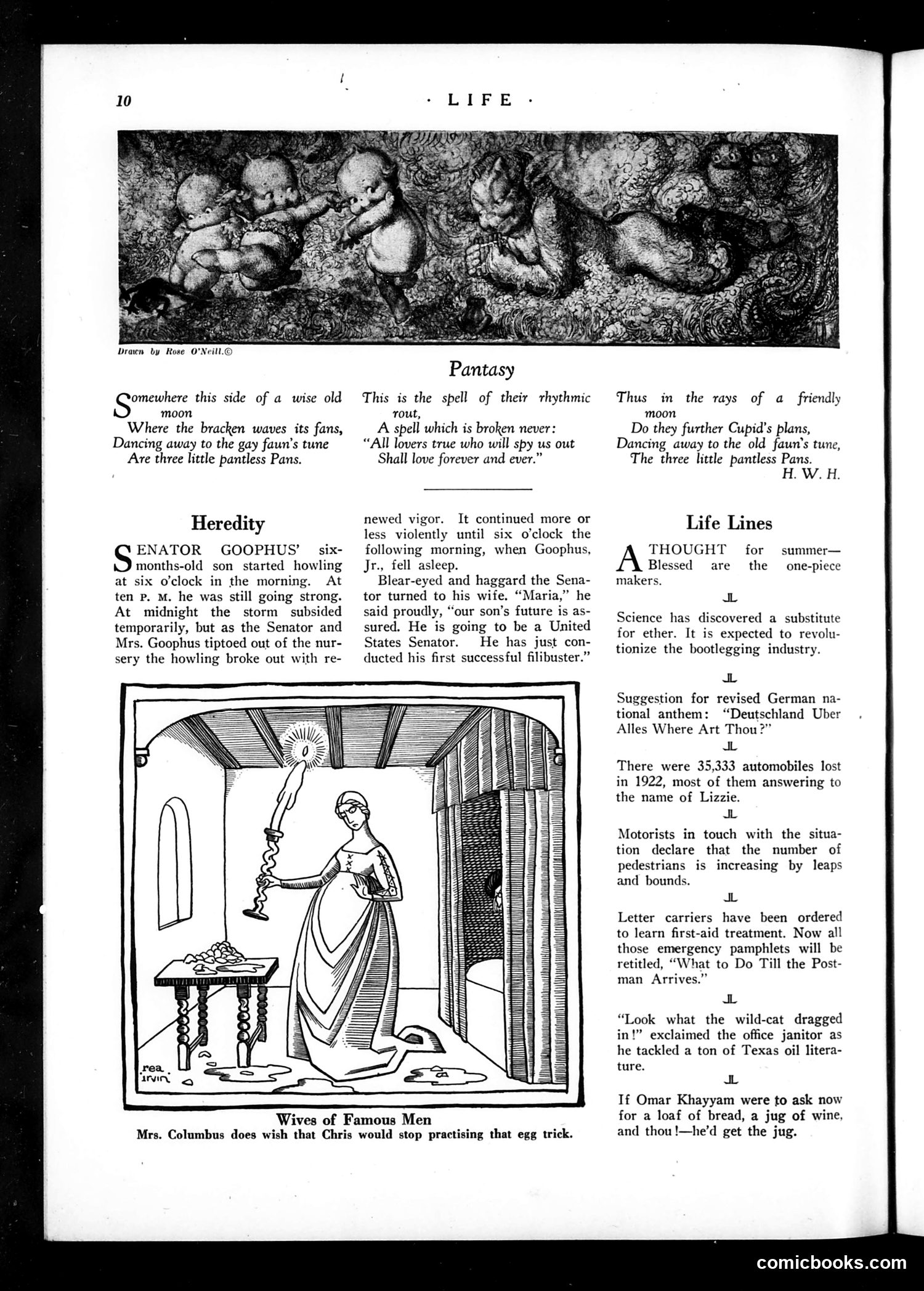
This page contains several distinct pieces of humor and commentary: **"Pantasy" (top):** A whimsical illustrated poem by H.W.H. about cherubs and "the three little pantless Pans"—apparently a playful visual gag about classical mythological figures. **"Heredity" (main article/cartoon):** Satirizes Senator Goophus's newborn son who is already "howling at six o'clock in the morning." The joke appears to be hereditary—the father is a U.S. Senator known for "filibustering" (lengthy speeches), and his infant son has inherited this trait. **"Wives of Famous Men" (cartoon):** Shows Mrs. Columbus performing an egg-balancing trick, with the caption joking that she wishes husband Chris would stop practicing this trick. This references Columbus and plays on domestic humor about wives' exasperation with their husbands' hobbies. **"Life Lines":** Brief satirical observations about contemporary issues (automobiles, pedestrians, letter carriers, etc.).
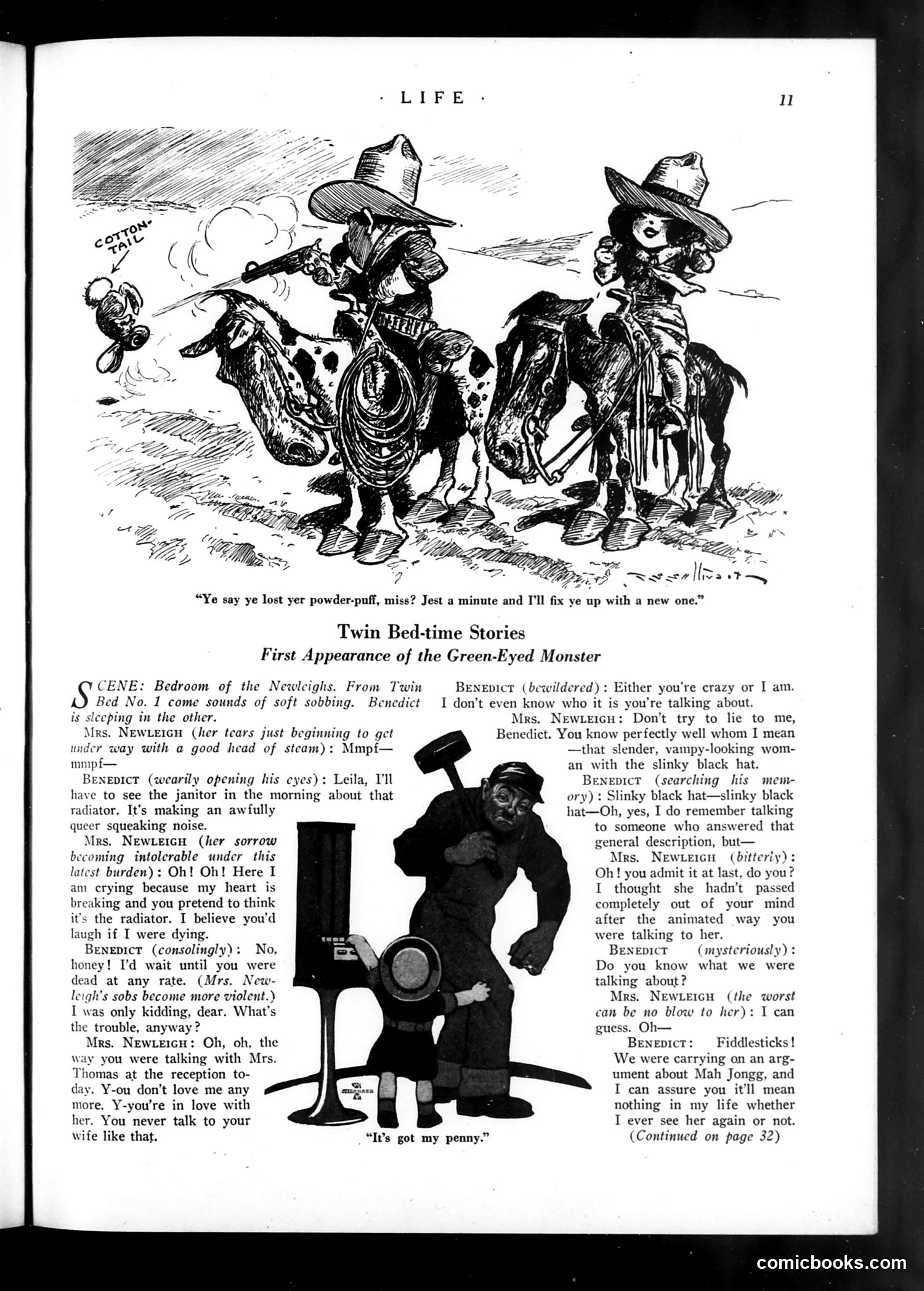
This page contains two distinct pieces: **Top cartoon:** A Western scene showing two cowboys on horses. One says to the other, "Ye say ye lost yer powder-puff, miss? Jest a minute and I'll fix ye up with a new one." This appears to be satirizing overly masculine or rough frontier types encountering feminine vanity items—the humor lies in the incongruity of a rugged cowboy being enlisted to help with cosmetic accessories. **Bottom section:** "Twin Bed-time Stories: First Appearance of the Green-Eyed Monster"—a domestic comedy sketch about married couple the Newleighs. Benedict and Mrs. Newleigh argue about his attentiveness to another woman (Mrs. Thomas) at a reception. The "green-eyed monster" refers to jealousy. A comedic illustration shows Benedict with a janitor or caretaker figure. The sketch explores marital tension and suspicion, which the text indicates continues on page 32.
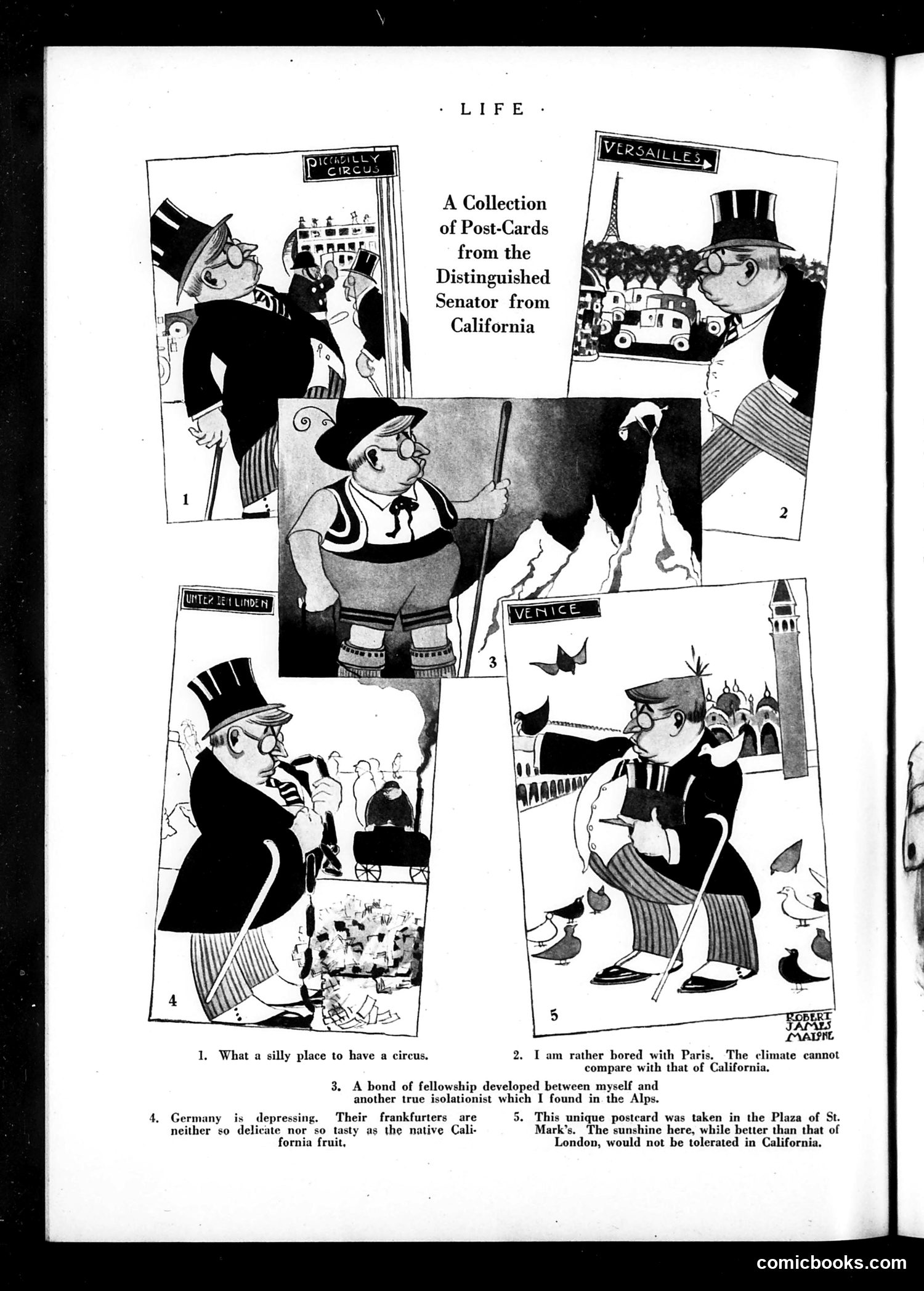
This page presents five cartoon postcards supposedly from a California senator, mocking his European travels and provincial attitudes. The caricatured figure—drawn with exaggerated features—visits famous landmarks (Piccadilly Circus, Versailles, Venice, the Alps, and St. Mark's Square) yet constantly disparages European culture in favor of California. The satire ridicules American parochialism: despite witnessing world-renowned destinations, the senator complains that Paris bores him, German fruit isn't as tasty as California's, and London's sunshine wouldn't be tolerated back home. The joke targets isolationist attitudes and unsophisticated tourists who judge everything by narrow provincial standards, unable to appreciate international culture. The artist is credited as "Robert James Calder."
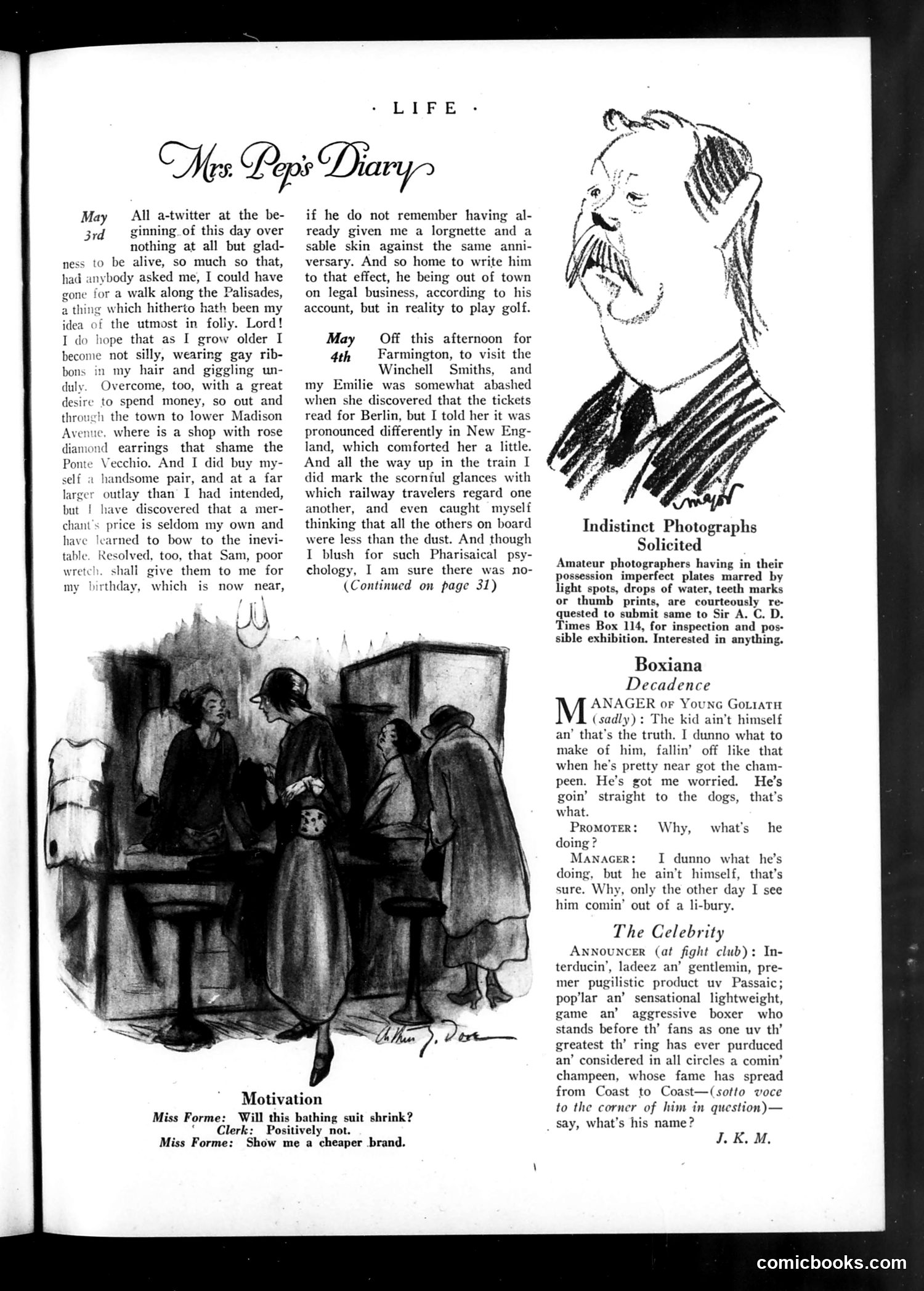
This page contains **"Mrs. Pep's Diary,"** a satirical column mocking upper-class leisure activities. The diary entries (May 3rd and 4th) humorously describe trivial social concerns: a woman complaining about gladness at being alive, shopping for diamond earrings, and fretting over train travel etiquette. The cartoon labeled **"Motivation"** depicts a shop clerk exchange satirizing consumer behavior. Miss Formé asks if cheaper items will shrink; the clerk suggests she buy a cheaper brand instead—mocking both customer vanity and retail dishonesty. Other sections include requests for "indistinct photographs" and brief humorous anecdotes about a young "manager" and a boxer celebrity. The overall satire targets **frivolous upper-class preoccupations** and superficial consumer culture of the era.
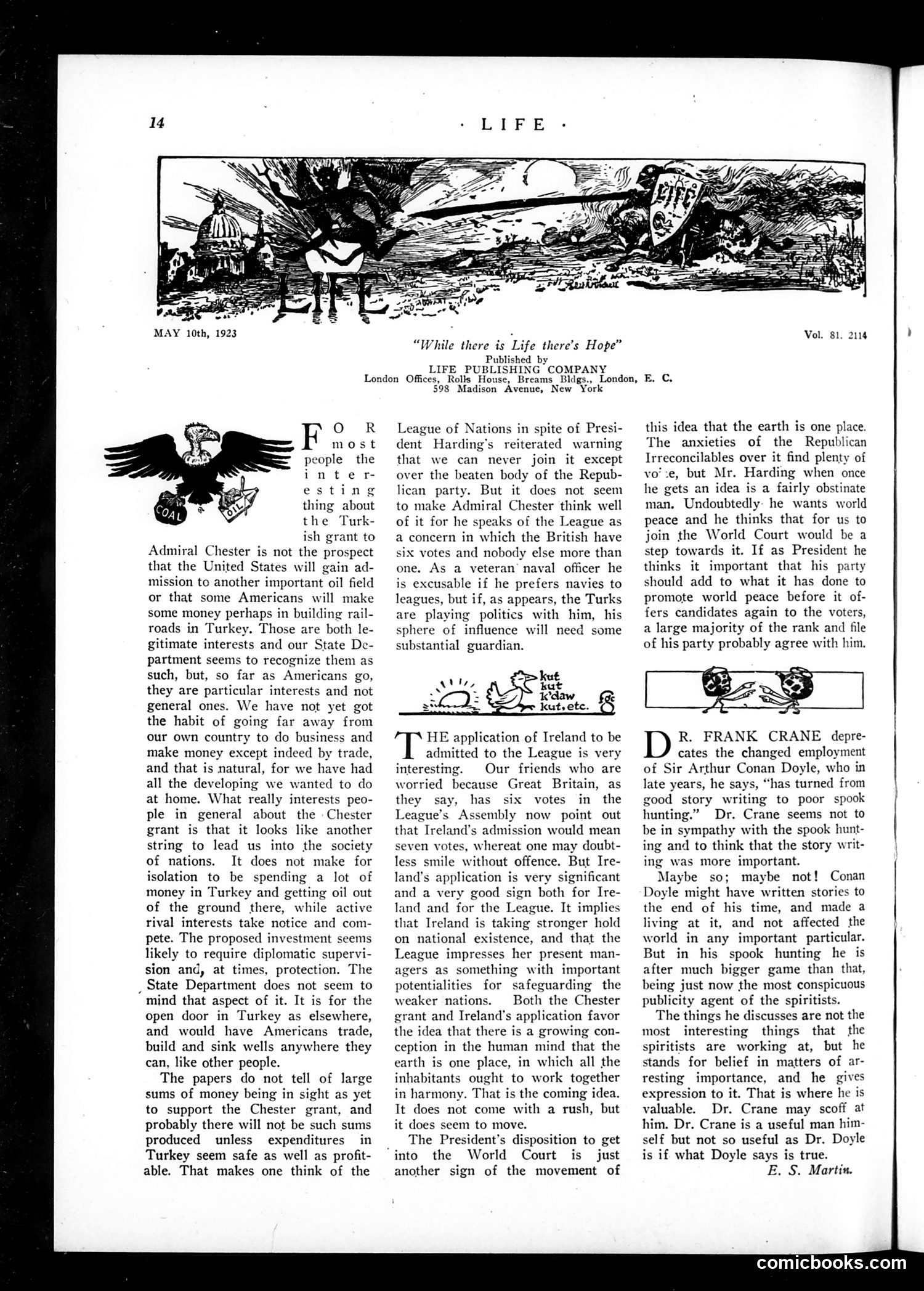
This page contains political commentary on American foreign policy. The main article criticizes Admiral Chester (likely Admiral Chester Nimitz or another naval figure of the era) for supporting U.S. involvement in League of Nations affairs and World Court participation—positions the author views as excessive foreign entanglement. The text debates whether American interests in Turkey and the Middle East justify diplomatic involvement. A secondary piece by E.S. Martin critiques writer Sir Arthur Conan Doyle's shift away from fiction to spiritualism and "spook hunting," expressing skepticism about his pivot to paranormal topics. The decorative header cartoon appears to be the magazine's masthead. Small comic vignettes appear embedded in the text, typical of Life's satirical format from this era.
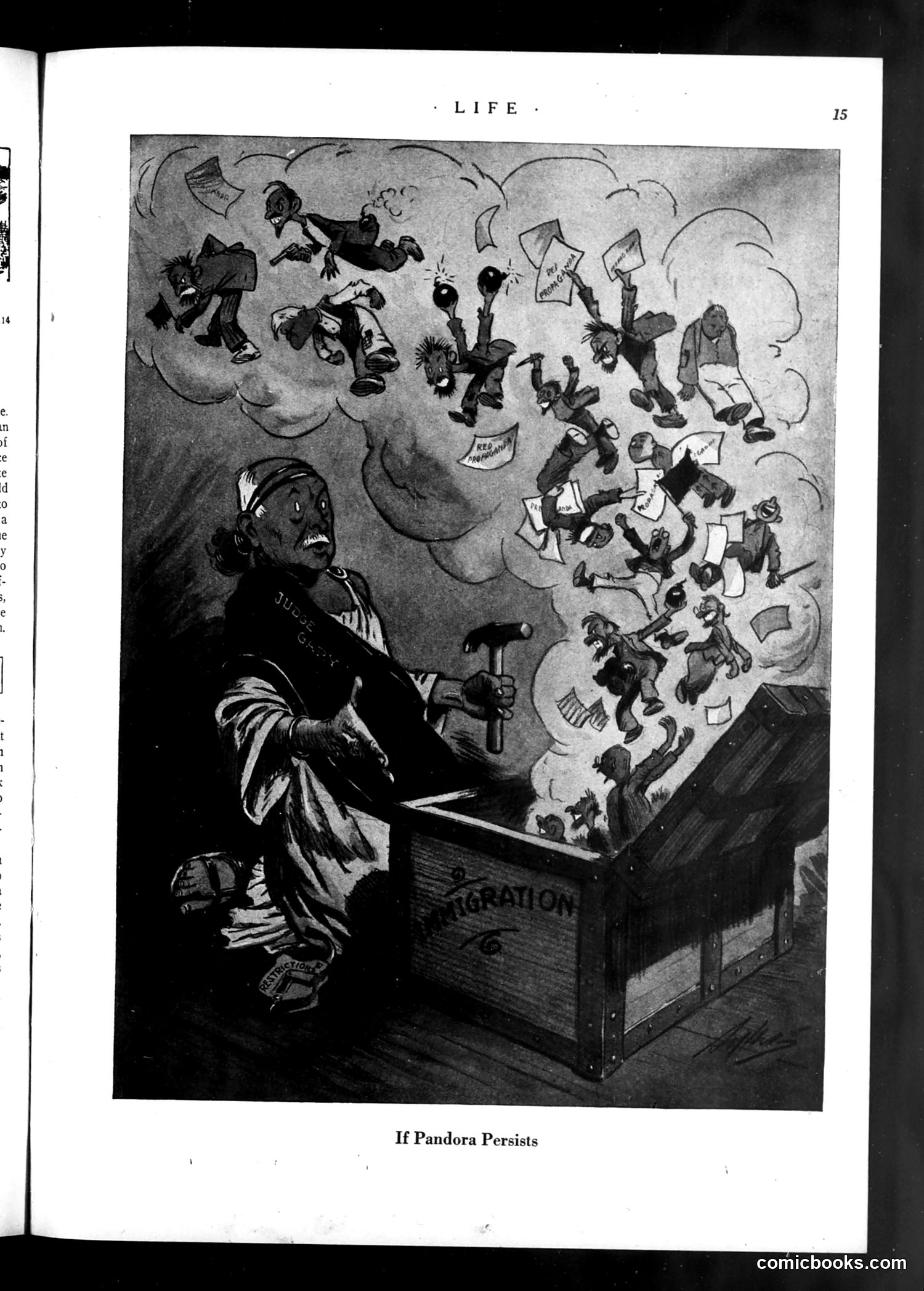
This political cartoon depicts a man with a hammer opening a box labeled "IMMIGRATION," from which swarms of small figures emerge in chaotic clouds. The title references Pandora's Box—the mythological source of human suffering released upon the world. The satire warns against unrestricted immigration policy. The man, appearing to be a politician or administrator, is portrayed as foolishly or recklessly opening immigration restrictions, thereby unleashing uncontrollable social problems (represented by the swarming figures and scattered papers). The cartoon presents immigration as an inherent danger—once the "box" opens, chaos cannot be recaptured. This reflects early-to-mid 20th century nativist anxieties common in American political discourse, positioning immigration itself as society's "Pandora's Box."
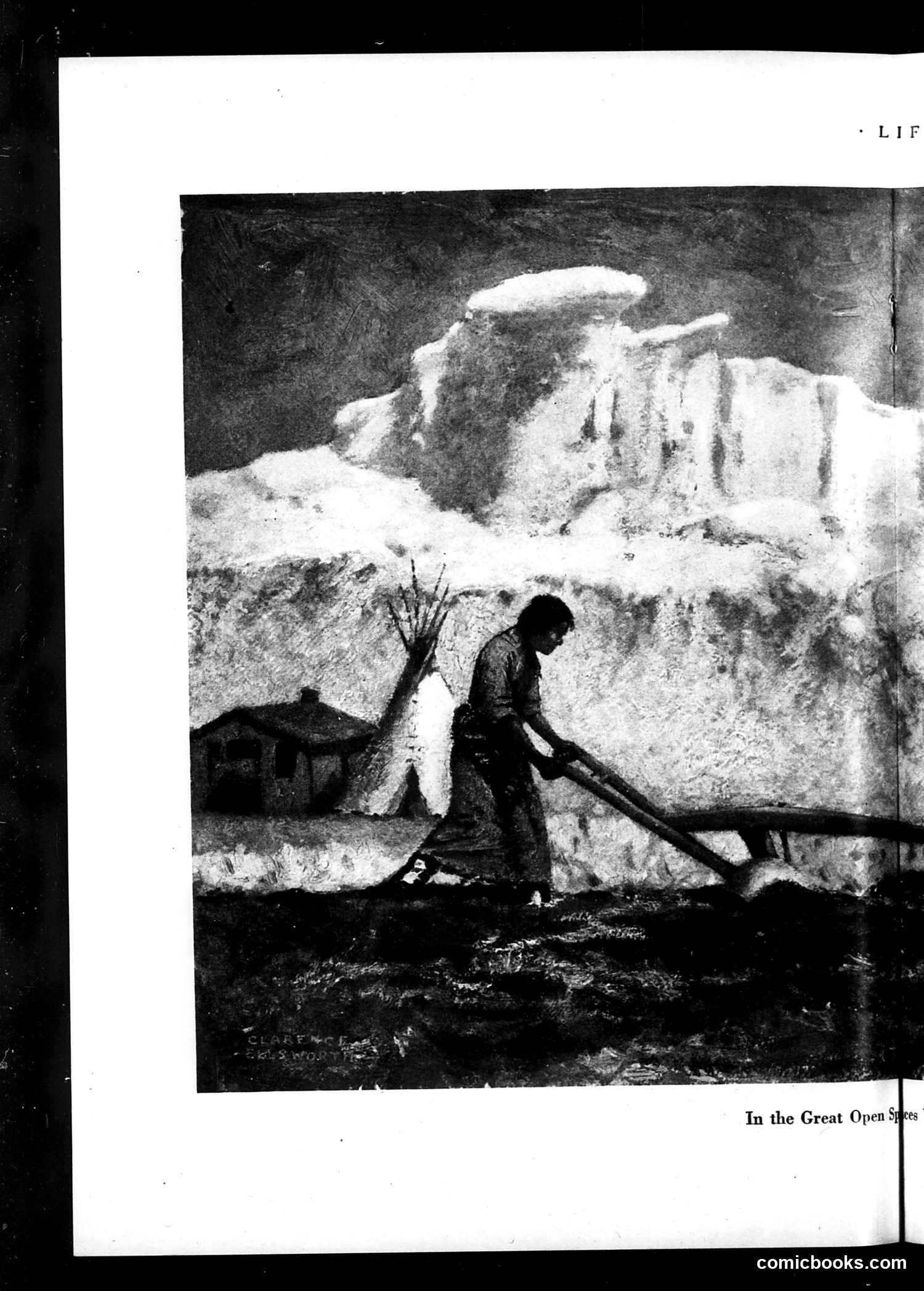
This black-and-white photograph shows a figure working outdoors with what appears to be a long tool or implement, set against dramatic rocky terrain or cliffs in the background. The caption "In the Great Open Spaces" suggests this is satirizing idealized notions of frontier life or rural labor. Without additional context or visible text identifying specific individuals or events, the precise satirical target remains unclear. The image could be commenting on romanticized views of outdoor work, pioneer mythology, or perhaps labor conditions—common subjects for Life magazine's social satire. The composition emphasizes the solitary figure against vast, imposing natural features, possibly ironizing notions of freedom or opportunity "in the open spaces."
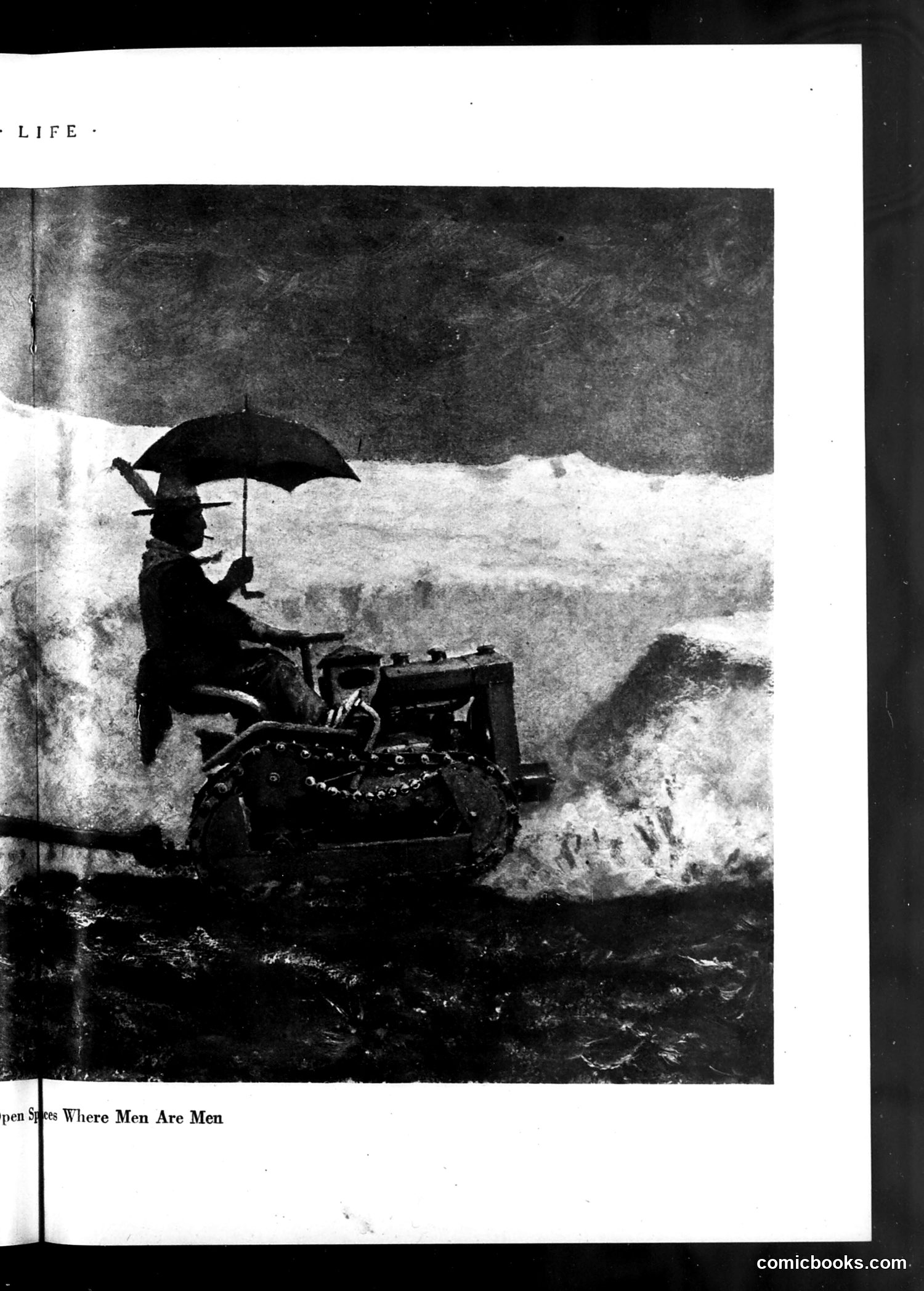
This appears to be a satirical illustration from *Life* magazine featuring a figure hunched over a typewriter in harsh weather conditions—heavy snow and dark skies. The person holds an umbrella for protection while working outdoors in brutal conditions. The caption reads "Open Spaces Where Men Are Men," which appears to be ironic commentary. The satire likely mocks either: 1. Romanticized notions of rugged frontier masculinity, or 2. The harsh realities faced by writers, journalists, or other professionals working in difficult conditions The juxtaposition of the typewriter (intellectual work) with extreme outdoor elements suggests the cartoonist is critiquing either the glorification of hardship or the actual working conditions of writers/creatives. Without additional context or visible artist attribution, the specific target remains somewhat unclear, though the satirical intent is evident.
This is a theater review mocking a production of Shakespeare's "As You Like It" by the American National Theatre movement—an initiative to establish quality theater for the American public. The satire's central joke: the audience fell asleep during this supposedly "edifying" performance. The critic argues Shakespeare's comedy is inherently tedious ("a very dull, uninspired piece of dramatic garden-truck"). The production added slapstick, singing, and physical comedy to compensate—actors slapped backs, did wrestling stunts, and grimaced excessively. Yet nothing could save the play. The only elements that kept viewers awake were attractive performers (Marjorie Rambeau, Margalo Gillmore) and Ian Keith's charisma—not Shakespeare's writing. The critic notes Rambeau even hummed "Oh, What a Pal Was Mary!" (a contemporary popular song) during her stage waits. The conclusion is biting: America's grand cultural movement succeeded only in providing insomniacs a good nap—perhaps the nation actually *needs* sleep more than serious theater.
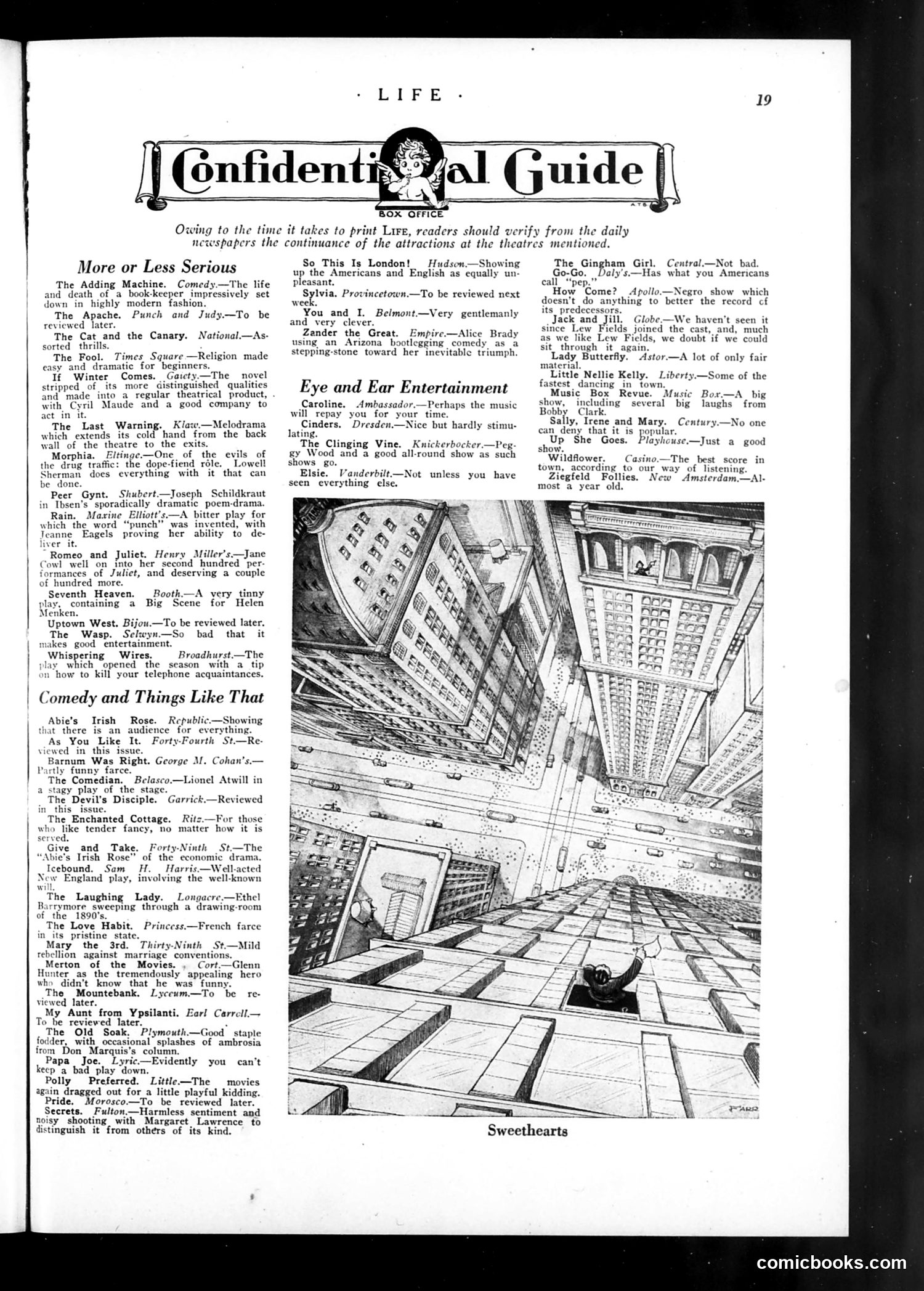
This page is a theater review column from *Life* magazine, likely from the early 1920s (based on play titles and venues). It's not a political cartoon but rather a satirical guide to current Broadway productions. The column offers terse, often dismissive reviews of dozens of shows organized by tone ("More or Less Serious," "Comedy and Things Like That," "Eye and Ear Entertainment"). The humor lies in the brevity and snark—reviews are reduced to single cutting sentences. For instance, *The Wasp* is "so bad that it makes good entertainment," and *Abie's Irish Rose* proves "there is an audience for everything" (implying indiscriminate taste). The accompanying illustration shows an aerial street view of Manhattan's theater district, establishing the page's focus on Broadway entertainment. This reflects *Life*'s identity as a sophisticated, urbane magazine mocking popular culture and theatrical trends to elite readers.
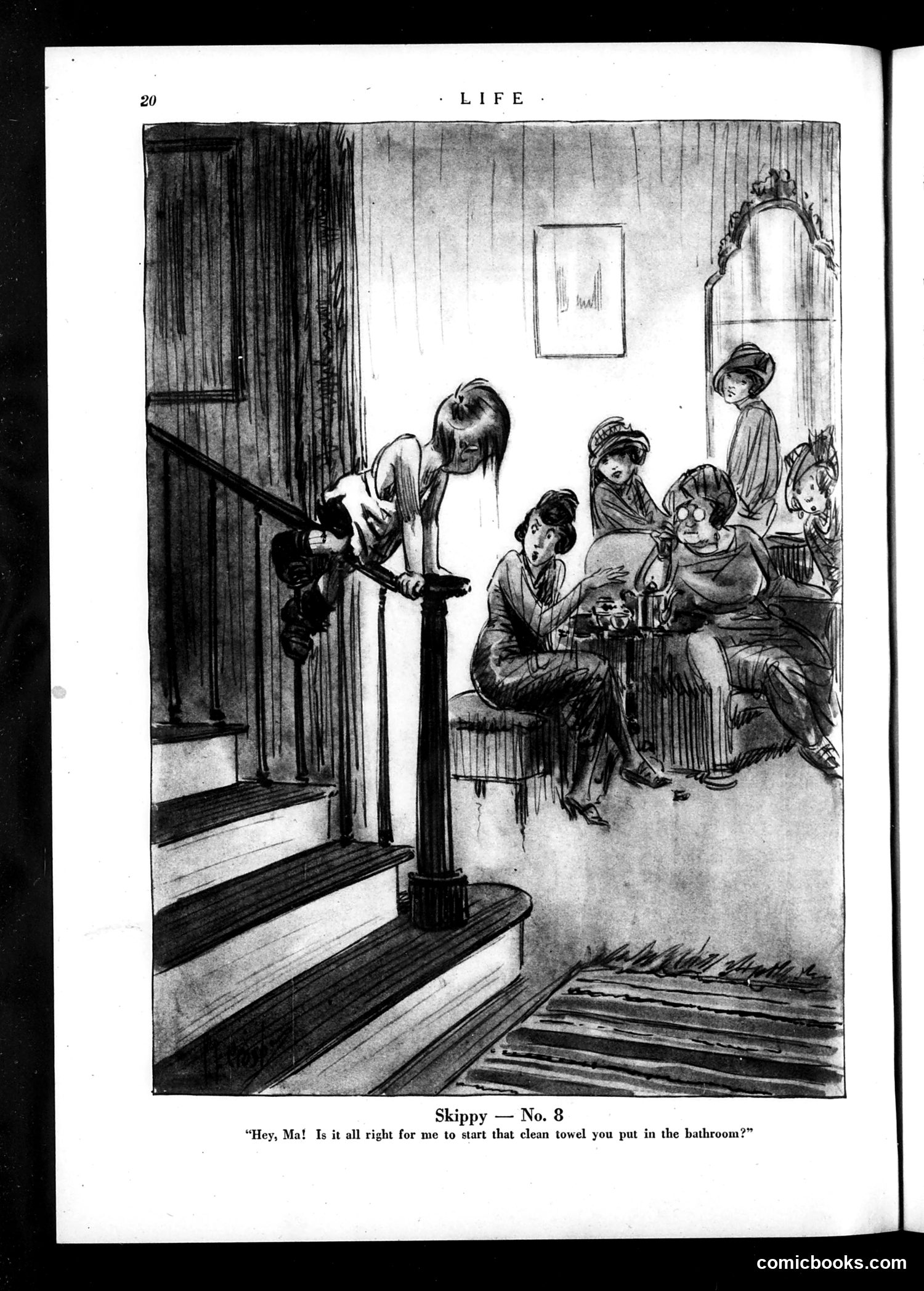
This is a humorous domestic scene from the "Skippy" comic strip. A young boy (Skippy) stands at a bathroom doorway asking his mother for permission to use a clean towel she's placed there. The joke relies on the contrast between the boy's politeness (asking permission) and the absurdity of the situation—he's seeking approval to use something his mother already provided *for* bathroom use. The humor comes from either: 1. The boy's excessive deference to household rules, or 2. An implication that using the towel might somehow ruin it, making his permission-seeking comically unnecessary This reflects early-20th-century domestic comedy, playing on parent-child dynamics and household routines familiar to contemporary readers.
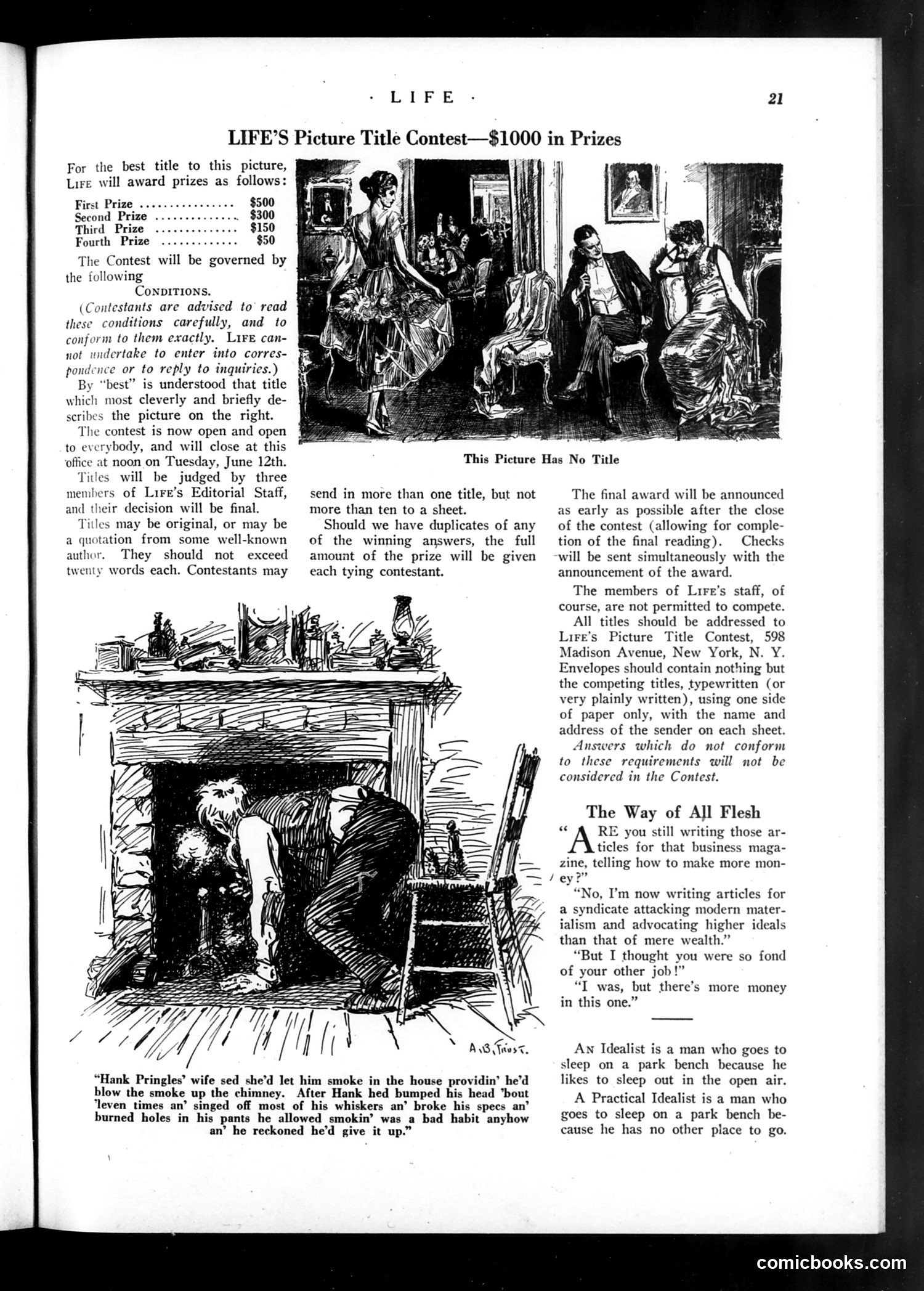
This page contains **LIFE's Picture Title Contest**, offering $1000 in prizes for readers to submit witty captions for an untitled illustration showing an elegant social gathering. The main image depicts what appears to be a formal interior scene with well-dressed figures—likely satirizing upper-class social pretension, though the specific social commentary isn't explicit from the image alone. Below is an unrelated cartoon about "Hank Pringles," a working-class character who attempts to smoke indoors by directing smoke up the chimney, repeatedly injuring himself until abandoning the habit. This appears to mock both stubborn male behavior and the inconvenience of smoking indoors. At bottom, a brief humor piece titled "The Way of All Flesh" satirizes hypocrisy: a man claims to have abandoned writing about making money to write about higher ideals—but admits the idealistic work pays better. The concluding definitions mock the difference between romantic idealism and harsh practical reality. The page emphasizes satire of human contradiction and social absurdity typical of early-20th-century American humor magazines.
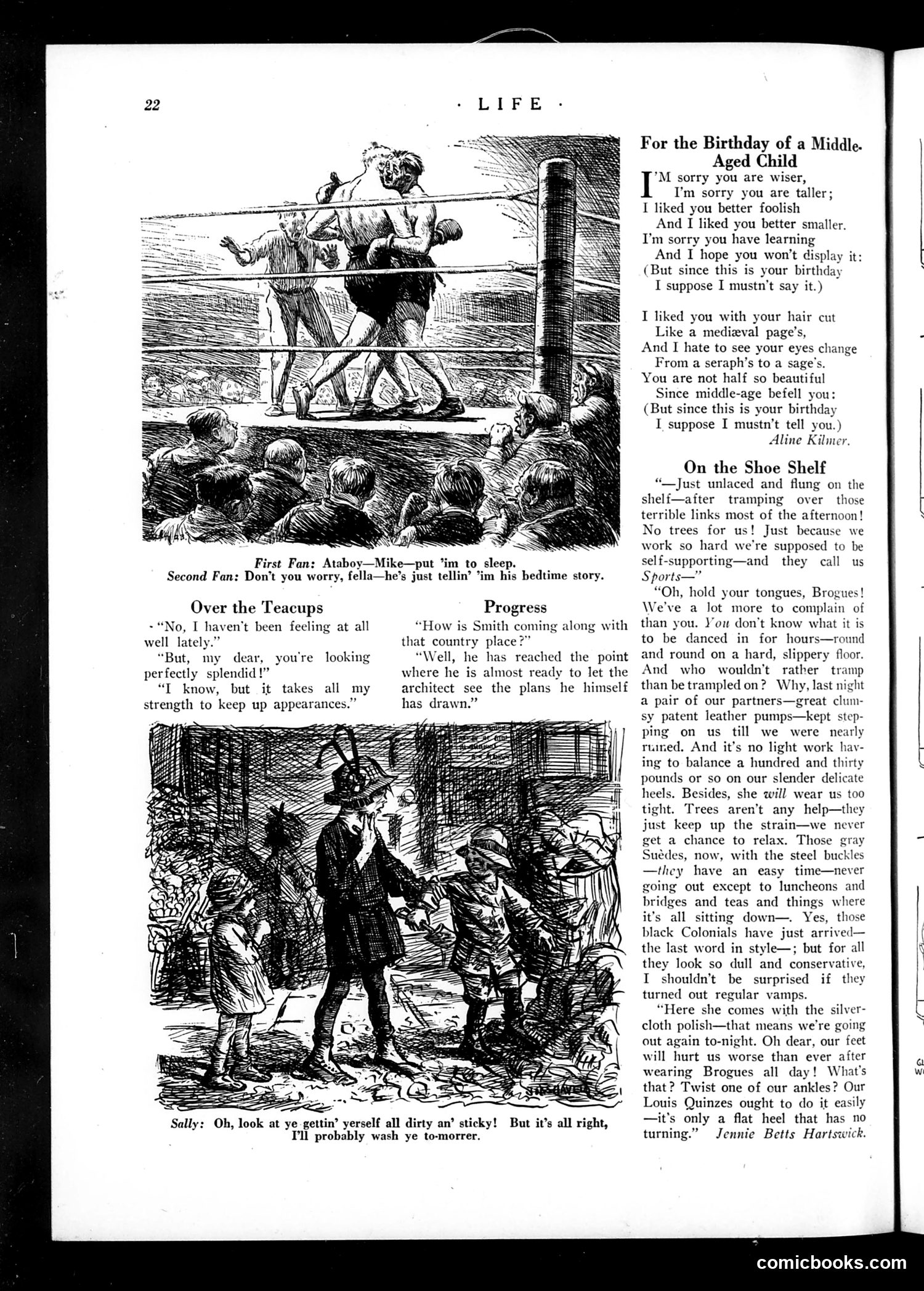
This page from *Life* magazine contains several humorous pieces satirizing early 20th-century American life: **"Over the Teacups"** sketches mock social pretense—a woman exhausted from maintaining appearances, and a man so indecisive about home construction he won't even show his architect the plans. **"First Fan/Second Fan"** depicts boxing spectators; the joke plays on "bedtime story" as a euphemism for a knockout punch putting someone to sleep. **"On the Shoe Shelf"** personifies shoes complaining about their lives. Golf shoes (Brogues) grumble about hard work; dancing shoes counter they suffer worse, balanced on heels for hours. It's gentle satire on class hierarchies—even among footwear, different "professions" claim superiority. The final mention of "vamps" (seductive women) suggests the newest colonial-style shoes might have hidden charms. **"For the Birthday of a Middle-Aged Child"** is sentimental verse by Aline Kilmer lamenting how a child has grown wiser, taller, and less beautiful—a bittersweet meditation on aging. The overall tone is lighthearted social commentary typical of *Life's* satirical humor.
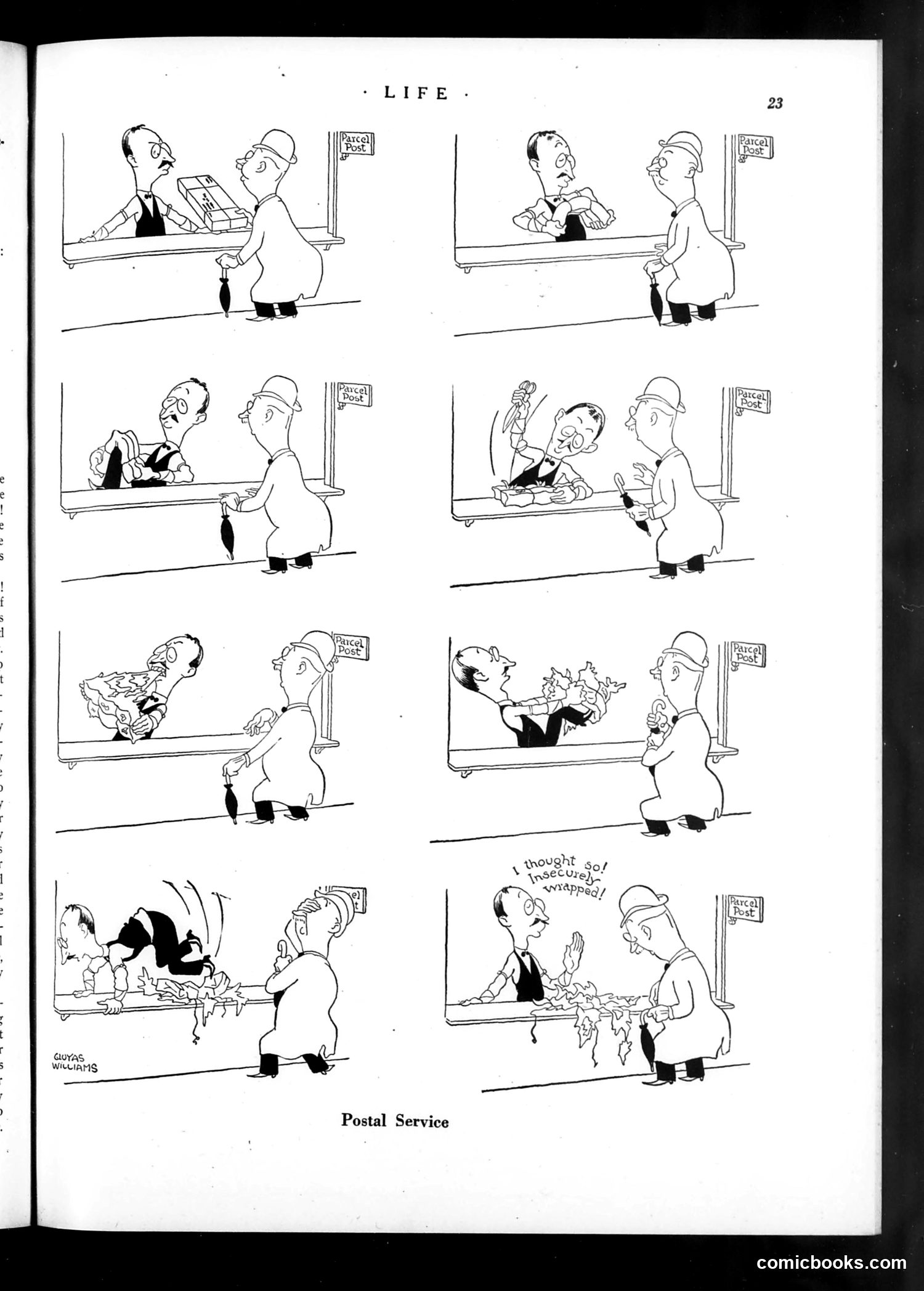
This is a seven-panel satirical comic by Gluyas Williams depicting a frustrating interaction at a post office window. A customer repeatedly approaches the clerk with various mail items, each time meeting dismissal or complications. The progression shows escalating absurdity: the clerk refuses packages, the customer's items multiply chaotically, and by the final panels, both participants appear overwhelmed and exasperated, with mail scattered everywhere. The satire targets bureaucratic inefficiency and the postal service's seemingly arbitrary rules and unhelpful staff. The comic's humor derives from the relatable experience of dealing with obstinate government workers who find reasons to deny service. This reflects common early-20th-century complaints about postal bureaucracy and poor customer service, capturing frustration many readers would have recognized from their own experiences.
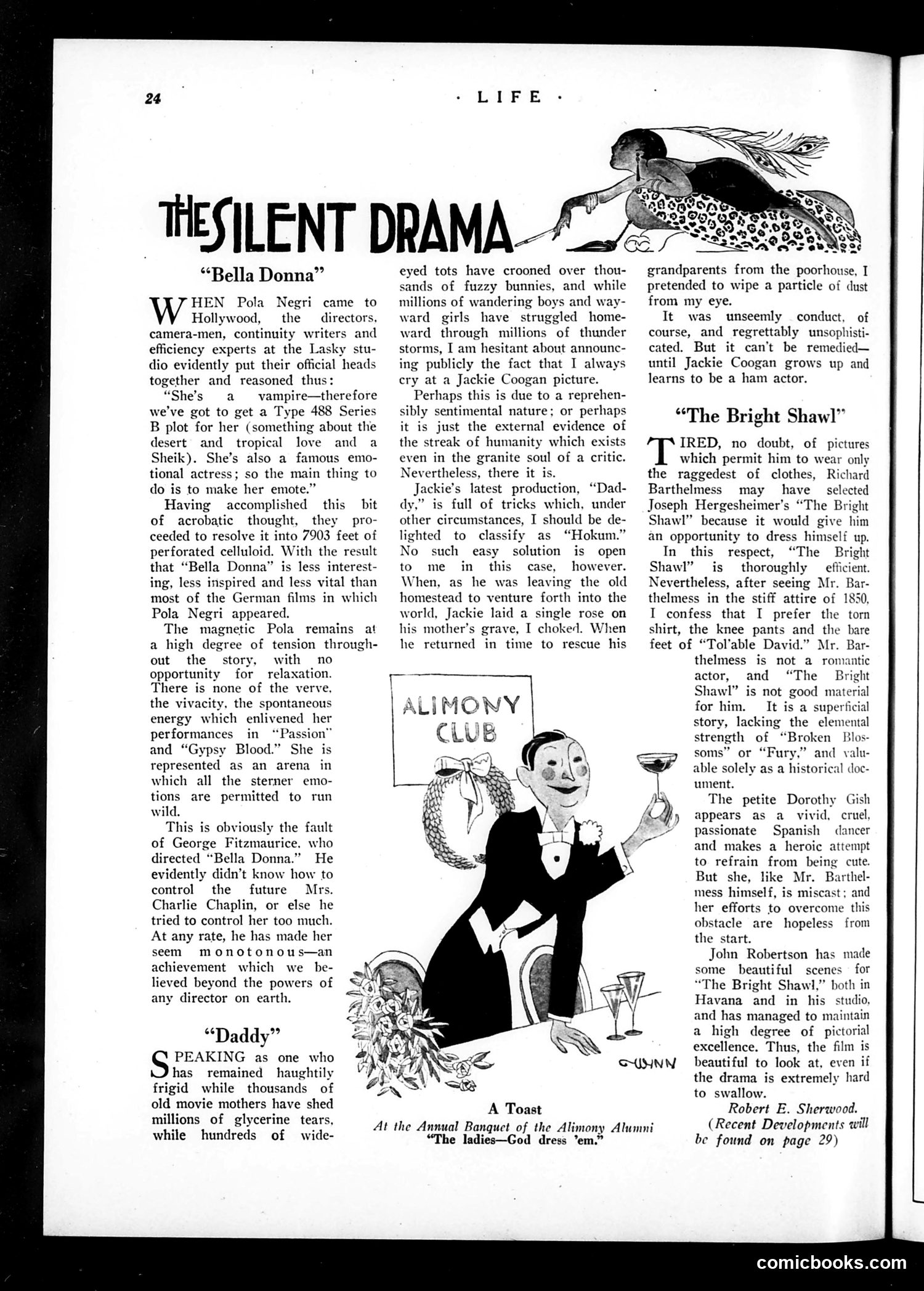
This page contains movie criticism from Life's silent film era. The main content critiques three Hollywood pictures: **"Bella Donna"** reviews Pola Negri's film, criticizing director George Fitzmaurice for over-controlling the actress and making her performance monotonous despite her talent. The reviewer suggests the studio forced a formulaic "vampire" plot on her. **"Daddy"** praises Jackie Coogan's child-actor abilities, admitting the critic cries at his sentimental scenes despite professional cynicism—a backhanded compliment about the film's emotional manipulation. **"The Bright Shawl"** critiques Richard Barthelmess in period costume, arguing his talents suit shabby roles better than romantic 1850s finery. The cartoon "Alimony Club" (unrelated to reviews) depicts a tuxedoed man toasting "The ladies—God dress 'em" at an alumni banquet, likely satirizing post-divorce financial obligations and wealthy men's social clubs.
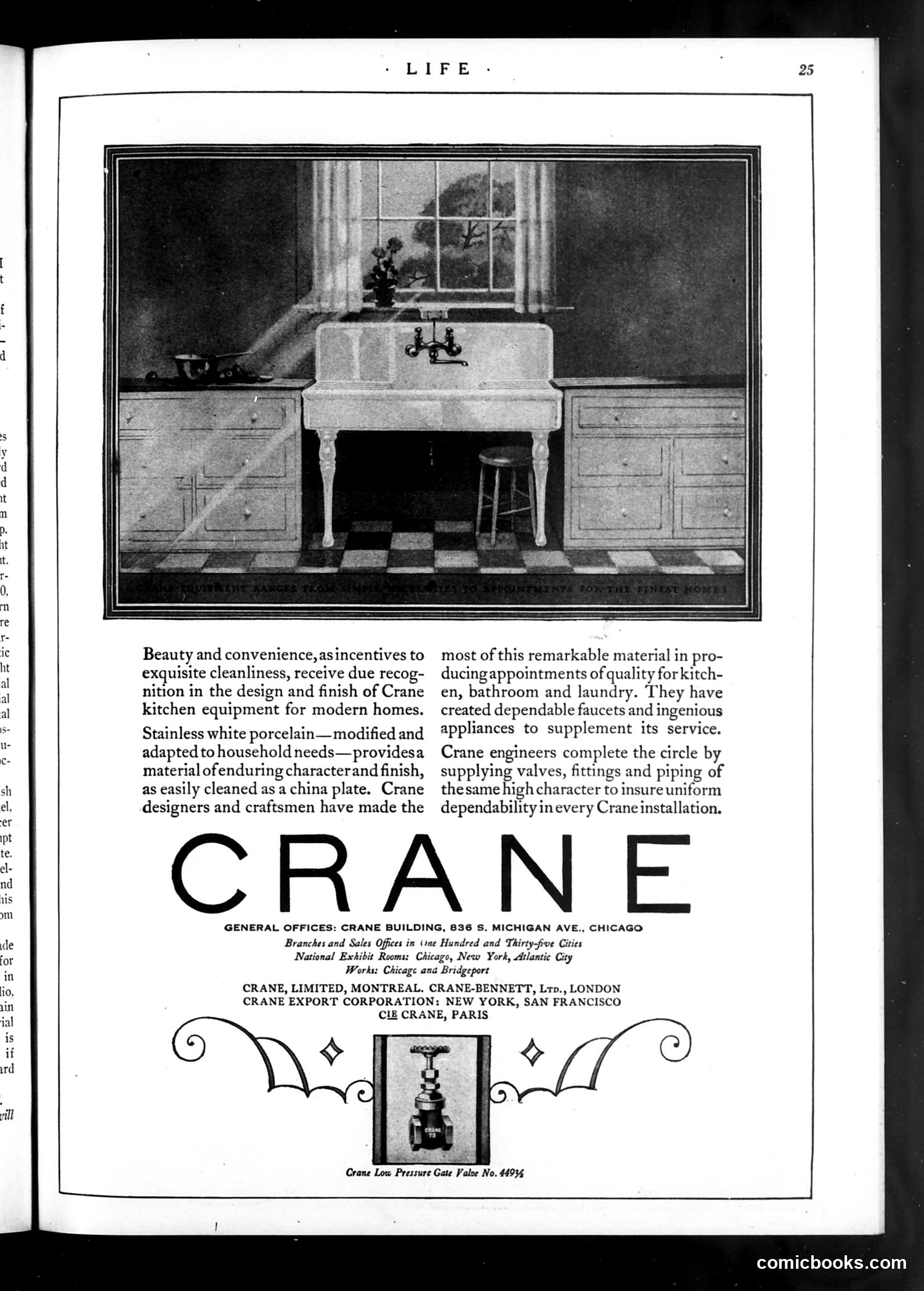
This page is a straightforward advertisement for Crane plumbing fixtures and kitchen equipment, not political satire or comedy. The image shows a modernist kitchen sink setup with cabinets and a window view, illustrating Crane's "stainless white porcelain" products designed for contemporary homes. The accompanying text emphasizes practical benefits: easy-to-clean surfaces, quality faucets, and reliable plumbing components. The decorative flourishes (the stylized valve illustration at bottom) and prominent company name suggest this was a prestige brand positioning itself as essential for modern household convenience. There is no cartoon, caricature, or satirical commentary present—this is simply a period advertisement from *Life* magazine showcasing industrial design and consumer goods for affluent homeowners.
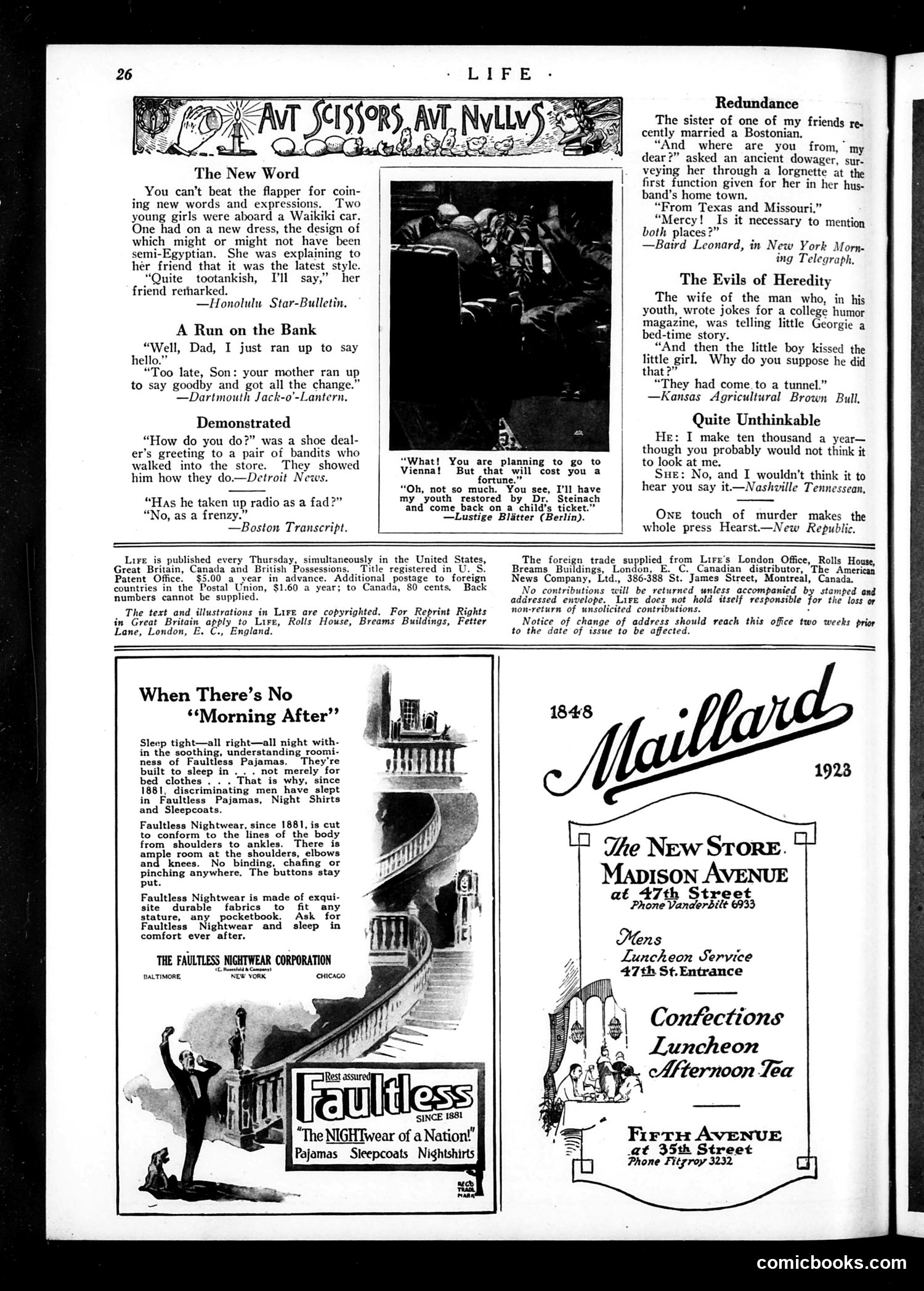
This page contains humorous anecdotes and jokes typical of Life's satirical format, plus advertisements. Key humor includes: **"The New Word"**: Mocks flapper slang—a young woman invents "tootankish" (Egyptian-style dress design, likely referencing King Tutankhamun's 1922 tomb discovery). The satire targets how flappers rapidly coined nonsensical neologisms. **"A Run on the Bank"**: A domestic joke where the wife has already spent all the money before the son asks his father for change—satirizing wives' spending habits. **"The Evils of Heredity"**: A child assumes a kissing scene in a bedtime story occurred in a tunnel (where couples supposedly kissed secretly), implying he inherited his father's humor-magazine sensibility. **"Redundance"**: Mocks Boston snobbery—a dowager finds it excessive/redundant to mention both Texas *and* Missouri as someone's origin. The page is primarily humor content with Mailliard department store and Faultless Pajama advertisements. No political cartoons appear—this is entertainment for affluent readers.
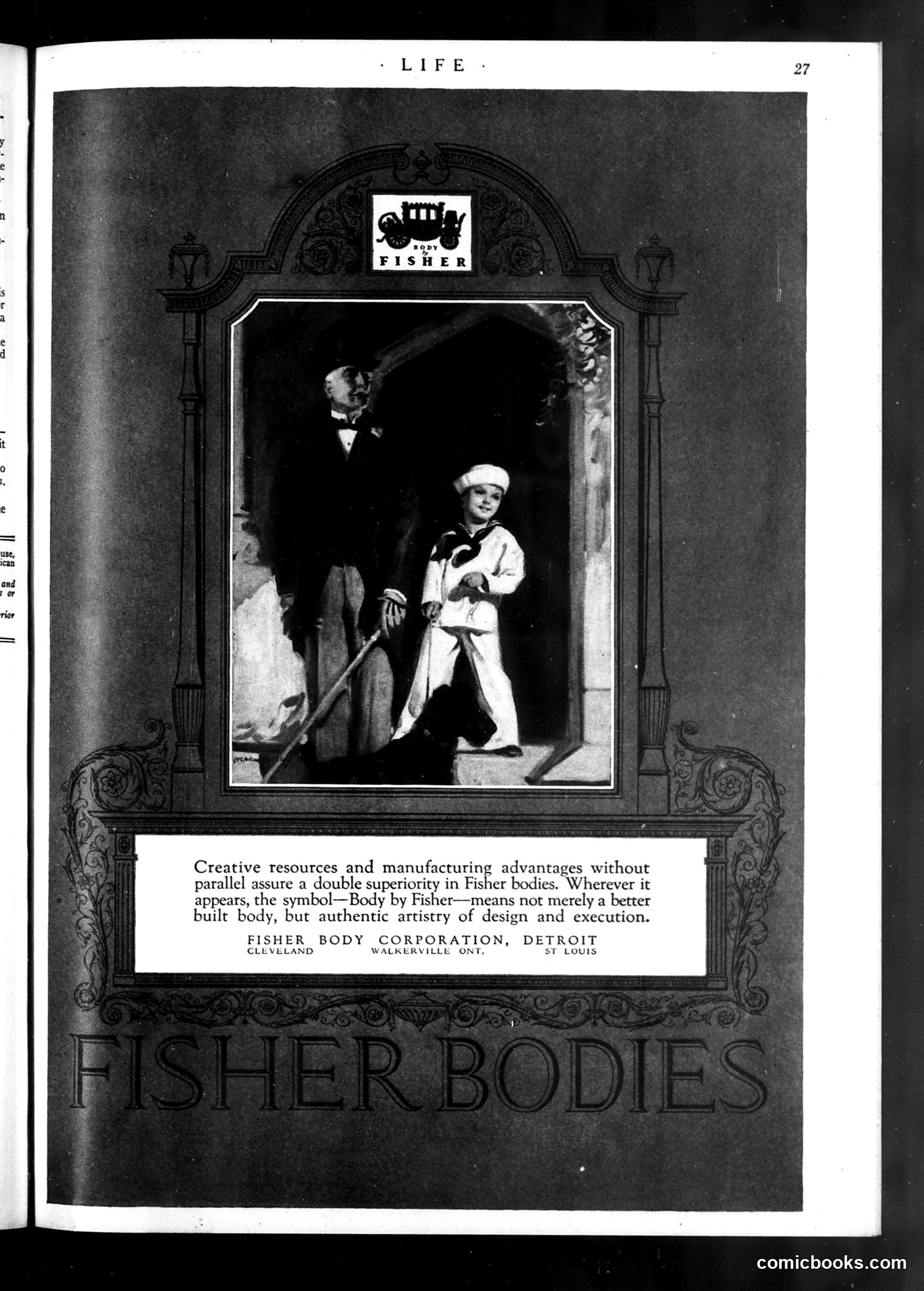
This is a **Fisher Body Corporation advertisement**, not political satire. It appears on page 27 of *Life* magazine and promotes automobile bodies manufactured by Fisher Body. The image shows an elegantly dressed man and a young boy in period costume (appearing to be from a theatrical or historical scene), framed in an ornate decorative border. The text emphasizes that Fisher bodies represent superior manufacturing and artistic design. The "symbol—Body by Fisher" was a prestigious automotive branding claim of the era. By associating their product with refined aesthetics and craftsmanship (suggested by the theatrical, cultured imagery), Fisher Body marketed themselves as producing quality automobile bodies, not merely functional vehicle parts. This was standard early-twentieth-century advertising strategy: linking consumer products to sophistication and artistic merit.
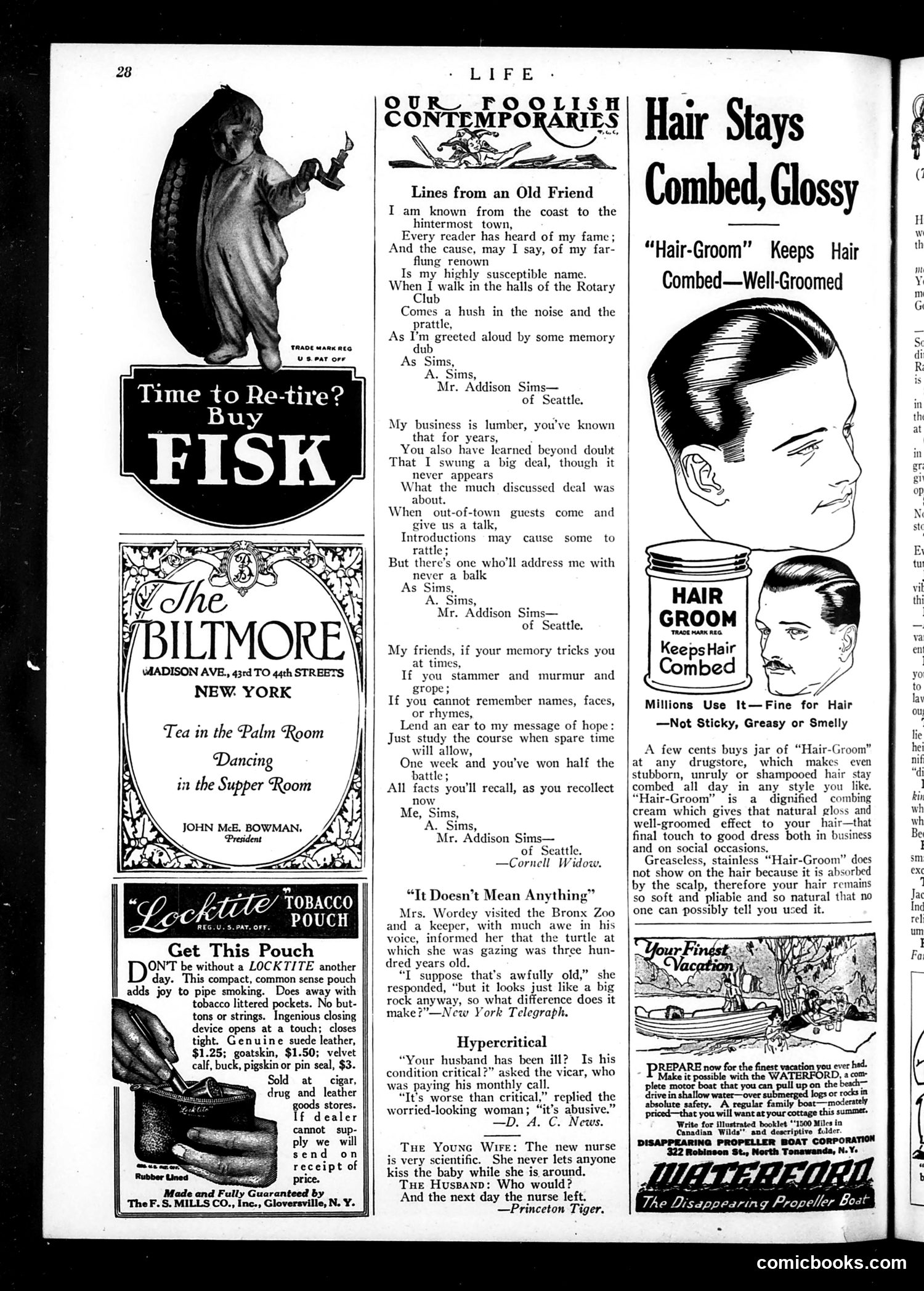
This page is primarily **advertisements and humor columns**, not political satire. The content includes: **"Our Foolish Contemporaries"** section: Reprints humorous pieces from other publications, including a poem about Mr. Addison Sims from Seattle, whose memorable name causes people to address him formally. The jokes mock everyday social awkwardness—forgettable people, memory lapses, and mistaken assumptions (a woman dismissing a 300-year-old turtle as "just a big rock"). **Advertisements**: The Biltmore Hotel, Locktite tobacco pouches, and Hair-Groom hair product dominate the page. These ads reflect 1920s-era grooming standards and leisure culture. The humor is gentle, domestic satire about middle-class life—memory tricks, social introductions, and personal appearance—rather than political commentary. It reflects the magazine's focus on satirizing contemporary manners and absurdities.
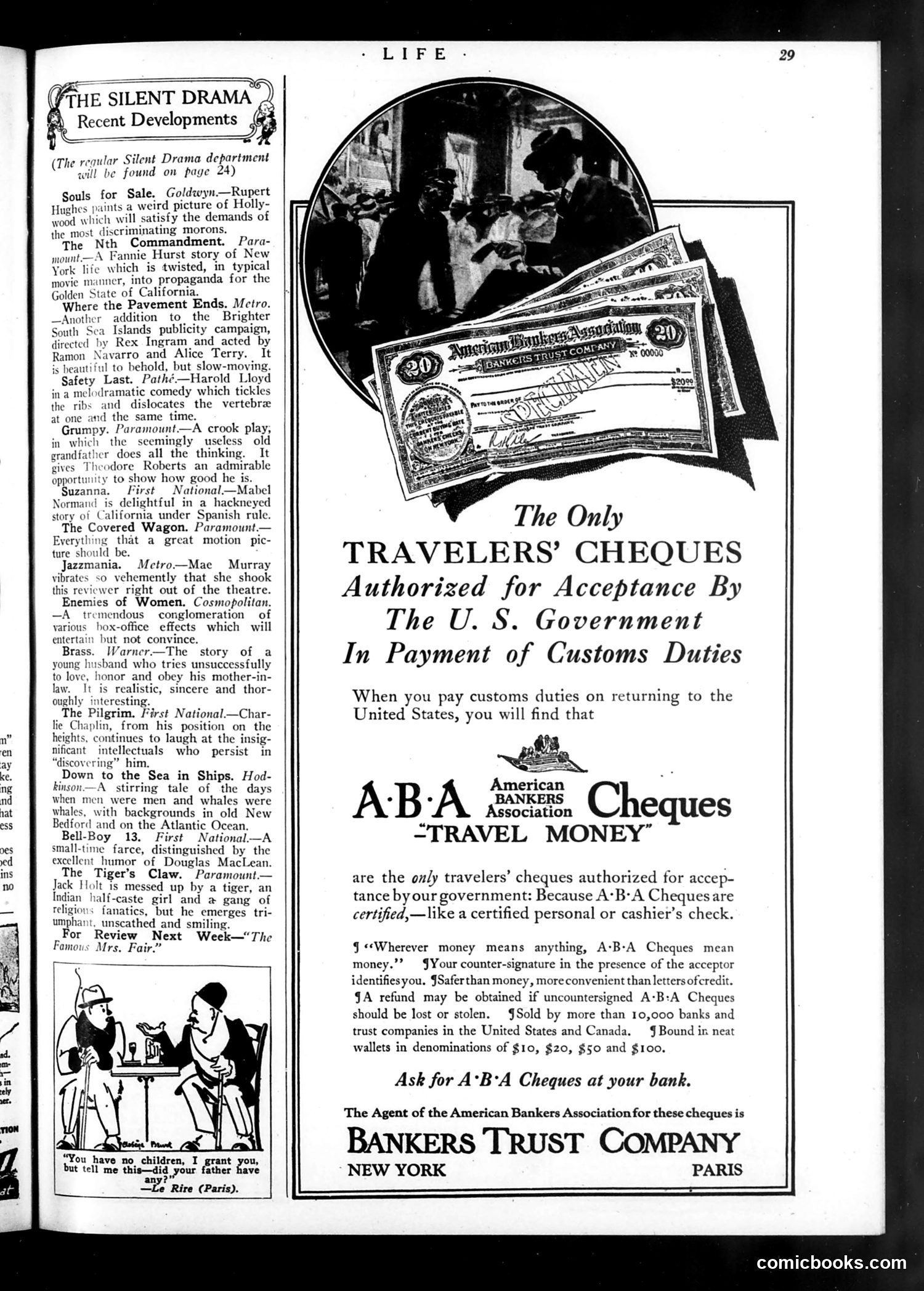
This page combines a film review column with a full-page advertisement. The left side features "The Silent Drama: Recent Developments," reviewing current movies including Harold Lloyd and Charlie Chaplin productions—typical 1920s cinema coverage. The right side is dominated by an ABA Travelers' Cheques advertisement. The small cartoon below the reviews shows two men at a table; one asks the other if his father had children, a nonsensical joke playing on faulty logic (a common format in *Life*'s humor section). The advertisement emphasizes that ABA cheques are "the only" travelers' cheques authorized by the U.S. Government for paying customs duties—a selling point for Americans traveling internationally during the 1920s, when such financial instruments were less standardized. The ad stresses safety, convenience, and government certification to build consumer confidence in this relatively new financial product.
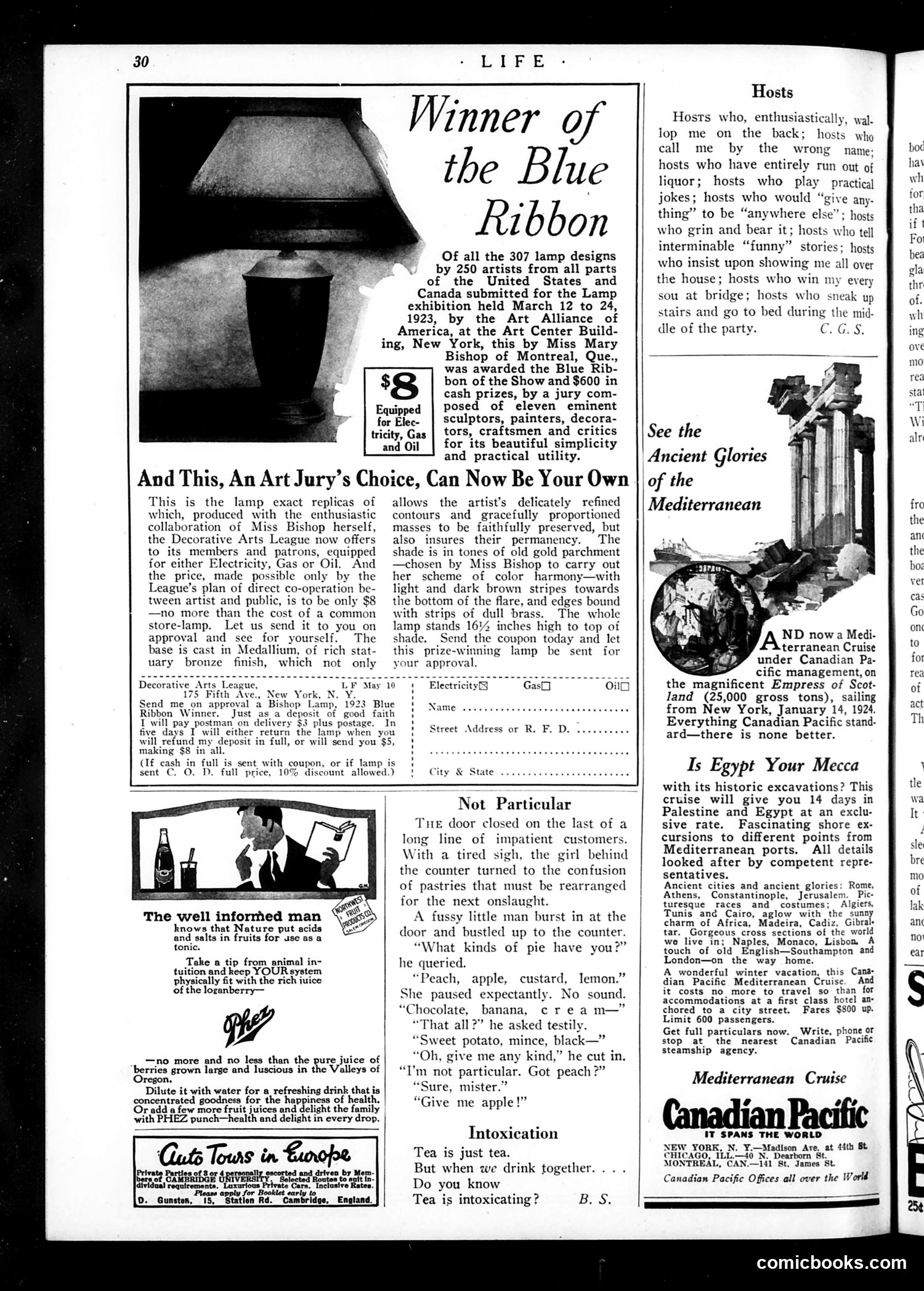
This page contains **three distinct pieces**: 1. **"Winner of the Blue Ribbon"** (top): An advertisement for a decorative lamp designed by Montreal artist Miss Mary Bishop that won a 1923 art competition. It sold for $8—affordable democratization of award-winning design. 2. **"Not Particular"** (middle): A humorous short story about an indecisive customer who demands specific pie flavors but then requests something entirely different when given options—satirizing inconsistent consumer behavior. 3. **"Intoxication"** (bottom): A brief joke suggesting tea becomes "intoxicating" when drunk socially with others—likely wordplay on Prohibition-era sensitivity about intoxicating beverages, since plain tea is non-alcoholic. The page is primarily **commercial advertising and light entertainment** typical of 1920s *Life* magazine content, mixing product promotion with humorous fiction and wordplay. No significant political satire is present.
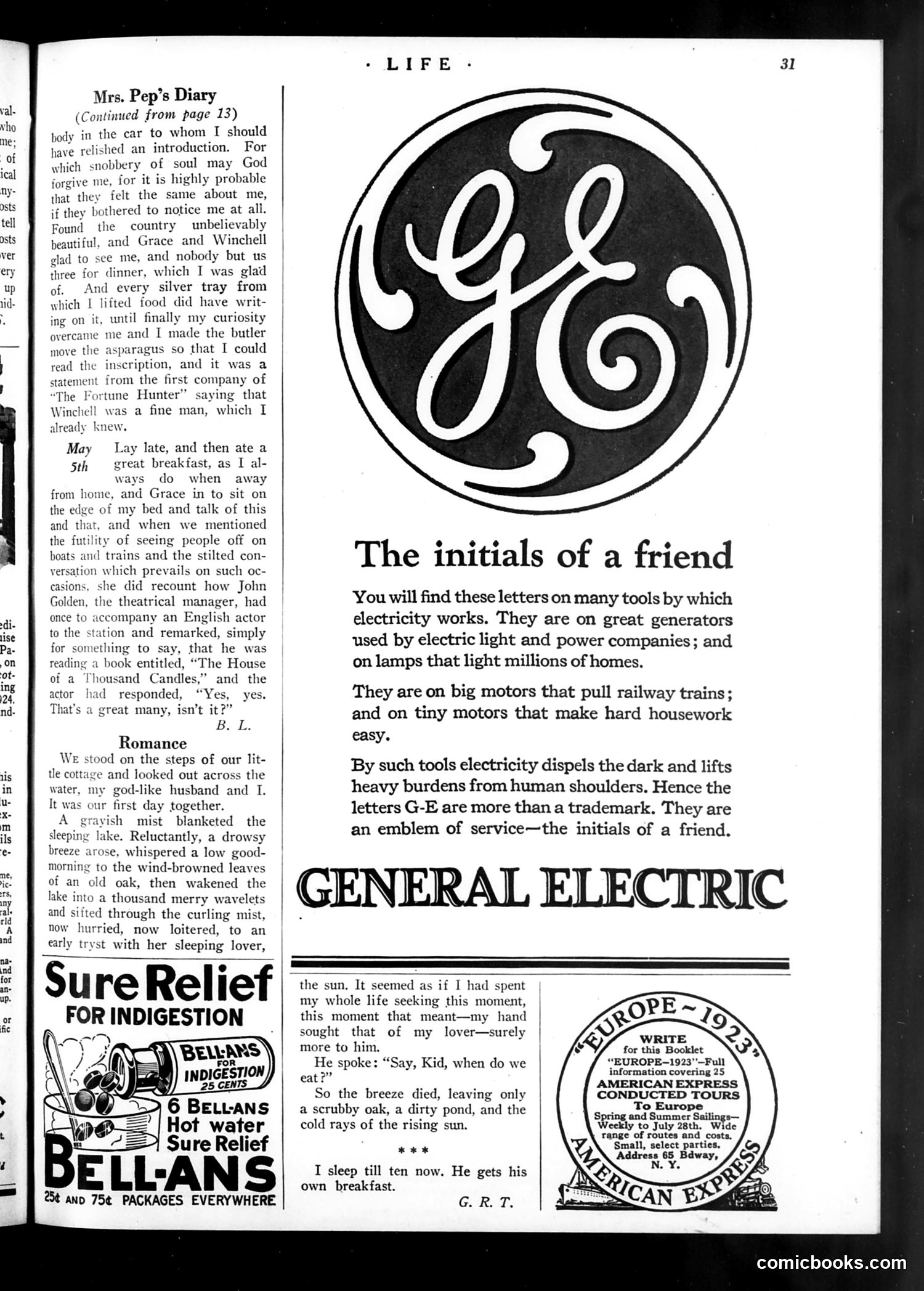
This page mixes personal diary entries with advertisements. The diary sections—"Mrs. Pep's Diary," "Romance," and a closing untitled piece—appear to be satirical commentary on marriage and romance. The "Romance" section mocks romantic idealization: a couple shares a poetic moment by a lake until the husband breaks the mood with a crude "when do we eat?"—deflating literary sentimentality with harsh reality. The final entry's punchline ("I sleep till ten now. He gets his own breakfast") continues this theme of post-marital disillusionment. The page's dominant feature is a **General Electric advertisement** showcasing the company's "G-E" monogram as "the initials of a friend"—positioning electricity as a servant to humanity, powering generators, trains, and household appliances. Below sits a **Bellans indigestion remedy ad** and an **American Express travel promotion** for European tours.
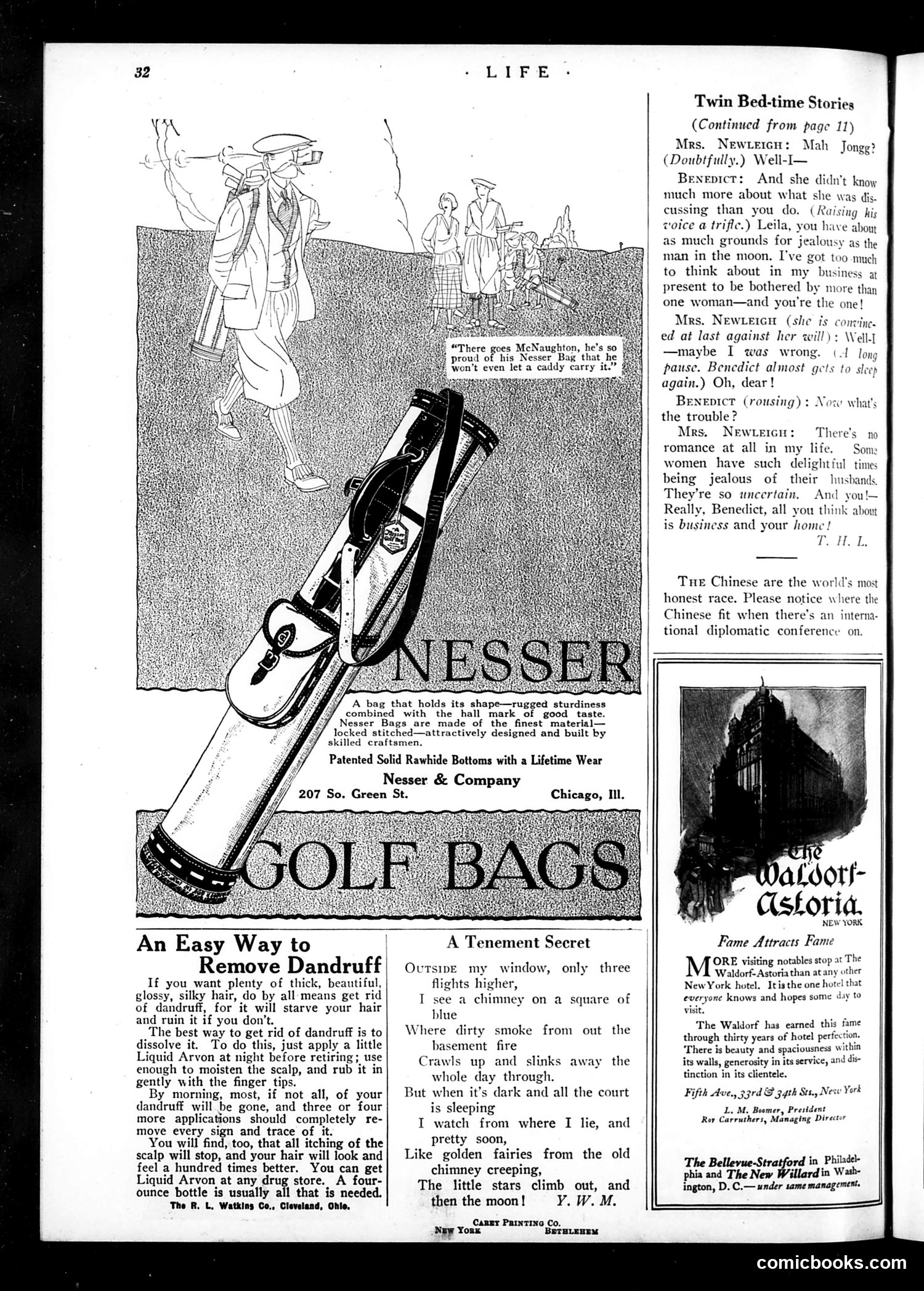
This page contains three distinct sections: **Main Cartoon/Advertisement**: A satirical illustration mocking a man named McNaughton who is so proud of his Nesser Brand golf bag that he won't even lend it out. The joke plays on excessive brand loyalty and materialism—the bag becomes more important than generosity or friendship. **Poetry Section** ("A Tenement Secret"): A sentimental poem contrasting urban poverty with natural beauty. A tenement dweller watches stars and the moon from their window, finding magic amid industrial smoke and basement fires. It's sentiment rather than satire. **Dialogue Story** ("Twin Bed-time Stories"): A marital comedy where a wife (Leila) expresses jealousy about her husband Benedict's attention to business. He dismisses her concerns, suggesting other women find jealousy exciting—a commentary on gender roles and marriage dynamics of the era. **Side Content**: Advertisements for hair treatment, hotel accommodations, and a comment about Chinese honesty at diplomatic conferences (appearing to reference international relations of the period). The page is primarily advertising-driven content with light satirical humor.
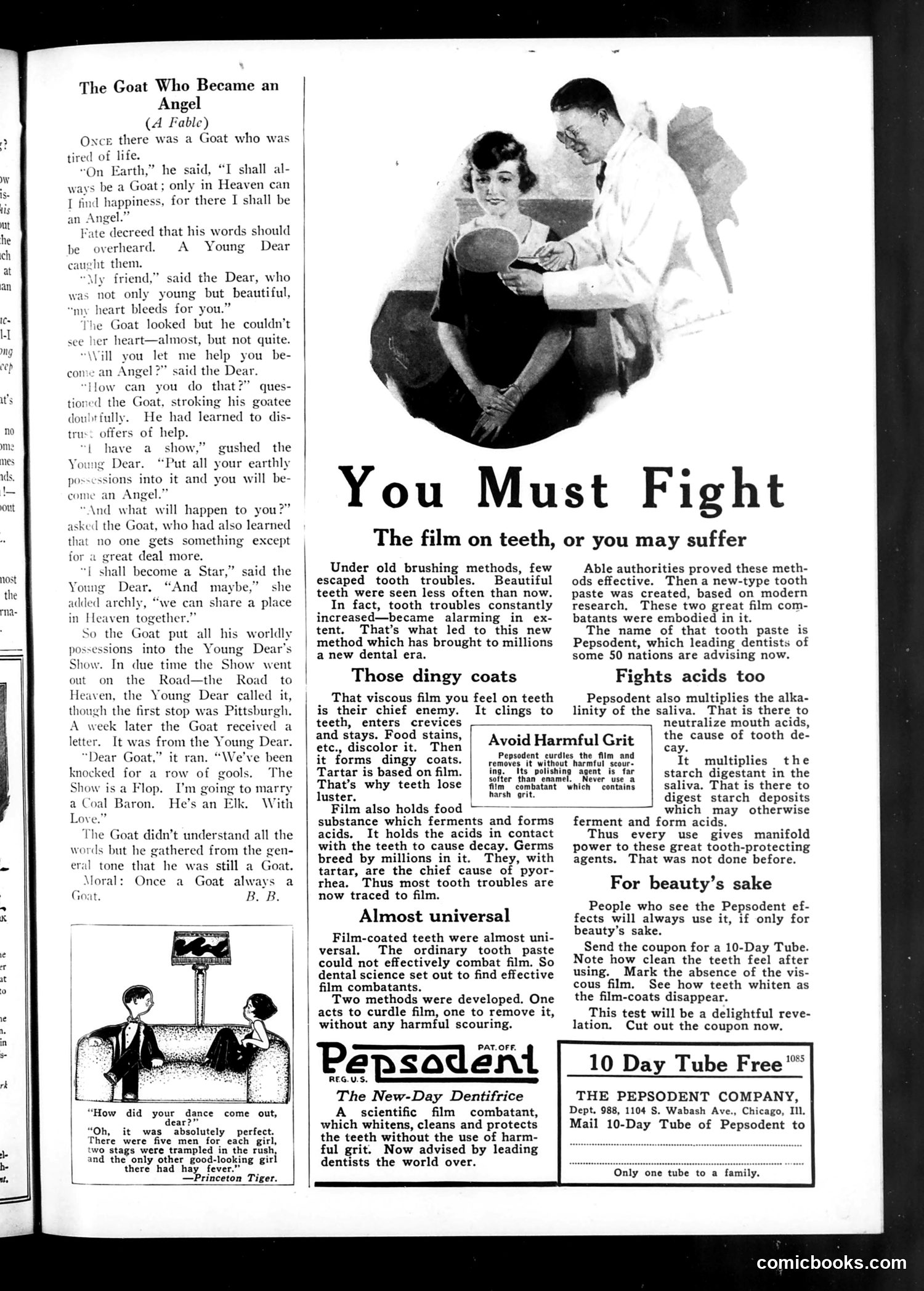
This page contains a satirical fable and a toothpaste advertisement. **"The Goat Who Became an Angel"** is a cautionary tale about financial exploitation. A naive goat, seeking spiritual improvement, invests all his earthly possessions in a theatrical show proposed by a beautiful young deer, who promises they'll both achieve success and share heaven together. The show flops after touring (notably stopping in Pittsburgh before "heaven"). The deer abandons the goat to marry a wealthy coal baron, leaving the goat unchanged—still just a goat. The moral warns that fundamental nature cannot be altered by wishful thinking or trusting con artists. The satire likely comments on theatrical investment schemes or stock market fraud common in the 1920s, where smooth-talking promoters convinced gullible investors to finance doomed ventures. The rest of the page is a Pepsodent toothpaste advertisement emphasizing scientific tooth-film removal methods—unrelated to the fable but typical of Life magazine's revenue model mixing editorial content with advertising.
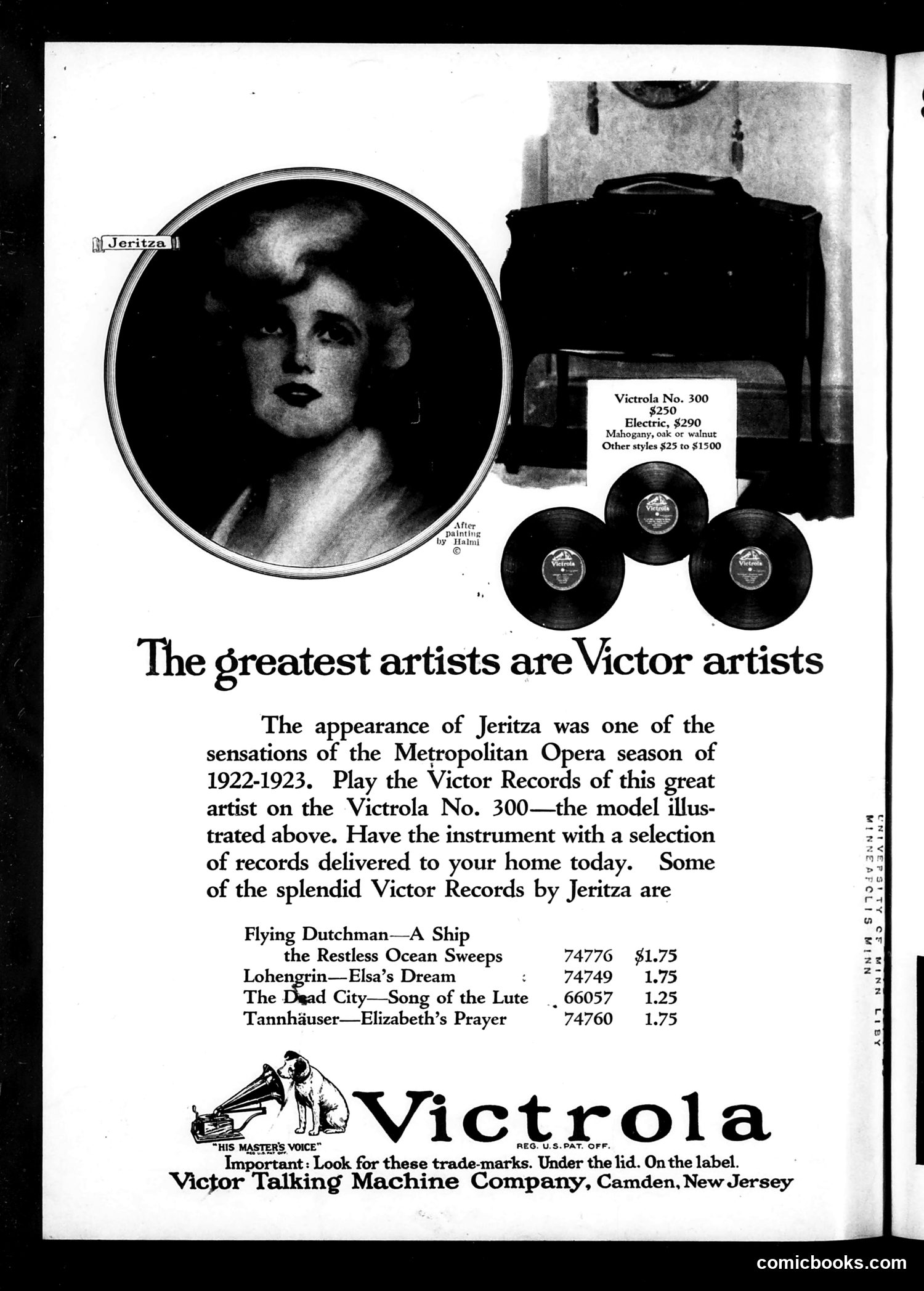
This is primarily a **product advertisement**, not political satire or comics. It promotes the Victrola No. 300 phonograph by leveraging the fame of opera singer Maria Jeritza, who was indeed a Metropolitan Opera sensation during the 1922-1923 season. The advertisement's strategy was to associate the phonograph with high culture and prestige—Jeritza's operatic recordings (listed from Wagner operas like *Flying Dutchman* and *Lohengrin*) served as premium content to justify the machine's cost ($250-$290, substantial money in 1923). The circular portrait and listing of her recordings functioned as celebrity endorsement. For modern readers, the significance is that phonograph companies marketed devices through classical music recordings and famous performers, positioning record players as aspirational luxury goods for cultured middle-class homes. This represents early 20th-century consumer marketing before radio dominance.