
Life, 1923-05-10 · page 21 of 36
Life — May 10, 1923 — page 21: what you’re looking at
What you’re looking at
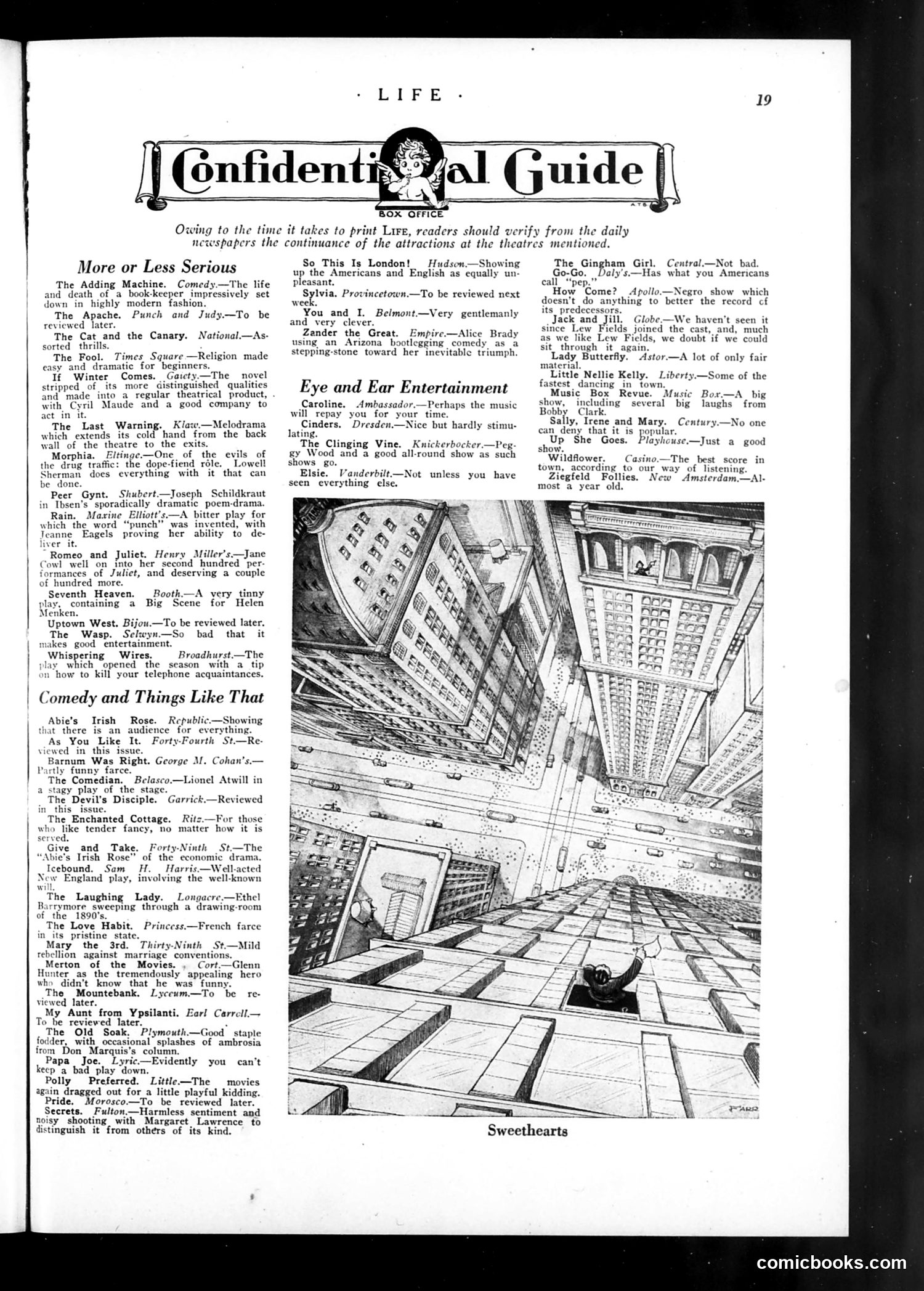
This page is a theater review column from *Life* magazine, likely from the early 1920s (based on play titles and venues). It's not a political cartoon but rather a satirical guide to current Broadway productions. The column offers terse, often dismissive reviews of dozens of shows organized by tone ("More or Less Serious," "Comedy and Things Like That," "Eye and Ear Entertainment"). The humor lies in the brevity and snark—reviews are reduced to single cutting sentences. For instance, *The Wasp* is "so bad that it makes good entertainment," and *Abie's Irish Rose* proves "there is an audience for everything" (implying indiscriminate taste). The accompanying illustration shows an aerial street view of Manhattan's theater district, establishing the page's focus on Broadway entertainment. This reflects *Life*'s identity as a sophisticated, urbane magazine mocking popular culture and theatrical trends to elite readers.
📄 Transcribed text from this page (OCR, searchable)
Machine-transcribed from the original scan — historical spelling and the odd misread are preserved.
More or Less Serious The Adding Machine. Comedy—The life and death of a book-keeper impressively set down in highly modern fashion. The Apache. Punch and Judy—To be reviewed later. The Cat and the Canary. sorted thrills. The Fool. Times Square —Religion made easy and dramatic for beginners, If Winter Comes. Gaicty.—The stripped. of its more distinguished qua and made into a regular theatrical product, with, Cyril Maude and a good company to act in it. Klowe-—_Meloa The Last Warning. Klaw.—Melodrama which extends its cold hand from the back wall of the theatre to the exits. Morphia. Fitinge.—One, of the evils of the drug traffic: the dope-fiend réle. Lowell Sherman does everything with it that can be done. Peer Gynt. Shubert—Joseph Schildkraut in Tbsen’s sporadically dramatic poem-drama. Rain. Maxine Elliott's—A bitter play for which the word “punch” was invented, with Jeanne Eagels proving her ability to de- liver it. Romeo and Juliet. Henry Miller’s—Jane Cowl well on into her second hundred ‘per- formances of Juliet, and deserving a couple of hundred more. Seventh Heaven. play, containing a Big Scene for Menken. Uptown West. Bijou.—To be reviewed later. The Wasp. Selwyn—So bad that it kes good entertainment. Whispering Wires. Broadhurst—The lay which sopened the season. with a. tip how to kill your telephone acquaintances. Comedy and Things Like That Abie's Irish Rose. Republic —Showing that there is an audience for everything. As You Like It. Forty-Fourth St—Re- viewed in this issue. Barnum Was Right. George M. Cohan’s.— Partly funny farce. The Comedian. Bela tagy play of the st The Di isci The Enchanted Cottage. National.—As- Booth.—A very tinny Helen will in —Lionel A Reviewed ‘or those who like tender fancy, no matter how it is served. Give and Take. St.—The “Abie’s Irish Rose” drama. Icebound. Sam H. — Harris.—Well-acted New England play, involving the well-known will, The Laughing Lady. Longacre. Barrymore sweeping through a drawing-room of the 1890's. The Love Habit. Princess.—French farce in its pristine state. Mary the 3rd. Thirty S rebellion against marriage conventions. Merton of the Movies. , Cort.—Glenn Hunter as the tremendously ’ appealing hero who didn’t know that he was funny. The Mountebank. Lyccum.—To be re- viewed later. My Aunt from Ypsilanti. Ear! Carrcll— To be reviewed later. ; _ The Old Soak, Plymouth—Good staple fodder, with occasional’ splashes of ambrosia Don_ Marquis’s column. Papa Joe. Evidently you can’t keep a bad play dow Polly Preferred. Little—The movies again dragged out for a little playful kidding. Pride. Morosco.—To be reviewed later. Secrets. Fulton.—Harmless sentiment and noisy shooting with Margaret Lawrence to distinguish it from others of its kind. wing to the time it takes to print Lire, readers should verify from the daily newspapers the continuance of the attractions at the theatres mentioned. So This Is London! Hudson.—Showing up the Americans and English as equally un pleasant. Sylvia. Provincetown.—To be reviewed next week. You and I. and very clever. Zander the Great. using an Arizona bootlegging comedy. as, stepping-stone toward her inevitable triumph. Belmont.—Very gentlemanly Eye and Ear Entertainment Caroline. Ambassador.—Perhaps the music will repay you for your time. Cinders. “Dresden.—Nice but hardly stimu- lating. The Clinging Vine. Knickerbocker.—Peg- gy Wood and a good all-round show as such shows go. Elsie. Vanderbilt, seen everything cls Not unless you have Ml Sweethearts The Gingham Girl. Central.—Not bad. Go-Go. Daly’s.—Has what you Americans call “pep.” How Come? Apollo.—Negro show which doesn't do anything to better the record cf its predecessors. Jack and Ji Globe-—We haven't seen it since Lew Fields joined the cast, and, much as we like Lew Fields, we doubt if we could sit, through it agai Lady Butterfly. material. . Little Nellie Kelly. Liberty.—Some of the fastest dancing in town. Astor.—A lot of only fair Music Box Revue. Music Box—A_ big show, including several big laughs from Bobby Clark. Sally, Irene and Mary. Century.—No one that it is he Goes. show. Wildflower. — Casino. town, according to our Ziegfeld Follies. New most a year old. opular. Playhouse. Just a good The best score in y of listening. Amsterdam.—A\- comicbooks.com