
Life, 1923-05-10 · page 20 of 36
Life — May 10, 1923 — page 20: what you’re looking at
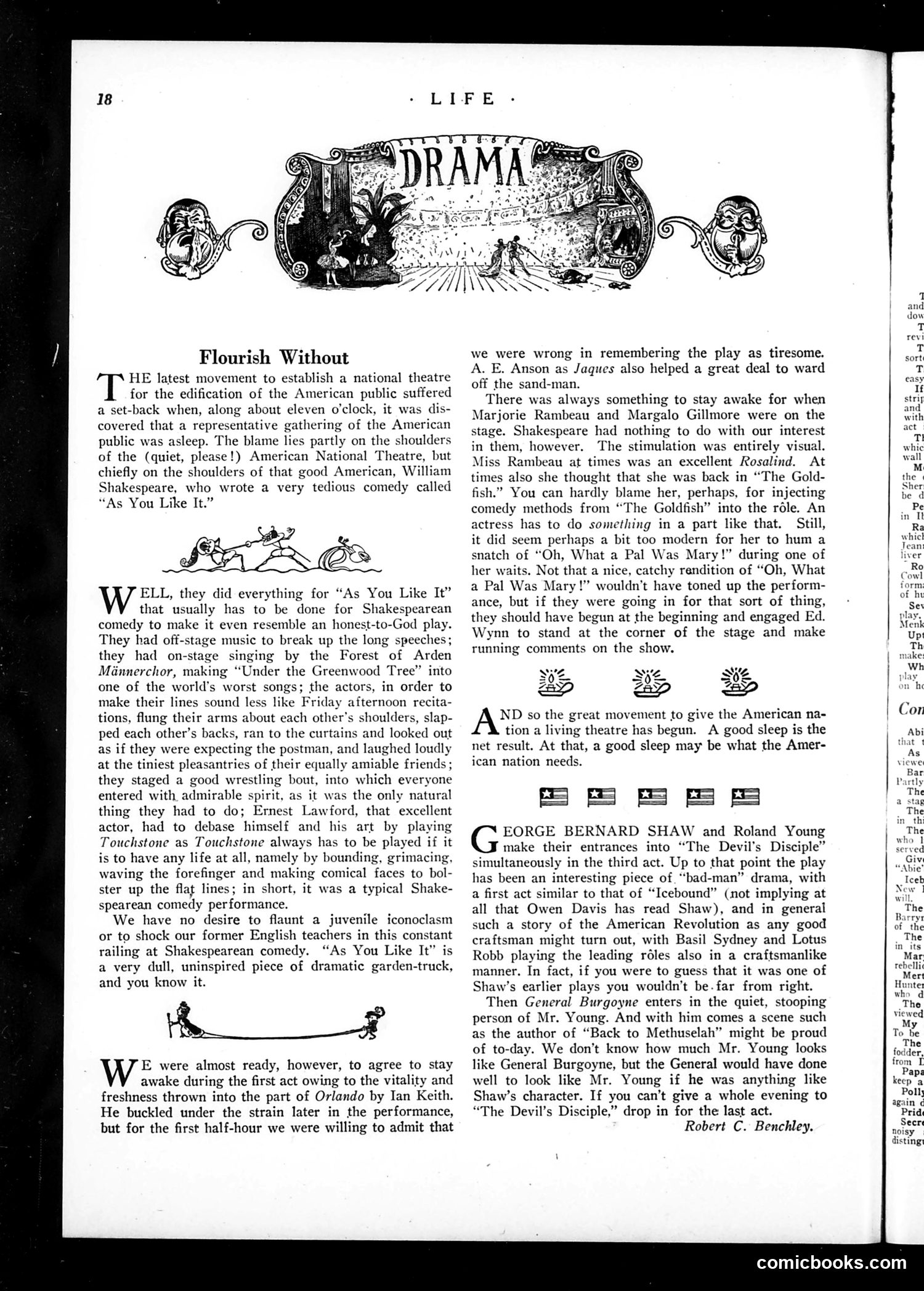
What you’re looking at
This is a theater review mocking a production of Shakespeare's "As You Like It" by the American National Theatre movement—an initiative to establish quality theater for the American public. The satire's central joke: the audience fell asleep during this supposedly "edifying" performance. The critic argues Shakespeare's comedy is inherently tedious ("a very dull, uninspired piece of dramatic garden-truck"). The production added slapstick, singing, and physical comedy to compensate—actors slapped backs, did wrestling stunts, and grimaced excessively. Yet nothing could save the play. The only elements that kept viewers awake were attractive performers (Marjorie Rambeau, Margalo Gillmore) and Ian Keith's charisma—not Shakespeare's writing. The critic notes Rambeau even hummed "Oh, What a Pal Was Mary!" (a contemporary popular song) during her stage waits. The conclusion is biting: America's grand cultural movement succeeded only in providing insomniacs a good nap—perhaps the nation actually *needs* sleep more than serious theater.
📄 Transcribed text from this page (OCR, searchable)
Machine-transcribed from the original scan — historical spelling and the odd misread are preserved.
Flourish Without HE latest movement to establish a national theatre for the edification of the American public suffered a set-back when, along about eleven o'clock, it was dis- covered that a representative gathering of the American public was asleep. The blame lies partly on the shoulders of the (quiet, please!) American National Theatre, but chiefly on the shoulders of that good American, William Shakespeare, who wrote a very tedious comedy called “As You Like It.” ELL, they did everything for “As You Like It” that usually has to be done for Shakespearean comedy to make it even resemble an honest-to-God play. They had off-stage music to break up the long speeches; they had on-stage singing by the Forest of Arden Mannerchor, making “Under the Greenwood Tree” into one of the world’s worst songs; the actors, in order to make their lines sound less like Friday afternoon recita- tions, flung their arms about each other's shoulders, slap- ped each other’s backs, ran to the curtains and looked out as if they were expecting the postman, and laughed loudly at the tiniest pleasantries of their equally amiable friends ; they staged a good wrestling bout, into which everyone entered with admirable spirit, as it was the only natural thing they had to do; Ernest Lawford, that excellent actor, had to debase himself and his art by playing Touchstone as Touchstone always has to be played if it is to have any life at all, namely by bounding, grimacing, waving the forefinger and making comical faces to bol- ster up the flat lines; in short, it was a typical Shake- spearean comedy performance. We have no desire to flaunt a juvenile iconoclasm or to shock our former English teachers in this constant railing at Shakespearean comedy. “As You Like It” is a very dull, uninspired piece of dramatic garden-truck, and you know it. ——— E were almost ready, however, to agree to stay awake during the first act owing to the vitality and freshness thrown into the part of Orlando by Ian Keith. He buckled under the strain later in the performance, but for the first half-hour we were willing to admit that we were wrong in remembering the play as tiresome. A. E. Anson as Jaques also helped a great deal to ward off the sand-man. There was always something to stay awake for when Marjorie Rambeau and Margalo Gillmore were on the stage. Shakespeare had nothing to do with our interest in them, however. The stimulation was entirely visual. Miss Rambeau at times was an excellent Rosalind. At times also she thought that she was back in “The Gold- fish.” You can hardly blame her, perhaps, for injecting comedy methods from “The Goldfish” into the réle. An actress has to do something in a part like that. Still, it did seem perhaps a bit too modern for her to hum a snatch of “Oh, What a Pal Was Mary!” during one of her waits. Not that a nice, catchy rendition of “Oh, What a Pal Was Mary!” wouldn’t have toned up the perform- ance, but if they were going in for that sort of thing, they should have begun at the beginning and engaged Ed. Wynn to stand at the corner of the stage and make running comments on the show. Nie WE We a eg ND so the great movement to give the American na- tion a living theatre has begun. A good sleep is the net result. At that, a good sleep may be what the Amer- ican nation needs. = PS EORGE BERNARD SHAW and Roland Young make their entrances into “The Devil's Disciple” simultaneously in the third act. Up to that point the play has been an interesting piece of. “bad-man” drama, with a first act similar to that of “Icebound” (not implying at all that Owen Davis has read Shaw), and in general such a story of the American Revolution as any good craftsman might turn out, with Basil Sydney and Lotus Robb playing the leading réles also in a craftsmanlike manner. In fact, if you were to guess that it was one of Shaw’s earlier plays you wouldn’t be.far from right. Then General Burgoyne enters in the quiet, stooping person of Mr. Young. And with him comes a scene such as the author of “Back to Methuselah” might be proud of to-day. We don’t know how much Mr. Young looks like General Burgoyne, but the General would have done well to look like Mr. Young if he was anything like Shaw’s character. If you can’t give a whole evening to “The Devil’s Disciple,” drop in for the last act. Robert C. Benchley. 1 and dow T revi T sort T easy If strip and with act TI whic wall M the « noisy disting comicbooks.com