
Life, 1923-05-10 · page 26 of 36
Life — May 10, 1923 — page 26: what you’re looking at
What you’re looking at
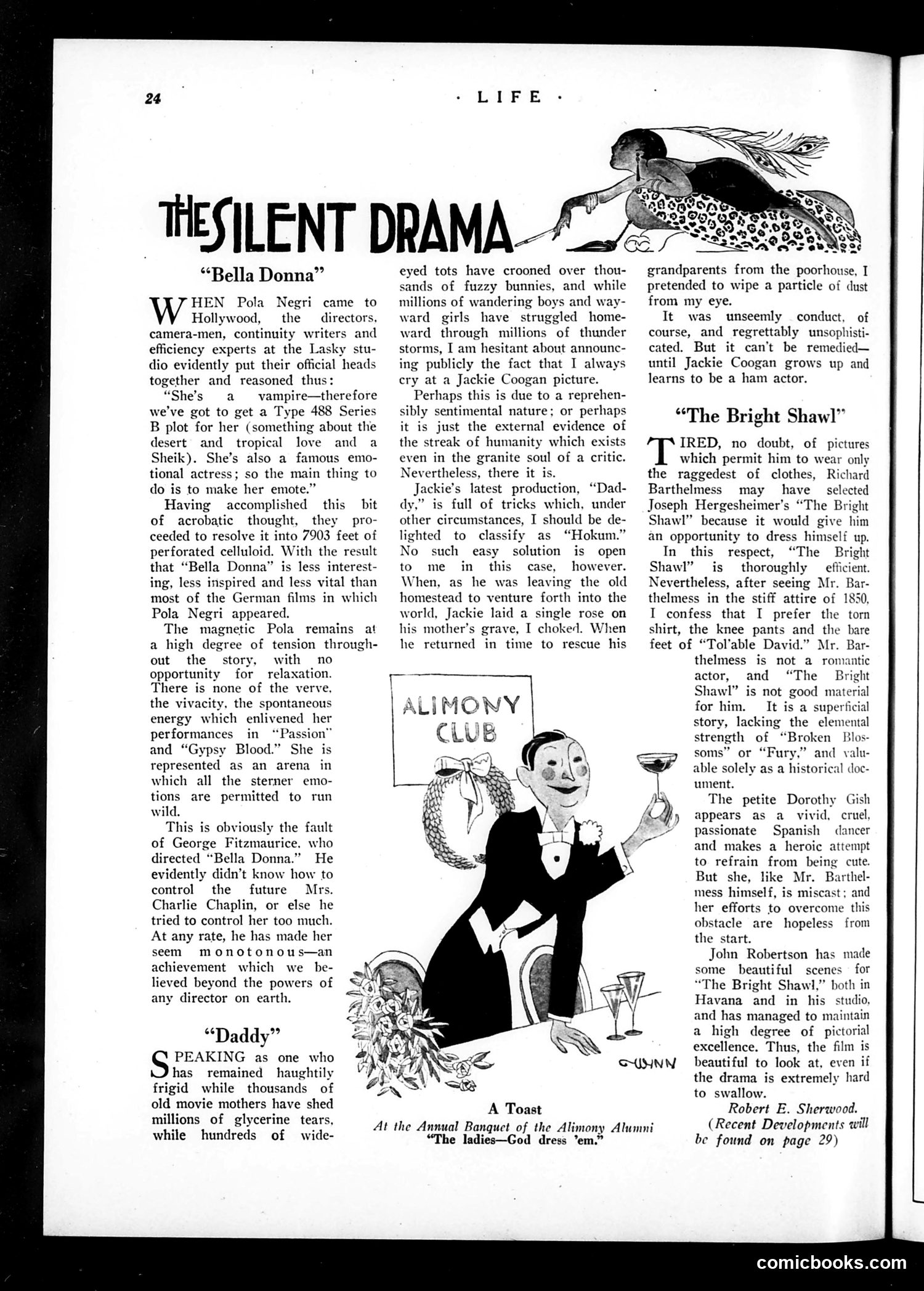
This page contains movie criticism from Life's silent film era. The main content critiques three Hollywood pictures: **"Bella Donna"** reviews Pola Negri's film, criticizing director George Fitzmaurice for over-controlling the actress and making her performance monotonous despite her talent. The reviewer suggests the studio forced a formulaic "vampire" plot on her. **"Daddy"** praises Jackie Coogan's child-actor abilities, admitting the critic cries at his sentimental scenes despite professional cynicism—a backhanded compliment about the film's emotional manipulation. **"The Bright Shawl"** critiques Richard Barthelmess in period costume, arguing his talents suit shabby roles better than romantic 1850s finery. The cartoon "Alimony Club" (unrelated to reviews) depicts a tuxedoed man toasting "The ladies—God dress 'em" at an alumni banquet, likely satirizing post-divorce financial obligations and wealthy men's social clubs.
📄 Transcribed text from this page (OCR, searchable)
Machine-transcribed from the original scan — historical spelling and the odd misread are preserved.
“Bella Donna” HEN Pola Negri came to Hollywood, the directors, camera-men, continuity writers and efficiency experts at the Lask dio evidently put their official heads together and reasoned thus: “She’s a vampire—therefore we've got to get a Type 488 Series B plot for her (something about the desert and tropical love and a Sheik). She’s also a famous emo- tional actress; so the main thing to do is to make her emote.” Having accomplished this bit of acrobatic thought, they pro- ceeded to resolve it into 7903 feet of perforated celluloid. With the result that “Bella Donna” is less interest- ing, less inspired and less vital than most of the German films in which Pola Negri appeared. The magnetic Pola remains at a high degree of tension through- out the story, with no opportunity for relaxation. There is none of the verve, the vivacity, the spontaneous energy which enlivened her performances in “Passion” and “Gypsy Blood.” She is represented as an arena in which all the sterner emo- tions are permitted to run wild. This is obviously the fault of George Fitzmaurice. who directed “Bella Donna.” He evidently didn’t know how to control the future Mrs. Charlie Chaplin, or else he tried to control her too much. At any rate, he has made her seem monotonous—an achievement which we be- lieved beyond the powers of any director on earth. “Daddy” PEAKING as one who has remained haughtily frigid while thousands of old movie mothers have shed millions of glycerine tears, while hundreds of wide- eyed tots have crooned over thou- sands of fuzzy bunnies, and while millions of wandering boys and way- ward girls have struggled home- ward through millions of thunder storms, I am hesitant about announc- ing publicly the fact that I always cry at a Jackie Coogan picture. Perhaps this is due to a reprehen- sibly sentimental nature; or perhaps it just the external evidence of the streak of humanity which ex even in the granite soul of a critic. Nevertheless, there it is. Jackie’s latest production, ‘“Dad- dy,” is full of tricks which, under other circumstances, I should be de- lighted to classify as “Hokum.” No such easy solution is open to me in this case, however. When, as he was leaving the old homestead to venture forth into the world, Jackie laid a single rose on his mother’s grave, I choked. When he returned in time to rescue his ALIMONY A Toast At the Annual Banquet of the Alimony Alumni “The ladies—God dress ’em.” grandparents from the poorhouse, I pretended to wipe a particle of dust from my eye. It was unseemly conduct, of course, and regrettably unsophisti- cated. But it can’t be remedied— until Jackie Coogan grows up and learns to be a ham actor. “The Bright Shawl” IRED, no doubt, of pictures which permit him to wear only the raggedest of clothes, Richard Barthelmess may have selected Joseph Hergesheimer’s “The Bright Shawl” because it would give him an opportunity to dress himself up. In this respect, “The Bright Shawl” is thoroughly _ efficient. Nevertheless, after seeing Mr. Bar- thelmess in the stiff attire of 1850, I confess that I prefer the torn shirt, the knee pants and the bare feet of “Tol’able David.” Mr. Bar- thelmess is not a romantic actor, and “The Bright Shawl” is not good material for him. It is a superficial story, lacking the elemental strength of “Broken Blos- soms” or “Fury,” and yalu- able solely as a historical doc- ument. The petite Dorothy Gish appears as a_ vivid, cruel, passionate Spanish dancer and makes a heroic attempt to refrain from being cute. But she, like Mr. Barthel- mess himself, is miscast; and her efforts to overcome this obstacle are hopeless from the start. John Robertson has made some beautiful scenes for “The Bright Shawl,” both in Havana and in his studio, and has managed to maintain a high degree of pictorial excellence. Thus, the film is beautiful to look at, even if the drama is extremely hard to swallow. Robert E. Sherwood. (Recent Developments will be found on page 29) comicbooks.com