
Life, 1923-05-10 · page 16 of 36
Life — May 10, 1923 — page 16: what you’re looking at
What you’re looking at
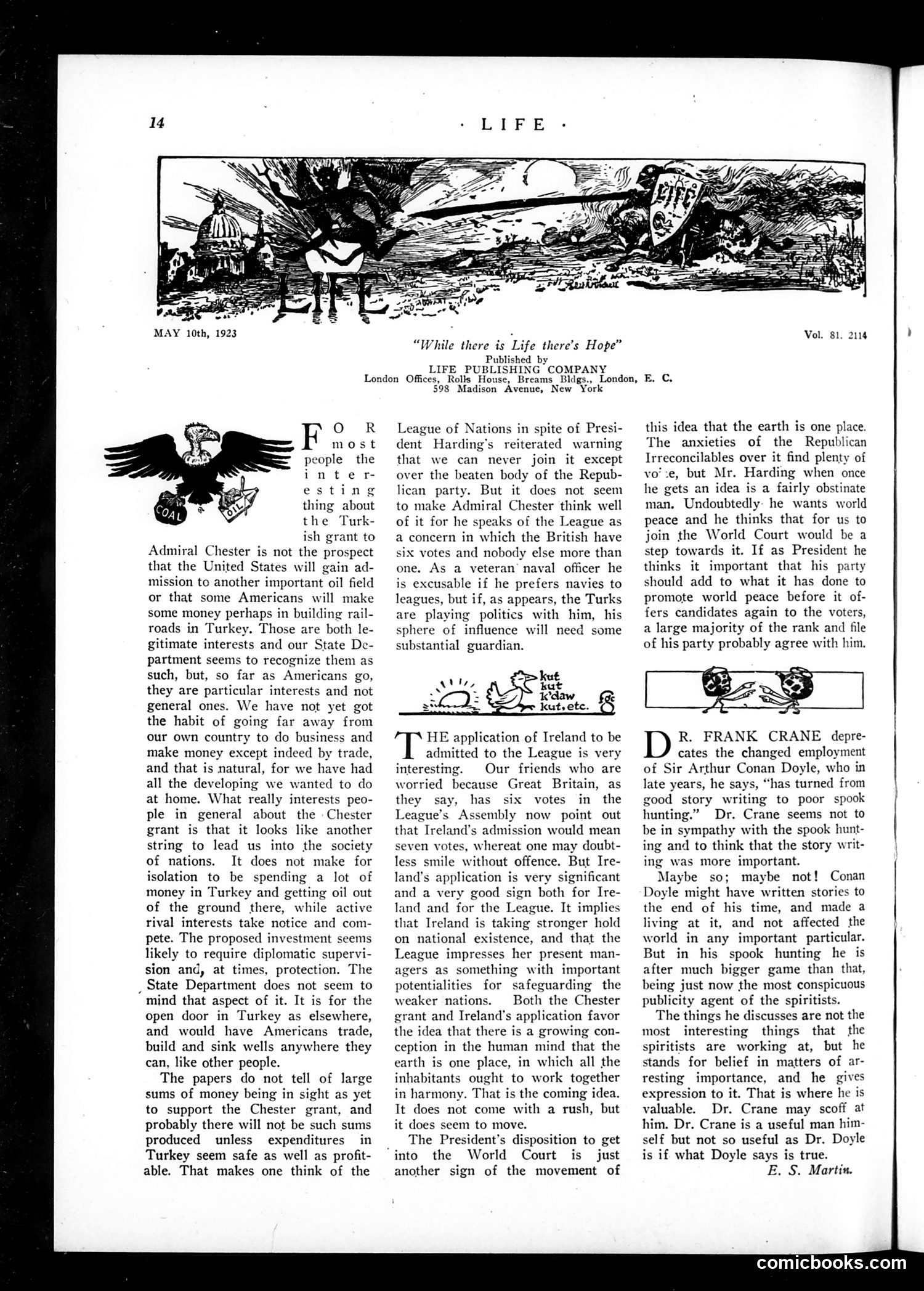
This page contains political commentary on American foreign policy. The main article criticizes Admiral Chester (likely Admiral Chester Nimitz or another naval figure of the era) for supporting U.S. involvement in League of Nations affairs and World Court participation—positions the author views as excessive foreign entanglement. The text debates whether American interests in Turkey and the Middle East justify diplomatic involvement. A secondary piece by E.S. Martin critiques writer Sir Arthur Conan Doyle's shift away from fiction to spiritualism and "spook hunting," expressing skepticism about his pivot to paranormal topics. The decorative header cartoon appears to be the magazine's masthead. Small comic vignettes appear embedded in the text, typical of Life's satirical format from this era.
📄 Transcribed text from this page (OCR, searchable)
Machine-transcribed from the original scan — historical spelling and the odd misread are preserved.
MAY 10th, 1923 “While there is Life there’s Hope” Published by LIFE PUBLISHING COMPANY Vol. 81. 2114 London Offices, Rolls House, Breams Bldgs., London, E. C. Oo R most people the inter esting thing about the Turk- ish grant to Admiral Chester is not the prospect that the United States will gain ad- mission to another important oil field or that some Americans will make some money perhaps in building rail- roads in Turkey. Those are both le- gitimate interests and our State De- partment seems to recognize them as such, but, so far as Americans go, they are particular interests and not general ones. We have not yet got the habit of going far away from our own country to do business and make money except indeed by trade, and that is natural, for we have had all the developing we wanted to do at home. What really interests peo- ple in general about the Chester grant is that it looks like another string to lead us into the society of nations. It does not make for isolation to be spending a lot of money in Turkey and getting oil out of the ground there, while active rival interests take notice and com- pete. The proposed investment seems likely to require diplomatic supervi- sion and, at times, protection. The _ State Department does not seem to mind that aspect of it. It is for the open door in Turkey as elsewhere, and would have Americans trade, build and sink wells anywhere they can, like other people. The papers do not tell of large sums of money being in sight as yet to support the Chester grant, and probably there will not be such sums produced unless expenditures in Turkey seem safe as well as profit- able. That makes one think of the ‘into the 598 Madison Avenue, New York League of Nations in spite of Presi- dent Harding's reiterated warning that we can never join it except over the beaten body of the Repub- lican party. But it does not seem to make Admiral Chester think well of it for he speaks of the League as a concern in which the British have six votes and nobody else more than one. As a veteran’ naval officer he is excusable if he prefers navies to leagues, but if, as appears, the Turks are playing politics with him, his sphere of influence will need some substantial guardian. kut, etc. HE application of Ireland to be admitted to the League is very interesting. Our friends who are worried because Great Britain, as they say, has six votes in the League’s Assembly now point out that Ireland's admission would mean seven votes, whereat one may doubt- less smile without offence. But Ire- land’s application is very significant and a very good sign both for Ire- land and for the League. It implies that Ireland is taking stronger hold on national existence, and that the League impresses her present man- agers as something with important potentialities for safeguarding the weaker nations. Both the Chester grant and Ireland's application favor the idea that there is a growing con- ception in the human mind that the earth is one place, in which all the inhabitants ought to work together in harmony. That is the coming idea. It does not come with a rush, but it does seem to move. The President’s disposition to get World Court is just another sign of the movement of this idea that the earth is one place. The anxieties of the Republican Irreconcilables over it find plenty of vo’:e, but Mr. Harding when once he gets an idea is a fairly obstinate man. Undoubtedly: he wants world peace and he thinks that for us to join the World Court would be a step towards it. If as President he thinks it important that his party should add to what it has done to promote world peace before it of- fers candidates again to the voters, a large majority of the rank and file of his party probably agree with him. R. FRANK CRANE depre- cates the changed employment of Sir Arthur Conan Doyle, who in late years, he says, “has turned from good story writing to poor spook hunting.” Dr. Crane seems not to be in sympathy with the spook hunt- ing and to think that the story writ- ing was more important. Maybe so; maybe not! Conan Doyle might have written stories to the end of his time, and made a living at it, and not affected the world in any important particular. But in his spook hunting he is after much bigger game than that, being just now the most conspicuous publicity agent of the spiritists. The things he discusses are not the most interesting things that the spiritists are working at, but he stands for belief in matters of ar- resting importance, and he gives expression to it. That is where he is valuable. Dr. Crane may scoff at him. Dr. Crane is a useful man him- self but not so useful as Dr. Doyle is if what Doyle says is true. E, S. Martin. comicbooks.com