
A complete issue · 36 pages · 1923
Life — February 8, 1923
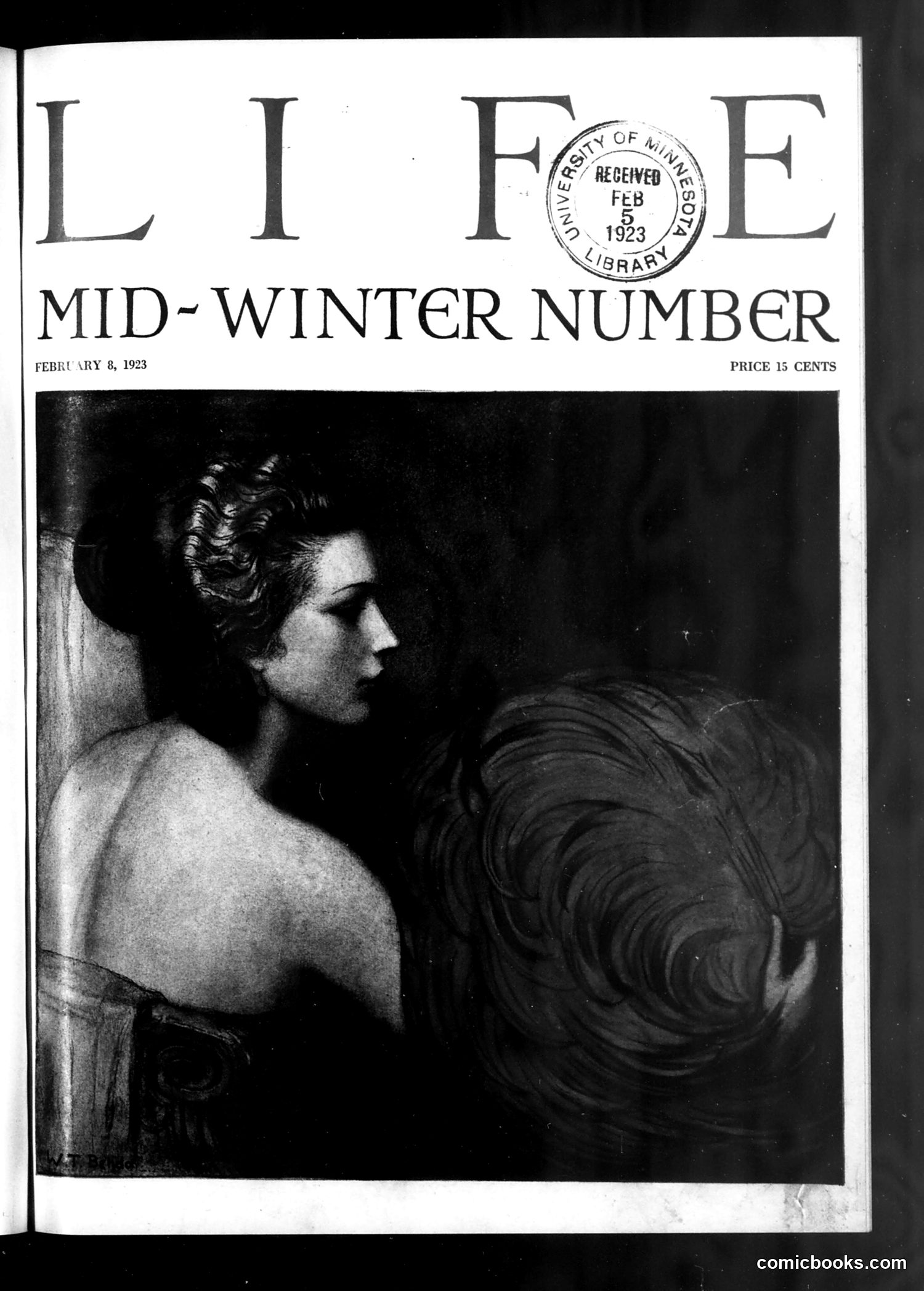
This is the cover of Life magazine's Mid-Winter Number from February 8, 1923, priced at 15 cents. The image shows a classical portrait photograph of a woman in profile, photographed from behind. She has her hair styled in waves typical of the 1920s era and appears partially draped in fabric. Without additional text or captions on this cover image itself, I cannot definitively identify who this woman is or determine if this represents satire, a celebrity profile, or purely aesthetic/artistic content. The photograph appears to be a serious portrait rather than a political cartoon. More context from the magazine's interior pages would be needed to explain the intended meaning or reference.
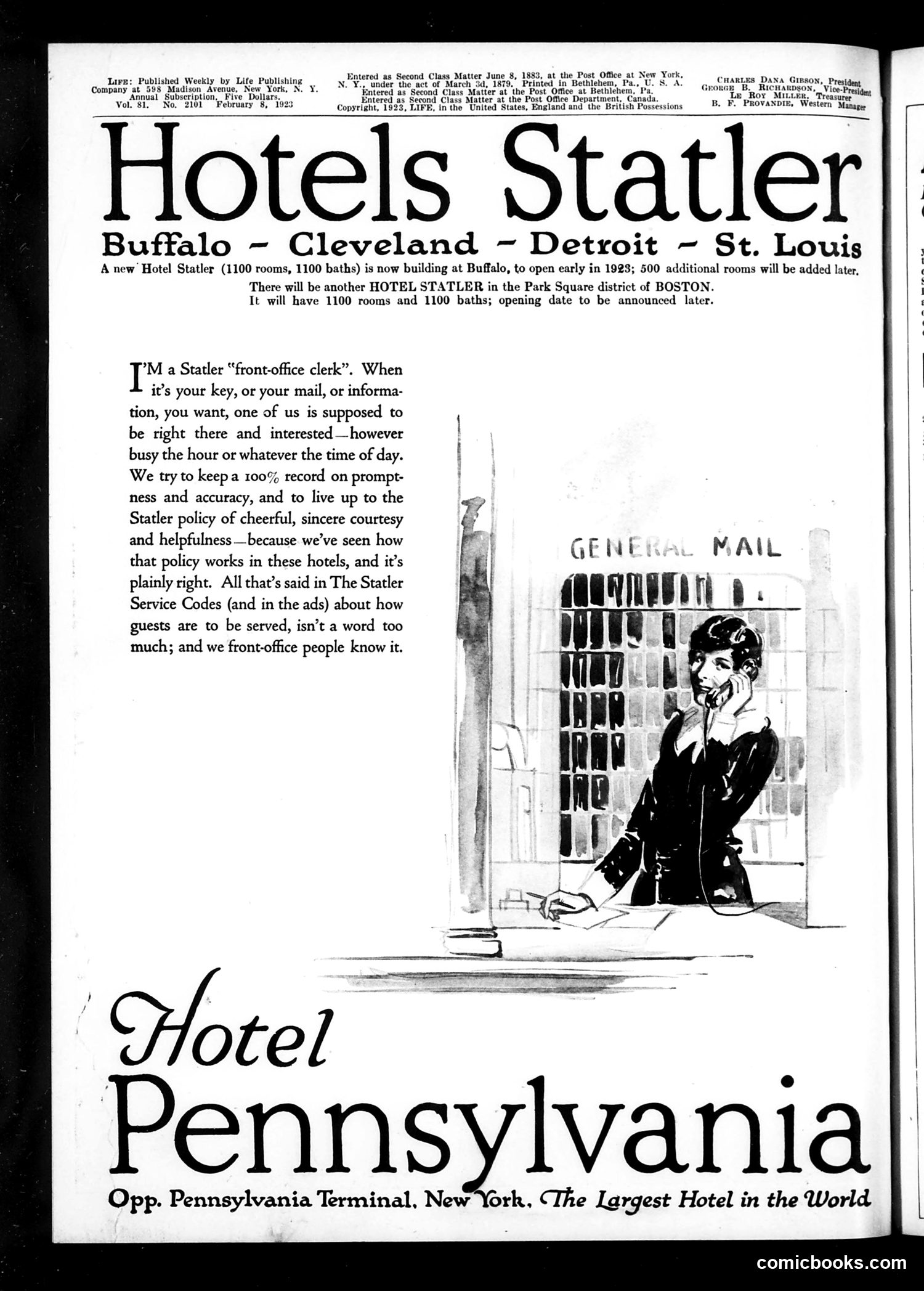
This page is primarily **advertising rather than satire or political commentary**. It contains two hotel advertisements: 1. **Hotels Statler** (top): Announces new luxury hotels opening in Buffalo, Cleveland, Detroit, St. Louis, and Boston, emphasizing their "front-office clerk" service philosophy—promising prompt, accurate, and courteous guest service. 2. **Hotel Pennsylvania** (bottom): Features an illustration of a female front-desk clerk at the "General Mail" window, promoting itself as "The Largest Hotel in the World" near Pennsylvania Terminal in New York. Both ads reflect **early 20th-century hotel industry competition**, emphasizing professional service and modern amenities. The female clerk illustration was typical advertising imagery of the era, representing cleanliness, efficiency, and hospitality. There is no political satire present—this is straightforward commercial messaging.
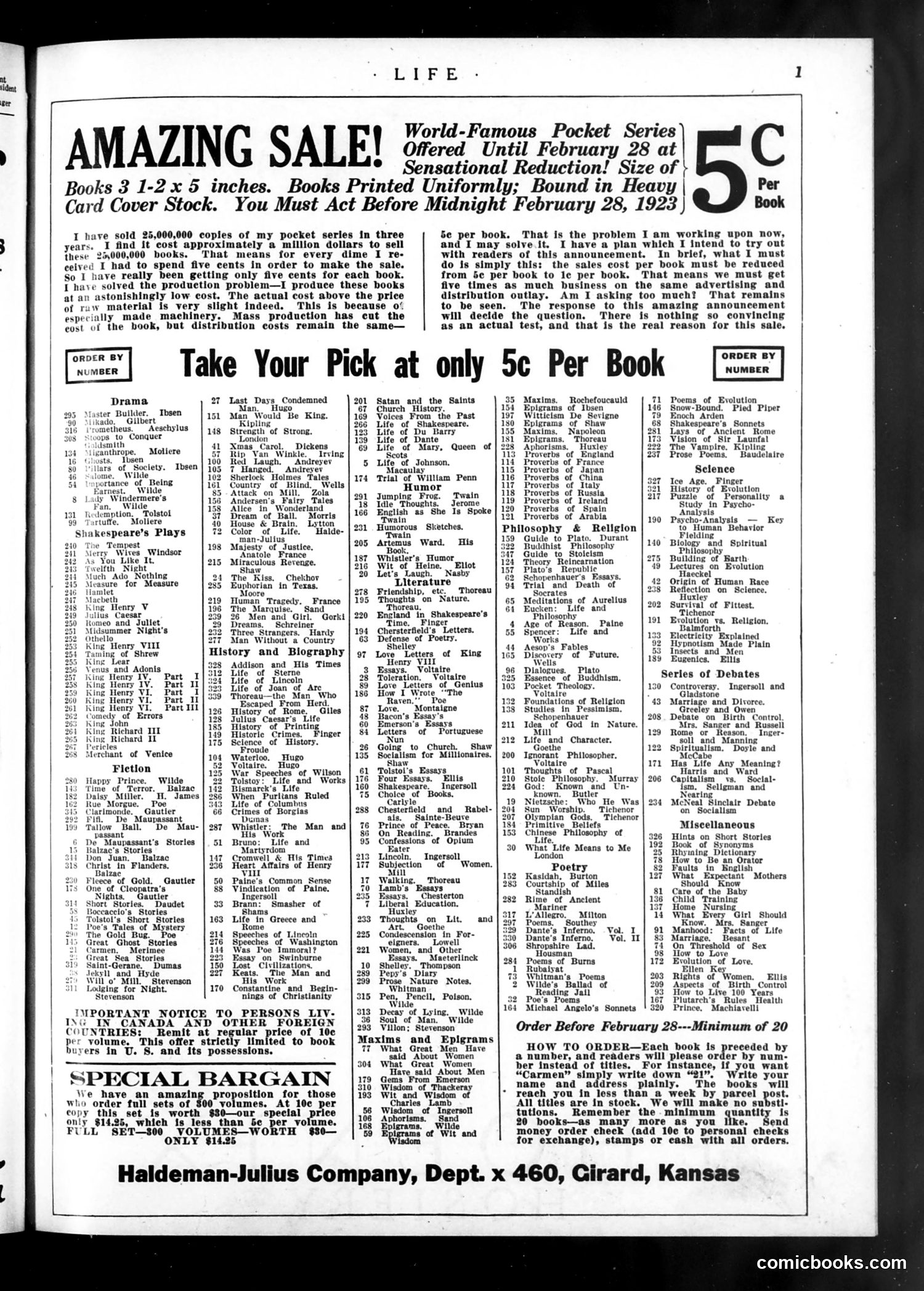
This page is **entirely advertising**, not satirical content. It contains a massive book sale advertisement from the Haldeman-Julius Company offering "World-Famous Pocket Series" books at 5 cents each—a sensational reduction from higher prices. The ad emphasizes mass production efficiency and claims to have sold 25 million copies in three years. It includes extensive catalog listings of available titles across Drama, Fiction, Literature, History/Biography, Philosophy, and other categories. The only non-advertising element is a small "Important Notice to Persons Living in Canada and Other Foreign Countries" regarding shipping restrictions. There are no political cartoons, caricatures, or satirical content on this page—it's a straightforward commercial advertisement typical of Life magazine's revenue model during the 1920s.
This is primarily **advertising copy, not satire or editorial content**. The page promotes Phoenix Hosiery stockings to a general audience (men, women, and children). The ornate decorative border frames a product testimonial emphasizing Phoenix stockings' durability ("strenuous testing"), economy, and aesthetic appeal ("beautiful," "elegant"). The text claims the product has proven itself through "years of the hardest wear, under the hurrying feet of an energetic nation." There is **no political cartoon or satire present**. This is straightforward commercial advertising from Life magazine, which regularly published advertisements alongside its satirical editorial content. The Phoenix brand name and the emphasis on American industrial achievement ("energetic nation") are period-typical marketing strategies from the early-to-mid 20th century.
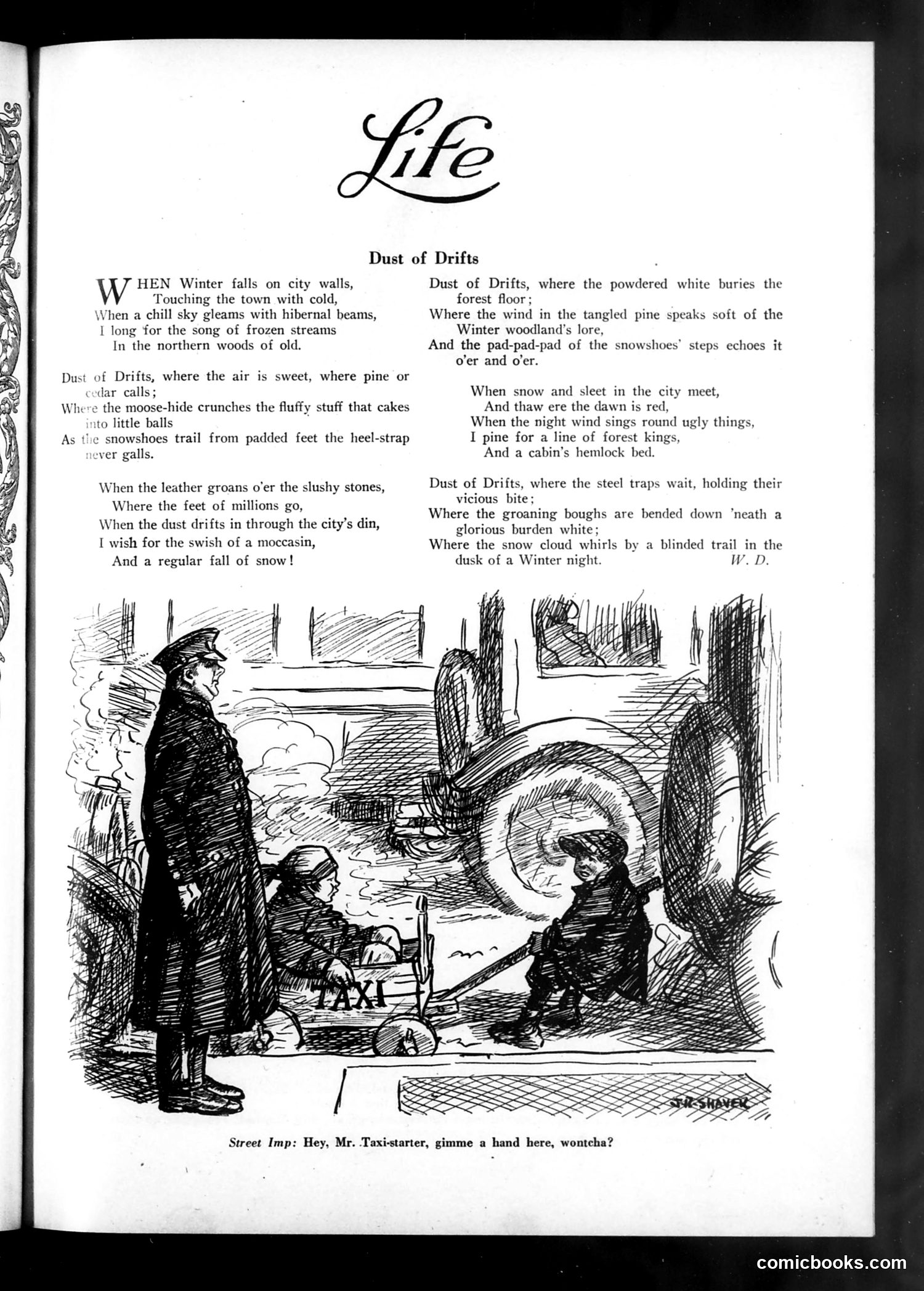
This page presents a poem by W.D. celebrating winter's beauty in natural settings ("forest floor," "woodland's lore"), contrasted with urban hardship. The accompanying sketch illustrates this tension: a well-dressed man in a long coat stands observing a child with a toy taxi in snowy city streets. The caption reads: "Street Imp: Hey, Mr. Taxi-starter, gimme a hand here, woncha?" The satire targets wealth disparity during winter. While the poem romanticizes snowy forests, the cartoon depicts urban poverty—a street child playing with a toy taxi while asking a prosperous man for help. The "taxi-starter" (taxi driver or affluent person) represents those insulated from hardship, contrasting sharply with the vulnerable "street imp" surviving winter's cold in the city.
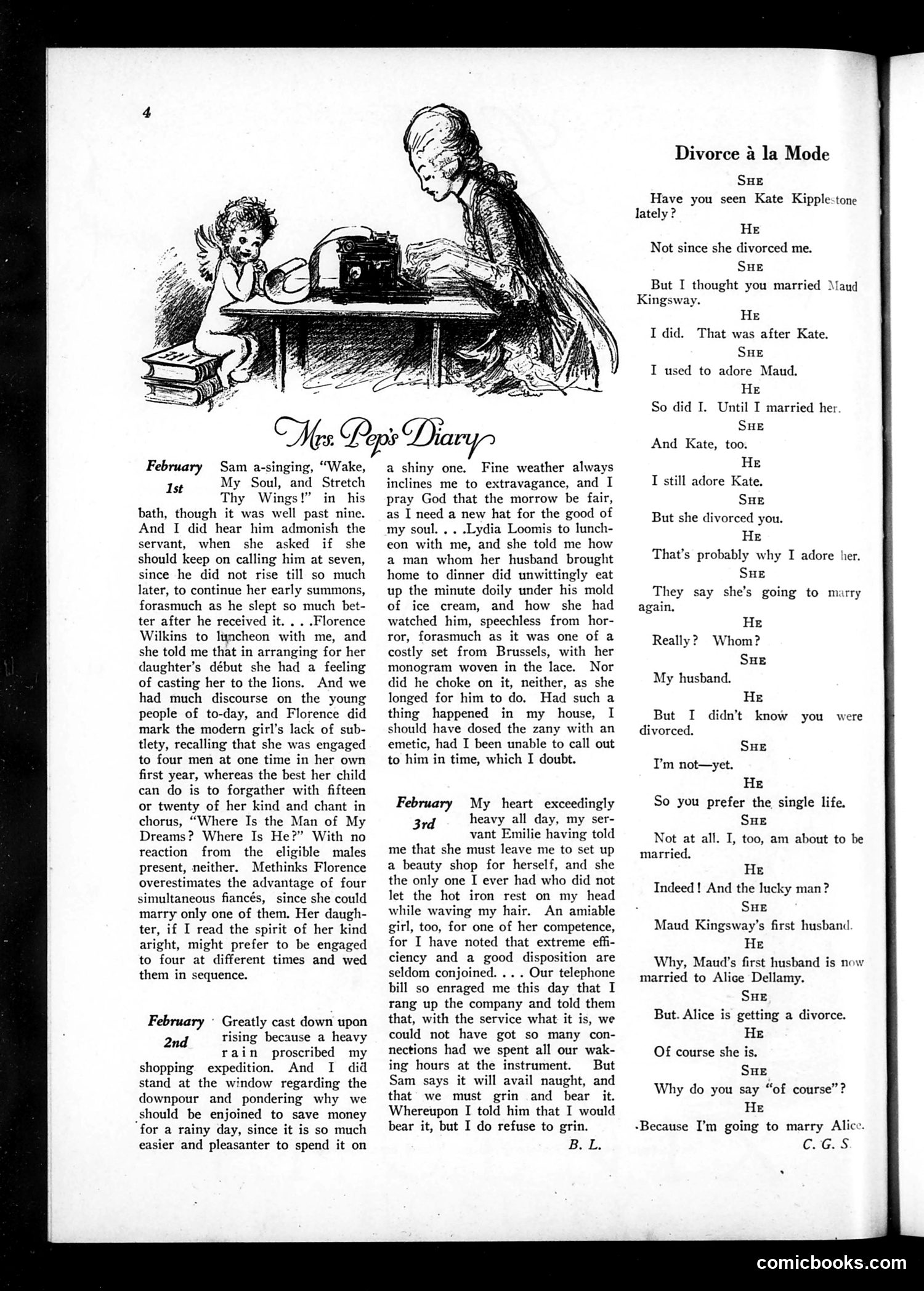
This page from *Life* magazine contains two distinct elements: 1. **"Mrs. Pep's Diary"** (left): A satirical diary entry from February describing domestic life, gossiping about servants and social arrangements. It's gentle domestic humor typical of the era. 2. **"Divorce à la Mode"** (right): A dialogue between a man and woman discussing marriage and divorce, apparently satirizing upper-class attitudes toward matrimony. The conversation reveals casual attitudes toward marriage dissolution—the woman mentions being "not yet" divorced and casually references remarriage prospects. The humor appears to target the frivolous approach to marriage among wealthy society, where divorce and remarriage are treated as fashionable social events rather than serious commitments. The title "à la Mode" (in fashion) reinforces this critique of treating divorce as a trendy social practice.
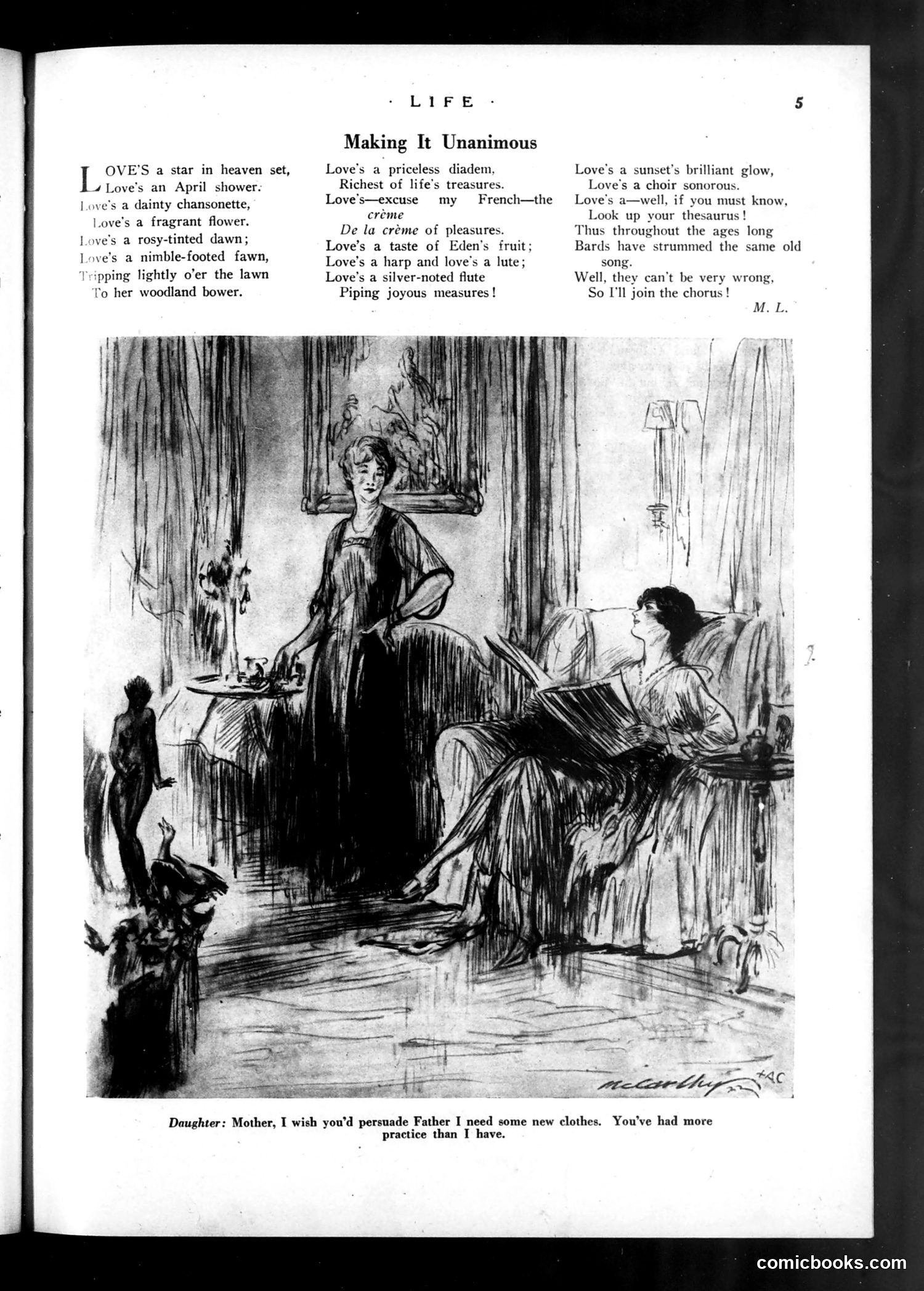
This page from *Life* magazine contains a poem celebrating love (titled "Making It Unanimous") and a single-panel cartoon below it. The cartoon depicts a domestic scene where a daughter stands before her mother (who is reclining on a bed), presumably making a request. The daughter's caption reads: "Mother, I wish you'd persuade Father. I need some new clothes. You've had more practice than I have." The satire targets gender dynamics and marital negotiation. The joke assumes that mothers are experienced manipulators of fathers regarding household finances and shopping—that persuading fathers for money is a practiced feminine skill passed between generations. It reflects early-20th-century attitudes about women's economic dependence on men and the stereotype of women as shrewd domestic negotiators.
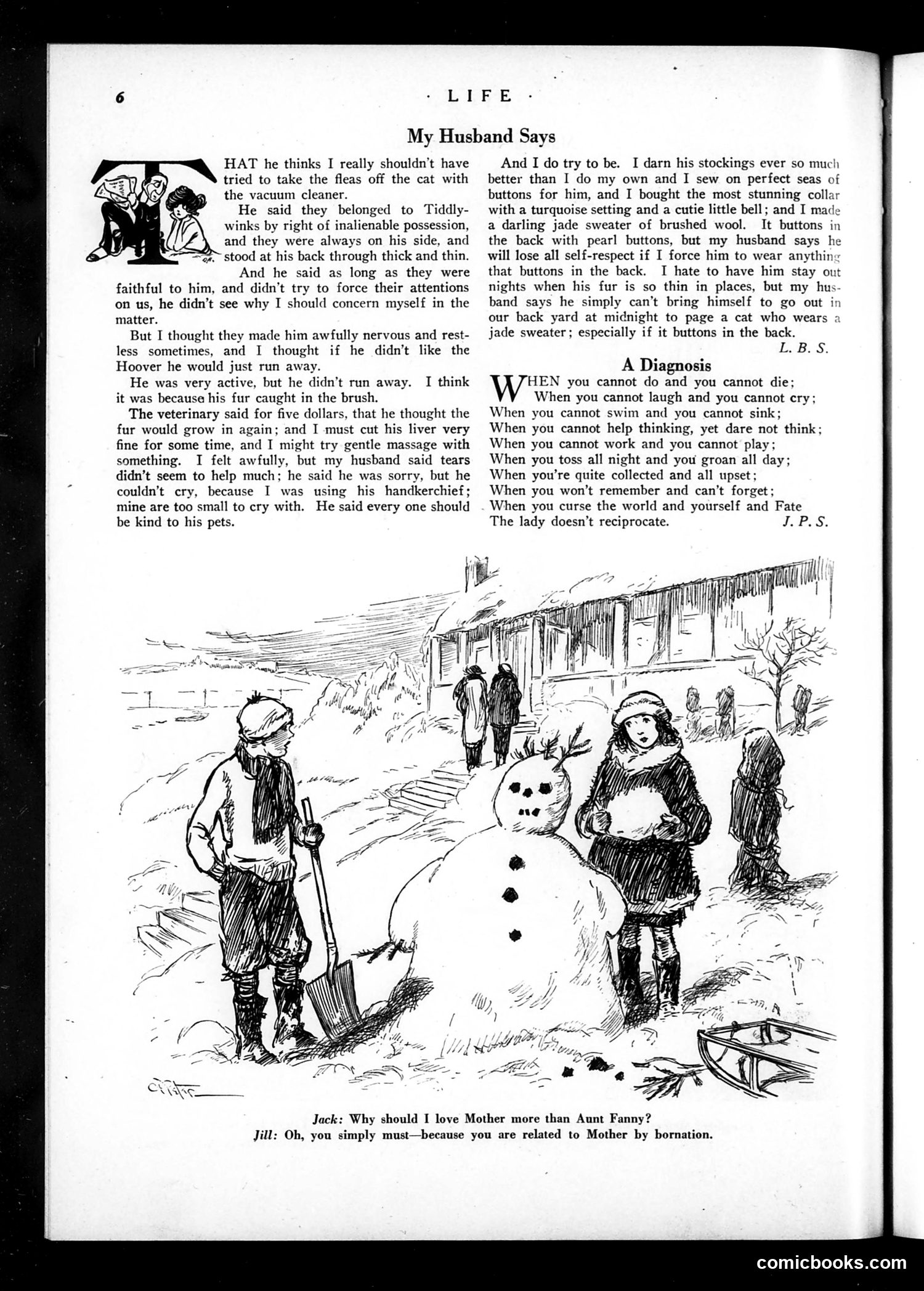
This page contains three distinct pieces: 1. **"My Husband Says"** - A humorous domestic column where a wife complains about her husband's complaints regarding her treatment of pets (particularly a cat with fleas). The husband's criticisms are portrayed as petty and hypocritical. 2. **"A Diagnosis"** - A pessimistic poem listing various states of depression and malaise (inability to do, laugh, cry, etc.), attributed to "J.P.S." This appears to be satirical commentary on depression or existential ennui. 3. **Bottom cartoon** - Shows children building a snowman. A boy (Jack) asks why he should love his mother more than his aunt, with the girl (Jill) responding that blood relation alone should determine affection—satirizing the arbitrary nature of familial duty. All three pieces gently mock human behavior and social conventions through domestic situations.
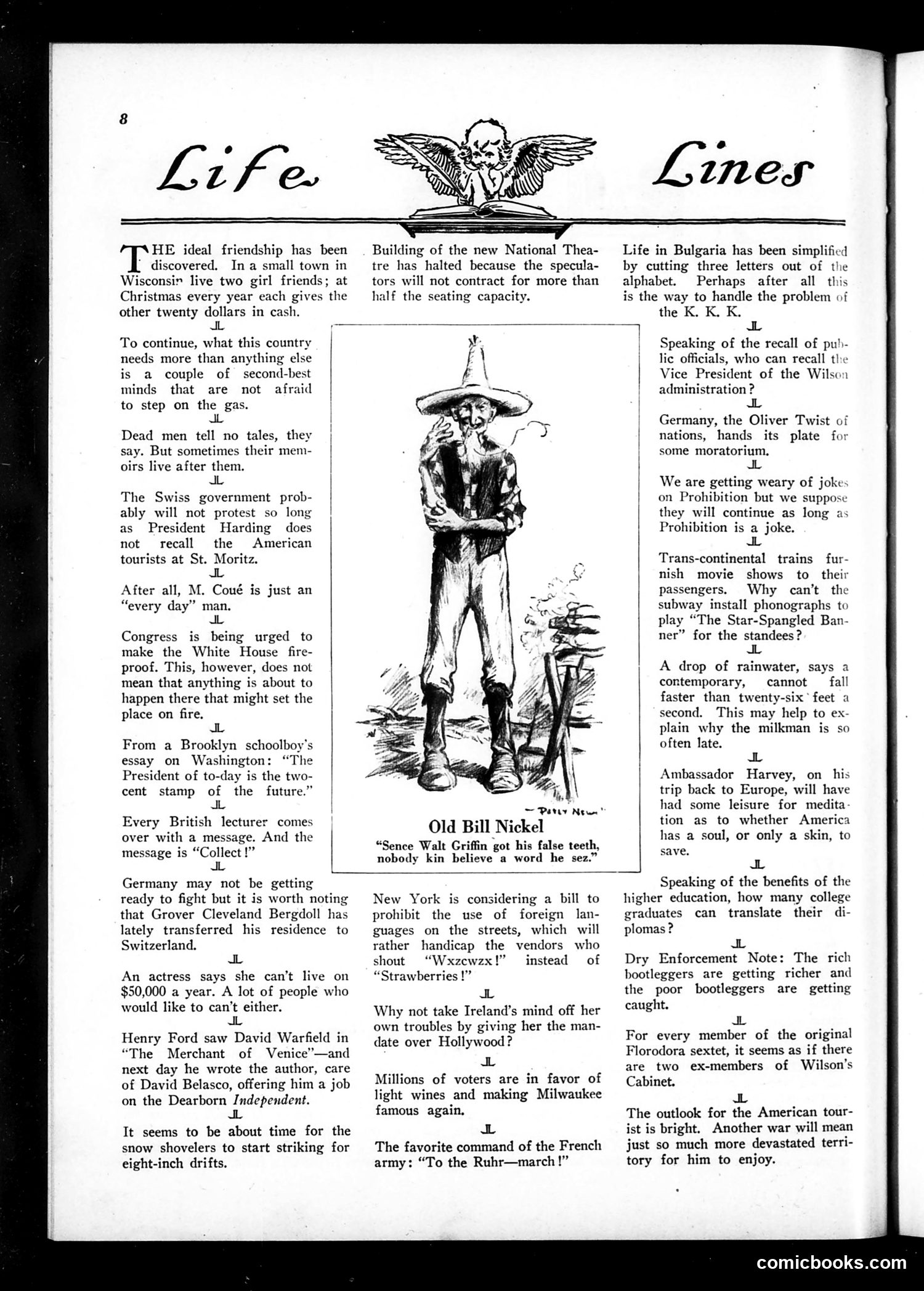
The central cartoon depicts "Old Bill Nickel," a gaunt, elongated figure in a wide-brimmed hat with the caption: "Since Walt Griffin got his false teeth, nobody kin believe a word he see." This appears to be a joke about credibility and deception—someone named Walt Griffin obtaining false teeth has made him literally untrustworthy ("can't believe what he says"). The exaggerated skeletal figure embodies this theme of unreliability or transformation through artifice. The surrounding "Life Lines" column contains brief satirical commentary on contemporary topics: Prohibition enforcement, higher education, Irish independence, and international relations. The humor targets political figures, social trends, and absurdities of the 1920s era. Without dated publication information visible, the specific historical context remains unclear, though Prohibition references suggest the 1920s.
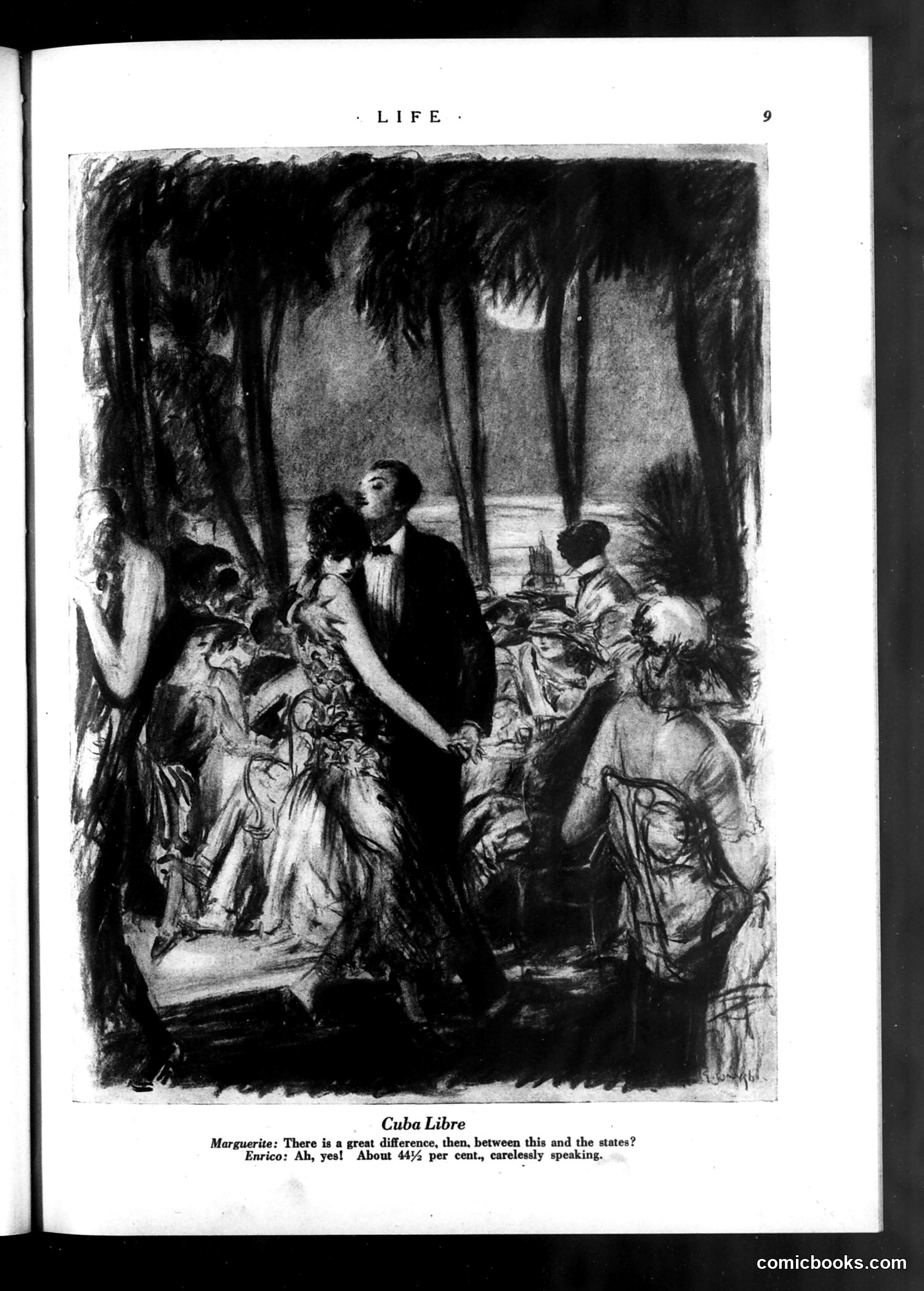
This political cartoon satirizes a conversation about Cuba's independence and economic relationship with the United States. **The figures**: Marguerite (a woman in elegant dress) asks Enrico (a man in formal attire) about economic differences between Cuba and American states. **The satire**: Enrico's casual, dismissive response—"About 44½ per cent., carelessly speaking"—mocks the vague and imprecise way political and economic figures discussed Cuba's actual status and financial disparity. The "44½ per cent." appears deliberately absurd, suggesting politicians spoke carelessly about serious economic matters affecting Cuba. **Historical context**: This likely references Cuba's relationship with the U.S. following the Spanish-American War (1898), when Cuba's formal independence masked substantial American economic and political influence. The cartoon criticizes superficial public discourse on colonialism and economic dependency.
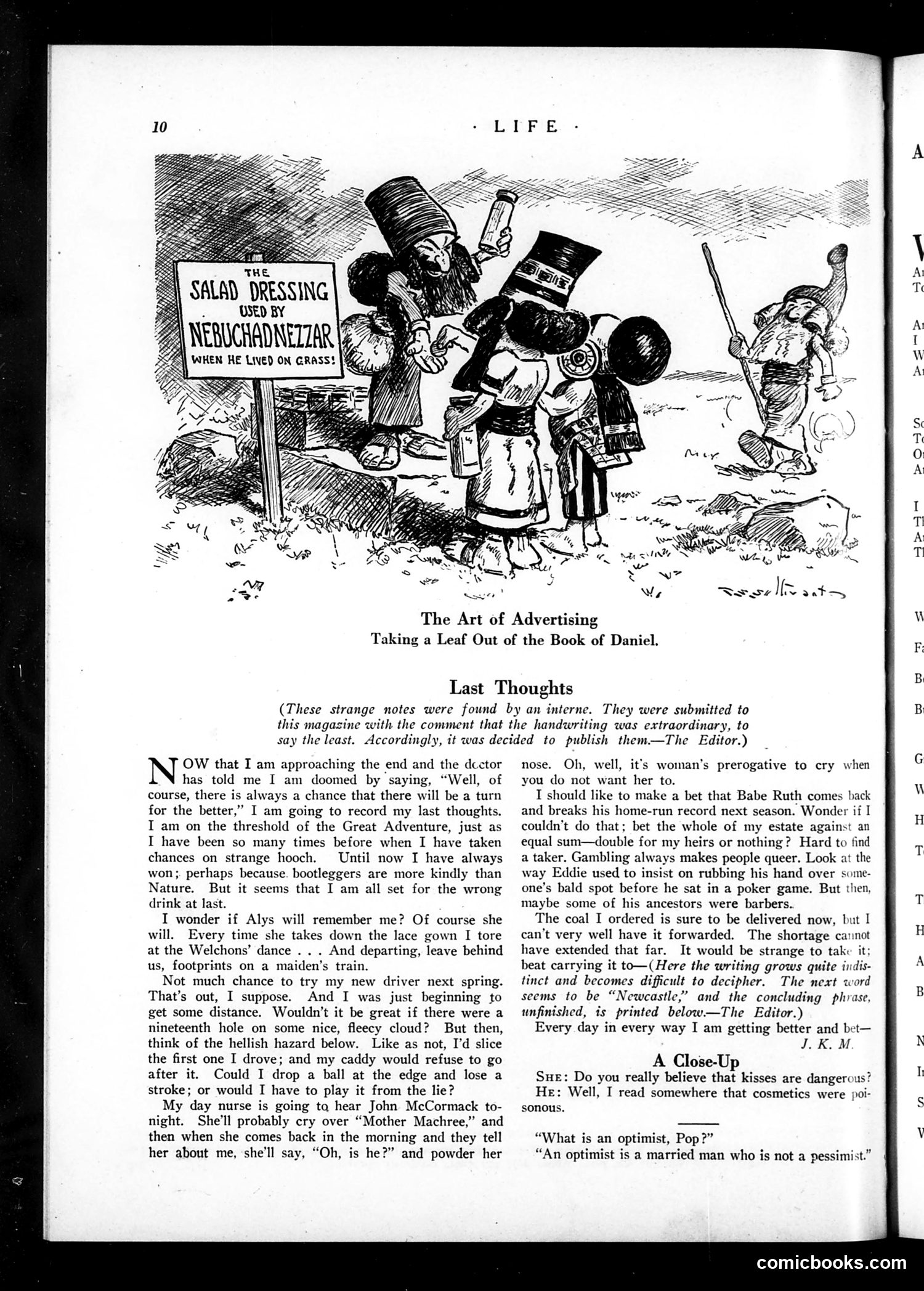
This cartoon satirizes aggressive advertising practices by depicting a bearded figure (likely representing a stereotypical "Eastern" merchant or dealer) hawking a product labeled "Salad Dressing Used by Nebuchadnezzar When He Lives on Grass." The satire works on multiple levels: First, it mocks absurd advertising claims that invoke historical/biblical figures to lend false legitimacy to products. Second, the reference to Nebuchadnezzar—the Babylonian king who, according to the Book of Daniel, ate grass as punishment—creates obvious humor: advertising a salad dressing to someone eating actual grass is nonsensical. The cartoon critiques how advertisers exploit any reference, however ridiculous or inappropriate, to manipulate consumers into buying products.
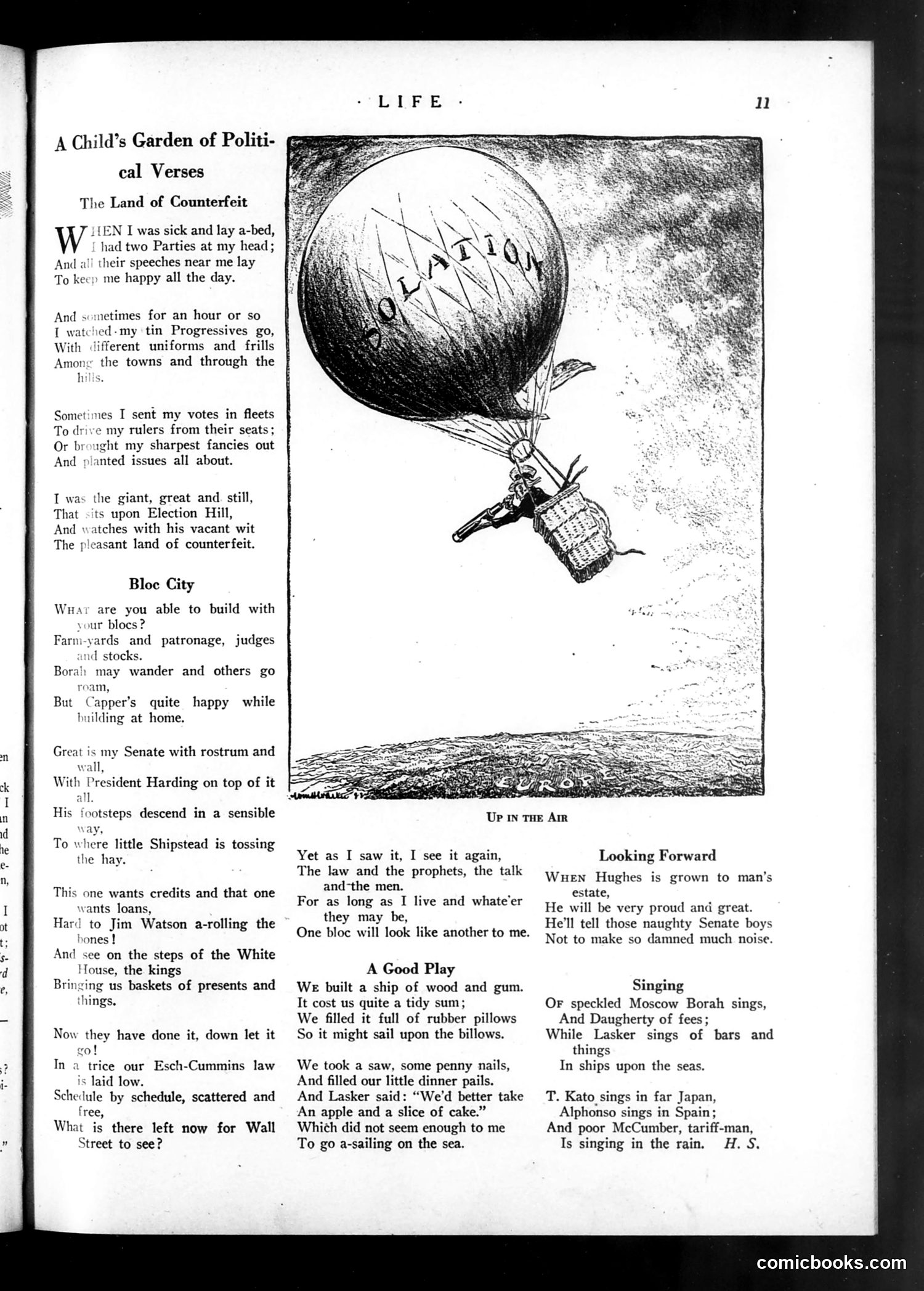
This page satirizes American politics through a child's perspective during the Warren G. Harding administration. **Key references:** - "The Land of Counterfeit" mocks political dishonesty and parties making empty promises to voters - "Election Hill" appears to reference political manipulation and vacant leadership - "Bloc City" satirizes political factionalism and patronage systems - References to "President Harding" and the "White House" place this during his presidency (1921-1923) - The balloon illustration labeled "CAUTION" suggests political hot air and inflated rhetoric The satire uses childlike innocence to expose adult political corruption—votes sent as "fleets," rulers driven from seats, and building political power through patronage rather than principle. The verses critique both major parties and Harding-era political dysfunction.
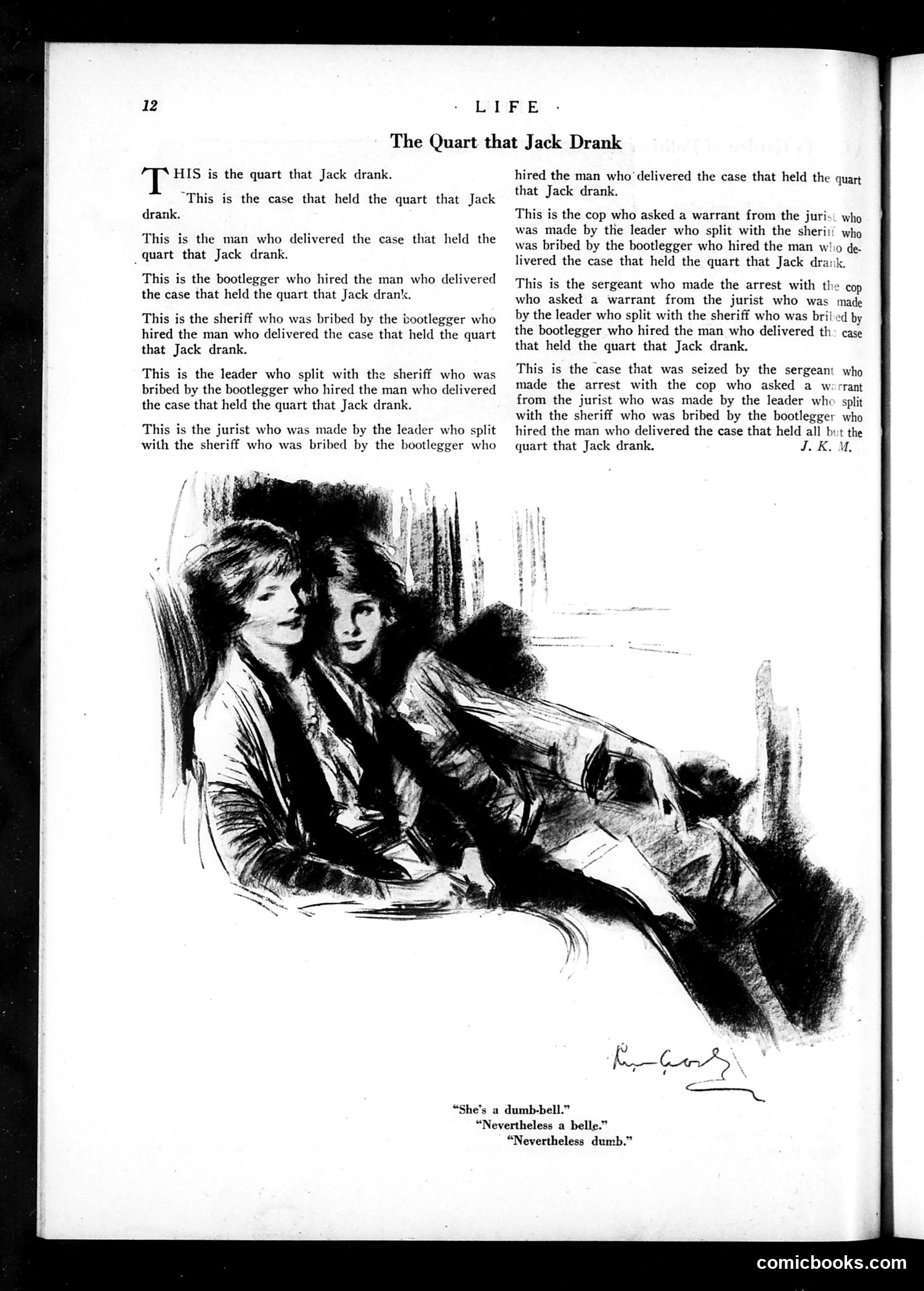
This page presents a cumulative poem/nursery rhyme parody titled "The Quart that Jack Drank"—a play on the traditional children's verse "The House That Jack Built." The text humorously traces a chain of corruption involving: a quart (of alcohol, likely liquor), Jack who drank it, the case holding it, the man who delivered it, a bootlegger, a sheriff, a leader, a jurist, a cop, and a sergeant. The satire targets Prohibition-era corruption, depicting how bootlegging, bribery, and law enforcement misconduct were interconnected—each official from sheriff to cop implicated in an elaborate criminal conspiracy. The illustration shows two women in period dress, with captions reading "She's a dumb-bell," "Nevertheless a belle," "Nevertheless dumb." The joke critiques how widespread corruption made Prohibition enforcement absurd and hypocritical.
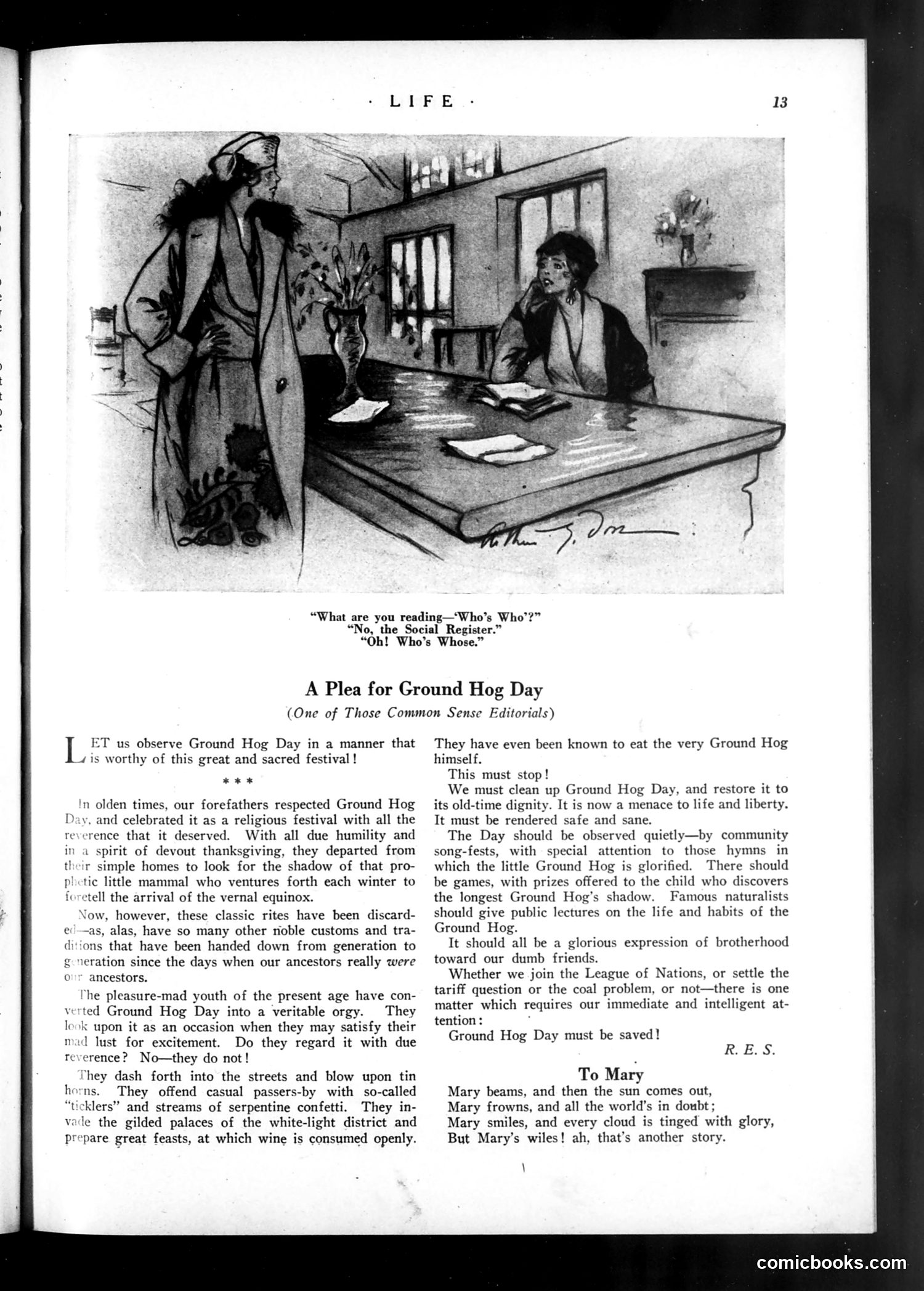
The cartoon depicts two office workers at a desk. One asks what the other is reading, receiving the reply "Who's Who?" followed by "Oh! Who's Whose." This appears to be a wordplay joke about the *Social Register*—a directory of socially prominent families in America. The accompanying editorial "A Plea for Ground Hog Day" sarcastically critiques how modern youth have corrupted the holiday into "a veritable orgy," replacing traditional reverence with street celebrations, tin horns, and wine-drinking in the "white-light district." The author laments the decline of dignified customs and calls for restoring the holiday's proper observance. The page reflects early 20th-century anxieties about youth behavior and erosion of genteel traditions.
This page contains an editorial article debating President A. Lawrence Lowell of Harvard College's decision regarding whether Negro students may live in freshman dormitories. The article presents the controversy as a test of democratic principles and Christian values at Harvard. The piece criticizes those who object to integrated housing while defending Dr. Lowell's willingness to reconsider the policy. It argues the real issue isn't Lowell himself, but broader questions about racial coexistence in America. The author suggests both institutional religious leaders and secular intelligentsia have failed to adequately address these fundamental contradictions between stated Christian principles and discriminatory practices—a satirical indictment of Harvard's hypocrisy on this matter.
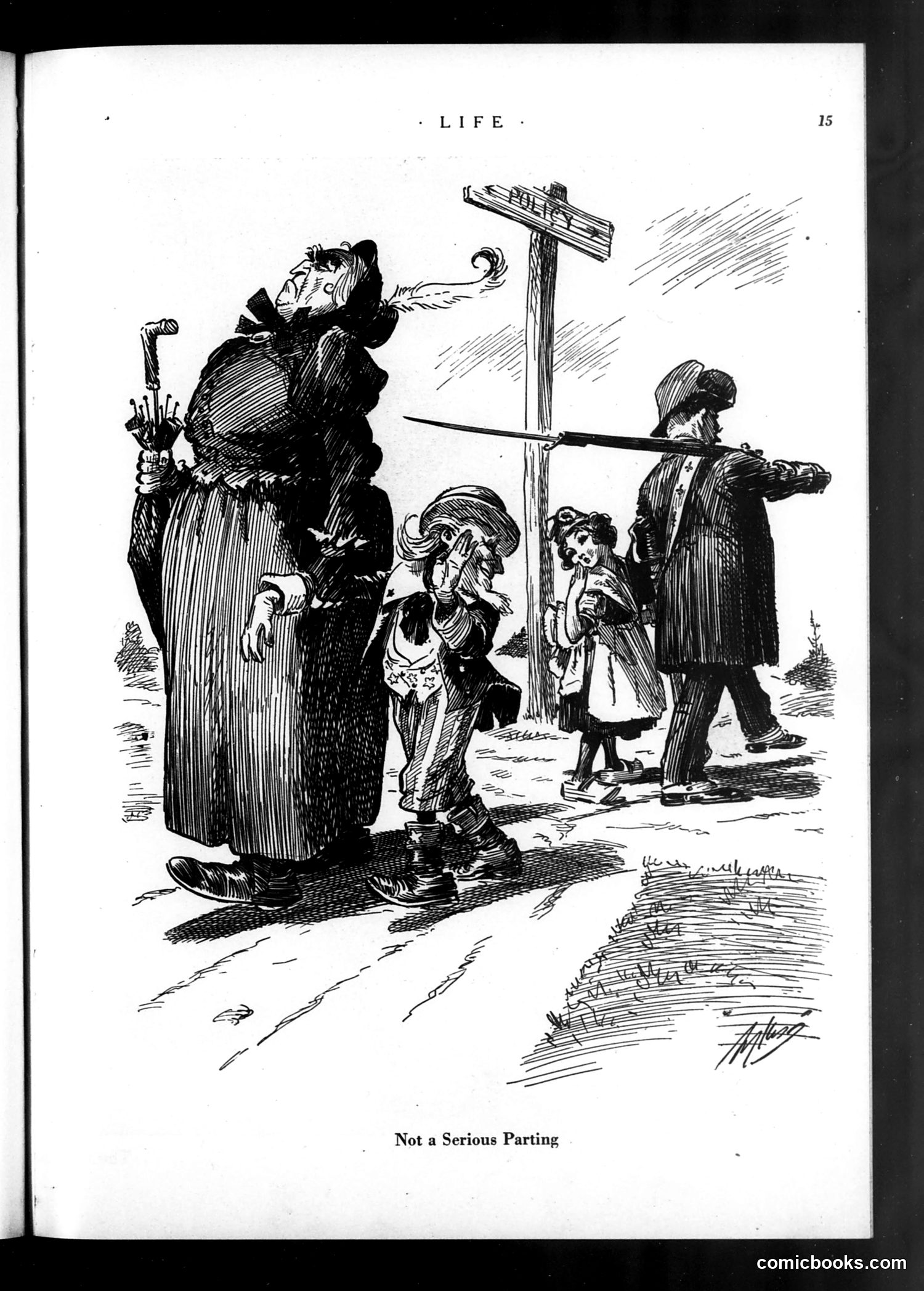
This satirical cartoon depicts a large, rotund figure in a long coat (appearing to represent a political or military authority figure) saying goodbye to smaller figures, likely representing either dependents, soldiers, or citizens. A cross stands prominently in the background, suggesting either a military or religious context—possibly a wartime departure or dismissal. The title "Not a Serious Parting" suggests irony: the scene appears somber (winter setting, cross), yet the caption implies the separation is casual or temporary. The exaggerated physicality of the central figure and the formal poses of those departing suggest satirical commentary on power dynamics, perhaps mocking either a leader's indifference to separation from those below him, or the false casualness with which authority treats significant departures. Without clearer historical context or identifying details, the specific political reference remains unclear.
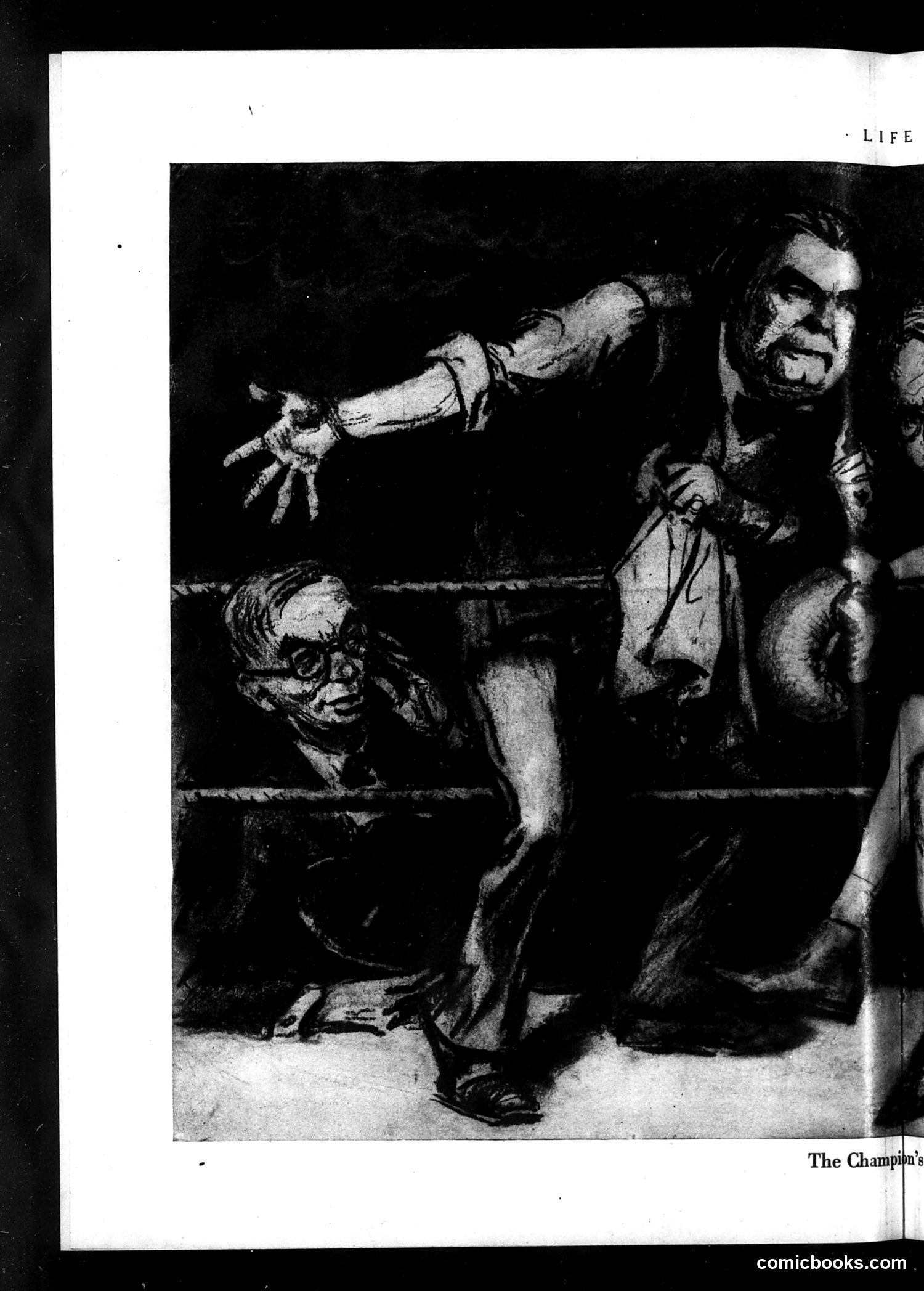
This appears to be a boxing-related illustration from *Life* magazine, as indicated by "The Champion's" caption at the bottom. The image shows what appears to be a boxing match or confrontation scene, with multiple figures in and around a boxing ring. The artistic style uses heavy contrast typical of early-to-mid 20th century satirical illustration. However, the OCR text is too fragmented to identify specific figures or understand the intended satire. Without legible text explaining who "The Champion" refers to or what social/political situation is being lampooned, I cannot reliably determine the cartoon's meaning for a modern reader. The image quality and incomplete caption prevent certain identification of the figures depicted or their symbolic significance.
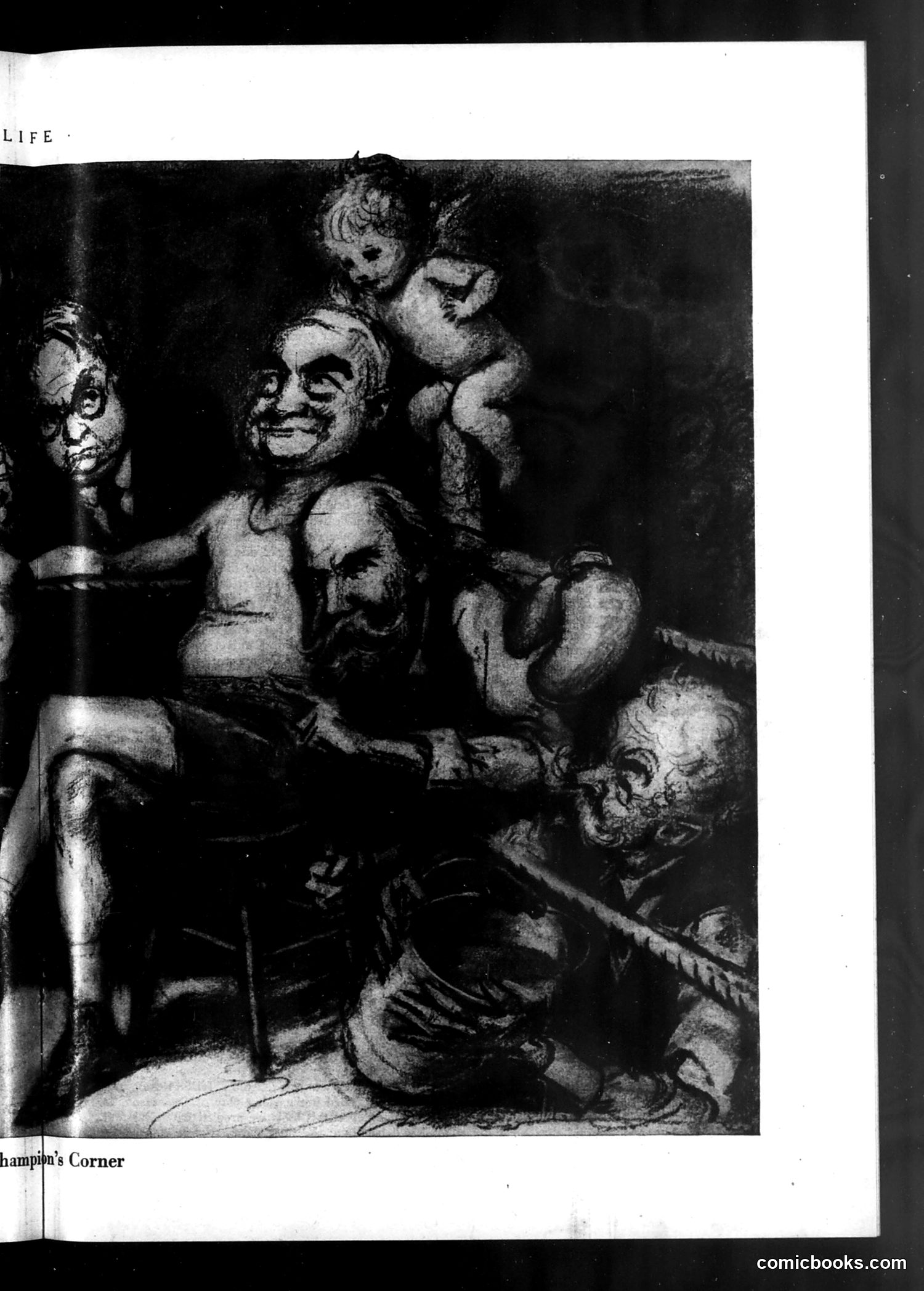
This appears to be a satirical illustration from Life magazine showing a group of figures with exaggerated facial features in what seems to be a theatrical or social scene. The image quality and style suggest late 19th or early 20th century. However, without clearer text identifying the specific figures, event, or political context being satirized, I cannot reliably identify who these caricatures represent or what the joke references. The bottom notation mentions "hampion's Corner," but the full title is cut off. The artistic style—heavy use of shadow, grotesque facial exaggeration, and crowded composition—is typical of Life's satirical approach, but determining the specific social or political commentary requires information not clearly legible on this page.
This page reviews three theatrical productions. The main review concerns "Dagmar," starring the famous Russian-American actress Alla Nazimova. The critic finds it dull despite its promising premise—Nazimova playing a seductive woman in negligees who dies dramatically. The problems: poor audibility, clichéd dialogue (dismissing it as mere "etc."), and sluggish pacing. The critic sarcastically suggests they should have killed her character after the first act curtain. The piece also mocks the theatrical convention of actresses performing "seduction," arguing that when women self-consciously "play seductive," it's ineffective rather than compelling. Brief mentions follow of "Jitta's Atonement" (with Bertha Kalich) and a positive reference to "Abie's Irish Rose" as the season's worst play. The satire targets both pretentious dramatic conventions and overwrought acting styles typical of 1920s theater.
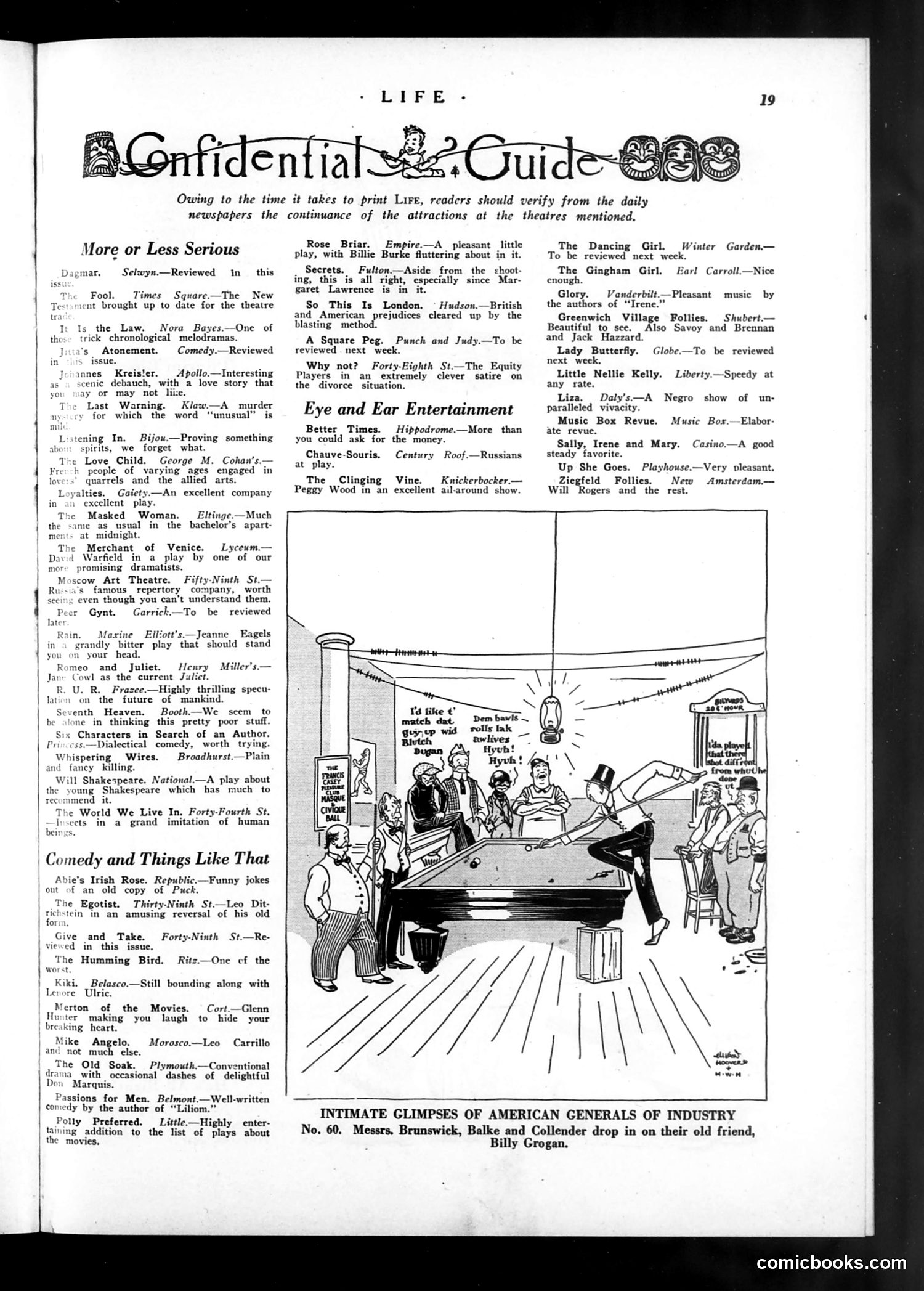
This page from Life magazine (circa early 1920s) is primarily a theater guide and review section—not political satire. The left column lists Broadway productions with brief critical assessments, organized by tone ("More or Less Serious," "Comedy and Things Like That," "Eye and Ear Entertainment"). The cartoon depicts a casual billiards scene with well-dressed men at a pool table, labeled "Intimate Glimpses of American Generals of Industry." The caption notes "Messrs. Brunswick, Balke and Collender drop in on their old friend, Billy Organ." This is a visual pun: Brunswick, Balke & Collender was a famous pool-table manufacturer, so "industry generals" refers to these businessmen literally meeting at their product. The humor relies on wordplay rather than political commentary—a lighthearted jab at corporate figures disguised through product naming.
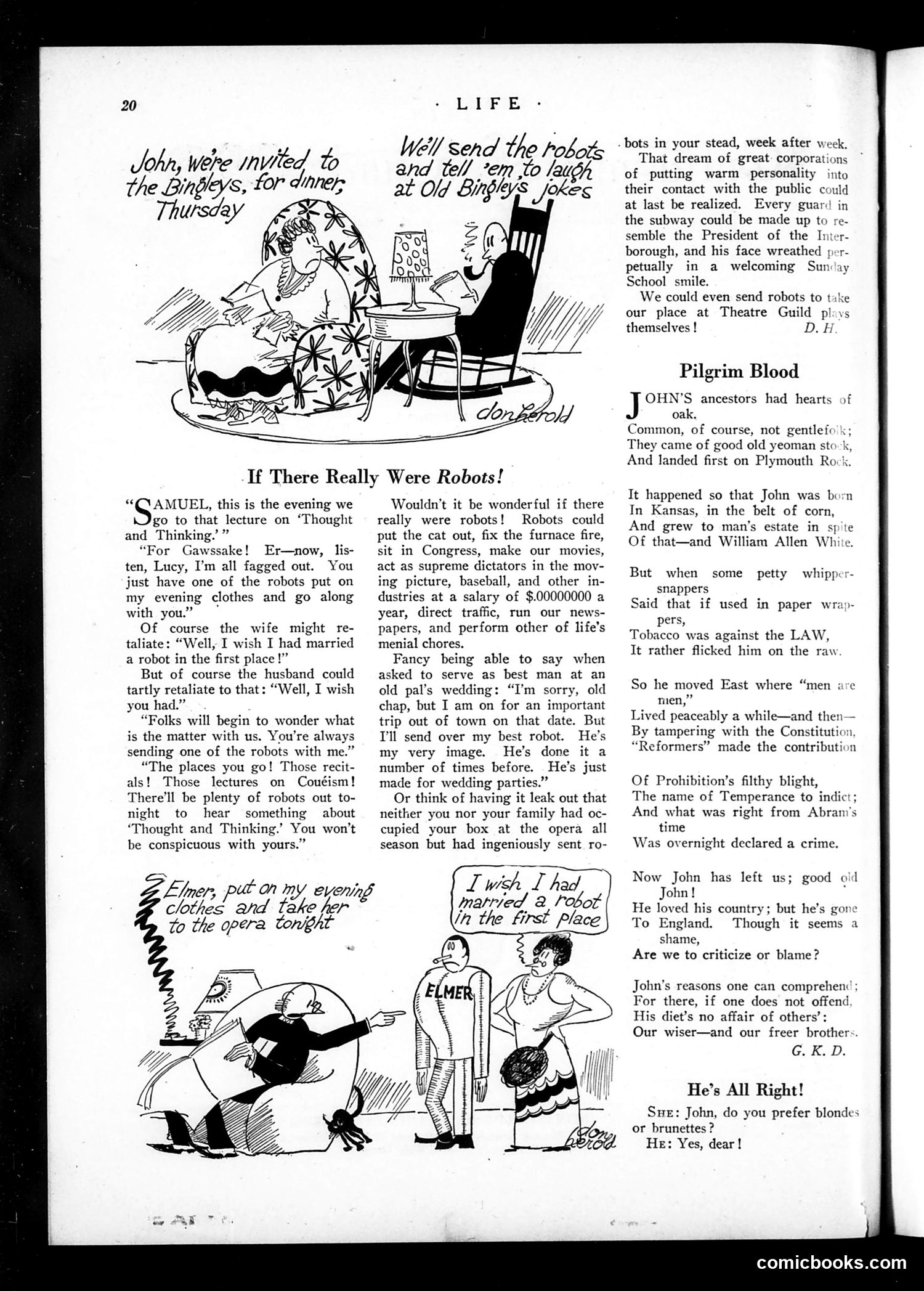
This page contains two satirical pieces typical of 1920s American humor. **"If There Really Were Robots!"** imagines a future where domestic robots perform tedious social obligations—attending lectures, operas, and dinners in owners' place. The satire targets the era's ennui among the middle class, their desire to escape social conventions, and the drudgery of obligatory socializing. References to "Couéism" (a popular self-help movement) and Congress suggest robots could replace both boring entertainment and incompetent government. **"Pilgrim Blood"** concerns John, whose ancestors came on the Mayflower, but who emigrated to England to escape Prohibition. The satire critiques America's 1920 alcohol ban as un-American and tyrannical, forcing a patriotic citizen into exile. The poem's tone suggests the author (G.K.D.) views Prohibition as fundamentally contrary to American freedom and personal liberty. The closing joke plays on the cliché marriage question about blonde versus brunette preferences—the husband's evasive "Yes, dear!" mocks men's inability to answer wives honestly.
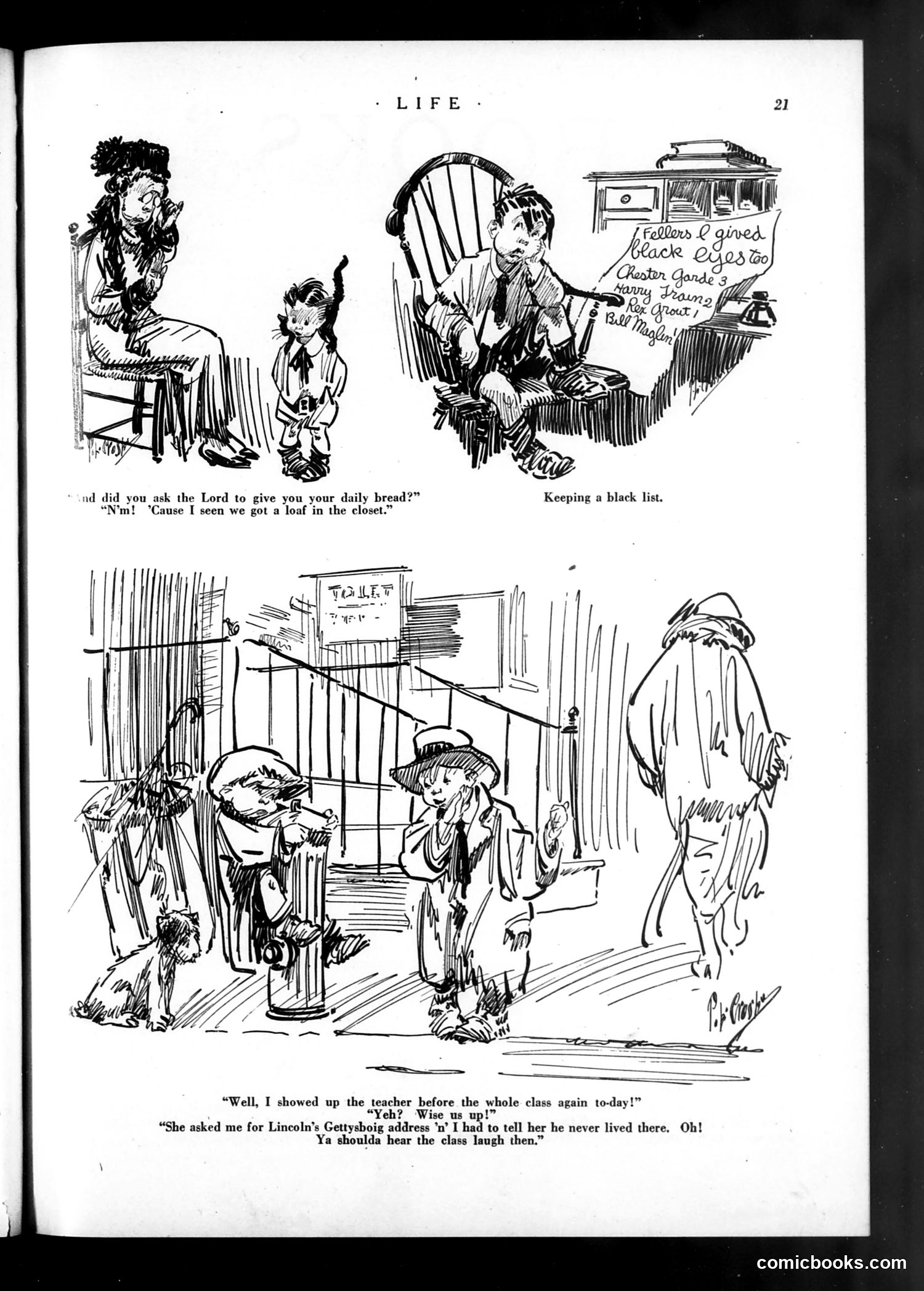
This page contains two satirical cartoons about children's impudence and poor education. **Top cartoon**: A child tells an adult that when asked to pray for "daily bread," they replied they already have bread in the closet—mocking religious piety with literal pragmatism. **Bottom cartoon**: A student boasts about deceiving their teacher by claiming Lincoln never lived in Gettysburg (where the famous address was delivered), getting classmates to laugh. The teacher asked for "Lincoln's Gettysburg address" (meaning the speech location), but the student deliberately misinterpreted it as Lincoln's home address. Both cartoons satirize children's smartass behavior and deflated respect for authority and education. The humor targets both the kids' impertinence and, implicitly, their poor understanding—they're "wise guys" without actual wisdom. This reflects early-20th-century anxieties about youth discipline and educational standards.
This is a **book review column**, not a political cartoon. The page discusses early 1920s literary trends with pointed satire about modern publishing excess. The main target is **Virginia Woolf's "Jacob's Room,"** mocked as overly intellectual and psychologically dense—so difficult that readers may fail to understand it, yet the "eager intelligentsia" read it to appear sophisticated. The reviewer sarcastically notes the book costs three dollars new but will sell for fifteen cents, suggesting it has no lasting value despite current prestige. By contrast, **"The Enchanted April"** is praised as genuinely delightful and accessible—the reviewer actually laughed while reading it. The column's **broader satire** criticizes modern publishing's speed and volume: authors now dash off books "on the installment plan" for newspapers rather than carefully crafting work over years, as in Elizabeth Barrett Browning's era. This flood of mediocre books makes the critic's job overwhelming. The *Life* magazine's response: **only review books worth discussing**—a witty declaration that merit, not trends, determines coverage.
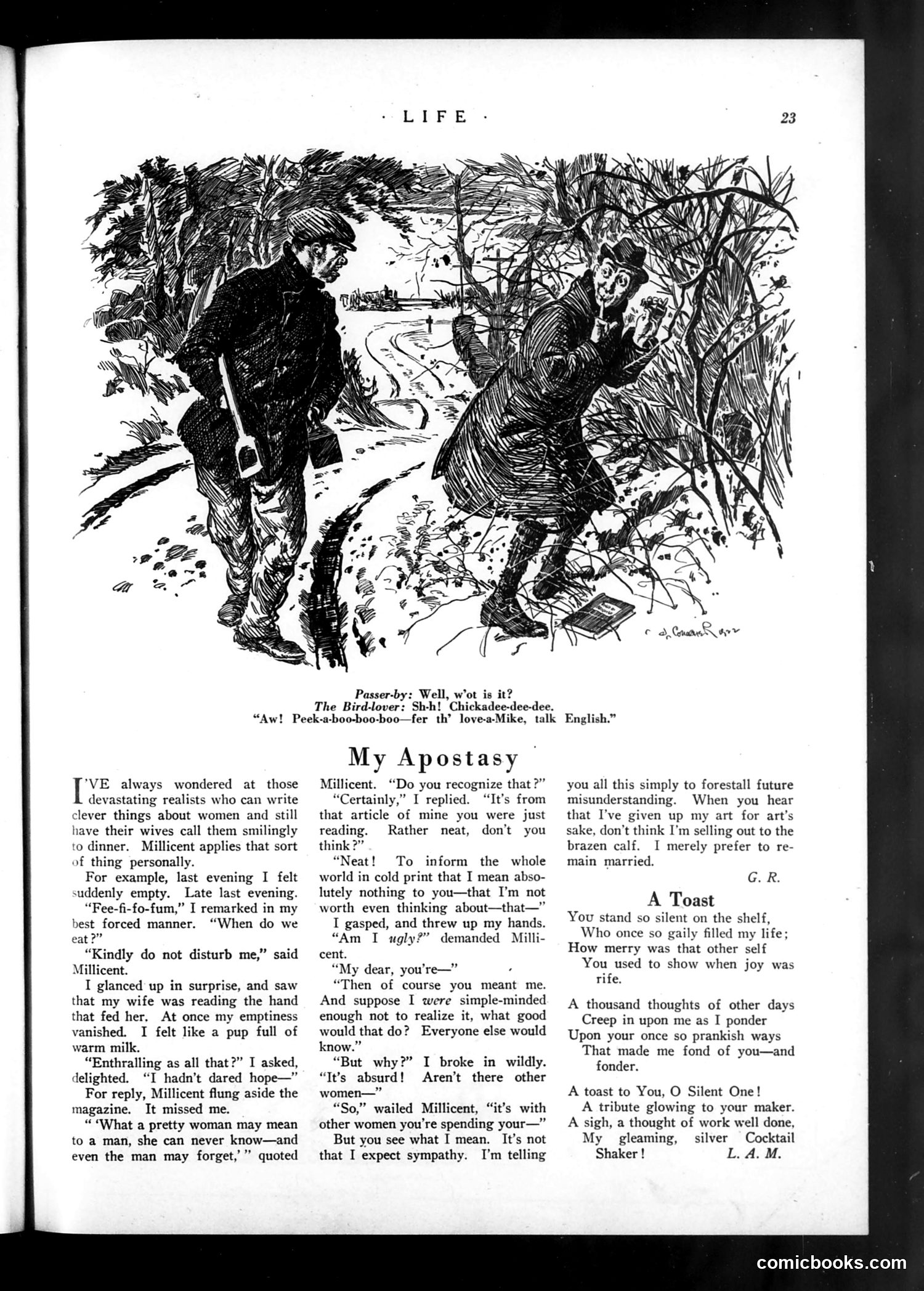
**The Cartoon:** A man attempts to imitate a chickadee's call ("Chickadee-dee-dee") while another man interrupts, demanding he "talk English" instead of making bird sounds. This is a simple joke about miscommunication—the bird-lover speaking the bird's language while the passer-by wants plain speech. **The Text Stories:** "My Apostasy" is a humorous domestic complaint where the narrator's wife Millicent reads his published article (likely critical of women) and becomes hurt and argumentative, twisting his words to suggest he finds her worthless. He ultimately surrenders his writing ambitions to keep peace in marriage—hence "apostasy" (abandoning his principles). "A Toast" is a sentimental poem praising a cocktail shaker, personifying it as a once-lively companion now silent on a shelf, likely a Depression-era reference to Prohibition's aftermath or lost pleasures. Both pieces satirize domestic life and male-female relationships through humor and irony typical of 1920s-30s *Life* magazine.
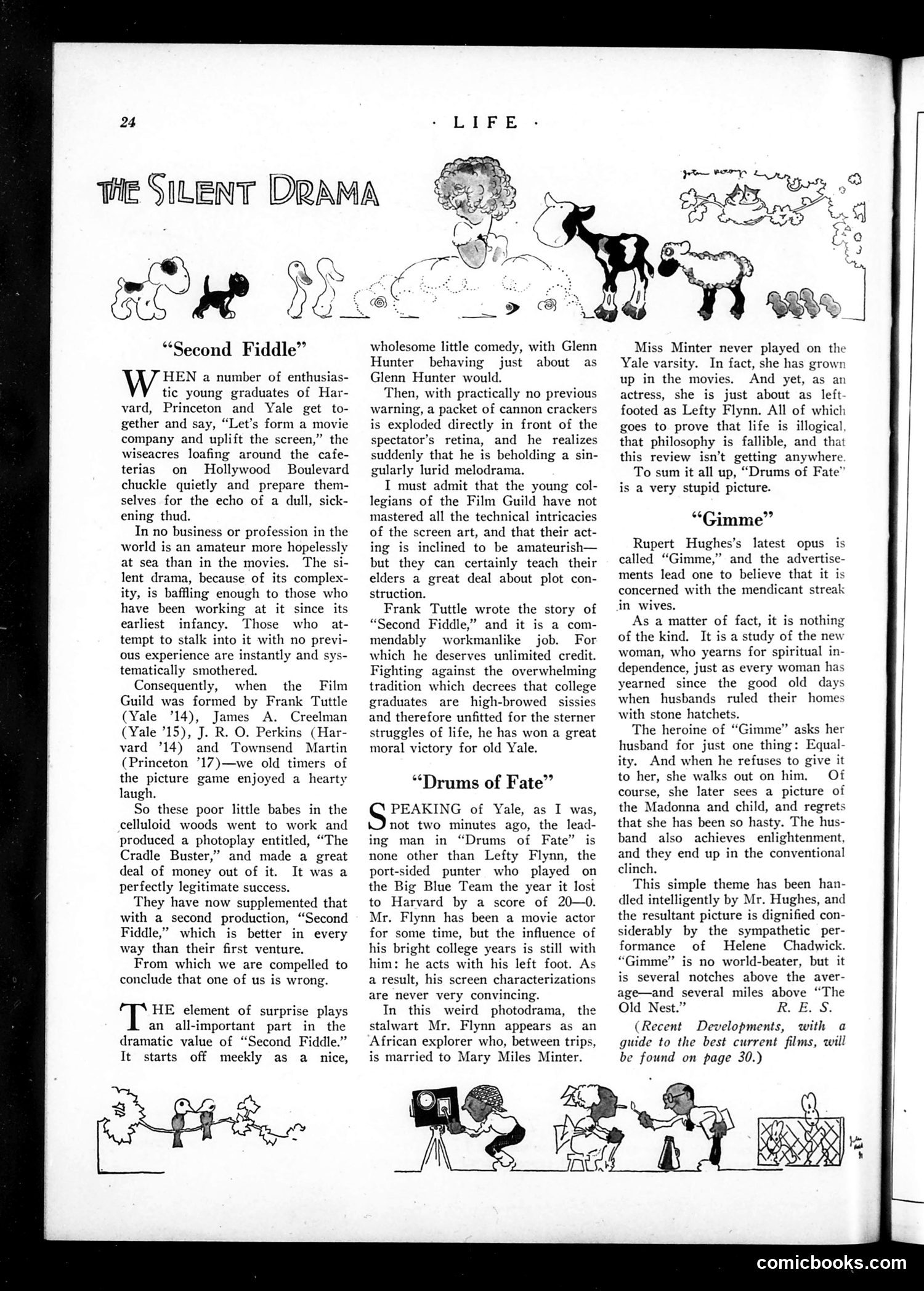
This page satirizes early 1920s Hollywood's amateur filmmakers—specifically Ivy League graduates attempting to break into silent cinema. The critic, R.E.S., mocks the pretension of Harvard, Princeton, and Yale grads forming the "Film Guild," expecting them to fail spectacularly. However, their films succeed despite amateurish acting, prompting the reviewer's wry conclusion: "one of us is wrong." The reviews cover three films: "Second Fiddle" (praised for plot construction), "Drums of Fate" (mocking actor Lefty Flynn, a Yale football player, for acting with his "left foot"), and "Gimme" (dismissed as illogical). The cartoons at page bottom illustrate filmmaking—showing cameras, actors, and production. The satire targets both wealthy amateurs invading Hollywood and the absurdity of cinema itself as a new, baffling art form.
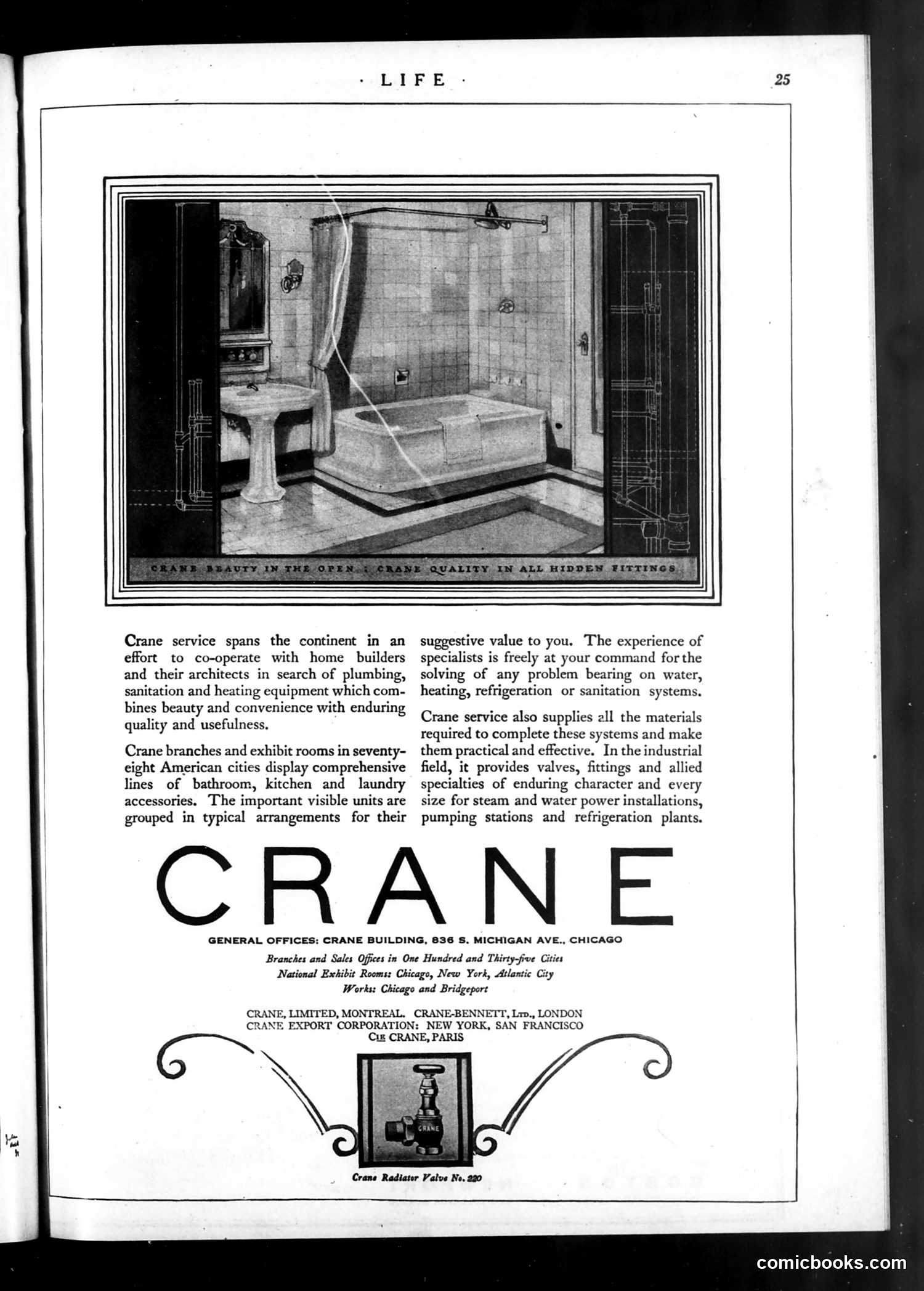
This page is not a cartoon or satire—it's a **full-page advertisement for Crane plumbing and heating equipment**, appearing in Life magazine (likely early 20th century based on the typography and design aesthetic). The image shows a modernist bathroom fixture display, featuring a pedestal sink and bathtub with tiled walls, meant to showcase Crane's products as combining "beauty and convenience with enduring quality." The ad emphasizes Crane's nationwide presence (78 cities) and positioning as a comprehensive supplier for home builders, architects, and industrial clients. There is no political or social satire here. This is straightforward commercial advertising typical of Life magazine's revenue model during this period, using aspirational imagery of modern domestic convenience to market plumbing products to middle and upper-class readers.
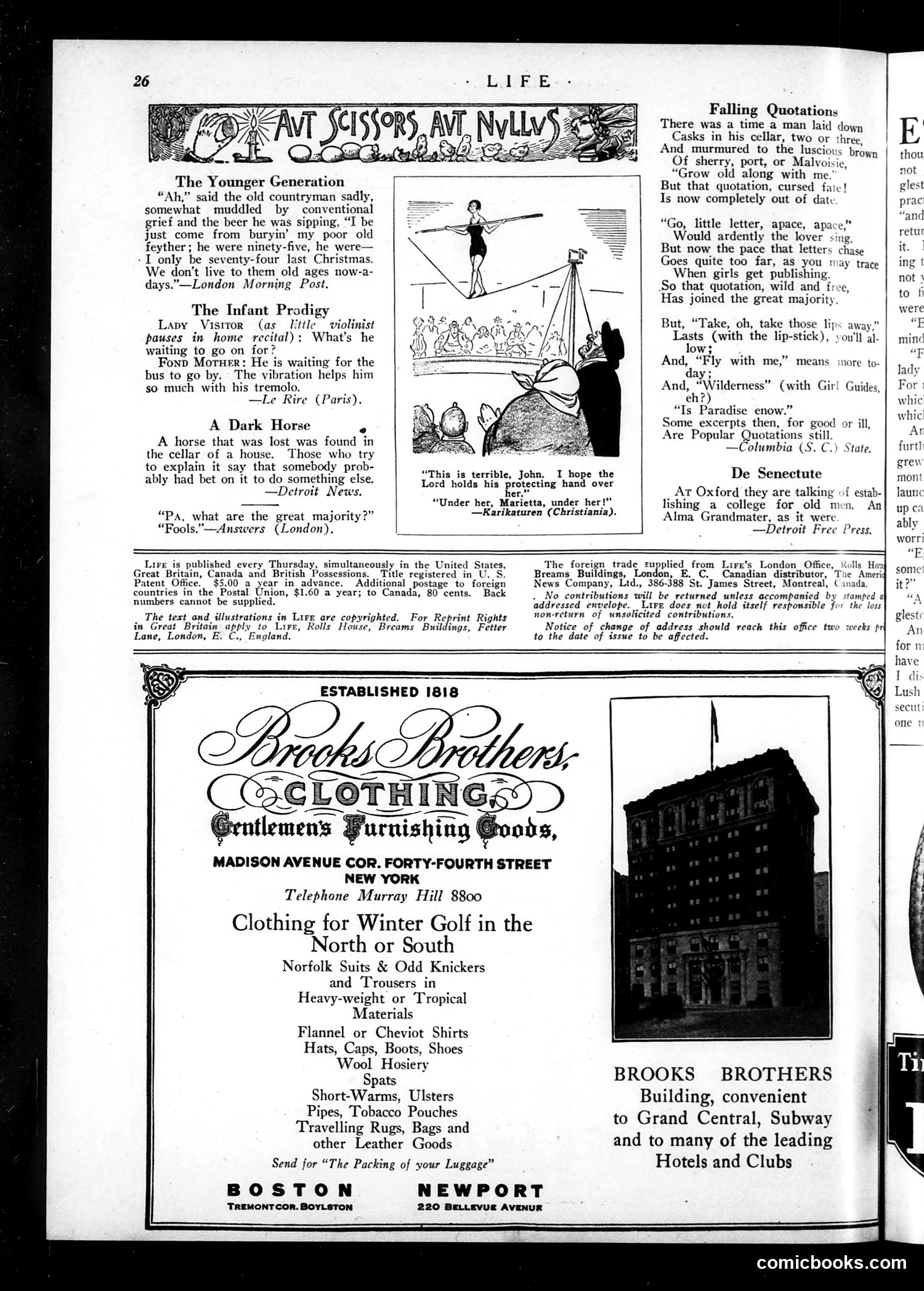
This page contains several short humorous pieces reflecting early 20th-century concerns: **"The Younger Generation"**: A countryman laments that people no longer live to advanced ages like his 95-year-old father, despite being 74 himself—the irony being his own considerable lifespan contradicts his complaint. **"The Infant Prodigy"**: A joke about a young violinist whose tremolo (hand-shaking technique) is aided by bus vibrations passing nearby—satirizing both child performers and their mothers' rationalizations. **"Falling Quotations"**: A poem mourning literary quotations rendered obsolete by modern life. It references Browning's "Grow old along with me," romantic letters now superseded by publishing girls, and love poems with lip-stick references—mocking how modernization (particularly women's new freedoms and cosmetics) has made Victorian sentimentalism outdated. **"De Senectute"**: A brief quip about Oxford proposing a college for elderly men—a classical reference suggesting the absurdity of geriatric education. The page also contains Brooks Brothers advertising, occupying roughly half the space.
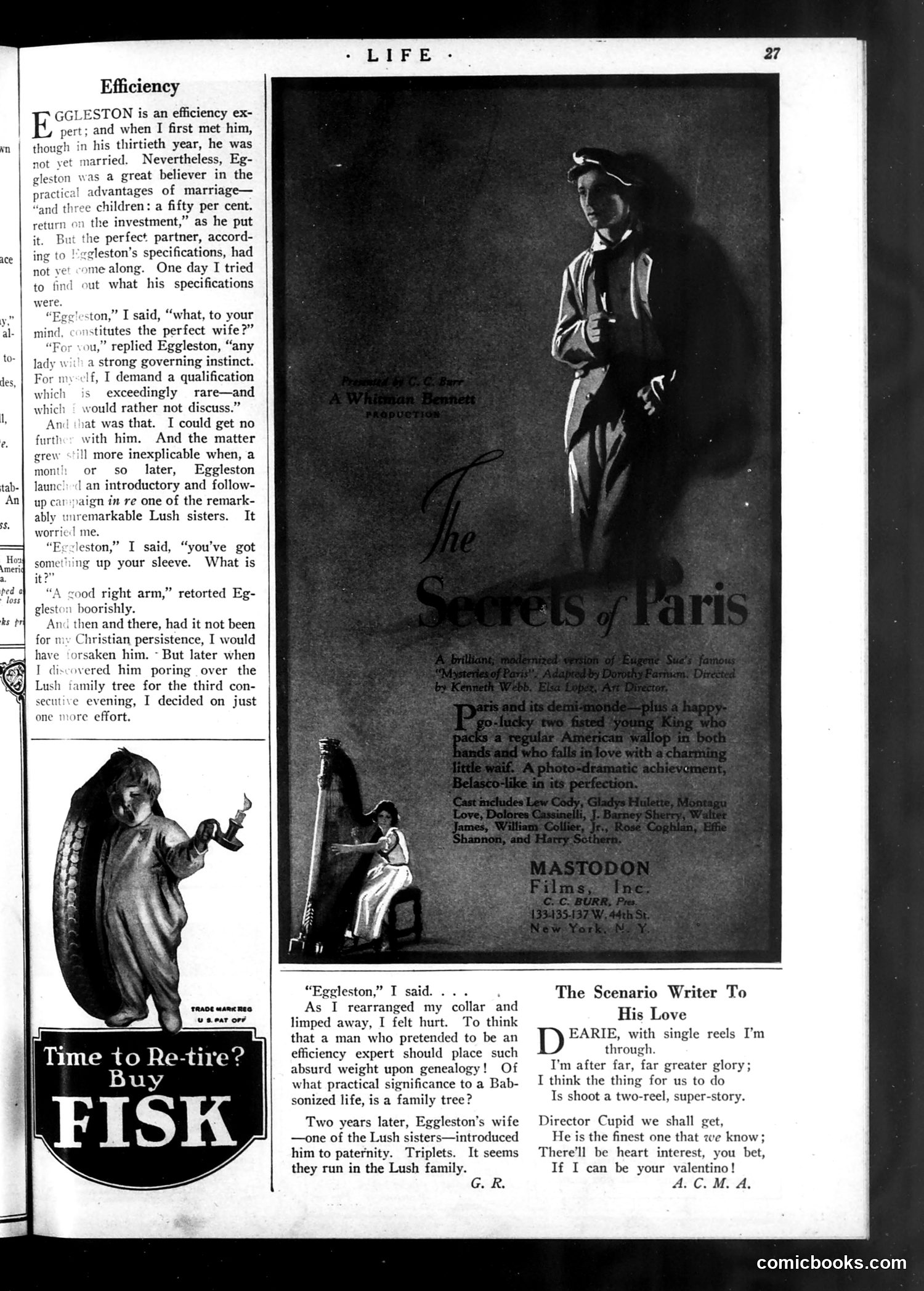
This humorous article mocks the early 20th-century "efficiency expert" craze—business consultants who applied rigid, mathematical approaches to life. The protagonist Eggleston represents this absurd type: he demands his wife possess "a strong governing instinct" as though selecting a machine part, dismisses genealogy as impractical, yet obsessively studies family trees seeking the "perfect" breeding stock. The joke's punchline: after rejecting genealogy as illogical, Eggleston discovers his wife's "Lush family" bloodline produces triplets—proving heredity matters after all. His efficiency calculations collapse when confronted with biological reality. The satire targets how early-1900s pseudo-scientific management philosophy, borrowed from business, was absurdly applied to human relationships and inheritance. The author (G.R.) ridicules Eggleston's contradictions and the era's obsession with quantifying and optimizing everything, including marriage and children as "investments with returns."
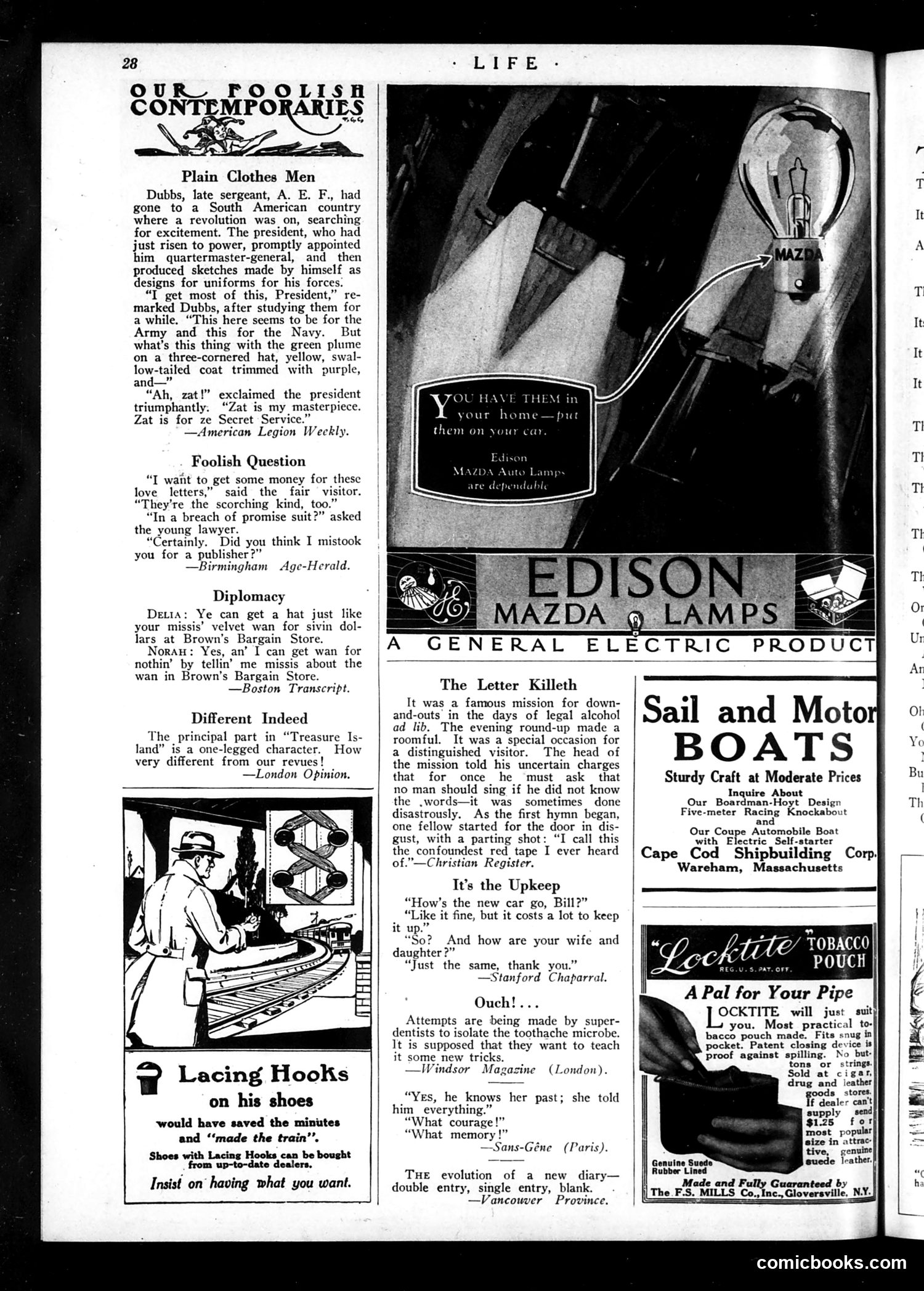
This page from *Life* magazine contains several brief humorous anecdotes typical of the publication's satirical style, plus advertisements. The main cartoon concerns "Plain Clothes Men"—a story about an American ex-soldier (Dubbs) hired by a newly-installed South American dictator to design military uniforms. The joke satirizes revolutionary government incompetence: the president proudly reveals his "masterpiece" uniform for the Secret Service, which is absurdly ornate (green plume, three-cornered hat, purple trim)—mocking how such regimes waste resources on ostentatious symbolism rather than functional governance. Other brief jokes mock common follies: a woman blackmailing with love letters, a man's failed diplomacy, theatrical conventions, and car maintenance costs. These represent *Life*'s stock satirical targets: romance, class pretension, and materialism. The page is otherwise dominated by period advertisements (Edison lamps, boats, tobacco pouches), indicating this is primarily a commercial publication using humor to attract readers.
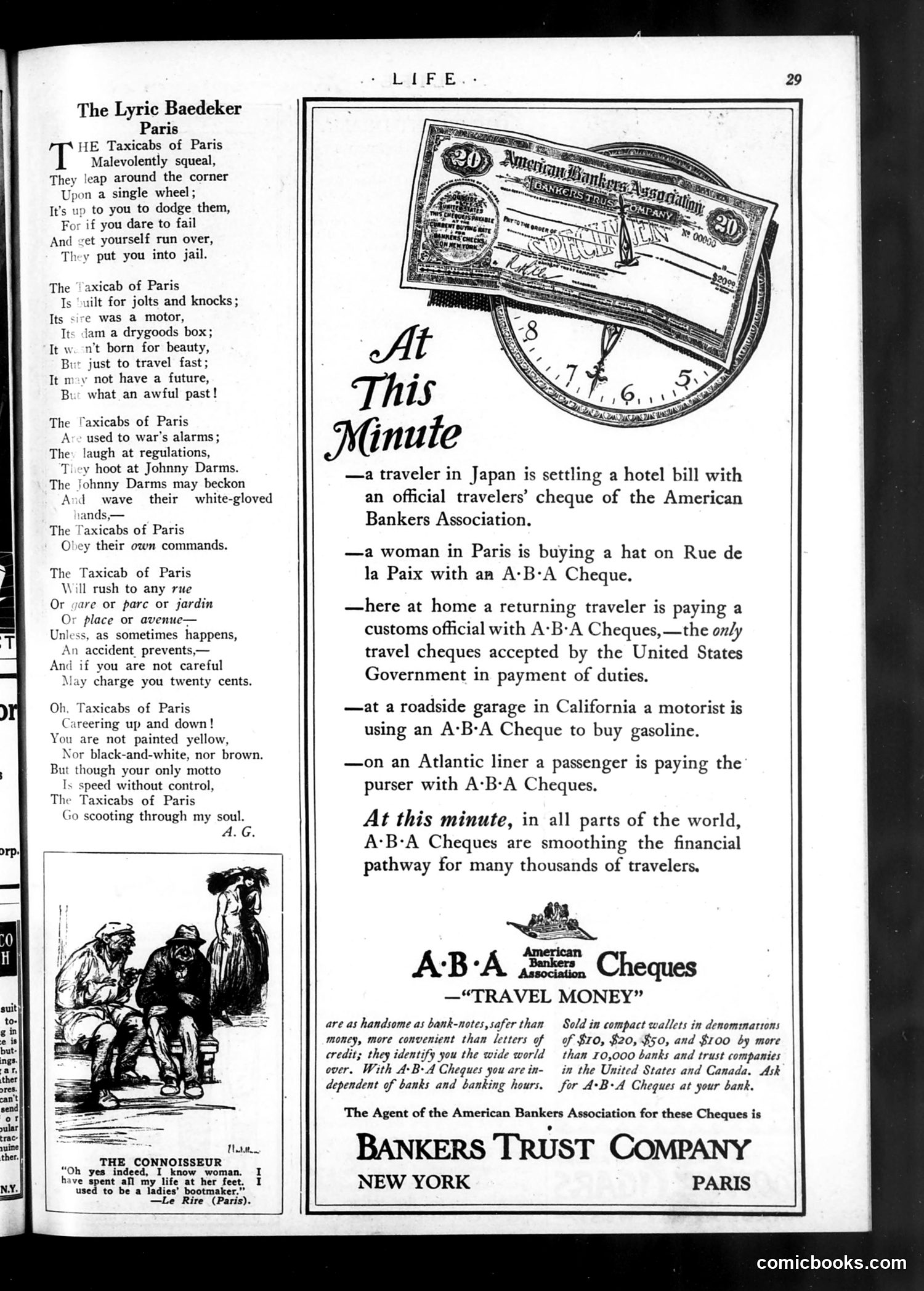
**Left side:** "The Lyric Baedeker Paris" is a humorous poem mocking Parisian taxicabs as reckless, chaotic vehicles driven by operators who ignore traffic laws and regulations ("Johnny Darmes"—likely French traffic police). The satire suggests Paris's taxi culture is dangerous, anarchic, and unpredictable, though oddly charming. The small cartoon below depicts a connoisseur claiming he's spent his life at a woman's feet, revealing he's merely a former ladies' shoemaker—a joke about pretentious social climbing. **Right side:** A full-page advertisement for A·B·A Traveler's Cheques (American Bankers Association), showing multiple scenarios where travelers use these checks globally instead of cash or letters of credit. The ad emphasizes convenience, safety, and government acceptance (notably for U.S. customs duties). This was cutting-edge financial technology for international travel in this era. The page juxtaposes satirical European social commentary with modernizing American financial innovation.
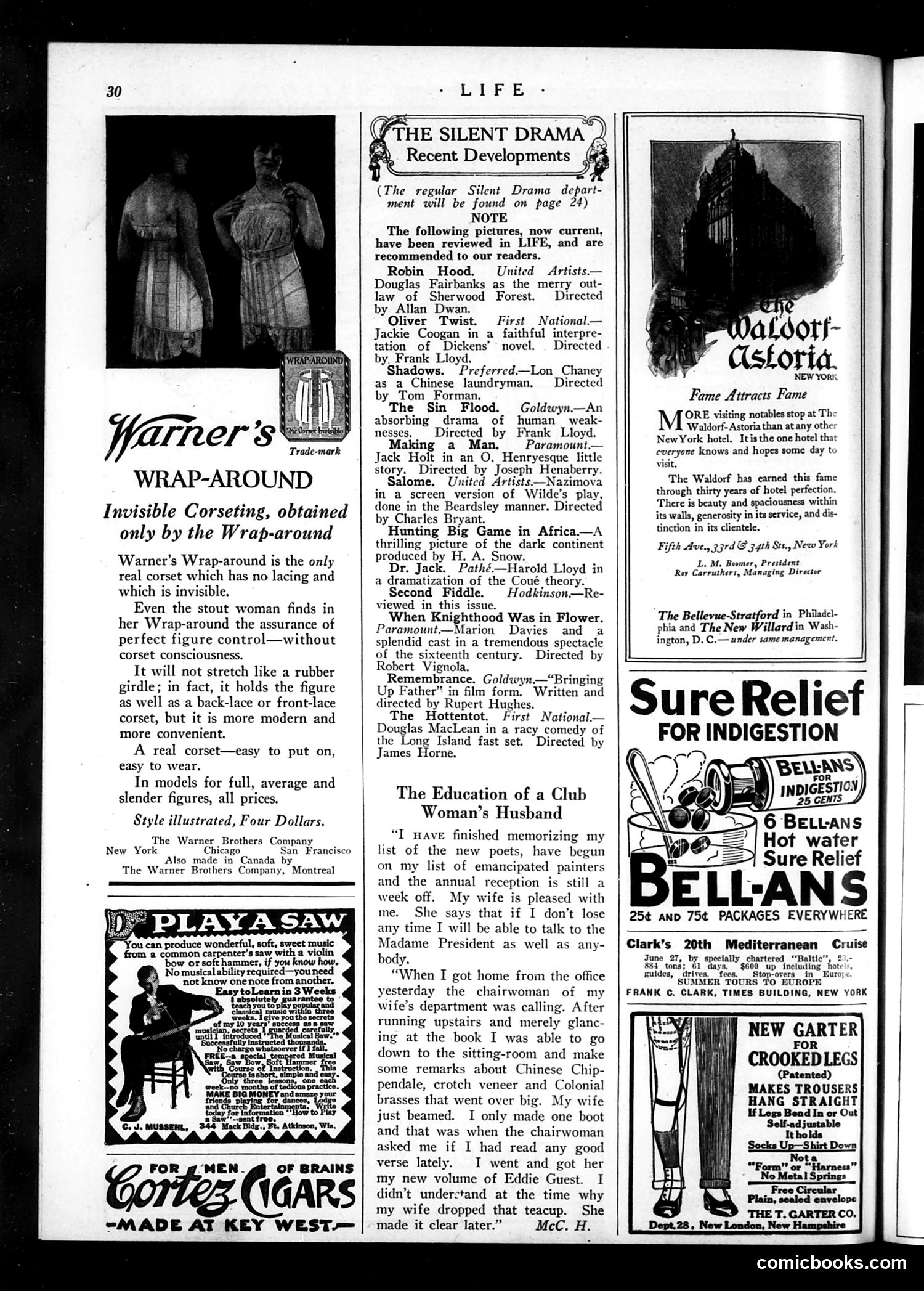
This is primarily a **collection of advertisements and entertainment reviews** from an early-1920s Life magazine issue. The main content includes: - **Warner Wrap-Around corset ad**: Marketed to women seeking "invisible" figure control—a corset with "no lacing" that would stay under clothing without being visible, catering to fashion's shift toward less conspicuous undergarments. - **"The Education of a Club Woman's Husband"** humor piece: A satire on self-improvement and social climbing among the upper-middle class. The husband rapidly memorizes facts about modern poets and artists to impress his wife's club friends, attempting to appear cultured at gatherings. The joke: he cites Eddie Guest (a popular but artistically dismissed poet) and his wife's silent reaction suggests his cultural misstep. - **Movie reviews**: Contemporary films featuring Douglas Fairbanks, Jackie Coogan (child star), Lon Chaney, Marion Davies—now-historical references to popular silent cinema. The page reflects 1920s preoccupations: consumer aspiration, gender performance within social hierarchies, and mass entertainment culture.
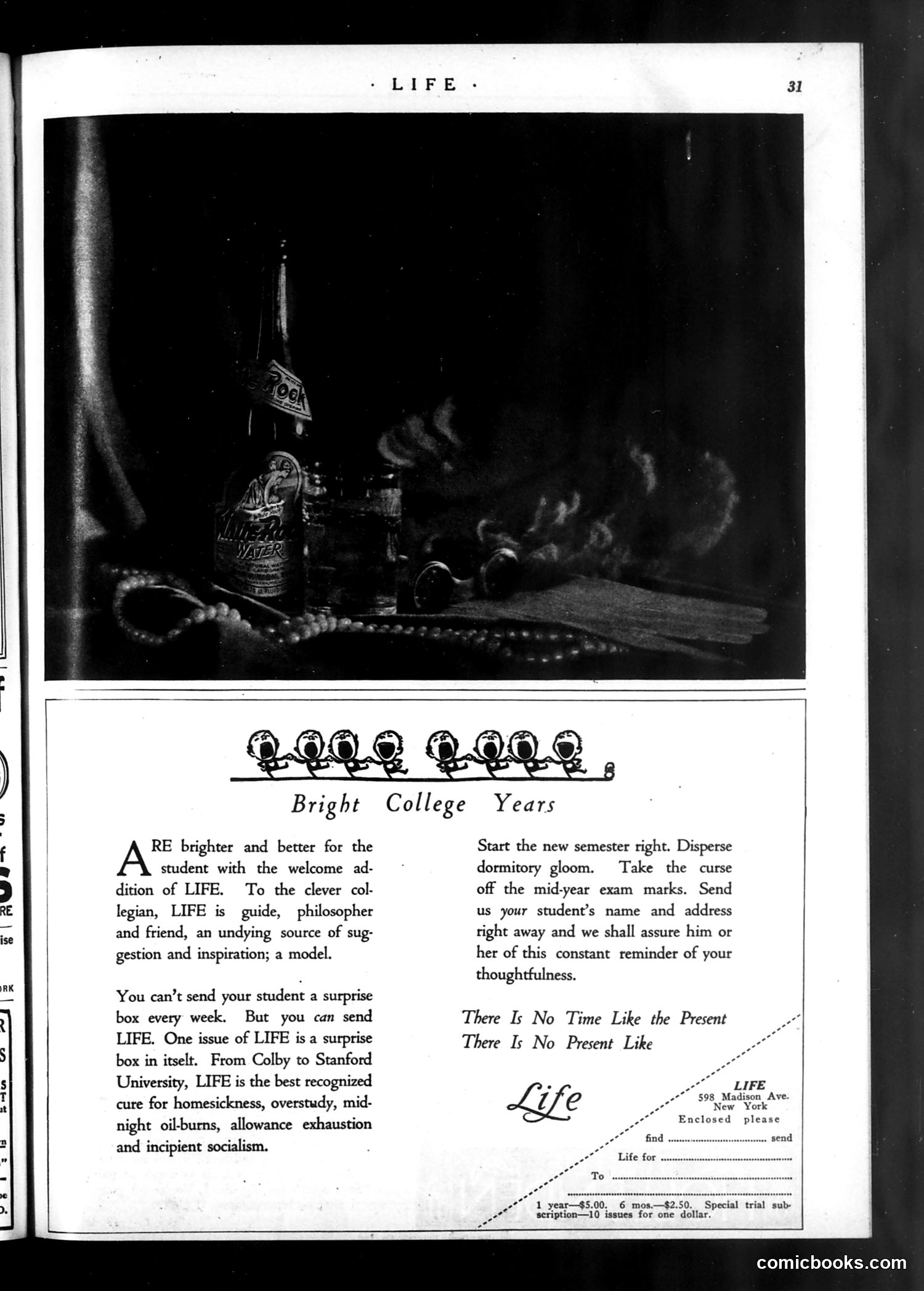
This is primarily a **subscription advertisement** for *Life* magazine targeting parents of college students. The satirical pitch claims *Life* is an essential remedy for typical college ailments: homesickness, academic stress ("mid-year exam marks"), exhaustion from studying ("midnight oil-burns"), financial strain ("allowance exhaustion"), and—notably—"incipient socialism." That final phrase reveals the era's anxieties: parents feared radical political ideas spreading on campuses. By positioning *Life* as an antidote to socialism, the ad suggests the magazine offers safe, establishment humor and values to counteract dangerous student radicalism. The decorative header shows college pennants and festive items (unclear exact references), emphasizing collegiate tradition and wholesomeness. The copy positions *Life* as a "guide, philosopher and friend"—essentially arguing the magazine will keep your student ideologically sound while away from home. This reflects early-to-mid 20th century American concerns about student activism and communist influence.
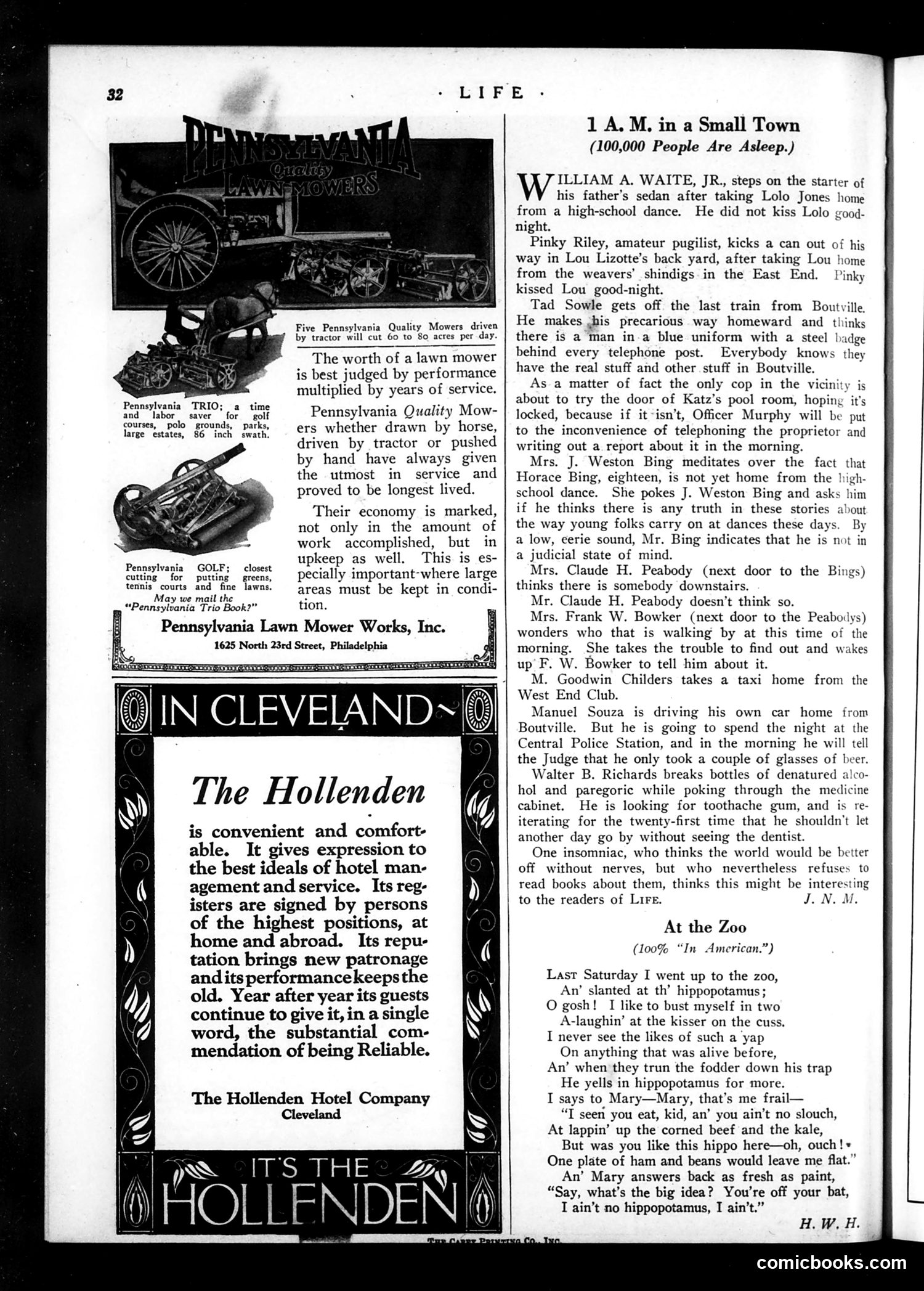
This satirical piece sketches small-town life during the early morning hours, likely written during Prohibition (references to "denatured alcohol," "paregoric," and concern about "stuff in Boutville" suggest illegal drinking). The humor derives from contrasting public anxieties with private realities: parents worry about their children's moral behavior at dances, yet the officer doesn't bother checking the pool room; a man drives drunk and will lie to the judge; another raids medicine cabinets for alcohol substitutes. The piece mocks both parental vigilance (Mrs. Bing's concerns) and the ineffectual enforcement of social morality—authorities are complicit or indifferent, youth engage in mild transgressions (kissing, drinking), and everyday hypocrisy prevails. It captures the gap between small-town propriety and actual conduct, suggesting that moral panic doesn't match reality. The satire targets both the town's pretenses and the adults' naive anxieties about youth behavior.
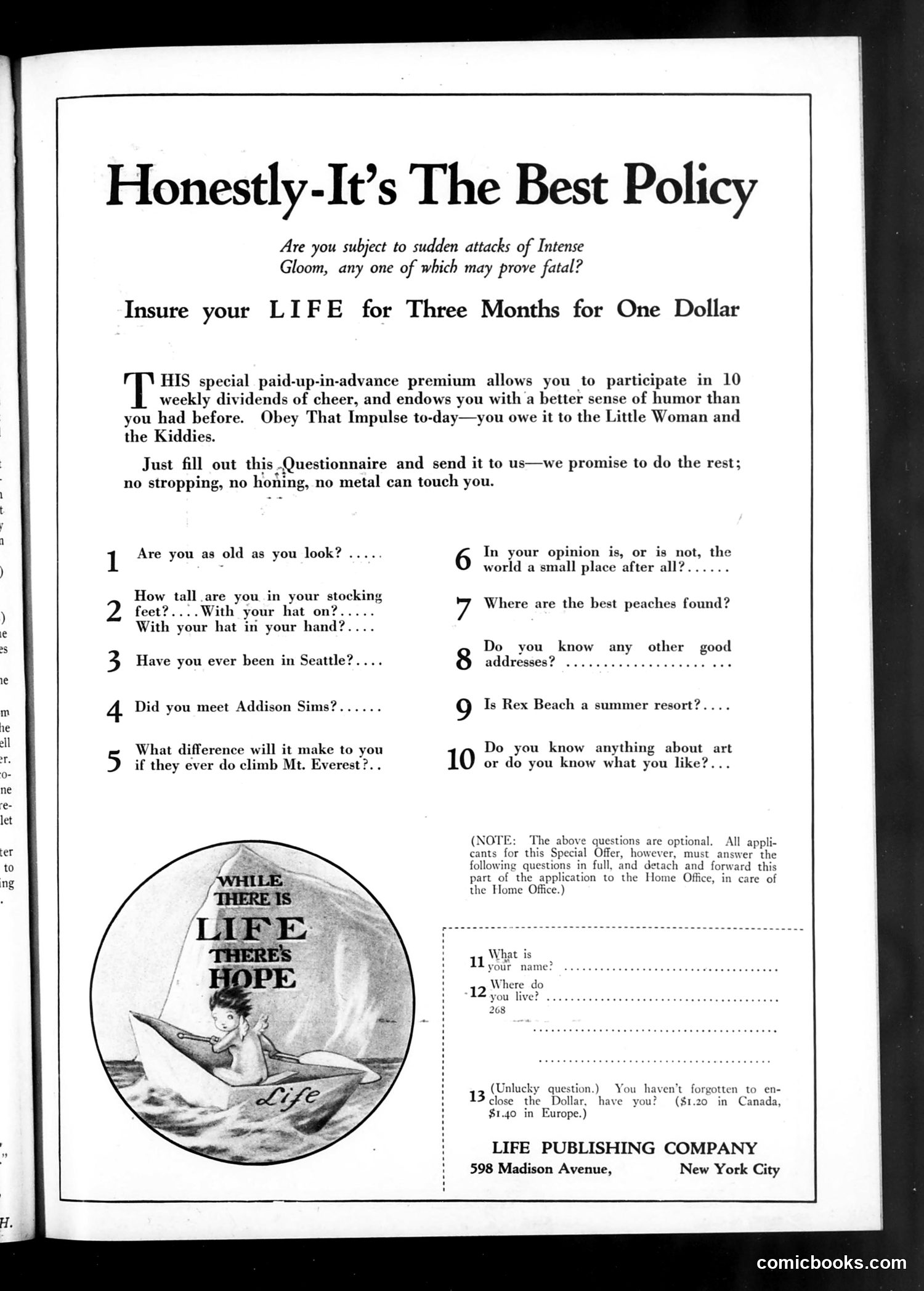
This is a fake insurance advertisement satirizing depression and melancholy through absurdist humor. The pitch offers "life insurance" against "Intense Gloom" for one dollar—a tongue-in-cheek remedy for what appears to be depression or existential despair. The questionnaire includes deliberately ridiculous questions ("Are you as old as you look?" "Did you meet Addison Sims?") that mock insurance applications' invasive nature. The circular illustration shows a figure in a boat with the motto "While There Is Life There's Hope"—a sentiment the ad ironically presents as purchasable. The humor derives from treating emotional suffering as an insurable risk through a cheaply-priced gimmick. References to "the Little Woman and the Kiddies" suggest domestic obligations as motivation for self-improvement. The note about "no stropping, no honing, no metal can touch you" appears to be a darkly comedic reference to self-harm prevention—another indicator this targets depression. This reflects early-twentieth-century Life magazine's satirical approach to contemporary anxieties and social absurdities.
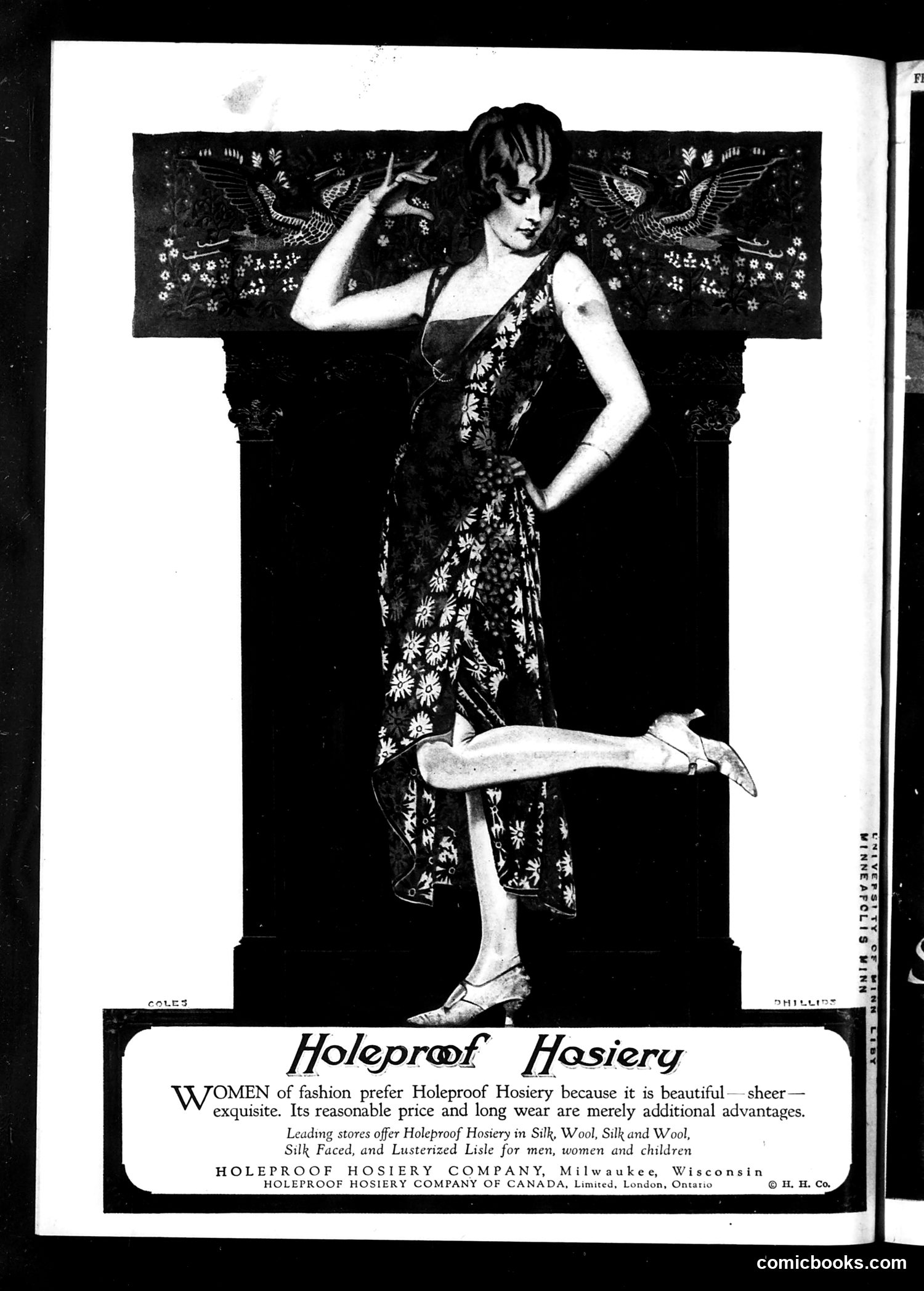
This is a **vintage advertisement**, not political satire. It promotes Holeproof Hosiery, a real brand from the early 20th century. The image features a stylized illustration of a fashionable woman in an elegant, patterned robe striking a posed stance against an Art Deco-style decorative background with winged motifs. She displays her leg to showcase the hosiery product. The ad's pitch emphasizes that quality hosiery appeals to fashion-conscious women—beauty and sheerness are primary selling points, with durability and affordability presented as bonuses. The text highlights multiple material options (silk, wool, blends, lisle) for different demographics. This reflects early-1900s marketing strategy: using glamorous imagery and aspirational lifestyle appeal rather than practical product claims to drive consumer desire. The woman's fashionable appearance and confident pose reinforce the message that wearing this brand signifies sophistication and taste.