
Life, 1923-02-08 · page 34 of 36
Life — February 8, 1923 — page 34: what you’re looking at
What you’re looking at
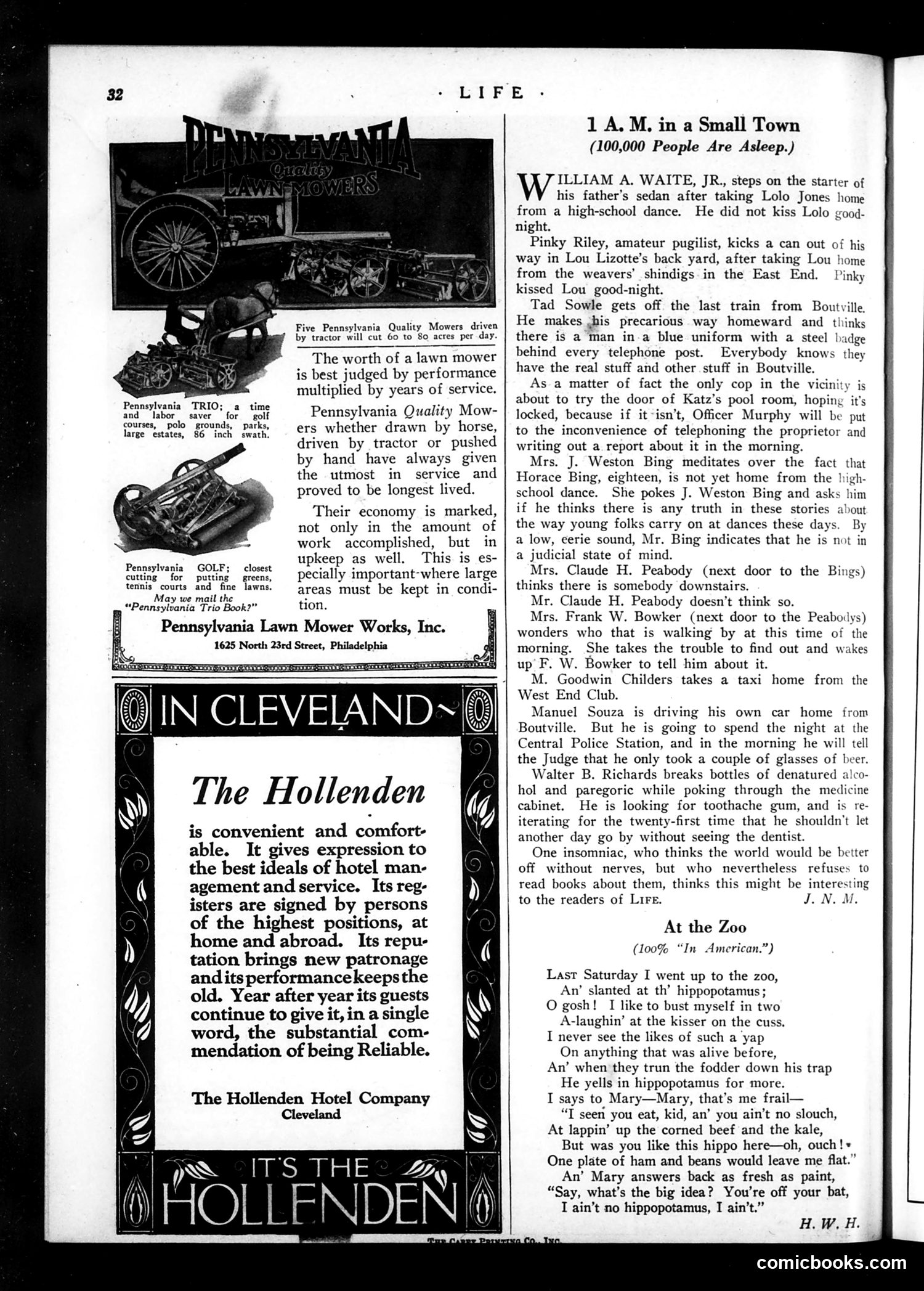
This satirical piece sketches small-town life during the early morning hours, likely written during Prohibition (references to "denatured alcohol," "paregoric," and concern about "stuff in Boutville" suggest illegal drinking). The humor derives from contrasting public anxieties with private realities: parents worry about their children's moral behavior at dances, yet the officer doesn't bother checking the pool room; a man drives drunk and will lie to the judge; another raids medicine cabinets for alcohol substitutes. The piece mocks both parental vigilance (Mrs. Bing's concerns) and the ineffectual enforcement of social morality—authorities are complicit or indifferent, youth engage in mild transgressions (kissing, drinking), and everyday hypocrisy prevails. It captures the gap between small-town propriety and actual conduct, suggesting that moral panic doesn't match reality. The satire targets both the town's pretenses and the adults' naive anxieties about youth behavior.
📄 Transcribed text from this page (OCR, searchable)
Machine-transcribed from the original scan — historical spelling and the odd misread are preserved.
Pennsylvania TRIO; a time and labor saver for golf courses, polo grounds, parks, large estates, 86 inch swath. Pennsylvania GOLF; closest cutting for putting greens, tennis courts and fine lawns, May we mail the “Pennsylvania Trio Book?” Five Pennsylvania Quality Mowers driven by tractor will cut 60 to 80 acres per day. The worth of a lawn mower is best judged by performance multiplied by years of service. Pennsylvania Quality Mow- ers whether drawn by horse, driven by tractor or pushed by hand have always given the utmost in service and proved to be longest lived. Their economy is marked, not only in the amount of work accomplished, but in upkeep as well. This is es- pecially important-where large areas must be kept in condi- tion. Pennsylvania Lawn Mower Works, Inc. 1625 North 23rd Street, Philadelphia The Hollenden is convenient and comfort- able. It gives expression to the best ideals of hotel man- agement and service. Its reg- isters are signed by persons of the highest positions, at home and abroad. Its repu- tation brings new patronage and its performancekeeps the old. Year after year its guests continue to give it, in a single word, the substantial com- mendation of being Reliable. The Hollenden Hotel Company nN Cleveland ITS THE By | iy SOLLENDEN 1 A. M. in a Small Town (100,000 People Are Asleep.) ILLIAM A. WAITE, JR., steps on the starter of his father’s sedan after taking Lolo Jones home from a high-school dance. He did not kiss Lolo good- night. Pinky Riley, amateur pugilist, kicks a can out of his way in Lou Lizotte’s back yard, after taking Lou home from the weavers’ shindigs in the East End. Pinky kissed Lou good-night. ‘ Tad Sowle gets off the last train from Boutville, He makes ,his precarious way homeward and thinks there is a man in-a blue uniform with a steel | udge behind every telephone post. Everybody knows they have the real stuff and other stuff in Boutville. . As a matter of fact the only cop in the vicinity js about to try the door of Katz’s pool room, hoping it's locked, because if it-isn’t, Officer Murphy will be put to the inconvenience of telephoning the proprietor and writing out a report about it in the morning. Mrs. J. Weston Bing meditates over the fact that Horace Bing, eighteen, is not yet home from the high- school dance. She pokes J. Weston Bing and asks him if he thinks there is any truth in these stories about the way young folks carry on at dances these days. By a low, eerie sound, Mr. Bing indicates that he is not in a judicial state of mind. Mrs. Claude H. Peabody (next door to the Bings) thinks there is somebody downstairs. Mr. Claude H. Peabody doesn’t think so. Mrs. Frank W. Bowker (next door to the Peabodys) wonders who that is walking by at this time of the morning. She takes the trouble to find out and wakes up F. W. Bowker to tell him about it. M. Goodwin Childers takes a taxi home from the West End Club. Manuel Souza is driving his own car home from Boutville. But he is going to spend the night at the Central Police Station, and in the morning he will tell the Judge that he only took a couple of glasses of beer. Walter B. Richards breaks bottles of denatured alco- hol and paregoric while poking through the medicine cabinet. He is looking for toothache gum, and is re- iterating for the twenty-first time that he shouldn't let another day go by without seeing the dentist. One insomniac, who thinks the world would be better off without nerves, but who nevertheless refuses to read books about them, thinks this might be intere | to the readers of Lire. JN. M. At the Zoo (100% “In Lasr Saturday I went up to the zoo, An’ slanted at th’ hippopotamus ; O gosh! I like to bust myself in two A-laughin’ at the kisser on the cuss. I never see the likes of such a yap On anything that was alive before, An’ when they trun the fodder down his trap He yells in hippopotamus for more. I says to Mary—Mary, that’s me frail— “T seen you eat, kid, an’ you ain’t no slouch, At lappin’ up the corned beef and the kale, But was you like this hippo here—oh, ouch! + One plate of ham and beans would leave me flat.” An’ Mary answers back as fresh as paint, “Say, what’s the big idea? You're off your bat, I ain’t no hippopotamus, I ain’t.” American.”) H.W. H. comicbooks.com