
Life, 1923-02-08 · page 22 of 36
Life — February 8, 1923 — page 22: what you’re looking at
What you’re looking at
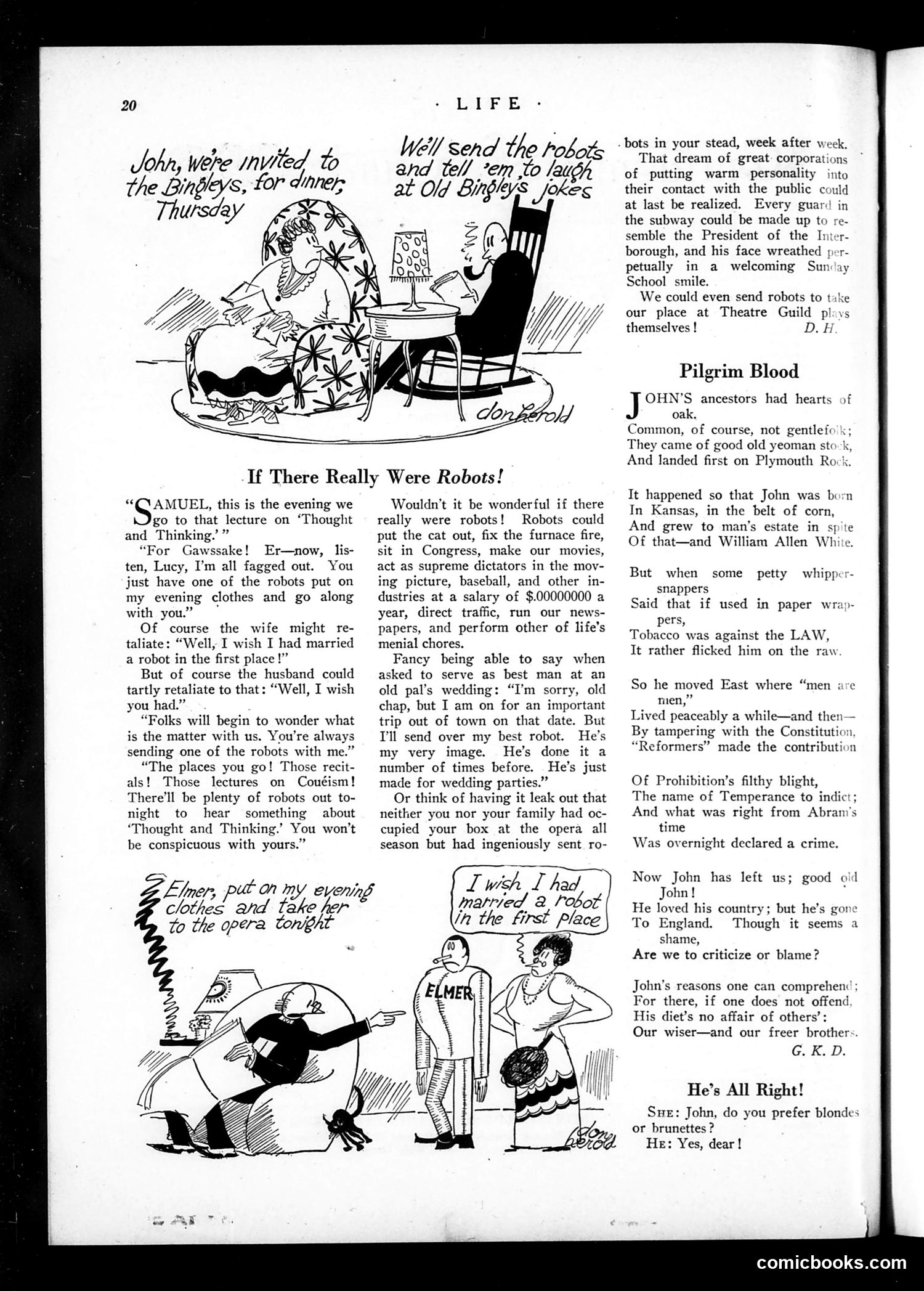
This page contains two satirical pieces typical of 1920s American humor. **"If There Really Were Robots!"** imagines a future where domestic robots perform tedious social obligations—attending lectures, operas, and dinners in owners' place. The satire targets the era's ennui among the middle class, their desire to escape social conventions, and the drudgery of obligatory socializing. References to "Couéism" (a popular self-help movement) and Congress suggest robots could replace both boring entertainment and incompetent government. **"Pilgrim Blood"** concerns John, whose ancestors came on the Mayflower, but who emigrated to England to escape Prohibition. The satire critiques America's 1920 alcohol ban as un-American and tyrannical, forcing a patriotic citizen into exile. The poem's tone suggests the author (G.K.D.) views Prohibition as fundamentally contrary to American freedom and personal liberty. The closing joke plays on the cliché marriage question about blonde versus brunette preferences—the husband's evasive "Yes, dear!" mocks men's inability to answer wives honestly.
📄 Transcribed text from this page (OCR, searchable)
Machine-transcribed from the original scan — historical spelling and the odd misread are preserved.
20 John, Were invited To the Bingleys, for dinner, Thursday LIFE We send the robots and tell *em ,to laugh at Old Singlys JOKES If There Really Were Robots! “QAMUEL, this is the evening we go to that lecture on ‘Thought and Thinking.’ ” “For Gawssake! Er—now, lis- ten, Lucy, I’m all fagged out. You just have one of the robots put on my evening clothes and go along with you.” Of course the wife might re- taliate: “Well, I wish I had married a robot in the first place!” But of course the husband could tartly retaliate to that: “Well, I wish you had.” “Folks will begin to wonder what is the matter with us. You're always sending one of the robots with me.” “The places you go! Those recit- als! Those lectures on Couéism! There'll be plenty of robots out to- night to hear something about ‘Thought and Thinking.’ You won't be conspicuous with yours.” Filmer, put an my epeving clothes and take fer to the opera tonight Wouldn't it be wonderful if there really were robots! Robots could put the cat out, fix the furnace fire, sit in Congress, make our movies, act as supreme dictators in the mov- ing picture, baseball, and other in- dustries at a salary of $.00000000 a year, direct traffic, run our news- papers, and perform other of life’s menial chores. Fancy being able to say when asked to serve as best man at an old pal’s wedding: “I’m sorry, old chap, but I am on for an important trip out of town on that date. But Til send over my best robot. He's my very image. He’s done it a number of times before. He's just made for wedding parties.” Or think of having it leak out that neither you nor your family had oc- cupied your box at the opera all season but had ingeniously sent ro- Ll wih T had, matried 2 robot /h the first Place bots in your stead, week after week, That dream of great: corporations of putting warm personality into their contact with the public could at last be realized. Every guard i the subway could be made up to re- semble the President of the Inte borough, and his face wreathed p petually in a welcoming Sun School smile. We could even send robots to take our place at Theatre Guild pls) themselves ! D.H Pilgrim Blood OHN’S ancestors had hearts oak. Common, of course, not gentlefo'k; They came of good old yeoman sto:k, And landed first on Plymouth Roc} It happened so that John was b In Kansas, in the belt of corn, And grew to man’s estate in spit Of that—and William Allen Wh But when snappers Said that if used in paper wrap- pers, Tobacco was against the LAW, It rather flicked him on the raw some petty whipper- So he moved East where “men are mien,” Lived peaceably a while—and then— By tampering with the Constitution, “Reformers” made the contribution Of Prohibition’s filthy blight, The name of Temperance to indict; And what was right from Abram’s time Was overnight declared a crime. Now John has left us; good old John! , He loved his country; but he’s gone To England. Though it seems a shame, Are we to criticize or blame? John’s reasons one can comprehend ; For there, if one does not offend His diet’s no affair of others’: Our wiser—and our freer brothers. G. K. D. He’s All Right! Sue: John, do you prefer blondes or brunettes ? He: Yes, dear! comicbooks.com