
Life, 1923-02-08 · page 20 of 36
Life — February 8, 1923 — page 20: what you’re looking at
What you’re looking at
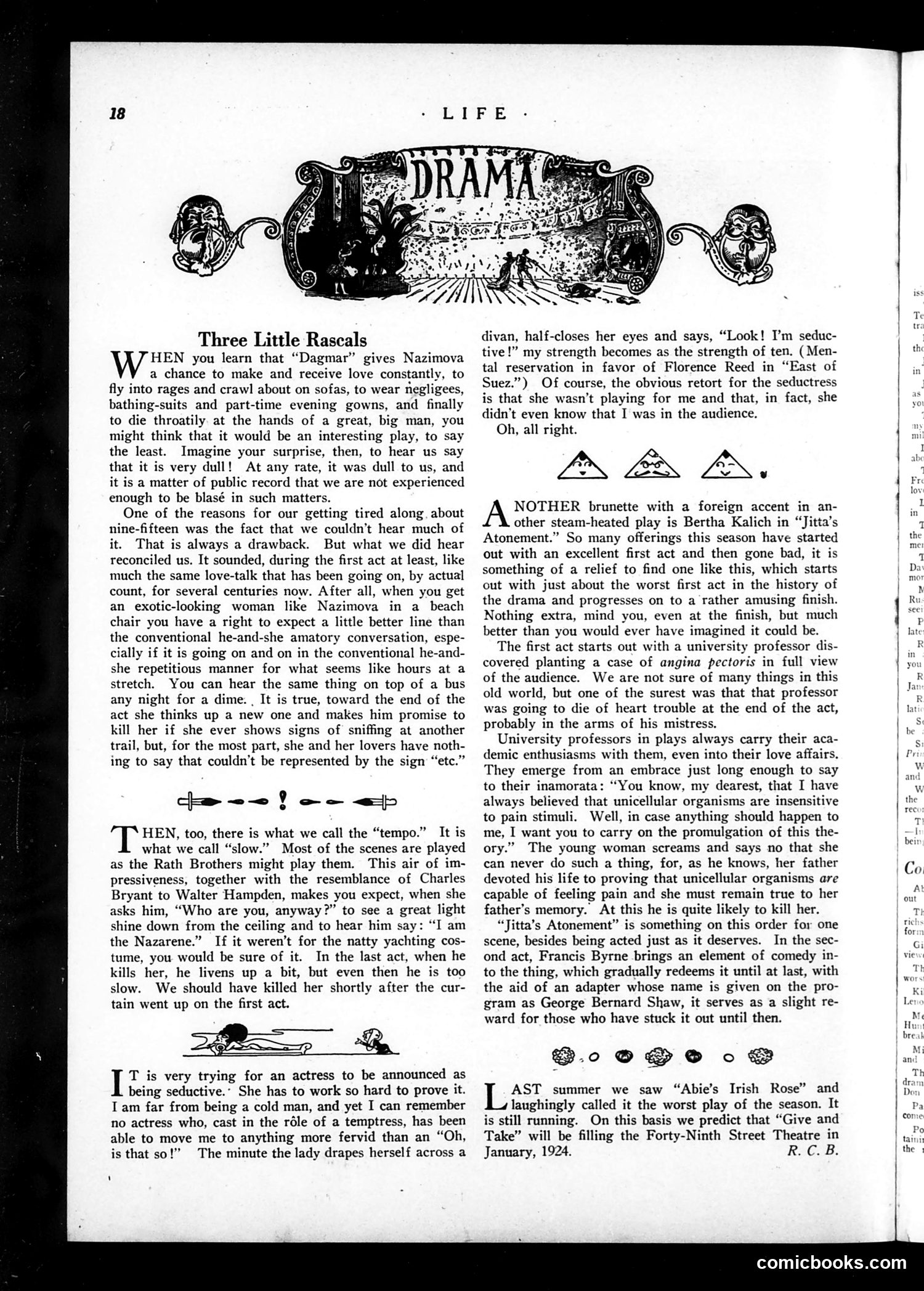
This page reviews three theatrical productions. The main review concerns "Dagmar," starring the famous Russian-American actress Alla Nazimova. The critic finds it dull despite its promising premise—Nazimova playing a seductive woman in negligees who dies dramatically. The problems: poor audibility, clichéd dialogue (dismissing it as mere "etc."), and sluggish pacing. The critic sarcastically suggests they should have killed her character after the first act curtain. The piece also mocks the theatrical convention of actresses performing "seduction," arguing that when women self-consciously "play seductive," it's ineffective rather than compelling. Brief mentions follow of "Jitta's Atonement" (with Bertha Kalich) and a positive reference to "Abie's Irish Rose" as the season's worst play. The satire targets both pretentious dramatic conventions and overwrought acting styles typical of 1920s theater.
📄 Transcribed text from this page (OCR, searchable)
Machine-transcribed from the original scan — historical spelling and the odd misread are preserved.
Three Little Rascals HEN you learn that “Dagmar” gives Nazimova a chance to make and receive love constantly, to fly into rages and crawl about on sofas, to wear negligees, bathing-suits and part-time evening gowns, and finally to die throatily at the hands of a great, big man, you might think that it would be an interesting play, to say the least. Imagine your surprise, then, to hear us say that it is very dull! At any rate, it was dull to us, and it is a matter of public record that we are not experienced enough to be blasé in such matters. One of the reasons for our getting tired along, about nine-fifteen was the fact that we couldn’t hear much of it. That is always a drawback. But what we did hear reconciled us. It sounded, during the first act at least, like much the same love-talk that has been going on, by actual count, for several centuries now. After all, when you get an exotic-looking woman like Nazimova in a beach chair you have a right to expect a little better line than the conventional he-and-she amatory conversation, espe- cially if it is going on and on in the conventional he-and- she repetitious manner for what seems like hours at a stretch. You can hear the same thing on top of a bus any night for a dime. , It is true, toward the end of the act she thinks up a new one and makes him promise to kill her if she ever shows signs of sniffing at another trail, but, for the most part, she and her lovers have noth- ing to say that couldn’t be represented by the sign “etc.” cee -—— 9 oe <p HEN, too, there is what we call the “tempo.” It is what we call “slow.” Most of the scenes are played as the Rath Brothers might play them. This air of im- pressiveness, together with the resemblance of Charles Bryant to Walter Hampden, makes you expect, when she asks him, “Who are you, anyway?” to see a great light shine down from the ceiling and to hear him say: “I am the Nazarene.” If it weren’t for the natty yachting cos- tume, you would be sure of it. In the last act, when he kills her, he livens up a bit, but even then he is too slow. We should have killed her shortly after the cur- tain went up on the first act. a= & T is very trying for an actress to be announced as being seductive.” She has to work so hard to prove it. I am far from being a cold man, and yet I can remember no actress who, cast in the réle of a temptress, has been able to move me to anything more fervid than an “Oh, is that so!” The minute the lady drapes herself across a divan, half-closes her eyes and says, “Look! I’m seduc- tive!” my strength becomes as the strength of ten. (Men- tal reservation in favor of Florence Reed in “East of Suez.”) Of course, the obvious retort for the seductress is that she wasn’t playing for me and that, in fact, she didn’t even know that I was in the audience. Oh, all right. Tes, ts, Pex NOTHER brunette with a foreign accent in an- other steam-heated play is Bertha Kalich in “Jitta’s Atonement.” So many offerings this season have started out with an excellent first act and then gone bad, it is something of a relief to find one like this, which starts out with just about the worst first act in the history of the drama and progresses on to a rather amusing finish. Nothing extra, mind you, even at the finish, but much better than you would ever have imagined it could be. The first act starts out with a university professor dis- covered planting a case of angina pectoris in full view of the audience. We are not sure of many things in this old world, but one of the surest was that that professor was going to die of heart trouble at the end of the act, probably in the arms of his mistress. University professors in plays always carry their aca- demic enthusiasms with them, even into their love affairs. They emerge from an embrace just long enough to say to their inamorata: ‘‘You know, my dearest, that I have always believed that unicellular organisms are insensitive to pain stimuli. Well, in case anything should happen to me, I want you to carry on the promulgation of this the- ory.” The young woman screams and says no that she can never do such a thing, for, as he knows, her father devoted his life to proving that unicellular organisms are capable of feeling pain and she must remain true to her father’s memory. At this he is quite likely to kill her. “Jitta’s Atonement” is something on this order for one scene, besides being acted just as it deserves. In the sec- ond act, Francis Byrne brings an element of comedy in- to the thing, which gradually redeems it until at last, with the aid of an adapter whose name is given on the pro- gram as George Bernard Shaw, it serves as a slight re- ward for those who have stuck it out until then. @c®oGec@ AST summer we saw “Abie’s Irish Rose” and laughingly called it the worst play of the season. It is still running. On this basis we predict that “Give and Take” will be filling the Forty-Ninth Street Theatre in January, 1924. R.C.B. bei comicbooks.com