
Life, 1923-02-08 · page 24 of 36
Life — February 8, 1923 — page 24: what you’re looking at
What you’re looking at
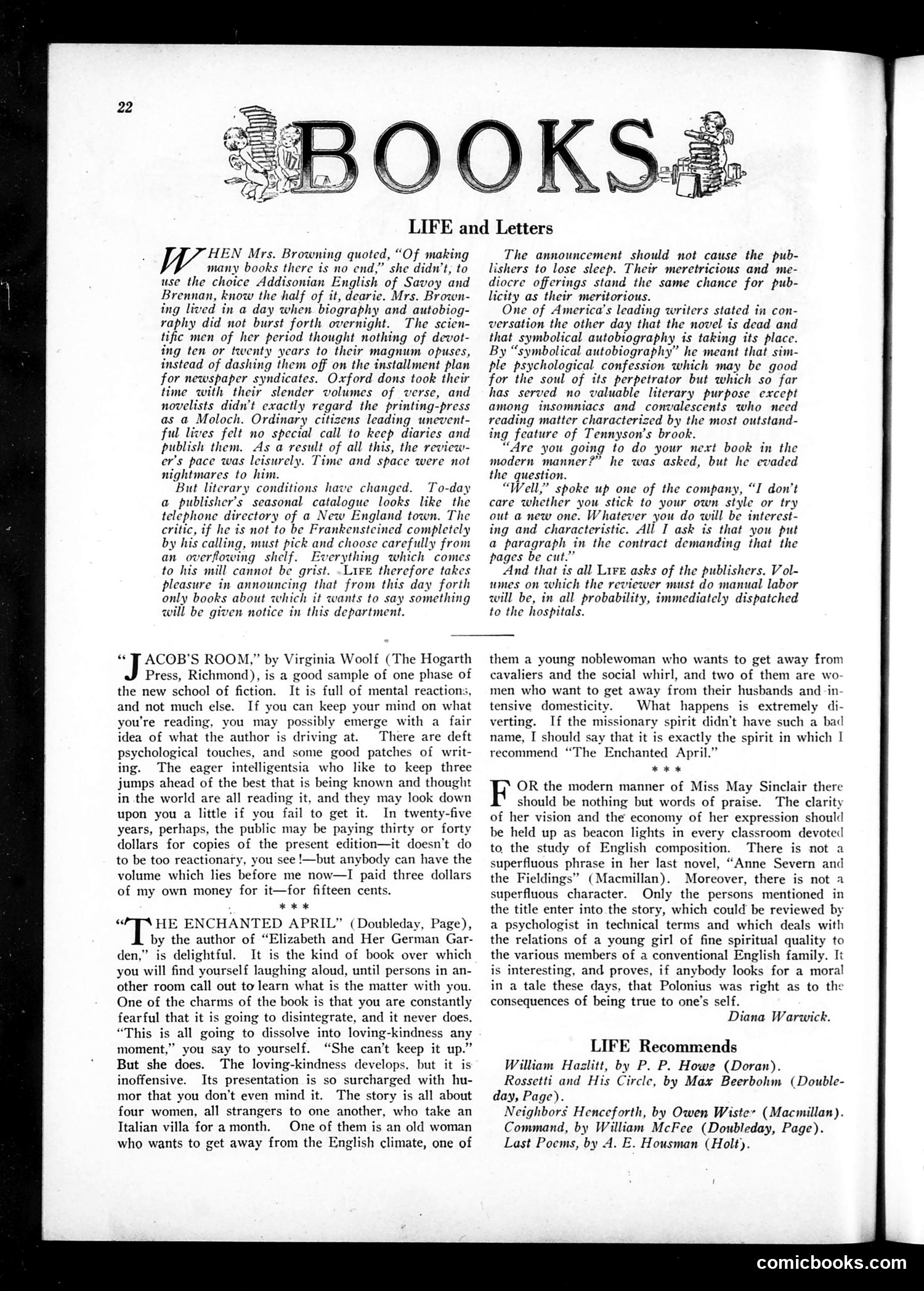
This is a **book review column**, not a political cartoon. The page discusses early 1920s literary trends with pointed satire about modern publishing excess. The main target is **Virginia Woolf's "Jacob's Room,"** mocked as overly intellectual and psychologically dense—so difficult that readers may fail to understand it, yet the "eager intelligentsia" read it to appear sophisticated. The reviewer sarcastically notes the book costs three dollars new but will sell for fifteen cents, suggesting it has no lasting value despite current prestige. By contrast, **"The Enchanted April"** is praised as genuinely delightful and accessible—the reviewer actually laughed while reading it. The column's **broader satire** criticizes modern publishing's speed and volume: authors now dash off books "on the installment plan" for newspapers rather than carefully crafting work over years, as in Elizabeth Barrett Browning's era. This flood of mediocre books makes the critic's job overwhelming. The *Life* magazine's response: **only review books worth discussing**—a witty declaration that merit, not trends, determines coverage.
📄 Transcribed text from this page (OCR, searchable)
Machine-transcribed from the original scan — historical spelling and the odd misread are preserved.
LIFE and Letters HEN Mrs. Browning quoted, “Of making many books there is no end,” she didn’t, to use the choice Addisonian English of Savoy and Brennan, know the half of it, dearie. Mrs. Brown- ing lived in a day when biography and autobiog- raphy did not burst forth overnight. The scien- tific men of her period thought nothing of devot- ing ten or twenty years to their magnum opuses, instead of dashing them off on the installment plan for newspaper syndicates. Oxford dons took their time with their slender volumes of verse, and novelists didn’t exactly regard the printing-press as a Moloch. Ordinary citizens leading unevent- ful lives felt no special call to keep diaries and publish them. As a result of all this, the review- er’s pace was leisurely. Time and space were not nightmares to him. But literary conditions have changed. To-day a publisher's seasonal catalogue looks like the telephone directory of a New England town. The critic, if he is not to be Frankensteined completely by his calling, must pick and choose carefully from an overflowing shelf. Everything which comes to his mill cannot be grist. .Lire therefore takes pleasure in announcing that from this day forth only books about which it wants to say something will be given notice in this department. “JACOB'S ROOM,” by Virginia Woolf (The Hogarth Press, Richmond), is a good sample of one phase of the new school of fiction. It is full of mental reactions, and not much else. If you can keep your mind on what you're reading, you may possibly emerge with a fair idea of what the author is driving at. There are deft psychological touches, and some good patches of writ- ing. The eager intelligentsia who like to keep three jumps ahead of the best that is being known and thought in the world are all reading it, and they may look down upon you a little if you fail to get it. In twenty-five years, perhaps, the public may be paying thirty or forty dollars for copies of the present edition—it doesn’t do to be too reactionary, you see !—but anybody can have the volume which lies before me now—I paid three dollars of my own money for it—for fifteen cents. aK «a HE ENCHANTED APRIL” (Doubleday, Page), by the author of “Elizabeth and Her German Gar- den,” is delightful. It is the kind of book over which you will find yourself laughing aloud, until persons in an- other room call out to learn what is the matter with you. One of the charms of the book is that you are constantly fearful that it is going to disintegrate, and it never does. “This is all going to dissolve into loving-kindness any moment,” you say to yourself. “She can’t keep it up.” But she does. The loving-kindness develops, but it is inoffensive. Its presentation is so surcharged with hu- mor that you don’t even mind it. The story is all about four women, all strangers to one another, who take an Italian villa for a month. One of them is an old woman who wants to get away from the English climate, one of The announcement should not cause the pub- lishers to lose sleep. Their meretricious and me- diocre offerings stand the same chance for pub- licity as their meritorious. One of America’s leading writers stated in con- versation the other day that the novel is dead and that symbolical autobiography is taking its place. By “symbolical autobiography” he meant that sim- ple psychological confession which may be good for the soul of its perpetrator but which so far has served no valuable literary purpose except among insomniacs and convalescents who need reading matter characterized by the most outstand- ing feature of Tennyson’s brook. “Are you going to do your next book in the modern manner?” he was asked, but he evaded the question. “Well,” spoke up one of the company, “I don’t care whether you stick to your own style or try out a new one. Whatever you do will be interest- ing and characteristic. All I ask is that you put a paragraph in the contract demanding that the pages be cut.” And that is all Lire asks of the publishers. Vol- umes on which the reviewer must do manual labor will be, in all probability, immediately dispatched to the hospitals. them a young noblewoman who wants to get away from cavaliers and the social whirl, and two of them are wo- men who want to get away from their husbands and -in- tensive domestici What happens is extremely di- verting. If the missionary spirit didn’t have such a bad name, I should say that it is exactly the spirit in which | recommend “The Enchanted April.” eee OR the modern manner of Miss May Sinclair there should be nothing but words of praise. The clarity of her vision and the economy of her expression should be held up as beacon lights in every classroom devoted to, the study of English composition. There is not a superfluous phrase in her last novel, “Anne Severn and the Fieldings” (Macmillan). Moreover, there is not a superfluous character. Only the persons mentioned in the title enter into the story, which could be reviewed by a psychologist in technical terms and which deals with the relations of a young girl of fine spiritual quality to the various members of a conventional English family. It is interesting, and proves, if anybody looks for a moral in a tale these days, that Polonius was right as to the consequences of being true to one’s self. Diana Warwick. LIFE Recommends William Haslitt, by P. P. Howe (Doran). Rossetti and His Circle, by Max Beerbohm (Double- day, Page). Neighbors Henceforth, by Owen Wiste (Macmillan). Command, by William McFee (Doubleday, Page). Last Poems, by A. E. Housman (Holt). comicbooks.com