
A complete issue · 36 pages · 1923
Life — January 25, 1923
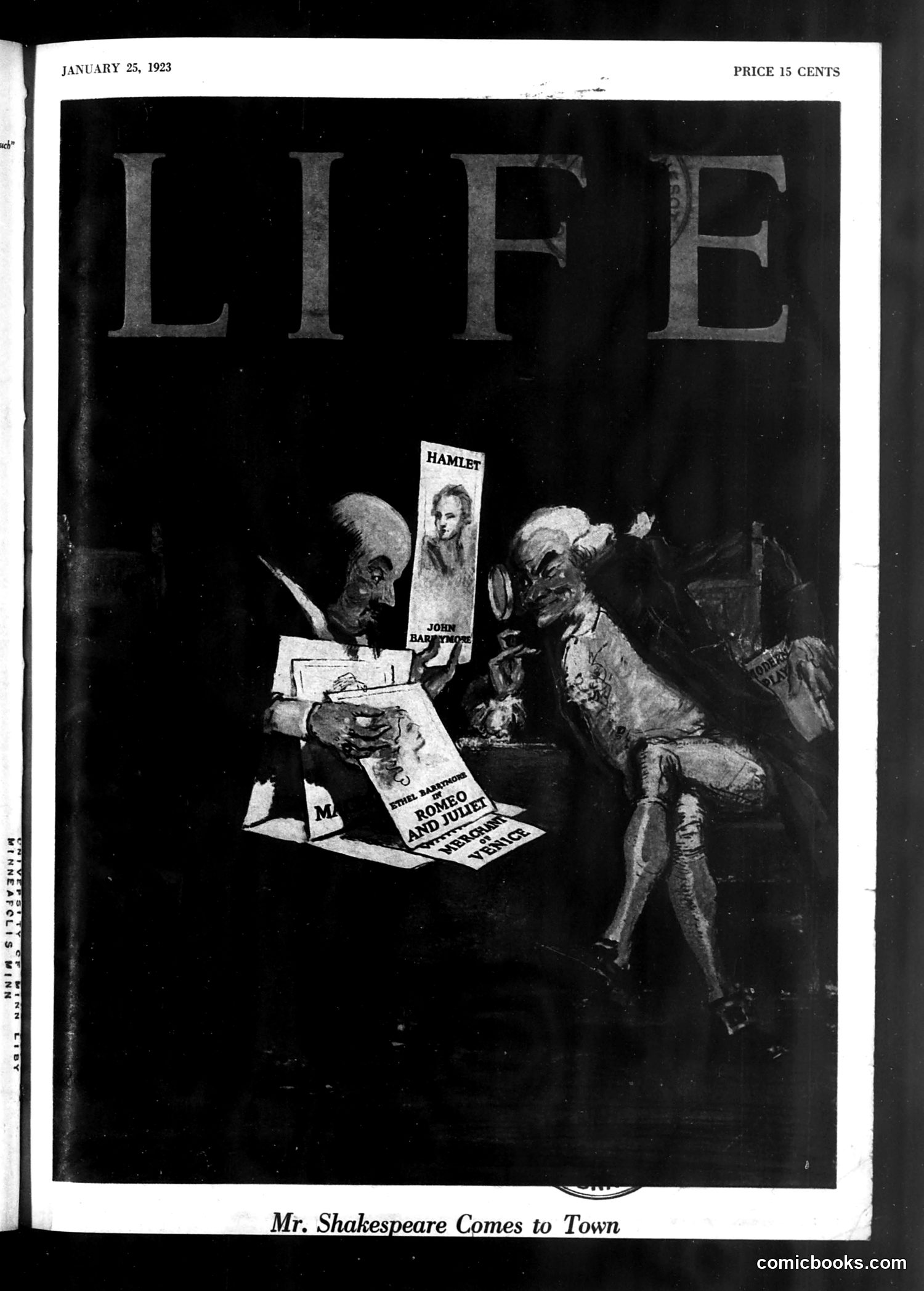
This January 1923 *Life* cover satirizes the commercial exploitation of Shakespeare's works in popular entertainment. The image shows grotesque, demon-like figures hawking theatrical playbills featuring classical Shakespeare adaptations—visible titles include "Hamlet" (with John Barrymore), "Romeo and Juliet," and what appears to be other productions. The caption's ironic title suggests Shakespeare's literary legacy is being aggressively marketed and degraded through mass commercialization. The demonic vendors represent how theatrical producers and promoters are treating the Bard's timeless works as mere commodities to peddle to audiences. The satire critiques the tension between high art and commercialism in 1920s entertainment culture, where canonical literature was being repackaged for profit rather than artistic merit.
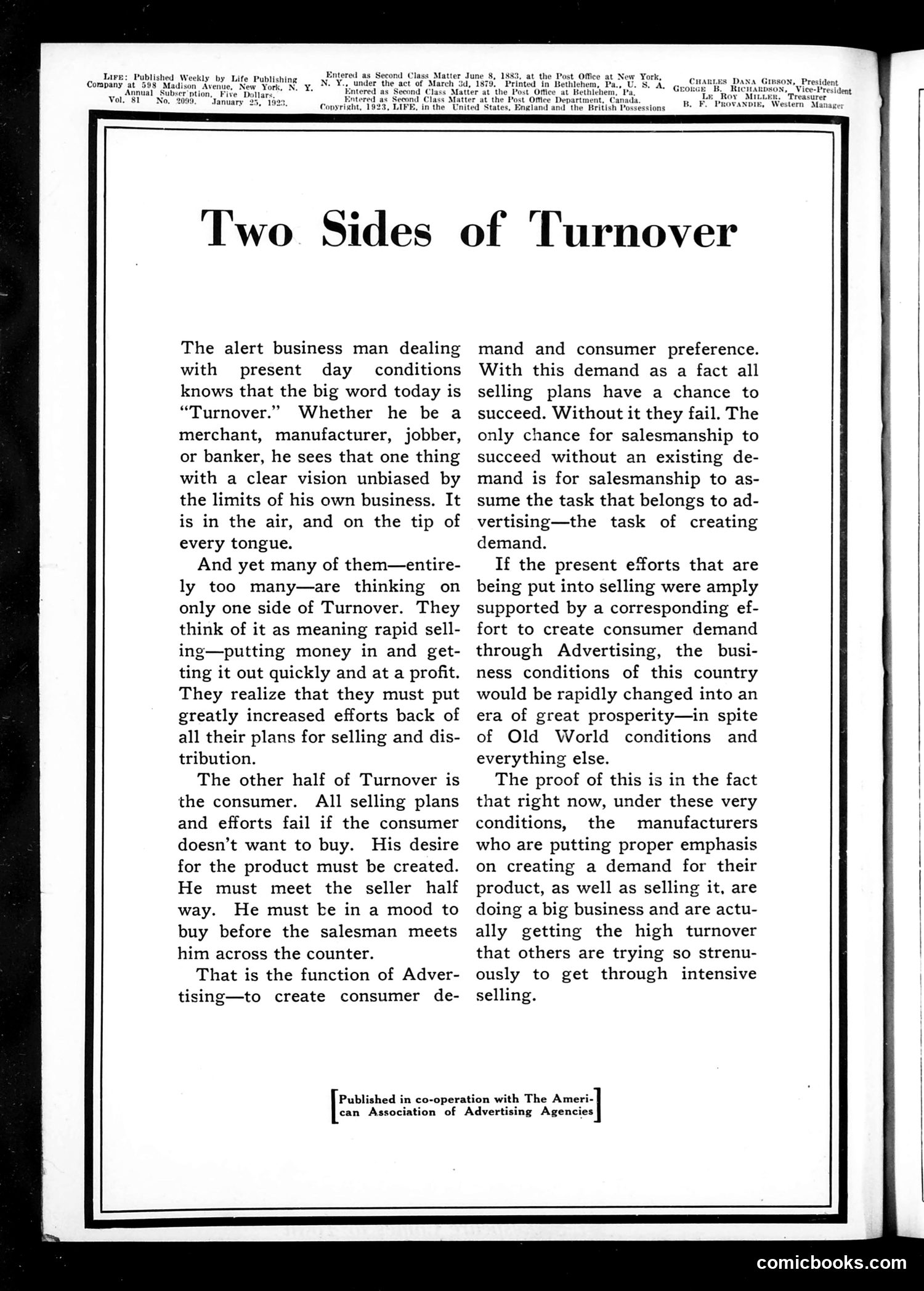
This is a business-focused article (not a cartoon) from Life magazine's January 25, 1923 issue. It discusses "Turnover"—a key business concept of that era meaning rapid inventory movement and sales velocity. The article argues that successful turnover requires **two complementary elements**: manufacturers and sellers must both create consumer demand through advertising AND ensure products actually sell quickly through effective salesmanship. The piece criticizes businessmen who focus only on rapid selling without creating demand, noting that without consumer desire, sales efforts fail. It advocates for advertising's role in generating consumer preference—a perspective that Life published "in co-operation with The American Association of Advertising Agencies," suggesting this partly represents advertising industry advocacy.
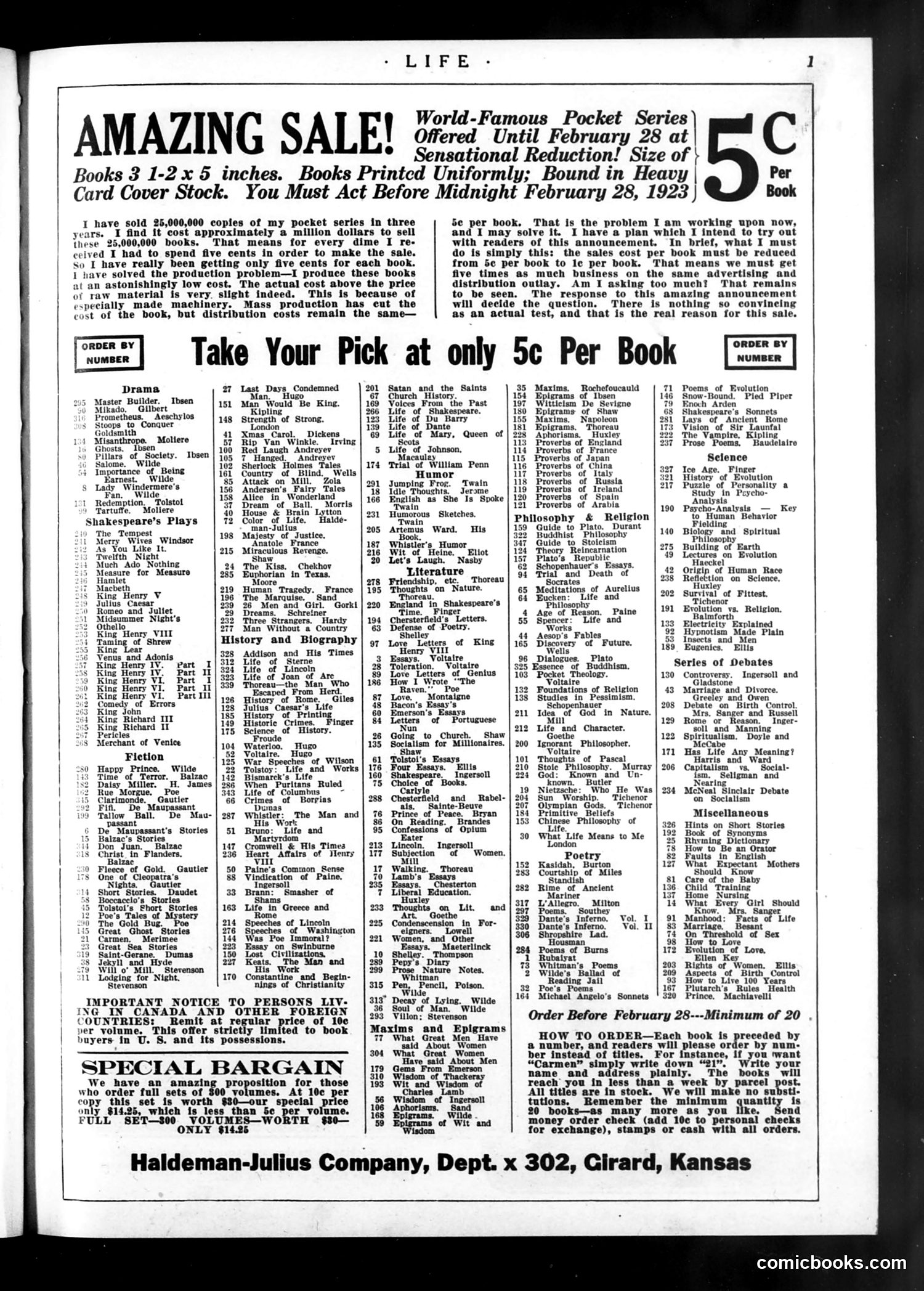
This page is **almost entirely advertising**, not editorial content or satire. It's a book catalog/sales promotion from the Haldeman-Julius Company offering their "World-Famous Pocket Series" books at 5 cents each, with an order deadline of February 28, 1923. The extensive catalog lists hundreds of titles across fiction, literature, science, philosophy, and poetry—classic works and contemporary titles priced aggressively low. The accompanying text emphasizes the business model: cheap production and distribution costs make this pricing possible. There is **no political cartoon or satirical commentary** visible. The page represents early-20th-century mass-market publishing economics, demonstrating how affordable paperback editions democratized access to literature during this period.
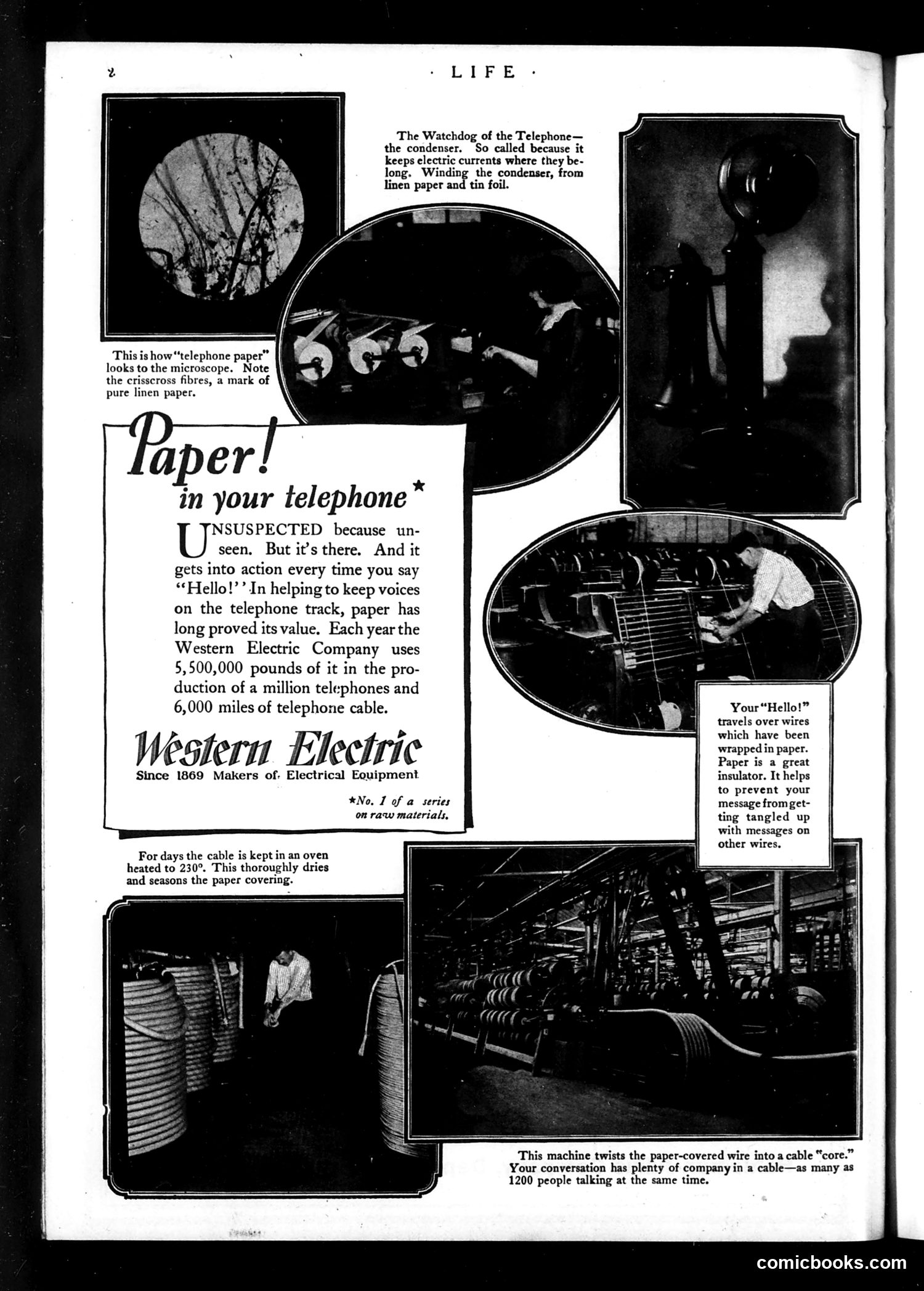
This is **not a political cartoon or satire**—it's a straightforward **advertisement** for Western Electric Company, disguised as educational content in the style of Life magazine's "raw materials" series. The page explains how paper is used inside telephone cables as insulation. Multiple photographs show the manufacturing process: microscopic views of paper fibers, the condenser mechanism that wraps linen paper around electrical wires, and factory machinery twisting paper-covered wires into cable bundles. The "joke" is the headline's faux-surprise tone: paper exists "unsuspected" inside your telephone. The ad emphasizes Western Electric's massive consumption (5,500,000 pounds annually) to establish the company's scale and importance to American infrastructure. This represents early 20th-century corporate advertising disguised as journalism.
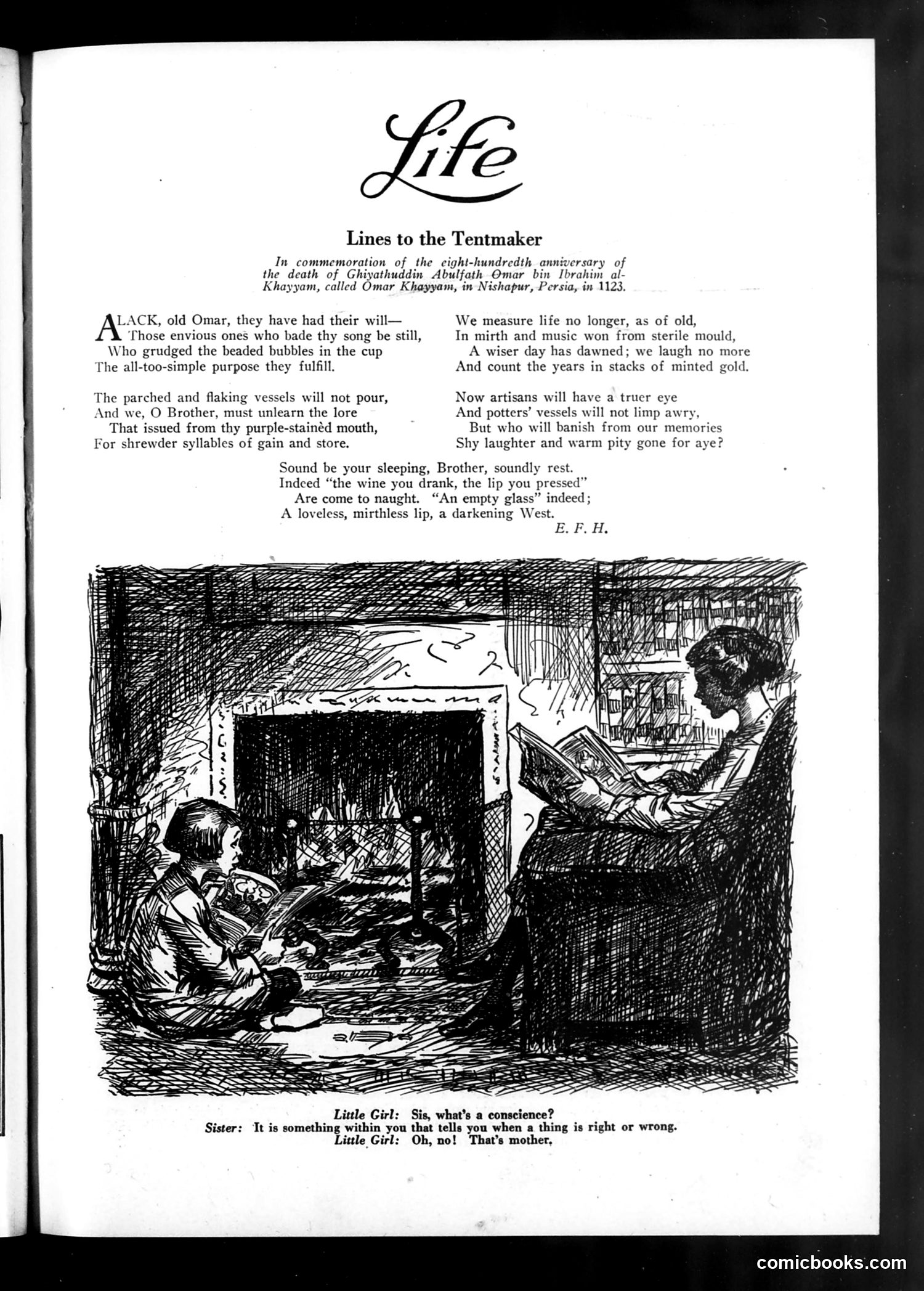
This page commemorates the 800th anniversary of Omar Khayyam's death (1123), the Persian poet-mathematician. The poem uses his famous association with hedonism—wine, song, and earthly pleasures—to meditate on mortality and legacy. The satirical point appears gentle: while Omar's sensual pleasures have faded into history, his artistic and intellectual contributions endure. The poem contrasts his "mirth and music" with lasting cultural impact, suggesting that life's true measure lies in what we leave behind rather than momentary indulgence. The illustration shows a domestic scene of a woman reading to a child, reinforcing themes of wisdom and memory passing between generations—a fitting visual for a piece about artistic legacy. The initials "E.F.H." credit the poem's author.
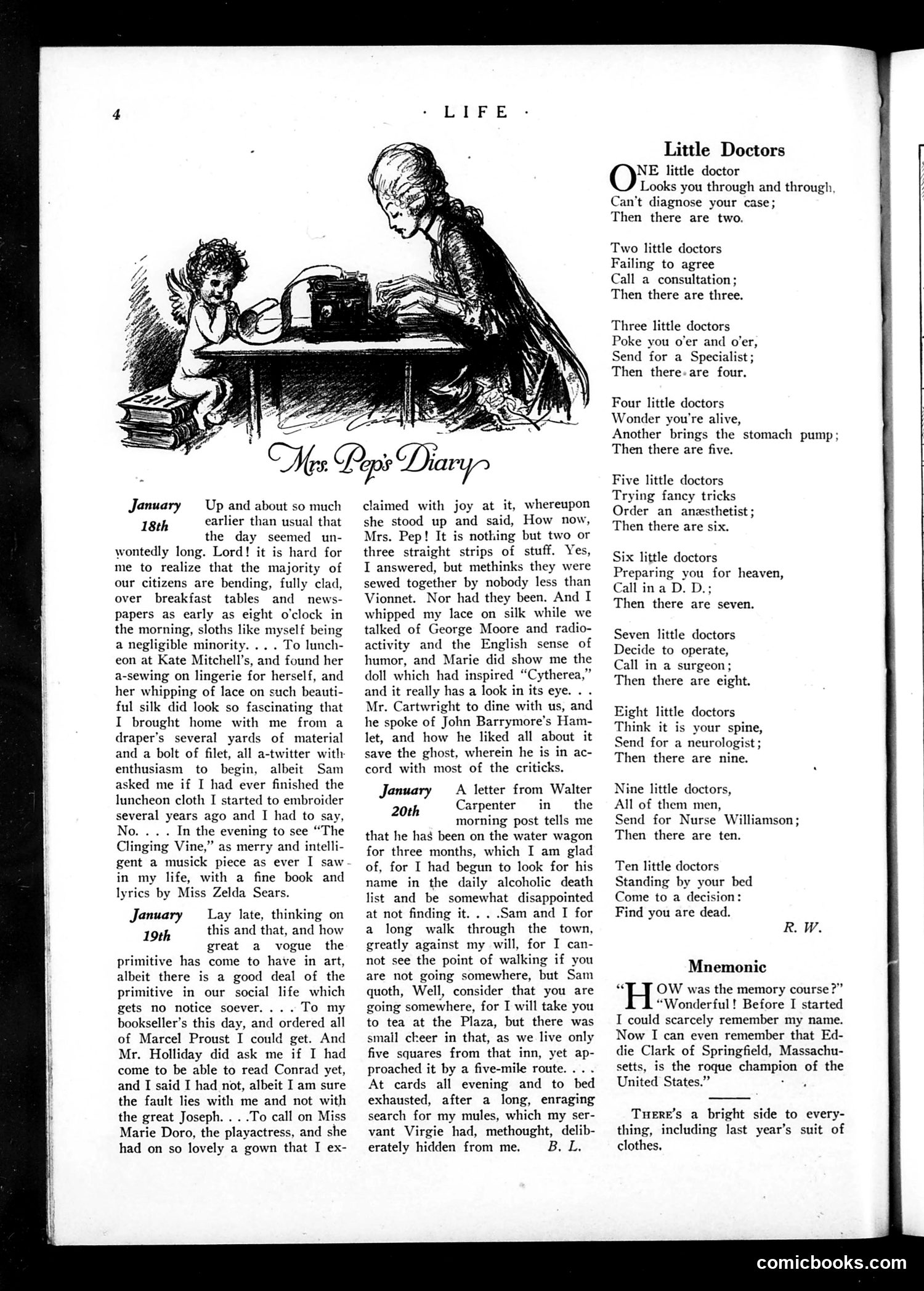
This page contains a humorous poem satirizing the medical profession's tendency toward unnecessary consultation and specialization. The verse progressively counts up from one to ten doctors, mocking how each additional physician adds another layer of diagnosis, disagreement, or expensive treatment—culminating in the dark joke that ten doctors conclude you're dead. The accompanying illustration titled "Mrs. Pep's Diary" shows a woman consulting with a doctor, likely representing the social context of early 20th-century medical practice when doctor-shopping and specialist referrals were becoming common. The satire targets both the medical profession's fragmentation into specialties and patients' tendency to seek multiple opinions, suggesting this multiplication of doctors leads to contradictory advice and unnecessary expense rather than better health outcomes.
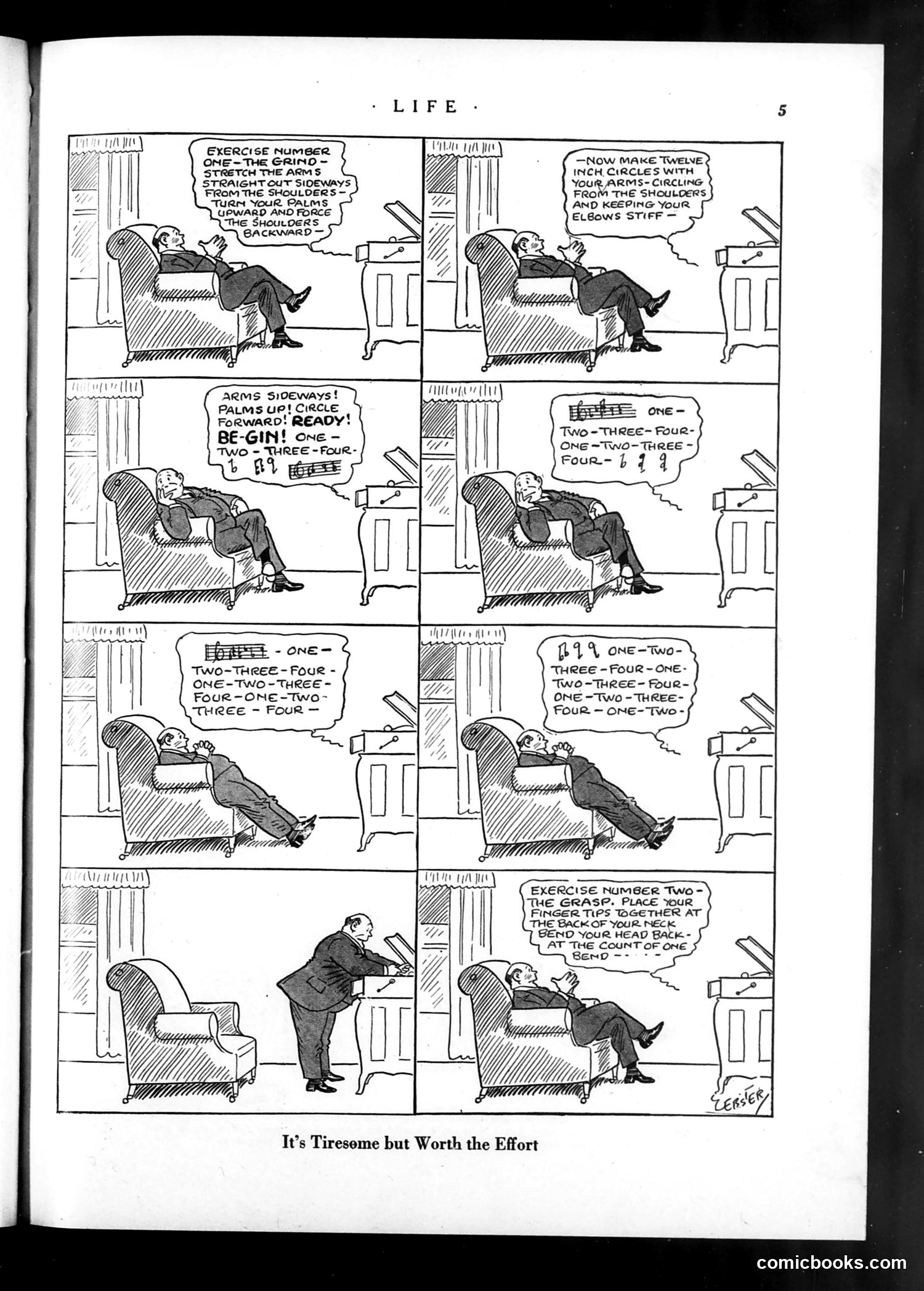
This single-panel comic satirizes office exercise routines. A businessman sitting in an armchair performs increasingly elaborate arm and vocal exercises while remaining seated—stretching arms, making circular motions, counting aloud in musical time, and finally performing head bends while reciting numbers. The joke targets the absurdity of sedentary office workers attempting minimal physical fitness without actually exerting themselves or leaving their chairs. The title's resignation ("Tiresome but Worth the Effort") ironically suggests these lazy substitutes for real exercise somehow constitute worthwhile health maintenance. This reflects early-to-mid 20th century concerns about desk-bound workers' health and the era's fascination with simple, low-effort wellness schemes—poking fun at both the exercises' ineffectiveness and workers' reluctance to genuinely exert themselves.
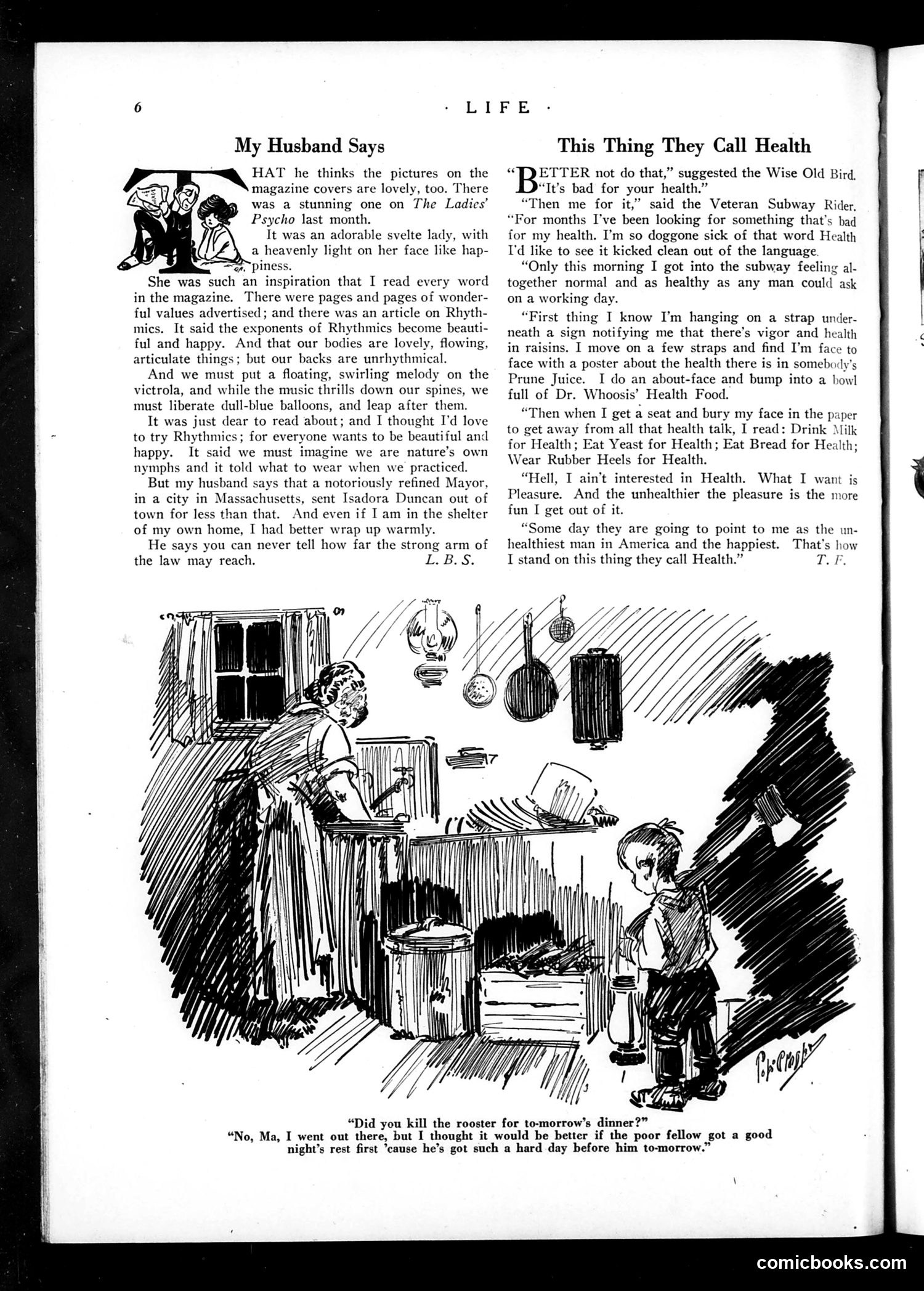
This page contains two satirical pieces about health obsession in early 20th-century America. **"My Husband Says"** (left column) mocks the era's health fad literature. The narrator's husband criticizes her love of health-themed magazine covers and articles, complaining she's become obsessed with health advice—referencing products like "Prune Juice" and "Rubber Heels for Health." He argues that constantly pursuing health prevents actually *enjoying* life and pleasure. **"This Thing They Call Health"** (right column) presents a contrasting view: a Subway Rider defends health consciousness as worthwhile, despite the husband's dismissal. **The cartoon below** shows a domestic kitchen scene where a mother tells a child she decided *not* to kill the rooster for dinner, sparing it because the poor man doing the work has "such a hard day." This illustrates class consciousness and charity, satirizing working-class hardship. Together, the page satirizes period debates over health culture versus life enjoyment.
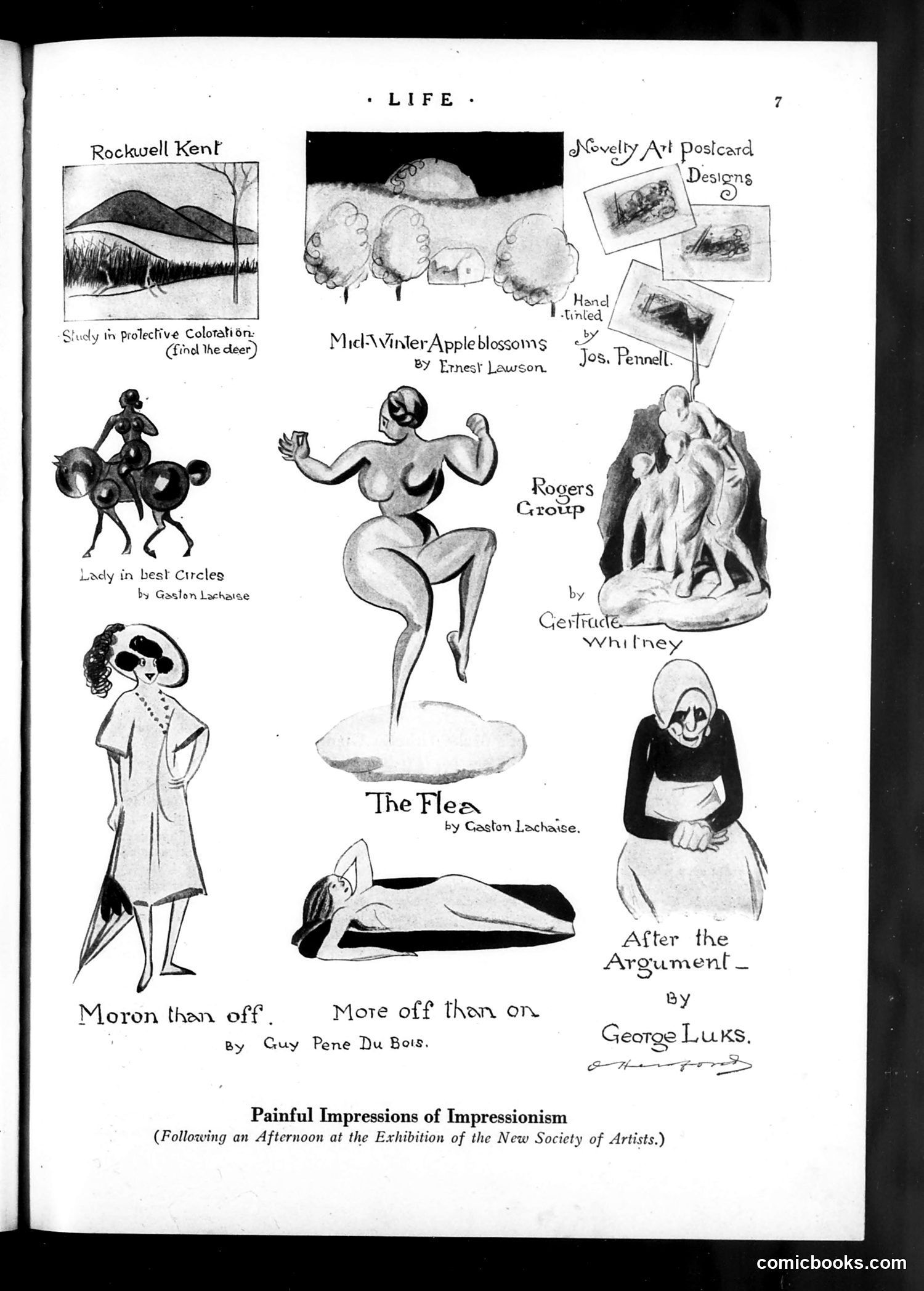
This page satirizes modern art movements, particularly Impressionism, through the subtitle "Painful Impressions of Impressionism (Following an Afternoon at the Exhibition of the New Society of Artists)." The cartoons mock contemporary artistic styles and social types. Notable pieces include: - **"The Flea"** and **"More off than on"** by Gaston Lachaise—crude figure drawings mocking simplified modernist forms - **"Moron than off"** by Guy Pène du Bois—caricaturing fashionable society - Works by Gertrude Whitney and George Luks representing established artists The page ridicules avant-garde Impressionist exhibitions as incomprehensible or absurd, reflecting early 20th-century American skepticism toward modernist art. The exaggerated, distorted figures and crude execution parody what satirists viewed as pretentious or nonsensical artistic innovation.
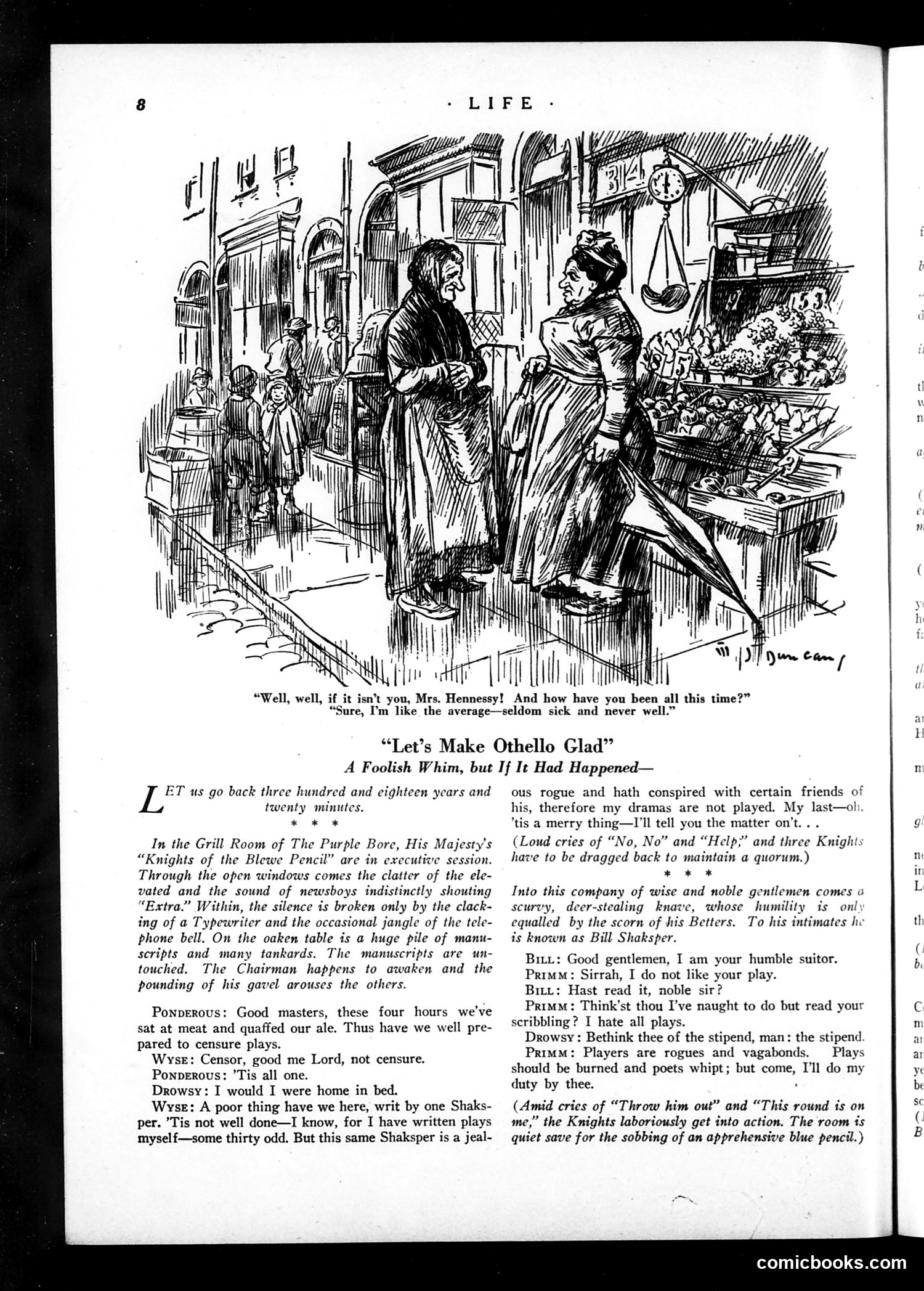
This satirical piece mocks theatrical censorship of Shakespeare's *Othello*. The cartoon depicts a street market scene where two women converse; the accompanying dialogue suggests casual, mundane social interaction has replaced dramatic performance. The title's wordplay—"Make Othello Glad" (a foolish whim)—suggests that removing *Othello* from the stage would please no one of taste. The sketch appears to reference contemporary debates about performing Shakespeare's tragedy, likely due to its themes involving a Black protagonist and interracial marriage, which proved controversial in early 20th-century American society. The subsequent script excerpt shows characters named Primm, Bill, Dowsy, and Wyss debating theatrical merit versus propriety, satirizing the tension between artistic freedom and social censorship of classic works.
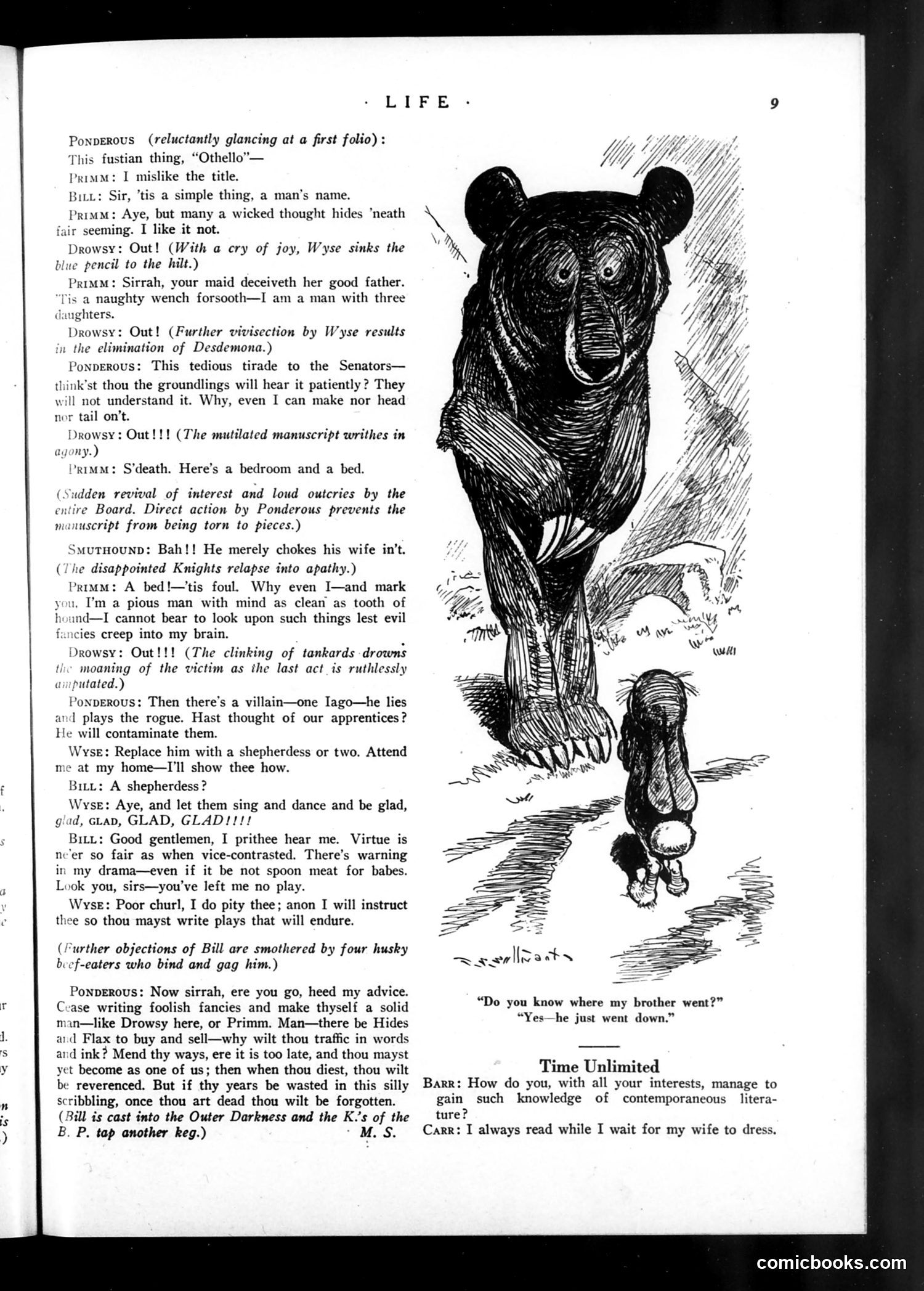
This page contains a theatrical dialogue (appears to be from Shakespeare's *Othello*) with editorial commentary mocking various characters' objections and interpretations. The accompanying illustration shows a bear walking upright on hind legs. The satire targets pompous literary critics and senators who misinterpret or complain about the play's content. Characters like "Ponderous" and "Primm" represent prudish objectors who find the drama morally offensive, while "Droowsy" and "Smuthound" represent other types of obtuse readers. The bear illustration likely symbolizes the bestial or ridiculous nature of these critics' complaints—suggesting their objections are crude and unintelligent. Life magazine is ridiculing both overly moralistic censors and pompous theatrical gatekeepers who fail to appreciate Shakespeare's sophisticated themes.
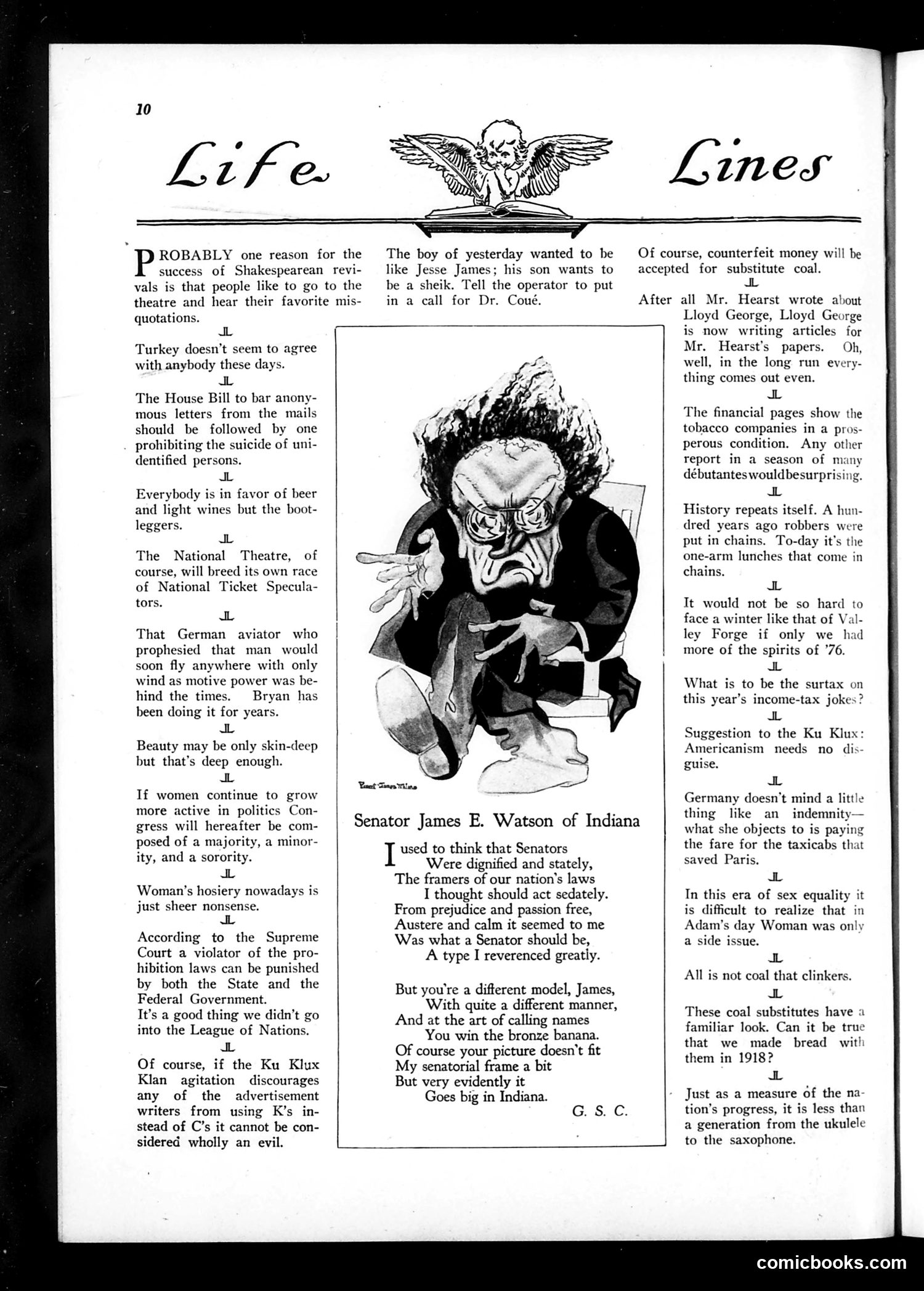
This page features a caricature of **Senator James E. Watson of Indiana**, depicted as a grotesque, wild-haired figure. The accompanying poem by G.S.C. criticizes Watson as a hypocrite—claiming he once respected dignified senators but has become a different, undisciplined model who "wins the bronze banana" through disreputable conduct that doesn't fit his senatorial image. The left column contains various satirical observations on contemporary issues: Turkish politics, proposed suicide prohibition laws, beer consumption, the National Theatre, aviation, women in politics, and Ku Klux Klan activities. The right column continues social commentary on counterfeit currency, tobacco industry finances, historical comparisons to Revolutionary-era chains, income taxes, and questions about American cultural progress. The overall tone is cynical observation of 1920s American politics and society.
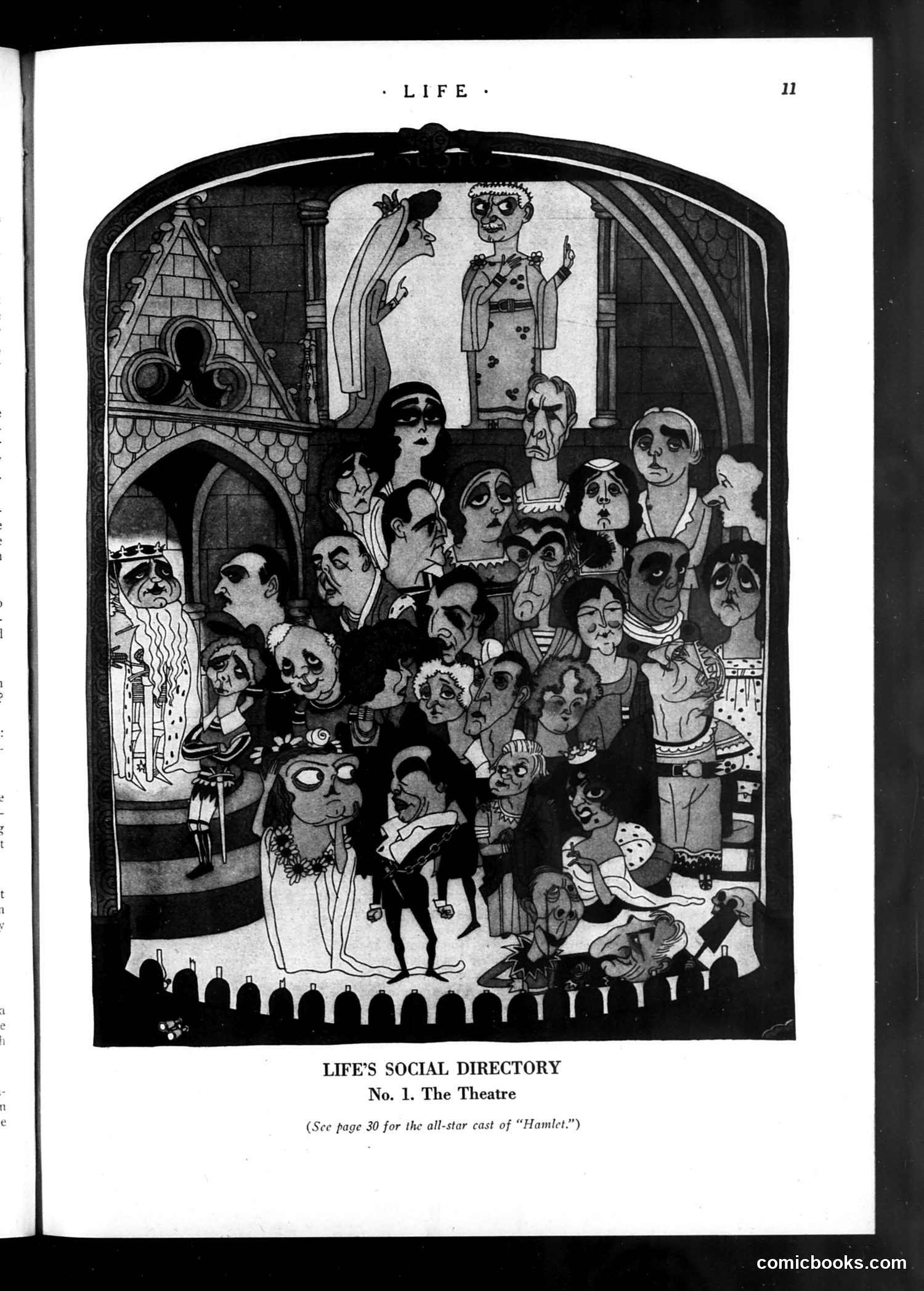
This satirical illustration depicts a crowded theatrical scene featuring exaggerated, grotesque character caricatures. The caption references an "all-star cast of 'Hamlet'" on page 30, suggesting this mocks contemporary theatre productions—likely Broadway's fashionable audiences and performers of the era. The style employs grotesque facial distortions typical of early 20th-century satirical cartooning to mock theatrical pretension and social posturing. The densely packed composition, with figures of varying prominence, appears to satirize the theatre world's hierarchy and affectations. Without access to the referenced page 30, we cannot identify specific individuals caricatured, but the overall intent seems to ridicule theatre-goers and performers as artificially vain or ridiculous. The "Social Directory" framing suggests critique of high-society theatrical circles.
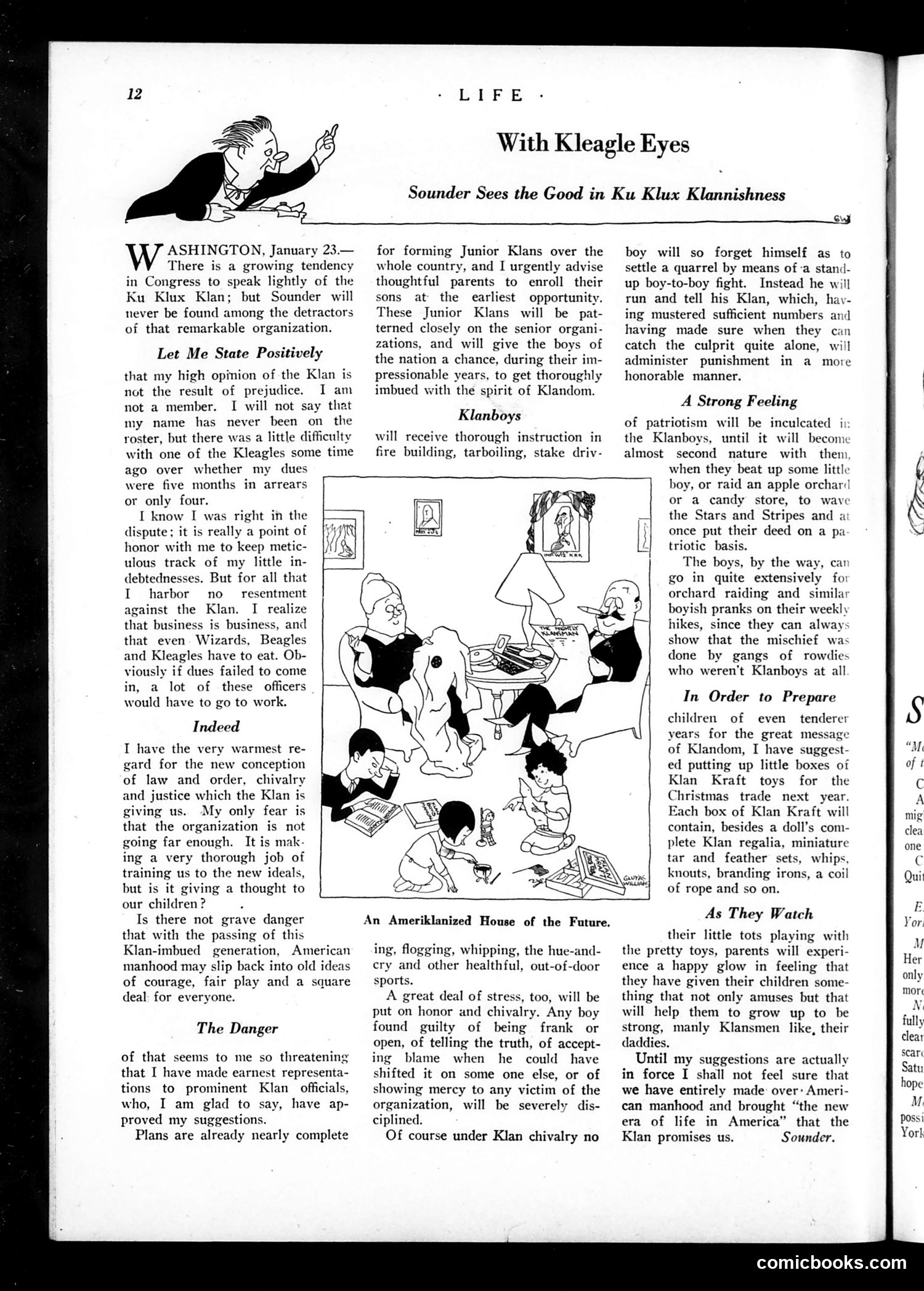
This page satirizes the Ku Klux Klan's recruitment of children through a "Junior Klans" program. The cartoon illustration shows children playing with Klan-themed toys and regalia in a domestic setting, captioned "An Americanized House of the Future." The accompanying article, written as a mock endorsement attributed to "Sounder," sarcastically praises the Klan's plans to indoctrinate young boys with "Klanishness" through instruction in violence ("fire building, tarboiling, stake driving") and patriotic indoctrination. The satire exposes how the Klan was systematically targeting American children, presenting this dangerous youth radicalization as normal family life. The piece critiques both the Klan's methods and any parent who would enable such indoctrination.
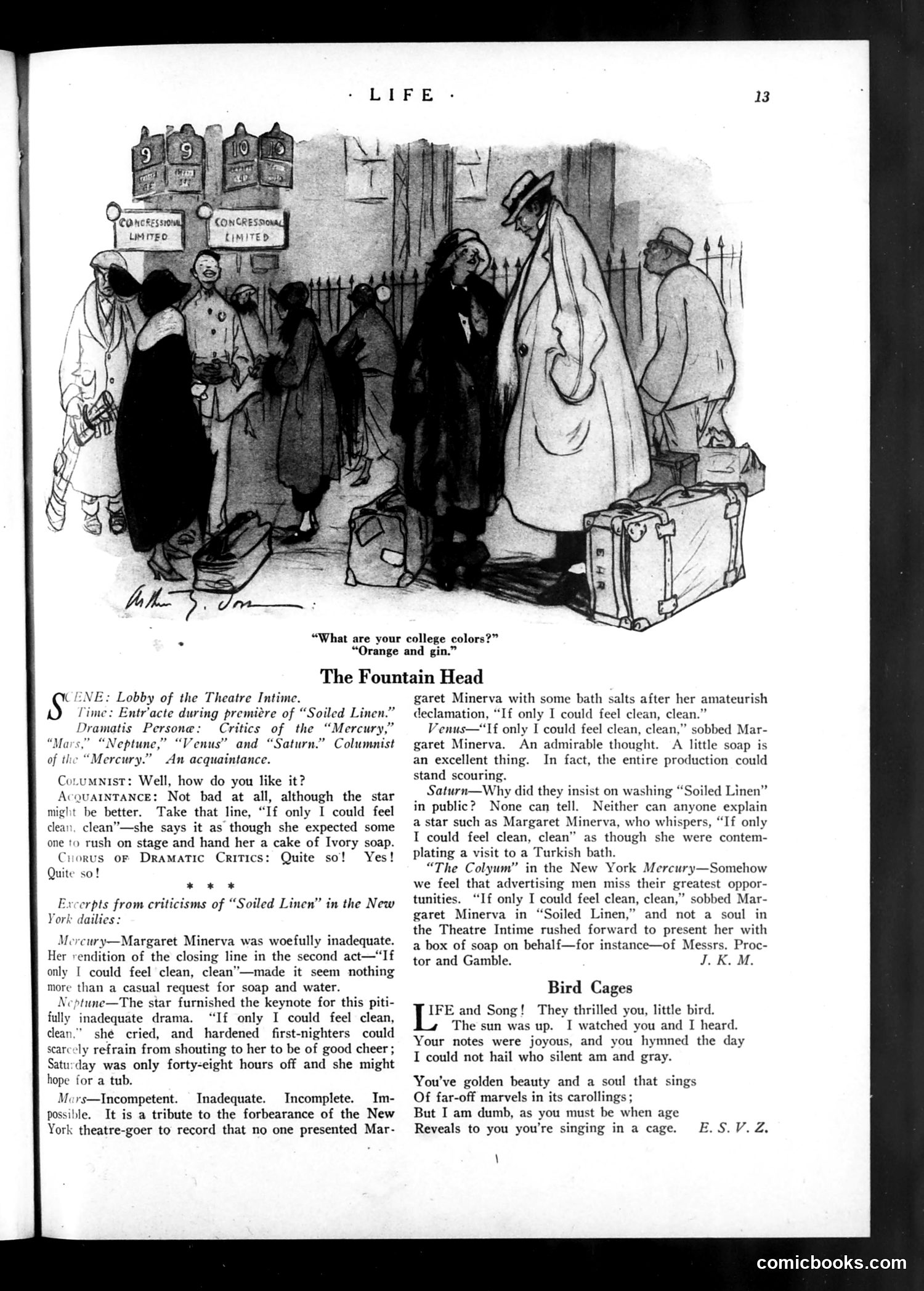
This satirical cartoon mocks theatrical actress **Margaret Minerva** and critical reviews of the play "Soiled Linen." The joke centers on Minerva's repeated delivery of the line "If only I could feel clean, clean"—apparently the play's emotional climax. The cartoon depicts a street scene where well-dressed theatergoers gather near what appears to be a public fountain, referencing Minerva's obsessive line about cleanliness. The satire suggests that her overwrought, repetitive performance made the phrase unintentionally laughable to audiences. The accompanying criticism confirms this: reviewers found her rendition "woefully inadequate" and the drama itself "incompetent" and "incomplete." The cartoon ridicules both the actress's hammy acting and the play's poor quality.
This page discusses European economic recovery after World War I. The article references **M. Clemenceau** (French wartime leader) and **Signor Nitti** (Italian Premier), debating whether Great Britain or France should lead Europe's economic restoration. The core debate: France wants German reparations and British trade support; Britain prefers focusing on its own prosperity rather than subsidizing German recovery. The author argues **France differs from Britain** — France fears German revival as an existential threat, while Britain views the matter more commercially. The small cartoon illustrations appear to be generic satirical figures commenting on these political positions, though specific identities aren't clearly marked. The piece advocates American involvement in settling European disputes through the League of Nations and contemporary diplomatic efforts.
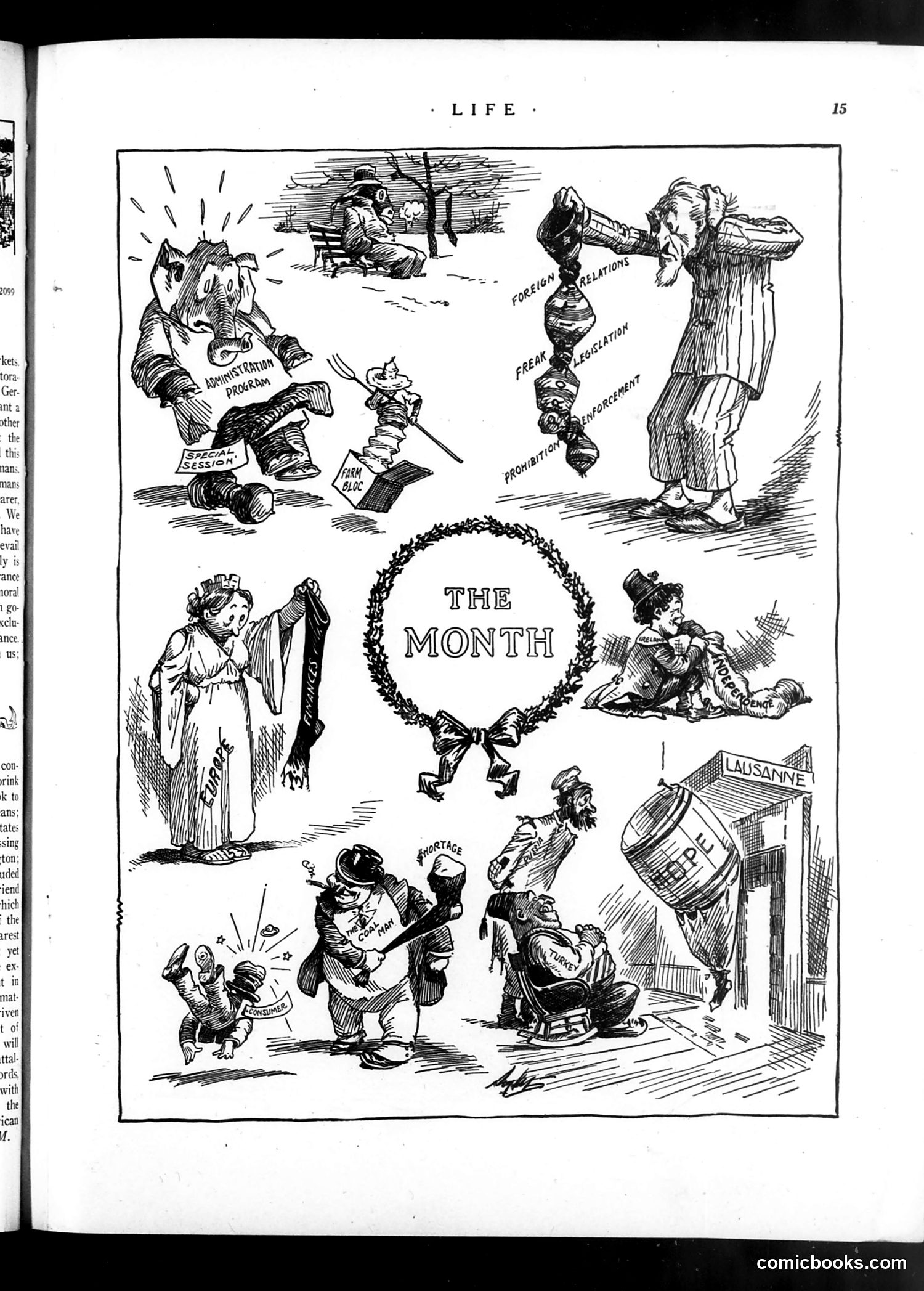
This is a satirical roundup cartoon from *Life* magazine titled "The Month," depicting various political and social troubles of the era. The central wreath frame organizes vignettes around current controversies: **Visible elements include:** - Upper left: A figure labeled "Administration Problems" juggling issues - Center-right: A tall figure (possibly representing a political leader or diplomat) examining through a telescope labeled with "Foreign Relations," "Freak Legislation," "Prohibition Enforcement," and "Foreclosure" - Lower sections: Figures dealing with "Shortage" and other domestic issues - Various administrative and social crises are represented through exaggerated caricature The overall message satirizes the government's struggle managing multiple simultaneous crises—likely from the Prohibition era based on visible references. The cartoon mocks the chaos of contemporary governance.
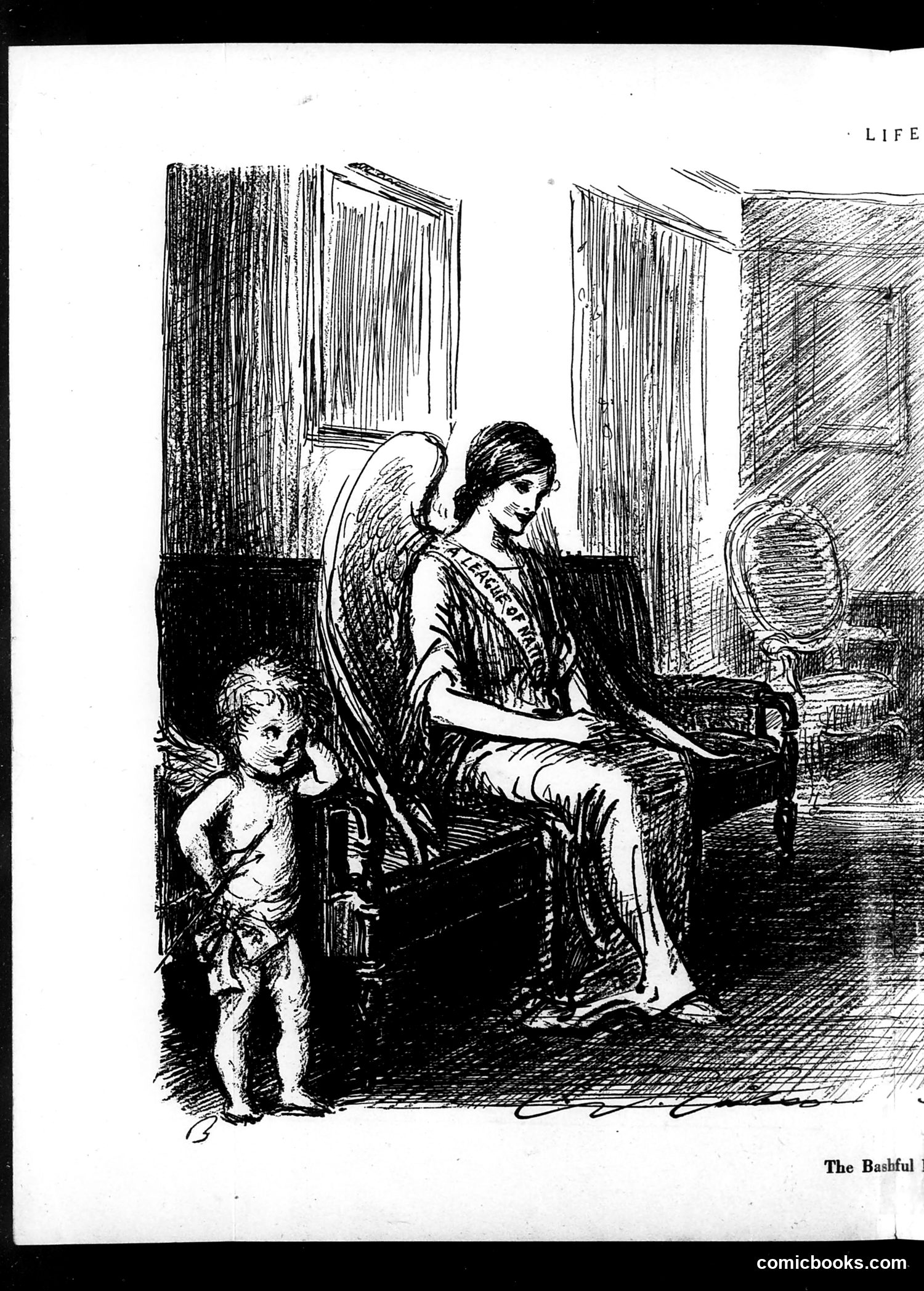
This is a satirical domestic scene depicting gender dynamics and social pretense. A woman sits while a cherub or cupid figure stands beside her, suggesting themes of love or courtship. The woman appears to be primping or adjusting her appearance before a mirror visible in the background, while maintaining a demure pose—likely the "bashful" demeanor referenced in the title. The satire appears to mock the Victorian-era social performance of female modesty and shyness, suggesting the woman is carefully staging her "bashfulness" as a deliberate, calculated act rather than genuine emotion. The cherub's presence reinforces the romantic or courtship context. The cartoon critiques the artificial social rituals around courtship and feminine performance that Life magazine's sophisticated audience would have found amusing.
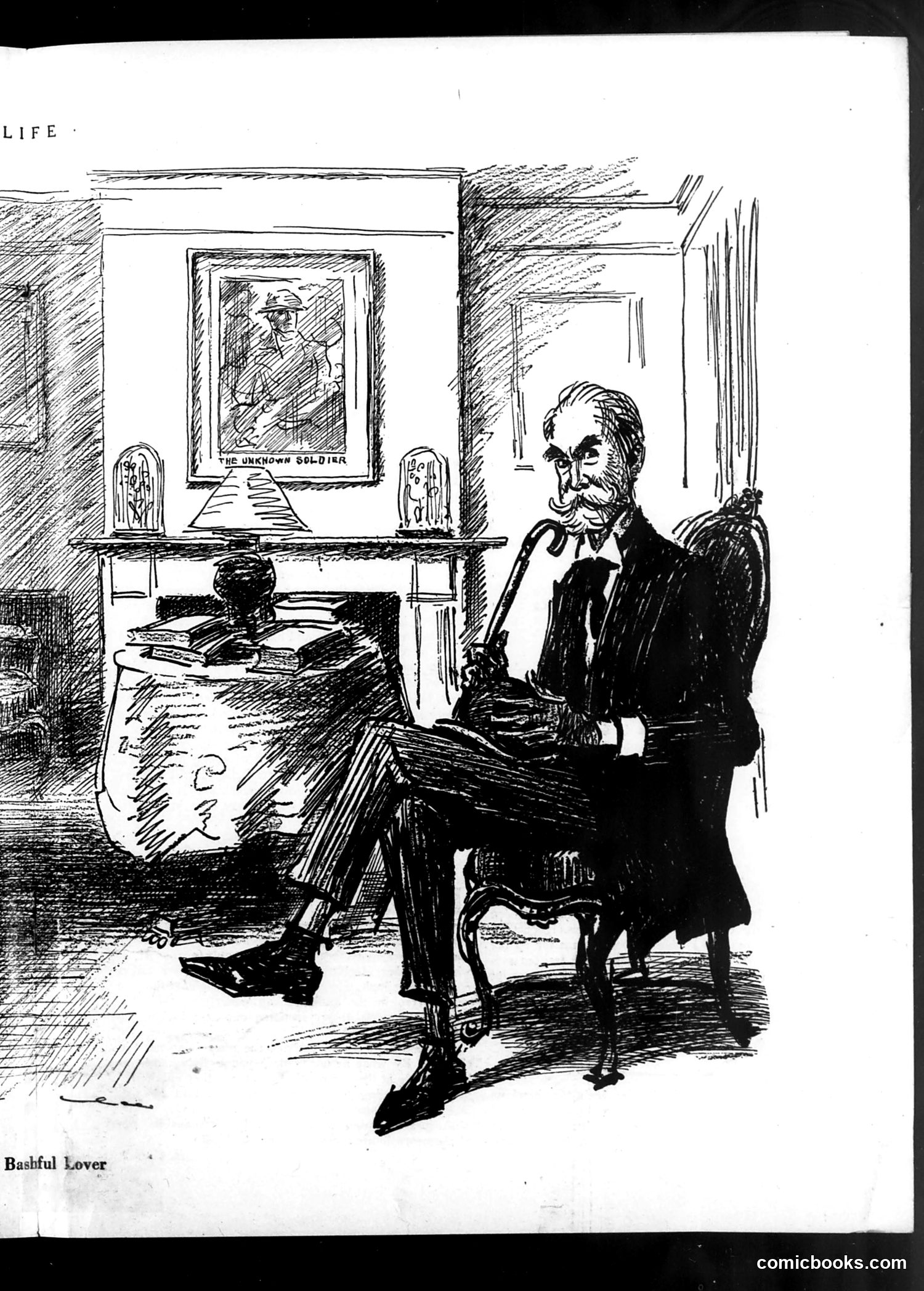
This cartoon depicts a man seated in a room, appearing bashful or uncomfortable. On the mantelpiece behind him sits a framed picture labeled "The Unknown Soldier," flanked by what appear to be memorial candles or urns. The man's posture and facial expression suggest awkwardness or shyness. The satire likely plays on the contrast between the solemnity of war memorials (the Unknown Soldier reference suggests post-WWI America) and domestic romantic situations. The title "Bashful Lover" combined with the memorial imagery suggests commentary on masculinity, sentimentality, or perhaps the difficulty some men faced transitioning from military to civilian domestic life after World War I. The exact satirical intent remains somewhat unclear without additional context about Life magazine's typical themes of this era.
This article satirizes the heated public debates erupting over contemporary theatrical productions of Shakespeare, particularly John Barrymore's *Hamlet* and David Belasco's *Shylock* staging. The piece mocks serious theater critics and Shakespeare scholars by deliberately writing absurd, nonsensical "analysis." The satire works by inventing fake textual details (a "coat-room scene," characters named "Labina" and "Flavio," marginal notes about "tripping"), fabricating spurious arguments about Elizabethan staging practices, and making deliberately illogical points—such as criticizing Barrymore for making Hamlet tall when the "real" Hamlet loved apples. The humor targets how passionately audiences and critics defended different productions, claiming personal authority over Shakespeare's "true" intent. By writing deliberately bad criticism, Life mocks the pretentiousness of theater commentary and the street-fighting fervor these productions inspired among different generational camps of Shakespeare devotees.
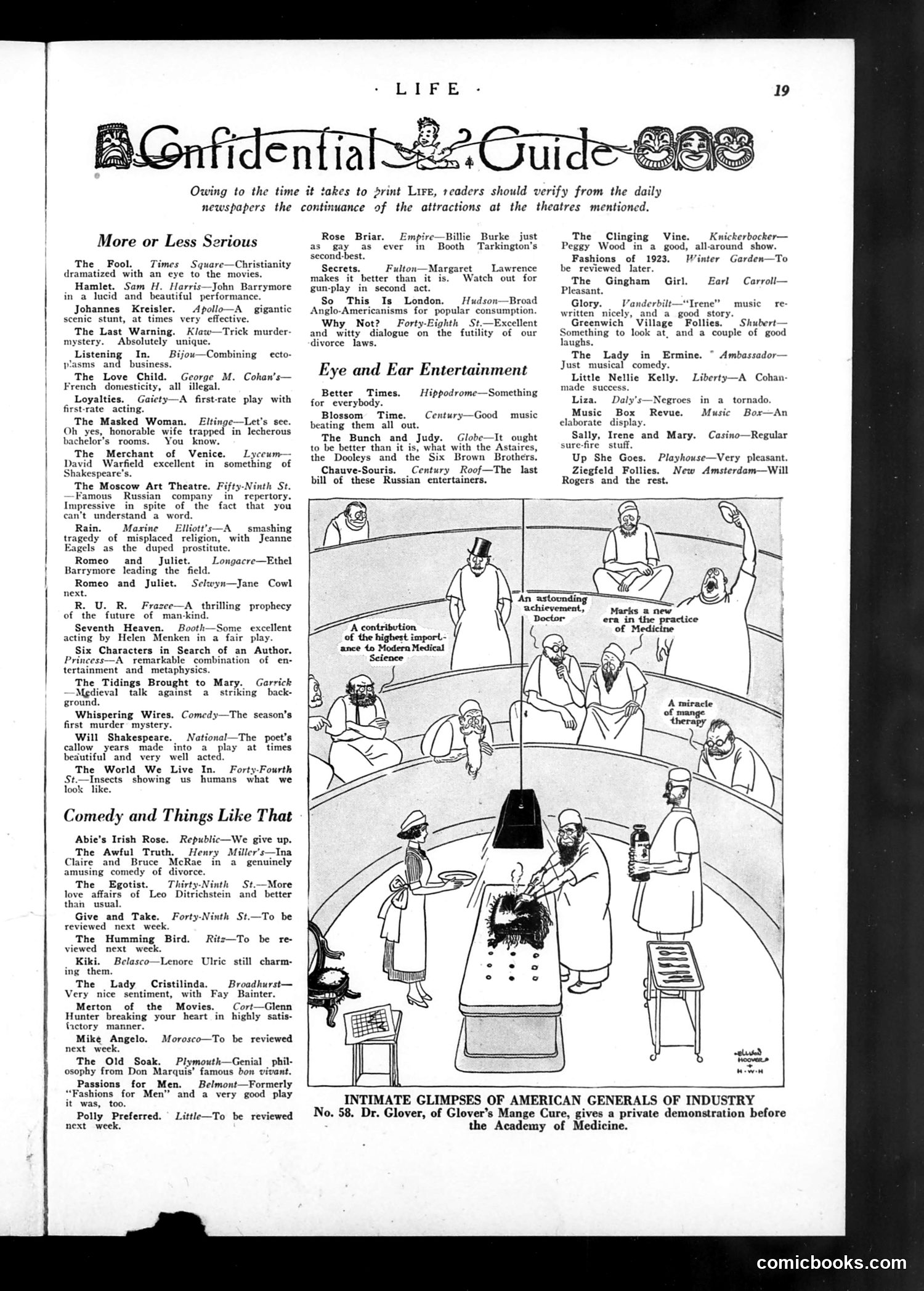
This is a **theatre review section** from Life magazine (circa 1923, based on references like "Abie's Irish Rose" and "Rain"). The page lists Broadway shows with brief, often sardonic critiques rather than traditional reviews. The **cartoon below** illustrates "Dr. Glover of Glover's Mange Cure" giving a medical demonstration at the Academy of Medicine. This is a satirical reference to **patent medicine charlatans** who were common targets of early 20th-century satire. The caption calls it "Intimate Glimpses of American Generals of Industry"—sarcastically elevating a quack doctor to "general" status, mocking fraudulent medical practitioners who presented themselves as serious scientists to gullible audiences. The reviews themselves are witty, dismissive observations: "We give up" on *Abie's Irish Rose*, calling *The Merchant of Venice* merely "something of Shakespeare's," and noting audiences "can't understand a word" of the Moscow Art Theatre despite finding it "impressive." The humor relies on theater-savvy readers recognizing shows' formulaic plots and pretensions.
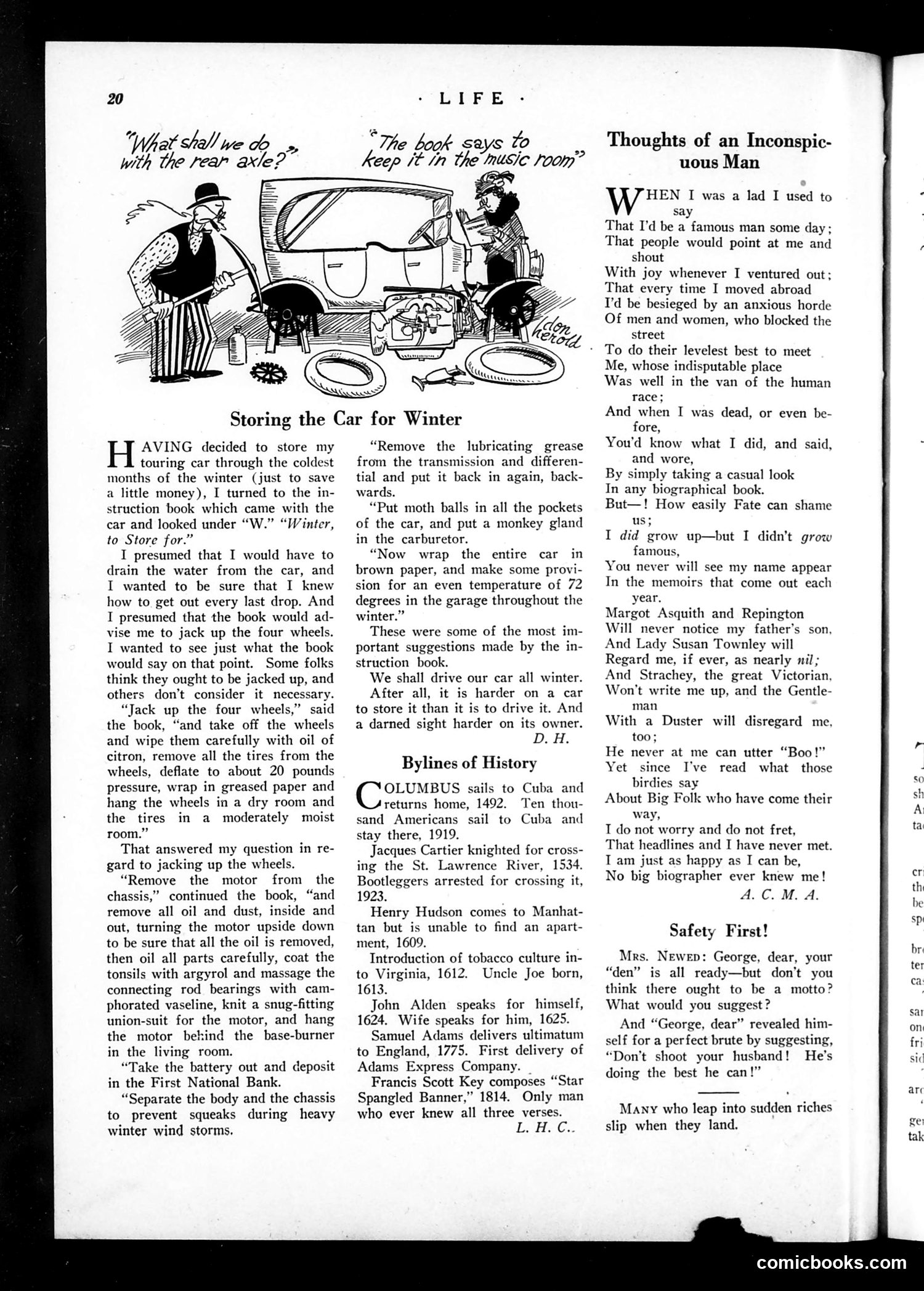
## Main Cartoon: "Storing the Car for Winter" The cartoon satirizes overly complicated automobile instruction manuals. A couple argues about car storage while surrounded by scattered parts and dishes. The humor comes from the absurd written instructions that follow—which escalate into ridiculous advice like removing the motor entirely, depositing the battery in a bank, wrapping the car in brown paper, and putting a "monkey gland in the carburetor." The joke mocks how manufacturers' instructions often overcomplicate simple tasks, treating car owners as incompetent. ## "Bylines of History" This humorous chronology pairs historical events with modern (1920s) parallels, usually showing decline or ironic contrast: Columbus's voyage versus Americans staying in Cuba (1919); dignified exploration versus modern bootlegging during Prohibition. It satirizes contemporary American society's perceived degradation. ## "Thoughts of an Inconspicuous Man" A melancholic poem about an ordinary person who dreamed of fame but became nobody—never appearing in biographies or memoirs. It's gentle social satire about average life's anonymity.
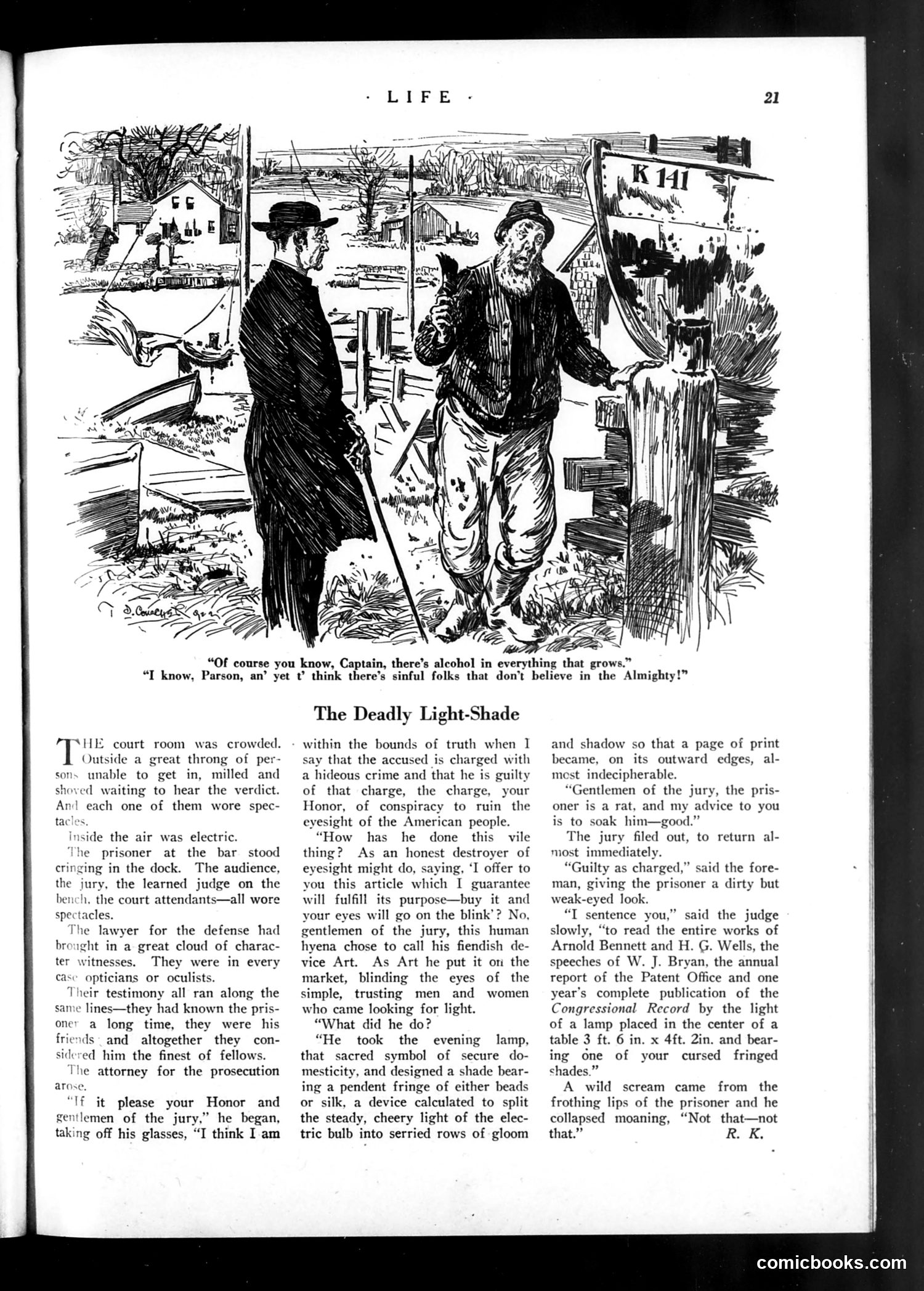
This is a courtroom satire mocking the "Arts and Crafts" movement's fashionable decorative lampshades with dangling beads or fringe. The joke presents a mock trial where a designer is prosecuted for "conspiracy to ruin the eyesight of the American people" by creating aesthetically pleasing but functionally terrible lamp shades that fragment light and make reading impossible. The humor targets several things: the tension between artistic design and practical utility, the pretentious marketing of impractical home goods as "Art," and early 20th-century eyestrain concerns. The punishment—forcing the prisoner to read tedious government documents under his own terrible shade—is darkly comic irony. The opening dialogue jokes that if alcohol exists in all growing things, skeptics of divine creation should reconsider. It establishes the satirical tone mocking unexamined beliefs, here applied to design trends.
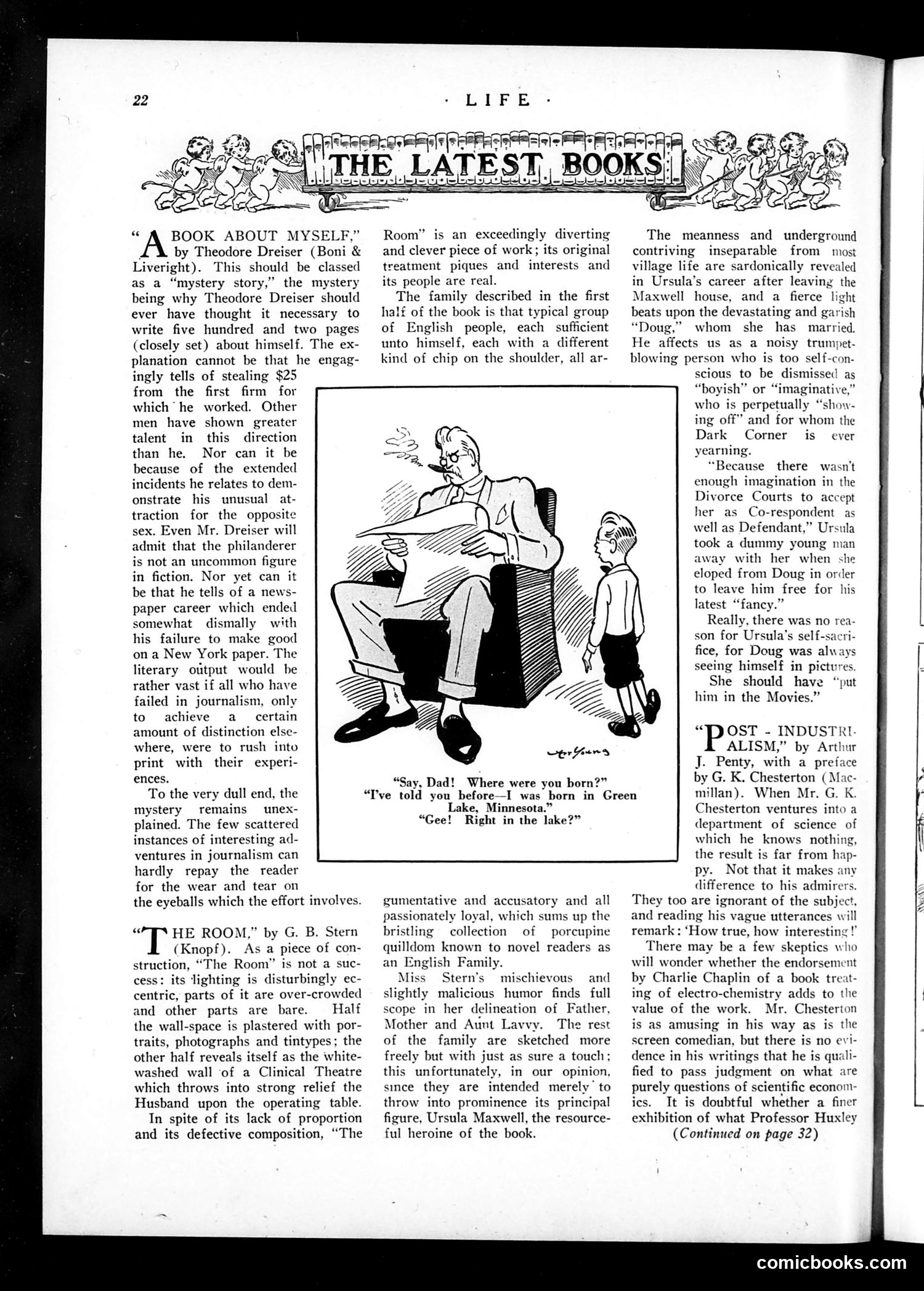
This is a book review page from *Life* magazine. The main cartoon shows a father and child in a simple joke: the child asks where the father was born, and when told "Green Lake, Minnesota," the child mishears it as being born literally "in the lake." The reviews themselves are satirical critiques. The first dismisses Theodore Dreiser's autobiography as unnecessarily lengthy and self-indulgent—mocking his inclusion of minor scandals (stealing $25, romantic exploits, failed journalism career) as unremarkable material stretched across 500+ pages. The reviewer suggests Dreiser has nothing particularly interesting to say about himself. The second review praises G.B. Stern's novel *The Room* despite its structural flaws, highlighting her sharp satirical portrayal of a typical English family—people quarrelsome, argumentative, and chip-on-the-shoulder types. The heroine Ursula is portrayed as resourceful but trapped in an unsatisfying marriage to the shallow "Doug." The satire targets literary pretension and the banality of certain autobiographical and domestic fiction popular in the 1920s-30s.
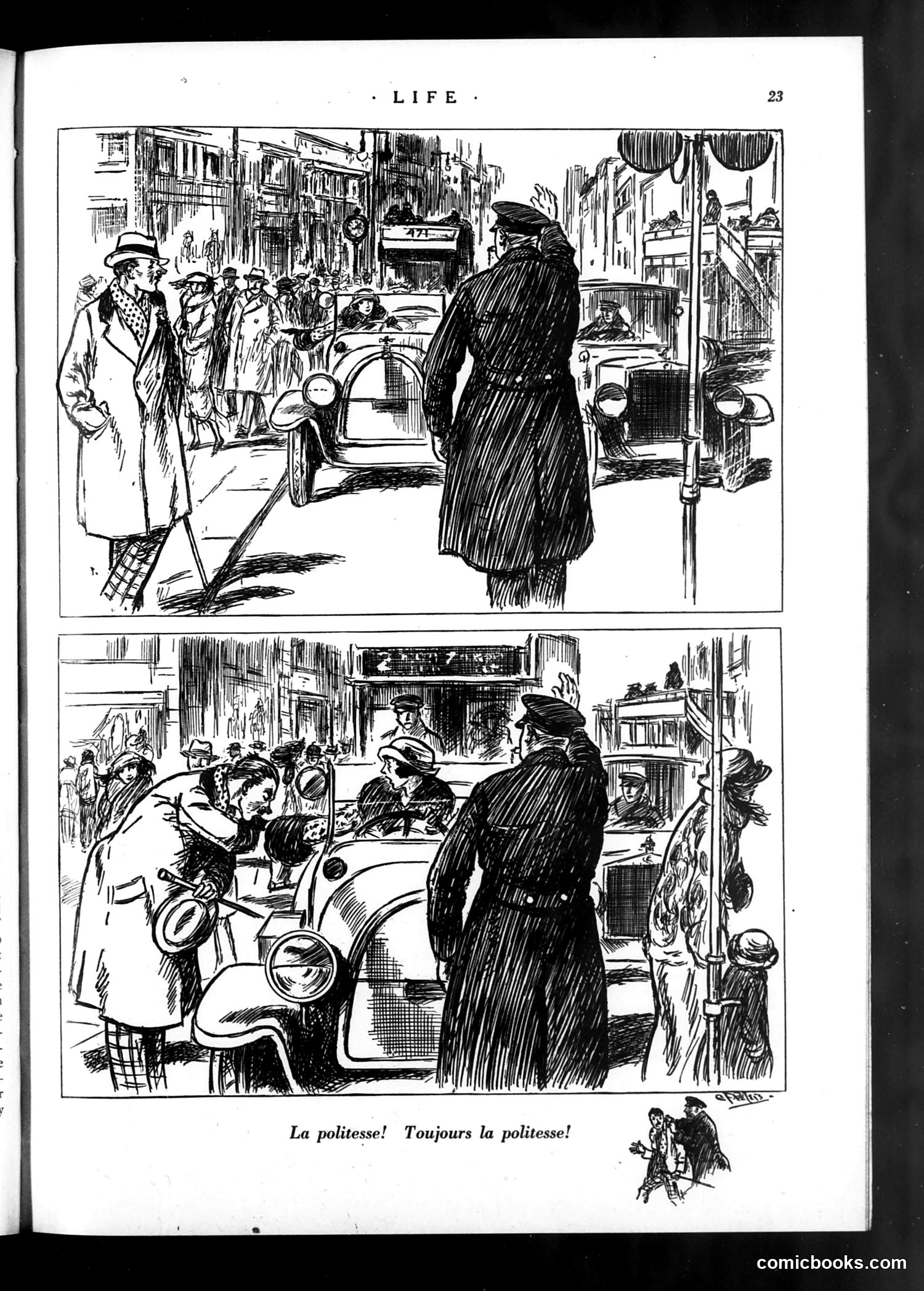
This two-panel cartoon satirizes French automotive traffic and manners. The caption reads "La politesse! Toujours la politesse!" ("Politeness! Always politeness!"), suggesting irony about French civility. Both panels depict busy urban streets crowded with early automobiles and pedestrians. The top panel shows a formal gentleman in a long coat and hat encountering traffic. The bottom panel depicts a more chaotic scene with multiple cars and pedestrians interacting. The joke appears to mock the contradiction between the French reputation for politeness and the actual aggressive behavior displayed in crowded urban traffic situations—drivers and pedestrians jostling despite social pretenses of civility. The detailed crosshatching style is typical of Life magazine's satirical illustrations from the early 20th century.
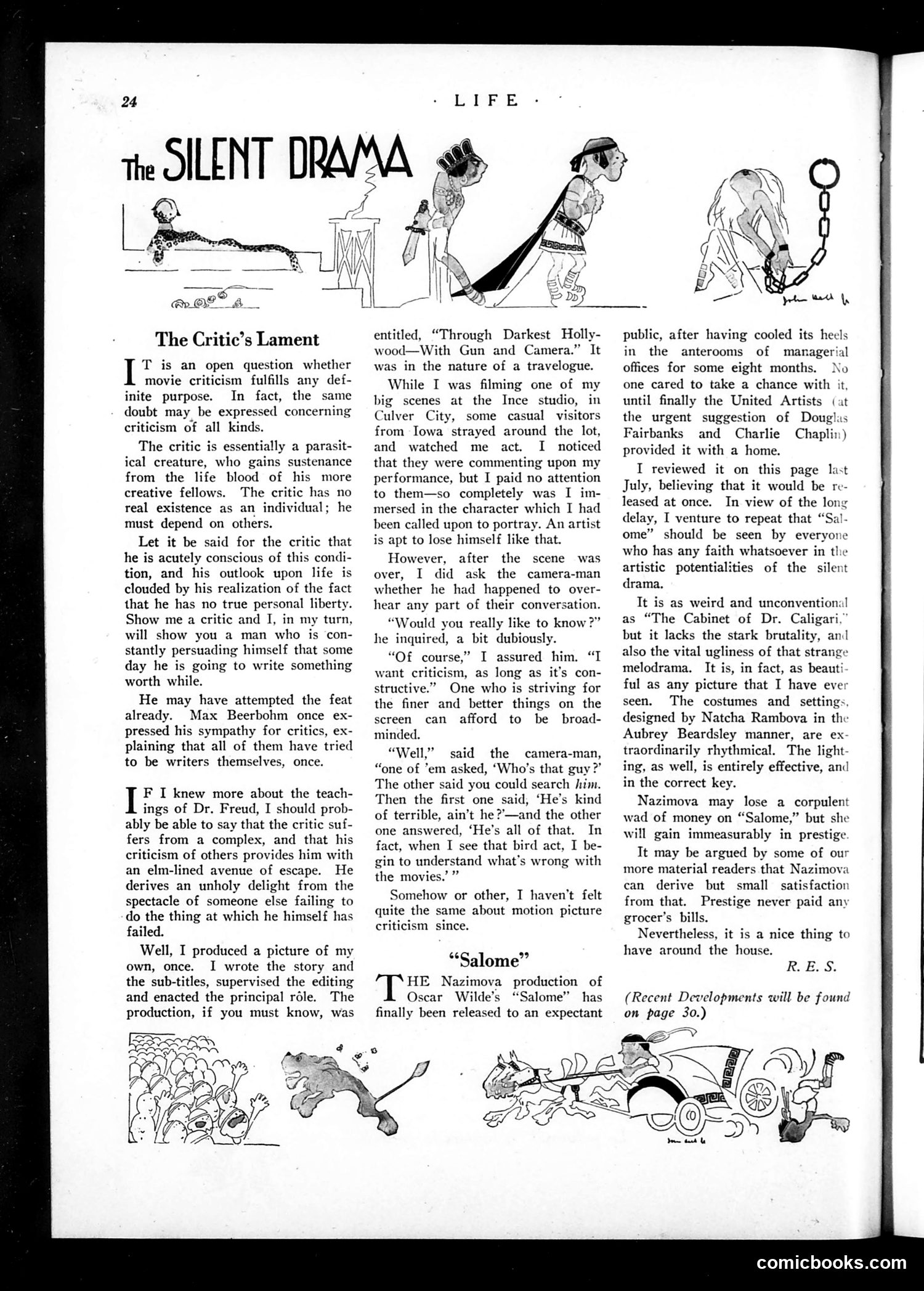
This page from Life magazine contains two articles about silent films, reflecting early 1920s cinema criticism. **"The Critic's Lament"** is a self-deprecating essay by the author (likely a film critic at Life) lamenting the parasitic nature of criticism itself. The piece humorously recounts the author's own failed acting attempt at the Ince studio in Culver City, where Iowa visitors watching him perform concluded he was "terrible" and exemplified "what's wrong with the movies." The satire targets both critics' essential dependency on creators and the author's wounded ego—he sought "constructive criticism" but received brutal honesty instead. **"Salome"** reviews the Nazimova production of Oscar Wilde's play, finally released after eight months in studio limbo. The author praises it as artistically ambitious and beautiful, comparing it favorably to German Expressionist cinema like "The Cabinet of Dr. Caligari," though noting it lacks that film's harsh brutality. The review celebrates the silent medium's artistic potential. The cartoons illustrate silent film tropes and slapstick comedy conventions of the era.
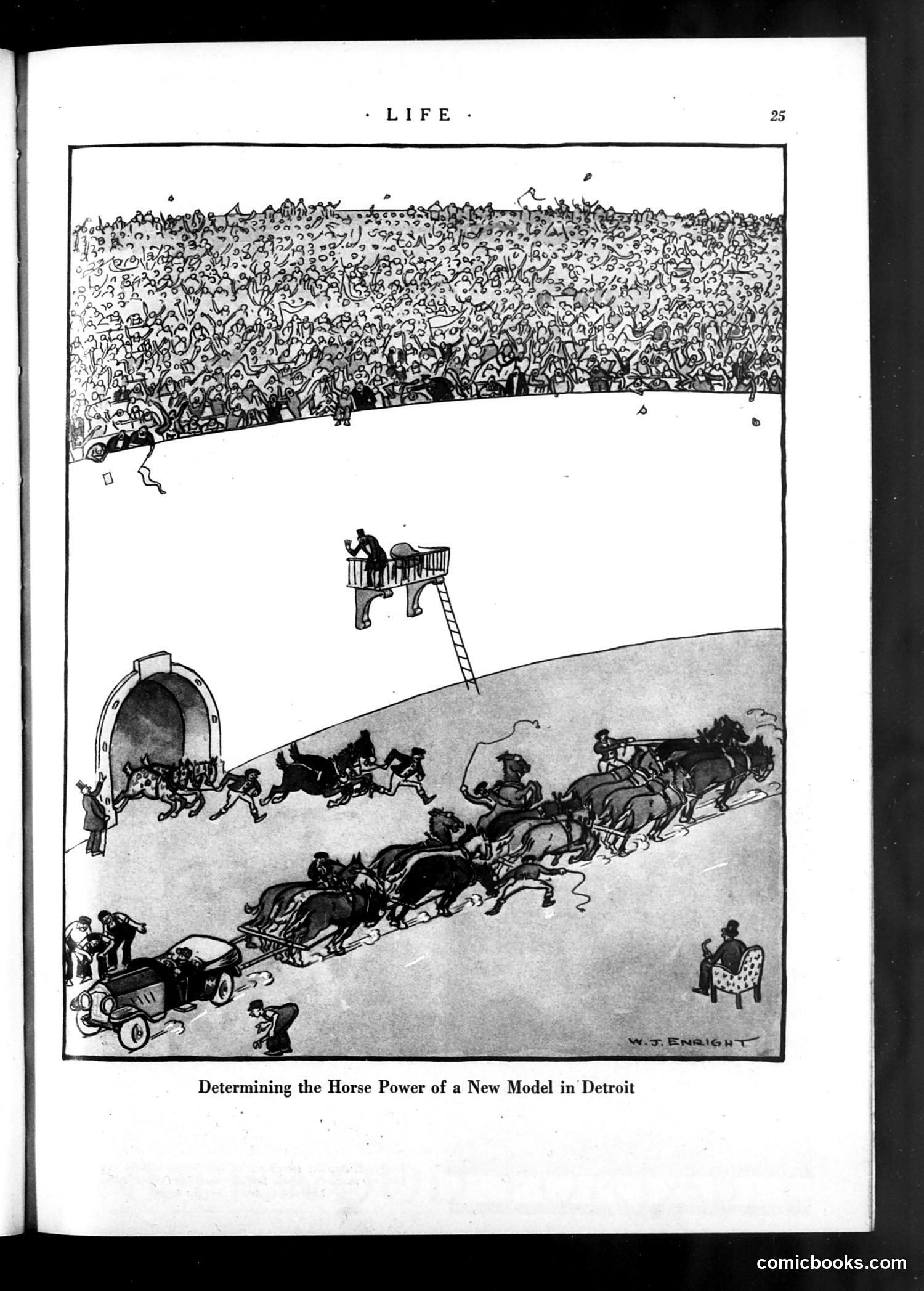
This satirical cartoon mocks automotive advertising claims about "horsepower." The joke shows a literal interpretation: to measure a car's claimed power, actual horses are harnessed to pull it across an arena floor while crowds watch from the stands. The cartoon critiques Detroit automakers' marketing exaggeration—their boasts about engine power are treated as fraudulent by literally substituting real horses. The image suggests consumers should be skeptical of manufacturers' performance claims. The signature reads "W.T. Enright." The cartoon likely dates from the early automotive era when horsepower ratings were unregulated and manufacturers made inflated claims about their vehicles' capabilities.
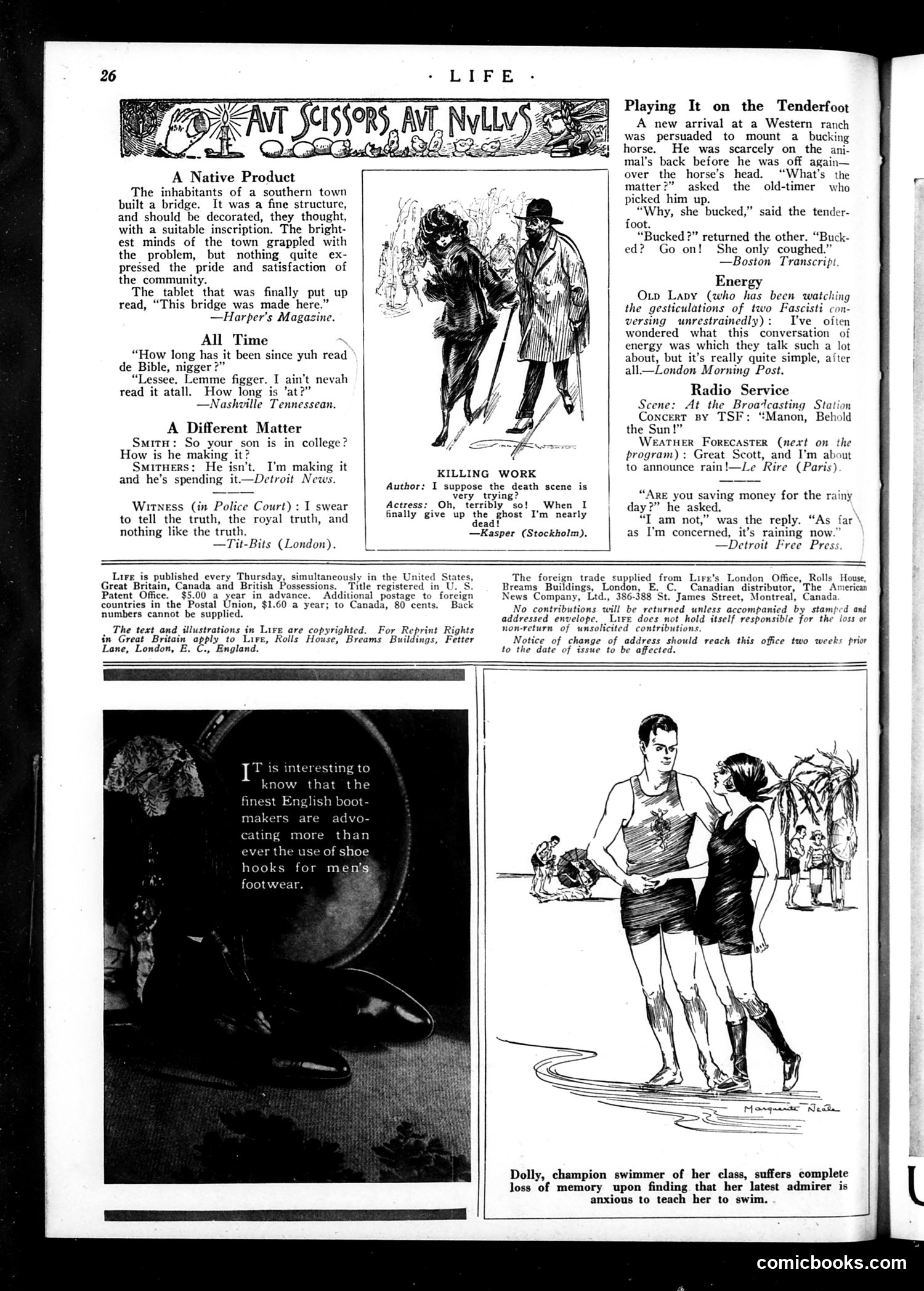
This page contains several brief humorous anecdotes typical of early 20th-century satirical magazines: **"Playing It on the Tenderfoot"** depicts the classic American frontier joke: a naive Eastern newcomer ("tenderfoot") is thrown from a bucking horse and complains she "bucked," only to be told by a seasoned rancher she was merely "coughing"—suggesting the horse is so rough even violent bucking is unremarkable. **"A Native Product"** satirizes Southern pride: a town's bridge inscription reads simply "This bridge was made here"—mocking their inability to articulate anything more sophisticated despite their aspirations. The other items are brief quips about biblical illiteracy, college spending, courtroom testimony, acting, Fascist Italian gesticulation, radio broadcasting, and swimming instruction—typical period humor targeting various social groups and situations. The **illustration** shows a young woman being taught to swim by an admirer, with the caption noting she's lost her memory of swimming lessons, implying romantic distraction. These represent genteel, mainstream American humor circa 1920s-1930s.
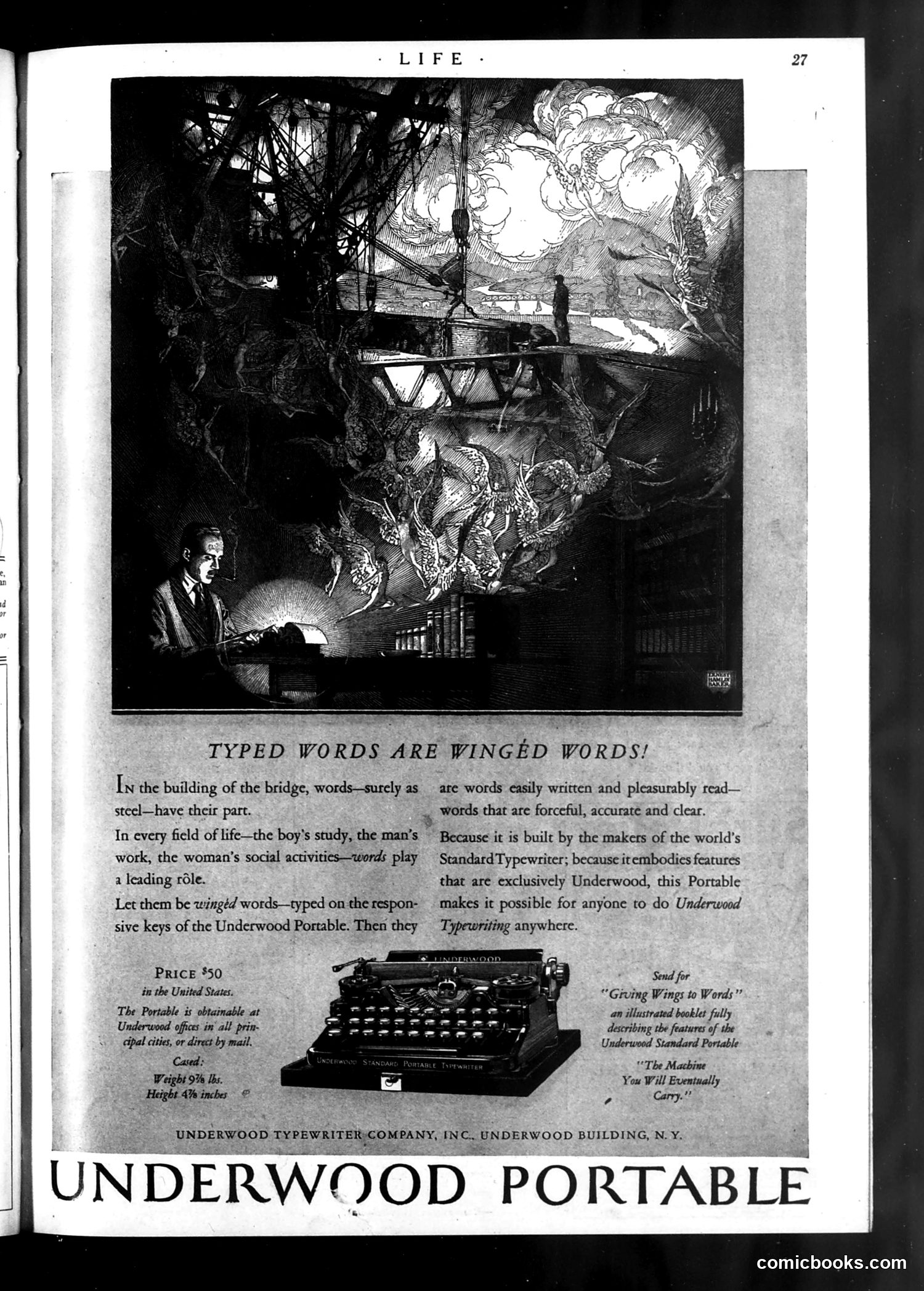
This is a full-page advertisement for the Underwood Portable typewriter, not political satire. The dramatic illustration depicts a figure at a desk with an imaginative scene above—appearing to show flying figures or "winged words"—visualizing the advertisement's central concept. The ad's metaphorical claim is that typed words are "winged words"—they travel farther and faster than handwritten ones. The copy positions typewritten communication as essential across all life domains: education, work, and social activities. The phrase "Typed Words Are Winged Words" serves as the central marketing message. The $50 price point and portability are emphasized as advantages for widespread accessibility. The visual metaphor of flight suggests speed, efficiency, and the liberation that mechanical typing offers compared to manual writing. This reflects early 20th-century enthusiasm for technological progress and mass communication.
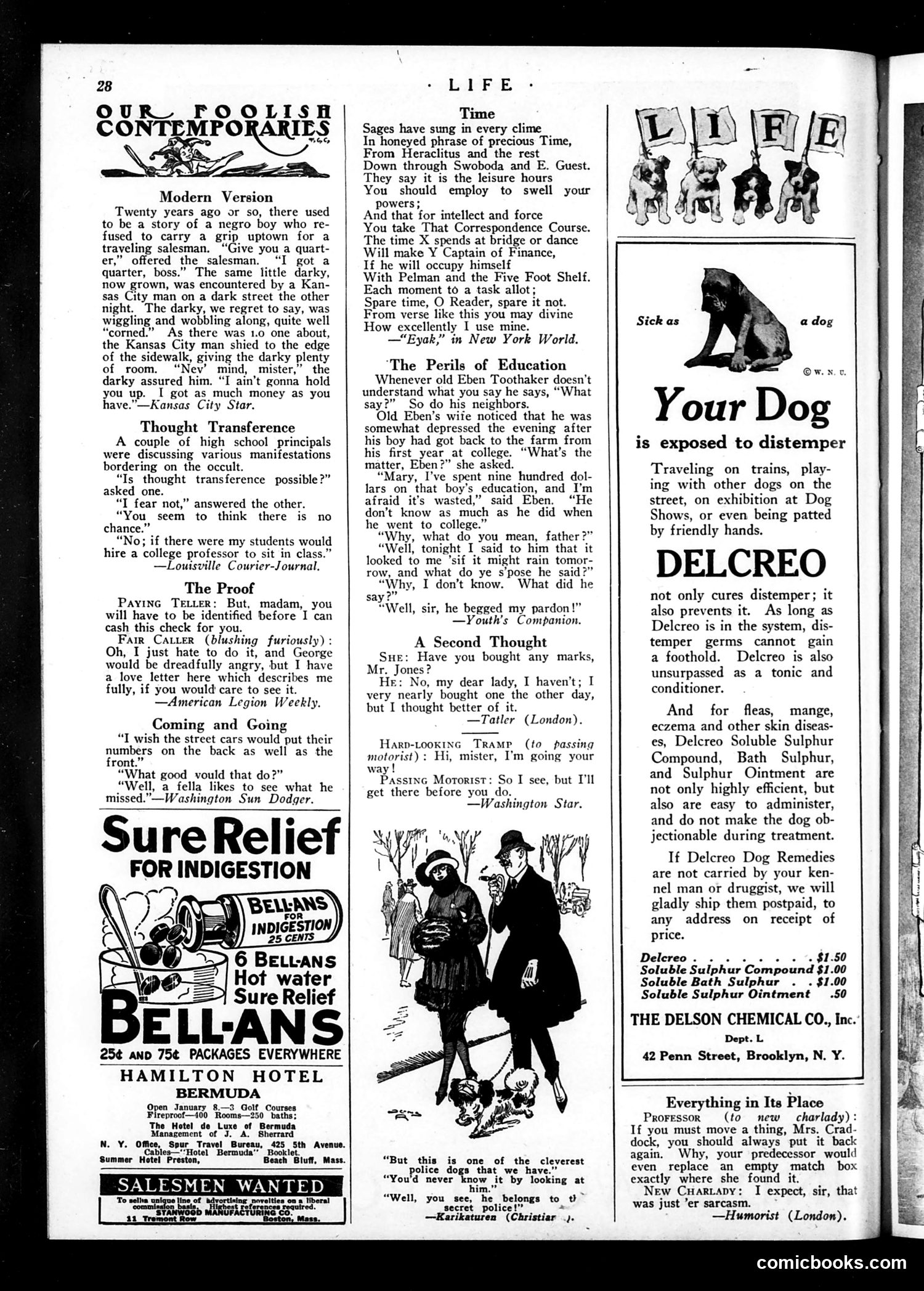
This page comprises primarily **short humor pieces and advertisements** rather than political cartoons. The jokes reflect 1920s American attitudes and concerns: **Key content:** 1. **"Modern Version"** — A racial dialect joke contrasting a poor Black boy from twenty years prior with a drunk adult version, playing on stereotypes of economic advancement and intoxication. 2. **"Thought Transference"** and other brief jokes about education, banking, and motorists — light workplace and social humor. 3. **"The Perils of Education"** — Satirizes overeducation, suggesting a farm boy's college education made him overly formal ("begged my pardon") rather than practical. 4. **Advertisements** dominate the right side: Bell-Ans indigestion remedy, Hamilton Hotel Bermuda, and Delcreo dog remedies. The page reflects period attitudes toward class, education, and race without sustained satirical commentary. The humor relies on stereotypes and observational comedy rather than pointed social critique. This is typical Life magazine filler content from the 1920s-1930s era.
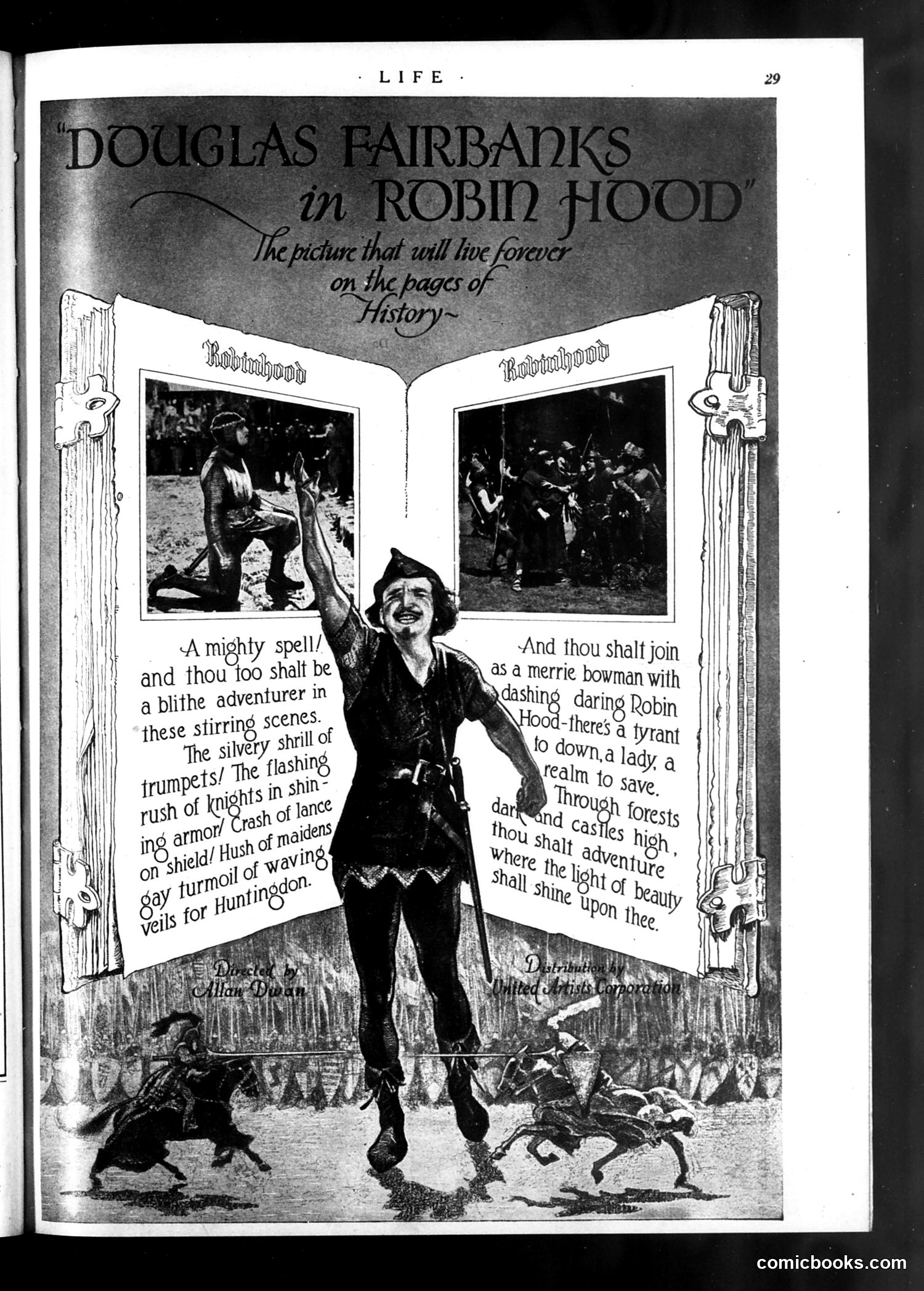
This is a **movie advertisement** for Douglas Fairbanks in "Robin Hood," presented as a theatrical poster rather than political satire. The page promotes the film as "the picture that will live forever on the pages of History." The design uses an open-book motif with two film stills flanking Fairbanks in his Robin Hood costume. The ornate text promises adventure—"silvery shrill of trumpets," "flashing rush of knights," "crash of lance"—and romantic elements ("merrie bowman," "lady," "tyrant to down"). This appears to be early cinema advertising emphasizing spectacle and swashbuckling action. Fairbanks was famous for athletic, adventurous roles. The grandiose language ("live forever") typifies 1920s film promotion, positioning movies as worthy of historical significance.
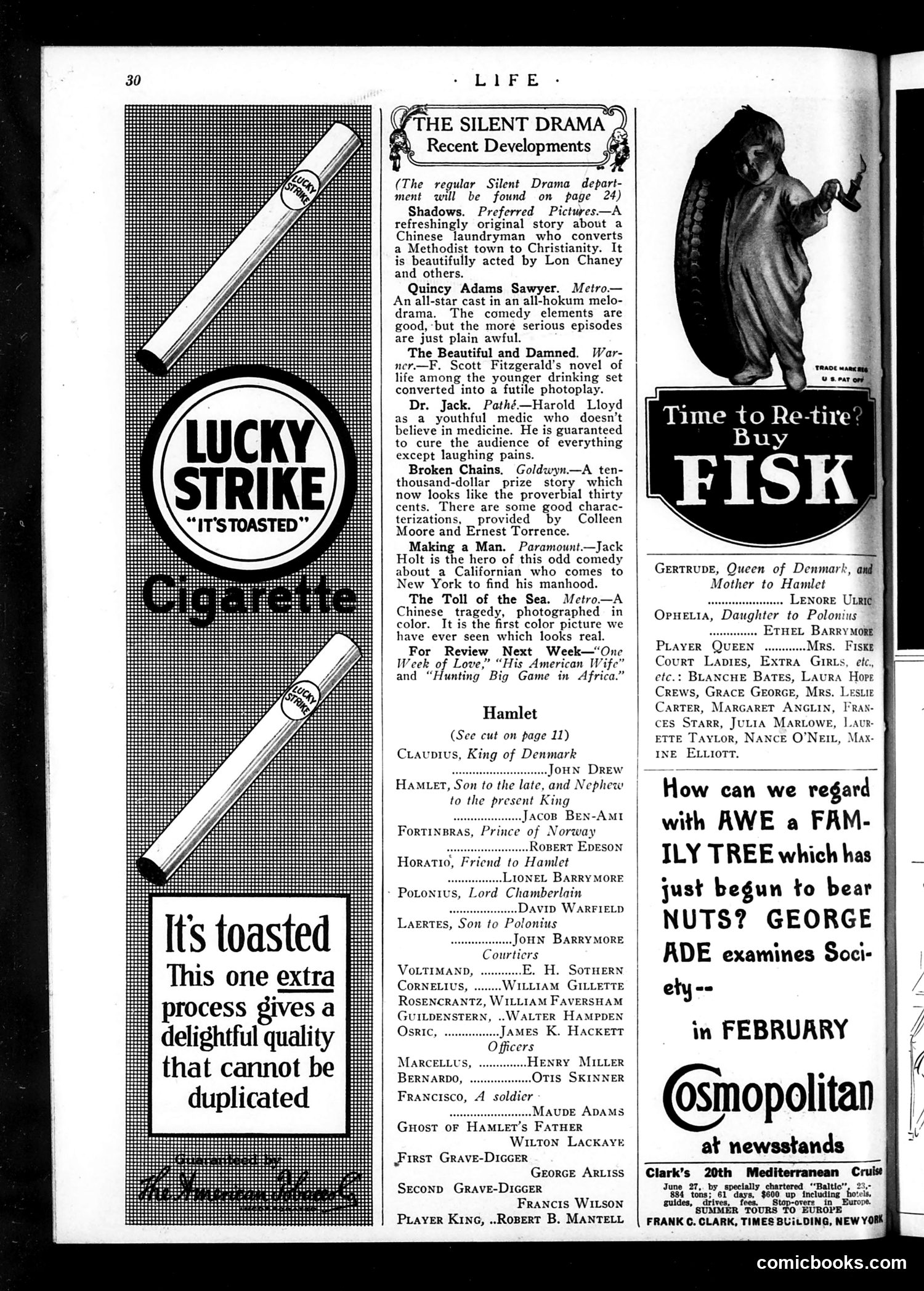
This page is primarily **advertising and entertainment listings**, not political satire. The left side features a **Lucky Strike cigarette advertisement** using the slogan "It's Toasted," claiming an exclusive process creates superior quality. This is straightforward product marketing. The bulk of the page reviews silent films and lists cast members for a theatrical production of *Hamlet*, featuring major actors of the era (John Drew, Jacob Ben-Ami, Lionel Barrymore, etc.). A small sidebar advertises *Cosmopolitan* magazine's February issue, featuring humorist **George Ade** examining society and family trees—likely a satirical piece about nouveau riche families or social pretension. The right side advertises **Clark's Mediterranean cruise tours**. This is a typical early 1920s magazine page mixing consumer ads with entertainment coverage—no political cartoon or significant satire present.
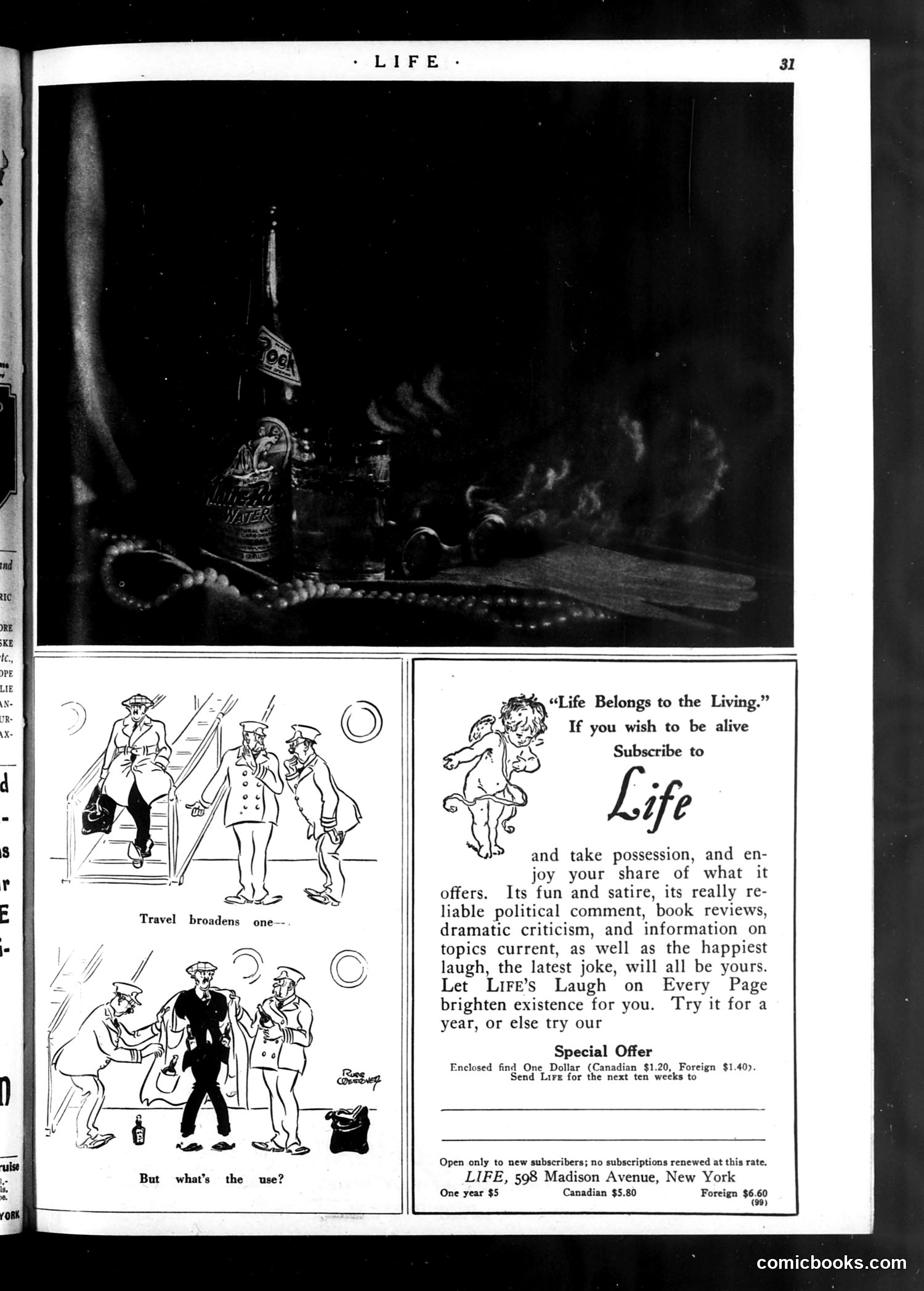
This is primarily a subscription advertisement for *Life* magazine, a satirical publication. The page features: **Top image**: A dramatic nighttime scene—likely theatrical or cinematic—showing what appears to be an exotic or Oriental-themed set with decorative elements and atmospheric lighting. **Lower cartoons**: Two humorous drawings depicting travel scenarios. The first shows sailors or travelers boarding a ship ("Travel broadens one—"), while the second depicts the same figures in a predicament, captioned "But what's the use?"—suggesting that despite travel's supposed broadening effects, people still end up in similar foolish situations. **Advertisement copy**: Emphasizes *Life's* appeal as a source of satire, political commentary, humor, and cultural criticism. The tagline "Life Belongs to the Living" positions the magazine as essential reading for those wanting to stay current and entertained. The pricing ($5 annually, with special introductory offer of $1 for ten weeks) dates this to the early 20th century. The overall message: subscribe to *Life* for wit and sophisticated commentary on current affairs.
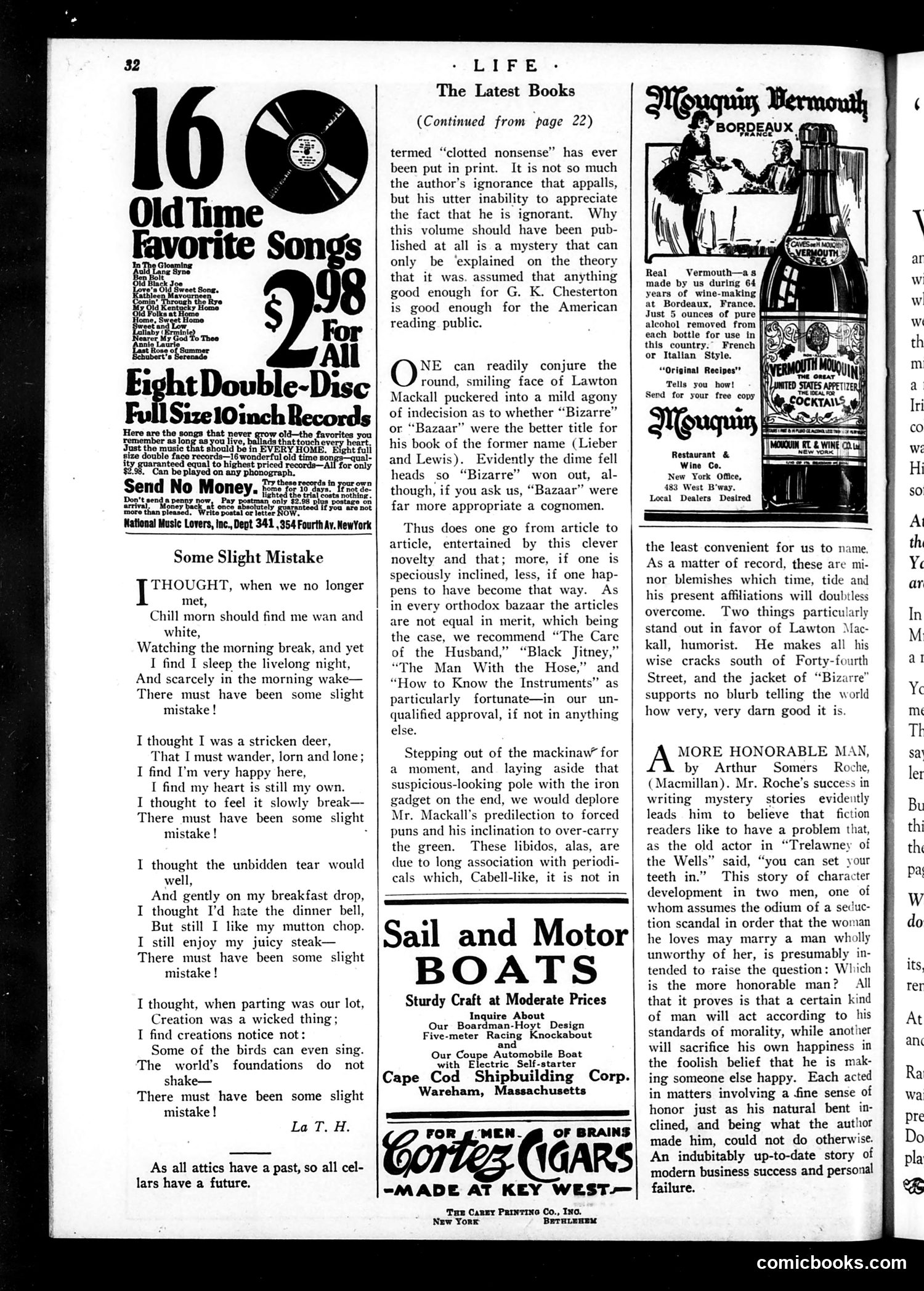
This page is primarily **literary criticism and advertising**, not political satire. The main content reviews a book titled "Bizarre" by Lawton Mackall—a collection of humorous essays. The critic praises Mackall's wit while critiquing the book's uneven quality and his tendency toward forced puns. The critic humorously notes that Mackall struggled to choose between "Bizarre" and "Bazaar" as the title. The poem "Some Slight Mistake" (left column) is a romantic lyric about a lover's unexpected happiness after separation—contrary to anticipated heartbreak. The advertisements feature **phonograph records** of "old time favorite songs," a **vermouth product** from Bordeaux, and **sailboats**—typical 1920s-era consumer goods. No political figures or social commentary are present. This is simply a book review issue of *Life* magazine.
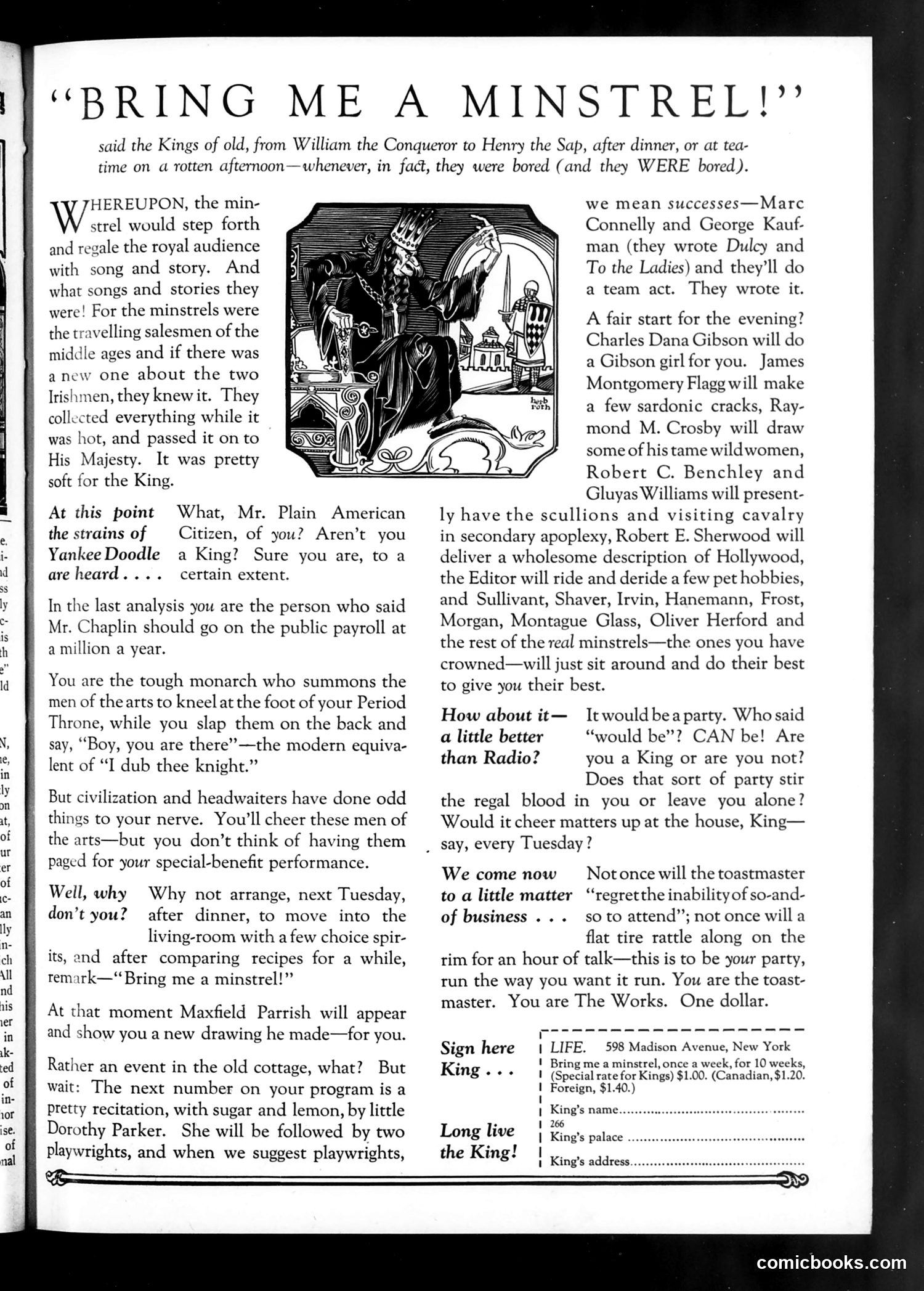
This page is a satirical pitch for a subscription service disguised as medieval entertainment fantasy. Life magazine proposes that ordinary Americans—"Kings" in their own homes—should hire famous artists and writers for private weekly performances, just as medieval monarchs summoned minstrels. The satire targets American vanity and consumerism. The page lists real celebrities of the era: Maxfield Parrish (illustrator), Dorothy Parker (humorist), Marc Connelly and George Kaufman (playwrights), Charles Dana Gibson (illustrator), and others. It mocks readers' sense of entitlement while flattering them as "tough monarchs." The underlying joke: Americans believe they deserve luxury entertainment on demand, elevating consumption to royal prerogative. The "one dollar" subscription fee (for 10 weeks) makes the fantasy affordable, converting it from impossible fantasy to achievable product. The medieval woodcut illustration reinforces the absurd comparison between actual kings and middle-class readers.
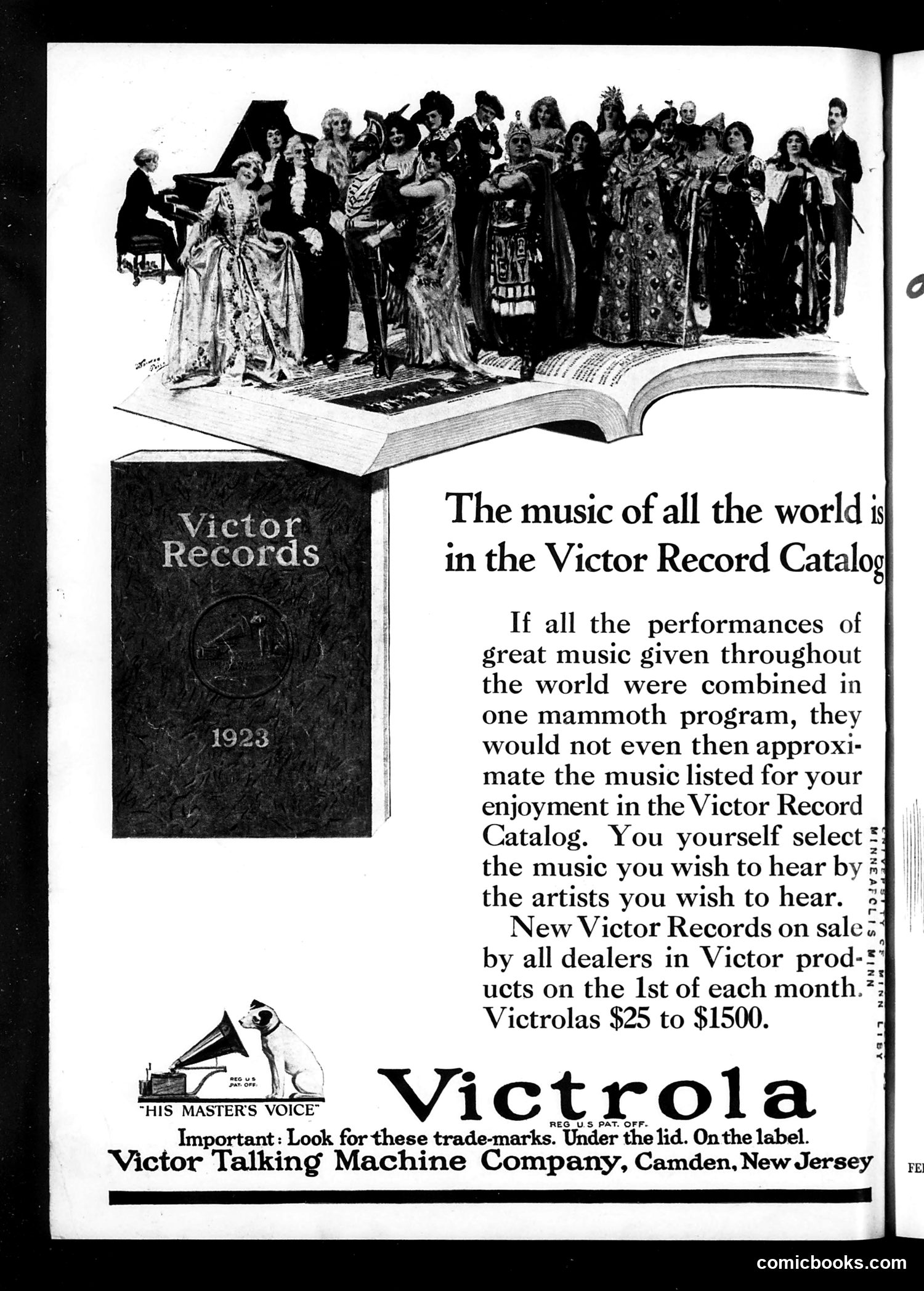
This is a **Victor Talking Machine Company advertisement**, not political satire. It promotes the Victrola phonograph and Victor Records catalog. The illustration shows an orchestra and opera performers standing on an open record catalog, symbolizing the vast musical repertoire available. The ad's central claim is hyperbolic: even combining all world performances couldn't match Victor's catalog selection. The marketing pitch emphasizes **consumer choice and control**—you select which artists and music you want to hear, rather than attending live performances. Prices range from $25 to $1500, positioning Victrolas across economic classes. The "His Master's Voice" trademark (bottom left) was Victor's iconic logo, showing a dog listening to a gramophone horn. This reflects early 1920s consumer culture, when recorded music was a relatively new luxury that promised unprecedented access to world-class performances at home.