
Life, 1923-01-25 · page 23 of 36
Life — January 25, 1923 — page 23: what you’re looking at
What you’re looking at
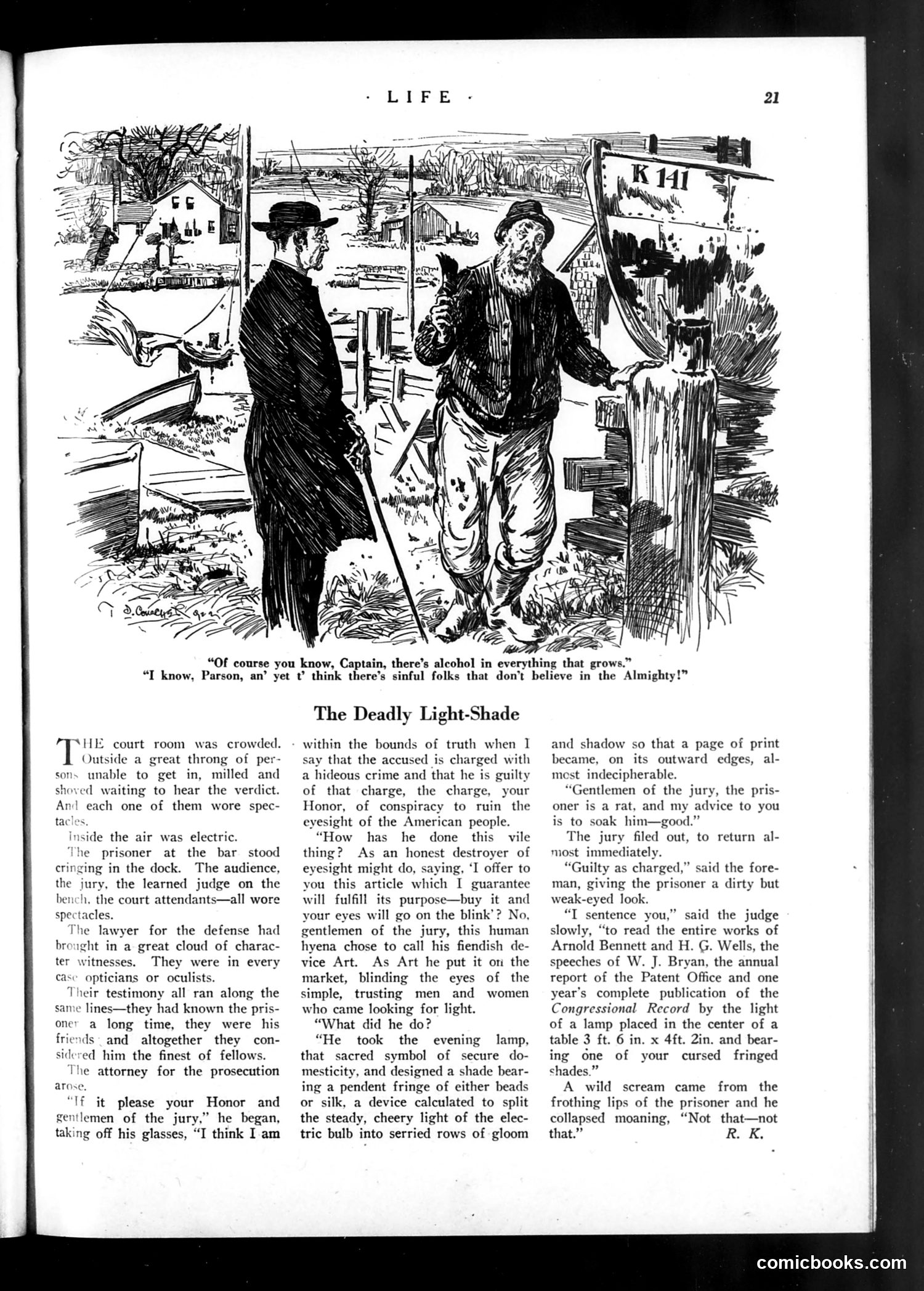
This is a courtroom satire mocking the "Arts and Crafts" movement's fashionable decorative lampshades with dangling beads or fringe. The joke presents a mock trial where a designer is prosecuted for "conspiracy to ruin the eyesight of the American people" by creating aesthetically pleasing but functionally terrible lamp shades that fragment light and make reading impossible. The humor targets several things: the tension between artistic design and practical utility, the pretentious marketing of impractical home goods as "Art," and early 20th-century eyestrain concerns. The punishment—forcing the prisoner to read tedious government documents under his own terrible shade—is darkly comic irony. The opening dialogue jokes that if alcohol exists in all growing things, skeptics of divine creation should reconsider. It establishes the satirical tone mocking unexamined beliefs, here applied to design trends.
📄 Transcribed text from this page (OCR, searchable)
Machine-transcribed from the original scan — historical spelling and the odd misread are preserved.
“Of course you know, Captain, there’s alcohol in everything that grows.” “I know, Parson, an’ yet t’ think there’s sinful folks that don’t believe in the Almighty!” Wom court room was crowded. Outside a great throng of per- sons unable to get in, milled and shoved waiting to hear the verdict. And each one of them wore spec- tacles side the air was electric. ‘The prisoner at the bar stood cringing in the dock. The audience, the jury, the learned judge on the bench, the court attendants—all wore spectacles. The lawyer for the defense had brought in a great cloud of charac- ter witnesses. They were in every case opticians or oculists. Their testimony all ran along the same lines—they had known the pris- oner a long time, they were his friends. and altogether they con- sidered him the finest of fellows. The attorney for the prosecution arose, “If it please your Honor and emen of the jury,” he began, taking off his glasses, “I think Iam The Deadly Light-Shade within the bounds of truth when I say that the accused is charged with a hideous crime and that he is guilty of that charge, the charge, your Honor, of conspiracy to ruin the eyesight of the American people. “How has he done this vile thing? As an honest destroyer of eyesight might do, saying, ‘I offer to you this article which I guarantee will fulfill its purpose—buy it and your eyes will go on the blink’? No, gentlemen of the jury, this human hyena chose to call his fiendish de- vice Art. As Art he put it on the market, blinding the eyes of the simple, trusting men and women who came looking for light. “What did he do? “He took the evening lamp, that sacred symbol of secure do- mesticity, and designed a shade bear- ing a pendent fringe of either beads or silk, a device calculated to split the steady, cheery light of the elec- tric bulb into serried rows of gloom and shadow so that a page of print became, on its outward edges, al- mest indecipherable. “Gentlemen of the jury, the pris- oner is a rat, and my advice to you is to soak him—good.” The jury filed out, to return al- most immediately. “Guilty as charged,” said the fore- man, giving the prisoner a dirty but weak-eyed look. “T sentence you,” said the judge slowly, “to read the entire works of Arnold Bennett and H. G. Wells, the speeches of W. J. Bryan, the annual report of the Patent Office and one year’s complete publication of the Congressional Record by the light of a lamp placed in the center of a table 3 ft. 6 in. x 4ft. 2in. and bear- ing one of your cursed fringed shades.” A wild scream came from the frothing lips of the prisoner and he collapsed moaning, “Not that—not that.” R. K, comicbooks.com