
Life, 1923-01-25 · page 16 of 36
Life — January 25, 1923 — page 16: what you’re looking at
What you’re looking at
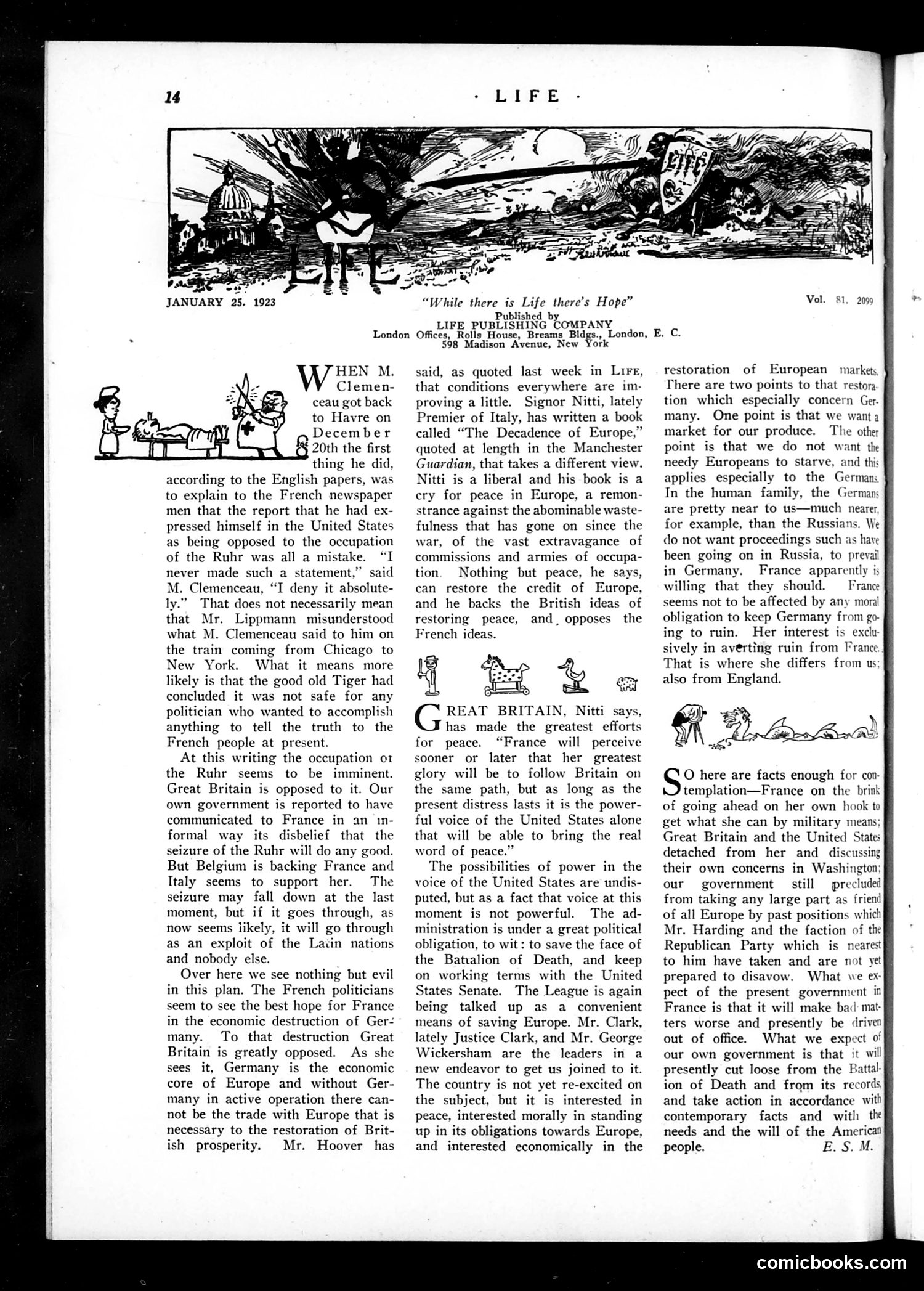
This page discusses European economic recovery after World War I. The article references **M. Clemenceau** (French wartime leader) and **Signor Nitti** (Italian Premier), debating whether Great Britain or France should lead Europe's economic restoration. The core debate: France wants German reparations and British trade support; Britain prefers focusing on its own prosperity rather than subsidizing German recovery. The author argues **France differs from Britain** — France fears German revival as an existential threat, while Britain views the matter more commercially. The small cartoon illustrations appear to be generic satirical figures commenting on these political positions, though specific identities aren't clearly marked. The piece advocates American involvement in settling European disputes through the League of Nations and contemporary diplomatic efforts.
📄 Transcribed text from this page (OCR, searchable)
Machine-transcribed from the original scan — historical spelling and the odd misread are preserved.
JANUARY 25, 1923 “While there is Life there’s Hope” Published by IFE PUBLISHING COMPANY L) London Offices, Rolls House, Breams Bldgs., London, E. C. HEN M. Clemen- ceau got back to Havre on December 20th the first thing he did, according to the English papers, was to explain to the French newspaper men that the report that he had ex- pressed himself in the United States as being opposed to the occupation of the Ruhr was all a mistake. “I never made such a statement,” said M. Clemenceau, “I deny it absolute- ly.” That does not necessarily mean that Mr. Lippmann misunderstood what M. Clemenceau said to him on the train coming from Chicago to New York. What it means more likely is that the good old Tiger had concluded it was not safe for any politician who wanted to accomplish anything to tell the truth to the French people at present. At this writing the occupation ot the Ruhr seems to be imminent. Great Britain is opposed to it. Our own government is reported to have communicated to France in an in- formal way its disbelief that the seizure of the Ruhr will do any good. But Belgium is backing France and Italy seems to support her. The seizure may fall down at the last moment, but if it goes through, as now seems iikely, it will go through as an exploit of the Latin nations and nobody else. Over here we see nothing but evil in this plan. The French politicians seem to see the best hope for France in the economic destruction of Ger- many. To that destruction Great Britain is greatly opposed. As she sees it, Germany is the economic core of Europe and without Ger- many in active operation there can- not be the trade with Europe that is necessary to the restoration of Brit- ish prosperity. Mr. Hoover has 598 Madison Avenue, New York said, as quoted last week in Lire, that conditions everywhere are im- proving a little. Signor Nitti, lately Premier of Italy, has written a book called “The Decadence of Europe,” quoted at length in the Manchester Guardian, that takes a different view. Nitti is a liberal and his book is a cry for peace in Europe, a remon- strance against the abominable waste- fulness that has gone on since the war, of the vast extravagance of commissions and armies of occupa- tion. Nothing but peace, he says, can restore the credit of Europe, and he backs the British ideas of and, opposes the restoring peace, French ideas. 4{ @& & a REAT BRITAIN, Nitti says, has made the greatest efforts for peace. “France will perceive sooner or later that her greatest glory will be to follow Britain on the same path, but as long as the present distress lasts it is the power- ful voice of the United States alone that will be able to bring the real word of peace.” The possibilities of power in the voice of the United States are undis- puted, but as a fact that voice at this moment is not powerful. The ad- ministration is under a great political obligation, to wit: to save the face of the Batvalion of Death, and keep on working terms with the United States Senate. The League is again being talked up as a convenient means of saving Europe. Mr. Clark, lately Justice Clark, and Mr. George Wickersham are the leaders in a new endeavor to get us joined to it. The country is not yet re-excited on the subject, but it is interested in peace, interested morally in standing up in its obligations towards Europe, and interested economically in the restoration of European markets There are two points to that restora. tion which especially concern Ger- many. One point is that we wanta market for our produce. The other point is that we do not want the needy Europeans to starve, and this applies especially to the Germans In the human family, the Germans are pretty near to us—much nearer, for example, than the Russians. We do not want proceedings such as have been going on in Russia, to prevail in Germany. France apparently is P willing that they should. — France f seems not to be affected by any moral obligation to keep Germany from go- ing to ruin. Her interest is exclu- sively in averting ruin from France. That is where she differs from us; also from England. O here are facts enough for con- templation—France on the brink of going ahead on her own hook to get what she can by military mea Great Britain and the United detached from her and di their own concerns in Washington; our government still precluded from taking any large part as friend of all Europe by past positions which Mr. Harding and the faction of the Republican Party which is nearest to him have taken and are not yet prepared to disavow. What we ex- pect of the present government in France is that it will make bad: mat- ters worse and presently be driven out of office. What we expect of our own government is that it will presently cut loose from the Battal- ion of Death and from its records and take action in accordance with contemporary facts and with the needs and the will of the America® people. E. S. M. comicbooks.com