
Life, 1923-01-25 · page 2 of 36
Life — January 25, 1923 — page 2: what you’re looking at
What you’re looking at
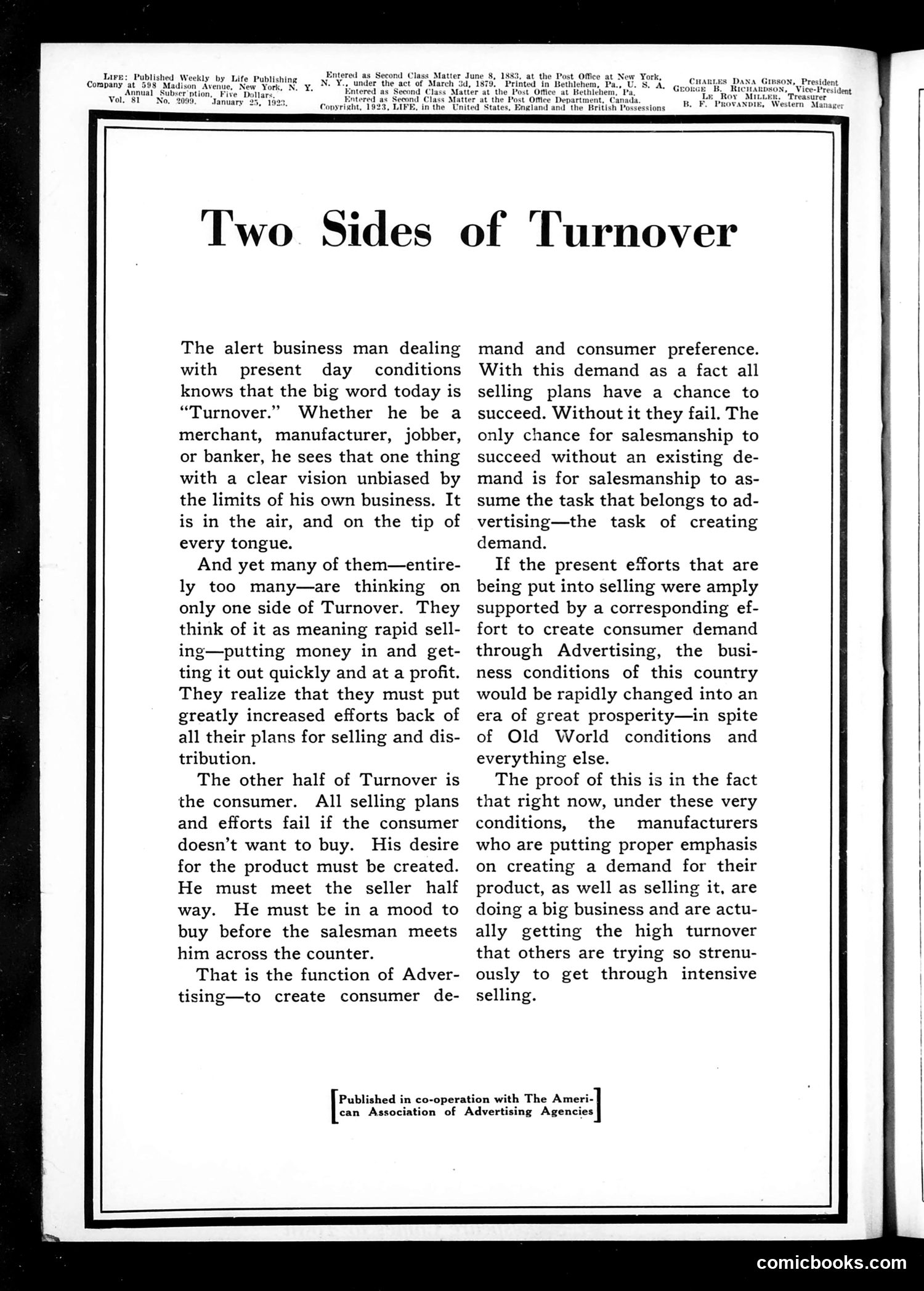
This is a business-focused article (not a cartoon) from Life magazine's January 25, 1923 issue. It discusses "Turnover"—a key business concept of that era meaning rapid inventory movement and sales velocity. The article argues that successful turnover requires **two complementary elements**: manufacturers and sellers must both create consumer demand through advertising AND ensure products actually sell quickly through effective salesmanship. The piece criticizes businessmen who focus only on rapid selling without creating demand, noting that without consumer desire, sales efforts fail. It advocates for advertising's role in generating consumer preference—a perspective that Life published "in co-operation with The American Association of Advertising Agencies," suggesting this partly represents advertising industry advocacy.
📄 Transcribed text from this page (OCR, searchable)
Machine-transcribed from the original scan — historical spelling and the odd misread are preserved.
Two Sides of Turnover The alert business man dealing with present day conditions knows that the big word today is “Turnover.” Whether he be a merchant, manufacturer, jobber, or banker, he sees that one thing with a clear vision unbiased by the limits of his own business. It is in the air, and on the tip of every tongue. And yet many of them—entire- ly too many—are thinking on only one side of Turnover. They think of it as meaning rapid sell- ing—putting money in and get- ting it out quickly and at a profit. They realize that they must put greatly increased efforts back of all their plans for selling and dis- tribution. The other half of Turnover is the consumer. All selling plans and efforts fail if the consumer doesn’t want to buy. His desire for the product must be created. He must meet the seller half way. He must be in a mood to buy before the salesman meets him across the counter. That is the function of Adver- tising—to create consumer de- mand and consumer preference. With this demand as a fact all selling plans have a chance to succeed. Without it they fail. The only chance for salesmanship to succeed without an existing de- mand is for salesmanship to as- sume the task that belongs to ad- vertising—the task of creating demand. If the present efforts that are being put into selling were amply supported by a corresponding ef- fort to create consumer demand through Advertising, the busi- ness conditions of this country would be rapidly changed into an era of great prosperity—in spite of Old World conditions and everything else. The proof of this is in the fact that right now, under these very conditions, the manufacturers who are putting proper emphasis on creating a demand for their product, as well as selling it, are doing a big business and are actu- ally getting the high turnover that others are trying so strenu- ously to get through intensive selling. Published in co-operation with The Ameri- can Association of Advertising Agencies comicbooks.com